1. Introduction
Language production requires speakers to use inhibition to select appropriate lemmas based on structural and socio-pragmatic requirements (Green, Reference Green1998; Levelt, Roelofs & Meyer, Reference Levelt, Roelofs and Meyer1999). Bilinguals experience an increased inhibitory processing load because they manage the additional criterion of language membership (Abutalebi & Green, Reference Abutalebi and Green2007; Green, Reference Green1986). Bilingualism has thus been hypothesised to train Executive Functions (EFs) (Bialystok, Reference Bialystok2009; Poarch & Bialystok, Reference Poarch and Bialystok2015; Kroll, Dussias, Bogulski & Kroff, Reference Kroll, Dussias, Bogulski and Kroff2012). Although bilinguals have been found to outperform monolinguals at EF tasks (Bialystok, Craik & Luk, Reference Bialystok, Craik and Luk2012), the effect of bilingualism on EFs is not always replicated, calling into question its robustness (Duñabeitia, Hernández, Antón, Macizo, Estévez, Fuentes & Carreiras, Reference Duñabeitia, Hernández, Antón, Macizo, Estévez, Fuentes and Carreiras2014; Paap & Greenberg, Reference Paap and Greenberg2013). In this study, we take these inconsistencies in findings as an opportunity to pin-point which specific bilingualism variables modulate which aspects of EFs (Bak, Reference Bak2016).
One key candidate suggested to be at the core of EF modulations in bilinguals is code-switching (Costa, Hernández, Costa-Faidella & Sebastián-Gallés, Reference Costa, Hernández, Costa-Faidella and Sebastián-Gallés2009; Lehtonen, Soveri, Laine, Järvenpää, de Bruin & Antfolk, Reference Lehtonen, Soveri, Laine, Järvenpää, de Bruin and Antfolk2018). Several studies on code-switching and EFs have revealed positive correlations between code-switching frequency and EFs. However, there are discrepancies regarding the specific aspects of the executive system modulated by code-switching. Whilst some studies suggest that code-switching involves inhibition (Ooi, Goh, Sorace & Bak, Reference Ooi, Goh, Sorace and Bak2018; Rodriguez-Fornells, Kraemer, Lorenzo-Selva, Festman & Muente, Reference Rodriguez-Fornells, Kramer, Lorenzo-Seva, Festman and Münte2012; Verreyt, Woumans, Vandelanotte, Szmalec & Duyck, Reference Verreyt, Woumans, Vandelanotte, Szmalec and Duyck2016), other studies reveal effects of code-switching on monitoring (Prior & Gollan, Reference Prior and Gollan2011; Hartanto & Yang, Reference Hartanto and Yang2016; Soveri, Rodriguez-Fornells & Laine, Reference Soveri, Rodriguez-Fornells and Laine2011). Moreover, several studies have failed to demonstrate any overlap between code-switching and EFs (Kang & Lust, Reference Kang and Lust2019; Paap, Myuz, Anders, Bockelman, Mikulinsky & Sawi, Reference Paap, Myuz, Anders, Bockelman, Mikulinsky and Sawi2017; Yim & Bialystok, Reference Yim and Bialystok2012).
It is possible that the inconsistencies in previous studies arose from a lack of using ecologically valid methods of assessing code-switching. All existing studies have relied either on self-reports of code-switching, or on experimentally induced language-switching. Both methods have been argued to be inadequate for capturing naturalistic code-switching practices (Gardner-Chloros, Reference Gardner-Chloros2009; Hofweber, Marinis & Treffers-Daller, Reference Hofweber, Marinis, Treffers-Daller, Sekerina, Spradlin and Valian2019). Moreover, none of the existing studies have differentiated between different types of code-switching. Code-switching is defined as the mixing of languages for socio-pragmatic optimization purposes (Bhatt & Bolonyai, Reference Bhatt and Bolonyai2011; Muysken, Reference Muysken2013). Bilinguals differ in the types of code-switching strategies they engage in as a function of a) typological differences between languages, and b) their sociolinguistic environment (Muysken, Reference Muysken2000). Importantly, different types of code-switching may affect different aspects of the executive system (Treffers-Daller, Reference Treffers-Daller, Bullock and Toribio2009; Green & Wei, Reference Green and Wei2014; Hofweber, Marinis & Treffers-Daller, Reference Hofweber, Marinis and Treffers-Daller2016). Effects of code-switching practices on EFs may therefore not be found if no distinction is made between different types of code-switching (Kang & Lust, Reference Kang and Lust2019). Hence, a more fine-grained picture is needed to fully understand the relationship between code-switching and EFs.
This study explores whether and how different types of code-switching modulate EFs, and whether the modulations brought about by the different code-switching types have the potential to explain performance differences between bilinguals and monolinguals. The predictions are created by combining insights from existing processing models of code-switching (Green & Abutalebi, Reference Green and Abutalebi2013; Green & Wei, Reference Green and Wei2014; Treffers-Daller, Reference Treffers-Daller, Bullock and Toribio2009) with a dual control perspective of EFs (Braver, Reference Braver2012), thus generating a detailed model of the control processes underlying different code-switching types. The following sections will describe the rationale of our research questions and predictions.
According to the Adaptive Control Hypothesis, bilingual language control processes differ as a function of interactional contexts (Green & Abutalebi, Reference Green and Abutalebi2013). The hypothesis predicts that speakers draw upon different aspects of EFs to adapt to the specific challenges posed by each interactional context. Whilst monolingual modes train inhibitory control, bilingual modes train the monitoring processes required to manage linguistic co-activation. This study differentiates between interactional modes involving different forms of intra-sentential code-switching. Intra-sentential code-switching is assumed to be most challenging from a monitoring perspective because competition is greatest within the attentional window of the utterance unit.
Based on Muysken's (Reference Muysken2000) comprehensive review of sociolinguistic corpora, this study sub-divides intra-sentential code-switching into three re-occurring patterns: Insertion, Alternation and Dense code-switching (or Congruent lexicalisation). Table 1 shows examples for the language pair investigated, i.e. German-English. In Alternation, loosely connected stretches from two languages alternate, e.g., involving a switch between a main clause and a subordinate clause that does not function as a complement of another constituent.
German-English code-switching examples

In Insertion the pattern is asymmetrical (Myers-Scotton, Reference Myers-Scotton2006). Elements from one language (Embedded language) are inserted into the morphosyntactic frame of another language (Matrix language). In any given language pair, the relationship can go in either direction, although the Matrix language usually is bilinguals’ first language (Muysken, Reference Muysken2013). The term Dense code-switching describes cases of language mixing in which languages remain co-activated at both the grammatical and lexical levels. This means that speakers select lexical items and structural features based on their socio-pragmatic and structural appropriateness, not based on language membership. Switching takes place more frequently in Dense code-switching than in Alternation, but switch points are hard to identify. Contrary to Insertion, it is impossible to identify a Matrix language as speakers combine structural rules from both languages. Dense code-switching primarily occurs between closely related languages.
According to Muysken (Reference Muysken2000), different sociolinguistic environments and bilingualism profiles generate different code-switching patterns. Recent immigration contexts favour Insertion, as bilinguals slot lexical items referring to their new L2-environment into the grammatical framework of their L1. Most bilinguals use Alternation but it is most frequent in contexts where languages are associated with different socio-political identities. Dense code-switching predominantly emerges in communities with long-standing bilingual traditions. The German–English bilinguals in this study were recent immigrants to the UK, so they were predicted to engage predominantly in Insertion (of English into German) and Alternation, but rarely in Dense code-switching (Hofweber et al., Reference Hofweber, Marinis and Treffers-Daller2016).
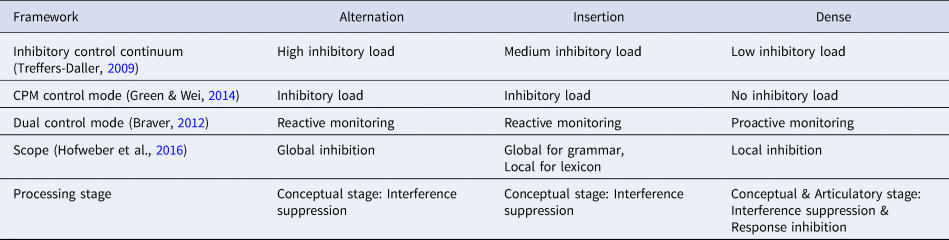
To explain cognitive control processes during code-switching, Treffers-Daller (Reference Treffers-Daller1998, Reference Treffers-Daller, Bullock and Toribio2009) applied Green's (Reference Green1986, Reference Green1998) inhibitory model of bilingual language production to code-switching. According to her Inhibitory Control Continuum, the three code-switching types differ in the extent to which languages are kept separate. Language separation is achieved through inhibition, so the more a given type of code-switching separates languages, the more inhibition is recruited. Alternation is the code-switching type that keeps languages most separate, so high levels of inhibition are recruited. In Insertion the matrix language becomes permeable to the non-matrix language, but only on a lexical level, so medium-levels of inhibition apply. Dense code-switching involves minimal levels of language separation and inhibition.
Similar predictions about the effects of different code-switching types on EFs were made by the Control Processing Model of code-switching CPM (Green & Wei, Reference Green and Wei2014). However, the CPM groups Insertion and Alternation into a category called Coupled control code-switching, in which bilinguals alternate between languages using inhibition to execute language switches. Although Green and Wei (Reference Green and Wei2014) acknowledge that Dense code-switching challenges the processes involved in the consolidation of competing linguistic structures, they claim that it does not train inhibition because there is no separation by language membership. This prediction about Dense code-switching was recently challenged in a study suggesting that Dense code-switching does enhance inhibition under high-monitoring conditions (Hofweber et al., Reference Hofweber, Marinis and Treffers-Daller2016).
This finding could be accounted for by adopting a dual control perspective, in which the monitoring of inhibition can be either proactive or reactive (Braver, Reference Braver2012). Our reasoning was motivated by the Adaptive Control Hypothesis (Green & Abutalebi, Reference Green and Abutalebi2013), which suggests that interactional contexts involving high-levels of linguistic co-activation draw upon more proactive monitoring and less reactive inhibitory control. Inhibition and monitoring are two sides of a coin (Costa et al., Reference Costa, Hernández, Costa-Faidella and Sebastián-Gallés2009; Morales, Yudes, Gomez-Ariza & Bajo, Reference Morales, Yudes, Gómez-Ariza and Bajo2015), with monitoring referring to the high-level processes managing the de- and re-activation of inhibitory schemata (Botvinick, Carter, Braver, Barch & Cohen, Reference Botvinick, Braver, Barch, Carter and Cohen2001). In reactive control modes, inhibition is activated in reaction to an event challenging cognitive control. The reactive use of inhibition is cognitively effortful, so it is restricted to circumstances requiring the infrequent use of inhibition (De Pisapia & Braver, Reference De Pisapia and Braver2006). When events challenging inhibition occur frequently, it is more efficient to transition to a proactive control mode, which involves the sustained goal-maintenance and monitoring of inhibitory schemata.
Different types of code-switching employ inhibition with differing degrees of frequency, thus triggering different control modes. The present study predicted that bilinguals would operate in a reactive mode during Alternation, because switching is infrequent. In Alternation, bilinguals stick to each language for prolonged stretches of speech. Whenever a switch does happen, the inhibitory effort to execute that switch is high because inhibitory schemata need to be re-activated. This is in line with existing models predicting Alternation to challenge inhibition most (Treffers-Daller, Reference Treffers-Daller, Bullock and Toribio2009; Green & Wei, Reference Green and Wei2014). Following Green and Wei's (Reference Green and Wei2014) grouping of Insertion and Alternation into Coupled control modes, it was assumed that Insertion also involves reactive control. Dense code-switching, on the other hand, was predicted to trigger proactive monitoring because bilinguals are continuously transitioning between languages, as demonstrated in the example in Table 1. This requires a constant proactive readiness to apply inhibition as bilinguals manage the selection of co-activated, yet potentially conflicting, features from both languages.
To create an executive functions task that would tease apart the control processes employed in the different code-switching types, we manipulated the proportion of congruent-incongruent trial switching in a Flanker task. In the Flanker task, participants switch between baseline congruent trials and incongruent trials requiring the inhibitory control. The proportion of congruent and incongruent trials in Flanker tasks has been shown to modulate the nature of the monitoring processes involved (Costa et al., Reference Costa, Hernández, Costa-Faidella and Sebastián-Gallés2009; De Pisapia & Braver, Reference De Pisapia and Braver2006). We administered a condition aimed at inducing a reactive control mode, in which mostly congruent trials were interspersed with a small number of incongruent trials. This infrequent reactive use of inhibitory schemata in incongruent trials was assumed to replicate the control processes during Alternation. In the proactive monitoring context, on the other hand, equal numbers of congruent and incongruent trials were administered, generating a need to maintain inhibitory schemata as a goal. This proactive monitoring context mirrors the monitoring processes employed during Dense code-switching. Bilingual EF modulations have previously been shown to occur predominantly for proactive monitoring (Bialystok et al., Reference Bialystok, Craik and Luk2012; Costa et al., Reference Costa, Hernández, Costa-Faidella and Sebastián-Gallés2009). This has been attributed to the training of monitoring skills through code-switching. In this study, we predicted that this effect will be modulated by the type of code-switching bilinguals regularly engage in. Coupled Control code-switching, particularly Alternation, trains bilinguals’ reactive control skills, whilst Dense code-switching trains proactive monitoring skills.
Further predictions were made about the stage at which inhibition applies in the language production process (Levelt et al., Reference Levelt, Roelofs and Meyer1999). This study differentiated between two forms of inhibition operating at different levels of processing (Luk, Anderson, Craik, Grady & Bialystok, Reference Luk, Anderson, Craik, Grady and Bialystok2010): (1) Interference suppression, which takes place at the conceptual lemma level; (2) Motor response inhibition, which applies at stages involving articulation and phonological assembly. Some models of bilingual processing assume that language selection operates at the conceptual lemma level (Green, Reference Green1998; Green & Wei, Reference Green and Wei2014), so bilingualism has been argued to modulate interference suppression, but not response inhibition (Bialystok et al., Reference Bialystok2009; Blumenfeld & Marian, Reference Blumenfeld and Marian2014; Carlson & Meltzoff, Reference Carlson and Meltzoff2008; Colzato, Bajo, van den Wildenberg, Paolieri, Nieuwenhuis, La Heij & Hommel, Reference Colzato, Bajo, van den Wildenberg, Paolieri, Nieuwenhuis, La Heij and Hommel2008; Costa, Hernández & Sebastián-Gallés, Reference Costa, Hernández and Sebastián-Gallés2008; Martin-Rhee & Bialystok, Reference Martin-Rhee and Bialystok2008; Luk et al., Reference Luk, Anderson, Craik, Grady and Bialystok2010).
While an in-depth discussion about language selectivity in bilingual processing is beyond the scope of this paper, we argue that linguistic co-activation may persist at multiple stages of languages production. According to Kroll, Bobb and Wodniecka (Reference Kroll, Bobb and Wodniecka2006), bilingual language production is a cascading interactive process. There is not just one locus for language selection (e.g., the lemma) but multiple loci. Thus, the authors argue that not only the conceptual level or the lemma level, but also the phonological and articulatory levels could be involved in language selection, “with the locus of eventual selection varying according to the specific manifestation of lexical competition” (Kroll et al., Reference Kroll, Dussias, Bogulski and Kroff2012, p. 120). Words and structures from both languages compete during language production, and a range of factors, such as language proficiency and dominance, affect the stage at which a particular language is selected. In this study, we argue that code-switching is one of these factors.
A key manifestation of the ways in which languages compete during speech production can be found in bilinguals’ code-switching behaviour, but very little is known about the extent to which the type of intra-sentential code-switching practised by bilinguals affects the locus of language selection. We suggest that the stage at which language selection happens may depend on the type of code-switching in which bilinguals engage, and the scope of inhibition in the different code-switching types. Building on the available literature discussed above, the following predictions were made: Alternation involves the macro-management of languages through temporary “global inhibition” of each respective language (De Groot & Christoffels, Reference De Groot and Christoffels2006; Guo, Liu, Misra & Kroll, Reference Guo, Liu, Misra and Kroll2011; Hofweber et al., Reference Hofweber, Marinis and Treffers-Daller2016). This form of language selection is predicted to happen at the conceptual lemma level through interference suppression (Green & Wei, Reference Green and Wei2014). In the case of Insertion only the grammar of the Embedded language is globally inhibited, whilst local inhibition takes place within co-activated lexical networks. We assume this also involves interference suppression rather than response inhibition as lexical selection happens at the lemma level.
Dense code-switching involves the micro-management of linguistic co-activation through local inhibition to select individual items from within co-activated linguistic networks (Hofweber et al., Reference Hofweber, Marinis and Treffers-Daller2016). Hence, languages do not get inhibited globally at early stages of language production. It could therefore be argued that this type of code-switching involves simultaneous co-activation at later articulatory stages. If Dense forms of code-switching maintain linguistic co-activation throughout articulatory production stages, then this should be observable in the shape of convergence phenomena. Indeed, studies investigating the phonological properties of code-switching suggest that linguistic co-activation may persist at articulatory stages of production (Botero, Bullock, Davis & Toribio, Reference Botero, Bullock, Davis and Toribio2004; Grosjean & Miller, Reference Grosjean and Miller1994; Marian, Spivey & Hirsch, Reference Marian, Spivey and Hirsch2003). Hence, Dense code-switching may recruit motor response inhibition. To explore this prediction, our participants were administered a Go/No-go version of the Flanker task teasing apart performance at interference suppression and response inhibition.
To summarise, this study investigated whether different types of code-switching modulate specific aspects of EFs and whether these modulations translate into performance differences between bilinguals and monolinguals. Table 2 provides an overview of how we suggest the different aspects of EFs map onto each other with regard to their involvement in different types of code-switching: Language modes involving global forms of interference suppression trigger reactive control modes, whilst languages modes with high levels of linguistic activation draw upon proactive monitoring using local inhibition. The latter may also involve response inhibition.
Inhibitory control processes involved in different code-switching types

Our study design was thus guided by the following hypotheses:
Hypothesis 1: The group comparison of bilingual and monolingual inhibitory performance
Bilinguals will outperform monolinguals at those aspects of the executive system that are trained by their frequent code-switching practices. Bilinguals in this study are predicted to engage predominantly in Coupled control code-switching. Hence, inhibitory advantages should occur in the task condition mirroring Coupled control code-switching, i.e., the reactive monitoring condition. As Coupled control code-switching was predicted to involve inhibition at the conceptual lemma level, any potential bilingual advantages should occur at interference suppression, not at response inhibition.
Hypothesis 2: The relationship between code-switching and inhibitory performance
Coupled control code-switching (Alternation and Insertion) will predict performance in the reactive monitoring condition, whilst Dense code-switching will predict performance in the proactive monitoring condition. Moreover, Dense code-switching will correlate with response inhibition, although this research question is exploratory because none of the existing models of code-switching incorporate response inhibition.
Importantly, code-switching was predicted to have a modulatory effect alongside other variables that have been shown to influence EFs, such as age, education and fluid intelligence. Previous research has shown that bilingualism mitigates the negative effects of age on EF performance (Bialystok, Craik & Luk, Reference Bialystok, Craik and Luk2008), so we predicted age to have a stronger impact in the monolingual than in the bilingual group. Language production and comprehension have been shown to involve similar cognitive control processes (Struys, Surmont, Van de Craen, Kepinska & Van den Noort, Reference Struys, Surmont, Van de Craen, Kepinska and Van den Noort2019). Hence, both the production and comprehension of code-switching should modulate EFs.
2. Methods
The online tasks (frequency judgement task and flanker task) were created using Psychopy 1.81 and presented on a 13-inch-screen HP notebook.
2.1. Participants and control variables
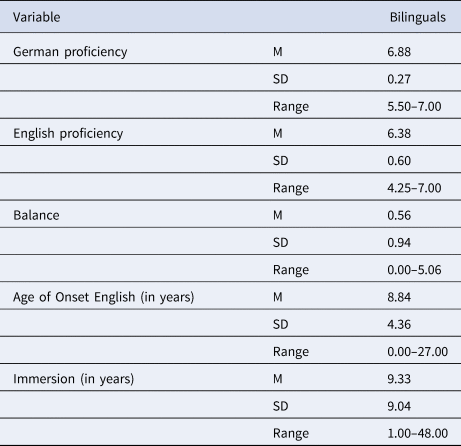
Participants had no known cognitive or visual impairments. All bilinguals were German–English, so confounds from differences in typological distance between languages were avoided. The online Language history questionnaire (Li, Zhang, Tsai & Puls, Reference Li, Zhang, Tsai and Puls2014) was used to collect linguistic background variables (Table 3). All bilinguals (N = 43) self-reported to be ‘native-like’ speakers of German (M = 6.88; 7 = native-like). They all reported a late onset age of the L2 English (M = 8.89), but were active L2-users living in the UK.
Linguistic background variables bilinguals

The balance between the two languages was calculated as the difference in proficiencies (Kupisch & Van de Weijer, Reference Kupisch, Van de Weijer, Silva-Corvalan and Treffers-Daller2016). Participants reported to have similar proficiencies in both languages, although German was their L1, and English their “very advanced” L2. There was a positive correlation between Immersion (duration of stay in L2-context) and Balance [R(1,43)= 0.33, p = 0.02], suggesting that bilinguals became more balanced through Immersion. However, a repeated-measures ANOVA with Proficiency (German, English) as the within-subject variable confirmed that German proficiency was greater than English proficiency [F(1, 83) = 32.50, MSE = 0.16, p < 0.001, η 2=0.44], meaning that the bilinguals remained German-dominant.
The bilinguals were compared to a group of monolinguals (N = 41). There was a choice of comparing the bilinguals to a monolingual baseline group in either Germany or Britain. We opted for a comparison to English-speaking monolinguals for two reasons. Firstly, it was impossible to find education-matched monolinguals in Germany. On average, the bilinguals held BA-level qualifications. Most Germans with university-level degrees are fluent in English, due to its Lingua Franca status (Seidlhofer, Reference Seidlhofer2001). Secondly, EFs are shaped by experience (Bialystok, Reference Bialystok2009), so it was more appropriate to compare the bilinguals to monolinguals living under similar circumstances, i.e., UK urban contexts.
The notions of monolingualism and bilingualism represent two extreme ends of a continuum (Luk & Bialystok, Reference Luk and Bialystok2013). The categorisation depends on the criterion applied to distinguish between groups. Bilingual advantages have been argued to arise primarily from active language use (De Bruin & Della Sala, Reference De Bruin and Della Sala2016), which was our main distinguishing criterion. To assess whether participants’ language practices should be described as “monolingual” or “bilingual”, participants were administered a questionnaire asking them to indicate whether they “regularly used two languages”.
The monolinguals were also asked to report on their usage of regional varieties, which may modulate executive performance (Antoniou, Grohmann, Kambanaros & Katsos, Reference Antoniou, Grohmann, Kambanaros and Katsos2016). Most monolinguals used only one (Southern) variety of British English. Five participants originated from Scotland or Wales, but indicated using the non-Southern varieties infrequently because they had been living in South-East England for a minimum of 10 years. The monolinguals thus engaged only infrequently, if at all, in sociolinguistic practices involving the management of linguistic co-activation.
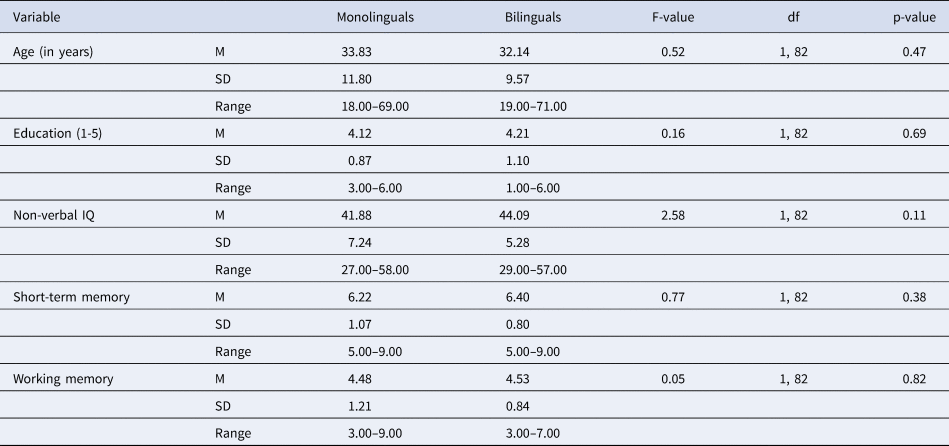
Crucially, bilinguals and monolinguals were matched on a range of variables that modulate EFs, such as Age, IQ, Working memory and Socio-Economic Status / Education (Table 4). Fluid intelligence was measured using Ravens Standard Progressive Matrices (Raven, Reference Raven1998). Short term (SM) and Working memory (WM) were measured using Wechsler's (Reference Wechsler1997) digit span. The two groups did not differ in any of these non-verbal control variables.
Non-linguistic background variables

2.2. Assessing the independent variable code-switching habits
A frequency judgment task was used as the primary measurement of participants’ regular code-switching habits. Judgement tasks have been argued to be representative of cognitive embedding (Backus, Reference Backus2014; Valk, Reference Valk2014) and predict code-switching in production tasks (Hofweber et al., Reference Hofweber, Marinis, Treffers-Daller, Sekerina, Spradlin and Valian2019). Participants were presented with 14 code-switches of each type: 1) Insertion English into German, 2) Insertion German into English, 3) Alternation, and 4) Dense code-switching. The stimulus sentences were matched for number of words (M = 8) and syllable length (M = 14). Insertions were also matched for the syntactic function of the embedded items. The stimuli were presented audio-visually in pseudo-randomized order. Stimuli were preceded by a 200ms fixation cross and presented for up to 30 seconds, during which participants rated its frequency.
Participants were instructed to imagine that they were having an informal conversation with a German–English bilingual friend and were asked to rate the frequency with which they would “encounter” utterances similar to the stimuli on a scale from 1 = never to 7 = all the time. Code-switching is frequently stigmatised in bilingual communities (Gardner-Chloros, Reference Gardner-Chloros2009; Dewaele & Wei, Reference Dewaele and Wei2014) and attitudes have been shown to modulate its acceptability ratings (Badiola, Delgado, Sande & Stefanich, Reference Badiola, Delgado, Sande and Stefanich2018). Hence, we asked about “frequency” rather than “acceptability” to reduce the risk that the term “acceptability” would introduce unintended attitudinal aspects into the ratings.
Furthermore, we asked participants to report on general communication patterns in their social networks rather than on their own production of code-switches. This allowed participants to distance themselves from the reported code-switching behaviour, thus reducing the risk of socially desirable responses. We assumed that bilinguals who come across certain patterns of bilingual speech would be primed into generalising and re-using these through implicit learning processes (Bock & Griffin, Reference Bock and Griffin2000), resulting in the interactive alignment of code-switching (Kang & Lust, Reference Kang and Lust2019). This was confirmed by a study by Hofweber et al. (Reference Hofweber, Marinis, Treffers-Daller, Sekerina, Spradlin and Valian2019), which found that the code-switching patterns bilinguals indicated encountering frequently in their environment were indeed the ones they produced in bilingual emails. Moreover, this paper argues that EFs should be trained through both the productive and the receptive processing of code-switching.
All code-switches were authentic utterances sourced from existing German–English corpora (Eppler, Reference Eppler2005; Eppler, Reference Eppler2010; Clyne, Reference Clyne2003) and from bilingual emails collected for a previous study (Hofweber et al., Reference Hofweber, Marinis, Treffers-Daller, Sekerina, Spradlin and Valian2019). This corpus-based approach increased the ecological validity of the stimuli (Beatty-Martinez, Valdes Kroff & Dussias, Reference Beatty-Martínez, Valdes Kroff and Dussias2018). However, Insertions of German into English occurred so rarely in the corpora that artificial stimuli needed to be created. Importantly, we used a classification method which takes into account the continuous nature of code-switching (Deuchar, Muysken & Wang, Reference Deuchar, Muysken and Wang2007). Like most other bilingualism variables (Luk & Bialystok, Reference Luk and Bialystok2013), code-switching is a continuous variable because many real-life code-switching instances are located on a continuum between different code-witching types (Muysken, Reference Muysken2000).
In addition to the frequency judgement task, bilinguals filled in an extensive code-switching questionnaire. This questionnaire contained one question designed to tease apart different code-switching types. In this question, participants received a brief explanation and examples of the three different code-switching types. They were then asked to rate the frequency with which they engaged in each code-switching type. As this question was assumed to raise participants’ metalinguistic awareness of code-switching, it was administered at the end of the study, so as not to affect the intuitiveness of other tasks.
2.3. Assessing the dependent variable EFs
Inhibition was measured using the Flanker task, chosen for the intuitiveness of its instructions. Participants were presented with rows of 5 arrows and instructed to indicate the direction of the central arrow as fast and accurately as possible, using the arrows key. The intuitiveness of these instructions reduced confounding working memory load, thus increasing “task purity” (Costa et al., Reference Costa, Hernández and Sebastián-Gallés2008). The arrows were blue and presented centred on a white background.
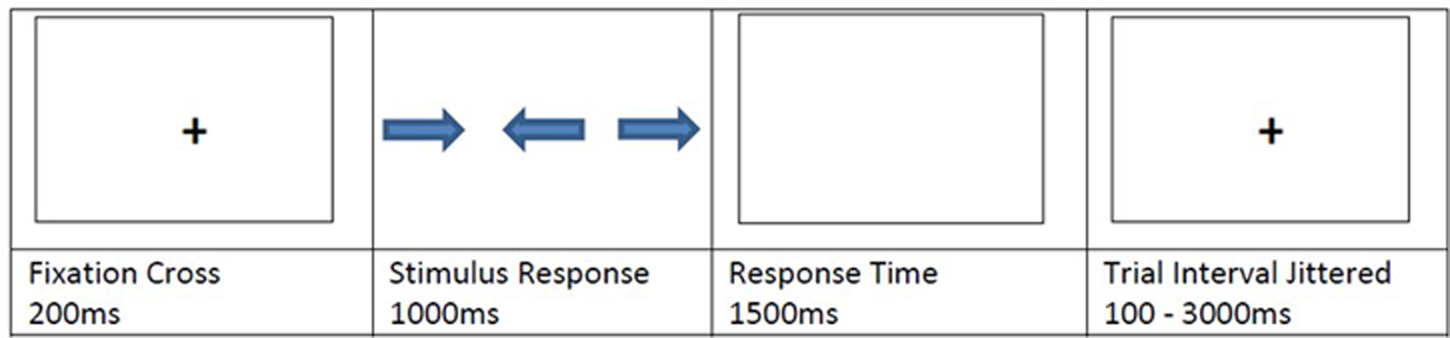
In the congruent trials, all arrows faced in the same direction. In the incongruent trials, the arrows surrounding the target arrow faced in the opposite direction, which required participants to use inhibition to suppress the distractor arrows. This inhibitory cognitive load leads to an increase in RTs and a reduction in Accuracy, measured in the Conflict effect (performance difference between congruent and incongruent trials). A smaller Conflict effect indicated greater inhibitory skills. Each trial started with a fixation cross presented for 200ms, followed by the 1000ms stimulus presentation with a maximum of 1500ms response time. Trial intervals were jittered (Figure 1).
Flanker task stimulus presentation

There were three conditions comprising 96 trials (Table 5). Crucially, the conditions differed in the proportion of congruent-incongruent trial-switching and resulting load to monitoring and inhibition (Costa et al., Reference Costa, Hernández, Costa-Faidella and Sebastián-Gallés2009). The reactive monitoring condition presented participants with a greater number of congruent (92%) than of incongruent trials (8%). The proactive monitoring condition contained 50% congruent and 50% incongruent trials, which required participants to maintain inhibition as a constant goal.
Experimental conditions in the Flanker task

Whilst the 50–50 condition posed the greatest load to proactive monitoring, the 92–8 condition triggered a reactive control mode. Most trials were congruent, but a minority of incongruent trials require the reactive activation of inhibition to solve the task. The 92–8 condition stress-tests participants’ ability to activate inhibition most. As the 92% majority of trials were congruent, requiring no inhibition of distractor stimuli, it becomes harder for participants to activate inhibitory schemata in the remaining 8% of incongruent trials (Costa et al., Reference Costa, Hernández, Costa-Faidella and Sebastián-Gallés2009). The 75–25 posed medium levels of cognitive load to inhibition.
In addition, a Go/No-go version of the Flanker task was administered to test participants’ response inhibition skills, i.e., their ability to suppress an automatized motor response. There were 64 Go trials (32 congruent, 32 incongruent) and 32 No-go trials. Participants were instructed to respond as fast and accurately as possible indicating the target arrow's direction, unless the target arrow was red (No-go). When the target arrow was red, they had to abstain from providing an answer. Response inhibition was measured by comparing Accuracy in the No-go trials to Accuracy in the Go trials.
3. Results
Statistical “significance” of results was established following Fisher's (Reference Fisher1955) continuous approach. Hence, a p-value of 0.05 was taken as a rough benchmark, but not as an absolute cut-off point. P-values in the region of 0.05 will therefore be considered as “marginal” or “trending” evidence for rejecting the Null hypothesis.
3.1. Bilinguals’ code-switching habits
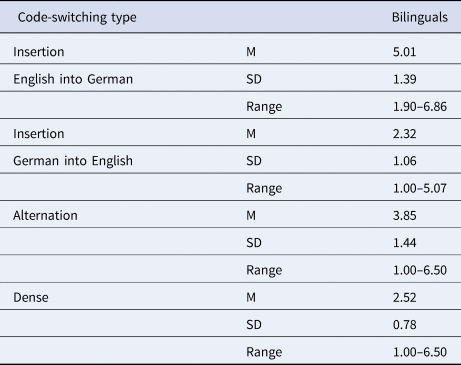
According to the frequency judgment task, the German–English bilinguals utilised all four types of code-switching to some extent (Table 6, Figure 2).
Frequency judgement task scores

Frequency judgement task scores (scale 1–7)

The ANOVA revealed that the main effect of Code-switching type (Insertion E > G, Insertion G > E, Alternation, Dense code-switching) was significant [F(3,126) = 124.98, p < 0.0001, η 2=0.75], indicating that frequency across the four types of code-switching differed. Bilinguals indicated to engage in Insertion (English into German) and Alternation significantly more frequently than in other code-switching types (p < 0.0001). Equally low frequency was reported for Insertion (German into English) and Dense code-switching (p > 0.05). The latter result suggests a strong preference for using German as the matrix language of Insertional code-switching.
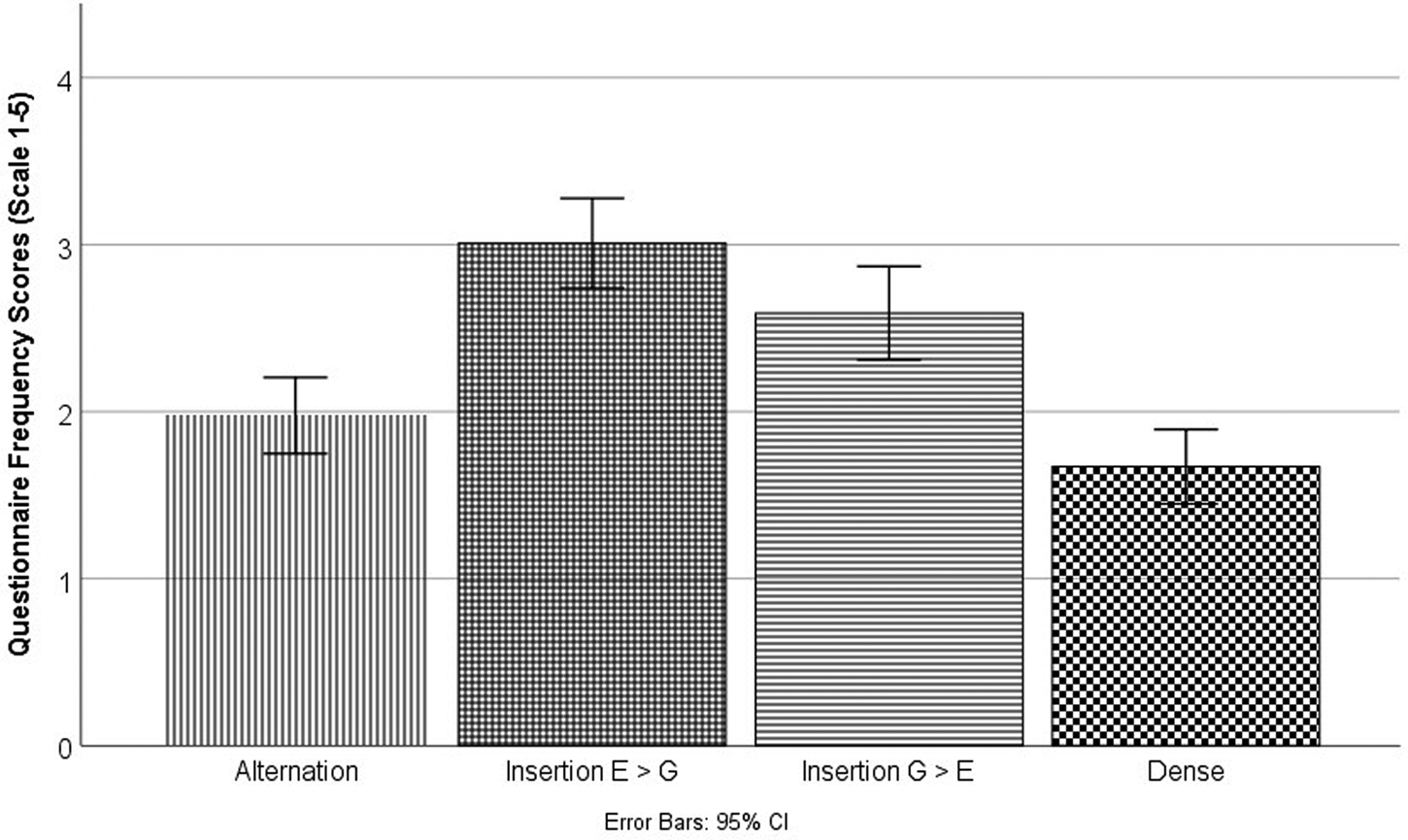
The questionnaire confirmed the frequency judgement task results (Figure 3). The ANOVA identified a significant main effect of Code-switching type [F(2.40, 100.67) = 32.58, MSE = 0.598, η 2=0.44, p < 0.0001]. Bilinguals reported to engage in Insertion and Alternation significantly more frequently than in Dense code-switching (p = 0.032). However, Insertion of German into English was reported to be used as frequently as Insertion of English into German. This is at odds with the judgement task and with existing corpora.
Code-switching questionnaire scores

Importantly, the frequency judgement task and questionnaire results converged in confirming the prediction that bilinguals in this study would engage predominantly in Coupled control code-switching (Insertion and Alternation), and that Dense code-switching would occur infrequently in 1st generation immigrants (Muysken, Reference Muysken2000). It is therefore likely that any potential EF enhancements will occur in tasks mirroring the inhibitory processes of Coupled control modes.
3.2. Executive performance
3.2.1 Executive performance in the Flanker task
Outlier values exceeding 3 SDs from the mean were excluded from the analysis. Due to ceiling effects, the accuracy rates were skewed, so they were assessed using non-parametric tests (Mann-Whitney U tests for between-subject comparisons, Friedman tests for within-subject comparisons).
3.2.2 Executive performance in the Flanker task: Accuracy
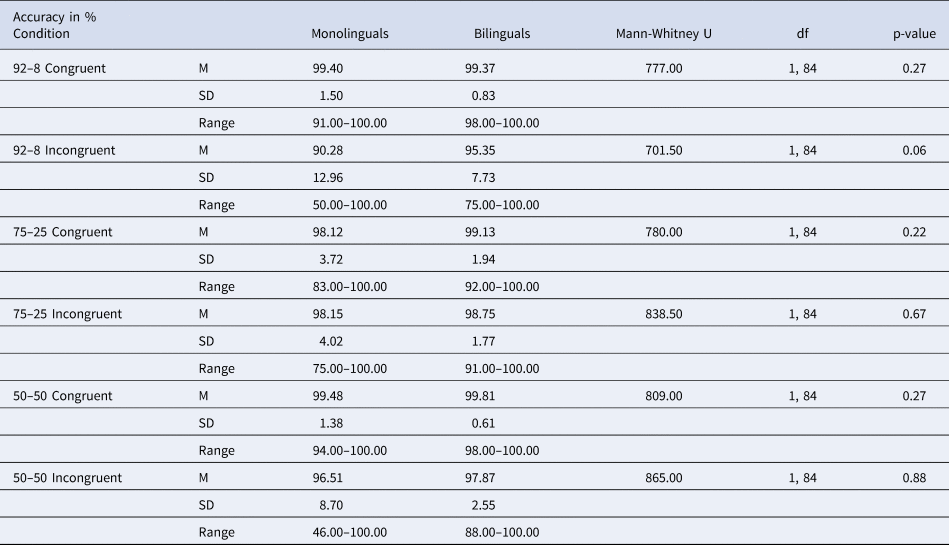
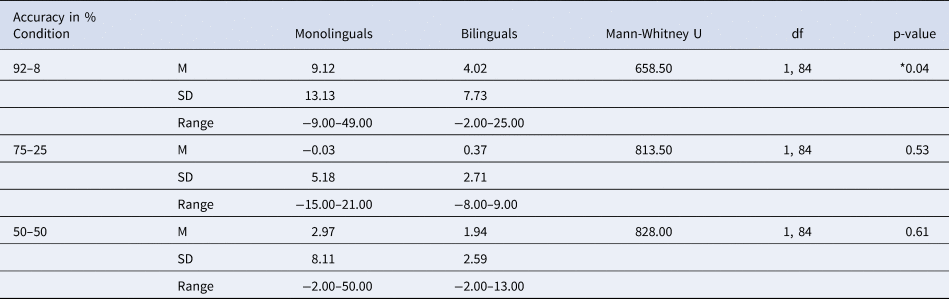
To investigate the effect of the independent variable Congruency (congruent, incongruent), Friedman tests were conducted for each Monitoring condition (cf. Table 7 for Accuracy). In the 92–8 condition, Accuracy in congruent trials was marginally greater than in incongruent trials (χ2 (1,84) = 3.19, p = 0.07, V = 0.19). The pattern was identical in the 75–25 condition (χ2(1,84) = 3.45, p = 0.06, V = 0.20). In the 50–50 condition, the effect of Congruency on Accuracy rates was strong (χ2(1,84) = 36.36, p < 0.001, V = 0.66). The Congruency manipulation thus appeared to lead to a reasonably robust Conflict effect. To investigate the effect of the independent variable Monitoring condition (92–8, 75–25, 50–50), Friedman tests were conducted for both congruent and incongruent trials for both groups. Monitoring condition significantly impacted Accuracy in both congruent and incongruent trials (congruent: χ2 (2,84) = 10.94, p < 0.001, V = 0.26; incongruent: χ2 (2,84) = 12.64, p < 0.001, V = 0.27). Participants performed least well in the reactive monitoring condition.
Accuracy rates in the Flanker task

Group performance (monolingual, bilingual) across the different conditions was compared using a Mann-Whitney U test producing the p-values listed in Table 7. There were no significant group differences in the 50–50 and 75–25 conditions or in congruent trials in the 92–8 conditions. However, there was a trend (Mann-W U test: p = 0.06) for bilinguals to perform more accurately than monolinguals on incongruent trials in the 92–8 condition. To summarise, there was an effect of Congruency with incongruent trials generating lower Accuracy than congruent trials. The 92–8 condition triggered the lowest Accuracy rates, suggesting that inhibition was harder in reactive than in proactive monitoring contexts. Importantly, there was a trend for bilinguals to outperform monolinguals at incongruent trials in the reactive condition.
3.2.3 Executive performance in the Flanker task: Reaction Times
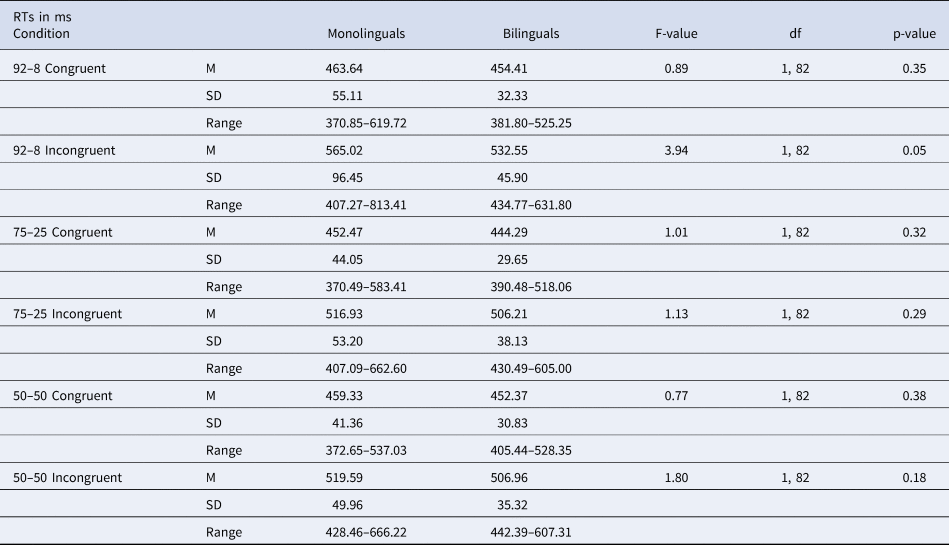
A mixed-design ANOVA with Monitoring condition (92–8, 75–25, 50–50) and Congruency (congruent, incongruent) as the within-subject factors and Group (monolinguals, bilinguals) as the between-subject factor was conducted (Table 8).
RTs in the flanker task

There was a robust Conflict effect, i.e., RTs in incongruent trials were greater than in congruent trials [F(1,82)= 769.521, MSE = 804.75, p < 0.001 η 2=0.09]. There was also a main effect of Monitoring condition [F(1.43, 117.44) = 30.62, MSE = 1235.39, p < 0.001, η 2=0.27]. RTs in the 92–8 condition were significantly higher than RTs in the other conditions (p < 0.001). This observation applied across both groups because there was no interaction between Group and Monitoring [F(1.43, 117.44) = 2.00, p = 0.15, η 2=0.024]. The between-subject comparison was not significant [F(1,82) = 1.25, MSE = 40002.01, p = 0.27, η 2=0.02]. However, there was a significant interaction between Congruency and Group [F(1,82) = 4.30, p = 0.04, η 2=0.05], suggesting that, as predicted, the pattern differed across the two groups.
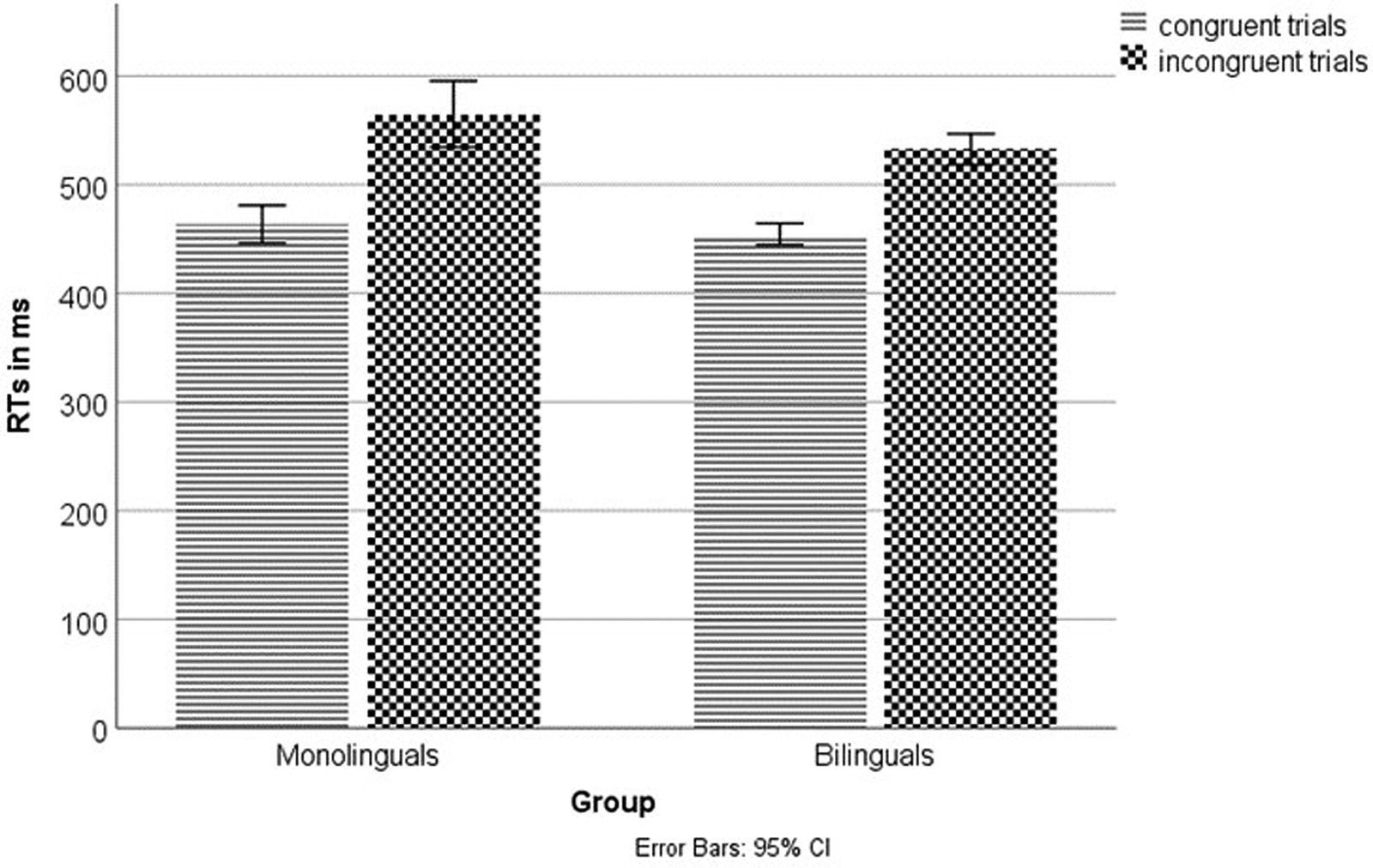
This study predicted that bilinguals would outperform monolinguals at those aspects of EFs that are modulated by the code-switching type they frequently engage in, i.e., Coupled control code-switching. Hence, the inhibitory performance difference between bilinguals and monolinguals was predicted to occur in incongruent trials in the reactive monitoring condition. To investigate this hypothesis, a planned comparison was conducted, comparing monolingual and bilingual inhibitory performance in the 92–8 condition. In line with predictions, there was a marginally significant group difference in incongruent trials in the 92–8 condition (p = 0.05), in which bilinguals performed on average 32.47ms faster than monolinguals (Figure 4).
RTs in reactive monitoring condition

3.2.4 Executive performance in the Flanker task: Conflict effect
The Conflict effect measures inhibitory control specifically and was computed as “Performance in incongruent - Performance in congruent trials”.
For Accuracy (Table 9), the effect of Monitoring was highly significant [χ2 (2,84) = 19.22, p < 0.001, V = 0.34]. The Conflict effect in the 92–8 condition was greater than that in the other conditions, confirming that this condition was hardest from an inhibitory perspective. The between-subject comparison for the Conflict effect in the three Monitoring conditions revealed that bilinguals and monolinguals performed equally well in the 50–50 condition (p = 0.61) and in the 75–25 condition (p = 0.53). Crucially, bilinguals displayed a significantly reduced Conflict effect compared to monolinguals in the 92–8 condition (p = 0.039). In line with trends in group differences in incongruent trials, this reveals enhanced inhibitory skills for bilinguals in the reactive condition.
Conflict effect (Accuracy) by Monitoring condition

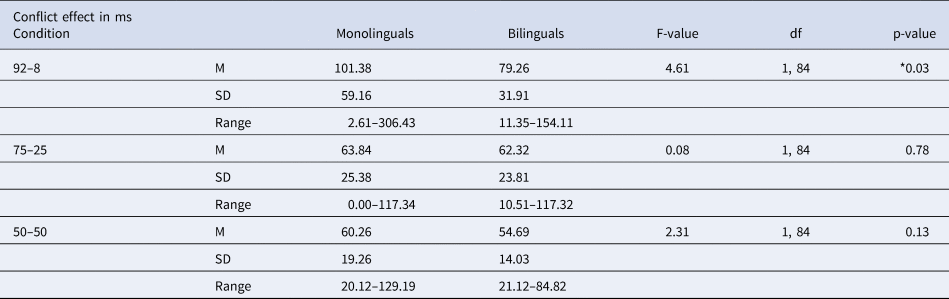
To assess the Conflict effect for RTs (Table 10), a mixed-design ANOVA with Monitoring condition (92–8, 75–25, 50–50) as the within-subject factor and Group (monolinguals, bilinguals) as the between-subject variable was conducted. Bilinguals (M = 65.42ms, SD = 23.25ms) experienced a reduced Conflict effect compared to monolinguals (M = 75.16ms, SD = 34.60ms) across all three conditions, but this effect was only trending [F(1,82) = 3.65, MSE = 1637.49, p = 0.06, η 2=0.004]. There was a significant effect of Monitoring [(F(1.34,109.51) = 35.09, MSE = 1106.44, p < 0.001, η 2=0.30]. The 92–8 condition yielded a greater Conflict effect than the 75–25 and the 50–50 condition (p < 0.001), confirming the effort involved in the reactive activation of inhibition. There was also a marginally significant interaction between Monitoring and Group [F(1.34,109.51) = 3.39, p = 0.056, η 2=0.04], suggesting that inhibitory performance across the conditions differed in the monolingual and the bilingual group.
Conflict effect (RTs) by condition

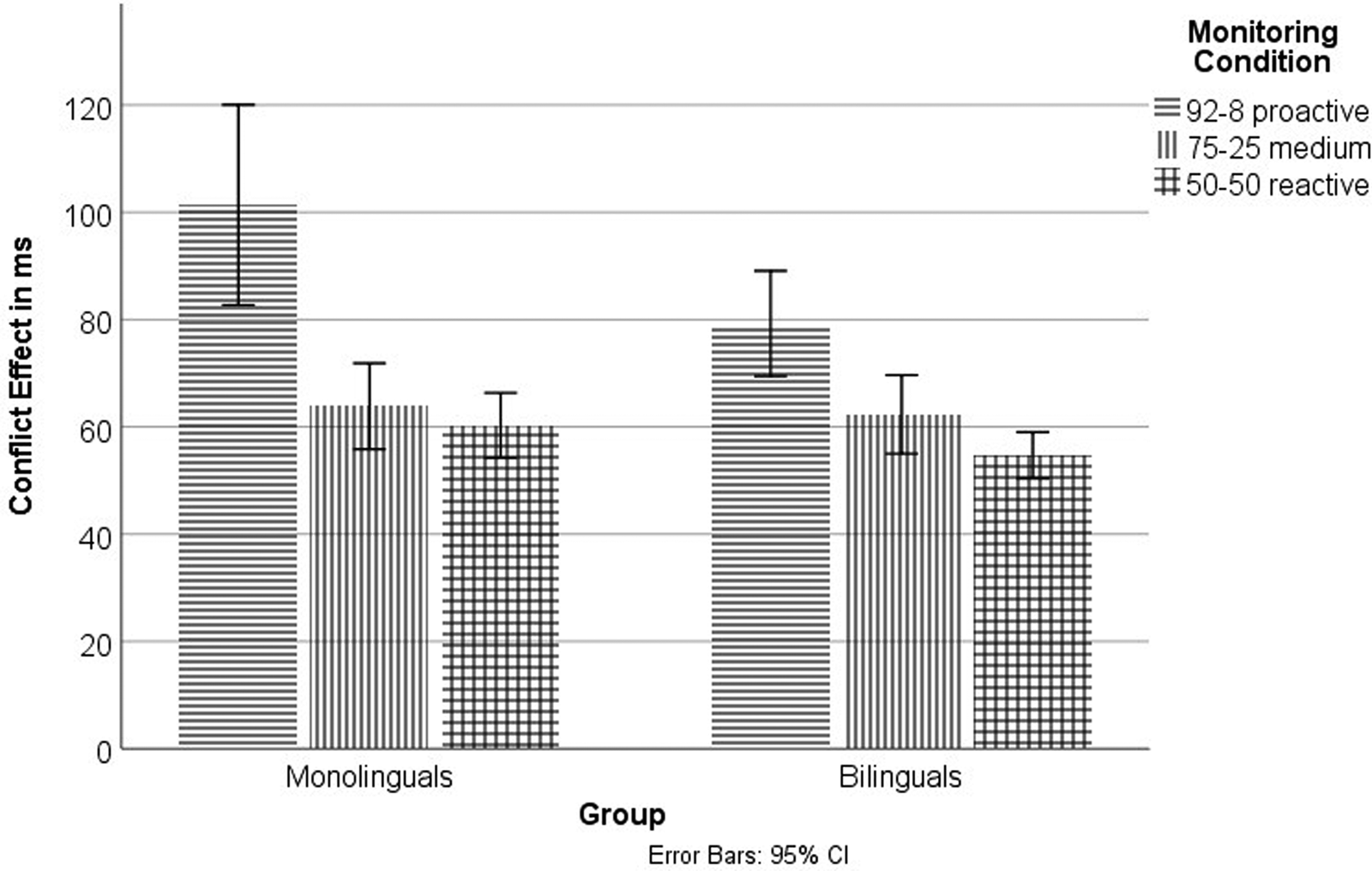
It had been predicted that bilinguals would experience executive enhancements at inhibitory processes analogous to those employed by the code-switching types they regularly engaged in. The bilinguals in this study most frequently engaged in Coupled control code-switching. Hence, they were predicted to excel at inhibition in the reactive monitoring condition. Indeed, a planned comparison investigating this prediction revealed that it was in this condition that bilinguals outperformed monolinguals at the Conflict effect measuring inhibition (monolinguals: M = 101.38ms, SD = 59.16ms, bilinguals: M = 79.26ms, SD = 31.91ms, F(1,84) = 4.61, p = 0.035, η 2=0.053). Figure 5 illustrates the Conflict effect across the three conditions, showing a similar group performance in the 50–50 and 75–25 conditions, but a diverging performance in the 92–8 condition.
Conflict effect in RTs by group and monitoring condition

To investigate the predictors of inhibitory performance, i.e., the Conflict effect, regression analyses were conducted for each condition separately as each condition challenged different aspects of the executive system. Inhibitory performance in the 92–8 condition was of specific interest because this was the condition in which performance differences between bilinguals and monolinguals occurred. Due to the ceiling effect, the Accuracy scores displayed too little variability to conduct a multiple regression (Field, Reference Field2009). Hence, regression analyses were conducted for RTs only. We first investigated the impact of non-linguistic predictors in the two groups, before zooming in on the linguistic predictors within the bilingual group. The initial stepwise regression was based on the following non-linguistic predictor variables, which may modulate EFs: Age, Education, IQ, Short-term and Working memory. The analyses were conducted separately for monolinguals and bilinguals.
In the 92–8 condition, 34.6% of monolingual inhibitory performance variance was explained by IQ and Age [R(1,38) = 0.59, R 2=0.35, adj. R 2=0.31%, IQ: B= -1.56, β= -0.45, Age: B = 1.74, β=0.35, Constant = 216.10, F-change = 6.91, p < 0.01]. However, in the bilingual group none of the non-linguistic variables accounted for inhibitory performance variance. A similar picture emerged in the 50–50 and 75–25 conditions. None of the non-linguistic variables reliably predicted the Conflict effect in the bilingual group. In the monolingual group, inhibitory performance was explained by Age in both conditions [75–25 condition: R(1,39) = 0.38, R 2=0.144, adj. R 2=0.123, F-change = 6.58, B = 0.82, β=0.38, Constant = 36.18, p < 0.01; 50–50 condition: R(1,39) = 0.43, R 2=0.18, adj. R 2=0.16, F-change = 8.62, B = 0.70, β=0.43, Constant = 36.76, p < 0.001].
Non-linguistic variables thus explained inhibitory performance in the monolingual, but not in the bilingual group. This raised the question whether performance in the bilingual group would be explained by bilingualism-related variables, such as code-switching, prompting further regression analyses with the following linguistic predictors: Age of Onset (L2 English), frequency judgement task scores for each code-switching type (Insertion G > E, Insertion E > G, Alternation, Dense code-switching), L2 proficiency, Balance and Immersion. None of the linguistic variables explained bilinguals’ inhibitory performance in either the 75–25 condition or the 50–50 condition. However, in the crucial 92–8 condition, in which performance differences between bilinguals and monolinguals had occurred, code-switching was a significant predictor: Alternation was singled out as the only predictor of inhibitory performance, explaining 27% of variance [R(1,41) = 0.52, R 2=0.27, adj. R 2=0.25, Constant = 100.00, B= -11.50, β= -0.52, F-change = 15.18, p < 0.01]. The more frequently bilinguals engaged in Alternation, the better they performed at inhibition in the reactive monitoring condition.
Additional analyses were conducted, using the self-reported code-switching scores from the questionnaire. These revealed two further results of interest to this study. Firstly, the only significant predictor of inhibitory performance in the 92–8 condition was bilinguals’ frequency of Alternational code-switching [R(1,41) =0.40, R 2=0.16, adj. R 2=0.14, F-change = 7.68, B= -17.13, β= -0.40, p < 0.01], which provided evidence converging with the regression using frequency judgement task scores. Secondly, inhibitory performance in the 50–50 condition was predicted by self-reported Dense code-switching frequency [R(1,41) =0.41, R 2=0.17, adj. R 2= 0.15, F-change = 8.30, Constant: 67.97, B= -7.95, β= -0.41, p < 0.01]. Dense code-switching explained 17% of performance variance at inhibition in the 50–50 condition. Bilinguals who self-reported to frequently use Dense code-switching performed better at inhibition in the proactive monitoring condition. This suggests that Dense code-switching recruits and enhances proactive monitoring. Most Dense code-switching scores in Study 2 were low. This is because the bilinguals in this study were all recent immigrants who rarely engaged in Dense code-switching. It is possible that if there had been a greater spread of Dense code-switching scores, the relationship between Dense code-switching and inhibition would have been different. Nevertheless, the case-wise regression diagnostics did not identify any outliers, so there was no need to exclude any values.
3.2.5. Executive performance in the Go/No-go task: Accuracy
In the monolingual group, the effect of congruency was marginally significant [congruent trials: M = 96.02%, SD = 16.06%; incongruent trials: M = 95.73%, SD = 12.26; χ2(1,41) = 3.67, p = 0.07, V = 0.21]. In the bilingual group, the difference between congruent and incongruent trials was significant [χ2(1,41) = 14.22, p < 0.0001, V = 0.41] with bilinguals performing at ceiling in congruent trials (M = 99.71%, SD = 1.14%), but making slightly more errors in incongruent trials (M = 97.75%, SD = 3.82%). Descriptively, bilinguals appeared to display greater Accuracy overall, but this difference was not statistically significant (Mann-Whitney U tests: p > 0.05).
3.2.6 Executive performance in the Go/No-go task: Reaction times
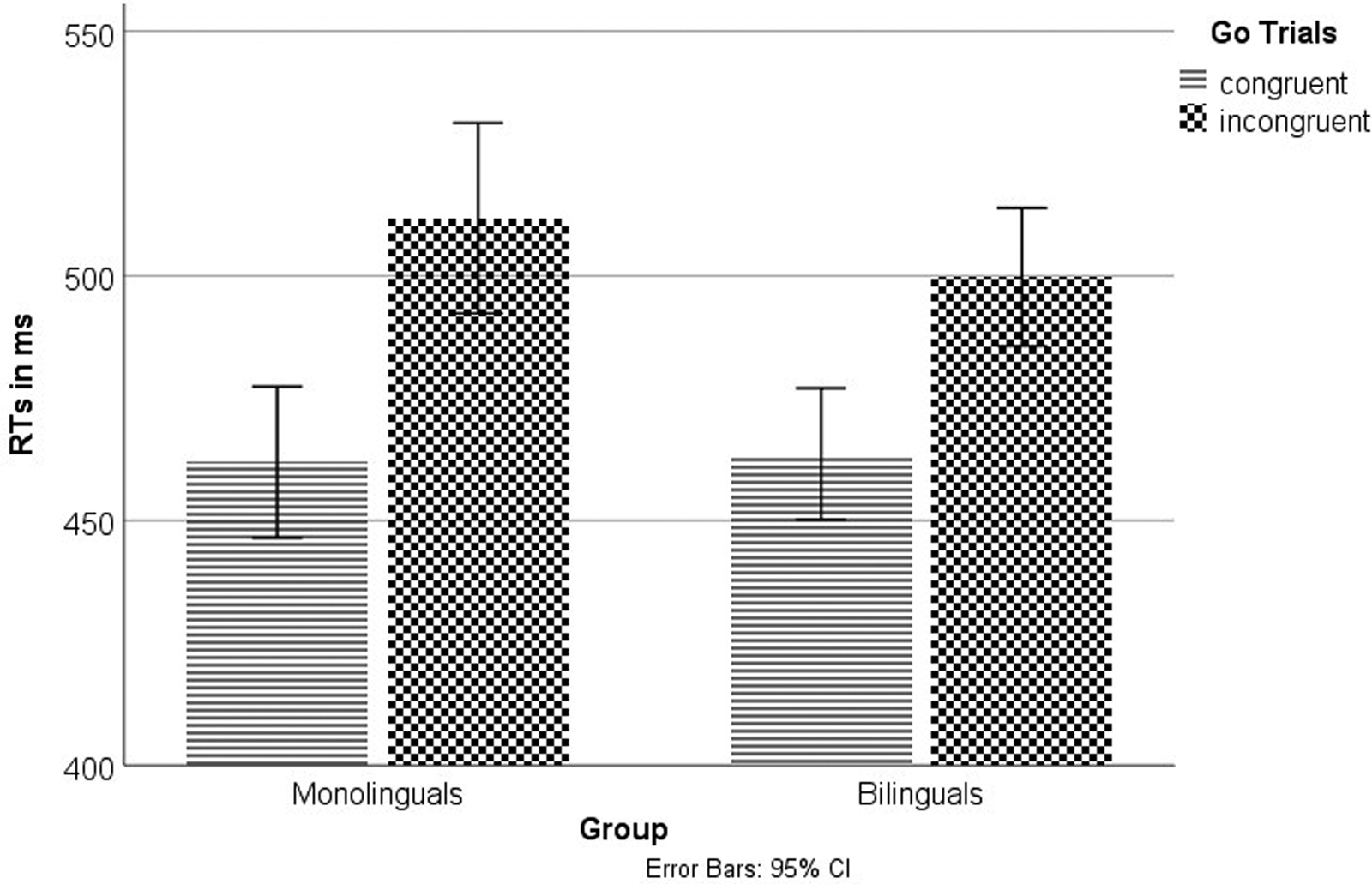
To analyse RTs in the Go trials, a mixed-design ANOVA was conducted with Congruency (congruent, incongruent) as the within-subject variable and Group (monolingual, bilingual) as the between-subject variable. The Conflict effect was significant with congruent trials yielding reduced RTs (M = 462.75ms, SD = 5.05ms) compared to incongruent trials (M = 505.76ms, SD = 5.90ms) [F(1,82) = 5.14, MSE = 386.52, p < 0.0001, η 2=0.71]. The overall between-subject comparison was not significant [F(1,82) = 0.63, MSE = 1106.86, p = 0.63, η 2=0.003]. However, there was an interaction between Group and Congruency [F(1,82) = 5.14, MSE = 386.52, p = 0.03, η 2=0.06]. To investigate this interaction, congruency effects were assessed in each group separately, and group effects were assessed for congruent and incongruent trials separately. Participants in both groups displayed shorter RTs in congruent trials (monolinguals: M = 461.87, SD = 49.01; bilingual: M = 463.62, SD = 43.60) than in incongruent trials (monolinguals: M = 511.76, SD = 61.57; bilingual: M = 499.75, SD = 45.75). Although the nature of the congruency effect was identical across both groups [monolinguals: F(1,40) = 76.72, MSE = 665.02, p < 0.0001, η 2=0.66; bilinguals: F(1,42) = 231.33, MSE = 121.28, p < 0.0001, η 2=0.85], the effect size in monolinguals (0.85) was larger than in bilinguals (0.66), which is likely to have led to the interaction (Figure 6). In the group comparison bilinguals and monolinguals performed equally well on congruent trials [F(1,83) = 0.03, MSE = 2145.44, p = 0.86, η 2=0.00]. In incongruent trials, bilinguals were on average 12.02ms quicker than monolinguals, but this difference was not statistically significant [F(1,83) = 1.04, MSE = 2921.50, p = 0.31, η 2=0.01].
RTs in Go trials by group

3.2.7 Executive performance in the Go/No-go task: Interference suppression and response inhibition
Bilinguals engaging predominantly in Coupled control code-switching had been hypothesised to outperform monolinguals at the interference suppression aspect of inhibition. To investigate this, an ANOVA was conducted with Group (monolingual, bilingual) as the between-subject variable and the Conflict effect for RTs in the Go trials as the dependent variable. Bilinguals displayed a reduced Conflict effect (M = 36.12ms, SD = 15.57ms) compared to monolinguals (M = 49.89ms, SD = 36.47ms). This turned out to be a small (13.77ms), yet significant difference [F(1,82) = 5.14, MSE = 3976.85, p = 0.03, η 2=0.06]. Bilinguals thus outperformed monolinguals at interference suppression.
Performance at No-go trials measured response inhibition. This can only be measured in error rates, because, by definition, correct responses in No-go trials do not have RTs. Friedman tests were conducted for each group separately to assess whether Accuracy in No-go trials differed from accuracy in Go trials. Group performance in No-go trials was compared in Mann-Whitney U tests. In congruent trials, monolinguals performed significantly [χ2(1,41) = 4.57, p = 0.03, V = 0.23] less accurately in No-go (M = 94.34%, SD = 15.86%) compared to Go trials (M = 96.02%, SD = 16.06%). The same can be said for bilinguals who performed nearly at ceiling on congruent Go trials, but slightly less well at No-go trials [Go: M = 99.71%, SD = 1.14%, No-go: M = 97.82%, SD = 4.70%, χ2(1,43) = 4.56, p = 0.04, V = 0.23]. In incongruent trials, the pattern was different. Monolinguals performed equally well in Go and No-go trials [Go: M = 95.73%, SD = 1.22%, No-go: M = 95.58%, SD = 12.36%, χ2(1,41) = 1.63, p = 0.20, V = 0.14]. Bilinguals on the other hand performed significantly better on No-go compared to Go trials [Go: M = 97.75%, SD = 3.82%, No-go: M = 98.69%, SD = 3.49%, χ2(1,43) = 4.55, p = 0.03, V = 0.23]. There were no group differences in No-Go trials (Mann-Whitney U tests: p > 0.05).
To summarise, participants performed more accurately in Go than in No-go trials when the trials were congruent. In incongruent trials, this effect was reversed in the bilingual group and disappeared in the monolingual group. How can this performance pattern reversal be explained? Firstly, it is possible that incongruent trials are less automated because the increased inhibitory effort requires some form of processing, triggering a “thinking pause” (increased RTs). It is possible that this response delay in incongruent trials facilitated response inhibition, which would explain why the No-go effect was cancelled out. A reversal of patterns is also possible if the heightened levels of inhibition in incongruent trials transferred to the response inhibition aspect of the task. Importantly, the group comparisons suggest a bilingual advantage for interference suppression, but not for response inhibition.
To compare predictors of performance in bilinguals and monolinguals, separate regression analyses were conducted for the two groups, and for congruent and incongruent trials in the Go and No-go conditions. Firstly, none of the non-linguistic predictors explained Accuracy in any of the conditions in either group. For RTs, Age explained 53.6% of variance at congruent RTs [R(1,39) = 0.73, R 2=0.54, adj. R 2=0.52, F-change = 45.09, Constant = 358.97, B = 3.04, β=0.73, p < 0.0001] and 31.6% of variance at incongruent RTs [R(1,39) = 0.56, R 2 = 0.32, adj. R 2=0.30, F-change = 18.02, Constant = 412.52, B = 2.93, β=0.56, p < 0.0001] in the monolingual group. Older monolinguals had slower RTs. This age effect was absent in the bilingual group. Variance at the Conflict effect was explained by Short-term memory in the bilingual group [R(1,41) = 0.32, R 2=0.10, adj. R 2=0.08, F-change = 4.68, Constant = 75.84, B= -6.21, β= -0.32, p = 0.04], but not in the monolingual group.
The regression analysis using linguistic variables provided limited insights. None of the predictor variables explained RT performance in Go trials. As for Accuracy, a complex picture emerged. None of the linguistic variables predicted Accuracy in the congruent Go trials or in the incongruent Go and No-go trials. However, in the No-go trials (congruent) Dense code-switching explained 11.4% of performance variance [R(1,40) = 0.34, R 2=0.11, adj. R 2=0.09, F-change = 5.12, Constant = 1.03, B= -0.02, β= -0.34, p = 0.03], so there was a negative correlation between response inhibition skills and Dense code-switching. Frequent Dense code-switchers performed less well at response inhibition.
To summarise, bilinguals outperformed monolinguals in interference suppression, but not in response inhibition. Linguistic variables did feature as significant predictors of response inhibition. There was a significant negative relationship between the frequency of Dense code-switching and response inhibition, suggesting that the Dense code-switchers are less good at suppressing an automated motor response.
4. Discussion
This study investigated whether and how different code-switching types (Muysken, Reference Muysken2000) modulate EFs, and whether code-switching explains executive performance differences between bilinguals and monolinguals. The predictions were based on existing processing models of code-switching (Treffers-Daller, Reference Treffers-Daller, Bullock and Toribio2009; Green & Abutalebi, Reference Green and Abutalebi2013; Green & Wei, Reference Green and Wei2014), which were extended by a dual control perspective of EFs (Braver, Reference Braver2012). The results revealed selective executive performance modulations in bilinguals, which can be explained in a model differentiating between different code-switching types and control modes.
Although bilinguals and monolinguals performed on a par in most conditions, there was a selective inhibitory advantage for bilinguals in the reactive monitoring condition. This suggests that the effect of bilingualism on inhibitory performance is modulated by monitoring, as suggested by previous studies (Costa et al., Reference Costa, Hernández, Costa-Faidella and Sebastián-Gallés2009; Morales et al., Reference Morales, Yudes, Gómez-Ariza and Bajo2015). Crucially, the bilingual performance modulation occurred in the condition mirroring the control processes employed in bilinguals’ most frequent code-switching habits. It was a type of Coupled control code-switching, Alternation, that accounted for bilingual advantages at inhibition.
Importantly, the observed relationships provide novel insights into the nature of the overlap between code-switching and EFs, suggesting that processing models of code-switching should differentiate between reactive and proactive monitoring (Braver, Reference Braver2012). Whilst Alternation draws upon reactive control forms, Dense code-switching requires proactive monitoring. The inhibitory processes called upon in the reactive monitoring condition are akin to what is required to globally inhibit languages for prolonged periods of time during Alternation, because the de- and re-activation of inhibition happens less frequently. The proactive monitoring context on the other hand challenges the continued maintenance of inhibition, thus replicating the need to manage a constant state of cross-linguistic competition during Dense code-switching. Inhibitory performance variance in the reactive monitoring condition was indeed explained by Alternation, whilst performance in the proactive monitoring condition was explained by Dense code-switching.
Our study converged with and differed from previous studies in several points. The positive correlation between Dense code-switching and inhibitory performance in the proactive monitoring condition was coherent with Hofweber et al. (Reference Hofweber, Marinis and Treffers-Daller2016). Hence, there is converging evidence suggesting that Dense code-switching trains the ability to manage inhibition proactively. However, the effect of Dense code-switching did not translate into performance differences between bilinguals and monolinguals in this study. This is inconsistent with Costa et al. (Reference Costa, Hernández, Costa-Faidella and Sebastián-Gallés2009) who found bilinguals to outperform monolinguals in a 50–50 version of the flanker task. We hypothesise that the observed divergence in results is due to differences in participants’ code-switching patterns. It is possible that the Spanish–Catalan bilinguals in the Costa et al. (Reference Costa, Hernández, Costa-Faidella and Sebastián-Gallés2009) study engaged in Dense code-switching because they were living in communities with long-standing bilingual traditions. The recent bilinguals in this study, by contrast, engaged in Dense code-switching too infrequently for group differences to occur. Hence, the divergence in results may be due to a threshold effect.
The results of this study also revealed that inhibitory performance was predicted by different variables in the bilingual and monolingual groups. A large percentage of inhibitory performance variance was predicted by the non-linguistic variables age and IQ in monolinguals, but not in bilinguals. The fact that age and IQ predicted executive performance amongst the monolinguals was unsurprising. Reaction times commonly increase with age (Bialystok et al., Reference Bialystok, Craik and Luk2008; Goral, Campanelli & Spiro, Reference Goral, Campanelli and Spiro2015; Weissberger, Wierenga, Bondi & Gollan, Reference Weissberger, Wierenga, Bondi and Gollan2012), and IQ is well known to correlate with a wide range of cognitive abilities (Raven, Reference Raven1998). Surprisingly, these influential variables did not impact inhibitory performance in the bilingual group. This observation is coherent with the notion that bilingualism generates neural adaptations re-shaping executive networks, leading to a fundamentally different modus operandi of executive control (Bialystok, Craik, Grady, Chau, Ishii, Gunji & Pantev, Reference Bialystok, Craik, Grady, Chau, Ishii, Gunji and Pantev2005; Abutalebi & Green, Reference Abutalebi and Green2007). The absence of an age effect is also in line with previous studies showing that bilingualism has the potential to reduce the age-related decline of EFs (Bialystok et al., Reference Bialystok, Craik and Luk2008). However, this study only tested middle-aged participants, so future research is needed to systematically investigate the interaction between code-switching and aging effects.
The response inhibition task produced another selective group difference: Bilinguals outperformed monolinguals at interference suppression, but not at response inhibition. This was in line with previous studies (Bialystok, Reference Bialystok2009). It was also consistent with the fact that the bilinguals in this study engaged primarily in Coupled control mode code-switching, thus training primarily interference suppression. However, there was evidence of a relationship between response inhibition and code-switching. In line with predictions, bilinguals’ response inhibition performance correlated with Dense code-switching frequency. Contrary to predictions, the nature of this relationship was negative. The more frequently bilinguals engaged in Dense code-switching, the less well they performed at response inhibition.
This raises a chicken and egg question. Is it more intuitive to say that Dense code-switching makes bilinguals worse at response inhibition or that less strong response inhibition abilities increase the likelihood of Dense code-switching? The answer to this question impacts the direction of causality implied in the relationship between code-switching and EFs. Bilinguals’ EF abilities could influence their code-switching behaviour. Most likely, the relationship between code-switching and EFs is mutual, making it hard to tease apart cause and effect. The correlational design of this study cannot provide a definite answer to this question. Future research should address the issue of causality using longitudinal study designs (Woumans & Duyck, Reference Woumans and Duyck2015).
Both interpretations of causality are nevertheless in line with the hypothesis that during Dense code-switching languages remain co-activated beyond the conceptual level (Botero et al., Reference Botero, Bullock, Davis and Toribio2004). Interestingly, Alternation and Insertion did not correlate with the response inhibition measure, indicating that they are unrelated to response inhibition. This suggests that Coupled control code-switching involves global language selection at conceptual processing stages, whilst Dense code-switching involves linguistic co-activation at articulatory stages and is managed through local forms of language selection (Hofweber et al., Reference Hofweber, Marinis and Treffers-Daller2016). Future research could test this hypothesis by comparing the nature of phonological transition processes in the different code-switching types.
The following sections will discuss some of the limitations of this study and how they could be addressed in future research. Firstly, this study assessed executive performance using purely behavioural methods. To identify the neural correlates of different language modes and interactional contexts, future research could use direct measures of neural activity (Van Hell, Fernandez, Kootstra, Litkofsky & Ting, Reference Van Hell, Fernandez, Kootstra, Litcofsky and Ting2018; Ruigendijk, Hentschel & Zeller, Reference Ruigendijk, Hentschel and Zeller2016). Furthermore, this study explored the predictions about the dual control modes involved in different code-switching types using a correlational design. Additional insights could be obtained by comparing bilinguals who display opposite usage frequency of Alternational code-switching, as it was done for Dense code-switching (Hofweber et al., Reference Hofweber, Marinis and Treffers-Daller2016).
The results from this study suggest that code-switching has a moderate modulatory impact on EFs. Hence, findings from this project do not contradict the notion that individuals’ EFs are partially shaped by genetic pre-disposition (Friedman, Miyake, Young, DeFries, Corley & Hewitt, Reference Friedman, Miyake, Young, DeFries, Corley and Hewitt2008) or by life experiences other than bilingualism (Bialystok, Reference Bialystok2009). They merely capture the specific modulatory impact of code-switching on EFs. Moreover, the data do not contrast with studies suggesting that code-switching may not be more effortful than monolingual modes (Gardner-Chloros, McEntee-Atalianis & Paraskeva, Reference Gardner-Chloros, McEntee-Atalianis and Paraskeva2013; Kleinman & Gollan, Reference Kleinman and Gollan2016). Rather, the data suggest a trade-off of dual control mechanisms (Braver, Reference Braver2012) and global and local control (Hofweber et al., Reference Hofweber, Marinis and Treffers-Daller2016). The “total” executive effort may be equal across all language modes, but language modes differ in their specific demands to reactive and proactive inhibitory mechanisms (Ooi et al., Reference Ooi, Goh, Sorace and Bak2018). This is in line with the Adaptive Control Hypothesis (Green & Abutalebi, Reference Green and Abutalebi2013, which suggests that the interplay of proactive and reactive control differs as a function of interactional contexts. Coupled control code-switching challenges reactive but not proactive monitoring, whilst the pattern of “executive effort” is the opposite for Dense code-switching.
A trade-off could also be hypothesised for the balance between executive and linguistic efforts, i.e., between the inhibitory effort used to suppress non-target languages and the linguistic effort used to consolidate competing linguistic structures. The Adaptive Control Hypothesis (Green & Abutalebi, Reference Green and Abutalebi2013) suggests that intra-sentential code-switching challenges the temporal processes responsible for syntactic processing. However, traditional models of syntactic processing suggest that speakers minimise effort during planning by using whatever linguistic item is most accessible. Syntactic priming paradigms show that speakers reuse structures previously used by their interlocutors (Bock & Griffin, Reference Bock and Griffin2000), and construct utterances around frequent or visually salient referents (Gleitman, January, Nappa & Trueswell, Reference Gleitman, January, Nappa and Trueswell2007). This raises the question if code-switching is driven by such accessibility criteria, i.e. whether there is something more accessible about the language-not-in-use that prompts a speaker to switch. Lexical frequency effects have, for instance, been shown to affect the pattern of insertional code-switching (Khakimov, Reference Khakimov2014). This implies that code-switching relieves the burden of syntactic planning and is less effortful from a linguistic perspective, but it does not necessarily mean it is less effortful for EFs.
Accessibility may indeed dominate language selection in Dense code-switching in which the gates are “open” and speakers are free to select linguistic items from either language (Green & Wei, Reference Green and Wei2014). However, even in the open control mode there will be a cost to proactive monitoring and local inhibition (Green & Abutalebi, Reference Green and Abutalebi2013; Green & Wei, Reference Green and Wei2014; Hofweber et al., Reference Hofweber, Marinis and Treffers-Daller2016). Speakers need to monitor competing linguistic structures. In the Dense code-switching example in Table 1 for instance the speaker opted for a calque translation of the English idiomatic expression “to make friends”. Whilst this term may have been lexically more accessible, its usage in a bilingual sentence involved the consolidation of incongruent word orders from German and English.
Moreover, accessibility criteria may be overwritten by sociolinguistic conventions. In bilingual communities with strong traditions of language separation speakers may avoid code-switching, even if it is linguistically less effortful. The impact of accessibility criteria may also be mitigated when the situational context requires speakers to inhibit a language. This study did not specifically investigate the impact of accessibility criteria on code-switching patterns, but an investigation of the interaction of linguistic accessibility and EFs in code-switching would be an interesting avenue for future research. Bilinguals’ selective attention abilities may for instance modulate the extent to which they utilise the visual saliency of referents when constructing utterances (Gleitman et al., Reference Gleitman, January, Nappa and Trueswell2007).
Another important avenue for further research is to investigate the relationship between EFs and code-switching patterns in sociolinguistic communities in which Dense code-switching is widely practised, such as Singapore (Kang & Lust, Reference Kang and Lust2019). Code-switching in those communities may not require (global) inhibition to the same extent as it draws on the open control mode (Kang & Lust, Reference Kang and Lust2019). Future research on the relationship between code-switching and EFs should consider the subtle differences in community-wide code-switching practices. Communities in which topics or activities are language-specific, and thus code-switching is less commonly practised (e.g. Brussels, Treffers-Daller, Reference Treffers-Daller1992), are different from communities in which topics and activities are covered equally by both languages and code-switching is widely found (e.g. Singapore, Kang & Lust, Reference Kang and Lust2019). A more in-depth analysis of the actual distribution of languages across a range of topics and activities in the communities under study is therefore needed. Such analyses could, for example, make use of Grosjean's (Reference Grosjean, Silva-Corvalán and Treffers-Daller2016) Complementarity Index, which measures the degree of overlap between the use of languages across topics and activities. This could shed light on fine-grained within-group and between-group differences in language use patterns (including code-switching practices) that may affect EFs.
To summarise, the results of this study suggest that code-switching impacts on EFs. Moreover, the answer to the question whether code-switching brings about modulations that translate into performance differences between bilinguals and monolinguals was affirmative. The nature of differences depended on the type of code-switching bilinguals regularly engaged in. In this study, bilinguals engaged predominantly in Coupled control code-switching, so group differences occurred in task conditions challenging the EFs involved in Coupled control code-switching. Bilinguals with different code-switching habits would probably display other EF modulations. This highlights the importance of assessing sociolinguistic variables in explaining inconsistent findings in bilingualism research (Bak, Reference Bak2016). A lack of assessing bilinguals’ sociolinguistic habits is likely to result in a lack of sensitivity of the administered EF tasks when it comes to replicating the cognitive processes trained by bilinguals’ practices.
5. Conclusion
This study investigated the effects of different types of code-switching, as distinguished by Muysken (Reference Muysken2000), on different aspects of the executive system. The study also explored whether EF modulations through code-switching would translate into performance differences between bilinguals and monolinguals. Based on processing models of code-switching (Treffers-Daller, Reference Treffers-Daller, Bullock and Toribio2009; Green & Wei, Reference Green and Wei2014; Braver, Reference Braver2012), Coupled control code-switching (Alternation, Insertion) was predicted to train reactive control modes. Dense code-switching was predicted to train proactive control modes because the prolonged linguistic co-activation in this code-switching type requires a constant readiness to use inhibition. The results confirmed the predicted interactions between code-switching and EFs. Moreover, the training effect of code-switching translated into “bilingual advantages”. Bilinguals outperformed monolinguals in the task conditions mirroring the EFs employed by the type of code-switching they frequently engaged in.
The results also indicated that different code-switching strategies involve language selection processes taking place at different stages in language production (Kroll et al., Reference Kroll, Bobb and Wodniecka2006). A correlation between Dense code-switching and response inhibition performance suggested that Dense code-switching involves linguistic co-activation at articulatory stages of language production, whilst in Coupled control code-switching selection happens at the conceptual lemma level. The findings of this study thus provided novel insights into the interaction of EFs with code-switching. They also suggested that the observed complexity of the relationship between code-switching and EFs necessitates the use of more bespoke assessment methods of code-switching in bilingualism research to explain performance differences between bilinguals and monolinguals.