Introduction
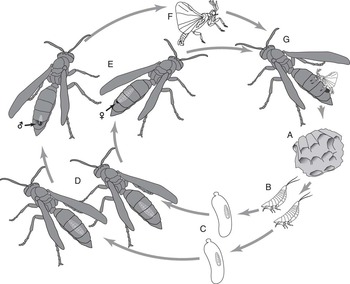
Strepsiptera are a peculiar and poorly understood insect order. As obligate endoparasites of other insects, they exhibit a high degree of adaptive specialisation. Most notable is the extreme dimorphism between male and female adults. The grub-like females never leave their host (except for females of the basal group Menengillidae) (Kathirithamby Reference Kathirithamby1989), whereas males undergo an additional instar and pupate (Kinzelbach Reference Kinzelbach1971; Kathirithamby Reference Kathirithamby2005), metamorphosing into winged adults that exit their host and search for mates (Fig. 1).
Illustration of the life cycle of Xenos peckii: (A) nest of host wasp Polistes fuscatus gets infested with (B) first-instar X. peckii that actively seek and burrow into (C) host wasp larvae where they moult into an apodous, grub-like, second instar and develop through three successive instars within the larvae of the host wasp; (D) adult wasps eclose with X. peckii larvae concealed within their abdomen; (E) male and female fourth instar larvae extrude from the abdomen of their host wasp; (E, left) the extruded structure of the male sclerotises and forms the cephalotheca (cap of the puparium); (E, right) the extruded structure of the female sclerotises to form the cephalothorax (fused head and prothorax), resulting in a neotenic adult female; (F–G) after a 10-day to 15-day pupation period, the winged male (F) emerges, locates a receptive female (G), and mates. Note: drawings not to scale; drawing of first instar larvae adapted from a SEM in Osswald et al. (Reference Osswald, Pohl and Beutel2010).

Strepsiptera have an unusual lifecycle, characterised by heteromorphosis (Reynolds Reference Reynolds2013). On a host nest (Fig. 1A) the viviparous larvae (Fig. 1B) crawl out of their mother's brood canal (also termed ventral canal) through which she was inseminated the previous season (Beani et al. Reference Beani, Guisti, Mercati, Lupetti, Paccagnini and Turillazzi2005), and quickly seek new host larvae into which they burrow. Once inside their host, the first instar larvae moult into a grub-like immotile form. They then develop through three successive instars within the abdomen of their host, growing in size (Manfredini et al. Reference Manfredini, Guisti, Beani and Dallai2007) (Fig. 1C), but not inhibiting their host's metamorphosis (Fig. 1D). They remain endoparasitic until a few days after eclosion of the adult host wasp, at which time the fourth instar larvae partially extrude (arrows in Fig. 1E) between two abdominal sclerites, forcing their way through the wasp's inter-segmental membrane (Hughes et al. Reference Hughes, Kathirithamby, Turillazzi and Beani2004). It is at this point that the male and female life cycles diverge.
Females extrude their head and prothorax which sclerotises, fusing into a structure termed cephalothorax (Nassonow Reference Nassonow1892). Once the cephalothorax has sclerotised, females undergo no further development and are considered neotenic adults, retaining larval features (Muir Reference Muir1906). Adult females exhibit “specialisation by reduction” (Bohart Reference Bohart1941), lacking eyes, mouthparts, antennae, legs, wings, and even external genitalia. Once extruded, they are thought to remain motionless, release pheromone that attracts males, overwinter as adults in the wasp's abdomen, and release their motile larvae the following spring (Schrader Reference Schrader1924).
Males, like females, also extrude their head and prothorax; their development differs in that they undergo an additional moult and pupation after they have extruded (Beani et al. Reference Beani, Guisti, Mercati, Lupetti, Paccagnini and Turillazzi2005). The sclerotised portion comprising the shell of the previous larval instars serves as a puparium (Kinzelbach Reference Kinzelbach1971; Kathirithamby Reference Kathirithamby2005). The anterior (extruded) portion of a male's puparium is referred to as a cephalotheca (Kathirithamby Reference Kathirithamby1983; Kathirithamby et al. Reference Kathirithamby, Hayward, McMahon, Ferreira, Andreazze and Almeida Andrade2010). Male pupation occurs in two stages, whereby a male sheds his pupal skin while still encased in his puparium. As an eclosed “pre-adult”, the male remains within the puparium until his cuticle hardens and his wings expand (Kathirithamby Reference Kathirithamby2005). As a consequence, the male is capable of immediate flight upon his emergence from the puparium (Fig. 1F), and quickly seeks females for mating (Fig. 1G). The winged adult males are short-lived (Kathirithamby Reference Kathirithamby1989), adding to the challenge of locating a receptive female in a mobile host wasp.
Xenos peckii Kirby (Strepsiptera: Xenidae) is a parasite of the paper wasp Polistes fuscatus (Fabricius) (Hymenoptera: Vespidae). Many life history traits of X. peckii remain unknown, controversial, or hardly described. Our objectives were to investigate: (i) timing of sexual maturity in female and male X. peckii; (ii) the role of females during sexual communication and diel periodicity of communication; (iii) the emergence process of males and diel periodicity of emergence; and (iv) the mating sequence.
Methods
Collection of wasp nests
Active nests of P. fuscatus were collected in and around New Canaan, Maine, United States of America, during the first week of July 2012. Each nest, together with at least three adult resident female wasps tending larvae, was placed in a Rubbermaid 1.2 L disposable freezer container (Newell Rubbermaid, Winchester, Virginia, United States of America) with screen top (32-mesh, Saran Fabric, Synthetic Industries, Lumite Division, Norcross, Georgia, United States of America) for transportation to Canada. The nests were ultimately housed in the Global Forest Quarantine Facility at Simon Fraser University (Burnaby, British Columbia, Canada), where they were hot-glued into Plexiglas cages (24 cm long × 14 cm wide × 22 cm high) with a sliding front door for access and a 32-mesh back. Cages were kept at 20–30 °C, 40–60% relative humidity, and a 16 light: 8 dark photoperiod. Wasps were provisioned with water delivered in cotton wicks (1 × 5 cm; Richmond Dental, Charlotte, North Carolina, United States of America), honey, and early instar larvae of wax moth (Galleria mellonella Linnaeus; Lepidoptera: Pyralidae) ad libitum. Voucher specimens of P. fuscatus and X. peckii have been deposited in the Spencer Entomological Collection at the Beaty Biodiversity Museum (University of British Columbia, Vancouver, British Columbia, Canada).
Timing of sexual maturity in females and males
Each wasp nest was examined daily. We marked the pronotum of each newly emerged wasp with a dot(s) using an oil-based paint pen (Sharpie®; Newell Rubbermaid, Illinois, United States of America), colour encoding the day of eclosion. In addition, we recorded the day a neotenic female or a male pupa of X. peckii appeared between the abdominal sclerites of a host wasp. Such parasitised wasps were isolated singly in a small Plexiglas cage (9 cm long × 6 cm wide × 9 cm high), and provided with a honey-water solution, allowing us to determine the day female X. peckii initiated calling (see below), and males emerged.
Role of females during sexual communication and diel periodicity of communication
To determine whether female X. peckii engage in active calling and assume a particular body posture during calling, we inspected females at 0.5–1.0-hour intervals between 06:00 and 22:00 hours. The extent (0–100%) of calling by a female was estimated based on the repleteness of her cephalothorax, its degree of additional protrusion, and its angle to the host's abdominal surface. A parallel study with a separate set of females that aimed at the identification of the female sex pheromone indicated that the pheromone was most abundant when it was extracted at the time the females’ cephalothorax was most replete and extruded farthest from the host, and that females only in this calling posture attracted males (M.H., personal observation).
Focus-stacked images of calling females and of adult males were obtained with a Canon 5D Mark II digital SLR camera (Canon USA Inc., Mellville, New York, United States of America) through a Mitotoyo M-Plan Apo long working distance microscope objective (Fig. 2G: 40-image composite, 5 × objective, numerical aperture (NA) =0.14, 20-μm step; Fig. 2H: 36-image composite, 2 × objective, NA = 0.055, 50-μm step; Fig. 8: 60-image composite, 10 ×, NA = 0.28 microscope objective, 10-μm step (Mitutoyo Canada, Mississauga, Ontario, Canada). Step increments were controlled with a StackShot™ controller and stepper motor (Cognisys, Kingsley, Michigan, United States of America), custom fitted to a micrometer-driven linear translation stage. Image composites were processed using Zerene Stacker software, version 1.04. (Zerene Systems LLC, Richland, Washington, United States of America).
Photographs of (A) two male pupae 1.5 hours (left) or 0.5 hours (right) after extrusion; (B) an adult neotenic female (right) with incomplete sclerotisation 10 minutes after extrusion and her brood canal still closed, and (left) a partially sclerotised female 1.5–2.0 hours after extrusion; (C) two 14-day-old male pupae each with an adult male ready to emerge (arrow points to the ecdysial suture line); (D) a fully extruded, 20-day-old virgin female with her brood canal (arrow) open, photographed at 08:30 hours while she was not posturing (see Fig. 4); (E) a male Xenos peckii in the process of emergence from a pinned wasp; (F) a puparium cap (cephalotheca) still hinged to the puparium (left), and an empty puparium with the cephalotheca brushed off (right); (G) a male's head revealing well-developed mandibles (arrow); (H) an adult male X. peckii (arrow points to the hooked adeagus). Scale bars A–F = 2.0 mm; G, H = 500 μm.

Emergence process of males and diel periodicity of emerging
With preliminary evidence for eclosion of males in early afternoon, we recorded the time of day that 47 males emerged from live single-caged host wasps at 0.5–1.0-hour intervals between 07:00 to 17:00 hours.
The emergence process of males was video recorded at 1920 × 1080 pixel resolution, 60 frames/second, interlaced, using a Sony HDR-XR550 camera (Sony of Canada Ltd., Toronto, Ontario, Canada). Wasps with one or more pupae each housing a ready-to-emerge male X. peckii were cold-sedated before removing the abdomen by snipping the pedicel with microscissors (Fine Science Tools, North Vancouver, British Columbia, Canada). The abdomen was then immobilised by embedding the pedicel in modelling clay (Flair Leisure Products PLC, Surrey, United Kingdom). Video recordings of the restrained abdomen were run continuously until the adult male X. peckii had completely emerged.
Mating sequence
The mating sequence was filmed by both real-time and high-speed videography. Real-time footage was obtained using a Sony HDR-XR550 camera (Sony of Canada Ltd.), and recorded at 1920 × 1080 pixel resolution, 60 frames/second, interlaced. High-speed video was captured using the Fastec imaging camera IN1000M2GB, equipped with Fastec imaging software version 3.0.4 (Fastec Imaging, San Diego, California, United States of America). Footage was obtained at 1000 frames/second, at 320 × 240 pixel resolution.
Wasp abdomens with a sexually mature virgin female X. peckii were removed and mounted as described above, inside a glass enclosure (20 × 12 × 12 cm), with both the head and end section covered by fabric mesh, allowing a gentle, desk fan-driven airflow through the enclosure to aid in directional pheromone dissemination. For each recording, a male was introduced into the down-wind section of the enclosure.
Results
Timing of sexual maturity of females and males
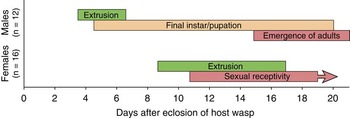
The period of male extrusion preceded the period of female extrusion, with no overlap between the late-extruding males and the early-extruding females in our sample (Fig. 3). Males (Fig. 2A) and females (Fig. 2B) extruded 3–7 days and 9–17 days, respectively, after eclosion of the host wasp. After the early extrusion of males an additional moult and pupation period of 10–15 days ensued (Fig. 3). As a result, adult, mate-searching males emerged at a time shortly after females had reached sexual maturity, two to three days after extrusion.
Days after eclosion of the host wasp at which male and female Xenos peckii extruded from their host, pupated and emerged (males), or attained sexual maturity and began posturing (females). One aberrant female that extruded after only two days following wasp eclosion is not depicted in this graph. Note: the emergence period of males overlaps with the onset of sexual receptivity in females.

Role of females during sexual communication and diel periodicity of communication
Females engaged in active calling behaviour and assumed a particular calling position and posture. They initiated calling on the third or fourth day following their extrusion from the host wasp and, if not mated, they continued to call for two to three weeks. Thereafter, they gradually reduced the extent and duration of calling, and ultimately ceased to call.
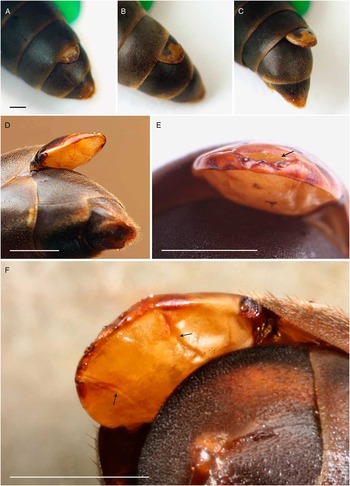
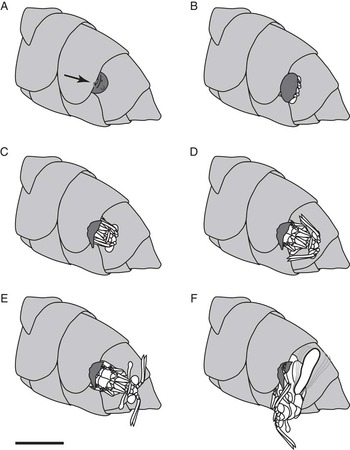
To call, females protruded their cephalothorax from the wasp's abdomen. Protrusion was mediated by, or accompanied with, inflation, “hyper/super-extrusion” (protruding farther out from the wasp), and tilting of the cephalothorax. Inflation typically occurred very slowly over the course of several minutes to more than an hour (Fig. 4D–F), presumably mediated by a shift in hemoloymph pressure, and seemed to be facilitated by fold lines on the underside of the cephalothorax. At some point during the inflation process, females extended their cephalothorax in a comparatively more rapid motion occurring over seconds to minutes (Supplementary Video 1), and tilted their cephalothorax resulting in a gap between it and the wasp's abdominal surface (Fig. 4A–C).
Representative photographs showing a female Xenos peckii in the process of assuming her calling (pheromone-release) posture. Calling is associated with a gradual inflation and a more rapid protrusion of the cephalothorax (see Results for details); (A–C) the female continues to inflate her cephalothorax and to protrude from the wasp's abdomen; (D) the female has assumed her final calling posture with her cephalothorax fully tilted away from the host's abdomen; (E) the cephalothorax is fully inflated, raising it off the wasp's abdomen (arrow points to the open brood canal); (F) underside of cephalothorax revealing fold lines (arrows) which allow inflation. Scale bars = 1.0 mm.

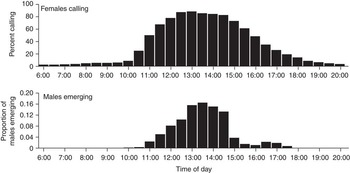
Female calling behaviour followed a distinct diel periodicity (Fig. 5, top). It typically commenced between 10:00 and 10:30 hours, peaked between 13:00 and 14:00 hours, and gradually ceased during the late afternoon and early evening. Females exhibited slight variability in the time when they initiated calling and in how long it took them to reach the final calling posture. Even when multiple females occupied the same wasp, they varied in their onset and degree of calling.
Comparison of (top) diel pheromone release (calling) periods of female Xenos peckii (final calling position assigned a value of 100%) (n = 5 averaged over 21 days) and (bottom) diel emergence period of conspecific males (n = 47).

Emergence process of males and diel periodicity of emergence
To emerge, males use their mandibles to cut open the puparium (Fig. 6), first piercing through it (Fig. 6A), and then cutting along a specific line (termed “ecdysial suture line” by Kathirithamby et al. (Reference Kathirithamby, Carcuypino and Mazzini1990)) in a scissor-like fashion (Fig. 2C; Supplementary Video 2), until the nearly severed cap (cephalotheca) just hinged to the puparium by a narrow thickening at the distal-most end. In our observations (n = 4), cutting always commenced at one side of the hinge point, proceeded radially around the ecdysial suture line, meeting the hinge point from the other side; however, the direction of cutting was not consistent clockwise or counter-clockwise between specimens. Once the cephalotheca was cut free, the male then pushed it open with his head (Fig. 6B; Supplementary Video 3), gradually emerging from the puparium ventral side out (Fig. 2E; Fig. 6C–E), and eventually rotated around his longitudinal body axis, bending ventrally to free himself (Fig. 6F). His wings were fully functional at this stage and he took flight as soon as he was free of the puparium. The cephalotheca (Fig. 2F) was eventually brushed off by the host wasp.
Emergence process of a male Xenos peckii: (A) a mandible pierces through the distal section of the puparium (arrow); (B) the nearly severed puparium cap (cephalotheca) hinges to puparium while the male uses his head to push open the cap; (C–E) the cap is completely pushed aside as the male gradually emerges from the puparium; (F) the male rotates around his longitudinal body axis, bends ventrally, and immediately takes flight in search for females. Scale bar = 2.0 mm.

Similar to the calling cycle of virgin females, male emergence followed a diel periodicity. Most males emerged between 11:00 and 15:00 hours (Fig. 5, bottom), with peak emergence time between approximately 13:00 and 14:00 hours.
Mating sequence
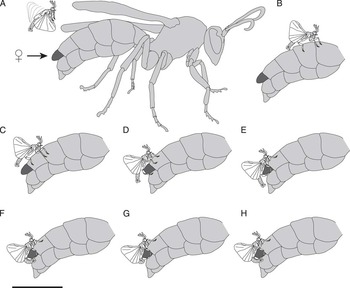
All X. peckii males that we observed in the laboratory (n = 6) approached calling females in a swaying flight with smooth turns and engaged in a similar sequence of mating behaviour. The sequence in Fig. 7, which was redrawn from a high-speed video recording (Supplementary Video 4), may serve as a representative example: The male approached a P. fuscatus host wasp in response to a calling conspecific female (Fig. 7A), landed on the anterior section of the wasp's abdomen (Fig. 7B), and then stepped backward (Fig. 7C–D) until he made contact with the female's cephalothorax (Fig. 7E). As soon as his mesothoracic legs touched the female's cephalothorax, they grasped it tightly (Fig. 7E). He then immediately curled his abdomen ventrally (Fig. 7F) and inserted his aedeagus into the female's brood canal (Fig. 7G). After a brief copulation (5 seconds), he detached from the female (Fig. 7H) and flew away. After copulation, the female immediately retreated back between the wasp's abdominal sclerites leaving only the very tip of her cephalothorax extruded and assuming the same position she exhibited during non-calling hours. Mated females remained in this retreated position, never to call again.
Mating sequence of Xenos peckii: (A) a flying male approaches a Polistes fuscatus host wasp in response to a calling conspecific female (arrow) protruded between abdominal sclerites of the wasp's abdomen; (B–C) he lands on the anterior section of the wasp's abdomen and steps backward; (D) his hindlegs make contact with the female's cephalothorax and curl around it; (E) as his mesothoracic legs touch the female's cephalothorax, they curl around it, and he immediately begins to bend his abdomen ventrally; (F) his abdomen is fully curved and copulation is about to commence; (G) 2-second copulation; (H) the male detaches from the female and is about to fly off. Scale bar = 5.0 mm.

Discussion
Our study adds to the understanding of life history traits of X. peckii. Specifically, we reveal (i) synchrony of sexual maturity in males and females; (ii) active calling of females during sexual communication; (iii) emergence of males by cutting open the puparium with their man-dibles; (iv) synchrony of female calling and male emergence periods; and (v) intricate details of the mating system. Below we will discuss our findings in the context of the current literature.
We predicted sexual maturity of male and female X. peckii to be highly synchronised because emergent winged Strepsiptera males are typically short-lived and have merely 4–6 hours to find a female (Kathirithamby Reference Kathirithamby1989). Male X. peckii in our study lived only 3–4 hours, leaving little time to locate and mate with a receptive female. Even though the period of male extrusion from the wasp abdomen preceded the period of female extrusion, with no overlap between late-extruding males and early-extruding females in our sample (Fig. 3), sexually mature virgin females were available immediately when males emerged. This was the case because males entered a pupation period, and thus had a longer developmental time than the neotenic females that were sexually receptive shortly after extrusion; thus, despite their disparate developmental times, males and females reached sexual maturity in synchrony.
Our data support the conclusion that X. peckii females play an active role during sexual communication. Females engaged in active calling behaviour, assumed a particular calling position and posture (Fig. 4A–C; Supplementary Video 1), and followed a distinct diel periodicity of calling (Fig. 5, top). Early literature had considered female Strepsiptera immobile and largely passive participants in the sexual communication and mating process, their primary role in life being simply to provide an environment for the maturation of their ova. Females had been described as “a great sack full of eggs…(which have) lost all instinct” (Pierce Reference Pierce1909: 13), where the “helpless female must lie motionless in the body of its host with only the cephalothorax protruding and await the coming of the active, nervous male” (Pierce Reference Pierce1909: 45). Females are still considered to be inactive (Kathirithamby et al. Reference Kathirithamby, Luke and Neville1990; Kathirithamby & Hamilton Reference Kathirithamby and Hamilton1992), and to be immobile once fully extruded and sclerotised (Pohl and Beutel Reference Pohl and Beutel2008). Similarly, studies on the sexual communication and sex pheromones of Strepsiptera do not report any evidence for an active role by females (Lauterbach Reference Lauterbach1954; Kinzelbach Reference Kinzelbach1971; Dallai et al. Reference Dallai, Lupetti, Giusti, Mercati, Paccagnini and Turillazzi2004; Cvačka et al. Reference Cvačka, Jiroš, Kalinová, Straka, Černá and Šebesta2012; Tolasch et al. Reference Tolasch, Kehl and Dötterl2012). Yet, many insects including nocturnal moths exhibit distinct periodicity of sexual communication and they assume a particular body posture or position during “calling” or pheromone release, which may either serve as a visual cue to a searching male (Ringo Reference Ringo1996) or aid in pheromone dissemination (McNeil Reference McNeil1991). Our data suggest that X. peckii females too engage in active and temporally discrete calling behaviour. Whether this is a widespread phenomenon in Strepsiptera is yet to be investigated but some information already implies that it may occur in species other than X. peckii. Studying mating of female Xenos vesparum (Rossi) in Polistes dominula (Christ) host wasps, Beani et al. (Reference Beani, Guisti, Mercati, Lupetti, Paccagnini and Turillazzi2005) noted the “cephalothorax fully extruded from the tergite”, and Waloff (Reference Waloff1981) and Hans Henderickx (University of Antwerp, Antwerp, Belgium) (personal communication) noted that a female Halictophagus silwoodensis (Waloff) “heaved” her cephalothorax towards the male during his attempts to inseminate her.
Video recordings of the emergence process revealed that males use their mandibles to cut open the puparium, nearly severing the entire cephalotheca (Fig. 2C; Supplementary Video 2). In studies with other Strepsiptera, males are reported to simply push off the pupal cap with their head (Williams Reference Williams1957; Kinzelbach Reference Kinzelbach1967), or with a ptilinum-like structure (Kathirithamby Reference Kathirithamby1983), or to cut open the puparium with their mandibles (Kathirithamby Reference Kathirithamby1989, and references therein). The discrepancy of accounts in the literature suggests that specific taxa may differ in the mode of male emergence, perhaps depending on the shape and structure of the mandibles (Kathirithamby Reference Kathirithamby1983). We show that X. peckii males use their sickle-shaped mandibles to systematically cut all the way around the ecdysial suture line of the puparium and then push the cephalotheca aside with their head during the emergence process.
Emergent, sexually mature males are faced with a mate-finding challenge that is unparalleled in the Insecta. Within the few hours of their short life, males must locate a receptive female, which is largely concealed within a mobile and defensive host wasp. The co-occurrence of the males’ emergence period (Fig. 5, bottom) and the females’ calling period (Fig. 5, top) may be an adaptation that mitigates this challenge. This does not exclude other potential adaptations including acute vision and olfaction of mate-seeking males (Strohm Reference Strohm1910; Rösch Reference Rösch1913; Wachmann Reference Wachmann1972; Bushbeck et al. Reference Bushbeck, Ehmer and Hoy1999, Reference Bushbeck, Ehmer and Hoy2003; Beutel et al. Reference Beutel, Pohl and Hünfeld2005; Srdjan et al. Reference Srdjan, Layne and Bushbeck2007), the males’ extraordinary flight ability and apparatus (Kinzelbach Reference Kinzelbach1971; Pohl and Beutel Reference Pohl and Beutel2008), as well as behavioural manipulation of the host wasp (Salt Reference Salt1927, Reference Salt1931, and references therein; Hughes et al. Reference Hughes, Kathirithamby, Turillazzi and Beani2004; Beani Reference Beani2006; Dapporto et al. Reference Dapporto, Cini, Palagi, Simonti and Turillazzi2007; Beani et al. Reference Beani, Dallai, Mercati, Guisti, Cappa and Manfredini2011).
In light of reports (Brues Reference Brues1905; Bohart Reference Bohart1941; Kinzelbach Reference Kinzelbach1971; Beani et al. Reference Beani, Guisti, Mercati, Lupetti, Paccagnini and Turillazzi2005, and references therein; P.W.S., personal observation) that male Xenos species in general, and male X. peckii in particular (Hubbard Reference Hubbard1892; Schrader Reference Schrader1924), emerge early in the morning (but see Kathirithamby and Hughes Reference Kathirithamby and Hughes2006), we expected X. peckii males in this study to emerge and mate in the morning. That males instead emerged, and females called, in the afternoon (Fig. 5) was surprising. The variation in diel emergence times may simply be due to phenotypic plasticity, or it may indicate the presence of cryptic species that may differ in their sex pheromone or the periodicity of sexual communication. For example, populations of the gall midge Dasineura oxycoccana Johnson (Diptera: Cecidomyiidae) on cranberry and blueberry were recently found to be cryptic species that look identical but produce and respond to different sex pheromone (Fitzpatrick et al. Reference Fitzpatrick, Gries, Khaskin, Peach, Iwanski and Gries2013). Recent molecular studies lend evidence to suggest that, due to a paucity of morphological features, cryptic lineages may be common in the Strepsiptera (Kathirithamby Reference Kathirithamby2009; Hayward et al. Reference Hayward, McMahon and Kathirithamby2011, and references therein; Nakase and Kato Reference Nakase and Kato2013).
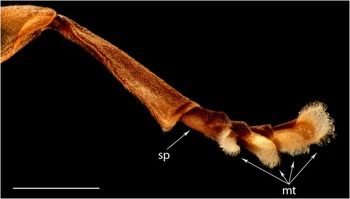
The mating sequence of X. peckii appears stereotypic and proceeded in the following way each time we filmed it (Fig. 7): after landing on the anterior section of the wasp's abdomen, the male stepped backward until he made contact with the female's cephalothorax. A sensory patch on his mesothoracic legs (Dubitzky Reference Dubitzky2001; Pohl and Beutel Reference Pohl and Beutel2004; Henderickx, Reference Henderickx2008) (Fig. 8) seems to mediate sensory recognition of the female, because as soon as his mesothoracic legs touched the female's cephalothorax, they grasped it tightly, and he initiated copulation through the opening of the female's brood canal. Copulation through the brood canal was also observed in a mating study with X. vesparum (Beani et al. Reference Beani, Guisti, Mercati, Lupetti, Paccagnini and Turillazzi2005). After copulation, female X. peckii immediately and fully retreated, assumed a noncalling position, and never re-mated. Similarly, recently mated female X. vesparum are ignored by conspecific males (Dallai et al. Reference Dallai, Lupetti, Giusti, Mercati, Paccagnini and Turillazzi2004).
Mesothoracic leg of an adult male Xenos peckii. Note: Microtrichia (mt) and sensory patch (sp) on tarsomers. Scale bar = 250 μm.

Other direct observations of mating in Strepsiptera are rare. However, Schrader (Reference Schrader1924) provide an early and most detailed account of copulation in Xenos species. She noted that the male maintains an erect position on the host wasp abdomen. Facing forward, and keeping his wings in constant vibration, the male recurves his abdomen ventrally, pushes his aedeagus downward and forward, and then inserts it into the female's brood chamber. The entire mating sequence, including the time from alighting on the host wasp, inseminating the female, and detaching from her, took 20–50 seconds to complete. According to Schrader (Reference Schrader1924), males mated only females that had extruded four or five days prior.
In conclusion, our study expands the knowledge of life history traits of X. peckii. Many other aspects, however, remain to be studied in X. peckii and in the entire Strepsiptera to fully appreciate their phylogeny, the selection of and interaction with their host, and the complexity of their sexual communication system as well as the sensory receptors involved.
Acknowledgements
We thank Pilar Cepeda for assistance with rearing wax moths to feed wasps; Dan Long as well as Christine and Ralph Payne for permission to collect wasp nests from their property; Stephen DeMuth for graphical illustrations; Laurence Packer for help in locating stylopised bee populations; Caesar Inducil and Anna Löppmann for help with field collections; Francis Drummond, Rodney Bushway, Eleanor Groden, and Tamara Levitsky (University of Maine) for providing laboratory space and logistical support, and Laura Beani and Jeyaraney Kathirithamby for constructive comments. This research was supported by a Natural Sciences and Engineering Research Council of Canada (NSERC) – Discovery Grant and a NSERC – Industrial Research Chair to GG, with Contech Enterprises Inc. and Global Forest Science (GF-18-2007-226; GF-18-2007-227) as sponsors.