A large amount of recent nutritional research has concerned health and quality of foods with high lipid content. These studies demonstrated that oxidative rancidity process is linked to lipids decomposition with negative effects on shelf-life, sensory properties, functionality and nutritional value (Mildner-Szkudlarz et al. Reference Mildner-Szkudlarz, Zawirska-Wojtasiak, Obuchowski and Goslinski2009). It is essential to slow the oxidation process as much as possible. Antioxidants, and particularly phenols, are largely used as additives to reduce lipid oxidation and protect food nutrients against oxidative degradation (Gulcin et al. Reference Gulcin, Berashvili and Gepdiremen2005; Benavente-Garcia et al. Reference Benavente-Garcia, Castillo, Alcaraz, Vicente, Del Rio and Ortuno2007; Han et al. Reference Han, Shen and Lou2007; Kampa et al. Reference Kampa, Nifli, Notas and Castanas2007; Crozier et al. Reference Crozier, Jaganath and Clifford2009; Key, Reference Key2011; Del Rio et al. Reference Del Rio, Rodriguez-Mateos, Spencer, Tognolini, Borges and Crozier2013). Phenols show a wide range of activities and health benefits, such as anti-aging and anti-inflammatory activities. Phenols also play important roles in the prevention of various diseases associated with oxidative stress, such as cancer, cardiovascular and neurodegenerative disorders.
Recently, different successful applications of phenols in food preservation have been achieved. Production of active packaging materials and coatings was one of the most innovative technologies in food preservation. With increased consumer expectations for food quality and convenience, production of edible coatings have gained considerable interest (Siew et al. Reference Siew, Heilmann, Easteal and Cooney1999; Morillon et al. Reference Morillon, Debeaufort, Capelle, Blond and Voilley2000). In recent years, development of protein based edible coatings has been one of the main research aims, although edible layers can be also prepared using polysaccharides and lipids materials (Bourtoom, Reference Bourtoom2009). In this regard, milk proteins such as casein (CN), sodium caseinate (Na-CN) or whey proteins have been considered as a suitable material for production of edible coatings, as they have numerous functional properties that make them excellent materials for edible coating-forming agents (Mezgheni et al. Reference Mezgheni, D'Aprano and Lacroix1998). Milk protein edible coatings have a soft transparent aspect and good oxygen barrier properties at low relative humidity (Galietta et al. Reference Galietta, Di Gioia, Guilbert and Cuq1998).
Na-CN is a water-soluble polymer obtained by acidic precipitation of CN (Audic & Chaufer, Reference Audic and Chaufer2005). Na-CN is suitable for use as coating material for wide range of food products such as cheese, vegetables and fruits. Furthermore, Na-CN has been used as microencapsulating agents for flavours and medicines (Khwaldia et al. Reference Khwaldia, Banon, Perez and Desobry2004).
Beside these favourable characteristics, strong interactions between milk CN and Na-CN and phenols were demonstrated; Tannic acid (TA) and catechin (CAT) were used as antioxidants in Na-CN films and showed good antioxidant activity (Helal et al. Reference Helal, Tagliazucchi, Conte and Desobry2012). Inhibition of lipid oxidation due to these active compounds entrapped in coatings may be even more efficient with slow antioxidant release on food surface. Phenols release and bioaccessibility were also shown as very important during digestion process to act as a limiting agent for oxidative stress, but phenols could degrade and lose part of their activity during digestion (Bermudez-Soto et al. Reference Bermudez-Soto, Tomas-Barberan and Garcia-Conesa2007; Tagliazucchi et al. Reference Tagliazucchi, Verzelloni, Bertolini and Conte2010).
Considering the effective binding of phenolic compounds by CN and Na-CN (Helal et al. Reference Helal, Tagliazucchi, Conte and Desobry2012), the aims of the present work were: (i) to evaluate radical scavenging activity of different types of phenolic molecules (TN, CAT, gallic acid, chlorogenic acid and rutin) incorporated in coating films with various CN/Na-CN ratios, and (ii) to determine phenols release from coatings and remaining activity during digestion process.
Materials and methods
Materials
To prepare coating films, commercial casein sodium salt from bovine milk (Nitrogen 13·5–16·0%, sodium⩽3%) and CN from bovine powders (Nitrogen 13·6–14·8%, 95% purity) and glycerol (99% purity) were purchased from Sigma Aldrich (Milan, Italy).
Model phenolic compounds were selected with regard to their chemical structure. Gallic acid (GAL) was representative of hydroxybenzoic acid with a general structure C6-C1. Phenolic compounds with the general formula C6-C3 were represented by chlorogenic acid (CHL). The flavonoids built upon a C6-C3-C6 flavone skeleton, were illustrated by rutin (flavonols, RUT) and catechin (flavan-3-ole, CAT). Tannic acid (TA) is a polymer of gallic acid and glucose (Kroll et al. Reference Kroll, Rawel and Rohn2003). All phenolic compounds were purchased from Sigma Aldrich (Milan, Italy).
Pepsin from porcine gastric mucosa (EC number 3.4.23.1), bile salts (mixture of sodium cholate and sodium deoxycholate) , pancreatin from porcine pancreas (4× USP specifications) and 2,2′-azino bis (3-ethylbenzothiazoline-6-sulfonic acid) (ABTS), ascorbic acid (vitamin C), 4- aminoantipyrine (4-AP), and horseradish peroxidase (HRP) type II, were supplied by Sigma Aldrich.
Preparation of films
Edible films with different ratios of Na-CN/CN were produced as described by Khwaldia et al. (Reference Khwaldia, Banon, Perez and Desobry2004) and modified by Helal et al. (Reference Helal, Tagliazucchi, Conte and Desobry2012). Mixing Na-CN and CN allowed modification of coating hydrophobicity and phenol/coating matrix interactions.
For 100% Na-CN coating films, a 10% solution of Na-CN (w/w) was prepared by dissolving the required mass of Na-CN powder in distilled water at 60 °C for 30 min with continuous stirring. The solution was then rapidly cooled down to room temperature. 10% (w/w) glycerol (plasticizer) and 1% (w/w) selected phenols, expressed as weight ratio relative to Na-CN dry powder weight, were dispersed in the aqueous mixture of Na-CN by continuous stirring for an additional 2 h at room temperature to obtain homogenous solution. To remove air bubbles, degassing processing was carried out by a vacuum pump for 30 min. The composition of final film-forming solution was 10% Na-CN, 1% glycerol, 0·1% of phenols, and 88·9% distilled water. Finally, 10 g of each film forming solution were poured into a Petri dish containing a Teflon layer (diameter 14·7 cm). The coating films were then dried for 48 h at 25 °C and 50% relative humidity.
To study the effect of increasing CN concentration, a maximum CN was added in the film formulation to prepare the most hydrophobic film possible. It was not technologically possible to add more CN because above this amount a phase separation occurred and the film was no longer homogeneous. The same protocol was followed by replacing part of Na-CN by CN giving Na-CN/CN film containing 90 and 80% Na-CN and 10 and 20% CN content (w/w), respectively.
Free phenols extraction from films
Helal et al. (Reference Helal, Tagliazucchi, Conte and Desobry2012) method was used to extract free phenols from coatings. The film was homogenised, weighed, and 10 mg was dissolved in 2 ml distilled deionised water at 60 °C for 3 h in sterile Eppendorf tubes. After cooling, 500 μl trichloroacetic solutions (20%) were added to 500 μl of film solution that produced CN precipitation. The Eppendorf mixture was incubated in ice bath for 15 min and centrifuged at 4 °C and 11 000 rpm for 15 min. The supernatant was collected for measuring antioxidant activity. This method isolated free phenols and precipitated CN and Na-CN, but phenol-free films were also submitted to the same procedures as references.
Radical scavenging activity by ABTS
To measure the global radical scavenging activity of coatings, ABTS method was used following the protocol described by Re et al. (Reference Re, Pellegrini, Proteggente, Pannala, Yang and Rice-Evans1999). The concentration of blue-green ABTS•+ radical solution was adjusted to an absorbance of 0·650±0·020 at 734 nm.
Forty microlitres of film forming solution prepared as described above (Preparation of films) were used to measure antioxidant activity. Furthermore, pure phenolics solutions, with the same concentration as in film forming solutions, were added to 1960 μl of resulting blue-green ABTS•+. The mixture was incubated in darkness in a Jasco V-550 spectrophotometer at 37 °C for 10 min and then absorbance was measured again at 734 nm.
Vitamin C standard curves that correlate vitamin C concentration (ranging from 50 to 1000 μM) and the absorbance reduction caused by vitamin C were obtained. Antioxidant activity was expressed as μM Vitamin C equivalent antioxidant capacity (VCEAC).
Radical scavenging activity by DPPH
DPPH method from Shimada et al. (Reference Shimada, Fujikawa, Yahara and Nakamura1992) was also used to measure the antioxidants activity of coating films. 0·1 mM DPPH solution in methanol was prepared by dissolving 3·9 mg DPPH in 100 ml methanol. After 30 min, 2 ml of the solution was mixed with 200 μl film forming solution and left for an additional 30 min in darkness. Solution absorbance was measured at 517 nm using Jasco V-550 spectrophotometer against a blank of DPPH. A standard curve of Trolox in the range of 50–500 μM was obtained. Antioxidant activity was calculated and expressed as μM Trolox equivalent antioxidant capacity (TEAC).
In both ABTS and DPPH methods, film forming solutions without phenols were measured as blanks and their values were subtracted from phenol solutions values.
Fluorescence spectroscopy
To measure interactions between phenols and CN, the fluorescence spectroscopy was used as reported by Tagliazucchi et al. (Reference Tagliazucchi, Helal, Verzelloni and Conte2012) at an excitation wavelength of 280 nm using Jasco, FP-6200 spectrofluorometer (Tokyo, Japan). Fluorescence spectra were recorded at 37 °C in the range of 390–500 nm. According to Dufour & Dangles (Reference Dufour and Dangles2005), the binding constant was calculated using intensity at 340 nm (tryptophan emission wavelength). In addition, binding parameters were determined using the Stern-Volmer equation (Lakowicz, Reference Lakowicz and Lakwicz2006; Bourassa et al. Reference Bourassa, Bariyanga and Tajmir-Riahi2013). Non-linear regression analysis was performed to calculate KD (dissociation constant) and n (number of binding site).
In vitro gastropancreatic digestion
To simulate gastropancreatic digestion, in vitro digestive model was performed (Tagliazucchi et al. Reference Tagliazucchi, Helal, Verzelloni and Conte2012). The coating film was homogenised, weighted, and 10 g were used for experiments as representative sample (before digestion).
Gastric digestion phase
The sample was mixed with 10 ml simulated gastric fluid, containing 2 g NaCl/l and 60 mM HCl, and homogenised for 2 min in a laboratory blender. The mixture was adjusted to pH 2·5 with concentrated HCl, then, 315 U pepsin/ml was added and the sample was incubated at 37 °C in a shaking bath for 2 h. At the end of the gastric digestion, an aliquot (1 ml) of the samples was collected.
Pancreatic digestion phase
The pH was increased up to 7·5 with NaHCO3 and later on, 5 mg bile salts/ml and 0·8 mg pancreatin/ml were added. The solution was then incubated again at 37 °C in a shaking bath. After 2 h incubation, sample pH was lowered down to 2·5 to stop the digestion process and ensure phenolic compounds stability.
At each digestion step, aliquots were collected and prepared as described above for analysis of total phenols content and activity.
Measurement of phenols content
The phenols content in coating films was determined by the spectrophotometric enzymatic method as described by Verzelloni, et al. (Reference Verzelloni, Tagliazucchi and Conte2007). This method was based on the peroxidase-catalysed oxidation of phenols to phenoxyl radicals, which can react with aromatic substrates to form intensely coloured products. The calibration curves of standard phenols were used to quantify the phenols present in the coating material. Several samples (before gastric digestion, after gastric digestion and after pancreatic digestion) were measured.
In vitro bioaccessibility index (BI%) is expressed as the percentage of phenols remaining after complete digestion reported to their initial amount.
Statistical analysis
All data are presented as mean±sd for three replicates. The Student's t-test was performed using XLSTAT-Pro 2007 (trial version 7.5, Addinsoft, Paris, France). When data were compared with other values, analysis of variance (ANOVA) was applied using statgraphics 16.1.11 (Stat Point Technologies, Inc, Virginia, USA) when multiple comparisons were performed. Differences were considered significant at P<0·05.
Results and discussion
Films radical scavenging activity
The main aim of manufacturing phenols-enriched coating films was to obtain antioxidant activity and protect foods from oxidation during storage. The antioxidant activities were measured by ABTS and DPPH methods and initial antioxidant activities are reported in Table 1. The antioxidant activities of all coating films were initially high and presented a good potential barrier against food oxidation. The different antioxidant activities of native phenols clearly acted on initial antioxidant activity of coatings. 100% Na-CN with entrapped GAL showed the highest antioxidant value measured by both ABTS and DPPH methods, followed by TA, CAT and RUT coatings, while CHL films always showed the lowest antioxidant values. GAL enriched coatings showed an antioxidant activity increased by 50–90% compared with CHL, according to DPPH and ABTS methods respectively, and could be of high interest for food coating. These results agreed with the decreasing order of antioxidant activity made with different standard phenols using ABTS assay (Kim et al. Reference Kim, Lee, Lee and Lee2002), as follows: GAL>quercetin>epicatechin>CAT>vitamin C>RUT>CHL>Trolox. These results were confirmed with the DPPH method, as follows: GAL>quercetin>epicatechin>CAT≈vitamin C>Trolox>RUT>CHL.
Initial antioxidant activity for Na-CN/CN coatings containing catechin (CAT), rutin (RUT), chlorogenic acid (CHL), gallic acid (GAL), and tannic acid (TA) according to ABTS and DPPH methods

Results are expressed μM VCEAC for ABTS and μM TEAC for DPPH method, Data are means±sd (n=3)
a,bSignificant differences within the same column are shown by different letters (P<0·05)
In recent study on phenols incorporated in Na-CN/CN films, Helal et al. (Reference Helal, Tagliazucchi, Conte and Desobry2012) reported that films containing TA showed higher antioxidant activity than those with CAT. Furthermore, Maqsood & Benjakul (Reference Maqsood and Benjakul2010) determined antioxidant activities of different phenolic compounds and found that TA exhibited higher Radical Scavenging Activity (RSA) for DPPH and ABTS than CAT; they also found that TA was the most efficient natural antioxidant of all tested compounds. Spranger et al. (Reference Spranger, Sun, Mateus, de Freitas and Ricardo-Da-Silva2008) demonstrated that CAT presented a lower antioxidant activity than its oligomers and polymers, then, antioxidant activities were related to degree of polymerisation.
In our work, TA that is a macromolecular complex containing GAL had the same initial activity as GAL determined by DDPH measurements (Table 1). ABTS tests showed apparent decreases of antioxidant activities for TA. In Table 1, a significant decrease (P<0·05) of radical scavenging activity of TA films was observed for 80% Na-CN compared with 100% Na-CN with an initial decrease of around 8 or 12% by ABTS or DPPH, respectively. Similar behaviour was obtained in the case of CAT films. The radical scavenging activity of 80% Na-CN films with CAT measured by ABTS was 18% less than 100% Na-CN films and was around 15% less in case of DPPH method. For all other phenolic compounds (CHL, RUT or GAL), the decrease ratio was slight compared with CAT and TA cases but this gave rise to the same conclusion, i.e. increase in CN content reduced the initial value of radical scavenging activity of films. These results can be due to the initial alteration of phenols antioxidant activity during film formation in presence of CN or, more probably, by the binding of TA, CAT or CHL molecules to CN, whereas CN form submicron particles (casein micelles). sodium caseinate does not build casein micelles because of calcium phosphate depletion during the acidification step during manufacture. CN is expected to bind more hydrophobic compounds due to its structure and the hydrophobic core inside the casein micelles than sodium caseinate that is well-dispersed in water.
Globally, increasing CN content in coating films increased the variations between antioxidant values for the phenolic compounds with the highest activities (GAL, TA and CAT). For example, in 100% Na-CN films, ABTS data showed that the differences between GAL coating films and TA films or CAT films were 48 or 44 μMVCEAC, respectively, while in 80% Na-CN films the differences increased to reach 61 and 96 μMVCEAC, respectively. On the other hand, these changes were lower in case of CHL or RUT films.
Due to purification process, the CN used was not in the film preparation was modified compared with the native CN. The protein surface κ-CN (‘hairy’) layer was altered but in this study the hydrophobic core of the micelle significantly changed. As the main interest in adding CN to the formulation was to introduce hydrophobic receptor for phenols, the CN properties were retained. The negative effect of CN on phenols antioxidant activity has been previously reported: milk decreased phenol bioaccessibility for CAT in green tea (Green et al. Reference Green, Murphy, Schulz, Watkins and Ferruzzi2007) and for other phenols in fruits beverages (Cilla et al. Reference Cilla, Gonzalez-Sarrias, Tomas-Barberan, Espin and Barbera2009) and black tea (Sharma et al. Reference Sharma, Kumar and Rao2008; Dubeau et al. Reference Dubeau, Samson and Tajmir-Riahi2010; Ryan & Petit, Reference Ryan and Petit2010).
Similarly, other studies (Hasni et al. Reference Hasni, Bourassa, Hamdani, Samson, Carpentier and Tajmir-Riahi2011; Kanakis et al. Reference Kanakis, Hasni, Bourassa, Tarantilis, Polissiou and Tajmir-Riahi2011) demonstrated interactions between milk protein components and tea phenols (catechin, epicatechin, epigallocatechin and epigallocatechin gallate) and found that CN binding increased with the number of -OH group in phenols.
Bourassa et al. (Reference Bourassa, Bariyanga and Tajmir-Riahi2013) showed that antioxidant capacities of tea phenols are affected by their interactions with milk α-CN. They found by ABTS method that antioxidant activity of all phenols was lowered by 11–27% in the presence of CN, according to our present results. However, using lipid peroxidation method, they demonstrated that the larger gallate esters containing phenols, as epicatechingallate and epigallocatechingallate, were less affected by the presence of CN than smaller phenols as CAT, epicatechin and epigallocatechin.
Fluorescence spectroscopy and binding of CN and phenolic compounds
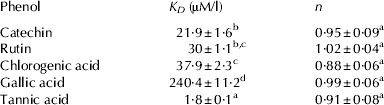
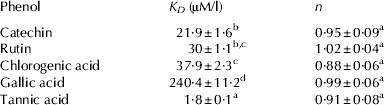
Taking into account the different behaviours of phenolic compounds, the binding affinity of phenols and the number of phenols molecules bound to CN were determined by fluorescence spectroscopy (Fig. 1 and Table 2). As shown in Fig. 1, increase of phenols concentration caused a decrease in CN fluorescence due to increased interactions between CN and phenols. Proteins and phenolic compounds can combine to form soluble complexes mainly by non-covalent hydrophobic binding (Kroll et al. Reference Kroll, Rawel and Rohn2003). In milk, most of intrinsic fluorescence intensity can be attributed to the tryptophan residues present in the CN micelles monomers. αs1-CN and αs2-CN contain two tryptophan residues at positions 164 and 199 and position 109 and 193, respectively. β-CN and κ-CN have just one tryptophan residue at positions 143 and 76, respectively. These residues are located in the hydrophobic domains of the proteins which act on the self-association behaviour of CN and are mostly located inside CN micelles. From Fig. 1, it is then possible to hypothesise that phenols interact with the hydrophobic sites in the interior of the micelles, as previously suggested for curcumin-CN complexes (Sahu et al. Reference Sahu, Kasoju and Bora2008).
Fluorescence emission spectra of Gallic acid-CN interaction as an example of polyphenol–CN systems in buffer pH 6·5 at 37 °C, phenolic concentration varied between 0 and 50 μM/l (arrow show increasing polyphenol concentration) and the CN concentration was fixed at 5 μM/l.

Quenching constants, K D and n, due to binding between phenols and casein at pH 6·5 and 37 °C
a–dSignificant differences within the same column are shown by different letters (P<0·05)
From quenching parameters (Table 2), K D values traduced phenol – CN complex dissociation Bourassa et al. (Reference Bourassa, Bariyanga and Tajmir-Riahi2013). The smaller the K D, the higher the affinity. TA had the lowest K D (1·8±0·1 μM/l), while GAL showed the highest K D (240·4±11 μM/l). The others K D varied from 21·9 to 37·9 μM/l in the following ranking order: CAT>RUT>CHL. TA (MW 1701.19 Da) had a better affinity for CN compared with CAT (MW 290.27), RUT (MW 610.52), CHL (MW 354.31) and GAL (MW 170.12). This showed that the binding to CN was influenced by the phenol molecular weight. For all phenols, the n values close to unity indicated one phenol molecule bound per CN molecule.
According to previous studies, binding between proteins and phenols had a negative effect on antioxidant activity of these compounds (Kilmartin & Hsu, Reference Kilmartin and Hsu2003; Liang & Xu, Reference Liang and Xu2003; Dubeau et al. Reference Dubeau, Samson and Tajmir-Riahi2010). Considering this hypothesis, values of binding affinity of the different phenols to CN could explain the differences in antioxidant activity variation when Na-CN was partially replaced by CN (Table 1). In case of TA enriched Na-CN films, an increasing CN content led to significant decrease in radical scavenging activity from 367 to 299 μMVCEAC, as a result of increased binding to CN. On the other hand, as expected, GAL showed the minimum binding affinity among all selected phenol compounds and, in this case, no significant effect was observed from increasing CN percentage.
Phenols release during digestion of coating films
The active edible coatings with high antioxidant activity could prevent food oxidation during storage.
Phenol degradation and binding before gastric digestion
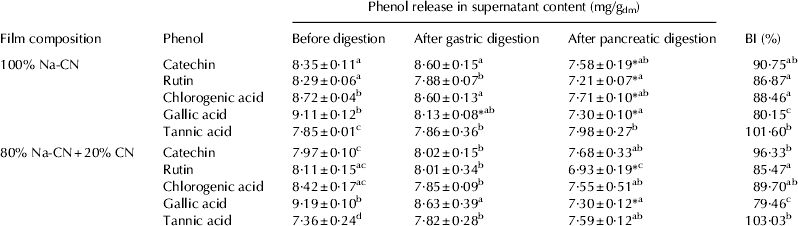
As shown in Table 3, before digestion, there was a general decrease in phenols content among all samples compared with the initial content of phenolic compounds in films (10 mg/g) due to phenol degradation during coating film production but also due to molecular binding. In case of high quenching between protein and phenol reactive sites were no more available for dosage reaction and phenol content was underestimated. This decrease was dependent on phenol and film composition. For 100% Na-CN films, TA showed the highest decrease (−21·5%) from 10 to 7·85 mg/g while GAL films showed the lowest (−8·9%) from 10 to 9·11 mg/g. This was explained by the higher CN binding to TA (K D=1·8±0·1 μM/l) compared with GAL (K D=240·4±0·1 μM/l) that showed the lowest binding affinity among all tested phenols. The initial phenol content before digestion among all other films with CAT, RUT and CHL was not significantly different.
Bioaccessibility data of phenol content in films samples. Data in the last column indicate the bioaccessibility index (BI). Initial phenol content was 10 mg/gdry matter
Data are means±sd; n=3
*Denotes P value<0·05 with respect to the same sample before digestion (significant variation)
a–dSignificant differences within the same column are shown by different letters (P<0·05)
Increasing CN content by replacing Na-CN with CN during coating film manufacture led to significant changes. Generally, increasing CN content led to increased phenolic interactions in the films and, consequently, reduced phenolic release from solubilised films as observed in Table 3. Considering the different values of CN binding affinity for phenolic compounds, various decrease ratios (compared with the initial phenol content) were observed. For example in TA and CAT films, the effect of increasing CN was significant. In 80% Na-CN films, the percentage decreased down to 26·3 and 20·3% for TA and CAT films respectively, while no significant effect was observed in GAL films. In case of 100% Na-CN, the ranking order of phenol released from the homogenised film samples was GAL≈CHL>RU≈CAT>TA. This rank was slightly modified in the case of 80% Na-CN to be as follows, GAL>CHL≈RU≈CAT>TA. The lower CN/phenols interactions, the higher was the initial release. The data ‘before digestion’ showed that CN content had a significant impact on phenols retention.
Phenol loss and binding after gastric digestion
Phenols entrapped in coating films were intended to protect the coated food from oxidation during storage and to be released and available during digestion for improved human nutrition. These bioactive compounds must be bioavailable during digestion. As in vivo studies for evaluating the bioavailability of compounds carried out in animals or human subjects are expensive, complex, and lengthy (Soler et al. Reference Soler, Romero, Macia, Saha, Furniss, Kroon and Motilva2010), an in vitro study was made to evaluate the availability of the phenolic compounds and their stability in digestive conditions. Table 3 reports phenols stability after gastric and pancreatic digestion. The bioaccessibility index (BI) represents the ratio of phenols released by the coatings before and after digestion.
After gastric digestion, phenols showed slight content variations, but generally there were no significant changes in phenols released by the coating films. The only significant decrease in phenol content was observed for GAL after gastric digestion, due to low linking (and then low protection) between CN and GAL. Moreover, the phenols content could be affected by their interaction with digestive enzymes. Rawel et al. (Reference Rawel, Frey, Meidtner, Kroll and Schweigert2006) showed that TA induced significant tryptophan quenching of proteins and enzymes, i.e. amylase and pancreatic α-amylase, while low molecular weight phenolic compounds did not. Moreover, tannin interaction with amylase resulted in a decrease of its enzymatic activity. The stability observed for phenols in coating films during gastric digestion was also consistent with data previously obtained by Lakowicz (Reference Lakowicz and Lakwicz2006), where stability of coffee phenols was observed during gastric digestion. Two hours of gastric digestion did not have any substantial effect on major phenolic compounds in chokeberry juice, and for pure phenols (Kroll et al. Reference Kroll, Rawel and Rohn2003). In another study, Green et al. (Reference Green, Murphy, Schulz, Watkins and Ferruzzi2007) mentioned that CAT showed high stability through gastric phase of in vitro digestion. Moreover, in a study about digestion stability of olive oil phenols (Soler et al. Reference Soler, Romero, Macia, Saha, Furniss, Kroon and Motilva2010), the majority of phenols also showed good stability in the gastric digestion phase.
Phenol loss and binding after pancreatic digestion
After pancreatic digestion, significant variations in phenols concentration were observed compared with the initial content. TA, CAT and CHL showed very good stability during digestion. In the case of TA, a non-significant increase was observed in both coatings (100 and 80% Na-CN coatings; BI>100%). It should be pointed out that the measured concentration of phenols in the supernatant was a result of the negative effect of their degradation during digestion and positive effect of phenols released from CN/Na-CN matrix from hydrolysed CN. In case of GAL and RUT, a significant decrease compared with the values in samples before digestion was achieved, suggesting that these compounds were partially degraded during the pancreatic digestion. A previous study (Tagliazucchi et al. Reference Tagliazucchi, Verzelloni, Bertolini and Conte2010) found a 43·3% decrease of pure GAL content after pancreatic digestion, even higher than the 20% decrease observed in the present work. Bermudez-Soto et al. (Reference Bermudez-Soto, Tomas-Barberan and Garcia-Conesa2007) found a significant decrease in phenolic compounds of chokeberry during the pancreatic digestion, in additional they reported flavonols and flavan-3-ols decreased by 26 and 19%, respectively. Similar results were also reported in another study (Boyer et al. Reference Boyer, Brown and Liu2005) and a recovery from 70 to 90% in CHL in cherries after simulated digestion was achieved (Fazzari et al. Reference Fazzari, Fukumoto, Mazza, Livrea, Tesoriere and Di Marco2008).
However, a poor bioavailability of CAT under digestive conditions was observed (Arts & Hollman, Reference Arts and Hollman2005; Manach et al. Reference Manach, Williamson, Morand, Scalbert and Remesy2005; Feng, Reference Feng2006). Several studies confirmed the instability of CAT under intestinal conditions (Zhu et al. Reference Zhu, Zhang, Tsang, Huang and Chen1997; Yoshino et al. Reference Yoshino, Suzuki, Sasaki, Miyase and Sano1999) and demonstrated for instance the instability of CAT during treatments with intestinal juice and buffered systems above pH 7·4. Nevertheless, in the present study, a high recovery of CAT (90·75 and 96·33%) was observed for 100 and 80% Na-CN, respectively, showing the very high protective action of CN on CAT.
Conclusion
Coatings were produced with high antioxidant properties by integrating selected phenolic compounds in CN/Na-CN films to protect food nutrients from oxidative degradation.
Phenols possessed a high radical scavenging activity after integration into the film matrix, and phenols were recovered in high amounts after pancreatic digestion extending their protective activity after the digestion, for better human nutrition. The CN 20%/Na-CN 80% films entrapping phenols are promising edible systems for food protection against oxidation coupled to interesting nutritional value. Limited negative effect of the pancreatic digestion on phenols was observed. High BI showed the good stability of entrapped phenols for all systems and reflected the high recovery of phenols. Furthermore, the increase of CN percentage to reach 20% led to a slight increase of BI for the majority of samples. Digestion data demonstrated that using the selected phenolic compounds as bioactive additives for manufacturing active edible coatings could successfully be applied in food industry.
The authors are grateful to the Department of Life Science (Nutrition Biochemistry Laboratory, Reggio Emiali), University of Modena and Reggio Emilia, Italy, for providing some of the materials and equipment used in this study.