


Introduction
The inland Pacific Northwest (PNW) is an important region for dryland agriculture in the United States. Of the 4,377,500 ha estimated to be under dryland production in the western United States, 76% is in the inland PNW (Schillinger et al. Reference Schillinger, Jirava, Kennedy, Young, Schafer and Schofstoll2007). Agronomic practices in the region are largely dictated by precipitation (Leggett Reference Leggett1959). Within the region, areas under dryland production are generally classified into three precipitation zones: (1) low, less than 300 mm year−1; (2) intermediate, 300 to 450 mm year−1; and (3) high, more than 450 mm year−1 (Schillinger and Papendick Reference Schillinger and Papendick2008). Growers in low- and intermediate-precipitation zones have historically relied on a winter wheat crop followed by summer fallow cropping rotation where annual crop production is limited or poses economic risk (Schillinger et al. Reference Schillinger, Jirava, Kennedy, Young, Schafer and Schofstoll2007). Fallowing production fields provides some economic utility wherein more stable grain yields are achieved biennially (Juergens et al. Reference Juergens, Young, Schillinger and Hinman2004) by allowing winter precipitation storage and adequate time for nitrogen and sulfur to mineralize and for effective weed control (Ghimire et al. Reference Ghimire, Machado and Rhinhart2015). However, benefits of conventional summer fallow can be offset by soil erosion and depletion of soil organic carbon (Camara et al. Reference Camara, Payne and Rasmussen2003; Unger et al. Reference Unger, Allen and Wise1971; Williams Reference Williams2008).
Although there has been some resistance to adopting new on-farm practices, conservation or reduced tillage and no-till cropping systems have been gaining acceptance among PNW growers (Huggins and Reganold Reference Huggins and Reganold2008). Reducing or removing tillage from 2-year wheat-fallow systems has reduced soil erosion and decreased fossil fuel inputs (Veseth Reference Veseth1988) but has brought substantial changes to weed management systems. Intensive tillage practices involved in conventional fallow rotations have offered effective and relatively simple weed control for inland PNW wheat growers. When tillage is removed from the system, weeds are managed through a chemical fallow strategy that has successive selective and nonselective herbicide applications replace conventional tillage (Jemmett et al. Reference Jemmett, Thill, Rauch, Ball, Frost, Bennett, Yenish and Rood2008; Wicks and Smika Reference Wicks and Smika1973). Fall-planted crops are then direct seeded into previous crop residue, omitting preplant tillage (Riar et al. Reference Riar, Ball, Yenish, Wuest and Corp2010). Where chemical fallow has been integrated as the standard practice, a weed species composition shift has taken place in which scouringrush and a sterile hybrid, intermediate scouringrush have invaded production fields. Thus, there has been interest in identifying herbicides that effectively control scouringrush in winter wheat–chemical fallow cropping systems.
Scouringrush is native to the inland PNW, but the association of scouringrush with winter wheat–summer fallow cropping systems has traditionally been of little concern to growers, because plants were confined to undisturbed areas and were rarely seen growing with winter wheat. All scouringrush species are deep-rooted, perennial, seedless vascular plants that spread primarily through a terraced rhizome system. Similar to ferns, scouringrush can reproduce and hybridize through spores. However, spore production is uncommon in agricultural settings (Husby Reference Husby2013).
Smooth scouringrush has deciduous aerial stems and is generally smaller than other scouringrush species found in the inland PNW. Compared with other scouringrushes, smooth scouringrush can be found in drier habitats in moderate density stands of 50 to 200 stems m−2. Intermediate scouringrush is a semideciduous sterile hybrid of smooth scouringrush and scouringrush (Equisetum hyemale L.), that occurs almost exclusively in low-density stands of 1 to 50 stems m−2. When smooth scouringrush and scouringrush hybridize, the progeny of the two species is a true intermediate in morphology, habitat preference, and life-cycle characteristics (Rutz and Farrar Reference Rutz and Farrar1984). Intermediate scouringrush is a named hybrid because of its commonality and persistence. However, within the genus Equisetum, many taxonomically insignificant forms have been named (Hauke Reference Hauke1966). Therefore, responses to management practices between the two forms of scouringrush should be nearly, if not entirely, the same. Smooth and intermediate scouringrush should be considered different forms or varieties of Equisetum, but not entirely separate species. Identifying hybrids can be difficult because of phenotypic plasticity and the frequency of scouringrush to persist in mixed population stands (Brune et al. Reference Brune, Thiv and Haas2008). For clarity, the name scouringrush is used throughout this manuscript unless distinction between forms is necessary.
Although intensive tillage from traditional summer fallowing practices likely prevented scouringrush from establishing at high densities in production fields, it is possible the practice played a role in how the species was able to proliferate to a point of concern for growers. Tillage implements increase dispersal of vegetative propagules. Chemical fallow and direct seeding will reduce vegetative propagule dispersal by tillage implements (Guglielmini and Satorre Reference Guglielmini and Satorre2004). However, scouringrush species are naturally tolerant to many herbicides, due to poor uptake and translocation (Coupland and Peabody Reference Coupland and Peabody1981), and the size of the underground rhizome structure relative to the aboveground shoots (Ainsworth et al. Reference Ainsworth, Gunasekera and Bonilla2006; Bernards et al. Reference Bernards, Sandell and Frasure2010; Rutz and Farrar Reference Rutz and Farrar1984). These factors result in a situation for which management tactics are limited.
Bernards et al. (Reference Bernards, Sandell and Frasure2010) evaluated 24 herbicide active ingredients for efficacy on scouringrush and only two (chlorsulfuron and dichlobenil) provided commercially acceptable control. Unfortunately, dichlobenil is not labeled for use in wheat and would not fit a dryland chemical fallow cropping system, because mechanical incorporation or irrigation is required for activation of this herbicide. Chlorsulfuron is labeled for use in wheat but was applied at 10 times the labeled rate for wheat in the Bernards et al. (Reference Bernards, Sandell and Frasure2010) study. Reed et al. (Reference Reed, Rauch and Thill2005) evaluated PRE (0.07 kg ha−1) and early POST (0.017 kg ha−1) applications of chlorsulfuron for control of scouringrush in winter wheat grown in the Palouse region of northern Idaho. Scouringrush was 86% and 99% controlled by PRE and early POST applications, respectively. Although there appears to be potential for chlorsulfuron to be applied in winter wheat to control scouringrush, these results need to be verified, and herbicides with different sites of action need to be identified that effectively control scouringrush.
Mowing is another option used to manage scouringrush in chemical fallow rotations. Both smooth scouringrush and the sterile hybrid found in the inland PNW produce a single, late spring flush of stems, making them vulnerable to early season cuttings. However, timing and thoroughness of cutting by mowing implements both contribute to how effective mowing treatments are for scouringrush control (Rutz and Farrar Reference Rutz and Farrar1984). Herbicides can be used in combination with mowing, but research is limited in this area. Field studies conducted in Murdock, Nebraska, resulted in no herbicide by mowing interactions when scouringrush was mowed after herbicide applications. A split application strategy was used whereby herbicides were applied on July 6 and August 11, 2007, and mowing took place on July 31 and October 31 of the same year (Bernards et al. Reference Bernards, Sandell and Frasure2010). Nice et al. (Reference Nice, Jordan, Johnson and Bauman2010) reported that imazapyr and aminopyralid applied separately to mowed plots in April and November resulted in adequate control of scouringrush 200 d after November treatments, and efficacy depended on mowing before herbicide application.
Objectives of the current study were to evaluate herbicides for control of scouringrush in growers’ fields during a chemical fallow rotation and to quantify interactions resulting from mowing before herbicide application.
Materials and Methods
Site Descriptions
Field experiments were established near Reardan, WA, and The Dalles, OR, in 2014 and 2015, respectively. Both locations are representative of typical direct-seeded winter wheat–chemical fallow cropping systems in intermediate precipitation zones of the inland PNW.
The Reardan, WA, trial site was located in Lincoln County, approximately 11 km northeast of Reardan, on an Athena silt loam soil with 3.3% organic matter and a soil pH of 4.9. Typical crop rotations at the site include a summer chemical fallow, followed by direct-seeded winter wheat, followed by one to several spring wheat crops before rotating back to summer fallow, depending on available moisture. Smooth scouringrush was naturally established at the trial site. Average scouringrush plant density was 167 stems m−2 with heights between 30 and 51 cm.
The Dalles, OR, trial site was located in Wasco County, approximately 13 km southeast of The Dalles, on a Walla Walla silt loam soil with 2.7% organic matter and a soil pH of 5.9. Plots were located on a north aspect with 20% to 35% slope. Typical crop rotations at the site are direct-seeded winter wheat followed by summer chemical fallow, followed by winter wheat. Intermediate scouringrush was naturally established at the trial site. Dr. Richard Halse (Oregon State University) was consulted to verify the taxonomy of intermediate scouringrush found at the site. Average scouringrush plant density was 52 stems m−2, with heights between 23 and 63 cm.
At both locations, 10 herbicide treatments were applied to mowed and nonmowed scouringrush during the chemical fallow rotation before seeding winter wheat (Table 1). Plots were mowed to the soil surface with a flail mower 24 hours before herbicide applications at The Dalles, and with a rotary mower to a height of 10 to 15 cm at Reardan.
Herbicide treatments, rates, and adjuvants for trial locations in Reardan, WA, and The Dalles, OR.

a Nonionic surfactant was added to treatments 2, 3, 4, 5, 6, 7, 9, and 11 at 0.25% vol/vol at Reardan and at 0.334% vol/vol at The Dalles; ammonium sulfate was added to treatments 7, 8, 10, and 11 at 3.5 kg ha−1; crop oil concentrate was added to treatment 8 at 1% vol/vol; and methylated seed oil was added to treatment 10 at 0.5% vol/vol.
b Herbicide rates for treatments 5 and 6 differed between trial locations.
c Abbreviation: N/A, not applicable.
Application Equipment and Environmental Conditions
At Reardan, herbicide treatments were applied on July 25, 2014, with a CO2-powered sprayer with a hand-held four-nozzle boom equipped with TeeJet XR11002 nozzles (TeeJet Technologies, Springfield, IL) pressurized at 207 kPa. Treatments were applied at 140 L ha−1 with a ground speed of 5.6 km h−1. Environmental conditions during the application were 10% cloud cover, an ambient temperature of 21 C, 36% relative humidity, and southwest winds at 10 km h−1. Soil temperature was 16 C at a depth of 15 cm.
At The Dalles, herbicide treatments were applied on September 9, 2015, with a compressed air–powered unicycle sprayer with a 2.3-m boom equipped with five TeeJet XR8003 nozzles pressurized at 138 kPa. Treatments were applied at 187 L ha−1 with a ground speed of 6.1 km h−1. Environmental conditions during the application were 0% cloud cover, an ambient temperature of 22 C, 70% relative humidity, and winds out of the west at 3.2 km h−1. Soil temperature was 18 C at a depth of 15 cm.
Planting and Trial Maintenance
At Reardan, hard red winter wheat ‘Whetstone’ (Syngenta Seeds, Inc., Greensboro, NC) was seeded in 24-cm rows at a rate of 67 kg ha−1 on September 10, 2014, using a Bourgalut 3710 disc drill (Bourgalt Industries, Ltd., Saint Brieux, Canada). A fertilizer application of 95 kg ha−1 nitrogen, 11 kg ha−1 phosphorus, and 17 kg ha−1 sulfur was applied at planting. Spring herbicides were applied before scouringrush emergence. An application of 17 g ai ha−1 pyroxsulam (PowerFlex HL, 10.3% by weight pyroxsulam; Dow AgroSciences LLC), 38 g ai ha−1 pyrasulfotole with 216 g ai ha−1 bromoxynil (Huskie: 37 g L−1 pyrasulfotole and 209 g L−1 bromoxynil; Bayer Crop Science) and 87.4 g ai ha−1 florasulam with 4.5 g ae ha−1 fluroxypyr (Starane Flex: 99 g L−1 florasulam and 5 g ae L−1 fluroxypyr; Dow AgroSciences LLC) was applied on April 15, 2015, to control grass and broadleaf weeds.
At The Dalles, soft white winter wheat ‘ORCF-101’ was seeded on October 7, 2015, in 30-cm paired rows at a rate of 95 kg ha−1 using a Flexi-Coil 5000 air drill (Flexi-Coil, St. Marys, NSW, Australia) with double shoot attachments. A fertilizer application of 78 kg ha−1 nitrogen and 11 kg ha−1 sulfur was applied at planting. An application of 17 g ha−1 pyroxsulam (PowerFlex HL) and 38 g ha−1 pyrasulfotole with 216 g ha−1 bromoxynil (Huskie) was applied on April 7, 2016, to control grass and broadleaf weeds. Because of an infestation of downy brome (Bromus tectorum L.), a second spring application of the same herbicides at the same rates was made on May 10, 2016.
Experimental Design
The experimental designs differed between field study locations because of terrain and scouringrush patch dynamics. The Reardan location had less slope influence and the scouringrush patch size, shape, and uniformity allowed for more design flexibility. To ensure scouringrush uniformity within the trial area in The Dalles, plots were placed within a narrow strip of scouringrush growing parallel to the contour of the slope.
At Reardan, the study was conducted in a split-plot design. Mowing treatments were randomly assigned to whole plots, and herbicide treatments were randomly assigned to subplots. Mowed and nonmowed herbicide treatments were replicated four times. An individual plot measured 2.4 m by 10.6 m. At The Dalles, the study was conducted in a split-block design with four replications. Herbicide treatments were randomly assigned to whole plots and mowing treatments were assigned to subplots. An individual plot measured 2.4 m by 9.14 m. Four rows were not seeded on the southernmost end of all nonmowed plots within the trial. To ensure accuracy of wheat yield data, the area of every nonmowed plot was calculated separately at harvest. A split-block arrangement was used due to equipment limitations from the steep terrain, and only the down-slope side of every plot was mowed. It should be noted that a split-plot arrangement would have been a more appropriate design. Considering equipment operator safety and the desire to cause as little disturbance as possible to the trial site, the best possible method was used. A normal randomization process was used to assign herbicide treatments to whole plots. To match the slope contour, blocks 1 and 2 were pivoted at the upslope break from blocks 3 and 4.
Data Collection
Visual estimates of scouringrush control were made 14 d after treatment at both locations. The spring following herbicide application, scouringrush density (stems m−1 row−1) was quantified by counting all stems contained on 1-m transects between rows in all plots. Spring stem densities were counted on May 15, 2015, in Reardan, and June 26, 2016, in The Dalles. Spring stem-count timings were different due to scouringrush emerging later in the season at The Dalles. However, spring stem densities were counted approximately 10 months after treatment at both locations. Stem density counts were repeated after wheat harvest on August 10, 2015, in Reardan, and August 3, 2016, in The Dalles. To account for variability in scouringrush plant density at The Dalles site, three 1-m transects were counted per plot compared to two 1-m transects per plot at the Reardan site.
Wheat was harvested on July 21, 2015, in Reardan with a Kincaid 8XP combine (Kincaid Equipment Manufacturing, Haven KS). Harvest at The Dalles took place on July 27, 2016, by using a sickle bar mower to cut a 1.2-m strip through the center of each plot. Wheat was then sampled by hand and threshed with a Wintersteiger Nursery Master Elite combine (Wintersteiger AG, Saskatoon, SK, Canada). Alternative harvest methods were used at The Dalles because of steep terrain.
Data Analysis
Scouringrush stem density counts were averaged within each subplot for statistical analysis. Data from each site were analyzed separately. ANOVA was conducted on control ratings, wheat yield, and scouringrush stem number at spring and postharvest timings using SAS Proc Mixed (SAS, version 9.3; SAS Institute, Cary, NC). A Satterthwaite approximation was used to account for heterogeneity of variance introduced by analyzing stem count data. Reardan data were analyzed as a split-plot design and The Dalles data were analyzed as split-block design because of the lack of randomization among mowed subplots. Herbicide and mowing treatments were treated as fixed effects, with blocks treated as random effects. Differences between spring and postharvest scouringrush stem density were analyzed as split plots in time. t-Test statistics were used to analyze differences in treatment means using the LSMEANS function of SAS Proc Mixed. ANOVA; statistical significance was set at 5% (i.e., P < 0.05).
Results and Discussion
Visual Ratings of Scouringrush Control
At Reardan, multiple herbicides with different sites of action induced a color response in treated scouringrush whereby stems became black after application. Black scouringrush within plots was considered to be controlled. There was no significant mowing effect or herbicide by mowing interaction. Clopyralid plus MCPA-ester, chlorsulfuron plus MCPA-ester, and halosulfuron plus MCPA-ester resulted in 65% to 76% control of scouringrush. Percent control for each treatment is presented in Table 2 as an average across all mowed or nonmowed plots.
Visual ratings of scouringrush control 14 days after treatment at Reardan, WA, and The Dalles, OR.

a Rates for treatments are listed in Table 1.
b Within a column, means followed by the same letter are not significantly different.
c Asterisk (*) indicates a significant herbicide by mowing interaction when comparing equivalent mowed and nonmowed herbicide treatments within locations.
At The Dalles, a treatment by mowing interaction occurred whereby MCPA-ester, chlorsulfuron plus MCPA-ester, halosulfuron plus MCPA-ester, and glyphosate plus glufosinate treatment increased scouringrush control in subplots that were not mowed. Chlorsulfuron plus MCPA-ester and halosulfuron plus MCPA-ester resulted in the highest percentage of scouringrush stems turning black (Table 2). Treatment interactions are only reported between equivalent herbicide treatments because it is expected that any preapplication mowing effects would produce different efficacy responses across herbicide treatments with different sites of action. Visual ratings of scouringrush control were a poor indicator of long-term herbicide efficacy, as determined by stem density counts the following spring in winter wheat or late summer following wheat harvest. Herbicides that turned scouringrush stems black did not consistently reduce scouringrush density the following season. Two possible explanations for this observation are that once the stems are black, the plant is not translocating enough herbicide to the underground structures, or there is enough belowground biomass to overcome herbicide applications at labeled field rates.
Spring Scouringrush Stem Densities
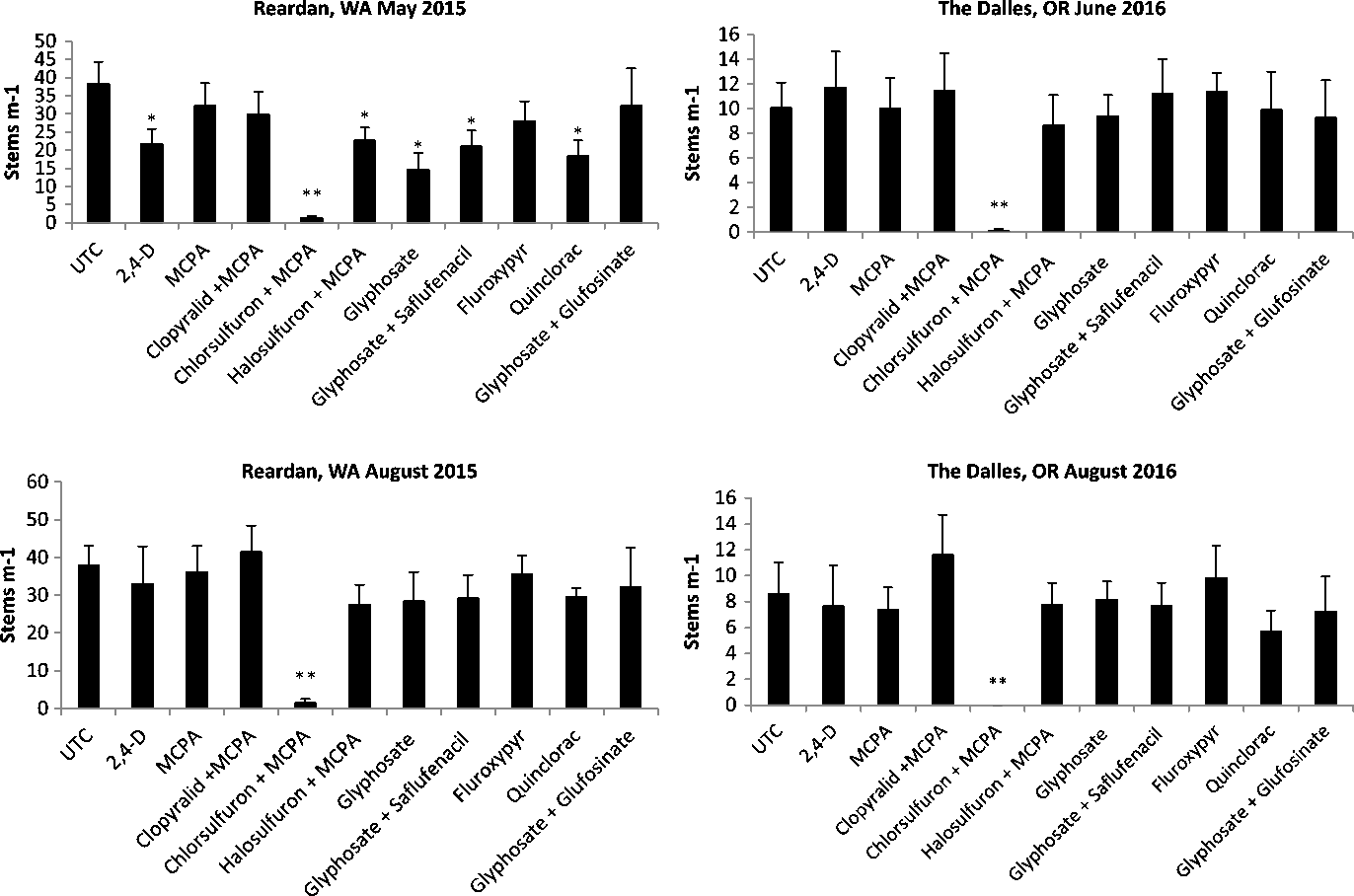
No mowing effects or herbicide by mowing interactions were observed for scouringrush stem densities at Reardan in May 2015; therefore, stem densities were averaged across mowed and nonmowed plots (Figure 1). Treatments of 2,4-D-ester, chlorsulfuron plus MCPA-ester, halosulfuron plus MCPA-ester, glyphosate alone, glyphosate plus saflufenacil and quinclorac reduced scouringrush stem density to as low as 1.25 plants m−2 compared with the nontreated control. Chlorsulfuron plus MCPA-ester reduced scouringrush stem density to 1.25 stems m−1 of inter-row, which was better control than achieved with all other treatments. Untreated control plots averaged 39 stems m−1 of inter-row. Although clopyralid plus MCPA-ester provided the greatest control 14 d after treatment, spring stem densities were no different than in untreated control plots, which suggests using the color response induced by herbicide applications is a poor indicator of long-term efficacy on scouringrush.
Scouringrush stem density per meter of row at spring and postharvest timings. Statistical analysis was conducted across the combined average of mowed and nonmowed subplots for each herbicide treatment at both locations. Chlorsulfuron plus MCPA-ester was the only treatment with results that differed from those of the nontreated control and all other treatments at both locations. Error bars show the standard error of the treatment means. *Different than the untreated control at P < 0.05. **Different than all other treatments at P < 0.05. Abbreviation: UTC, untreated control.
At The Dalles, a mowing by herbicide interaction was observed for scouringrush stem densities measured between rows in June 2016. However, the interaction was likely due to a gradient whereby scouringrush density increased from north to south within the trial area and along the same slope contour outside of the trial. Mowing was applied on the north half of each plot and the scouringrush density gradient likely caused a false mowing effect in the data. For this reason, scouringrush stem densities were averaged across mowed and nonmowed treatments for analysis.
Chlorsulfuron plus MCPA-ester was the only treatment that reduced scouringrush stem density compared with the nontreated control and with all other herbicide treatments (Figure 1). Plots treated with chlorsulfuron plus MCPA-ester averaged fewer than one scouringrush stem m−1 of inter-row, and untreated plots averaged 10.5 stems m−1 of inter-row, when measured in June 2016. At the late summer sampling, plots on the southern end of the trial had 3.25 times more scouringrush m−1 than plots on the north side, suggesting scouringrush had not yet entirely emerged during the first sampling in June 2016.
Late Summer Scouringrush Stem Densities
No effects for mowing or herbicide by mowing interactions were observed for scouringrush stem densities at Reardan in August 2015; therefore, stem densities were averaged across mowed and nonmowed plots for analysis. Chlorsulfuron plus MCPA-ester was the only treatment that reduced scouringrush stem density compared with the nontreated control and all other herbicide treatments at the end of the growing season. Plots treated with chlorsulfuron plus MCPA-ester contained on average two scouringrush stems m−1 of inter-row, whereas untreated control plots averaged 38 stems m−1 of inter-row. Overall stem densities within the trial increased from May to August 2015; however, there were no month by herbicide treatment interactions within or between mowing treatments.
At The Dalles, a mowing by herbicide interaction was observed for scouringrush stem density. As discussed previously, the spatial distribution of the scouringrush across the landscape likely resulted in a false interaction, so stem densities were averaged across mowed and nonmowed plots for analysis (Figure 1). Overall, stem densities within the trial decreased from June to August 2015; however, there were no month by herbicide treatment interactions. No scouringrush was present in plots treated with chlorsulfuron plus MCPA-ester, which was different from all other treatments, including the untreated control, which had, on average, nine stems m−1 of inter-row.
Winter Wheat Grain Yield
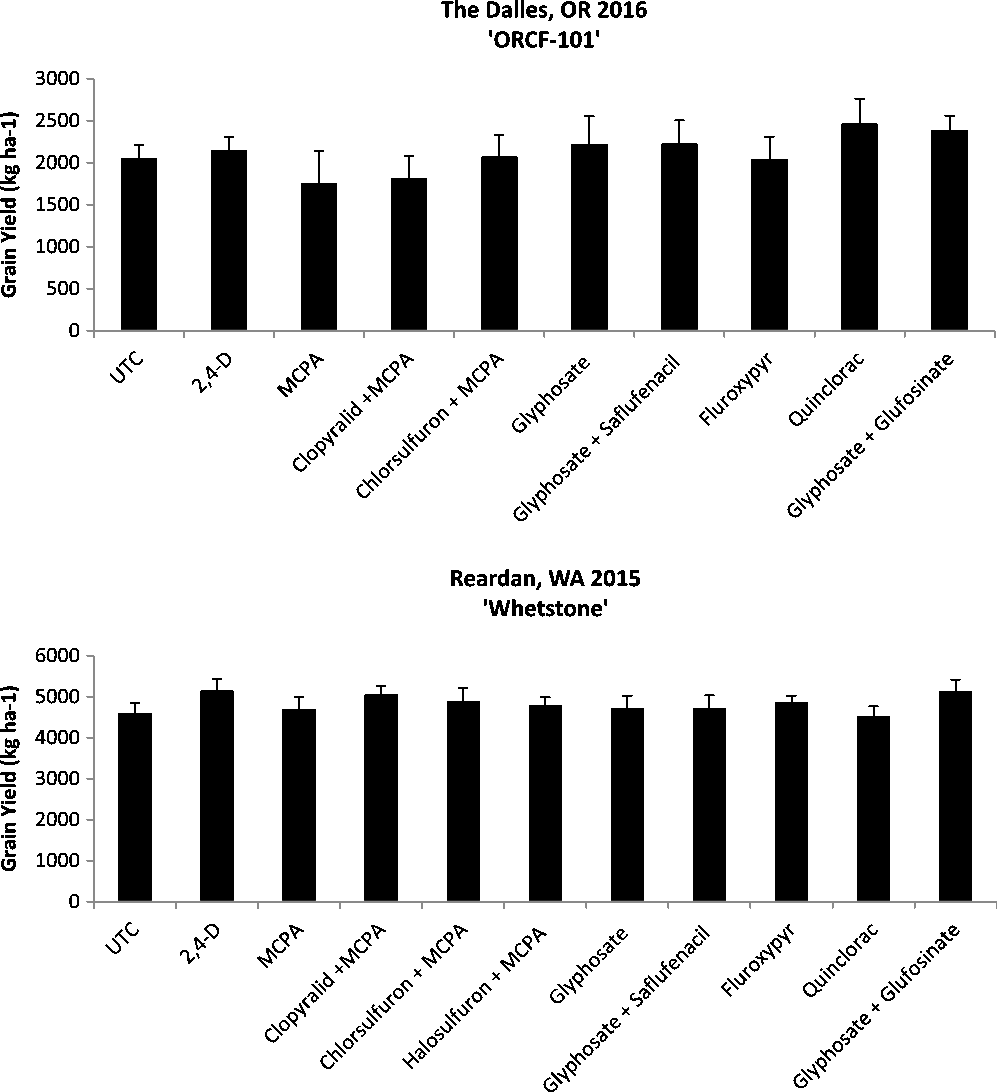
There was no mowing effect or mowing by herbicide interaction at Reardan. Therefore, mowed and nonmowed plots were combined for analysis. There were no differences in yield between any herbicide treatments or the untreated control. Average grain yield at the Reardan site was 4,820 kg ha−1.
At The Dalles, because of a mixing error, halosulfuron plus MCPA-ester and chlorsulfuron plus MCPA-ester were applied at rates 1.7 times the rate applied at Reardan. There was no mowing effect or mowing by herbicide interaction on crop injury; therefore, crop injury, as defined by percent stand reduction, was averaged across mowed and nonmowed plots. Fluroxypyr, halosulfuron plus MCPA-ester, and chlorsulfuron plus MCPA-ester reduced wheat stands by 10%, 30%, and 4%, respectively (data not shown). Because of the substantial stand reduction after halosulfuron plus MCPA-ester, yield data from this treatment were excluded from statistical analysis. Other treatments were not excluded, because the increased rates did not result in substantial stand reductions.
There was no herbicide treatment effect or mowing by herbicide interaction on wheat grain yield at The Dalles in 2016 (Figure 2). However, there was a mowing effect whereby mowing increased yields by an average of 28% when compared with nonmowed treatments. The mowed block at The Dalles was lower on the slope and near the bottom of a valley. Top soil will accumulate in these areas and more water will be available throughout the growing season. Higher-yielding plots in the lower mowed half of the trial likely were a result of having better growing conditions rather than from flail mowing a strip though the bottom of the trial. Therefore, analysis was conducted across the combined average of mowed and nonmowed plots. Although chlorsulfuron plus MCPA-ester provided almost complete control of scouringrush, wheat yield was not increased compared with the untreated control (Figure 2). Stand reductions induced by fluroxypyr and chlorsulfuron plus MCPA-ester applications did not result in reduced grain yield (Figure 2). Average grain yield at The Dalles was 2,090 kg ha−1.
Wheat yield at Reardan, WA, and The Dalles, OR. Statistical analysis was conducted across the combined average of mowed and nonmowed subplots for each herbicide treatment at both locations. Plots treated with halosulfuron plus MCPA-ester at The Dalles were excluded from statistical analysis because of injury resulting from an application error, and data from these plots are not shown. Error bars represent standard error of the treatment means. No differences in yield were observed at either location. Abbreviation: UTC, untreated control.
Implications for Management
Mowing scouringrush before herbicide application did not affect herbicide efficacy. The only treatment that provided effective control of smooth scouringrush and a sterile hybrid (intermediate) scouringrush was chlorsulfuron plus MCPA-ester, and efficacy was not dependent on mowing at either location. Because the taxonomic differences between smooth and intermediate scouringrush are insignificant, and given their morphological and physiological similarities, it is unlikely that the hybrid would respond differently to herbicide treatment than the parent species. These data support that claim.
Fallow application of chlorsulfuron alone is not currently labeled; however, chlorsulfuron plus metsulfuron is labeled for use in fallow. Except for north central Texas and southern Oklahoma, the maximum winter wheat use rate for chlorsulfuron is 17 g ha−1. In north central Texas and southern Oklahoma, chlorsulfuron can be applied at 26 g ha−1. When applied at 26 and 43 g ha−1 during summer fallow rotations at Reardan and The Dalles, respectively, chlorsulfuron effectively controlled scouringrush without affecting wheat grain yields. Brewster and Appleby (Reference Brewster and Appleby1983) applied spring applications of chlorsulfuron at rates up to 140 g ha−1 without affecting wheat grain yield, suggesting chlorsulfuron rates applied in these trials would result in adequate crop safety in winter wheat–chemical fallow cropping systems. Thus, the 26 g ha−1 rate of chlorsulfuron plus 1.12 kg ha−1 MCPA-ester could be a commercially acceptable treatment option for scouringrush control in winter wheat–summer fallow rotations in the inland PNW. However, the minimum rotation interval for noncereal crops is 36 months in Washington, Eastern Oregon, and Idaho.
Another management consideration is that at both field sites where applications of chlorsulfuron plus MCPA-ester resulted in near-complete control of scouringrush, no differences in wheat grain yields were observed between plots clean of scouringrush and plots with up to 50 stems m−1 of inter-row and 20 stems m−1 of inter-row in Reardan and The Dalles, respectively. Special considerations should be made to determine if scouringrush control is worth increasing selection pressure for acetolactate synthase resistance of other weeds by adding another acetolactate synthase–inhibiting herbicide into a winter wheat–chemical fallow crop rotation (Campbell et al. Reference Campbell, Mallory-Smith, Hulting and Thill2011).
Author ORCIDs
Blake Douglas Kerbs https://oricd.org/0000-0002-9449-7796
Acknowledgements
Funding for this research was provided by the Oregon Wheat Commission and the Oregon State Agricultural Research Foundation. Partial funding was provided by the Washington Grain Commission. Charlie Remington was the primary cooperator for all trial work in The Dalles, OR. The Hutterian Brethren of Spokane were the farmer cooperators for the Rearden, WA, site, and Derek Appel managed the research plots at the site. No conflicts of interest have been declared.



