Implications
On-farm hatching systems are increasingly being used for broiler chickens, and farmers report positive effects on performance and health. Although we did not find a difference in performance between on-farm hatched flocks and hatchery-hatched flocks at depopulation, our study showed that on-farm hatching enhances broiler welfare by a lower prevalence of footpad dermatitis (FPD) and better litter quality compared to control flocks obtained from a conventional hatchery.
Introduction
In order to tackle some of the drawbacks of broiler hatcheries, new on-farm hatching systems have been developed. In these systems, eggs are transported to the broiler house at day (d) 18 of incubation, where the chicks can access feed and water immediately after hatching. There are several commercial systems available for on-farm hatching that differ in lay-out and the degree of automation. For example, eggs can be placed in the broiler house on simple cardboard trays in the litter or on trays situated above the litter. In the latter situation egg shells and non-hatched eggs can either be removed manually or transported automatically on a conveyor belt to be discarded. In North-West Europe, an increasing number of broiler farms is using on-farm hatching systems. Farmers report better technical performance, such as higher growth, lower feed conversion and better health, leading to lower application of antibiotic treatments in the on-farm hatched flocks compared to flocks obtained as day-old chicks from a hatchery. Thus far, on-farm hatching has only been studied in the so-called Patio system, which differs from on-farm hatching in traditional broiler houses with respect to lay out (Patio is a multi-tier system) and ventilation (Van de Ven et al., Reference Van de Ven, Van Wagenberg, Groot Koerkamp, Kemp and Van den Brandt2009). Day-old chick weights were higher and first week mortality was lower in the Patio system compared to chicks derived from the hatchery (Van de Ven et al., Reference Van de Ven, Van Wagenberg, Groot Koerkamp, Kemp and Van den Brandt2009). However, no differences in performance at d45 of age were found (Van de Ven et al., Reference van de Ven, van Wagenberg, Debonne, Decuypere, Kemp and van den Brand2011). To date, no published data are available on the performance of on-farm hatched flocks in traditional broiler houses in comparison to broiler chicks obtained from a hatchery and transported to the farm. Moreover, effects of on-farm hatching on broiler welfare are unknown.
With on-farm hatching, broilers have immediate access to feed and water after hatching, whereas in the traditional hatchery chicks are pulled from the hatcher when the majority has hatched, followed by selection of second-grade chicks, vaccination and transportation to the farm, where they receive their first feed and water. This may involve a period of 48 h or more before chicks receive feed and water for the first time after hatching (Careghi et al., Reference Careghi, Tona, Onagbesan, Buyse, Decuypere and Bruggeman2005; Willemsen et al., Reference Willemsen, Debonne, Swennen, Everaert, Careghi, Han, Bruggeman, Tona and Decuypere2010). Immediate post-hatch feeding has positive effects on technical performance, reduces mortality (e.g. Willemsen et al., Reference Willemsen, Debonne, Swennen, Everaert, Careghi, Han, Bruggeman, Tona and Decuypere2010; De Jong et al., Reference de Jong, Bracke, Riel and Brand2017) and may promote physiological development and health, although this merits further study (De Jong et al., Reference de Jong, Bracke, Riel and Brand2017). Apart from feed and water deprivation, chicks in hatchers are exposed to environmental challenges, such as disinfection, high dust and pathogen loads (de Gouw et al., Reference de Jong, Bracke, Riel and Brand2017), continuous darkness (Archer and Mench, Reference Archer and Mench2014), and a high noise level, which are reduced or absent in a broiler house. Other stressful events in the early life of a chicken, such as handling, and subsequent transportation of day-old chicks to a broiler farm (Mitchell, Reference Mitchell2009) are absent for on-farm hatched broiler chicks. Taken together, on-farm hatching appears to involve a substantial reduction in major stressors in the 1st days of life of a chicken.
Because early-life stressors can have long-term effects on the development, performance and survival of chickens later in life (e.g. Decuypere et al., Reference Decuypere, Tona, Bruggeman and Bamelis2001; Elfwing et al., Reference Elfwing, Natt, Goerlich-Jansson, Persson, Hjelm and Jensen2015; Ericsson et al., Reference Ericsson, Henriksen, Belteky, Sundman, Shionoya and Jensen2016), our hypothesis is that on-farm hatched chicks would show better performance compared to chicks hatched at the hatchery and transported to the broiler farm at day-old. In addition, we hypothesise that lower stress associated with on-farm hatching would improve welfare and health compared to hatchery-hatched chicks. The objective of the present study, therefore, was to compare commercial broiler chicken flocks that either hatched on-farm or in the hatchery (and were exposed to regular handling and transport) with respect to welfare, health and performance.
Material and methods
Study design
The experiment was carried out on seven commercial farms during two successive production cycles in the period between August and December 2015. Six farms had two broiler houses and one farm had four broiler houses. On each farm, a treatment house in which the broilers hatched on-farm (OH) was paired to a control house (C) in which broilers were housed that had hatched at the hatchery, resulting in eight replicates per treatment per production cycle. This was repeated once, thus in total two production cycles per farm and 16 flocks per treatment were included. The paired houses were as equal as possible (i.e. in relation to heating, ventilation, size) and subjected to similar management (e.g. feed, lighting program, vaccinations), apart from the installation of the X-treck system (Vencomatic, Eersel, The Netherlands; see below) in OH houses to enable on-farm hatching of the broiler chicks. Because of the installation of the X-treck system in only one house per farm, we could not apply a cross-over design over the two production cycles. Flock size varied between 19 000 and 57 000 chicks per house. Farmers participated voluntarily in the project and had already used the X-treck system for several production cycles. Two farms were located in Belgium, the other five farms were located in the Netherlands.
Animals, hatching procedures and management
Matched OH and C flocks were from the same batch of eggs of a breeder flock, aged between 30 and 54 weeks. All broiler flocks were of the Ross308 breed and mixed sex (as hatched). At d18 of incubation, after candling, incubation trays were alternately assigned to the treatment (on-farm hatching, OH) or control group (hatching at the hatchery, C). For on-farm hatching, egg trays were transported to the farm and placed in the X-treck system in the broiler house. Eggs of the control group were placed in the hatching baskets, hatched in the hatchery, subjected to standard hatchery procedures, such as selection of second-grade chicks, and transported to the farms at d0. Broiler chicks that received vaccinations at d0 received these either on-farm for all treatments, or in the hatchery for C and on-farm at d0 for OH flocks. Four hatcheries participated in the project, that were instructed beforehand to ensure they followed the required procedures of assigning eggs to a treatment group at d18 of incubation.
The X-treck system consists of a system containing setter trays that are placed on a suspended rail system 14 to17 cm above a polypropylene belt, which is placed 33 cm above the floor. After hatching, chicks fall onto the belt. After drying on the belt they move to the edge of the belt and fall into the litter, where feed and water is provided. Trays with egg shells and non-hatched eggs are removed from the house. The farmer can control the height of the X-treck system, using a winch, and raise the rail system to the ceiling after use. The X-treck system is cleaned in between production cycles.
Management was farm specific, but similar for paired OH and C flocks on a farm. Lights were on for 24 h during hatching in the OH houses and during the 1st days of life in both OH and C houses, after which each farm followed its own lighting program (but same within pairs). In all houses, feed was available on paper during the 1st days for both OH and C groups, and water and feed were available ad libitum during the whole experiment. Paired OH and C houses received the same feed, usually a three or four phase commercial broiler diet. All farms thinned at least once, which means that between 20% and 30% of the broiler chickens were removed from the flock and slaughtered about 1 week before depopulation. The remaining broilers stayed in the house and were grown to a higher slaughter weight. Depopulation of the houses was on average at d41 of age. None of the houses had windows. Stocking density at the end of the production period varied between 40 and 42 kg/m2, which is in accordance with national welfare legislation. Houses had a litter floor of either straw, wood shavings or peat and no additional enrichment was provided. Either gas heaters or a central heating system was used, being equal for paired houses.
Day-old chick quality and organ weights
The day at which the chicks arrived from the hatchery was, according to commercial practice, named ‘d0’ for both treatments. At d0, 25 chicks per house were randomly selected from five locations in the broiler house (OH), and 25 chicks were randomly selected upon arrival at the broiler house from different boxes and did not receive feed yet (C). Chicks were weighed, navel and hock quality was determined and the chicks were killed by decapitation. In addition, 100 chicks per house were weighed and navel and hock quality were determined. Navels were assigned a score on a 1 to 3 scale according to Van der Pol et al. (Reference van der Pol, van Roovert-Reijrink, Maatjens, van den Brand and Molenaar2013). Hocks were also assigned a score on a 1 to 3 scale, with 1=no red hocks, 2=slightly red hocks, 3=red hocks, skin possibly damaged. Organs (heart, gizzard plus proventriculus, gut, liver, yolk sac) were dissected and weighed. Yolk-free body mass was calculated as BW minus yolk sac weight. All organ weights are expressed as percentage of yolk-free body mass. Crops were opened and checked for presence of feed.
Technical performance
Hatchability was determined by the hatchery (C) according to their standard procedures, or on-farm (OH) by the farmer. For the OH treatment, number of unhatched eggs and the number of second grade chicks at d0 were summed and divided by the number of placed eggs to determine the hatchability, thus a similar calculation was used as in hatcheries. Body weight at d7 of age was determined for 100 chicks per house. These were sampled at five locations distributed over the house (front to rear end, near the walls and in the central litter area). Other performance indicators were registered by the farmers according to their standard procedures. These included 1st week mortality, total mortality, feed conversion corrected to 1500 g, total feed conversion ratio (depopulation weight) and whether or not antibiotics were used, including type of antibiotics and reason for treatment. In addition, rejection figures and depopulation weight were registered by the slaughter houses (at d41 on average).
Welfare measurements
Gait score, latency-to-lie and litter quality
To assess the quality of locomotion, 25 chickens per house were gait scored at d21 of age and 1 to 3 days before depopulation (on average at d39). At five locations in the house (two locations near the walls and three in the central area), groups of five birds were randomly selected in a catching pen and gently encouraged to walk out of the pen one-by-one, and their gait was assigned a score between 0 (perfect) to 5 (unable to walk) (Welfare Quality®, 2009). The latency-to-lie (LTL) test involved gently encouraging a lying bird into a standing position. A stopwatch was then used to record the time spent standing before the bird sat down (Sherwin et al., Reference Sherwin, Lewis and Perry1999; Bailie et al., Reference Bailie, Ball and O’Connell2013). If the bird remained standing after 300 s, the test was stopped and the bird was assigned a maximum score of 300 s. Per house 20 chickens in total were scored for LTL at five different locations (similar locations as for the gait score, birds were first scored for LTL and subsequently different birds were penned and assessed for gait score). Litter quality was assessed at the same ages, according to the Welfare Quality broiler assessment protocol (Welfare Quality®, 2009). A score between 0 (completely dry and flaky) and 4 (sticks to boots once compacted crust is broken) was assigned to five locations spread over the broiler house, which were the same locations as for gait scoring.
Footpad dermatitis, hock burn and, breast irritation and cleanliness
Footpad dermatitis, hock burn (HB), breast irritation and cleanliness of the broiler chickens were also scored at d21 and d39. A minimum of 100 broilers in total per house were scored at four locations in the house. These locations were different from the locations used for gait scoring and also included locations near walls and in the central area. Chickens were collected in a catching pen and inspected one by one until all chickens in the pen had been scored. Footpads and hocks were inspected and assigned a score between 0 (no lesions) and 5 (severe lesions); cleanliness was scored by inspection of the breast area and assigned a score between 0 (completely clean) and 4 (very dirty) (Welfare Quality®, 2009). Breast skin discoloration/blister was assigned a score between 0 and 2, score 0 meaning no discoloration of the skin visible, score 1 a single or multiple spots with brownish discoloration visible and a score 2 a minimum of 1 large spot of brownish discoloration >1 cm2 visible or a blister present.
Dissections and intestinal morphology
Dissections of a random selection of 25 broiler chickens per flock was performed for ten flocks (five paired OH and C flocks) during production cycle 1 between 1 and 3 days before depopulation (on average at d38 of age). These flocks were housed at four farms (one of these farms had two pairs of OH and C houses). These four farms all received their eggs or chicks from the same hatchery. Broiler chicks were weighed, and subsequently killed by a percussive blow on the head. After exsanguination, tissue specimens from small intestinal segments, that is, duodenum, mid-jejunum and ileum were randomly taken, opened and fixed in 4% buffered formalin. The formalin-fixed samples were processed, paraffin-embedded and tissue slides of 5-μm thickness were sectioned and stained with Alcian Blue/PAS staining. Morphometric analysis of histological slides were done with computer-assisted image analysis (Image-Pro Plus 7.0). Crypt depth and villus length were measured three times per microscopic field at 10× objective magnification. This was done on two sections per intestinal segment per chicken.
Ten of these chickens per house, five males and five females, were further examined by a veterinarian to score the intestines on coccidiosis (Johnson and Reid, Reference Johnson and Reid1970) and dysbacteriosis (Teirlynck et al., Reference Teirlynck, Gussem, Dewulf, Haeserouck, Ducatelle and Van Immerseel2011), for gross pathology (inspection of organs, such as heart, liver, trachea, air sacs, lungs, kidney, proventriculus and gizzard, bursa, and clinical signs of disease), and for femoral head necrosis (FHN) and tybial dischondroplasia (TD) for each leg separately. Femoral head necrosis was assessed by dislocating the femur and scored as follows: 0=intact femur, 1=red irritation, 2=femur fracture before or as a consequence of dislocation. Similarly, the proximal growth plate of the tibia was cut open to assign a score for TD, 0=no visual signs of TD, 1=small cartilage lesion and 2=large cartilaginous plug in the growth plate.
Statistical analysis
All analyses were performed with GenStat (version 17, VSN International). Differences with P<0.05 were considered statistically significant, 0.05⩾P⩽0.10 were considered a trend. Scores of individual chickens per house (for each combination of house, flock and age-level) were pre-analysis aggregated to total number of scores per score class. The normality of the data was checked with residual plots. A natural log transformation was applied when a normal distribution could not be assumed. A house within a farm was the experimental unit with farm as a block effect. Treatments were tested against this variance (ndf, ddf 1,7); in case of measuring at d21 and d39, age was tested against farm : age variance in a mixed (REML) model (ndf, ddf 1,7). A general ANOVA was used to test for chick and relative organ weights at d0 and d7, for technical performance, dysbacteriosis and coccidiosis scores. Body weights at d0 and d7, 1st week mortality and total mortality were natural log transformed before testing. Navel and hock scores, FPD, HB, cleanliness, gait score and litter quality were (because of the type of ordinal data) transformed, using the procedure IRCLASS in Genstat.
Particular scores of each type of ordinal data were transformed and tested on an underlying continuous variable z (on logit-scale), based on a threshold concept, providing transformed means for each fixed model term, which are 100%-cumulative probabilities for each score. This threshold model (in case of no random terms) is also known as the proportional odds model (McCullagh and Nelder, Reference McCullagh and Nelder1989). The underlying z-variable was tested using a mixed (REML) model with age, treatment and the interaction between these included as main effects. Breast discoloration/blister scores were binomially distributed, and hence analysed with a GLMM procedure (binomial distribution). Latency-to-lie scores were log+0.1 transformed and subsequently analysed using a mixed (REML) model. All scores for TD were 0, preventing statistical analysis. Femoral head necrosis scores per chicken were summed. IRCLASS and REML procedures were applied to compare total FHN scores. A mixed (REML) model was also applied for intestinal morphology. All variables for intestinal morphology were log transformed before testing. Treatment, intestinal segment and their interaction were included as fixed effects, and segment within house as random effect. A Fisher’s LSD test was done to test for significant differences between the two treatments within each intestinal segment. Predicted means of scores were back transformed to produce the estimated fractions per class.
Results
Day-old chick quality
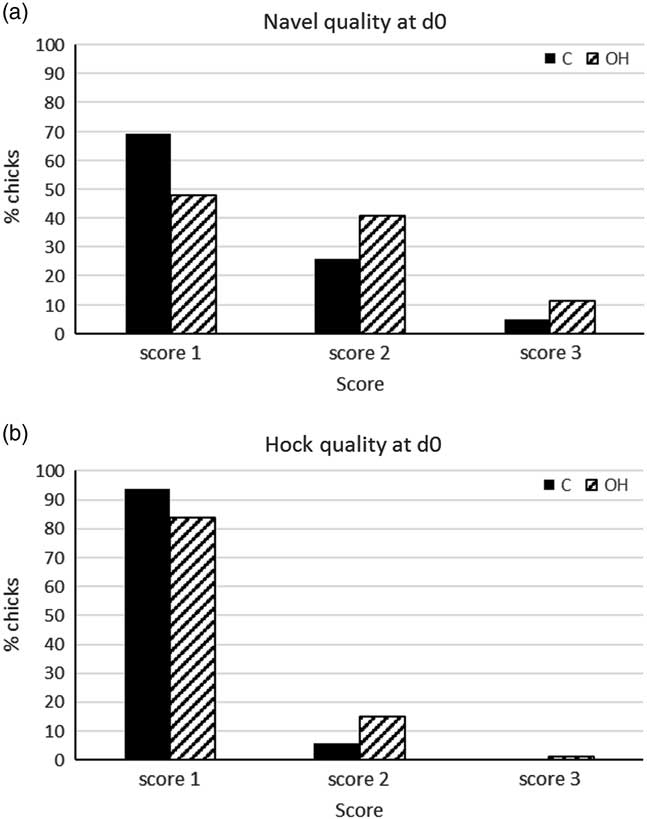
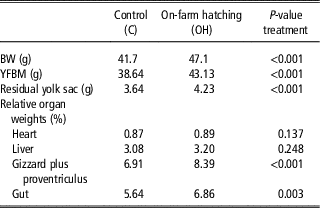
Navel and hock quality at d0 of OH chicks was significantly worse as compared to C chicks (Figure 1). Predicted means (on a logit scale) for hock score were −2.73 (C) and −1.65 (OH), respectively (SED=0.59; Wald statistic=14.41; P=0.01). Predicted means (on a logit scale) for navel score were −0.81 (C) and −0.09 (OH), respectively (SED=0.27; Wald statistic=30.69; P=0.003). Supplementary Table S1 provides the cut-points resulting from the analysis. Body weight (Δ=5.4 g; F 1,7=54.93; P<0.001; predicted means (on a log scale): C: 3.73; OH: 3.85; SED: 0.009), yolk-free body mass (Δ=4.49 g; F 1,7=26.7 6; P<0.001; predicted means (on a log scale): C: 3.65, OH: 3.76; SED: 0.021) and residual yolk sac weights (Δ=0.59 g; F 1,7=36.30; P<0.001; predicted means (on a log scale): C: 1.29; OH: 1.44; SED: 0.02) at d0 were higher for OH chicks (that were fed) than for the unfed C chicks (Table 1). In addition, the relative organ weights for gut (Δ=1.22% of YFBM) and stomach (Δ=1.48% of YFBM) were higher for OH chicks than for C chicks (F 1,7=20.50, P=0.003 and F 1,7=37.29, P<0.001 respectively; predicted means (on a logit scale) gut: C:−2.87; OH: −2.68; SED=0.04; stomach: C: −2.67, OH: −2.48, SED=0.03). There were no differences in relative heart and liver weight between both treatments(Table 1). For the OH chicks, at dissection 41.5% of the chicks had crops filled with feed.
Distribution of navel (a) and hock scores (b) expressed as percentages per score for on-farm hatched (OH) and control (C) chicks at day 0. A higher score indicates a worse quality.

Predicted means for BW, yolk free body mass (YFBM) and residual yolk sac weight in grams and relative organ weights relative to YFBM (expressed in %) of heart, liver, stomach (gizzard plus proventriculus) and gut at day 0 for hatchery-hatched (control) chicks and on-farm hatched chicks

Performance
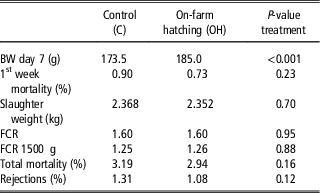
Average hatchability for C flocks was 95.12% and average calculated hatchability for OH flocks was 95.30%. Other flock performance measures are shown in Table 2. Apart from a significantly higher BW at d7 for OH chicks than for C chicks (Δ=11.5 g; F 1,7=54.93; P<0.001; predicted means (on a log scale) and SED: C: 5.156, OH: 5.220, SED=0.009), no other significant differences in performance indicators were found. Seven OH flocks received antibiotic treatments and ten C flocks did so, for reasons of gut health problems (3C flocks), locomotion problems (six OH flocks and six C flocks) or respiratory problems (only once in one C and one OH flock, respectively).
Predicted means for BW at day 7, 1st week mortality, slaughter weight, mean feed conversion ratio (FCR) at slaughter age over the whole rearing period, FCR corrected to 1500 g (FCR 1500 g), total mortality over the whole rearing period and percentage rejections at the slaughter house for on-farm hatched and control broiler chicken flocks

Welfare
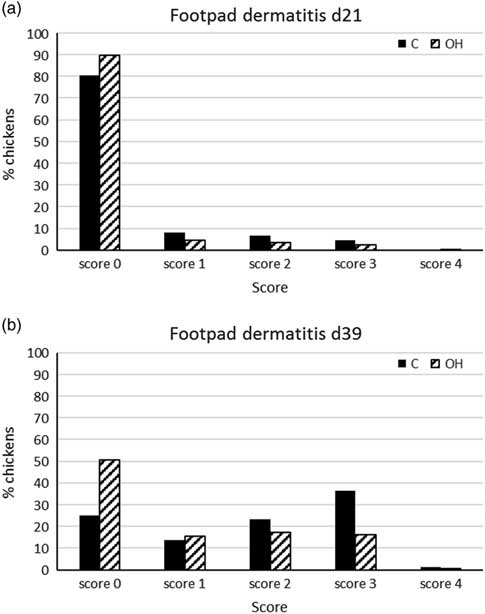
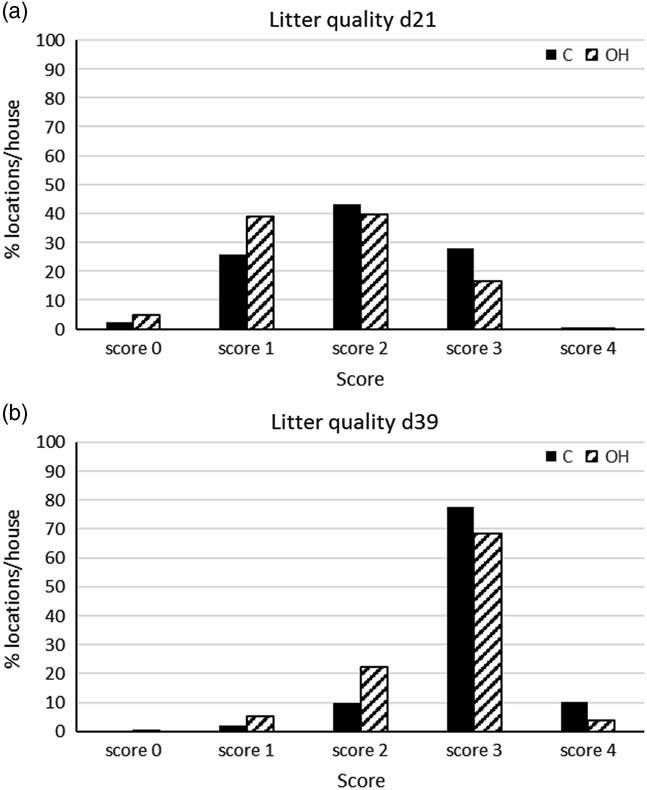
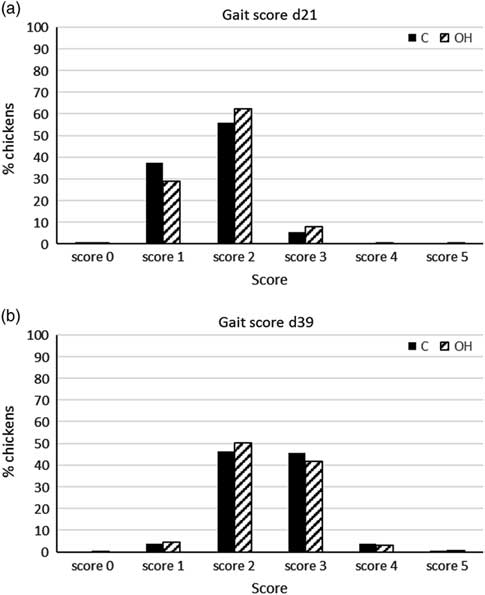
A significant effect of age was found for FPD, HB, gait score and litter quality (P<0.001), and a tendency of age effect for cleanliness (P=0.07), with scores getting worse from d21 of age to depopulation age (d39) (predicted means on interaction level are provided in Supplementary Table S2). No significant age × treatment interactions were found. A tendency for a treatment effect on FPD was found, with better scores for OH flocks than for C flocks (Figure 2) (predicted means C: −0.161, OH: −1.100, SED=0.412, P=0.05). No treatment differences were found for HB (P=0.39) (Supplementary Figure S1) and cleanliness (P=0.14) (Supplementary Figure S2). Furthermore, a tendency for a difference in litter quality was found with on average better scores for OH flocks than for C flocks (Figure 3; predicted means C: 5.140, OH: 4.286, SED=0.422, P=0.08). Breast discoloration scores were very low at all ages and not significantly different between treatments (data not shown). Gait scores did not differ between C and OH broilers (P=0.65) (Figure 4). Supplementary Tables S2 and S3 provide the predicted means on the interaction level and the cut-points resulting from the analysis, respectively, for FPD, HB, cleanliness, litter quality and gait scores. In contrast to the other welfare scores, LTL scores were not affected by age and no significant treatment effects were found (average back transformed scores for both ages: C=36.48 s, OH=33.18 s, P treatment=0.26).
Distribution of footpad dermatitis scores for on-farm hatched (OH) and control (C) broiler chicken flocks at day 21 (a) and day 39 (b) of age. A higher score indicates a worse score.

Distribution of litter quality scores for on-farm hatched (OH) and control (C) broiler chicken flocks at day 21 (a) and day 39 (b) of age. A higher score indicates a worse quality.

Distribution of gait scores for on-farm hatched (OH) and control (C) broiler chicken flocks at day 21 (a) and day 39 (b) of age. A higher score indicates a worse quality.

Pathology and intestinal morphology
None of the dissected birds showed signs of TD. The score for FHN did not differ between treatments (predicted means C=0.239, OH=0.368, SED=0.421, P=0.76) with an average score of 0.82 and 0.77 for C and OH, respectively. Gross pathology did not indicate any differences between both treatments (data not shown). Average dysbacteriosis and coccidiosis scores were low and did not differ between treatments (data not shown). A tendency was found for higher villi in C broilers and a higher crypt : villus ratio in OH broilers in all intestinal segments (P=0.081 and P=0.075, respectively), but no treatment differences in crypt depth were found at d38 (Supplementary Table S4).
Discussion
On-farm hatching (OH) of broiler chicks resulted in a higher BW at d0 and d7 in comparison to control (C) flocks derived from the hatchery, which underwent standard hatchery procedures, such as selection of second-grade chicks, and were subsequently transported to the broiler farm at d0 (and thus experienced a delay in the ability to feed and drink). However, no long-term effects of hatching conditions on performance were found in the present study. With respect to broiler welfare, OH resulted in lower FPD scores compared to C flocks, which was probably related to a tendency for a better litter quality in OH flocks. We did not find indications for effects of hatching conditions on flock health.
The present study did not allow for an identification of the individual factors that were responsible for the differences in welfare and first week performance between C and OH flocks. The provision of post-hatch feed and water in OH flocks is likely to be one of the main factors that caused a higher BW at d0 and d7 (Gonzales et al., Reference Gonzales, Kondo, Saldanha, Loddy, Careghi and Decuypere2003; Willemsen et al., Reference Willemsen, Debonne, Swennen, Everaert, Careghi, Han, Bruggeman, Tona and Decuypere2010). However, it should be further studied whether or not other factors, such as disinfection in the hatcher, selection of poor-quality chicks and stress related to handling and transport also play a role. In the present study treatments could not be randomly assigned to poultry houses by the experimenters nor could we apply a cross over design, as we carried out our study under commercial conditions on farms that already did apply the X-treck system during several production cycles and the installation of the X-treck system involves a financial investment for a farmer. Although we selected farms with control and on-farm hatching in houses as equal as possible, it cannot be excluded that there were differences between the houses related to the suitability to have the X-treck system and on-farm hatching, such as age of the house. A further study under more controlled conditions is therefore required.
Day-old chick quality and performance
OH chicks were heavier at d0 than C chicks arriving from the hatchery, which confirms previous studies (Van de Ven et al., Reference Van de Ven, Van Wagenberg, Groot Koerkamp, Kemp and Van den Brandt2009; van de Ven et al., Reference van de Ven, van Wagenberg, Debonne, Decuypere, Kemp and van den Brand2011). The provision of feed and water immediately after hatching in the on-farm hatched flocks likely contributed to the higher BW at d0 for OH chicks compared to C chicks (Gonzales et al., Reference Gonzales, Kondo, Saldanha, Loddy, Careghi and Decuypere2003). Approximately 40% of the OH chicks had a crop containing feed, which may indicate that not all chicks had consumed feed at d0. This is likely caused by the variation in hatching moment within a batch of eggs (Willemsen et al., Reference Willemsen, Debonne, Swennen, Everaert, Careghi, Han, Bruggeman, Tona and Decuypere2010). Alternatively, it could also mean that the amount of feed ingested already passed the crop. Dehydration may also have played a role in the lower d0 BW for C chicks compared to OH chicks (Fairchild et al., Reference Fairchild, Northcutt, Mauldin, Buhr, Richardson and Cox2006). Results of our study further showed that OH chicks did not use the yolk sac as much as the C chicks did, as indicated by higher relative yolk sac weight. This may reflect the use of the yolk sac for energy in C chicks (Mitchell, Reference Mitchell2009). Previous studies are ambiguous with respect to yolk sac resorption in post-hatch feed deprived or early fed chicks. Some studies showed that yolk consumption was higher, others show that it was lower following immediate post-hatch feeding in comparison to post-hatch feed deprivation (e.g. Sklan and Noy, Reference Sklan and Noy2000; Gonzales et al., Reference Gonzales, Kondo, Saldanha, Loddy, Careghi and Decuypere2003). No treatment differences in relative organ weights were found at d0, apart from significantly higher gizzard plus proventriculus and gut weights in OH chicks compared to C chicks. These organs were probably filled with feed in OH chicks, whereas this was not possible in C chicks. This all indicates no or small differences in physiological development between OH and C chicks, which is in accordance with earlier findings (van de Ven et al., Reference van de Ven, van Wagenberg, Debonne, Decuypere, Kemp and van den Brand2011).
At d0, C chicks had better navel and hock scores, indicating a better chick quality, compared to OH chicks. Suboptimal navel quality has been associated with reduced chick quality and lower post-hatch growth in hatchery-hatched chickens (van de Ven et al., Reference van de Ven, van Wagenberg, Uitdehaag, Koerkamp, Kemp and van den Brand2012). Red hocks might indicate a too high incubation temperature and may relate to suboptimal chicken quality (Leksrisompong et al., Reference Leksrisompong, Romero-Sanchez, Plumstead, Brannan and Brake2007). Perhaps the on-farm hatching temperature was too high, resulting in a lower chick quality. Alternatively, a higher percentage of suboptimal chicks could have been selected in the hatchery compared to the OH flocks (where the farmer did the selection, but most likely to a lower degree as during standard practice in commercial hatcheries). Interestingly, the worse navel and hock scores of OH chicks compared to C chicks did not negatively affect first week mortality and performance. This might mean that navel and hock scores are no valuable variables to compare different hatching systems.
At d7, BW was significantly higher in OH chicks compared to C chicks. However, in agreement with results of the Patio system (van de Ven et al., Reference van de Ven, van Wagenberg, Debonne, Decuypere, Kemp and van den Brand2011) no treatment differences were found in BW, nor in feed conversion and mortality, at depopulation age (d41). This may indicate that C flocks ‘catch up’ with the OH flocks after the 1st week, resulting in similar performance at depopulation age. Earlier studies suggested that with long durations (i.e. at least 24 h) of post-hatch feed and water deprivation broiler performance at depopulation is negatively affected as compared to immediate post-hatch fed broiler chicks (De Jong et al., Reference de Jong, Bracke, Riel and Brand2017). However, effects of shorter durations of post-hatch feed and water deprivation on performance generally seemed to be more short-lasting (Gonzales et al., Reference Gonzales, Kondo, Saldanha, Loddy, Careghi and Decuypere2003). In the present study the duration of post-hatch feed and water deprivation in C flocks might have been too short to find any long-term negative effect on performance. Alternatively, it might be that OH flocks require different management strategies than hatchery-hatched flocks, because of their higher BW during the first week of life. Because OH and C flocks were managed as equally as possible in the current study, it can be speculated that the flock of one of the treatments might have been treated less optimal than the paired flock. Individual differences between farms in performance of their OH compared to C flocks indicated that farm-specific management conditions could have been more in favour of one or the other treatment. Whether or not a different management is needed depending on hatching conditions remains to be determined.
Welfare
We found a lower prevalence of FPD in OH flocks compared to C flocks. Footpad lesions negatively affect animal welfare, as these are considered to be painful and birds with severe lesions are less able to perform their natural behaviours (Shepherd and Fairchild, Reference Shepherd and Fairchild2010). A major factor contributing to the development of footpad lesions is the quality of the litter (de Jong et al., Reference de Jong, Gunnink and van Harn2014). Likely, the lower litter quality in the C flocks compared to the OH flocks may have induced the development of FPD, leading to the better FPD scores at depopulation in OH compared to C flocks. Deteriorated litter quality also contributes to the development of HB (Hepworth et al., Reference Hepworth, Nefedov, Muchnik and Morgan2010), explaining the numerically higher HB scores in C flocks compared to OH flocks at depopulation age. Despite the tendency in better litter quality in OH flocks than in C flocks, no differences in cleanliness were found, whereas usually these are related (de Jong et al., Reference de Jong, Gunnink and van Harn2014). Gait and LTL scores and observations of FHN and TD in dissected birds did not indicate differences in these leg disorders or walking ability between the treatments. Sample sizes might have been too small to detect differences, but at first sight, results do not indicate an effect of hatching conditions.
Health and intestinal morphology
A sample of birds in a subsample of five flocks per treatment was dissected for gross pathology, to examine whether or not there were any indications for differences in health between OH and C flocks. No differences were found between OH and C flocks in gross pathology. In addition, antibiotic treatments, production performance and total mortality did not differ between the OH and C flocks, supporting the suggestion that hatching environment did not affect flock health. As these findings were in contrast to the perception of the farmers that OH flocks had less health problems than C flocks, it is advised to monitor OH and C flocks with respect to, for example, antibiotic treatment use for a longer period of time (including different seasons) and in a larger sample of farms to determine whether these perceived health differences can be confirmed.
Immediate post-hatch feeding may stimulate the development of the intestinal tract, resulting in morphological and physical differences in the intestines between early fed and post-hatch feed deprived broiler flocks during the 1st days after hatching (e.g. Bigot et al., Reference Bigot, Mignon-Grasteau, Picard and Tesseraud2003; Uni et al., Reference Uni, Smirnov and Sklan2003; Lamot et al., Reference Lamot, van de Linde, Molenaar, van der Pol, Wijtten, Kemp and van den Brand2014). Increased villus height and crypt depth have been found in early fed birds compared to feed deprived chicks, especially in the duodenum and ileum (Uni et al., Reference Uni, Ganot and Sklan1998; Geyra et al., Reference Geyra, Uni and Sklan2001). However, previous studies are ambiguous and also no effects of early feeding on intestinal development or even negative effects of early feeding have been found (De Jong et al., Reference de Jong, Bracke, Riel and Brand2017). In the current experiment, we determined whether or not we could find evidence of a changed intestinal morphology at the long term, that is, around depopulation age. Results of the present study did not indicate significant differences in intestinal morphology, although some tendencies were present which were in contrast to findings in other studies during the 1st days after hatching (i.e. lower villus height and higher crypt : villus ratio on OH compared to C chicks in the present study). However, in the current study, not only the moment of first feed and water access differed between the treatments, but many other factors also differed. In most published studies only the moment of first feed and water access differed between treatments, which makes comparison of the current study with other studies, focussing on post hatch feed and water deprivation only, difficult. Our findings of intestinal morphology seem to be in line with the absence in performance differences between the treatment around depopulation age. The examined morphological variables indicate that there are no long-term functional effects by the treatments, but further studies are needed to address the gut barrier and gut wall immunology as part of chicken health at various developmental stages.
Conclusions
On-farm hatching of broiler chicks using the X-treck system resulted in slightly better performance in the 1st week of life compared to flocks obtained from the hatchery, but no long-term effects on performance were found. With respect to broiler welfare, on-farm hatching resulted in less FPD and a tendency for a better litter quality. Because we compared two hatching systems including differences in various factors, we cannot say which individual factors played a role in the difference in performance and welfare between the treatments. This merits further study.
Acknowledgements
This project was financed by the public-private partnership ‘Robust Broilers 4 Healthy Humans’ (project number BO-22.04-014-001). Marc Bracke is acknowledged for reviewing the draft manuscript. Filip Boel is acknowledged for performing the dissections and Norbert Stockhofe and his team for assistance with the intestinal morphological analyses. Freek Leijten, Lotte van de Ven and Pieter de Gouw are acknowledged for assisting with the measurements taken at d0. The authors much appreciate the help of our students.
Declaration of interest
The authors declare no conflicts of interest.
Ethics statement
Project approval was received on June 10, 2015 by the Central Commission on Animal Experiments. The experiment was approved by the Institutional Animal Care and Use Committee at 20 August 2015.
Software and data repository resources
None of the data were deposited in an official repository.
Supplementary material
To view supplementary material for this article, please visit https://doi.org/10.1017/S1751731118002872