Introduction
The remarkable extension of life expectancy could be considered as one of the most important accomplishments of the 20th century. However, ageing populations in many wealthy countries in Europe forecast an unbalanced demographic dependency ratio caused by the growing proportion of senior citizens compared to younger people that will pose serious challenges for social security systems (Prast et al. Reference Prast, van Soest, Blank, Logeay, Türk, Wöss, Zwiener, von Nordheim, Bauknecht, Cebulla and Zaidi2016). The rising number of people aged 65 and over and the expectation that this population will continue to grow in the future requires researchers to take an in-depth look at the ageing process and its effects to identify the factors that contribute to maintain satisfactory levels of subjective wellbeing in older people. International economic and health bodies such as the Organisation for Economic Co-operation and Development and the World Health Organization are increasingly acknowledging the importance of relying on subjective and self-reported wellbeing measures as health indicators and cost–benefit analysis tools to evaluate public health policies (Lindert et al. Reference Lindert, Bain, Kubzansky and Stein2015; O'Donnell et al. Reference O'Donnell, Deaton, Durand, Halpern and Layard2014). Single-item measures of life satisfaction and self-perceived health have been found to be significant predictors of mortality and of a wide range of chronic diseases (Collins, Glei and Goldman Reference Collins, Glei and Goldman2009; Koivumaa-Honkanen Reference Koivumaa-Honkanen2000), especially among older adults (Mossey and Shapiro Reference Mossey and Shapiro1982; Rouch et al. Reference Rouch, Achour-Crawford, Roche, Castro-Lionard, Laurent, Ntougou Assoumou, Gonthier, Barthelemy and Trombert2014). In addition, higher levels of subjective wellbeing are protective against the long-term risk of hospitalisation and correlate with positive health-related habits (Kennedy Reference Kennedy2001; Miilunpalo et al. Reference Miilunpalo, Vuori, Oja, Pasanen and Urponen1997).
Recent studies in ageing research have associated social trust to various measures of psychological health including life satisfaction and self-perceived health (e.g. Koutsogeorgou et al. Reference Koutsogeorgou, Nyqvist, Nygard, Cerniauskaite, Quintas, Raggi and Leonardi2015; Nyqvist and Forsman Reference Nyqvist and Forsman2015; Schneider et al. Reference Schneider, Konijn, Righetti and Rusbult2011; Zhang and Zhang Reference Zhang and Zhang2015). Indices of perceived trust such as generalised trust have been found to affect subjective wellbeing indicators at the country level (Bjørnskov Reference Bjørnskov2003). Concurrently, research has evidenced the importance of interpersonal trust on health systems and health production in any given society (Gilson Reference Gilson2003). However, despite the extant literature on this issue, it appears there are still some major challenges to address. First, the mechanisms mediating the association between trust and wellbeing are still partially unknown (Tokuda, Fujii and Inoguchi Reference Tokuda, Fujii and Inoguchi2010). One could argue that political interest, such as engaging in discussions about politics and becoming informed about political issues, may mediate the relationship between social trust and self-reported individual wellbeing. Second, social trust is a multi-dimensional concept and includes different dimensions of perceived trust (Leung et al. Reference Leung, Kier, Fung, Fung and Sproule2011; Paldam Reference Paldam2000). Testing separate associations between different sources of social trust and wellbeing measures among older adults may evidence whether specific sources of social trust are more determinant than others for this relationship. Such knowledge could help advance psychological research on wellbeing and advise new intervention strategies in this field. Third, there is a broad consensus that wellbeing entails satisfaction with life as a whole and with specific domains, the importance of which may change according to different stages in life (e.g. Diener, Kahneman and Helliwell Reference Diener, Kahneman and Helliwell2010; Helliwell, Layard and Sachs Reference Helliwell, Layard and Sachs2013). In late life, self-perceived health has often been identified as being amongst the most important sources of happiness (Pinquart and Sörensen Reference Pinquart and Sörensen2000). Indeed, as life expectancy is growing worldwide (Lutz, Sanderson and Scherbov Reference Lutz, Sanderson and Scherbov2008), senior years will cover an increasingly longer period in a person's life which will increase the probability of experiencing impairments to physical health. Accordingly, the present study looked at how trust in people and trust in institutions relate to life satisfaction and self-perceived health among older adults through the mediational effect of political interest. Including these two relevant subjective wellbeing outcomes may help to better weight the relationship between social trust and self-perceived wellbeing in late life and further provide evidence for policy making.
Social trust, political interest and wellbeing in late life
Paldam (Reference Paldam2000) distinguished between two types of social trust, namely generalised trust and special trust. Similarly, Leung et al. (Reference Leung, Kier, Fung, Fung and Sproule2011) found that both generalised trust (measured in terms of interpersonal trust) and special trust (measured in terms of institutional trust) were associated with happiness, although they remain weakly correlated. However, few studies have inferred about the independent contributions of generalised and special trust on wellbeing among older adults. For instance, Zhang and Zhang (Reference Zhang and Zhang2015) evidenced the positive association between institutional trust and life satisfaction in a sample of older adults in China, while Schneider et al. (Reference Schneider, Konijn, Righetti and Rusbult2011) demonstrated how experiencing higher levels of interpersonal trust in late life increases self-reported levels of physical health by reducing symptoms of anxiety and depression.
On the other hand, political interest, often measured as general interest in politics or in terms of how often people talk about politics or become informed about it (Shani Reference Shani, Aldrich and McGraw2011), has been found to be positively associated with assessments of social trust (Scheufele and Shah Reference Scheufele and Shah2000). Reading from Kramer, Brewer and Hanna (Reference Kramer, Brewer, Hanna, Kramer and Tyler1996), this relationship can be explained by the fact that individuals who show high interpersonal trust may be more likely to display attitudes aimed at offsetting the lack of trust by some and to illicit trust from others. Individuals with high levels of social trust can thus tend to engage in behaviours for the ‘good of society’, such as being interested in politics. Indeed, in his definition of social trust as one of the key features of social capital, Putnam (Reference Putnam1993) stressed that trust can favour co-ordinated actions in a given society by enhancing interaction between people. Accordingly, political interest and social trust may be part of the same collectivistic outlook.
Both social trust and political interest are associated with positive outcomes such as health and wellbeing (e.g. Hudson Reference Hudson2006; Putnam Reference Putnam2000). Reading from Durkheim's (Reference Durkheim1951) seminal work, up until the study of social capital in public health (e.g. Kawachi, Kennedy and Glass Reference Kawachi, Kennedy and Glass1999; Kawachi et al. Reference Kawachi, Kennedy, Lochner and Prothrow-Stith1997), research has shown how individuals with higher levels of social integration and social networks report better health and higher wellbeing. More specifically, Giordano, Björk and Lindström (Reference Giordano, Björk and Lindström2012) concluded that generalised trust is an independent longitudinal predictor of health status, while Lindström and Mohseni (Reference Lindström and Mohseni2009) suggested that political trust (an aspect of institutional trust) is significantly and positively associated with mental health. Specific mechanisms explaining these effects may be found for specific sources of trust. When trust levels are measured in terms of trust in institutions, these may reflect improved access to resources such as education or health care (Hendryx et al. Reference Hendryx, Ahern, Lovrich and McCurdy2002). Moreover, high levels of trust in people may reflect high levels of perceived support that are responsible for improving health and wellbeing via psycho-social pathways (Giordano and Lindström Reference Giordano and Lindström2011).
In older adults, several explanations have been put forward to describe the relationship between social trust and wellbeing. First, as older adults age, they are often forced to adapt to increasingly lower levels of physical, psychological and social functioning, as they have to rely more on close relationships and public structures. Given this, trustworthiness in human kind and credibility of public institutions may affect not only their feelings towards society, but also their self-perceived wellbeing more than is the case for younger people (Cramm, van Dijk and Nieboer Reference Cramm, van Dijk and Nieboer2012; Rostila, Nygård and Nyqvist Reference Rostila, Nygård, Nyqvist, Nyqvist and Forsman2015). Second, being interested in politics, actively engaging in discussions about political issues and getting informed about political affairs have all been found to relate positively to self-perceived wellbeing across the lifespan (Blace Reference Blace2012; Klar and Kasser Reference Klar and Kasser2009) and this relationship appears to increase with age (Hooyman and Kiyak Reference Hooyman and Kiyak1996). Indeed, with the loss of former work-related social roles and social interactions, frequent interpersonal contacts and information sharing may particularly serve as a source to preserve life satisfaction and psychological wellbeing among retired seniors (Kahana et al. Reference Kahana, Bhatta, Lovegreen, Kahana and Midlarsky2013).
The current study
In addition to the above rationale regarding the interconnections between social trust, political interest and wellbeing, in the current study political interest was considered a mediating factor of the relationship between trust and wellbeing. Even though social trust and political interest fall under the same theoretical construct of social capital, they should not be generalised into a unique personality trait (Kaase Reference Kaase1999; Newton Reference Newton2001). For example, analysing long-term panel data, Jennings and Stoker (Reference Jennings and Stoker2004) concluded that social trust is a cause of political engagement rather than a consequence, and the strength of this relationship increases with age. In fact, the hypothesis stating political interest mediates the relationship between social trust and wellbeing may be supported by reading from Ryan and Deci's (Reference Ryan and Deci2000) self-determination theory of motivation. More specifically, social and political interest may be a source of intrinsic motivation to contribute to a better society and thus benefit wellbeing because these interests satisfy important psychological needs that are prerequisite for healthy functioning (Klar and Kasser Reference Klar and Kasser2009; Ryan and Deci Reference Ryan and Deci2001). Conversely, using longitudinal data, Lai, Bond and Hui (Reference Lai, Bond and Hui2007) found that negative attitudes towards society may result in less social engagement and more negative social feedback, which further results in lower satisfaction with life. Therefore, older adults who maintain high levels of involvement and interest in societal affairs, with a positive perception of social trust, may have bolstered wellbeing indicators.
The Italian context
Italy is in an interesting setting to study the dynamics between social trust and wellbeing among older adults. First of all, the Italian population is among the top 10 oldest in the world (United Nations 2013). Moreover, the country is expected to experience one of the largest growths in persons ⩾65 years in the world (>20% by 2020; Bustacchini et al. Reference Bustacchini, Abbatecola, Bonfigli, Chiatti, Corsonello, Di Stefano, Galeazzi, Fabbietti, Lisa, Guffanti, Provinciali and Lattanzio2015). This rapid population ageing has social and economic consequences, especially in terms of state expenditure for health services, in particular if we consider the high percentage of older adults living alone in Italy (27.1% in 2009; Osservatorio Nazionale sulla Salute nelle Regioni Italiane 2010). That said, there is little psychological research that has looked at perceptions of social trust as health and wellbeing-associated factors among older people in Italy (de Belvis et al. Reference de Belvis, Avolio, Spagnolo, Damiani, Sicuro, Cicchetti, Ricciardi and Rosano2008b). Therefore, there is a compelling need to advise new welfare strategies to face present and forthcoming challenges in contexts such as Italy.
Aims and hypotheses
Based on previous studies of the associations among social trust, political interest and wellbeing, the current study aimed to determine: (a) the relationship between trust in people and trust in institutions with life satisfaction and self-perceived health, and (b) whether political interest mediates this relationship, after controlling for gender, educational level and self-assessment of household income. We hypothesised that:
• Hypothesis 1: Trust in people and trust in institutions are both positively associated with older adults’ life satisfaction and self-perceived health.
• Hypothesis 2: Political interest fully or partially mediates the relationship between social trust and wellbeing (e.g. indirect associations via political interest would be significant).
Methods
Sample
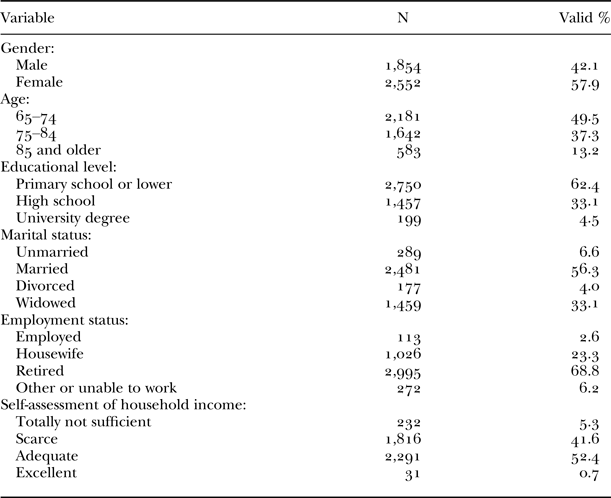
This paper used data from the 2013 Aspects of Daily Life survey conducted by the Italian National Institute of Statistics (Istituto Nazionale di Statistica – ISTAT) which adopted a multi-stage stratified cluster sampling procedure. Aspects of Daily Life is a large annual sample survey that covers the Italian resident population in private households, by interviewing a sample of about 20,000 households and 50,000 people (using paper and pencil questionnaires). According to the definition of an older adult given by the World Health Organization (2002), this study was restricted to adult respondents aged 65 years and older. This left a total of 4,406 respondents for these analyses. Table 1 reports demographic and socio-economic characteristics of the sample.
Demographic and socio-economic sample's characteristics

Note: N = 4,406.
The questionnaires used in the Aspects of Daily Life survey include questions on individual characteristics, daily lifestyles and social activities (ISTAT 2015). For the purpose of this paper, the most important questions included the ones concerning life satisfaction, self-perceived health, and potential predictors relative to social trust and political interest. Such questions, reported in the following paragraphs, were aligned to previous empirical research on social capital from Putnam's theoretical perspective (Helliwell and Putnam Reference Helliwell and Putnam2004; van Deth Reference van Deth, Castiglione, van Deth and Wolleb2008).
Measures
Trust in people
Two questions were asked to measure trust in people: ‘Imagine you lost your wallet, how probable do you think it is that one of your neighbours would return it to you?’ and ‘Imagine you lost your wallet, how probable do you think it is that a complete stranger would return it to you?’ Participants could answer on a 1 (not at all) to 4 (very much) scale. The scale yielded a satisfactory internal consistency (Cronbach's α = 0.70).
Trust in institutions
Three questions assessed trust in institutions: ‘How much do you trust the Italian national government?’, ‘How much do you trust your local government?’ and ‘How much do you trust your regional government?’ Participants could answer on a 0 (not at all) to 10 (completely) scale (α = 0.79).
Political interest
Interest in politics was assessed through two questions: ‘How often do you seek information about Italian politics?’ and ‘How often do you talk about politics?’ Participants could answer on a 1 (never) to 6 (every day) scale (α = 0.83).
Life satisfaction
The degree of self-rated life satisfaction was measured with a global question: ‘Currently, how satisfied are you with your life as a whole?’ Participants could answer on a 0 (not satisfied at all) to 10 (fully satisfied) scale.
Self-perceived health
The following question accounted for an overall assessment of individual health: ‘How would you rate your health status?’ Participants could answer on a 1 (very bad) to 5 (very good) scale.
Covariates
Among older adults, gender and education-level differences in political interest (e.g. Inglehart and Norris Reference Inglehart and Norris2000; Verge Mestre and Tormos Marín Reference Verge Mestre and Tormos Marín2012), self-perceived health (e.g. Benyamini et al. Reference Benyamini, Blumstein, Lusky and Modan2003) and life satisfaction (e.g. Cheng and Chan Reference Cheng and Chan2006) have been extensively documented, although findings in this respect are not unequivocal. Nevertheless, these variables have often been included as covariates in models testing associations between social capital constructs and wellbeing in late life (e.g. Zhang and Zhang Reference Zhang and Zhang2015). In addition, self-reported measures of income have also been found to account for significant portions of variability in political interest (Nyqvist and Forsman Reference Nyqvist and Forsman2015) as well as in self-perceived health and life satisfaction (Andrew and Keefe Reference Andrew and Keefe2014). Accordingly, gender (coded 0 = female and 1 = male), educational level (1 = elementary or lower, 2 = secondary school, 3 = high school, 4 = university degree) and self-assessment of household income (1 = totally not sufficient, 2 = scarce, 3 = adequate, 4 = excellent) were included as covariates in the current analysis.
Data analyses
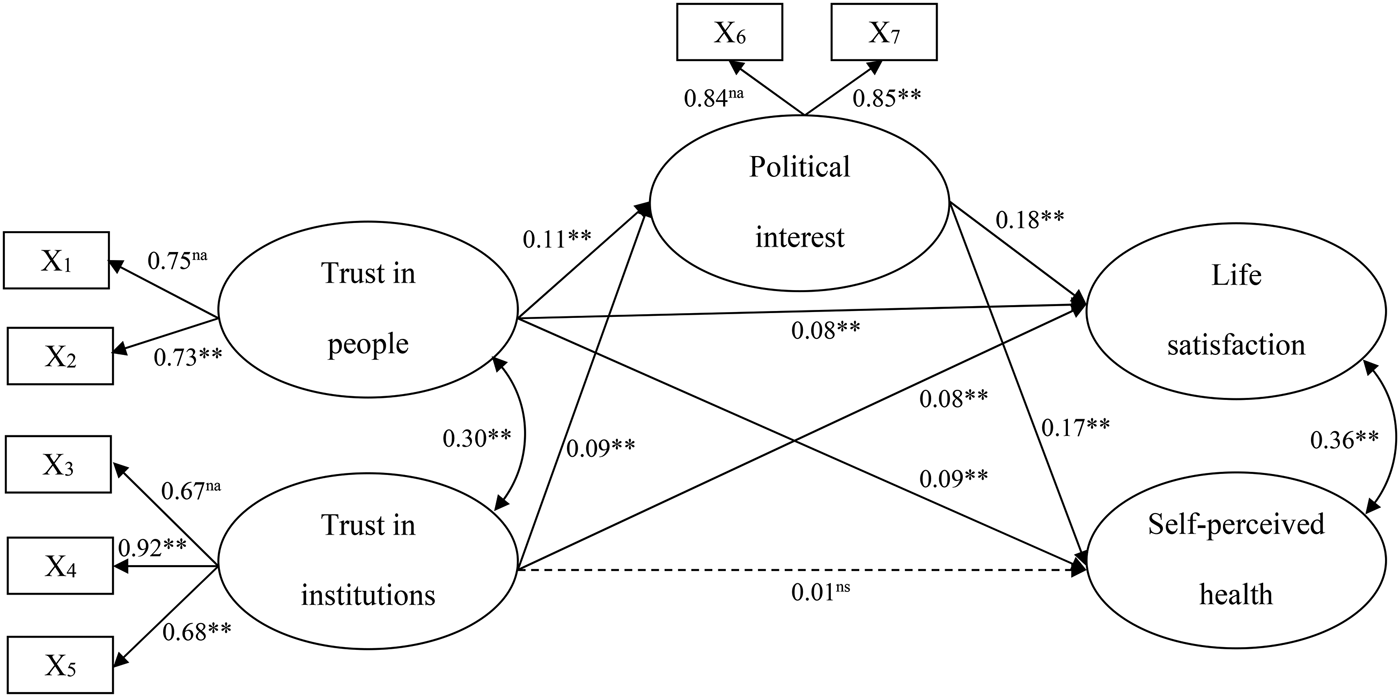
SPSS for Windows, version 19 (SPSS Inc., Chicago, USA), was used for data analyses of descriptive statistics and correlations. The expectation–maximisation algorithm (EM) was adopted to deal with the problem of missing values. Subsequently, structural equation modelling was implemented in two steps using AMOS (version 20.0; Arbuckle Reference Arbuckle2011). First, the proposed mediation model (see Figure 1) was tested. In addition, analyses were run controlling for participants’ gender, educational level and self-assessment of household income. Second, mediation effects were tested following the procedure described by MacKinnon, Lockwood and Williams (Reference MacKinnon, Lockwood and Williams2004) that has been proven to reduce the risk of obtaining unbiased mediation estimates (Cheung and Lau Reference Cheung and Lau2007) and allows confidence intervals around the estimated indirect effects to be computed. The present study employed this bootstrapping method using 2,000 iterations, a number previously employed by researchers (Johnson et al. Reference Johnson, Rowatt, Barnard-Brak, Patock-Peckham, LaBouff and Carlisle2011). Model fit was evaluated by examining the following four estimates: (a) chi-square (χ2) goodness-of-fit, (b) Root Mean Square Error of Approximation (RMSEA), (c) Tucker–Lewis Index (TLI), and (d) Comparative Fit Index (CFI). Sample weights were not adopted in the analyses because of the use of a non-random subset (i.e. individuals aged 65 and older), rather than the entire sample of the data-set. A similar approach was adopted in previous studies using secondary data (see Hahs-Vaughn Reference Hahs-Vaughn2006). Accordingly, results from the analyses in the following sections can be interpreted only for the sample of individuals selected here.
Model depicting mediation effects of political interest on social trust (trust in people and trust in institutions) and wellbeing (life satisfaction and self-perceived health): standardised coefficients are shown.

Results
Descriptive statistics
Attrition analysis showed that participants with complete data (94% of the entire survey) did not differ from participants with missing data on any of the variables tested in the current study, which supported the assumption that the missingness was random. Accordingly, the EM approach was adopted to deal with missing data before testing the structural equation model. Composite mean scores for trust in people, trust in institutions and political interest were calculated. Means, standard deviations and Spearman correlations between all variables examined in our model are presented in Table 2.
Descriptive statistics and Spearman correlations for all variables included in the model

Notes: Gender was coded 0 = female and 1 = male. Educational level was coded 1 = elementary or lower, 2 = secondary school, 3 = high school, 4 = university degree. Self-assessment of household income was coded 1 = totally not sufficient, 2 = scarce, 3 = adequate, 4 = excellent. SD: standard deviation.
Significance levels: *p < 0.05, **p < 0.01.
Mediation model and mediation effects
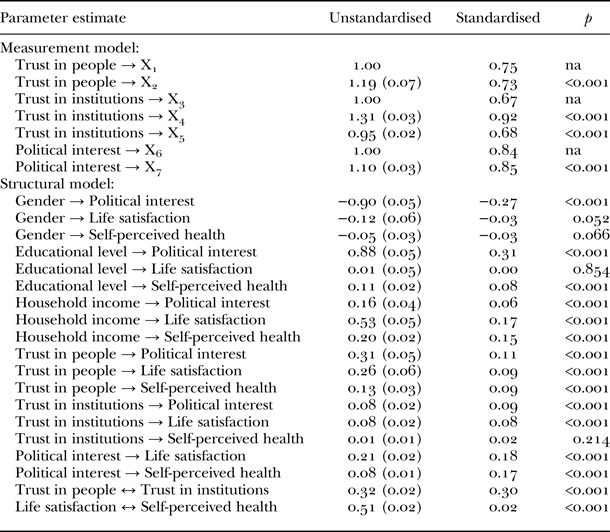
The mediation model appeared to fit the data well. The chi-square was significant, χ2(31) = 302.922, p < 0.001. The RMSEA value, compensating for the effects of model complexity, was 0.045 (90% confidence interval (CI): 0.040–0.049). This value indicates a good fit of the model as being less than 0.050. The value of the TLI was 0.954 and the value of the CFI was 0.979, each meeting the standards of good fit at 0.950 or higher. Table 3 reports unstandardised, standardised and significance levels for the overall mediational model, while Figure 1 depicts the model along with beta weights. Loadings of the manifest indicators on their respective latent variables were strong (ranging from β = 0.672 to β = 0.921) and statistically significant (p < 0.001). One-path mediations were tested in the present model. The results for the mediation analyses are presented below. Each lower and upper bound value for the 95% CI values around each indirect effect failing to contain zero indicates support for the mediation hypothesis because the null hypothesis states the indirect effect value is zero. Thus, CI values not containing zero indicate the mediating variable (i.e. political interest) was a statistically significant mediator between social trust variables (i.e. trust in people and trust in institutions) and wellbeing variables (i.e. life satisfaction and self-perceived health).
Unstandardised, standardised and significance levels for the overall mediational model

Notes: Standard errors are given in parentheses. Gender was coded 0 = female and 1 = male. Educational level was coded 1 = elementary or lower, 2 = secondary school, 3 = high school, 4 = university degree. Self-assessment of household income was coded 1 = totally not sufficient, 2 = scarce, 3 = adequate, 4 = excellent. X1: ‘Imagine you lost your wallet, how probable do you think it is that one of your neighbours would return it to you?’ X2: ‘Imagine you lost your wallet, how probable do you think it is that a complete stranger would return it to you?’ X3: ‘How much do you trust the Italian national government?’ X4: ‘How much do you trust your local government?’ X5: ‘How much do you trust your regional government?’ X6: ‘How often do you seek information about Italian politics?’ X7: ‘How often do you talk about politics?’ na: not applicable.
Political interest mediated the effects of trust in people on life satisfaction (mediated effect = 0.020; 95% CI: 0.011–0.028) and on self-perceived health (mediated effect = 0.018; 95% CI: 0.011–0.026), as well as of trust in institutions on life satisfaction (mediated effect = 0.016; 95% CI: 0.009–0.026) and on self-perceived health (mediated effect = 0.015; 95% CI: 0.008–0.023). Direct effects of trust in people on life satisfaction and on self-perceived health and of trust in institutions on life satisfaction were significant at p < 0.001, indicating that political interest partially mediated such relationships. On the other hand, the direct association between trust in institutions and self-perceived health was not significant when political interest was entered in the model. That said, while excluding the mediator factor, the direct association between trust in institutions and self-perceived health was significant at p < 0.001, indicating that political interest fully mediates the relationship between trust in institutions and self-perceived health. To determine the percentage of variance attributable to the mediator factor, the direct and indirect effects were summed together for total effects. Next, indirect effects were divided by the total effects, giving the percentage of variance in life satisfaction and in self-perceived health attributable to political interest. Results indicated that political interest accounted for approximately 11 per cent of the variance in life satisfaction and 8 per cent of the variance in self-perceived health.
Additionally, we conducted some mediating analyses with political interest as the predictor and trust in people and trust in institutions as the mediators. This model fits the data well, χ2(32) = 478.126, p < 0.001 (CFI = 0.965, TLI = 0.927, RMSEA = 0.056), although comparatively speaking, the former model is more significant than the latter. Moreover, in this second model the direct association between trust in institutions and self-perceived health was also not significant. These results suggest that political interest is more suitable for the role of mediator than trust in people and trust in institutions.
Discussion
Our results confirm the two hypotheses: there is a significant positive relationship between trust in people and trust in institutions from one side, and life satisfaction and self-perceived health on the other side (Hypothesis 1); and political interest serves a mediating role between social trust and wellbeing among older adults (Hypothesis 2). These findings reflect those of other studies sampling older adults (Barefoot et al. Reference Barefoot, Maynard, Beckham, Brummett, Hooker and Siegler1998; Nyqvist and Forsman Reference Nyqvist and Forsman2015; Yip et al. Reference Yip, Subramanian, Mitchell, Lee, Wang and Kawachi2007), which confirmed social trust is associated with positive self-rated health and subjective wellbeing among older people. More specifically, the current study adds new insights to previous research undertaken in the Southern Mediterranean area about the role of social capital as a health resource in late life (de Belvis et al. Reference de Belvis, Avolio, Sicuro, Rosano, Latini, Damiani and Ricciardi2008a; Garcìa et al. Reference García, Banegas, Pérez-Regadera, Cabrera and Rodríguez-Artalejo2005; Piumatti Reference Piumatti2016) and provides new perspectives to study the psychological mechanisms underlying the relationship between trust and individual wellbeing among older adults.
The descriptive analyses indicated that Italian older adults tended to report high trust in people, and moderate to high life satisfaction, self-perceived health and political interest. Similarly, Li and Fung (Reference Li and Fung2012) showed that a positive association between age and various forms of trust can work as a coping strategy that buffers against social isolation by enhancing connectedness with others. These descriptive results reflect recent figures pointing to the fact that despite its struggling economy Italy ranks among the top healthiest countries in the world (Bloomberg Global Health Index 2017). Conversely, in the current sample, Italian older adults showed very low trust in institutions. Indeed, Van de Walle, Van Roosbroek and Bouckaert (Reference Van de Walle, Van Roosbroek and Bouckaert2008) observed that in comparison with other European countries, levels of trust towards institutions are lower overall in Italy where corruption scandals in recent years may have affected citizens’ opinion about the public sector. On a related note, while trust in people was directly associated with both life satisfaction and self-reported health, trust in institutions was directly associated only with life satisfaction (i.e. the latter was fully mediated by political interest). These results confirm how family/friends networks (the primary source of interpersonal connections among older adults) are especially important correlates of perceived support among older adults in Mediterranean contexts such as Italy (Damiani et al. Reference Damiani, Gainotti, de Belvis, Manzoli and Ricciardi2005). Such a finding has important implications for policy making at the European level, especially if we consider how family fragmentation results in more unstable and smaller structures thereby creating a greater need for external public and private support in Europe among older adult populations (Hill Reference Hill2015). Accordingly, results of the current study may suggest that interventions aimed at improving wellbeing among older adults should look at non-institutional actions shaped according to individual network characteristics. In particular, as reminded by Börsch-Supan et al. (Reference Börsch-Supan, Kneip, Litwin, Myck and Weber2015), enhancing social capital from an individual network perspective may enhance intergenerational support and further reduce the risk for deprivation and social exclusion among older adults in Europe.
A novel finding of this study was that political interest partially mediated the relationship between trust in people, life satisfaction and self-perceived health, on one side, and the relationship between trust in institutions and life satisfaction, from the other side (while it fully mediated the association between trust in institutions and self-perceived health). As previous studies have suggested, being politically active expresses a basic human motive necessary for wellbeing (Klar and Kasser Reference Klar and Kasser2009; Ryan and Deci Reference Ryan and Deci2001). For older people, social trust and political interest may ascribe to the definition of generativity given by Erikson (Reference Erikson1950), a feeling representing a personal need and concern for establishing and guiding the next generation, a need that increases during adulthood. This personal inclination is intrinsically linked to a sense of optimism, such as the one that stems from social trust, and correlates not only with political interest (Peterson, Smirles and Wentworth Reference Peterson, Smirles and Wentworth1997), but also with life satisfaction (de St. Aubin and McAdams Reference de St. Aubin and McAdams1995) and other measures of psychological wellbeing (Grossbaum and Bates Reference Grossbaum and Bates2002). Generativity is a term that can also be used to describe ‘successful ageing’ via positive social and personal development (Villar Reference Villar2011). Individuals that fail to maintain good social networks in late life are posing risks to this individual development. Accordingly, by maintaining high levels of political interest and political engagement, older adults may nurture their sense of community bonding, further exhibiting higher wellbeing. In particular, older adults reporting high social trust may show high levels of life satisfaction and self-perceived health by fulfilling a desire to contribute to the next generation and thereby reducing perceptions of social exclusion. Support for these results can also be found reading from socio-emotional selectivity theory (Carstensen Reference Carstensen2006), which posits that as individuals grow older and face limited future time perspectives they tend to give priority to goals that are emotionally more meaningful to them. Generative activities such as contributing to discussions about politics where they can bring in their longer life experience and benefit the society they trust may indeed be considered an emotionally meaningful goal that can enhance their wellbeing when fulfilled (Lancee and Radl Reference Lancee and Radl2012).
Limitations and final remarks
Given the study design, these analyses had the advantage of being able to test the mediation effect of political interest on the connection between social trust and wellbeing on a large sample of older adults. However, this study does have limitations. First, the use of cross-sectional survey data makes it impossible to assess the causal relationships between variables. Longitudinal research is needed to support and recommend interventions and evidence-based best practice in this field. Second, life satisfaction and self-perceived health were measured with a single item, which could not reflect various dimensions of these two constructs. In particular, subjective wellbeing is a complex construct with multiple factors (Gallagher, Lopez and Preacher Reference Gallagher, Lopez and Preacher2009). Adopting state-of-the-art measurement analysis techniques such as structural equation modelling, future studies may replicate the model tested here by assessing the multi-dimensionality of this construct rather than examining relevant outcomes separately. Third, political interest was assessed only in terms of how often people talk about politics or seek information about it. Future studies should test more varied models of political interest and participation, focusing on social and civic participation, for example. Finally, it should be noted that in most cases only a partial mediation was found. Social trust, in particular referring to people, may thus be independently associated with life satisfaction and self-perceived health, or there may be other mediating factors that remain unexplored. On a related note, the current study results cannot exclude the fact that the associations found could be an effect of unmeasured factors and therefore these should be investigated in future research so as to overcome the intrinsic limitations of drawing from secondary data analysis.
Despite these limitations, the present study provides new insights within the debate on the connection between social trust and wellbeing amongst the older adults. In particular, to our knowledge, no previous study has examined, from a psychological perspective, the contributions of different sources of social trust to life satisfaction and health in late life, especially examining the role of mediating factors. Evidence for the relationship between trust in people and trust in institutions on life satisfaction and self-perceived health will help to guide interventions aimed at enhancing wellbeing in late life by examining individual levels of political interest.
Acknowledgements
The authors have no funding to report and declare that no competing interests exist.