Vin Diesel doesn't usually enter into conversations about Shakespeare in performance, but he made his way into my conversation with José Esquea, producer and director for the Soñadores players, a classical theater company known for its annual Shakespeare productions staged at Teatro LATEA (Latin American Theater Experiment and Associates) and other venues in New York City (Figure 1). Interviewing Esquea about an upcoming production of The Taming of the Shrew set in a segregated town somewhere/sometime in the US South, I asked Esquea to talk about some of his early experiences as an actor of color. I reminded him of what he had written in a short piece included in Ayanna Thompson and Scott Newstok's edited volume Weyward Macbeth in which he recalls “many casting disappointments”:
Shakespearean productions have historically been closed to dramaturges, directors, production designers, and, most notably, actors of color. This was my immediate reality after my graduation from Skidmore College in 1993. Like most kids still green from undergraduate optimism, I was ready to change the world with my training as an actor. Yet I found myself frustrated, at times even angry, with an industry that had very little room for me in it.Footnote 1
The storm, The Tempest, 2013, Medicine Snow Theatre, New York. Left to right: A. B. Lugo, Otis Cotton, Mark J. Dempsey, George Belcher. Photo by Anthony Ruiz.

Esquea describes himself as the “son of Dominican immigrants” – “My mother is a black woman and my father is a fair-skinned mixed Dominican man.”Footnote 2 He describes himself as “racially mixed.”Footnote 3 As a young actor, Esquea ran into difficulty when he found that his look did not match any of the narrowly defined ethnic “types” sought by casting directors across the city:
So when I got out of college and I was going in for a lot of acting calls, I would go in for a Latino guy and I didn't look like whatever a Latino was supposed to look like in 1993 for casting agents, so I would not get those … Then if I would go in for a black guy, then I wasn't black enough to be considered black, you know, and obviously I wasn't white enough to be considered white … I remember once I went to a casting call for a young urban Latino type and I walked in and I said, “My name is José.” The woman looked at me and she said, “Really?” and I said, “Yes, my name is José.” She said, “You look more like a ‘Tyrone’ to me,” and I said, “Okay, nonetheless, my name is José,” and she said, “Well you just don't look Spanish enough.” I went to another casting call for a commercial to play a roadie, and they wanted a big black guy, and I'm a big dude. I'm 6′3″ 250 lbs. So I went in and they said, “Okay. Well, you have a great look but we're looking for somebody that is a little blacker.” I said, “What?” and they said, “You know, someone darker-skinned, just a little more black. You don't read as black.”Footnote 4
It was around this time that Esquea saw the small independent film Multi-facial (1995), written, directed by, and starring self-identified mixed-race actor Vin Diesel (born Mark Sinclair). As a struggling New York actor, Mike (Diesel) auditions for a series of casting agents, each seeking actors fitting ethnic “types” (offhand remarks refer to “Spanish types,” “Wesley [Snipes] types,” and “longhair types”) to fill roles in commercials, music videos and other unnamed productions.Footnote 5 Diesel tries and fails to convince agents that he fits the bill as Italian, Latino, and African American. The film played at Cannes and caught the attention of many, including Steven Spielberg, who quickly cast the young actor in Saving Private Ryan (1998), effectively launching Diesel's career. Esquea identified with Diesel's challenges – jokingly referring to Diesel and himself as “tragic mulattos” – and with his creative solution:
After enough of those experiences I thought, you know what, until I'm producing things … I'm just going to just be a victim to this and I'm not going to get a chance to do anything. If I produce it I can put anybody that I want in it and it will be at my discretion.Footnote 6
Esquea found his calling when he began directing productions at Teatro LATEA (Figure 2). Over the last eleven years, Esquea has directed or produced eight Shakespeare productions, beginning with Hamlet in 2006. His Taming of the Shrew is now in development. Esquea sees Shakespeare as fertile ground for actors of color seeking to challenge the discriminatory practices of the industry and has called the Shakespeare production a “performative measure of achievement” for actors.Footnote 7
First, they are damn good stories. They are damn good, juicy stories that make you want to go, “Oh my god – no? That happened? For real? Who did that?” And there is also this sort of bone of contention, this chip on my shoulder, this kind of nit to pick about language and subjugation … This language that we inherited, we seldom have mastery of it. Classical literature, particularly the canon or Shakespeare … is a symbol of mastery for an actor, for a director, a producer.Footnote 8
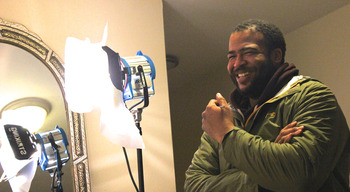
Director José Esquea on the set of the film St. Nicholas (producer Monte Bezell, writer Ariel Garcia), 2015. Photo by Ariel Garcia.
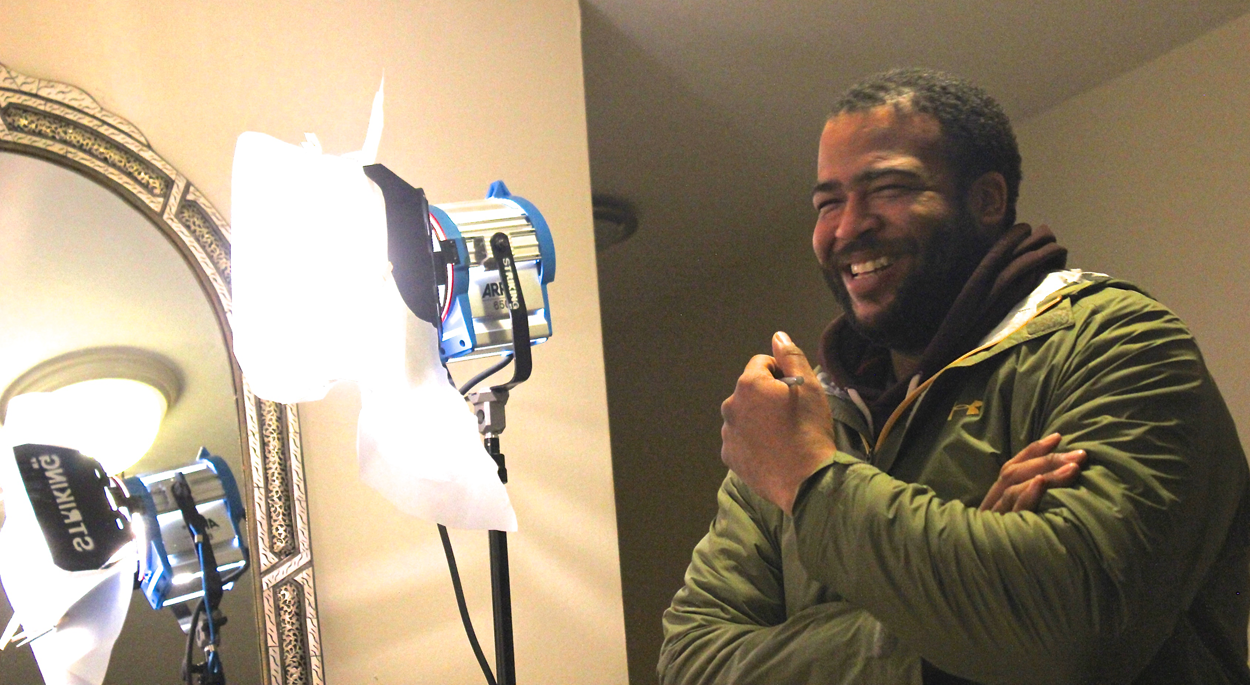
Speaking of his work at LATEA with his company, later to become the Soñadores Players, Esquea wrote, “We have suspended our audience's preconceived ideas about our backgrounds and made the story their main concern. We strive to transcend the limitations of oppression through the theatrical experience and we strive to interpret Shakespeare's work successfully.”Footnote 9 Soñadores productions are known for a practice sometimes called color-blind or “open” casting, and feature Latinx, African American and Asian American actors, reflecting the demographics of Manhattan's Lower East Side where they perform. This neat description fails to capture the extent to which Esquea's Shakespeare productions test the possibilities of consciously racialized casting on the Shakespearean stage (Figure 3).
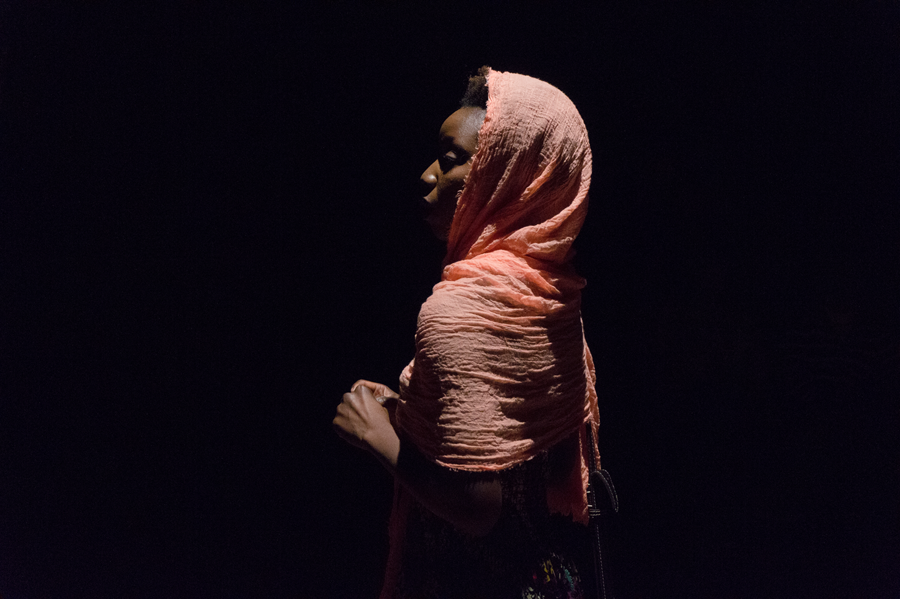
Celia becomes Aliena, As You Like It, 2016, Clemente Soto Velez Cultural and Educational Center, Flamboyan Theater, Esther Ayomide Akinsanya. Photo by Amber McDonald.
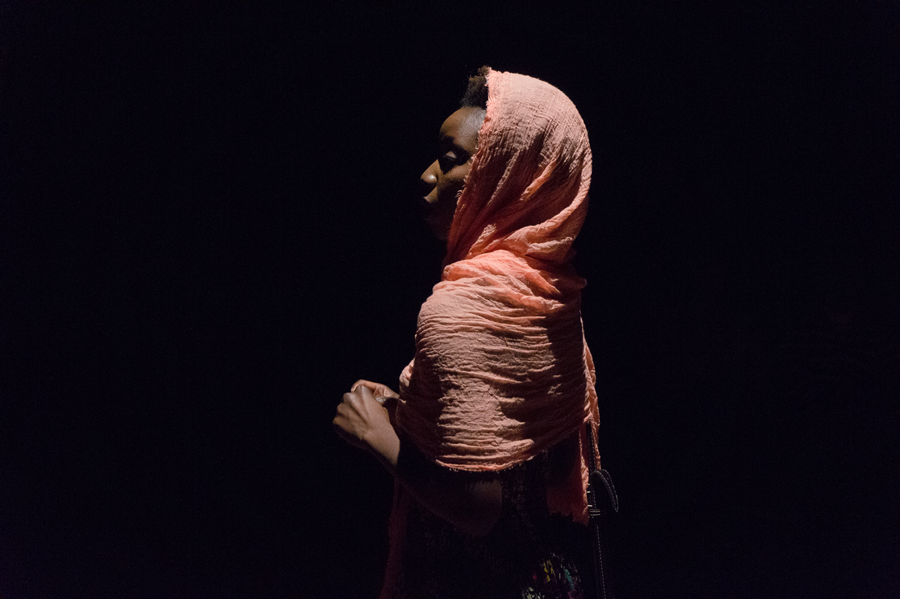
Past productions have, in Esquea's words, “fus[ed] experimental and classical theater,” by doubling lead roles (casting two actors for the same part), switching the genders of major and minor characters, and featuring multiple languages in the same performance.Footnote 10 And Esquea employs not “color-blind” but deliberately and provocatively color-conscious casting – or caste-ing – that calls attention to the way that actors’ skin color, accent, language, ethnicity, gender and sexual orientation change how audiences perceive characters in the play, understand their actions, and interpret their status in relation to other characters. Most notably, Esquea's casts include a mixture of seasoned professional actors, young professionals with very little experience, and amateurs from the community that “have never set foot in a theater, much less attempted classical theater.”Footnote 11 Thus, in building casts with different backgrounds, Esquea is intent on representing racial diversity as well as what he calls “mixed ability.”Footnote 12
In response to a question in which I referred to such casting practices as “unusual,” Esquea took issue with the characterization.
I wouldn't call it “unusual” casting, because to call it “unusual” casting means again surrendering to the idea that we, as actors of color, do not belong there … Now obviously as people of color … for us to be cast in classical pieces, it is unusual, it is untraditional, it is rare … Don't get me wrong, of course I understand why we call it “unusual.” It has to do with, again, with our own acceptance of the system of subjugation that we live under. We have to call it “unusual” because then other people understand what we mean. But the reality of it is that it is not unusual.Footnote 13
In Hamlet (2006) Esquea represented class difference through color difference, a social hierarchy that ran from fair-skinned royals to dark-skinned grave-diggers. In Othello (2007), Esquea cast two African American actors, one male and one female, in the title role. In Romeo and Juliet (2009), set in New York's Lower East Side, the lovers were played by a Chinese actor and a Latina actor (Figure 4). Amongst themselves, the Capulets spoke only Spanish, while the Montagues spoke Cantonese. I asked Esquea what he had planned for the upcoming production of the comedy The Taming of the Shrew. As he envisions it, the play will feature sisters Katharina and Bianca Minola and their father, the wealthy merchant, Baptista, as members of a mixed-race family, living in the US South in an unnamed time period that may evoke contemporary as well as the antebellum and Jim Crow eras, a place where, Esquea said, “It's supposed to be the twenty-first century but it feels like its back in a segregated twentieth century.”Footnote 14
Romeo kills Tybalt, Romeo and Juliet, 2009, Teatro LATEA. Left to right: Chester Poon and Gary Orlando Maxwell. Photo by Anthony Ruiz.

Against this backdrop, the tensions between Kate and Bianca, between the undesirably “shrewish” and darker-skinned older sister and her widely admired and beloved lighter-skinned younger sister, take on added layers of import. In the text of the play suitors repeatedly refer to “fair Bianca,” while Kate receives Petruchio's more dubious praise: “Kate like the hazel twig / Is straight and slender, and as brown in hue / As hazelnuts, and sweeter than the kernels.”Footnote 15
That's another reality of racially mixed families, you know. Kids will come in different shades. My brother and I are two completely different shades. That impacts the way that people – I mean my brother and I have been in situations where we're sitting on the subway and police will come and harass him and not me.Footnote 16
It is at such moments of encounter that the color line reappears. As with mixed-race families in films like Pinky (1949) and Imitation of Life (1934 and 1959), in The Taming of the Shrew that moment may come when suitors seek to court and marry the adult children of mixed heritage – “brown” Kate and her sister “fair” Bianca. The necessity of marriage, which facilitates inheritance and the production of future heirs, reintroduces unspoken familial histories of miscegenation and illegitimacy, calls attention to hierarchies of racialized beauty, and questions the efficacy and even the existence of romantic love.
Esquea had originally imagined playing Kate's suitor, Petruchio, himself: “I would have been close to Kate's color.”Footnote 17 Later, he reenvisioned the part played by a “hypermasculine, darker-skinned” actor.Footnote 18 Now, Esquea is toying with the idea of double-casting Petruchio with both a dark-skinned actor and a fair-skinned or white actor. Any of these permutations would elicit a response from an audience trained to attend to race difference in “real” and in staged performances of physical and emotional intimacy. If two actors with different skin tones play the role of Petruchio, audiences will see two very different dramas, both familial and racial, play out.
Esquea's production will bring a mixed-race family to Shakespeare, and a romanticized US South to New York City. It will also bring a mixed-ability cast to The Taming of the Shrew, a play with as many as twenty-four characters, including non-speaking roles.Footnote 19 As Esquea noted, it is the sheer size of the cast (along with any period costuming and props) that makes mounting any Shakespeare production difficult:
The scary thing about Shakespeare productions to especially present-day independent producers in New York City is just the casts are huge … the actors’ salaries alone … it is pretty cost-prohibitive to try to do. Aside from that, the other thing that is an incredible challenge is the New York City market for theater rental. Even small theaters are becoming increasingly unaffordable for independent producers.Footnote 20
I asked Esquea if there was anything he would want the readers of this essay to know.
If you're in New York, support small local theater, especially if that small local theater is doing Shakespeare … There are these companies that are doing really fantastic work … and not just my company, any company … That's the only way to keep the work alive.Footnote 21
My conversations with Esquea have prompted me to recontextualize and to curate my own experience as a small piece of the history of Shakespeare and black America. How does my own mixed race and mixed-race family fit into this larger story and to what extent does my identity as a scholar of color and scholar of mixed race inform the questions I ask in my scholarship? My father, who migrated to the US as a young college student from Nigeria, had read his paperback copy of Julius Caesar in Ebelle, a small village where the houses have mud walls and dirt floors, and at Government College Ughelli, a British prep school for boys, where he played Antonio in a school production of The Merchant of Venice. Recently, Nikhil, my teenage nephew, sent me a text from his high-school library to ask me where to start his research for a paper on racism in Shakespeare. His teacher had told him he wasn't likely to find any articles or books on that topic. Nikhil is third-generation Indian American. His grandparents, my in-laws, studied Shakespeare in British schools, too. Somehow, though, these past experiences, and the everyday experiences of my big and growing mixed-race, family don't seem to enter into my published work as a Shakespearean. My conversation with José Esquea reminded me that the task of transforming the field is one that my own experiences have equipped me to do: he writes, “After many casting disappointments, I turned to directing and producing. I believed that as the director/producer, I would be able to create the world in which the story took place, thereby freeing me and my fellow actors of color from the racist constraints of our industry.”Footnote 22 If we rise to take on the role of director and producer – I suppose author and editor would be our scholarly analogue – we can effect change.