Anterior cruciate ligament (ACL) reconstruction is one of the most common orthopedic surgeries in the United States, with an estimated 100,000 procedures annually.Reference Lyman, Koulouvaris, Sherman, Do, Mandl and Marx 1 – Reference Katz, Battaglia, Patino, Reichmann, Hunter and Richmond 4 Risk of deep tissue infection following ACL reconstruction is low, with reports ranging from 0.14–1.7%.Reference Katz, Battaglia, Patino, Reichmann, Hunter and Richmond 4 – Reference Williams, Laurencin, Warren, Speciale, Brause and O’Brien 18 However, these infections can be devastating because treatment often requires additional operative procedures and extended courses of intravenous antibiotics.
Risk factors for infection following ACL reconstruction are not well characterized. Risk factors typically associated with surgical site infections presumably also hold true for ACL reconstruction, but a recurring area of controversy is whether graft choice influences infection risk. Options include replacing the damaged ligament with either allograft tissue harvested from a deceased human donor or autograft tissue harvested from the index patient. The most common autograft harvest tissues are hamstring and bone-patellar tendon-bone.
Potential advantages of allograft tissue include avoiding harvest site morbidity, shortening operative time, decreasing postoperative pain, and flexibility to choose from a variety of graft sizes.Reference Baer and Harner 19 – Reference Strickland, MacGillivray and Warren 21 There is concern, however, that introducing tissue from deceased human donors may increase the risk of infection.Reference Mallick, Mosquera, Zinderman, Martin and Wise 22 – 33 Studies to date comparing allograft vs autograft tissue for ACL reconstruction have not found statistically significant differences in infection risk but may have been underpowered.Reference Greenberg, Robertson, Vallurupalli, White and Allen 3 – Reference Barker, Drakos, Maak, Warren, Williams and Allen 5 , Reference Indelli, Dillingham, Fanton and Schurman 16 Given these concerns, we conducted a study to assess risk factors for infection following ACL reconstruction, with particular attention to the role played by the type of graft implanted.
METHODS
Setting and Population
The study was conducted at 6 US health plans: Harvard Pilgrim Health Care, HealthPartners Institute for Education and Research, Henry Ford Health System, LCF Research, Kaiser Permanente Georgia, and Kaiser Permanente Hawaii. Each site’s institutional review board provided approval.
As described in a previous study,Reference Murphy, Du and Hua 34 we searched insurance claims from each site for Current Procedural Terminology code 29888 (arthroscopically aided ACL reconstruction) and International Classification of Diseases, Ninth Revision procedure code 81.45 (other repair of the cruciate ligaments) to identify all patients undergoing ACL reconstruction from January 1, 2000, through December 31, 2008.
Medical Record Review
We reviewed medical records for a sample of patients undergoing ACL reconstruction to identify clinical characteristics, operative factors, and surgical site infections. We used a hierarchical stratified sampling strategy to identify patients for medical record review. This strategy preferentially selected patients considered a priori to have a higher probability of infection on the basis of claims codes suggestive of possible infection within the 6 months following surgery. These claims codes included new claims for readmission, reoperation, microbiology tests, infection management procedures, and/or new antibiotic dispensings. Patients were divided into 5 non-overlapping strata on the basis of their claims codes. Within each stratum, a random sample was selected for medical record review with a greater proportion of patients sampled in the higher probability strata compared with the lower probability strata. This method is described in further detail elsewhereReference Murphy, Du and Hua 34 and additional information is included in the supplementary materials.
At each study site, a trained nurse reviewed medical records and abstracted data including demographic characteristics, medical histories, comorbidities, medications, surgical procedures, and evidence of presence or absence of a surgical site infection within 6 months of surgery. An infectious disease physician with expertise in infection control trained the lead abstractor, who in turn trained all the other abstractors. All unclear cases were referred to the lead abstractor and infectious disease physician for adjudication.
Abstractors were instructed to assess an extensive list of infection risk factors: prior infection in the affected knee, prior surgery in the affected knee, chemotherapy within the past year, bone marrow transplant, cancer, diabetes, human immunodeficiency virus, renal disease (defined as creatinine level ≥2), organ transplant, connective tissue disorder (eg, rheumatoid arthritis, Marfan syndrome, Ehlers-Danlos syndrome), immune suppressive medications (eg, tumor necrosis factor–blockers, azathioprine, cellcept) within 1 month before surgery or 3 months following surgery, prolonged (>2 weeks) oral or intravenous steroids within 1 month prior or 3 months following surgery, and radiation therapy to the affected knee at any time before surgery or 3 months following surgery.
Abstractors applied Centers for Disease Control and Prevention’s National Healthcare Safety Network definitions for surgical site infections, classifying them as deep or organ/space (hereafter referred to as “deep” infections) or superficial.Reference Horan, Andrus and Dudeck 35 We limited the postoperative risk window for deep infections to 6 months rather than 1 year because prior studies have shown that nearly all infections occur within this time frame.Reference Crawford, Kainer and Jernigan 2 , Reference Katz, Battaglia, Patino, Reichmann, Hunter and Richmond 4 , Reference Barker, Drakos, Maak, Warren, Williams and Allen 5 , Reference Wang, Ao, Wang, Hu, Cui and Yu 8 , Reference Binnet and Basarir 9 , Reference Van Tongel, Stuyck, Bellemans and Vandenneucker 11 – Reference Schollin-Borg, Michaelsson and Rahme 15 , Reference Williams, Laurencin, Warren, Speciale, Brause and O’Brien 18 If a patient was determined to have an infection, the abstractors recorded any pathogens identified. For surgeries using an autograft, we only included infections of the implant site in infection incidence estimates, not the harvest site.
Statistical Analysis
We estimated infection risk in the entire study cohort by calculating the incidence of infection within the subset of sampled medical records for each stratum and then projecting to the total population using inverse probability weighting. This method corrects for the oversampling of patients most likely to have infections. Specifically, for each combination of study site and sampling strata, we estimated the number of infections as Estimated Infections=Patients Identified* (Confirmed Infections/Records Reviewed). We added across all strata and divided the total estimated infections by the total number of patients identified to estimate the risk of infection. We generated confidence intervals (CIs) using Monte Carlo simulations. Specifically, we simulated the number of infections for each stratum using the binomial distribution and probabilities estimated from the observed data. We repeated this process 100,000 times and derived 95% CIs from the resulting 2.5 and 97.5 percentiles.
We used logistic regression to assess the association between infections and patients’ demographic characteristics, comorbidities, and choice of graft. Only patients whose medical records were reviewed were included in this analysis with each observation weighted using the inverse of the patient’s probability of being sampled to reflect the entire study cohort. We used deep infections as the outcome for this analysis because they are clinically unambiguous and more serious events than superficial infections. Analyses were performed using SAS, version 9.3 (SAS Institute).
RESULTS
We identified 11,778 patients with procedure codes for ACL reconstructions. We requested 2,044 medical records and received 1,752 for review. Of these, 1,452 had sufficient information to confirm ACL reconstruction, graft type, and infection status. At some study sites there were medical record review strata with no records reviewed. These strata with no medical record data did not contribute to the projected population, thus our projected study population is 11,772, instead of 11,778.
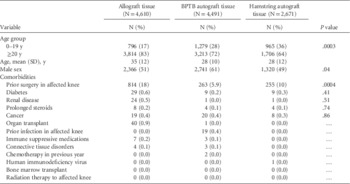
On review of the medical records, 485 procedures (33%) used allograft tissue, 561 (39%) used bone-patellar tendon-bone autograft tissue, and 406 (28%) used hamstring autograft tissue. After correcting for sampling weights, we projected 4,610 allograft recipients (39%), 4,491 bone-patellar tendon-bone autograft recipients (38%), and 2,671 hamstring autograft recipients (23%) in the total population. Characteristics of these patients are presented in Table 1. Hamstring autograft recipients were more likely to be younger than bone-patellar tendon-bone graft recipients and allograft recipients (36% of hamstring recipients were younger than 20 years compared with 28% for bone-patellar tendon-bone autograft recipients and 17% for allograft recipients; P=.0003). They were also less likely to be male (49% compared with 61% for bone-patellar tendon-bone autograft recipients and 51% of allograft recipients). Allograft tissue recipients were most likely to have had prior surgery in the affected knee (18%), followed by 10% of hamstring autograft recipients, and 5.8% of bone-patellar tendon-bone autograft recipients (P=.0004).
Characteristics of Patients Undergoing Anterior Cruciate Ligament Reconstruction

NOTE. Projected results are based on 485 procedures using allograft tissue, 561 using bone-patellar tendon-bone (BPTB) autograft tissue, and 406 using hamstring autograft tissue, corrected for sampling weights. See supplementary materials for results from this sample.
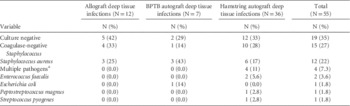
We identified 203 infections (55 deep and 148 superficial) through medical record review. After correcting for sampling weights, we projected 496 infections (121 deep and 375 superficial) for an overall infection risk of 4.2% (95% CI, 3.4%–5.1%) and a deep infection risk of 1.0% (0.7%–1.4%) in the 6 months following surgery. The rate of deep infection was 0.5% (95% CI, 0.3%–0.8%) among allograft recipients, 0.6% (0.1%–1.5%) among bone-patellar tendon-bone autograft recipients, and 2.5% (1.9%–3.1%) among hamstring autograft recipients. The pathogens identified from patients with deep tissue infections are shown in Table 2. Coagulase-negative Staphylococcus was the most common organism overall (27%) and for both allograft tissue recipients and hamstring autograft tissue recipients (33% and 28%, respectively). Among bone-patellar tendon-bone autograft recipients Staphylococcus aureus was the most common pathogen (43%). A plurality of deep infections (35% overall) were culture negative.
Pathogens by Graft Type

NOTE. Results from 55 deep tissue infections confirmed by medical record review. BPTB, bone-patellar tendon-bone.
a Multiple pathogen cases: (1) Acinetobacter lwoffi, Corynebacterium, and Enterococcus faecalis; (2) coagulase-negative Staphylococcus and Staphylococcus aureus; (3) Klebsiella and Pseudomonas; (4) Peptostreptococcus magnus and Staphylococcus aureus.
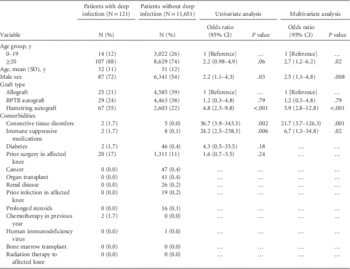
Characteristics of patients with and without deep tissue infections are presented in Table 3. In the univariate analysis, patients with deep infections were more likely to be male, to have hamstring autograft tissue implanted, to have connective tissue disorders, and to be taking immune suppressive medications. In the multivariate analysis, hamstring autograft tissue implanted (OR, 5.9; 95% CI, 2.8–12.8), connective tissue disorders (21.7; 3.7–126.3), male sex (2.5; 1.3–4.8), age 20 years or greater (2.7; 1.2–6.2), and use of immune suppressive medication (6.7; 1.3–34.8) remained significant risk factors.
Risk Factors for Infection After Anterior Cruciate Ligament Reconstruction

NOTE. Projected results are based on 55 patients with deep infection and 1,397 without deep infection, corrected for sampling weights. See supplementary materials for results from this sample. BPTB, bone-patellar tendon-bone.
Autograft recipients had a significantly elevated risk of infection compared with allograft recipients (OR, 2.7; 95% CI, 1.2–5.9). However, there was no difference in risk of infection between bone-patellar tendon-bone autograft recipients vs allograft recipients (OR, 1.2; 95% CI, 0.3–4.8). Hamstring recipients, by contrast, had significantly higher risk of infection compared with both allograft recipients (OR, 5.9; 95% CI, 2.8–12.8) and bone-patellar tendon-bone autograft recipients (4.9; 1.4–17.8).
DISCUSSION
Deep surgical site infections following ACL reconstruction are rare; however, there appear to be significant differences in infection risk between different implant types. The adjusted risk of infection is higher with autograft vs allograft overall; however, this difference is driven exclusively by elevated risk with hamstring autografts vs bone-patellar tendon-bone autografts. We found no difference in the risk of infection between bone-patellar tendon-bone autografts vs allografts but significantly increased risk of infection with hamstring autografts vs allografts and vs bone-patellar bone-tendon autografts. Additional risk factors for infection include connective tissue disorders, male sex, age 20 years or greater, and immune suppressive medications.
Our estimated risk of deep infections is consistent with previous reports.Reference Katz, Battaglia, Patino, Reichmann, Hunter and Richmond 4 – Reference Williams, Laurencin, Warren, Speciale, Brause and O’Brien 18 Prior studies found trends toward decreased risk among patients receiving allograft tissue but were not statistically significant.Reference Greenberg, Robertson, Vallurupalli, White and Allen 3 – Reference Barker, Drakos, Maak, Warren, Williams and Allen 5 , Reference Indelli, Dillingham, Fanton and Schurman 16 Our large, multicenter sample makes our estimate more robust than those of prior investigations. Some of these prior studies also had the weakness of assessing autograft tissues as a homogenous entity. In our study we were able to distinguish hamstring vs bone-patellar tendon-bone autografts and identified a significantly increased risk of infection in recipients of the former but not the latter. Decreased surgical time, less extensive tissue dissection, and less graft preparation have been proposed as explanations for decreased infection risk among allograft recipients. The only organisms identified in infections following allograft procedures, and in most of the infections following autograft procedures, are common on the skin and are frequently present in postsurgical infections in general.
The increased risk of infection with hamstring autografts vs bone-patellar tendon-bone autografts has been previously observed but the reasons for increased risk with this harvest site remain unclear.Reference Barker, Drakos, Maak, Warren, Williams and Allen 5 , Reference Maletis, Inacio, Reynolds, Desmond, Maletis and Funahashi 6 Maletis et alReference Maletis, Inacio, Reynolds, Desmond, Maletis and Funahashi 6 proposed several potential causal mechanisms, including increased preparation time for hamstring autografts; use of multifilament suture that may harbor bacteria in preparation of hamstring grafts; and the location of the hamstring graft harvest site directly over the tibial tunnel site as opposed to allograft (no harvest site) or bone-patellar tendon-bone (contralateral knee), perhaps creating a wound environment more conducive to bacterial growth. We further speculate that the patellar fossa may be a more conducive environment for bacterial growth because it is less exposed, more difficult for patients to routinely clean, more likely to have hair, and perhaps more often moist than the anterior patellar in some patients. Furthermore, the patellar fossa may be more difficult to disinfect adequately during surgery compared with the patellar region given its more complex topography and the increased difficulty of adequately positioning patients to access this site compared with the anterior patellar. Finally, there has been a case report of 3 hamstring autograft infections attributed to improper sterilization of the graft harvester.Reference Tuman, Diduch, Baumfeld, Rubino and Hart 36
An important limitation of our study is its retrospective design. Operative details such as concurrent procedures (eg, meniscus or posterior cruciate ligament repair), tourniquet use, length of surgery, and prophylactic antibiotics were not always available in the medical records. These potential risk factors for infection were not included in our analysis and may be sources of residual confounding. Additionally, we note that some of the potential risk factors for infection we assessed are rare (eg, radiation therapy, bone marrow transplant, renal disease) and therefore we cannot reliably estimate their true infection risk despite our large sample size. Another potential limitation is the decision to limit the postoperative risk window for deep infections to 6 months rather than 1 year, per National Healthcare Safety Network criteria. In our study, 98% of confirmed deep infections occurred within 90 days of surgery, which is consistent with prior reports.Reference Crawford, Kainer and Jernigan 2 , Reference Katz, Battaglia, Patino, Reichmann, Hunter and Richmond 4 , Reference Barker, Drakos, Maak, Warren, Williams and Allen 5 , Reference Wang, Ao, Wang, Hu, Cui and Yu 8 , Reference Binnet and Basarir 9 , Reference Van Tongel, Stuyck, Bellemans and Vandenneucker 11 – Reference Schollin-Borg, Michaelsson and Rahme 15 , Reference Williams, Laurencin, Warren, Speciale, Brause and O’Brien 18
In conclusion, we found that risk of deep infection following ACL reconstruction is low. We found no significant difference in infection risk between allografts and bone-patellar tendon-bone autografts, but there was a significantly elevated infection risk with use of hamstring autograft tissue. Our results contribute to a growing body of evidence that use of allograft tissue implants in ACL reconstruction is a safe alternative to surgery with autografts. Other risk factors for infection included connective tissue disorders, male sex, age, and immune suppressive medications.
ACKNOWLEDGMENTS
We thank the project managers, programmers, and medical record reviewers at each site. We thank Yury Vilk for developing the data extraction program and Victoria J. Morrison for leading record reviews and training abstractors at each site.
Financial support. US Food and Drug Administration (HHSF223200810026I/TO6 and HHSF22301005T).
Potential conflicts of interest. All authors report no conflicts of interest relevant to this article.
Disclaimer: The views expressed in this paper are those of the authors and are not intended to convey official Food and Drug Administration policy or guidance.
SUPPLEMENTARY MATERIAL
To view supplementary material for this article, please visit http://dx.doi.org/10.1017/ice.2016.65