Introduction
The CyberKnife robotic radiosurgical system (CK) is a stereotactic device that has been used to treat extracranial sites since 2001 when the system received approval from the American Food and Drugs Agency.Reference Gibbs1 CK is one of the major modalities available enabling the stereotactic radiosurgery principles, developed by the neurosurgeon Lars Leksell, to be applied to extra cranial sites.Reference Martin and Gaya2
This application of radiosurgical principles to extra cranial sites is referred to as stereotactic body radiotherapy (SBRT) and is characterised by the irradiation of an image-defined lesion by a number of precise beams with treatment given in no more than five fractions.Reference Martin and Gaya2 Some noted challenges for the delivery of SBRT lie in the inherent lack of consistency in the position of internal targets within the abdo-thoracic region.Reference Read3
CK SBRT may be considered a novel modality in the United Kingdom but its principles are based on well-established radiosurgical practice. The recent report from the National Radiotherapy Implementation Group (NRIG) notes that the rapid evolution in SBRT has arisen from technological advances.Reference Kirkbride and Cooper4 SBRT can offer much shorter fractionation, less side effects and potentially greater chances of disease control.Reference Kirkbride and Cooper4 There are clear reasons why SBRT is beneficial. Systems such as the CK possess imaging capabilities that allow the verification, tracking and correction of tumour and patient movement.Reference Joseph5 This gives greater confidence in treatment delivery allowing tighter margins to be placed onto target volumes with the application of a number of thin beams of radiation creating highly conformal treatment plans.Reference Read3 This increased conformality then allows for the greater sparing of normal tissues.Reference Read3 Higher doses of radiotherapy can lead to a greater chance of local controlReference Schick6 as hypofractionation can bypass the radiobiological challenges of hypoxia, the cell cycle and rapid clonogen repopulation.Reference Joseph5
SBRT can offer both palliative and curative options to patients whose treatment choices are severely limited due to co-morbidities.Reference Kirkbride and Cooper4 Currently CK SBRT lacks a base of high-level research evidence.Reference Kirkbride and Cooper4 This is a paradox for clinicians and treatment commissioners here in the United Kingdom; there are clear benefits to CK SBRT but the required level of research evidence for proving economic and clinical outcomes is lacking. With shorter courses of treatment and comparable outcomes and side effects as compared with conventional radiotherapy (CRT), SBRT may offer a lesser burden on health resources. This is pertinent as we face the effects of an ageing population and the rising incidence of cancer.Reference Dewas7 Therefore, clinicians may look to SBRT more frequently as a treatment option. This is where the optimal selection of patients needs to come to the fore. SBRT will not be suitable for all patients and treatment options should be considered in the multidisciplinary format.Reference Muacevic, Wowra and Reiser8
In this review, the author chose to critically examine CK SBRT patient selection for two of the most common sites, the spine and pancreas in the hope of contributing to the research base in this area.
Methods
A systematic literature search was conducted. Keywords were used for the search and these included ‘CyberKnife patient selection’, ‘Stereotactic body radiotherapy’ and ‘CyberKnife body radiosurgery’. These terms were also combined with ‘pancreas’ and ‘spine’. Medline, the Cochrane Database, PubMed, Web of Science, Highwire Press, Sciencedirect and Scopus were searched. Only articles using CyberKnife to deliver SBRT were included. CK is a relatively young modality and therefore broad search terms were employed in order to identify all relevant articles. Identified articles were published in the years 2005–11.
Seventeen papers were identified for the spine, and nine for the pancreas. The majority of selected papers retrospectively assessed clinical or dosimetric outcomes of CK SBRT; however, four literature reviews and two prospective studies were also found. No randomised clinical trials (RCT) or meta-analyses (MA) were identified. Methodology checklists from the Scottish Intercollegiate Guideline Network were employed.9
Spine analysis
Spinal metastases
Wowra et al.Reference Wowra, Zausinger and Drexler10 evaluated 102 patients with no more than two spinal metastases who underwent single fraction CK SBRT.Reference Wowra, Zausinger and Drexler10 The studies’ methodology was well thought out in ensuring that patients had similar performance status, but the paper states that only small lesions were included, and the median and maximum size given were 16·4 and 64·3 cm3, respectively. Thorough statistical analysis was provided through the application of the Kaplan Meier method (KMM), log-rank tests and Cox proportional hazard analysis (CPH), however, there was still a large variation in the doses given despite single-fraction delivery.Reference Wowra, Zausinger and Drexler10 Despite this variation in dose, this paper reports high rates of local control with no acute spinal toxicity.Reference Wowra, Zausinger and Drexler10
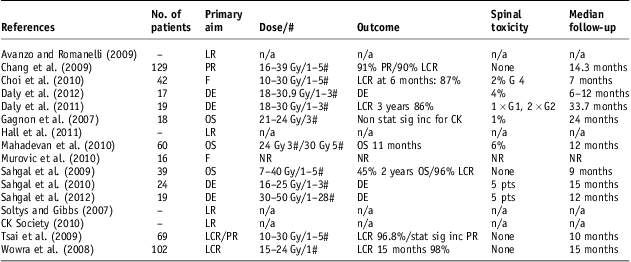
Chang et al.Reference Chang, Youn, Park and Rhee11 reported on a cohort of 129 patients. This paper reported on the treatment of metastases throughout the spine and from a variety of primary sources; it also notes that patients were a mixture of previously irradiated and primary treatments.Reference Chang, Youn, Park and Rhee11 This paper applied overall higher biological equivalent doses (BED) than comparable papers (57·4 Gy rather than a typical 45–55 Gy range, see Table 1) and achieved excellent rates of both pain relief and local control with no acute spinal toxicity.Reference Chang, Youn, Park and Rhee11 The strength of the papers findings are limited due to the large variation in dose fractionation and the authors did not apply any statistical analysis bar the calculation of BED.Reference Chang, Youn, Park and Rhee11 This paper does, however, report on the safe application of CK SBRT for the contiguous treatment of multiple spinal metastases.Reference Chang, Youn, Park and Rhee11 In their conclusions, the authors also endorse CK SBRT in a primary role for the clinical management of spinal metastases though higher levels of evidence would be required before this could be a full recommendation.Reference Chang, Youn, Park and Rhee11
Spine summary of findings table

Abbreviations: CK, CyberKnife robotic radiosurgical system; DE, dosimetric evaluation; F, feasibility; LCR, local control rate; LR, literature review; NR, not reported; OS, overall survival; PR, pain relief; Sx, Surgery.
Spinal re-irradiation
The re-irradiation of spinal metastases is a common clinical challenge and can be caused by a lack of pain relief or an increase in size of the metastasis or both.Reference Avanzo and Romanelli12
The feasibility of CK SBRT for the re-irradiation of spinal metastases in close proximity to the spinal cord is demonstrated by Choi et al.Reference Choi, Alder and Gibbs13 In this paper, the treatment of 42 patients over a 6-year period was retrospectively evaluated.Reference Choi, Alder and Gibbs13 Despite this being a single-institution study with short median follow-up and variety of dose and fractionation, the researchers applied detailed dosimetric evaluation coupled with KMM and CPH analysis. The study demonstrated high rates of local control with minimal toxicity.Reference Choi, Alder and Gibbs13 The authors found that patients who required a repeat treatment within 12 months of their CRT suffered worse local control from their CK SBRT.Reference Choi, Alder and Gibbs13 This may indicate that higher doses may be required for these patients. This concept is endorsed by a paper published from Taiwan in which the authors stated that higher doses should be investigated to further the clinical benefits of CK SBRT.Reference Tsai14
In 2007, Gagnon et al.Reference Gagnon, Henderson and Gehan15 evaluated CK SBRT for the treatment of metastases from breast cancer. This paper demonstrated an innovative way to retrospectively create a pseudo control group by including patients who received CRT only and those who needed follow up CK SBRT.Reference Gagnon, Henderson and Gehan15 The authors used matched pair analysis between the two groups in an attempt to make the analysis as robust as possible.Reference Gagnon, Henderson and Gehan15 This paper suffered from low patient numbers but employed a median follow-up period of 2 years and the dose fractionation used was more consistent than in other studies.Reference Gagnon, Henderson and Gehan15 This review did not demonstrate statistically significant improvements in outcomes but low rates of spinal toxicity between the two groups of patients were reported.Reference Gagnon, Henderson and Gehan15
Sahgal et al.Reference Sahgal, Ames and Chou16 compared patients who received CK SBRT as first-line therapy with those who received it as a salvage treatment.Reference Sahgal, Ames and Chou16 Just over half the patients in the study had received prior CRT, but the paper was hampered by the low number of patients and by a lack of imaging follow-up caused by the death of patients. In addition, there was a significant variation in the dose fractionation and the inclusion of repeat SBRT treatments.Reference Sahgal, Ames and Chou16 However, the 1-year local control rates were 96% and no radiation induced myelopathy (RM) was seen.Reference Sahgal, Ames and Chou16 The reliability of this study's findings can be attributed to a combination of detailed dosimetric evaluation and stringent statistical analysis including descriptive methods, KMM, CPH and log-rank tests.Reference Sahgal, Ames and Chou16 This study also conducted an exploratory analysis on factors to indicate likelihood of local failure following CK SBRT.Reference Sahgal, Ames and Chou16 The analysis indicated a potential relationship when the distance from the thecal sac to the planning target volume is a millimetre or under.Reference Sahgal, Ames and Chou16
A similar paper by Mahadevan et al.Reference Mahadevan, Floyd, Wong, Jeyapalan, Groff and Kasper17 examining recurrent epidural disease from 2010 failed to apply any statistical analysis to its cohort of 60 patients despite the study demonstrating less variability in the dose delivered than comparable papers. Because of this, only feasibility can be determined from this study.
Primary lesions and spinal cord tolerance
The feasibility of CK SBRT has also been established for primary lesions of the spine. A recent retrospective study analysed the efficacy of CK SBRT for the management of foraminal nerve sheath tumours with surgery.Reference Murovic, Charles Cho and Park18 This paper struggled with low patient numbers, patient characteristics differed from surgery only patients, no clinical outcomes or toxicity were reported and the majority of the papers’ discussion focussed on surgical aspects of operating on different areas of the spine.Reference Murovic, Charles Cho and Park18 This paper represents a missed opportunity to comment on a new clinical application for CK SBRT.
A major area of uncertainty is the reliability of prediction of SBRT-related toxicity and cord tolerance itself.Reference Hall, Stapleford, Hadjipanayis, Curran, Crocker and Shu19 A recent study by Daly et al.Reference Daly, Luxton and Choi20 set out to determine the accuracy of current complication probability methods in order to predict the likelihood of RM from CK SBRT. This paper retrospectively analysed single-fraction treatment of 17 patients with spinal haemangioblastomas and employed complex dosimetric modelling to determine α/β ratios and evaluation of toxicity.Reference Daly, Luxton and Choi20 A range of doses were applied, which added to the difficulty in toxicity probability estimation but the authors were able to determine that the current method of predicting toxicity indicated that the spinal cord tolerance was higher than previously thought.Reference Daly, Luxton and Choi20 However, this paper examined the treatment of small, primary spinal lesions and as this was a single-centre retrospective study with low patient numbers findings cannot be conclusive.Reference Daly, Luxton and Choi20
Sahgal et al.Reference Sahgal, Lijun and Gibbs21 undertook a retrospective analysis of patients who reported no toxicity to a smaller subset who suffered RM. Despite the overall low numbers of patients, and a difference in size of the two cohorts, this paper delivered a detailed insight into a complex area of dosimetry.Reference Sahgal, Lijun and Gibbs21 From the application of analysis of variance methods and the Mann–Whitney test, the paper reaches appropriate evidence-based conclusions; re-emphasising the need to maintain a 10 Gy maximum point tolerance to the thecal sac.Reference Sahgal, Lijun and Gibbs21 The same investigators undertook further work, this time examining spinal cord tolerance of CK SBRT following CRT.Reference Sahgal, Lijun and Weinberg22 The same robust statistical analysis was applied here but the findings were again hampered by low patient numbers and short median follow-up time.Reference Sahgal, Lijun and Weinberg22 Despite these drawbacks, the authors were able to offer some guidelines for safe practice though they were not able to offer firm conclusions in terms of further dose escalation.Reference Sahgal, Lijun and Weinberg22 The papers’ safe practice guidelines included a maximum BED to the thecal sac and minimum time period following CRT before attempting CK SBRT.Reference Sahgal, Lijun and Weinberg22
Daly et al.Reference Daly, Choi and Gibbs23 also followed previous work with a paper focussing on the spinal cord tolerance to CK SBRT. The authors offered comprehensive dosimetric analysis but no additional statistical evaluation was employed, which reduces the weight of the papers’ findings.Reference Daly, Choi and Gibbs23 However, safe exceeding of historical spinal cord tolerances and a high local control rate were reported though targets were small with a median volume of 0·16 cm3, and this may indicate a difference in partial cord volume tolerances.Reference Daly, Choi and Gibbs23 This paper indicates that further dose escalation may be possible but multicentre studies would be required to confirm this.Reference Daly, Choi and Gibbs23
Spine summary and recommendations
The treatment of the spinal metastases is increasing as patients live longer with progressive disease.Reference Chang, Youn, Park and Rhee11 CRT has been a mainstay for the treatment of spinal metastases but SBRT allows greater sparing of the spinal cord.Reference Tsai14 The ability to safely deliver hypofractionated doses via CK has also been found to improve pain relief and increase the chance of retaining neurological function.Reference Chang, Youn, Park and Rhee11 Patients who are inoperable24 or that are not suitable for CRT can now be treated because of the increased accuracy associated with SBRT.Reference Soltys and Gibbs25
SBRT to the spine is safe and clinically effective for both metastatic and primary lesions. Low levels of RM are seen and almost without exception studies demonstrate high rates of local control. In particular, SBRT can be recommended for patients who require re-irradiation and for those patients with multiple lesions who are clinically fit.
Given that SBRT is a common modality successfully used to treat spinal metastases, should it be considered as a primary treatment in the first instance? Results are demonstrably superior to those of CRT. As more patients live longer with metastatic disease, this means that they are more likely to develop spinal metastases. This in turn means that there is a greater emphasis on providing these patients with the best possible outcomes while minimising the risk of toxicity. However, uncertainties with regard to optimal dose and fractionation are still present and there is a requirement for prospective multicentre trials to determine this. Further higher level research is also required to determine if spinal cord tolerances truly are different between point and partial volumes as this may have an impact on the potential of further safe dose escalation.
Pancreas
Pancreatic cancer represents a significant clinical challenge. Five-year survival rates are 5% and this dismal prognosis can be attributed to two characteristic features of pancreatic cancer. First, surgery currently represents the only possibility of long-term control, however, 50% of patients present with inoperable disease.Reference Schellenberg, Quon and Minn26 Second, patients rapidly develop systemic disease following first-line treatment causing survival to rarely extend beyond 15 months.Reference Seo27 Because of the inoperability of half of presenting patients a combination of chemotherapy (Cx) and radiotherapy treatment has been applied.Reference Seo27 Previously, CRT was applied in the management of these patients to try and achieve local control, however, as SBRT has become more widely established it has been increasing in use as an adjuvant treatment alongside Cx.Reference Koong, Christoffer Son and Le28 Researchers have experimented with the addition of Cx to try and prevent the onset of distant metastases.Reference Schellenberg, Goodman and Lee29
CK SBRT and chemotherapy
Koong et al.Reference Koong, Christoffer Son and Le28 analysed the outcomes of 19 patients who received CK SBRT as phase II treatment following intensity-modulated radiotherapy (IMRT) and concurrent 5-fluorouracil (5FU) Cx to the primary tumour and adjacent lymph nodes. This study demonstrated excellent local control but did not translate into any improvement in survival and high rates of gastrointestinal (GI) toxicities were reported.Reference Koong, Christoffer Son and Le28 Furthermore, because of the rapid onset of systemic disease, the authors subsequently altered their management of these patients to weekly gemcitabine Cx (GCx) plus SBRT instead of IMRT and weekly 5FU.
A similar program of treatment was investigated by Seo et al.Reference Seo27 with a major difference that CRT preceded SBRT instead of IMRT. This study was limited by the uneven numbers of patients who received CK SBRT as compared with those who received CRT only. In contrast to similar studies, low and varying doses were used. This further limited the study's findings.Reference Seo27 In addition, higher rates of GI toxicity were seen and can be attributed to the use of CRT.Reference Seo27 However, comparable rates of overall survival (OS; 60% at 1 year) were seen and based on this the authors called for phase II studies.Reference Seo27
Schellenberg et al.Reference Schellenberg, Goodman and Lee29 investigated single-session CK SBRT in between cycles of GCx. This study found that single-session SBRT and GCx had comparable survival to CRT and GCx.Reference Schellenberg, Goodman and Lee29 Acute toxicity was moderate but the researchers found that late GI toxicity was more frequent.Reference Schellenberg, Goodman and Lee29 Findings were reinforced by KMM analysis and the paper gave a detailed analysis of comparable studies to further justify its conclusions.Reference Schellenberg, Goodman and Lee29
Chang et al.Reference Chang, Schellenberg and Shen30 reported on 77 patients who received CK SBRT and GCx for inoperable pancreatic cancer. This paper also used a standard CK SBRT dose of 25 Gy in one fraction with patients undergoing a variation in GCx regimes.Reference Chang, Schellenberg and Shen30 Clinical outcomes were disappointing as local control rate and OS were low even for pancreatic patients but only a small percentage of patients reported GI toxicity.Reference Chang, Schellenberg and Shen30 In this paper, there is omission of the details of the various GCx regimes used and the explanation of the methodology applied is simplistic.
Mahadevan et al.Reference Mahadevan31 also applied a combination of CK SBRT and GCx, but unlike other comparable studies, chemotherapy commenced after delivery of SBRT. This study demonstrated comparable clinical outcomes but because of the onset of distant metastases, the authors suggested that patients may already be suffering from micro-metastases at the start of treatment.Reference Mahadevan31 They suggest that GCx should be started earlier with restaging before CK SBRT in an attempt to identify patients at high risk of distant metastases.Reference Mahadevan31 The paper also described three different dose fractionations that were used depending on the proximity of the lesion to the duodenum; this approach was successful in terms of acute GI toxicity as high rates were not detected.Reference Mahadevan31
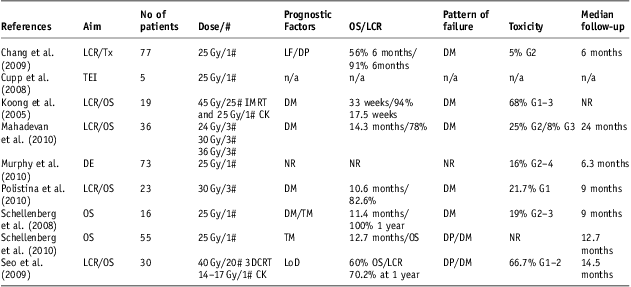
Polistina et al.Reference Polistina, Costantin and Casamassima32 reported on a prospective non-randomised multimodal approach in an attempt to make surgery possible for inoperable patients. Low patient numbers were reported but appropriate statistical analysis was used (KMM, CPH, log-rank tests) and clinical results were comparable to similar studies, see Table 2.Reference Polistina, Costantin and Casamassima32 However, the study reported very low rates of patients who were subsequently suitable for resection (8%).Reference Polistina, Costantin and Casamassima32 The authors spent considerable time discussing quality-of-life issues, an area somewhat neglected in other papers in this review. A single dose fractionation regime was applied but, akin to other studies, distant metastases were the primary cause of failure.Reference Polistina, Costantin and Casamassima32
Pancreas summary of findings table
Abbreviations: CK, CyberKnife robotic radiosurgical system; DE, dosimetric evaluation; DM, distant metastases; DP, disease progression; F, feasibility; LCR; local control rate; LF, local failure; LoD, location of disease; LR, literature review; NR, not reported; OS, overall survival; PR, pain relief; Sx, Surgery; TEI, tissue effect investigation; TM, tumour marker; Tx, Toxicity.
Duodenal tolerance to CK SBRT
The duodenum is one of the most dose-limiting organs for the treatment of pancreatic cancer and a recent study focussed particularly on its tolerance to CK SBRT.Reference Murphy33 In all, 27% of the patients in this study were treated using a non-CK modality but this was not found to have a statistically significant impact.Reference Murphy33 The authors conducted a comprehensive review of the patient's dose volume histograms and outlined tolerance doses for five different volumetric sizes, which, when breached, were statistically significant for the onset of high-grade toxicity.Reference Murphy33 The authors acknowledged that prospective trials would be necessary in order for the findings to be conclusive, but they could be used as guidance for safe practice.Reference Murphy33 The authors also noted the difficulty in assessing GI toxicity when GCx can also be responsible.Reference Murphy33 The strength of the results of this paper can be attributed to the large cohort of patients (73), and complex dosimetric evaluation coupled with thorough statistical analysis, which applied normal tissue complication probabilities and univariate and multivariate CPH.Reference Murphy33
Determining response to treatment
Schellenberg et al.Reference Schellenberg, Quon and Minn26 conducted a retrospective analysis on 55 patients who received single-fraction CK SBRT in order to ascertain the role of 18F-fluorodeoxyglucose positron emission computer tomography (FDG PET-CT) in determining progression free and overall survival. This study features a well focussed and robust methodology design. Full statistical analysis is provided and this adds credence to the papers’ findings.Reference Schellenberg, Quon and Minn26 The papers statistically significant conclusion is that FDG PET-CT scan parameters can predict the length of survival. The authors acknowledged limitations of the study, which included difference in GCx regimes used and the lack of reported performance status for all patients.Reference Schellenberg, Quon and Minn26 However, there is sufficient weight from the statistical analysis to suggest that FDG PET-CT may offer a means of predicting which patients will benefit most and could aid the selection of patients for further or more intensive treatment.
Pancreas summary and recommendations
As the prognosis for pancreatic patients is generally so poor, the focus for research, in this author's opinion, should be threefold: prediction of response to treatment, greater individualisation of treatment and more effective systemic therapy. Schellenberg's paper on using PET–CT parameters to predict length of OS and PFS is key, as patients facing a limited life span require tailored treatment that will be as clinically effective as possible while maintaining quality of life. It is clear from this review that CK SBRT is effective in local control but patients identified as having more aggressive disease may be better treated with GCx alone if there are no immediate clinical issues requiring localised SBRT.
Without doubt more effective chemotherapy is required. As Table 2 indicates, the majority of patients succumb to metastatic disease, so can the role of SBRT be further improved? Indeed, should it be when SBRT is capable of excellent local control rates, which help to maintain, and improve patients’ quality of life by reducing pain and local obstructions while also causing little significant GI toxicity.
Any advancement for pancreatic patients, however modest, would have a significant impact. There is no agreement on the precise timing and level of both SBRT and GCx and there is a need for reliable methods of predicting response in order to manage this patient group more effectively.
Currently, SBRT should be offered to any patient with inoperable pancreatic cancer and delivered in conjunction with GCx. A minimum of 6 months’ wait for the proper assessment of late side effects is also advocated.Reference Cupp, Koong, Fisher, Norton and Goodman34
Conclusion
The quality of the evidence found in this review can be described as being applicable to the targeted sample (i.e., the patients in a single institution study) and therefore only conservative conclusions or baseline recommendations can be made. The levels of evidence are insufficient for any universal guidelines. This is mainly due to a lack of RCTs and MAs and variability of the overall length of follow-up periods, especially for the comprehensive evaluation of long-term toxicities. Furthermore, patient numbers are both low and too inconsistent to justify a higher ranking of quality of evidence. However, many of the papers had well-constructed methodologies combined with stringent statistical analysis, which can justify higher quality research to be carried out.
The priority for further research for spine patients should be in cross-modality comparisons of outcomes and toxicities and multicentre studies to determine tolerance doses with greater confidence. For pancreatic patients, more effective systemic treatment is urgently required. Better means of predicting response is also vital in order to ascertain which patients will derive meaningful benefit from multimodal treatment.
The primary limitation of this literature review was the exclusion of papers using non-CK modalities. There has been no evidence generated in this review, which suggests that CK is a superior modality for the delivery of SBRT in terms of outcomes. Large number of papers were excluded, which could have contributed to the findings of the study. In addition, search terms were broad but this was partly due to the paucity of papers using the CK system for these sites.
For spine patients, there are strong grounds to propose SBRT as a first-line treatment. Uncertainties lie in the determination of the most clinically effective dose fractionation and this is intrinsically linked to the generation of further data on spinal cord tolerances.
Investigators call for more intensive treatments to try and improve survival for pancreatic patients but a careful balance must be struck between intensity of treatment and toxicities. This is not only because SBRT and GCx cause similar side effects but also because quality of life is important for patients facing a limited prognosis. SBRT offers clear advantages to these patients; much shorter overall treatment times than with CRT and with comparable, if not enhanced, clinical outcomes that maintain quality of life for as long as possible.
No papers were found that exclusively examined patient selection in detail. It is clear from this review that almost any patient diagnosed with a pancreatic cancer or spinal lesion may derive some clinical benefit from SBRT. Optimal selection of treatment for the patients in this review will ultimately be determined by greater knowledge and confidence in levels of dose-escalated hypofractionation and tolerance levels of organs at risk with a more effective means of predicting response to treatment. With greater understanding of treatment response, clinical management can be further customised so that appropriate patients can receive further intensive treatment, whereas the emphasis of non-responsive or ineligible patients can be the maintenance of their quality of life.
Acknowledgements
The author express his gratitude to the following people for their assistance: Brian Laframboise, Deborah Waters, Alistair Gifford-Moore and Catherine Holborn.
Conflict of interest
The author is responsible for the management of a CyberKnife system at his clinical centre.