Introduction
There is growing evidence that reflux (both laryngopharyngeal and gastroesophageal) has a role to play in the pathogenesis of upper aerodigestive tract squamous cell carcinoma (SCC).Reference Bacciu, Mercante, Ingegnoli, Ferri, Muzzetto and Leandro1–Reference Freije, Beatty, Campbell, Woodson, Schultz and Toohill5 In addition, some authors have suggested that controlling reflux can reduce the risk of recurrence of upper aerodigestive tract SCC.Reference Qadeer, Lopez, Wood, Esclamado, Strome and Vaezi6 Furthermore, reflux symptoms may be exacerbated by chemotherapeutic agents given in the treatment of upper aerodigestive tract SCC.Reference Biacabe, Gleich, Laccourreye, Hartl, Bouchoucha and Brasnu7
With these factors in mind, identifying and treating reflux in patients with upper aerodigestive tract SCC may potentially be as important as encouraging this patient group to stop smoking or drinking alcohol.
We assessed whether patients presenting with upper aerodigestive tract SCC had reflux, using flexible oesophagogastroscopy (a widely used investigation for reflux). Here, we present our results and discuss whether this is a useful test in this patient group.
Methods and materials
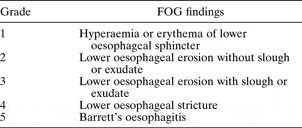
We undertook a prospective review of all patients with newly diagnosed upper aerodigestive tract SCC presenting between February 2005 and August 2007. All these patients underwent flexible oesophagogastroscopy as part of their pre-treatment investigation. Appropriate consent was obtained. The results of the procedure were interpreted by the same clinician throughout. Oesophagitis was graded as shown in Table I, using a variation of the Savary–Miller classification.Reference Savary and Miller8
Oesophagitis grading*

* Variation of the Savary–Miller classification.Reference Savary and Miller8 FOG = flexible oesophagogastroscopy
Results
We included 45 consecutive, prospectively recruited patients with upper aerodigestive tract SCC. The group comprised 13 men and two women, with an age range of 36 to 81 years (mean age, 63 years).
All patients who underwent flexible oesophagogastroscopy had evidence of oesophagitis: 15 patients had grade one oesophagitis, 16 grade two, 12 grade three and two grade five (Figure 1). One patient had evidence of gastritis. Three patients had evidence of oesophagitis despite taking a proton pump inhibitor twice daily (one had grade three oesophagitis and two grade two oesophagitis). No complications were reported as a result of the procedure.
Flexible oesophagogastroscopy findings.

Discussion
Reflux is common in patients with upper aerodigestive tract SCC. In our study, all patients had evidence of oesophagitis of varying degrees. In comparison, 10–14 per cent of patients with reflux symptoms, and without upper aerodigestive tract SCC, have been found to have oesophagitis on flexible oesophagogastroscopy.Reference Bochud, Gonvers, Vader, Dubois, Burnand and Froehlich9 Thus, our patients showed quite an astonishing rate of oesophagitis. However, we acknowledge that, in our oesophagitis grading system, our grade one was subjective and has been shown to have great inter-observer variability, and is thus of limited value.Reference Amano, Ishimura, Furuta, Okita, Masaharu and Azumi10 Even after discounting this finding, we were still left with 30 patients out of 45 having evidence of oesophagitis.
• There is growing evidence that reflux is a factor in the development of head and neck squamous cell carcinoma (SCC)
• This paper reports the results of flexible oesophagogastroscopy in patients with head and neck SCC
• Flexible oesophagogastroscopy for reflux diagnosis may be useful in the management of head and neck SCC patients
Is reflux investigation in patients with upper aerodigestive tract SCC important? Qadeer et al. suggested that managing reflux in patients with upper aerodigestive tract SCC may reduce recurrence of this malignancy.Reference Qadeer, Lopez, Wood, Esclamado, Strome and Vaezi6 This concept is beginning to make more sense with the accumulation of evidence supporting the role of reflux as an independent risk factor for upper aerodigestive tract SCC.Reference Bacciu, Mercante, Ingegnoli, Ferri, Muzzetto and Leandro1–Reference Freije, Beatty, Campbell, Woodson, Schultz and Toohill5
Furthermore, diagnosing and treating reflux in upper aerodigestive tract SCC patients may potentially reduce symptoms related to cancer treatment. One study showed that chemotherapy, and in particular cisplatin, may aggravate reflux.Reference Biacabe, Gleich, Laccourreye, Hartl, Bouchoucha and Brasnu7 It has even been suggested that patients who use proton pump inhibitors to reduce such reflux symptoms are less likely to delay chemotherapy or to have their treatment dose reduced.Reference Steer and Harper11
Once reflux is diagnosed in this patient group, correct treatment is important. The starting point for reflux treatment, according to the American Society for Gastrointestinal Endoscopy, is a trial of a proton pump inhibitor, to assess for effective management of symptoms. However, if other disease is present, or if reflux is severe, then endoscopy should be the investigation of choice. If endoscopy (i.e. flexible oesophagogastroscopy) is negative despite ongoing symptoms, the next step is a 24-hour pH study.Reference DeVault and Castell12
In this study, we used the term reflux to encompass laryngopharyngeal reflux (LPR) and gastroesophageal reflux. This is obviously not without its flaws, as these two disease entities do have differences. Laryngopharyngeal reflux has different symptoms and is often identified as being more resistant to conventional reflux treatment.Reference Koufmann13 The ideal method for diagnosing LPR is 24-hour intra-oesophageal pH monitoring.Reference Koufmann13 Flexible oesophagogastroscopy will detect LPR (i.e. signs of oesophagitis); however, it is less sensitive.Reference Koufmann, Wiener, Wu and Castell14 (Thus, our 15 patients with grade one oesophagitis, discounted as not having definite oesophagitis, may still have had positive findings on 24-hour pH testing.) The disadvantage of 24-hour pH testing is that it is not widely accepted by patients – a refusal rate of 12 per cent has been quoted.Reference Koufmann13 In addition, pH monitoring is still not widely accessible. The advantage of flexible oesophagogastroscopy is that it can be used to assess the upper aerodigestive tract in head and neck cancer as an investigative tool, as in our study.
Conclusion
Reflux appears to be common in patients with upper aerodigestive tract SCC. However, it is treatable, and such treatment may prevent recurrence of malignant disease and alleviate the symptoms of upper aerodigestive tract SCC chemotherapy. Flexible oesophagogastroscopy is a good tool in the investigation of reflux.