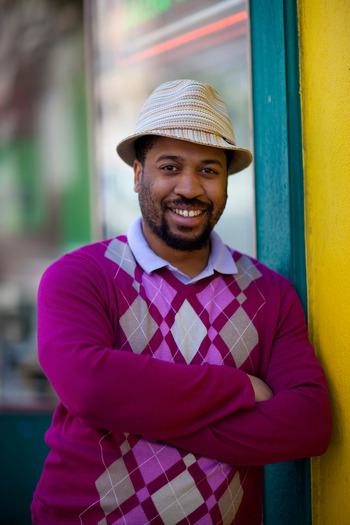
In this wide-ranging interview conducted by Associate Editor Harvey Young, Thomas Bradshaw (Figure 1) reflects on his plays, talks about the determining influence of class in contemporary society, and comments on his reputation as a provocateur.
Playwright Thomas Bradshaw. Photo by David Paul-Morris, care of the CUNY Archives.

Harvey Young: What are you working on right now?
Thomas Bradshaw: It's a play called Intimacy, which will be staged Off-Broadway at the New Group next season. It's about a group of people in a wealthy town in New Jersey who all end up acting in an amateur porn movie together. The play really has to do with the normalization of pornography within our society and about classism. Part of my hypothesis—and part of my thinking, in general—is how racism doesn't exist in the way that we've traditionally talked about it. It has morphed into classism. In this play there's a white family who lives next door to a biracial family—black guy, white woman, and their kid who looks absolutely white even though she isn't (she's biracial). On the other side of the tracks, in the less wealthy part of the wealthy town, a Hispanic family. The Hispanic father serves as the contractor for these really wealthy people, and the mother works at Walmart. Racism is pretty much never talked about in this play. It's. . . .
HY: In the atmosphere.
TB: In the atmosphere, but none of these characters are particularly concerned about it, except when a character makes a comment about the fact that Mexicans have to do real work in America. They don't get to sit around and play the banjo all day like they do in Mexico. That's pretty much the only time that race is brought up. Growing up in the suburbs, the things that I would hear people say about their Hispanic housekeepers and landscapers were shocking.
HY: How does racism work in your plays? How do you conceive of racism within the world of your plays?
TB: I approach racism differently in each of the plays where I deal with that subject. Some plays don't deal with that subject at all, like Dawn. Dawn is just a white family drama. My play Cleansed is about this biracial girl from Indiana who rejects her blackness and joins a white supremacist group. And what I was interested in in that play was the idea of the one-drop rule, if you have any black blood in you, then you are black. If you are biracial—black father/white mother, black mother/white father, then you are black. Everybody assumes that you are going to adopt this black identity. Something about that seems absurd to me.
In the South, there was this ridiculous hysteria surrounding degrees of “blackness.” A biracial person was “mulatto,” but there were also “quadroons” and “octoroons,” many different levels of blackness. My thesis was that a biracial person can choose their own identity, and that it might not fit within the accepted social paradigms. If we can accept them saying, “I am black,” then we should also be prepared for them to say, “I am white.” A lot of my plays ask questions about our assumptions, our societal assumptions, about race—they don't answer them, but they challenge the assumptions that we have in place.
HY: Sometimes audiences bristle at the types of questions that you ask. What are your thoughts on the strong reactions your plays frequently elicit?
TB: I'm generally happy with the debate that happens. I'm not interested in forcing a specific point of view down anyone's throat, and that means that some people walk away with ideas that maybe I'm less than pleased with. But I'm pretty much happy as long as a serious discussion is being had. I've witnessed some very interesting audience reactions while watching my plays. I remember the second time Strom Thurmond Is Not a Racist was produced. I remember sitting in the audience and people started to laugh. There is one black guy in the room and in the audience (besides me). But you know that was a pretty “in” crowd. People knew who I was, so they weren't particularly concerned about what my reaction was. People started to laugh and then suddenly they realized that this other black guy was in the room. This was at Walkerspace (where Soho Rep produces) in New York. And people started turning around to see what the black guy's response was. . . . They're like, “Wait, wait, wait, maybe we should do whatever the black guy is doing. We're just going to mimic the black guy.” And that black guy was not laughing. The black guy was not laughing. So everybody stopped laughing and about halfway through the play he walked out. Stormed right across the stage.
HY: Really?
TB: Yeah.
HY: And then what happened?
TB: I don't know. That's a good question. I think by that point it had become a very serious play. The audience plays a large role in [determining] the tone of the play on a given night. My play Southern Promises, sometimes, people would laugh all the way through it, and then there would be nights when nobody—I mean nobody—laughed at all and it became dark. I sometimes think those quiet audiences really loved it more because it was striking them in this really deep place. Strom Thurmond Is Not a Racist, I remember my grandmother attended a performance before she died and people were really laughing. And she was like, “I don't know what all these people are laughing about. This is the truth. This is what things were like. It's not funny.”
Baltimore Center Stage had me down in January [2013] and they did a weekend festival of my work. They read three of my plays. Part of their conception was that there would be talkbacks every night. We do this talkback for Strom Thurmond Is Not a Racist and this guy—first his wife, a white woman, makes all these intelligent comments about the play and then it was as if her husband didn't hear anything that she said—raises his hand and he says: “What I learned from this play is that black women are idiots.” And I was like, “Black women are idiots? What is this?” And that's the type of response that's not really on the level of discussion that I'm looking for. However, that type of response is very rare. People are usually very engaged and have intelligent responses.
HY: Critics and journalists always refer to you as a “provocative playwright.” It's a kind of catchphrase. What does it mean? When, in your mind, did you become a provocative playwright to others?
TB: I'm not really sure when that happened. It seemed to happen pretty soon after the press started to take notice of me. I don't know which came first—the press or the press materials describing me that way. Luckily, it's been dropped a little. For a while, the word provocateur was always put in front of my name any time I was being written about. I was like, “I really wish that they would stop doing that,” and then there would be this language: “Tom Bradshaw is going to ignite the stage again.” And I thought to myself: “Stop. Stop talking about the work this way because it sets up a false impression of what's about to happen.”
HY: It also limits you.
TB: Yes. It's super limiting. It implies that there's no intellectual depth behind the work. It assumes that the only thing that I do is sit around trying to figure out what might be shocking to people. I am interested in approaching subjects in a way that they have never been approached before. I'm interested in talking about things and presenting things that aren't normally shown on a stage—that we don't normally see in film or in our media in general.
HY: Like what?
TB: Like what I talked about with Cleansed. To someone, that's a provocative idea, but to me it comes perfectly naturally. You know what I mean? It just seems logical to me. It simply seems logical. What I'm really trying to do is to have a more honest conversation than I feel like we are often having. Another example: in Purity, the protagonist is this black guy, this black professor at Columbia who is perfectly happy in this white world that he's created for himself. White wife. White best friend. He is really content in the white life that he's built for himself. Then there is a “Black professor” (like in quotation marks) who is hired into his department. He wears kente cloth all the time and is always talking about The Autobiography of Malcolm X and whatnot. This guy starts to become friends with his [the protagonist's] friends and the protagonist essentially goes crazy over it. He essentially loses his mind because he hates everything that this guy represents in the world. Blacks—and all sorts of racial groups—are often talked about as if they are homogenous, as if they are a homogenous group. That they vote in a homogenous way. That they all think the same way. The play opened, really illuminated something else that's not talked about. I only show two sides of it in the play, but there are many sides once you get into the upper-class and upper-middle-class black world. There are many different ways of thinking. I show two extremes, but there are many different levels within them.
HY: Why is class so interesting to you?
TB: Why is class so interesting to me? Who knows why anyone is interested in anything? But I will attempt to answer the question. I think I am particularly interested in it because I grew up in Orange, New Jersey. My parents wanted to live in a big Victorian house and they couldn't afford a Victorian in the really wealthy neighborhoods: South Orange, Livingston, Short Hills. So they bought this big Victorian home on the border of South Orange. I mean literally on the border of South Orange but in Orange, which is not a wealthy town. It was in the nice section of Orange, but on the South Orange side their house would have cost twice the amount. I grew up in this twenty-room Victorian mansion on two acres with a carriage house and servant quarters. No servants, of course.
It was a crazy situation because my parents couldn't quite afford the house. They needed help, so my dad's mother and his sister moved into the servants' quarters on the third floor and then my mother's family moved into the carriage house. My parents are divorced. That is not a good recipe for staying together—living with your in-laws. I can't even imagine it.
HY: There's a movie in that.
TB: There's definitely a movie in that. My mother was a probation officer. She really believes in the goodness of people. I mean really believes people are good and that everybody can be redeemed. My dad's an engineer. Both of my parents grew up in Newark. Long story short, everybody who lived in my neighborhood bought these houses and then they sent their kids to private school. They were like, “We're buying this great house, but the schools here aren't so great, so we're going to send our kid to private school.” My parents sent me to public school. They sent me to public school in Orange, New Jersey. I was going to school with a group of underprivileged black kids essentially and. . . .
HY: You were the guy who lived in the big house.
TB: I was thought of as the rich kid, even though my parents weren't actually rich. Everybody knew where I lived, it was all, “Why do you talk white?” and all that stuff. At the same time, I was very much a part of the community. You are still part of it even though some kids are making fun of you for all these things. I wasn't afraid of getting beat up for being the kid who talked white. I was in a Boy Scout troop with these kids, which means that we went camping together, etc.
When I was in sixth grade, one of the most prestigious country day schools in New Jersey decided they needed some diversity and went shopping for a black kid within the gifted and talented program at my public elementary school. This is not how they presented it but that's, in retrospect, what they were doing. That's how I ended up attending private school for the rest of my youth.
HY: Were you the only one from your school to get selected? Or were there more kids?
TB: There was another kid who was Moroccan, who was also in the gifted and talented program. This school is in Short Hills, one of the wealthiest towns in New Jersey. It seemed like everyone was a millionaire. We spent half the day doing art and half the day doing academics. I played Macbeth in the seventh grade. I played Theseus from A Midsummer Night's Dream in the eighth. It put art front and center, which shaped me in a real and tangible way—it's why I'm in the theatre now. It was a very different world than what I was used to.
And these places, the country day school and my public school, were only twenty minutes away from each other. I also went to an elite private high school. I loved these places, by the way. I wouldn't be who I am today without them. And I certainly wouldn't be doing the type of work I do without these places, in part because of the fact that these experiences made me super aware of class. You know, the disparity in wealth. It's constantly bumping up against you. There's something about New Jersey where I feel that it's really on full display. South Orange even borders Newark. I don't think there are many places in the country where that disparity is so severe.
I think that's partly why I'm interested in [class]. It was always very much a part of the social life of these places. The private high school I went to bused in kids from Newark, the “scholarship kids.” And they seemed segregated from the rest of the school. I don't know whether they self-segregated or felt alienated from the rest of the school community. Maybe both are true to some degree. It's very complicated. I do know that in the cafeteria there was the “black table.” I wasn't really a part of that group, though I did date a girl from “that group,” but it clearly seemed like a class thing to me. I was in a weird middle ground, since I was essentially a “scholarship kid” as well, but since my parents were middle class, I didn't have a free ride. Of course, there weren't just black scholarship kids and white rich kids, there was a slightly greater level of racial and economic diversity than that, but overall the school was predominantly privileged and white, and this dynamic really stood out for me. I felt like since I had been in private schools for a longer period of time, I had learned how to function within them. For instance, I knew how to ski. My private school experience included two weeks in Vermont each year. We would ski all day and go to school at night. That's a status thing. That's a social order thing. I could say, “Yes, I'm going to go on a ski trip with you.” That allowed me entrance into this privileged world in a different way, a social way.
HY: Because if you have similar hobbies, it's easier to become friends. You have something in common.
TB: Absolutely. When I was in in college, we had a dean of . . . diversity? I don't know. Dean of . . . something.
HY: Where did you go?
TB: I went to Bard College. When you go to a place that's 97 percent white, you almost have to go out of your way to. . . . Same thing happened [as] when I was in high school. The black kids seemed separated from the rest of the community. They had this club. The dean brings me in. She says, “Thomas, you have to join the Black Student Organization.” And I said “Why?” She says, “You have to because it can't just be a bunch of poor black kids. You know we need kids who are. . . .”
HY: You need diversity.
TB: Yes. It was like, “We need diversity,” and I was like, thanks but no thanks. I just want to do what the rest of Bard students are doing. I don't want to be pigeonholed because of my race. I want to drink some beer, hang out in the field, and talk about Plato. That's what I'm trying to do. (And we did a little more than that). I didn't join that group. What's funny is, the Black Student Organization kids were pretty cool people. Obviously, I was friends with some of them, but I wasn't trying to be in the club. Who knows what might have happened if that dean hadn't tried to force me to be a part of it, but the fact that she did pretty much guaranteed that I wasn't going to join.
HY: Let's talk about Strom Thurmond. What inspired you to tell that story of all the stories you could tell?
TB: What year was it? Was it 1999? 2000? 2001? Whenever he died, his black daughter came forward. I thought: “This is the craziest thing that could have ever happened.” I just couldn't believe it. I was like, “This is amazing.” The hypocrisy. It was so stark. And yet, I thought, “This is America.” This story is representative of what's been going on in America since before its founding. It says so much about race in this country. The fact that our arch-segregationist—self-defined as segregationist numero uno, our country's number one racist—had a twenty-year affair with a black woman. And had this black child that he took care of. And that's what I was interested in. It was pretty common—from my understanding—for young southern men to have sex with black women on their properties and to get them pregnant. But they weren't trying to carry on relationships—like real romantic relationships—with them. They certainly weren't going to care for these children. And Strom Thurmond was actually this super moral guy. His morality was intact, and that's why he took care of her. A father provides. “I have a child. I'm going to provide for her.” And I think that he provided for her the best that he could given the circumstances. He would visit her at her college. Secret meetings took place in the president of the college's office so that no one would see this interaction taking place. She would visit him in the governor's mansion. His whole staff knew about it. It says a lot about the difference between our politicians and the press, what it was then versus now. That could never happen [today]. Everybody knew about it [Thurmond's daughter] and yet they were like, “That's his private life.” Same thing with JFK, right?
HY: The extramarital affairs.
TB: And they [the press] were just like, “Let's go have a look over here [and not meddle in President John F. Kennedy's personal affairs]. I think that his [Thurmond's] behavior says so much about the human condition. We all live with contradictions. We are all hypocrites. We all consistently fall short of our ideals. I don't think in Strom Thurmond's ideal world he would have been carrying on an affair with this black maid. But you can't always live up to your ideals. Things happen.
HY: She was there.
TB: Yes, she was there. Proximity has so much to do with it. He's got to see her day in and day out.
HY: It's like that line in The Silence of the Lambs: “You covet what you see.”
TB: Totally. He had the opportunity to be alone with her. . . .
HY: Your play could be interpreted as redeeming him, right?
TB: I don't know about that. But I certainly strive to present him in a more complicated light.
HY: The argument that you are making is that people are more complex than they appear in the history books.
TB: Absolutely. There are probably a few through lines that you'll see in my work. One very strong through line is this idea that no one is pure good or pure evil. Everybody exists along the spectrum of gray. We all embody both of those elements and are capable of almost anything given the right circumstances. I try to put my characters in circumstances to exhibit this. It is not about the redemption of Strom Thurmond at all. It's just about truth, an honest look.
We've all seen that view of him [as a racist], and I'm saying this is another view. This is another way that we could view him that we haven't seen him before, and I don't brush anything under the rug. He has long tirades in my play—going on and on about “the niggers”—and then the next moment he's with his daughter being a good father. So it's showing the behavior side by side without attempting to explain it. So much of theatre attempts to explain things that aren't explainable as far as I'm concerned. Plays about war and the risks of war. Race and how to solve racism. Theatre is often spouting these juvenile, almost naïve, assertions. I can't even fathom why anybody would assert these things. But yet we often see these things on our stages. I am interested in showing complexity and then having a conversation about it rather than presenting a problem and then answering it. If we actually had the answers to these extremely complicated problems, then they wouldn't exist anymore.
HY: How do you know when issues are sufficiently complex enough or interesting enough or appealing to you enough to merit being presented to a larger audience?
TB: I simply follow my interests.
HY: When does it go from “this interests me” to “this is something that needs to be a play?”
TB: I just know.
HY: You just know?
TB: I know. I hear things. As soon as she [Thurmond's daughter] came forward, I thought: “Time to start doing some research.” I'm really thrilled that I wrote the first draft of my play before she wrote her book because that probably would have messed me up. You know what I mean? Because, I had to invent. . . .
HY: The relationship.
TB: Yes, the relationship without having the benefit of her saying, “This is what the relationship was.”
When I hear certain stories, I just know. Like with Mary. This gay opera singer that I know came to me after—he's seen a lot of my work and he came up to me after a production of my play Dawn, and he was like, “I have a story to tell you.” And I was like, “I don't know.” Because people do that all the time: “I have a story for you. Oh my God, you've got to write about my life.” But since he has an idea of what I'm interested in, I called him. He tells me how in 1983 he went to visit his boyfriend over Christmas break in southern Maryland. His boyfriend lived on this large southern plantation, and his boyfriend's parents had a black woman that worked for them that they casually referred to as “nigger Mary.” Of course, he was like, “What on earth is going on here?” And it came out that Mary's family had been in his boyfriend's family for hundreds of years and that her family hadn't left after emancipation. They had become domestic servants on the property. As soon as I heard that, I was . . . “That's a story that needs to be told.”
Again, as far as history is concerned, I'm really interested in getting into the world of that time and presenting that versus putting a modern perspective on it, which is often how we deal with history. We'll have a play set in 1927 and characters hold all sorts of opinions that no character would have ever held in 1927 because the purpose is to make a modern audience feel good. So a nugget in that story is that a lot of slaves didn't run off their plantations after emancipation for obvious reasons. The economy really wasn't set up to support them. To carry that forward 137 years later, here's a place where things haven't changed all that much since 1865. But then, of course, that would be too easy, right? To show ignorant southerners who are still perpetuating this point of view. So I have them have one foot in the modern world while having one foot in this backwards world.
HY: And what was the foot they had in the modern world?
TB: They are super accepting of their gay son. The son is in the closet, but the parents are secretly really upset that he won't come out to them. The father and the mother give the son every opportunity to come out. That's what I mean by existing along the spectrum of gray. Here are these people who think nothing of keeping an almost indentured servant who they refer to as nigger Mary and [yet] they're very tolerant in another way that many of their peers might not be. When you see this type of work, it's often structured [differently]: the white people are evil, and the black people are these noble martyrs. I was interested in subverting [that]. Mary, the main character, and her husband are pretty complicated in that they are the super homophobes, which is very much keeping in line with a lot of the tenets of the black church, the kind of theology that you might embody [after] growing up in [a] black church. They're super homophobes which complicates Mary. It's all kind of funny in the play. They shoot the boyfriend in the crotch with a BB gun. It's bad . . . but it's kind of funny. You're not judging Mary. And then in the last scene of the play, she graduates from college and the [play] looks like it's going towards a very feel-good ending, and then at the end of the play Mary gives a super homophobic speech that's not funny in the least. And the character that we expect that we're supposed to identify with—that we are supposed to feel happy for and feel sympathy for—is suddenly saying things that are very hard to get on board with.
HY: It's shocking because you've already identified with her.
TB: You've already identified with her. It's at the moment that is supposed to be the feel-good moment in the play. She's graduating from college, which is the biggest cliché in this sort of narrative: the illiterate woman becomes literate and everything works out for everybody. Again, Mary exists along the spectrum of gray. She's not this good or bad character. She's very human. But Mary also isn't a hypocrite at all. She's been saying the same thing the whole play. It seems funny at the time but she advocates for someone getting shot in the crotch for being gay. She carried out a hate crime. It's all very consistent.
HY: Have you ever received any pushback from actors who refuse to audition for these roles?
TB: Lots of things like that have happened to me. It's an interesting question. Obviously, things have changed as I've become more established in my career. I don't have the same types of problems that I had, though it definitely does come up. Even casting Mary was very difficult. Casting the role of Mary was very difficult. There were a lot of people who wouldn't audition for it in earlier incarnations, before [we cast] Myra Lucretia Taylor, who played Mary [in the Goodman production] and is amazing. She was wonderful. There were previous incarnations of Mary—readings and whatnot. We had a lot of trouble with actresses in the room who had signed up to do it. I mean pretty much all-out rebellion in the rehearsal room trying to thwart the proceedings. Trying to get me to change Mary's trajectory. We had an actress . . . it was full-on rebellion in the rehearsal room to the point where I was worried about whether she was gonna go onstage and do what she's supposed to do. Is she going to go out onstage at all? I was really wondering these things. She actually went onstage and did a great job. She brought her professionalism with her once she actually got in front of an audience. Another actress, in another incarnation in rehearsal, she seemed totally cool with it and [then] she just started crying through scenes, just crying, and we were like, “Oh God, it's happening again.” We'd be like, “Are you okay?” She's like, “Yeah, yeah, it's okay. It's just bringing up some stuff for me.” And we were like, “Oh Lord, help me.” Because I feel like some black actors have issues about representation and what they are representing onstage and they only want to be the right thing, the right type of blackness, characters who they view as being positive figures in the world. Clearly not all black actors feel this way. But that's the type of thing that I have run up against.
My first “hit” play was Prophet. I'm using the word “hit” loosely, extremely loosely. I'm defining hit as my first rave New York Times review. Prophet really put me on the map [and attracted] mainstream attention. However, it was not a hit at the box office. There were a few black actors in this play. But there was one who was a very young actor. Sometimes I push an extreme of a stereotype. This guy was representing an extreme stereotype. He was a drug dealer. I had him walking around without his shirt on and he had a gun in his pants. When you push it that far, you start to subvert the stereotype. It forces the audience to confront their own beliefs when it's put in front of them so starkly. We talked about this—this is a smart guy—and he was totally on board. Opening night, his parents come. His parents sat in the front row and sat stone-faced and didn't clap during the curtain call. Front row. Their boy's up there, and they are not clapping. It was pretty odd. I was like, “What are you doing inviting your parents? You know what they're going to like and what they're not going to like.” He thought they were going to see all the things that I was talking about—which they failed to appreciate. So after the play, my whole family is there (because my family is extremely supportive). My family is talking to his family, trying to talk to them about why it's okay.
The next night he tried to quit the show. He sat down with me and called me the devil. He said I was the devil and that I had tricked him. It was very serious. I appealed to his professionalism. Every night, he'd scare me because he'd show up five minutes before the show. He didn't adhere to his half-hour call. He showed up five minutes before he was supposed to walk onstage. He'd walk across the stage—we'd still have the house closed and I'd be sitting there—and he'd say “Stupid fucking play. I can't believe I got to do this goddamn shit again.” Every night some version of that. So there was that. I had a lot of trouble casting Purity, the role of the black guy who's against the Malcolm X–type black.
HY: Why'd you have such a hard time casting that one?
TB: I guess he said some pretty controversial things. The guy's also a drug addict and a pedophile on top of that, so those elements might have had something to do with it, as well. He and his buddy go to Ecuador and rent a nine-year-old girl from her father, but that's just the subplot. That's just giving some background on who this guy is before you get to the main dish. It really wasn't the pedophilia thing. People would call me and they wanted to talk to me about the portrayal, [about] this black guy's ideas. People seem to get pretty concerned about representation. I run up against a lot of that. If you represent something onstage, then it's seen as a promotion of it.
HY: If you choose to stage it, then you must endorse it.
TB: Exactly. I think that's a simplistic view of the theatre, and art in general. When I was writing the play, the New York Times was doing a series of articles about sex offenders and sex crimes. There would be these front-page [stories]. They were interviewing these guys and I was like, “This is fascinating stuff.” They are talking about all these really rich businessman going on these sex tours, having sex with kids and pretty much doing it openly because it was beyond the reach of United States law. I think since then that's changed. They've found a way to prosecute. All this stuff and on top of that To Catch a Predator being beamed into everybody's living room. I got interested in the subject. Law and Order would have you believe that every crime is solved no matter what. No matter what it is, crimes are solved. When in reality only 60 percent of murders are solved in this country. You have a good chance of killing somebody and getting away with it.
HY: There'd be no order in Law and Order.
TB: Yes, exactly. Maybe I should pitch that TV show? About police, like Law and Order, where they don't really solve much of anything. Case after unsolved case. It's a good idea.
Someone did ask me the question. This is what people had a problem with as far as the pedophile . . . pedophilia stuff is concerned. They had a problem with the fact that these guys never got caught and that they never expressed remorse for their actions, which are the things that people have to do in plays if they do something wrong. You have to express remorse and repent. Or justice has to come in from the outside. And neither of these happened. The play just continues. In plays you often feel the point of view of the writer. The writer is making a moral judgment and he's clear what moral judgment he is making. I never do it. And [sometimes people] are like, “If you don't say that it's bad, then how are people going to know? My answer is [with an incredulous tone], “People need me to tell them that having sex with children is wrong?” I almost find it to be astonishing that someone could question me about such a thing. That that's going to be the takeaway from seeing the play: “I guess that it's all right. I mean, the playwright never said that it's wrong, you know.”
That's something that . . . I've run up against, especially with portrayals of race. A lot of black actors are more sensitive about this than other actors. In Burning, there were thirteen people onstage. Eleven of them are engaged in pretty graphic sex acts. We didn't even allow people to audition who aren't willing to. . . . Don't even come into the audition room unless you're willing to do all this stuff. Because this is what we are doing. And that's really going to happen. If we were really interested in somebody, we'd have a conversation in the room with them about what we are going to do and this is what we're going to do. And full nudity. I mean everything. Do you know Hunter Foster? He played the lead in Little Shop of Horrors on Broadway. He's a big musical actor. He wanted to do something different, so he was in Burning. In some publication, he wrote an article about doing the nudity in the play and his process. It's kind of funny, because in the room, he was like, “Yep, totally fine with it.” And we kept going through all these scenarios—exactly what's going to happen—and he's like, “Yep, fine totally.” And he talks [in the article] about how in his mind the lights were going to fade as they begin whatever sex act they were in. And then he's talking to his wife about it and his wife was like, “How do you know the lights are going to go down?” And then it dawned on him that the lights were not going to go down. He talked about his process, it dawning on him and accepting [the visible nudity and sex acts] and then what that was actually like. It was interesting and funny. He's a good writer.
HY: Does your voice change as your write for the screen?
TB: No, my voice doesn't change. All the elements of drama are always there whether you're writing a feature or whether you are writing for television. The process is what's the most different. I had a producer one time be like, “This is a little R-rated, Thomas. This is a little bit R, and we'd really like this to be able to be shown in schools.” That's a very real conversation that can't be dismissed. And the reality that you can get fired off your own project. It's a different reality, because [in theatre] the playwright is kind of king in the room. People will argue with you. People will wish that you weren't doing certain things. But at the end of the day, you do what you want to do. You might not get invited back to work at that theatre. That's all.
HY: It's your thing.
TB: They are going to let you do what you want to do at the end of the day. In the film world . . . there was this major script. There were four writers. First, the producers commissioned a writer to do the first draft. But then they became unhappy with him, so they give it to somebody else to clean up what he did. And then they became unhappy with that person and then they gave it to a third writer. And that person didn't want to write the ending that the studio wanted. . . .
HY: A fourth writer.
TB: And that is typical. For feature contracts, they actually say, “So and so owns, the studio of the producer, not the writer, owns this material in perpetuity and throughout the universe.” Just in case we start doing stuff on Mars. Television is a bit different. I think writers in the television world retain a bit more power. It's closer to the theatre, except that you have a lot more writing collaborators. You have a lot of people weighing in on what you should be doing in the script. You are treated with a lot of respect but still you could get fired off the project. There's this awareness. It's in the contracts. You will get such amount of money if you receive sole creator credit, but if you end up being the creator with somebody else, then you will get half that amount, and so on. And what they don't say is that the only reason that you would ever get that cocreator credit would be if you get removed and they bring in somebody else. I really enjoy film work and TV work. But it's different. It's a different hat. It's a different hat because you have to be in a super collaborative mood.
HY: Plays by black authors are infrequently produced. What are your thoughts on the limited opportunities available to playwrights of color?
TB: I feel like minority artists often get pigeonholed. There's a narrow set of things that they want a black writer to write about. I've been very conscious of not getting stuck in that trap.
I'm interested in exploring [material] that doesn't have to do with race. It was actually harder [at] first. My first white family drama, Dawn at Flea [Theater in New York City], I remember there was a review of that play that said, “Who does Thomas Bradshaw think he is writing about these people? He needs to stick to writing about subjects that he knows something about.” What is interesting about that was that Dawn was produced two months after Southern Promises, which I had gotten lots of acclaim for. That's when the New Yorker first wrote about my work. And there was the review implying that I need to stick to writing about subjects that I know something about. Clearly I know what it was like to be on a plantation in 1827. That's sticking to something that I actually know something about.
HY: It's in your blood.
TB: It's in my blood. We've talked, you know something about my background. I am definitely more qualified to write a play about some rich white people. I know all about that. I know all the ins and outs of rich white folks.
HY: And also living in a mansion. . . .
TB: [Laughing] Yes, yes exactly, what life was actually like on a plantation. Dawn didn't get the greatest reviews in the world. I mean the reviews were fine but it really didn't get the greatest reviews in the world. And then [with] The Bereaved, which is pretty much another white family drama, something broke open there. I think something else was recognized about what I was doing stylistically that wasn't necessarily being fully picked up on before. That play was suddenly . . . I broke out of that box of minority playwright just writing about race. I want to feel free to explore any subject that I want. Sometimes I want to write about race and sometimes I don't. There's a world of subjects to explore, and I don't want to be limited.