The twenty-four-stanza abecedarium Audi tellus, audi magni maris limbus, found in Montpellier, Bibliothèque de la ville, 6, fols. 133v–135r, stands at the beginning of a long tradition of similar songs of judgement. The musical connections between this eleventh-century song and its later versions and revisions are much more complex than stated by Gòmez and has misled many later scholars; it even confused the listing in Anderson's Catalogue raisonné of conductus, where similar incipits were listed as L12 and L74.Footnote 1 A closer study of the sources provides for a richer and clearer understanding of the transformation of a song into a versicle for the Libera me and its further adaptation by the thirteenth century into a well-known and widely disseminated new text and set of melodies, whose significance was still being felt in the sixteenth century.
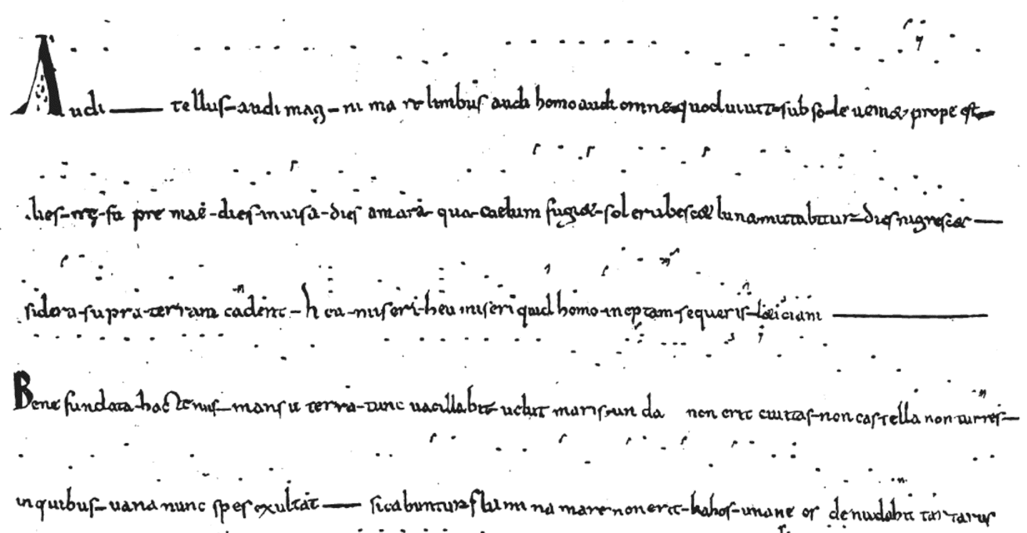
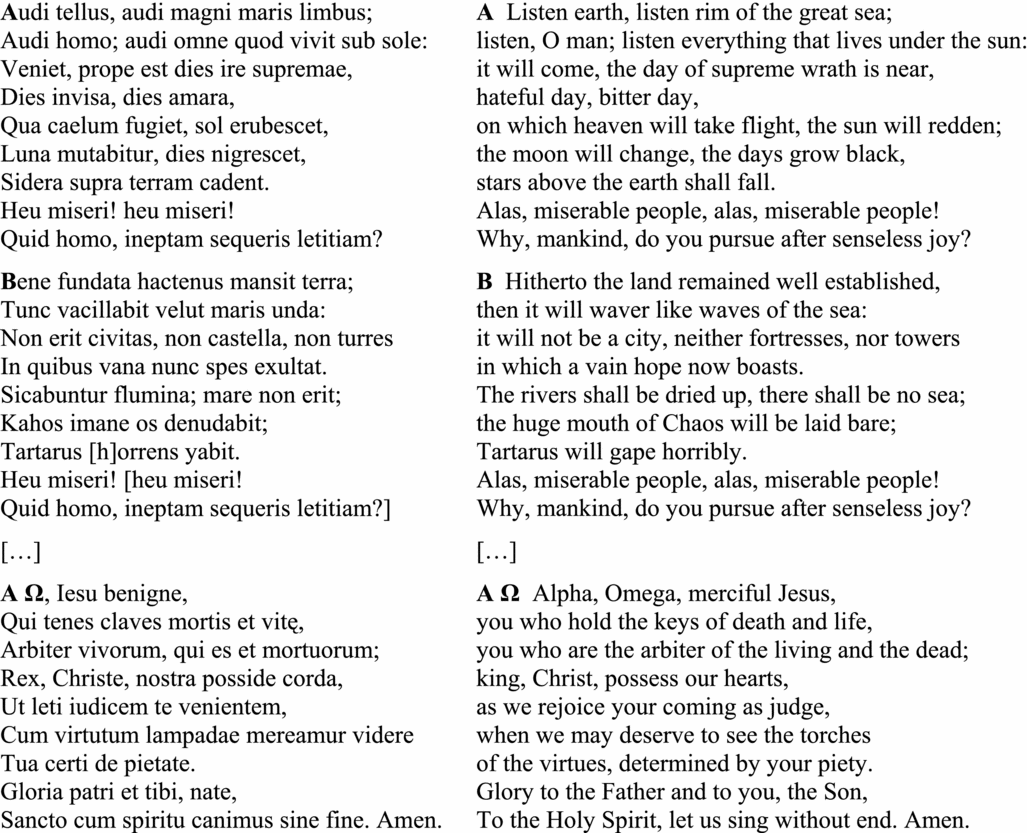
The twenty-four stanza song Audi tellus, audi magni maris limbus is an addition to a tenth-century Epistolar from the Benedictine Abbey of Aniane in southern France and was first published in 1841 by Paulin Blanc (F-MOv 6; Fig. 1 and Ex. 1, excerpts from the manuscript and text; Table 1).Footnote 2 The text was copied in a curious mixture of classical and medieval orthography, making irregular use of dipthongs, the e caudata (ę), or the adspirationis nota (⊢) instead of the letter ‘h’; Bischoff noted some Visigothic influences in the script of the manuscript.Footnote 3 The music was copied in a typical Aquitanian notation around a single drypoint line, here probably indicating the pitch F (see Fig. 1 and Ex. 2).Footnote 4 The irregular syllable counts, especially in its opening verses, may reflect a more improvisational prose poetry, matched by the use of the recitation tone a from the protus authenticus mode; Chailley noted a similarity to the so-called ‘Ancient Tone’ for the recitation of the Lessons at Matins.Footnote 5 According to Norberg, the song is ‘very curious’ and it was ‘obvious that the melody played a fundamental role for the author of this poem. The form of the strophes is so artistically constructed that only experienced singers could have performed it.’Footnote 6
Montpellier, Bibliothèque de ville, 6, f. 133v (detail).

Audi tellus, audi magni maris limbus (excerpt).

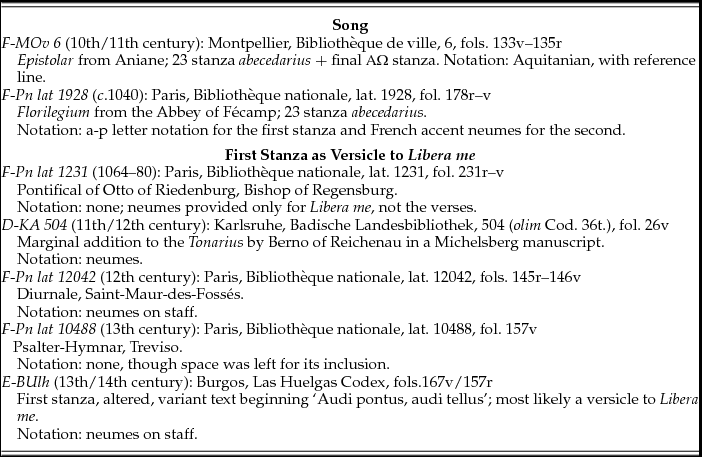
Audi tellus, audi magni maris limbus, early musical sources [L12]

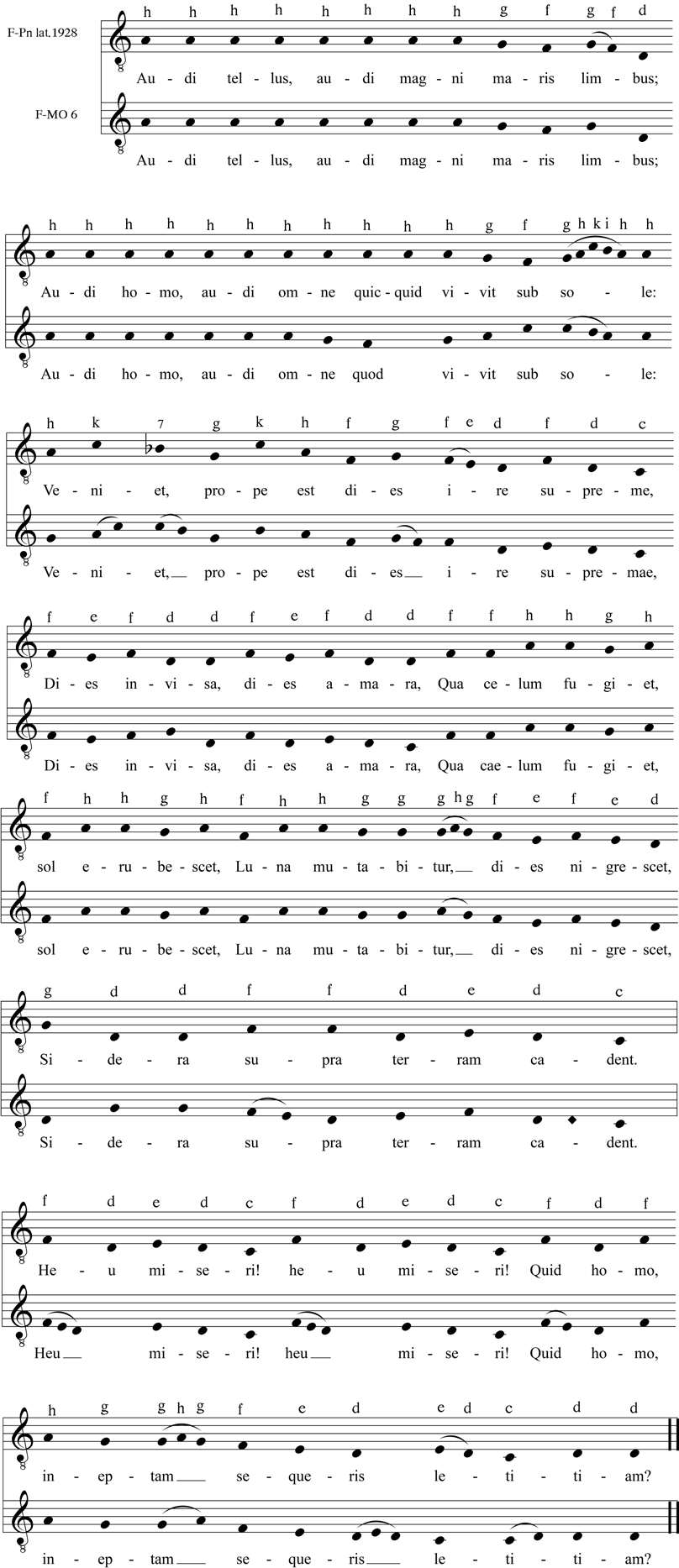
Audi tellus, audi magni maris limbus [L12] (F-MO 6 and F-Pn lat. 1928).

Michel Huglo discovered a second source for the song that has not been extensively noted in the literature (F-Pn lat. 1928).Footnote 7 Copied around 1040 at the Benedictine abbey of Fécamp, this manuscript is a collection of the letters of Augustine to which a small collection of songs were added, including the abecedarium Audax es vir (fols. 170v–171r; attributed to Bede), Gottschalk of Orbais's O mi custos, o mi heros (fols. 171v–172r), Qui signati Christo estis (fol. 172r–v) and Aurea personet lyra (f. 172v).Footnote 8 The copy of Audi tellus is the full abecedarium without the final ΑΩ stanza, but with the unlikely ascription ‘Versus Venerabilis Bede Presbiteri de Fine Seculi’ (‘Verses of the Venerable Presbyter Bede concerning the End of the World’), with the first stanza notated using the a-p letter notation and the second stanza with neumes.Footnote 9 Its presence in this source would seem to indicate that the original song was circulating within Benedictine circles.Footnote 10 The melodies of the two manuscripts are very similar with only small differences of detail (see Ex. 2).
The first stage of the metamorphosis of Audi tellus, from song to versicle, is evident in three eleventh- or twelfth-century manuscripts that preserve different versions of the text and music. The earliest of these is the Pontifical of Otto of Riedenburg, Bishop of Regensburg (F-Pn lat. 1231), copied between 1064 and 1080. In this source, only the first stanza with its refrain has been copied without notation as number twenty-nine among the forty-two versicles for the responsory Libera me, Domine, de morte eterna.Footnote 11 While knowledge of the full admonitory song may have waned, the first stanza was still known and was now integrated into the liturgy as a single versicle for the Libera me responsory.Footnote 12
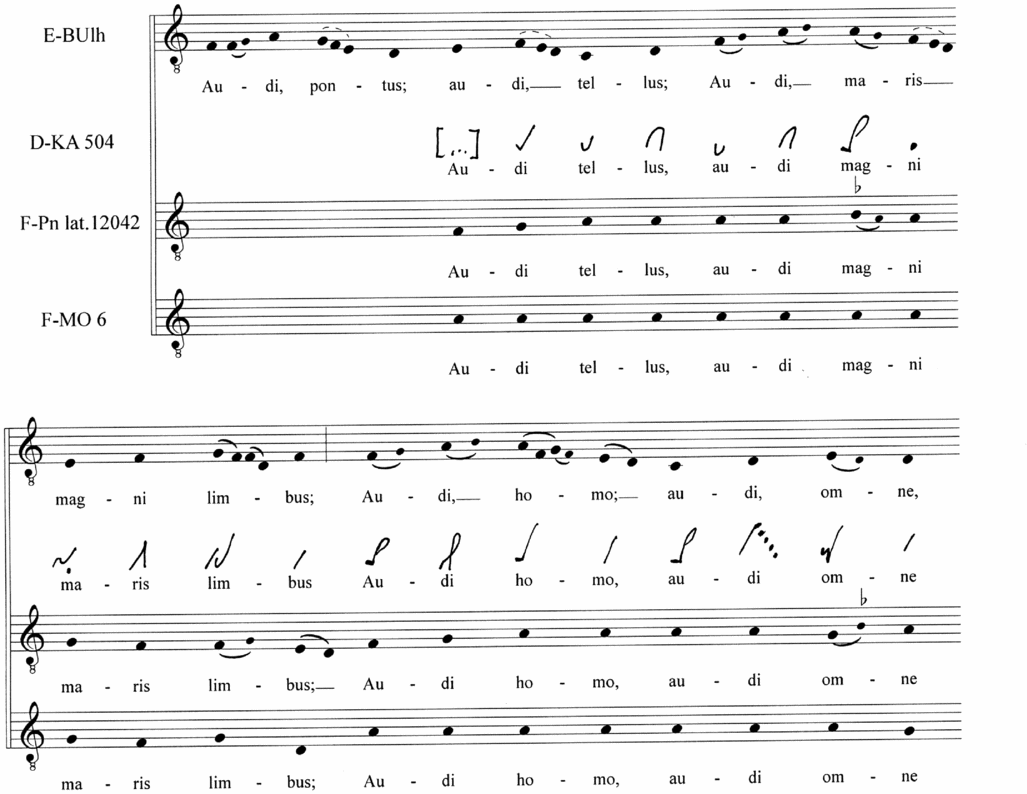
A notated version of the versicle for the Libera me is found in a marginal addition to Berno of Reichenau's Tonarius (D-KA 504).Footnote 13 Franz Joseph Mone, without knowledge of the Montpellier version, published in 1853 just this stanza believing that it was an excerpt illustrating the Tonarius, but did note its connection with the Libera me responsory.Footnote 14 Since he was unaware of any of the concordant versions, he could not have known that the Karlsruhe copy modified the original refrain to ‘Heu, heu quid nos peccatores et miseri / In die illa tremenda sumus facturi?’ (‘Alas, alas, what are we to do, sinners and miserable ones, on that dreadful day?’). The notation of the Karlsruhe version also indicates that it was most likely more florid than the song, as in the melisma on the word ‘audi’ and the neumes that appear to indicate a different melodic direction (Ex. 3).
Comparison of Audi tellus, audi magni maris limbus, versicle.

The most musically significant of these early versicle concordances is a twelfth-century diurnale from Saint-Maur-des-Fossés (F-Pn lat. 12042), in which the first stanza of Audi tellus is again used as a versicle for the Libera me.Footnote 15 The staff notation of this manuscript shows that the basic melody of the song was still known and also demonstrates how the psalmodic melodic style was easily adaptable into a responsory verse (Ex. 3). These three early concordances indicate the developing strength of the connection between the stanza ‘Audi tellus’ from the song and the responsory Libera me.
This process of transformation may also relate to the adaptation of the song's first stanza copied in the Las Huelgas Codex (E-BUlh; see Ex. 3).Footnote 16 Though there is no specific rubric or cue that this was considered a separate versicle, at least one other single stanza in this section of the manuscript, Veni redemptor gentium (E-BUlh, fol. 158r), is copied in a manuscript from Tortosa as a Sanctus trope.Footnote 17 The Las Huelgas text has been altered, beginning ‘Audi pontus, Audi tellus’, and the melody is much more florid than the song, and indicates that the text could have had an independent transmission that was, like the Karlsruhe copy, locally adapted to a new tune.Footnote 18
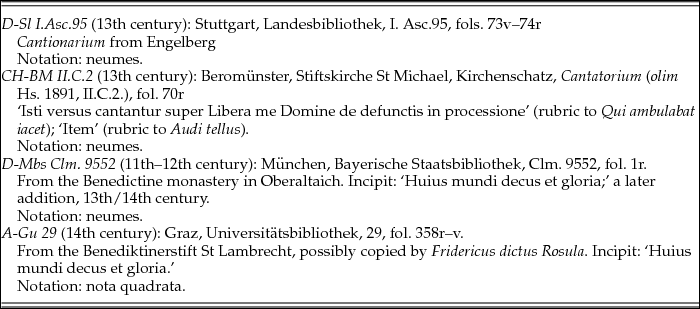
The thirteenth century, however, was also the period for an extensive transformation of the Audi tellus tradition. While the Las Huelgas manuscript represents the last source related to the first stanza of the eleventh-century song, the strong images of its opening lines were adapted as the opening for one of the most enduring of the Libera me versicles.Footnote 19 This part of the story begins with four musical sources linked by their common text variants and melodies, which I have termed Variant 1: the Cantionarium (D-Sl I.Asc.95), the Cantatorium from Beromünster (CH-BM II.C.2), an incompletely neumed addition to a collectio from Oberaltaich (D-Mbs Clm. 9552) and a fourteenth-century version with staff notation from St Lambert (A-Gu 29) (Table 2).
Audi tellus, audi magni – ‘Ubi [sunt]’, early musical sources, Variant 1.

Perhaps the earliest example of this new tradition is the so-called Cantionarium (D-Sl I.Asc.95) (Ex. 4).Footnote 20 While earlier studies had placed the provenance for this manuscript at the monastery in Weingarten, Irtenkauf and more recently Purcell-Joiner have demonstrated the double-monastery at Engelberg is a more likely place of origin.Footnote 21 Following the main song collection rich in concordances to other prominent Ars antiqua manuscripts, a later scribe and notator added the text and neumes for this new versicle, distinguished by its use of the topos ‘Ubi sunt?’
Cantionarium (D-Sl I.Asc.95), Audi tellus versicle.

Common to both this early form of the versicle and the later versions is a basic three-part division of the text into an introduction, a litany of names most frequently following the word ‘ubi’ (‘where is?’) and a conclusion. While the opening is centred on the idea of ‘sic transit gloria mundi’, the conclusion ends with a prayer for deliverance on the day of judgement.
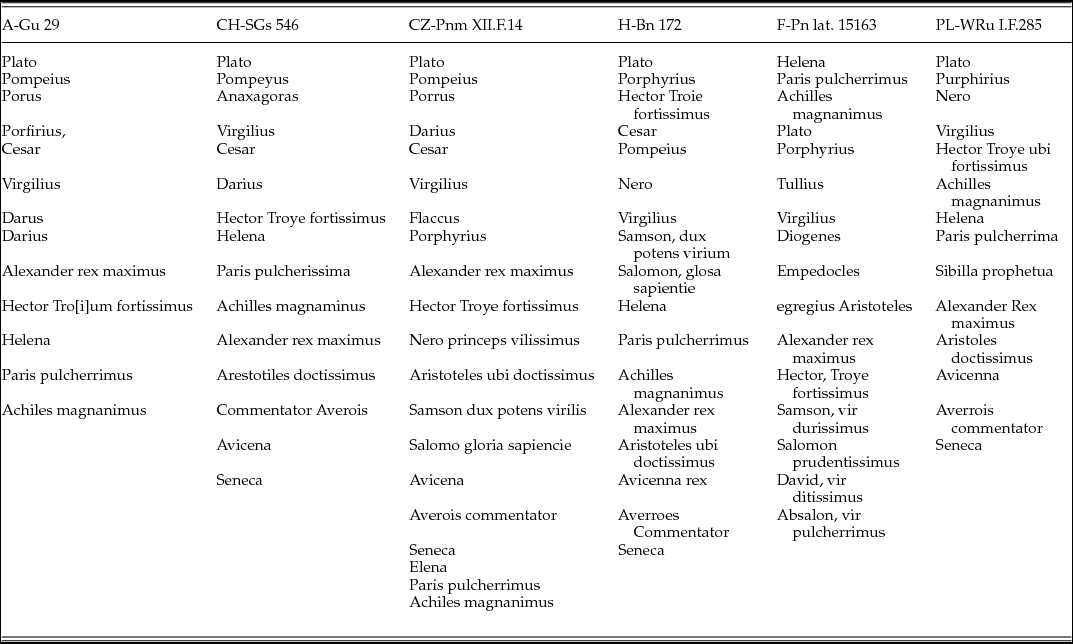
The central litany of names includes a varying cast of characters, all of whom seem out of place in the context of the Catholic liturgy (see Table 3). The topos of ‘Ubi sunt?’ has a long and significant literary tradition beginning in Antiquity.Footnote 22 In the Middle Ages, it was very early incorporated into patristic traditions, and there are strong resonances between the Audi tellus versicle and St Isidore.Footnote 23
Brevis est hujus mundi felicitas, modica est hujus saeculi gloria, caduca est et fragilis temporalis potentia. Dic ubi sunt reges? ubi principes? ubi imperatores? ubi locupletes rerum? ubi potentes saeculi? ubi divites mundi? Quasi umbra transierunt, velut somnium evanuerunt.
(Short is the happiness of this world, small is the glory of this age, transitory and fragile is temporal power. Tell me, where are the kings? where the princes? where the emperors? where the wealthy? where the powerful of this age? where the rich of the world? Just as if a shadow, they have passed; like as a dream, they fade.)
Comparison of names included in the Audi tellus, audi magni – ‘Ubi [sunt]’.

As already mentioned, many of the names listed in the Audi tellus versicle are rarely found in the liturgy. While Saint Helen is common, Helen of Troy is not. General Flaccus is mentioned in the office for Saint Gregory of Spoleto, but this appears to be a rare feast.Footnote 24 The term ‘Cesar’ occurs a few times, as it is also used in the Vulgate, but it appears that different emperors may be meant by this title.Footnote 25 The majority of names, such as Paris, Alexander, Hector et al., do not occur in the currently indexed chant sources. Plato, Aristotle, Cicero and Ovid are mentioned in ‘Magnificandus et omnicolendus’, indexed as a sequence on the Cantus database, but this is a metrical poem in seventeen hexameters about Pope Paschal II (titled in the manuscript: ‘Versus de Paschali Papa’) without notation.Footnote 26
The text in the Cantionarium is actually in one small respect an anomaly, since the majority of the manuscripts for this versicle begin the litany with ‘Ubi Plato?’ Though very little was known of Plato's works in the Middle Ages, he was considered as a figure of wisdom, though flawed.Footnote 27 The same could be said for many of the other figures mentioned in the different recensions of the text, including other classical figures, such as Aristotle, Virgil, Alexander, Helen and Paris, just to cite the most popular. Later, even the Arabic philosophers Avicenna (Ibn Sina) and Averroes (Ibn Rushd) were added to the list. There is the prominent exception in the mention of the Sibyl in the Dies irae.Footnote 28
One liturgical text, however, mentions Plato, Aristotle, Demosthenes and Chrysippus (these later two names are not found in any of the versions of the Audi tellus versicle I have examined) in versicle 42 to the Libera me from the Pontifical of Otto of Riedenburg, mentioned earlier:Footnote 29
Iudicaturo domino lugubre mundus immugiet, et tribus ad tribum pectora ferient; potentissimi quondam reges nudo latere palpitabunt; ex<h>ibebitur cum prole sua fere tunc ignitus Iupiter; adducetur cum suis stultus Plato discipulis; ibi arebit mutus fluvii olim os torrens Demostenici; contorta Crisippi illic acumina nec argu<men?>ta Aristotilis proderunt sillogistica. Tunc tu rusticanus et pauper quivis in Christo exultabis dicens in gaudio ecce crucifixus deus meus.
(When the Lord comes to give judgement, the universe will utter a mournful groan; and tribe to tribe will beat their breasts; kings once most mighty will shiver with naked flanks; Jupiter with all his offspring will be shown entirely amid real fires; Plato with his disciples will be revealed as but a fool; there the mouth of Demosthenes, formerly the roaring of a river, will dry up mute; there [neither] the acute contortions of Chrysippus nor the syllogistic arguments of Aristotle will prosper. Then you, rustic and poor, whoever is in Christ, will exult, saying in praise: ‘Behold my crucified God.’)
This is a slightly adapted version of a passage from Jerome's letter 14 to Heliodorus on the ascetic life:Footnote 30
Iudicaturo domino lugubre mundus inmugiet; tribus ad tribum ferient pectora; potentissimi quondam reges nudo latere palpitabunt; exhibebitur cum prole sua vere tunc ignitus Iuppiter; adducetur et cum suis stultus Plato discipulis; Aristoteli argumenta non proderunt. Tunc tu rusticanus et pauper exultabis ridebis et dices, ‘Ecce crucifixus deus meus’.
(When the Lord comes to give judgement the universe will utter a mournful groan; the tribes of men will beat their breasts; kings once most mighty will shiver with naked flanks; Jupiter with all his offspring will then be shown amid real fires; Plato with his disciples will be revealed as but a fool; Aristotle's arguments will not help him. Then you the poor rustic will exult, and say with a smile: ‘Behold my crucified God’.)
The presence of both this versicle and the Audi tellus versicle in Otto's Pontifical from the late eleventh century indicate there was a context in which these classical names would have had significance to the singers and auditors of these texts, if only to raise the question of ‘Where are they?’
With the exception of the partially neumed version from Oberaltaich (D-Mbs Clm. 9552), the liturgical use as a versicle for the Libera me is clear in the three remaining early sources, either through textual cues, or, in the case of the St Lambert manuscript (A-Gu 29), being copied along with the Libera me and its other versicles. One important point can be seen in that the scribe of the Cantionarium copied after the new Audi tellus text the well-known Libera me versicle, ‘Iudex clementissime’, and the respond cue, ‘Quando celi’, without neumes, implying that these melodies would have already been known; perhaps a clue to the newness of this Audi tellus versicle.
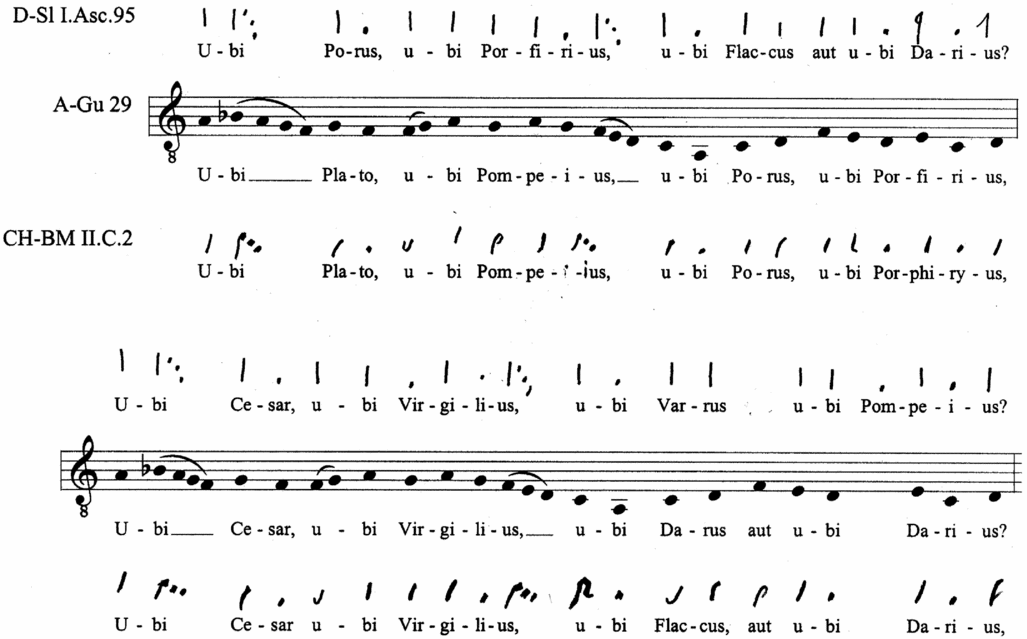
The neumed melodies in both the Cantionarium and the Cantatorium from Beromünster (CH-BM II.C.2) are musically similar to the later concordance from St Lambert.Footnote 31 All manuscript sources for this early Audi tellus versicle have a number of musical phrases in common, including a distinctive melismatic variant for two occurrences of the word ‘ubi’ (see Ex. 5).
Comparison of Audi tellus versicle, distinctive setting of ‘Ubi’, Variant 1.

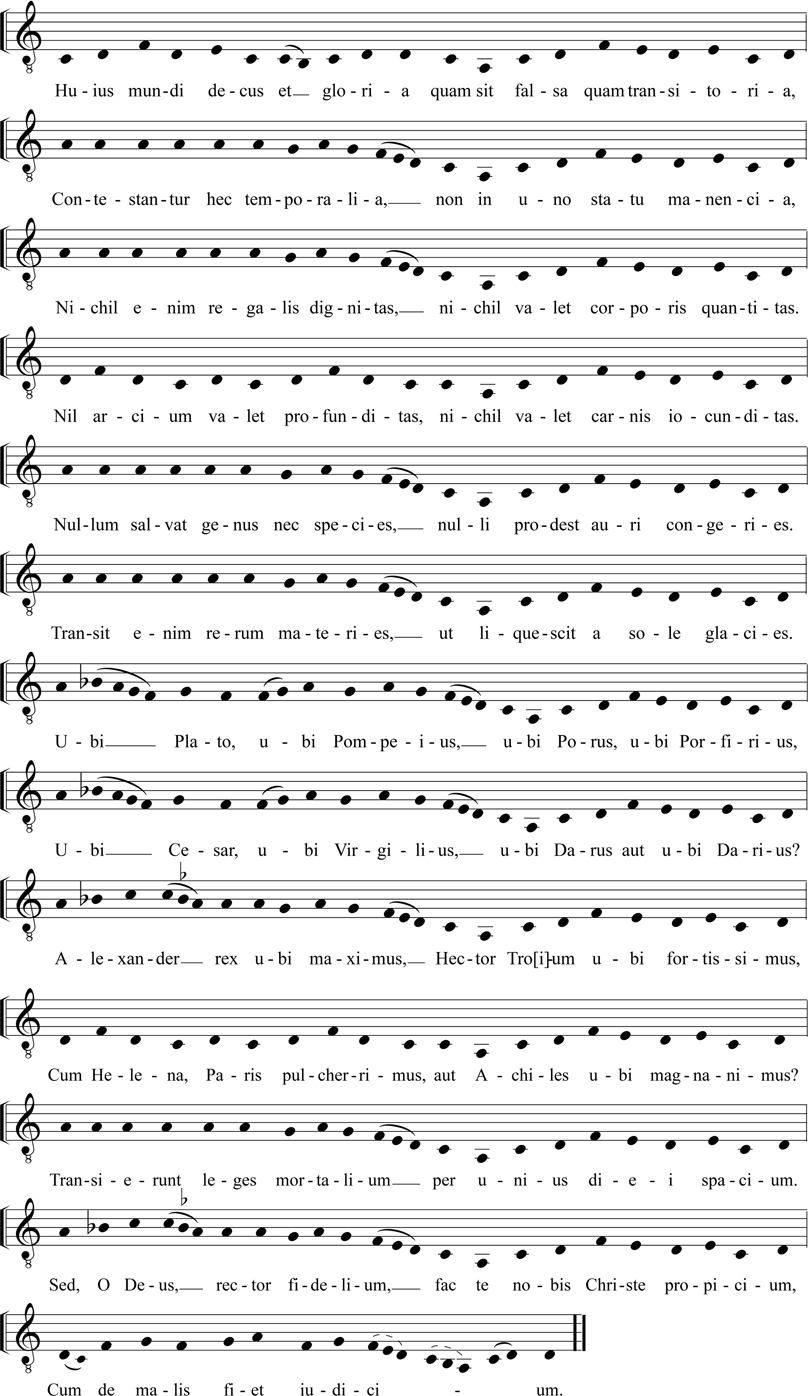
The text in the St Lambert manuscript, however, lacks the opening phrase found in the Cantionarium, the ‘Audi tellus’ incipit. Since this same opening phrase is also missing in the two fourteenth-century manuscripts from Oberaltaich (the partially neumed D-Mbs Clm. 9552, and D-Mbs Clm. 9640, with only the text), it seems possible that the distinctive opening phrase, beginning ‘Audi tellus’ was added onto an earlier versicle beginning ‘Huius mundi’.Footnote 32 The similarity of the melody indicated by the neumes in the Cantionarium and Cantatorium with the St Lambert melody is clear (see Ex. 5). The St Lambert version also shows an indebtedness to psalmody, common in many responsory versicles, but I find striking the similarity of many melodic gestures in this version to the original Audi tellus song, especially the descent to D from the repeated pitches on a in lines 2/3 and 4/5 when compared with the opening phrase of the song (compare with Ex. 2). Perhaps, this indebtedness to the root practice of psalmodic recitation enabled the longevity of melodic memory evident even in shift of genre from song to versicle. What is clear in the St Lambert melody is the introduction of parallel melodic phrases which mimic the paired versicles of a sequence or the paired phrases of a canzo (Ex. 6, Table 4).
Huius mundi versicle from St Lambert (A-Gu 29).

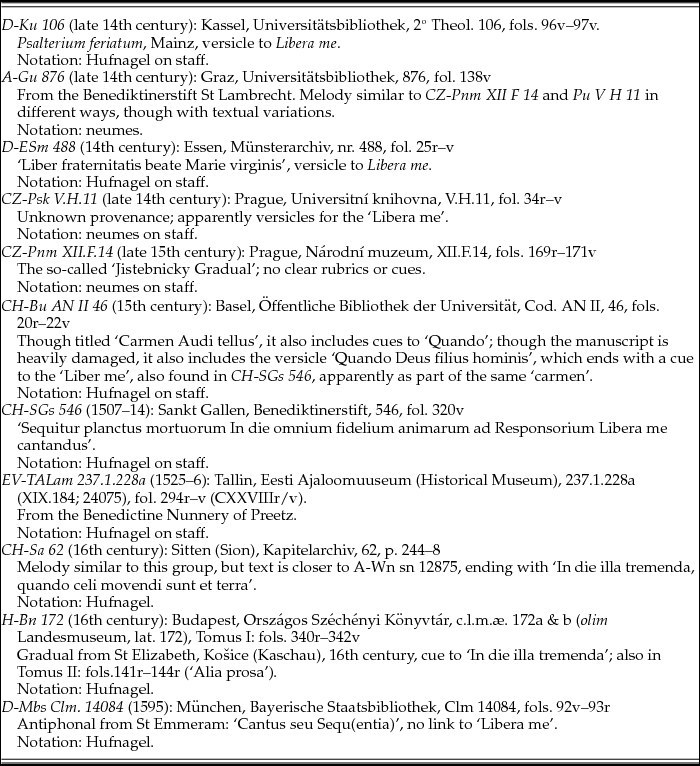
Audi tellus, audi magni – ‘Ubi [sunt]’, Variant 2, musical sources.

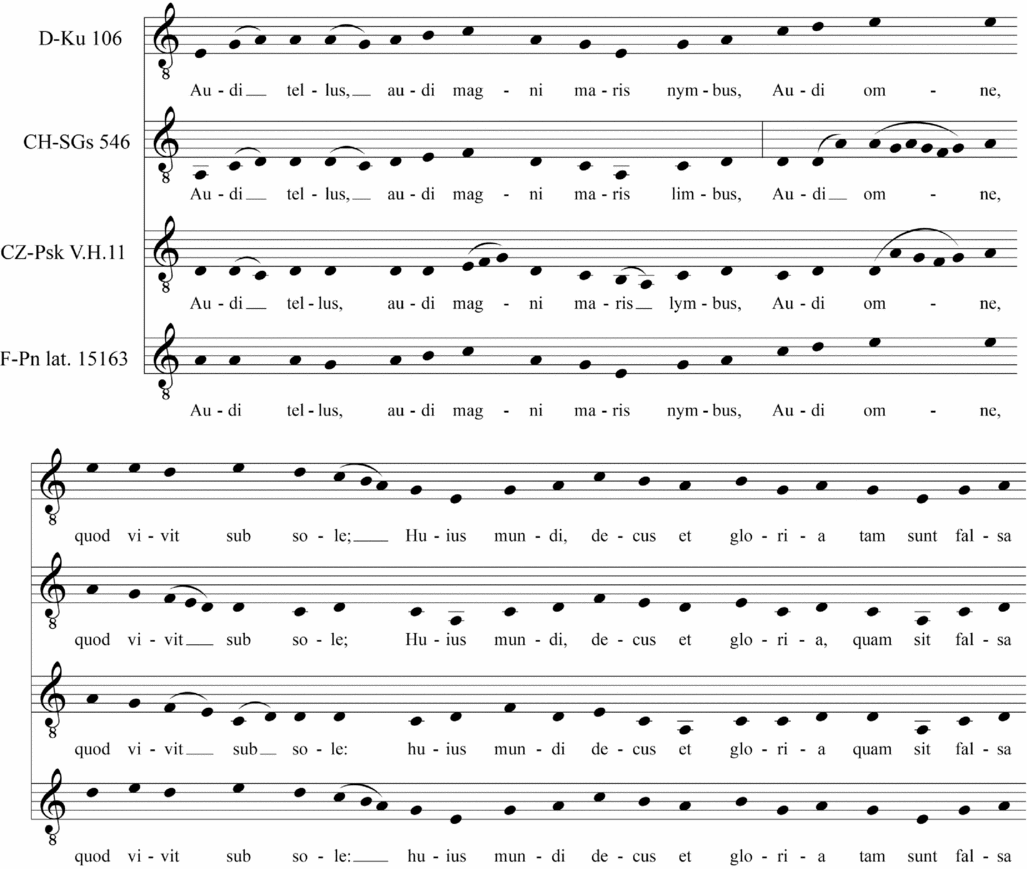
While the melody from the Cantionarium, the Cantatorium from Beromünster and the St Lambert manuscripts represents one early tradition, a variant melody was being created in Central Europe, most likely during the fourteenth century. The earliest version in staff notation is a Psalterium feriatum from Mainz (D-Ku 106).Footnote 33 Although the similarities of basic melodic outline is evident, there are many melodic differences between the sources in the ‘Variant 2’ melody-group, including at least two different openings and variations of mode (either D or A; see Ex. 7, lines 1, 2 and 3).
Comparison of Audi tellus, audi magni – ‘Ubi [sunt]’, Variants 2 and 3.

The rubrics found in some sources for this versicle discussed so far also provide interesting evidence for its specific use and significance. For example, the rubric in the Beromünster Cantatorium (variant 1) indicates that the Libera me with this new versicle was sung in procession in the Office for the Dead; the versicle, Qui ambulabat iacet, indicates that ‘Isti versus cantantur super Libera me Domine de defunctis in processione’ (these verses are sung in addition to the Libera me Domine concerning the departed in procession), and this is followed by the Audi tellus with the rubric ‘Item’. The early sixteenth-century CH-SGs 546 (variant 2) specifies that this ‘lament of the dead’ was sung on All Souls Day (2 November): ‘Sequitur planctus mortuorum In die omnium fidelium animarum ad Responsorium Libera me cantandus’ (‘Here follows the lament of the dead on the day of all the faithful souls, sung with the responsory Libera me’).
The history of this second melodic version of the new Audi tellus versicle extends far beyond the thirteenth century, but one last transformation within the tradition should be mentioned. In some of the latest sources, such as the antiphonal from St Emmeram (D-Mbs Clm. 14084), the versicle has lost its association with the Libera me and is rubricated in a new way: ‘Cantus seu Sequ[entia].’ The later sources for the new Audi tellus also add biblical figures, such as David and Solomon, to the ‘Ubi sunt’ litany.
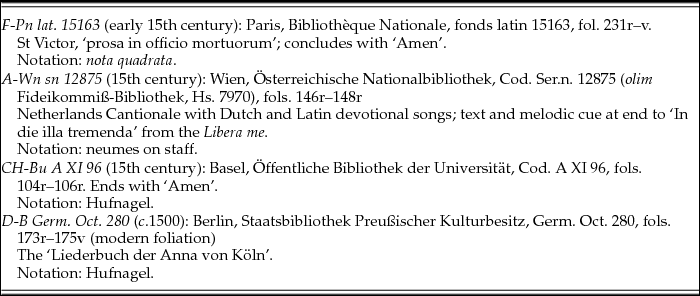
By the end of the Middle Ages and into the Renaissance, the transformation from a versicle to the Libera me into a distinct song is complete. There is also a third variant melodic tradition associated with this transformation. The earliest source known to me is a miscellaneous fifteenth-century collectio from St Victor (F-Pn lat. 15163), where it is labelled as ‘prosa in officio mortuorum’ (‘a prose in the office of the dead’) (Table 5). There is still a remarkable consistency in the basic melodic outline between the melodies of both Variants 2 and 3 (compare Ex. 7, line 4 with lines 1, 2 and 3). What distinguishes Variant 3 is a melisma on the word ‘Ubi’, as can be seen in example from A-Wn sn 12875, a fifteenth-century Cantionale from the Netherlands (see Ex. 8).Footnote 34
Audi tellus, audi magni – ‘Ubi [sunt]’, Variant 3, musical sources.

Audi tellus, audi magni – ‘Ubi [sunt]’, Variant 3, A-Wn sn 12875.

This third version also becomes especially popular as a devotional song within the monasteries and cloisters associated with the Devotio moderna, and this devotional usage may be reflected in the later motets on this text, by Caspar Othmayr, Jacobus Gallus and Orlandus Lassus, and in an arrangement in the Bottegari Lutebook.Footnote 35
This progression from the apocalyptic images in the eleventh-century abecedarium to the litany of classical figures placed within the ‘Ubi sunt’ topos from the thirteenth century and its continued use into the sixteenth century may represent an intention to integrate even secular history into the liturgical and ritual context of death and the Last Judgement. The Audi tellus tradition also illustrates the continuing fluidity of genre in the Middle Ages. There are examples of other medieval works that morphed in different ways, such as Dulcis Jesu memoria, Porta salutis Ave and the Ave Maria.Footnote 36 While it was perhaps necessary to set limits in earlier bibliographic overviews, such as Anderson did for his Catalogue raisonné, a more open approach would allow for a more inclusive view of medieval song in all its varieties.Footnote 37 The multivalent and long-enduring aspects of the Audi tellus tradition, from song to versicle and back to song, is just one example of the creativity and adaptability of the poets, composers and singers of the Middle Ages.