Introduction
Since the production of the first cloned sheep by somatic cell nuclear transfer (SCNT) by Wilmut et al. (Reference Wilmut, Schnieke, McWhir, Kind and Campbell1997), many mammalian species have been cloned, including mouse (Wakayama et al., Reference Wakayama, Perry, Zuccotti, Johnson and Yanagimachi1998), cattle (Kato et al., Reference Kato, Tani, Sotomaru, Kurokawa, Kato, Doguchi, Yasue and Tsunoda1998), pig (Polejaeva et al., Reference Polejaeva, Chen, Vaught, Page, Mullins, Ball, Dai, Boone, Walker, Ayares and Colman2000), cat (Shin et al., Reference Shin, Kraemer, Pryor, Liu, Rugila, Howe, Buck, Murphy, Lyons and Westhusin2002), rat (Zhou et al., Reference Zhou, Renard, Le Friec, Brochard, Beaujean, Cherifi, Fraichard and Cozzi2003), and dog (Lee et al., Reference Lee, Kim, Jang, Oh, Yuda, Kim, Shamim, Kim, Kang, Schatten and Hwang2005). Cloning by SCNT is a powerful tool that can be strategically applied to farm animal breeding and research, for the production of genetically engineered animals for biomedical purposes, or for the conservation of endangered species. However, the low cloning efficiency and the high incidence of pre- and postnatal developmental abnormalities have limited a wider practical application of the procedure (Solter, Reference Solter2000; Cibelli et al., Reference Cibelli, Campbell, Seidel, West and Lanza2002; Yang et al., Reference Yang, Smith, Tian, Lewin, Renard and Wakayama2007; Kishigami et al., Reference Kishigami, Mizutani, Ohta, Hikichi, Van Thuan, Wakayama, Bui and Wakayama2006).
The process of cloning involves a series of steps that, when under suboptimal conditions, may contribute to failures to obtain live and healthy animals (Callensen et al., Reference Callensen, Liu, Pedersen, Li and Schmidt2014; Lin et al., Reference Lin, Lee, Shin, Oqani and Jin2015; Aguiar et al., Reference Aguiar, Ticiani, Rodriguez-Villamil, Ongaratto, Lazzarotto, Rodrigues, Bertolini and Bertolini2017). Therefore, numerous efforts have been made to improve each step of the cloning process to increase success rates. Factors such as oocyte quality are decisive for successful cloning (Lin et al., Reference Lin, Lee, Shin, Oqani and Jin2015). In addition, adequate activation and reprogramming processes are key to embryo development and, consequently, to production of viable cloned animals.
One of the parameters to enhance higher developmental rates is the selection of more competent oocytes for manipulation, using alternative procedures other than the subjective morphological assessment, which is commonly used for in vitro embryo production. Sucrose has already been used either as a method to aid enucleation in cloned mice (Wang et al., Reference Wang, Liu, Li, Lian and Chen2001) or for the selection of oocytes (Dang-Nguyen et al., Reference Dang-Nguyen, Nguyen, Somfai, Wells, Men, Viet-Linh, Noguchi, Kaneko, Kikuchi and Nagai2018; Iwasaki et al., Reference Iwasaki, Yamanaka, Sugiyama, Teshima, Briones-Nagata, Maeki, Yamashita, Takahashi and Miyazaki2018). For the latter purpose, exposing low quality oocytes to a hyperosmotic medium-induced shrinkage, showing an irregular oolemma shape, whereas good quality oocytes maintain their shape after exposure to sucrose solution. Therefore, this could be an inexpensive and fast tool to select competent oocytes prior to micromanipulation. For activation, several effective protocols for artificial oocyte activation have been developed. However, most protocols require prolonged exposure to non-specific inhibitors with high variability in results (Bang et al., Reference Bang, Yoo, Park, Shin, Cho, Lee, Kim, Kang, Kong, Kim and Cho2013; Liu et al., Reference Liu, Cui, Li, Sun, Lu, Shen, Liu and Shi2015; Li et al., Reference Li, Guo, Zhu, Jin, Zhang, Zhang, Xing, Xuan, Luo, Luo and Wang2017). Hence, it has been shown that the use of agents that mimic the physiological activation events, such as the zinc chelator TPEN, through the manipulation of Ca2+ and Zn2+, improved chemical activation and developmental rates of porcine oocytes (Lee et al., Reference Lee, Davis, Zhang, Ryu, Spate, Park, Samuel, Walters, Murphy, Machaty and Prather2015; Macedo et al., Reference Macedo, Glanzner, Rissi, Gutierrez, Currin, Baldassarre and Bordignon2019). Finally, to increase reprogramming efficiency, some authors demonstrated that the use of Scriptaid, an inhibitor of histone deacetylase enzymes (HDACi), enhanced developmental rates after cloning, even correcting epigenetic errors, hence, improving reprogramming (Xu et al., Reference Xu, Li, Yu, He, Shi, Zhou, Liu and Wu2013; Liang et al., Reference Liang, Zhao, Choi, Kim and Cui2015). Therefore, the aim of this study was to compare: (i) the exposure of oocytes to sucrose as a means to select better quality oocytes, (ii) the use of the zinc chelator TPEN for parthenogenetic embryo activation, and (iii) the use of a HDACi (Scriptaid) after cloning on developmental outcome of porcine embryos cloned by SCNT.
Materials and methods
All chemicals were obtained from Sigma Chemical Co. (St. Louis, MO, USA), unless stated otherwise.
In vitro maturation and cloning by somatic cell nuclear transfer
In vitro-matured pig cumulus–oocyte complexes (COCs) were obtained from a commercial supplier (DeSoto Biosciences, Inc., Seymour, TN, USA). After 20–22 h of in vitro maturation in IVM medium, composed of TCM-199 medium supplemented with 10% (v/v) porcine follicular fluid, 0.6 mM cysteine, 50 ng/ml EGF, 10 ng/ml IGF1, 15 IU/ml eCG and 10 IU/ml hCG, at 39°C in 5% CO2, COCs were further cultured for 24 h in maturation medium without hormones, as previously described (Liu et al., Reference Liu, Cui, Li, Sun, Lu, Shen, Liu and Shi2015). At the end IVM, cumulus cells were removed by vortexing for 6–8 min in HEPES-buffered TCM-199 medium supplemented with 0.1% hyaluronidase. Then, denuded oocytes were rinsed three times in Medium 199 + HEPES (Gibco, NY, USA) supplemented with 0.4% BSA (w/v) and moved into holding medium until cloning. For manipulation, matured oocytes were transferred into micromanipulation medium composed of TCM-199 supplemented with 7 µg/ml cytochalasin B. The polar body along with a portion of the adjacent cytoplasm were removed using micropipettes, and a fibroblast cell (wild-type Yorkshire x Landrace) was placed into the perivitelline space. Oocyte-cell couplets were placed on a 1-mm cell fusion electrode slide (BTX451, Harvard Apparatus, MA USA), overlaid with 500 μl fusion medium (280 mM mannitol solution, 0.001 mM CaCl2 and 0.05 mM MgCl2), and given two 1.2-kV/cm DC pulses for 30 µs using a cell fusion electroporation system (BTX ECM-2001, San Diego, CA, USA). For chemical activation of pig embryos, and following polar body selection (parthenote embryos) or embryo reconstruction by fusion (cloned embryos), control oocytes were activated by chemical activation under standard chemical protocols, by exposure to 5 µM ionomycin in TCM-199 HEPES-buffered medium supplemented with 0.4% BSA for 5 min at 39°C in air, protected from light, followed by 4 h incubation in 2 mM 6-DMAP in PZM-3 medium supplemented with 0.4% BSA. Finally, presumptive zygotes were in vitro cultured (IVC) in PZM-3 culture medium supplemented with 0.4% BSA according to Cao et al. (Reference Cao, Sui, Li, Ji, Zhang and Zhang2012), at 39°C in 5% CO2, 5% O2 and 90% N2 and high humidity for 7 days. Cleavage rates were determined 48 h after activation, and blastocyst rates on day 7 post-activation.
Experiment 1: Oocyte selection by sucrose treatment
After IVM, groups of 20 to 30 denuded oocytes were treated with 0.2 M sucrose in Medium 199 supplemented with HEPES and 0.4% BSA for 5 min. Based on the changes of cytoplasm and membrane morphology during and after sucrose treatment, good oocytes were selected, according to Dang-Nguyen et al. (Reference Dang-Nguyen, Nguyen, Somfai, Wells, Men, Viet-Linh, Noguchi, Kaneko, Kikuchi and Nagai2018), discarding oocytes with misshaped form. After treatment, good oocytes were washed three times in Medium 199 with HEPES + 0.4% BSA to remove sucrose, for production by cloning or by parthenogenesis, as described above. Oocytes that were not exposed to sucrose were used as controls for the production of cloned or parthenote embryos. Cleavage rates were determined 48 h after nuclear transfer and blastocyst rates on day 7 post-activation.
Experiment 2: Chemical activation by zinc chelator TPEN
Groups of embryos produced by SCNT were chemically activated by one of two protocols. Reconstructed presumptive SCNT embryos were treated with 5 µM ionomycin for 5 min. After ionomycin treatment, zygotes were washed twice and incubated in 2 mM 6-DMAP for 4 h (SCNT control). The TPEN treatment was performed with a concentration of TPEN based on previous studies by Lee et al. (Reference Lee, Davis, Zhang, Ryu, Spate, Park, Samuel, Walters, Murphy, Machaty and Prather2015). Oocytes were exposed to ionomycin for 5 min followed by 200 μM TPEN in PZM-3 + 0.4% BSA for 30 min. To prevent extrusion of the second polar body, embryos were cultured in PZM-3 + 0.4% BSA in the presence of 2 mM 6-DMAP for 4 h after exposure to TPEN. After 6-DMAP incubation, presumptive zygotes were washed in PZM-3 culture medium and in vitro cultured in PZM-3 + 0.4% BSA at 39°C in 5% CO2, 5% O2 and 90% N2 up to the blastocyst stage on day 7 of development. Parthenote embryos activated under the standard protocol (ionomycin + 6-DMAP) were used as controls. Cleavage rates were determined 48 h after nuclear transfer and blastocyst rates on day 7 post-activation.
Experiment 3: Inhibition of histone deacetylases (Scriptaid)
To assess the effect of the Scriptaid treatment, a proportion of the cloned embryos activated under the standard activation protocol were in vitro cultured in PZM-3 + 0.4% BSA supplemented with 500 nM Scriptaid for 15 h, immediately after activation, at 39°C in 5% CO2, 5% O2 and 90% N2. Embryos were then in vitro cultured in PZM-3 + 0.4% BSA and in a humidified atmosphere at 39°C in 5% CO2, 5% O2 and 90% N2. Cloned and parthenote embryos not treated with Scriptaid were used as controls. Cleavage rates were determined 48 h after nuclear transfer and blastocyst rates on day 7 post-activation.
Embryos that developed to the blastocyst stage after 7 days in culture were separated, rinsed in phosphate-buffered saline (PBS) + 0.1% polyvinyl alcohol (PBS-PVA), fixed in 4% paraformaldehyde for 15–20 min, and then stored in PBS containing 0.3% BSA and 0.1% Triton X-100 at 4°C. Nuclei were stained by exposing embryos to 10 µM Hoechst 33342 for 10 min. Embryos were then mounted in a drop of glycerol on a glass slide and covered with a cover slip. Blastocysts were gently flattened under the coverslip, so that most cells appeared in the same focal plane. Total cell numbers were counted using an epifluorescence microscope.
Data analysis
Cleavage and blastocyst rates were compared between groups, for the three experiments, using the chi-squared test (P < 0.05), whereas total cell number in blastocysts (Experiment 3) were compared by analysis of variance (ANOVA), with pairwise comparisons using the Tukey test (P < 0.05).
Results
Experiment 1: Sucrose treatment
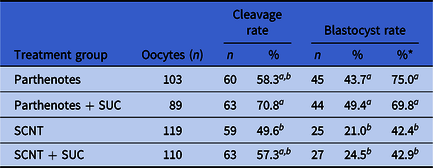
The percentage of oocytes classified as good, and therefore selected after sucrose treatment, was 87.7% (199/235). Cleavage and blastocyst rates for parthenote or cloned embryos derived from oocytes treated with sucrose were similar to untreated controls, as shown in Table 1. Cleavage rates in the parthenote sucrose-treated group were higher than in the untreated cloned group. In addition, cleavage rates were higher after oocyte selection in sucrose, irrespective of SCNT or parthenote (119/222, 53.6% vs. 126/199, 63.3%, for controls and sucrose-treated embryos, respectively; P < 0.05), with no differences in blastocyst yield. Blastocyst rates for parthenote embryos were higher than for cloned embryos, regardless the sucrose treatment.
Developmental rates of in vitro-produced pig parthenogenetic or cloned (SCNT) embryos after oocyte selection in sucrose hypertonic solution (SUC) following in vitro maturation

a,bNumbers with distinct superscripts in the same column differ, at P < 0.05.
* Blastocyst rates based on total number of cleaved embryos on day 2 of IVC, per group.
Experiment 2: TPEN treatment
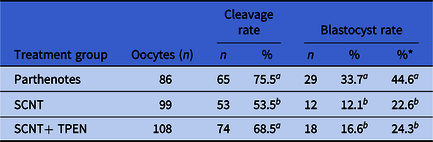
Cleavage rates were lower in control cloned zygotes (TPEN-untreated) than parthenote controls and TPEN-treated cloned embryos (P < 0.05), which were similar to one another. However, blastocyst rates were similar between treated and untreated cloned groups, but lower than the parthenogenetic control untreated group (Table 2).
Developmental rates of in vitro-produced pig parthenogenetic or cloned (SCNT) embryos after treatment with TPEN during activation

a,bNumbers with distinct superscripts in the column differ, at P < 0.05.
* Blastocyst rates based on total number of cleaved embryos on day 2 of IVC, per group.
Experiment 3: Scriptaid treatment
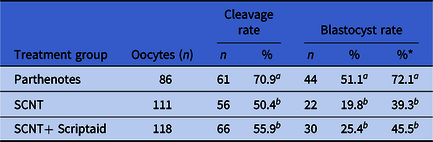
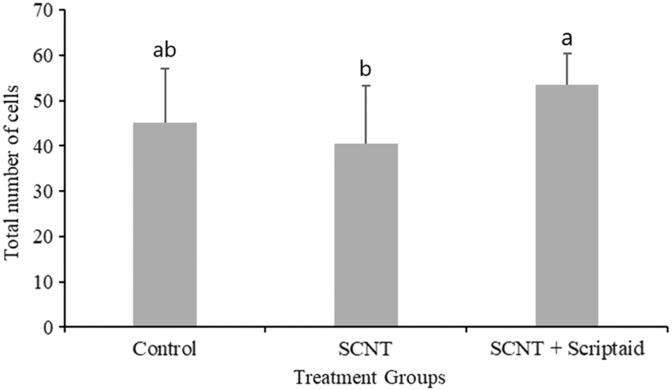
Scriptaid treatment after fusion did not improve embryo development after cloning when compared with the untreated cloned groups, with both cloned embryo groups showing lower cleavage and blastocyst rates than parthenogenetic control embryos (Table 3). However, the total number of cells in Scriptaid-treated cloned embryos was higher than in untreated cloned embryos (Figure 1).
Developmental rates of in vitro-produced pig parthenogenetic or cloned (SCNT) embryos after treatment with Scriptaid after activation

a,bNumbers with distinct superscripts in the column differ, at P < 0.05.
* Blastocyst rates based on total number of cleaved embryos on day 2 of IVC, per group.
Total number of cells (means ± standard deviation) in day 7 in vitro-produced pig parthenogenetic (parthenotes) or cloned (SCNT) blastocysts after treatment or not with Scriptaid after activation. a, bColumn bars with different superscripts differ, at P < 0.05.

Discussion
Although several mammalian species have been successfully cloned using SCNT technology, cloning success rate remains extremely low, especially in pigs (Keefer, Reference Keefer2015). In the present study, we evaluated factors in procedures for SCNT cloning in pigs that may improve cloning efficiency. The oocyte competence is one of such main factors. It is known that oocyte quality has a direct and important influence on developmental rates when used for in vitro embryo production (Kempisty et al., Reference Kempisty, Piotrowska, Rybska, Woźna, Antosik, Bukowska, Zawierucha, Ciesiółka, Jaśkowski, Nowicki and Brüssow2015). However, the visual evaluation that is currently used for the process continues to be subjective. In this study, oocyte quality was evaluated by incubating oocytes for 5 min in a hyperosmotic medium containing 0.2 M sucrose, with subsequent morphological assessment of viability. Previous authors reported that the exposure to a hyperosmotic sucrose solution allowed the selection of better quality oocytes, with subsequent increase in in vitro developmental rates in pigs (Dang-Nguyen et al., Reference Dang-Nguyen, Nguyen, Somfai, Wells, Men, Viet-Linh, Noguchi, Kaneko, Kikuchi and Nagai2018; Iwasaki et al., Reference Iwasaki, Yamanaka, Sugiyama, Teshima, Briones-Nagata, Maeki, Yamashita, Takahashi and Miyazaki2018; Lee et al., Reference Lee, Lee, Park, Elahi, Jeon, Hyun and Lee2014). The exposure of oocytes in the hyperosmotic sucrose solution, unlike other methods of selection, such as Brilliant Cresyl Blue (BCB), is faster and proven innocuous to oocytes, neither compromising further embryo development nor causing chromosomal abnormalities, in contrast to what has been reported for viability staining processes (Iwasaki et al., Reference Iwasaki, Yamanaka, Sugiyama, Teshima, Briones-Nagata, Maeki, Yamashita, Takahashi and Miyazaki2018; Lee et al., Reference Lee, Lee, Park, Elahi, Jeon, Hyun and Lee2014). Nevertheless, our results demonstrated that despite the selection of oocytes with sucrose producing more blastocyst on a per routine basis, total blastocyst rates were not significantly higher than the groups undergoing no sucrose selection. Cleavage rates were higher in the pre-selected group, but not the blastocyst rate. Therefore the deformation observed in the oolemma in the present study was not as significant, as reported elsewhere (Dang-Nguyen et al., Reference Dang-Nguyen, Nguyen, Somfai, Wells, Men, Viet-Linh, Noguchi, Kaneko, Kikuchi and Nagai2018), indicating the oocytes used in this study were high quality, which may very well be the reason for no differences being detected between treated and non-treated oocytes in terms of development, as only about 12% of the oocytes were discarded after treatment. Oocytes used in this experiment were purchased from a commercial source, which employs a strict morphologic pre-selection prior to shipping. The selection with the exposure to sucrose could be more valuable for heterogenic pools of oocytes, in which the elimination of bad quality oocytes would improve the total efficiency of the in vitro embryo culture.
It is known that the artificial activation of oocytes occurs under suboptimal conditions, trying to emulate the natural signalling pathway produced by the fertilizing sperm. In Experiment 2, a novel activation protocol was attempted to provide better results in terms of embryo yield. Artificial activation of oocytes is an essential process after cloning. Oocyte activation is also considered to be the major cause of success or fertilization failures following ICSI (Vanden Meerschaut et al., Reference Meerschaut, Nikiforaki, Heindryckx and De Sutter2014). The success of activation also depends on the inherent quality of oocytes, adequate selection of good oocytes, adequate maturation, and proper culture conditions (Tosti et al., Reference Tosti, Boni and Cuomo2002). Most of the activation protocols are based on agents that promote the increase in intracellular Ca2+, such as calcium ionophores, ethanol and electric stimulation (Ferrer-Buitrago et al., Reference Ferrer-Buitrago, Bonte, De Sutter, Leybaert and Heindryckx2018). A recent study confirmed that TPEN, a zinc chelator, can effectively activate pig oocytes. However, the production of blastocysts was lower than the standard chemical activation protocol (Zhao et al., Reference Zhao, Kim and Cui2014). The authors demonstrated that events of oocyte activation, such as cortical granule release and reduction in MPF occurred when matured oocytes were incubated with TPEN. Such events are a part of oocyte activation (Ducibella and Fissore, Reference Ducibella and Fissore2008), indicating that the depletion of Zn2+ by TPEN is enough to stimulate the machinery that is normally associated with meiotic resumption. The use of TPEN showed better results when used in combination with the chemical activation. Pre-activated oocytes exposed to the zinc chelator, promote higher blastocyst rates than only chemical activation or only TPEN exposure (Lee et al., Reference Lee, Davis, Zhang, Ryu, Spate, Park, Samuel, Walters, Murphy, Machaty and Prather2015). Our results showed similar blastocyst rates between cloned embryos (16.6% vs. 12.1%), probably resulting from suboptimal culture conditions, as parthenote embryo yield was rather low (33.7%). However, cleavage rates were higher in the SCNT cloned embryos incubated in TPEN for 30 min after chemical activation, confirming the efficient meiotic resumption due to appropriate oocyte activation.
Scriptaid is an HDACi that belongs to an existing class of hydroxamic acid-containing HDACis. In this study, we performed Scriptaid treatment after activation in an attempt to improve epigenetic modifications in SCNT embryos and to increase developmental competence, as demonstrated by others (Zhao et al., Reference Zhao, Hao, Ross, Spate, Walters, Samuel, Rieke, Murphy and Prather2010). It is known that deacetylase inhibitors increase histone acetylation (Siriboon et al., Reference Siriboon, Li, Yu, Chern and Ju2018), keeping the chromatin open, therefore facilitating access to reprogramming factors present in the cytoplast (Bannister and Kouzarides, Reference Bannister and Kouzarides2011). The abnormal epigenetic reprogramming pattern seen in donor nuclei after cloning is thought to be the main cause of low cloning efficiencies. It is known that the methylation status will change the transition to embryonic transcription after activation of the genome and, consequently, also the initial cell divisions and differentiation (Whitworth et al., Reference Whitworth, Zhao, Spate, Li and Prather2011). Our findings did not show significant differences in blastocyst yield between treated and not treated embryos with Scriptaid (25.4% vs. 19.8%). In fact, blastocysts produced after exposure to Scriptaid showed a higher cell count in relation to those not treated with Scriptaid, indicating that such a higher cell count may be due to a more adequate epigenetic reprogramming in relation to cloned control embryos.
In summary, findings from this study shows that: (i) oocyte selection in a sucrose hypertonic solution prior to enucleation did not improved the in vitro embryo development; (ii) use of TPEN, a zinc chelator, during chemical activation improved the cleavage but did not improved the blastocyst rate; and (iii) exposure of cloned activated embryos to Scriptaid, a histone deacetylase inhibitor, allowed the production of embryos of better quality, according to the total cell number. Such treatments could be new approaches to increased developmental rates for SCNT pig embryos, when further tested and with the refinement of conditions and protocols. However, more studies must be done to understand their mechanisms and using in combination to evaluate the interaction of the different treatments.
Financial support
This research did not receive any specific grant from funding agencies in the public, commercial, or not-for-profit sectors.
Conflicts of interest
No conflicts of interest.
Ethical standards
The authors assert that all procedures contributing to this work comply with the ethical standards of the relevant national and institutional guides.