Introduction
Genetic structuring is the outcome of restricted gene flow and lineage divergence during periods of population isolation (Hartl and Clark, Reference Hartl and Clark2007). For some organisms, such as obligate symbionts (parasites, mutualists and commensals), population isolation events may take place at very small spatial and temporal scales, because individual hosts represent a patchy and ephemeral habitat (Poulin, Reference Poulin2007; Barrett et al. Reference Barrett, Thrall, Burdon and Linde2008). This forces symbionts to colonize continuously new habitat patches, thereby creating opportunities for population structuring via founder effects, especially if populations established on one individual host originate in a low number of colonizers (Hedrick, Reference Hedrick2000). Host population size and symbiont dispersal ability can also influence symbiont genetic structuring (Johnson et al. Reference Johnson, Williams, Drown, Adams and Clayton2002; Whiteman et al. Reference Whiteman, Kimball and Parker2007; Dabert et al. Reference Dabert, Coulson, Gwiazdowicz, Moe, Hanssen, Biersma, Pilskog and Dabert2015; Martinu et al. Reference Martinu, Sychra, Literák, Capek, Gustafsson and Stefka2015). Moreover, geographic structuring of host populations themselves, either because of low host vagility, or because of host population isolation in discrete habitat patches, may result in the further genetic structuring of symbiont populations (Harper et al. Reference Harper, Spradling, Demastes and Calhoun2015).
The genetic structuring of symbiont infrapopulations (the stock of symbionts that become temporarily isolated in a single host individual; Poulin, Reference Poulin2007) can determine several aspects of their ecological and evolutionary interactions. Regarding within-host population dynamics, individual symbionts may differ in their ability to access host resources, or to occupy the best habitat within the host (Mideo, Reference Mideo2009). Poor competitors may be displaced to areas of inferior quality and have reduced individual fitness (Fretwell and Lucas, Reference Fretwell and Lucas1970). However, within-host fitness differences among symbionts will have evolutionary consequences only in genetically diverse symbiont infrapopulations (Rigaud et al. Reference Rigaud, Perrot-Minnot and Brown2010): if all symbionts are close kin because of intense transmission bottlenecks, individuals that occupy poorer microhabitats within the host may still obtain fitness returns from close kin occupying the best habitat (Emlen, Reference Emlen1995). Among-host population dynamics can also be dependent on genetic structuring, because reduced infrapopulation genetic diversity might entail inbreeding costs (Keller and Waller, Reference Keller and Waller2002), while too much gene flow might hamper local adaptation to specific host types (Lenormand, Reference Lenormand2002). Host specificity is thus a further element driving the genetic structuring of symbiont populations: some symbionts may exploit different host types (either different host species, or host populations of the same species occupying contrasting environments), which may differ in their spatiotemporal distribution or in their suitability for the symbionts. For example, alternative host types may offer different quantity or quality of resources to the symbiont (Fernández-González et al. Reference Fernández-González, De la Hera, Pérez-Rodríguez and Pérez-Tris2013), which may promote specialization of symbionts, and ultimately genetic isolation among populations of symbionts associated with different host types (Nadler, Reference Nadler1995; Rigaud et al. Reference Rigaud, Perrot-Minnot and Brown2010).
Population genetic structure of symbionts should inform our understanding of their ecology and evolution (Hewitt, Reference Hewitt2001), but the genetic composition of symbiont populations within host individuals, and the genetic structuring of such populations among individual hosts and host types, remain obscure for most host–symbiont systems (Nadler, Reference Nadler1995; McCoy et al. Reference McCoy, Boulinier, Tirard and Michalakis2003; Doña et al. Reference Doña, Moreno-García, Criscione, Serrano and Jovani2015a). We studied the genetic structuring of two species of astigmatan feather mites, Proctophyllodes sylviae Gaud (Proctophyllodidae) and Trouessartia bifurcata (Trouessart) (Trouessartiidae) sampled from resident and migratory blackcaps, Sylvia atricapilla (L.) (Sylviidae), coexisting in winter in Southern Spain. Feather mites are a very diverse and broadly distributed group of avian mutualists, composed mostly of host specialists (Proctor, Reference Proctor2003). Estimates of genetic diversity calculated for mitochondrial DNA show that it depends to some extent on average infrapopulation size (Doña et al. Reference Doña, Moreno-García, Criscione, Serrano and Jovani2015a), which is in turn roughly repeatable for a given species of feather mite (Díaz-Real et al. Reference Díaz-Real, Serrano, Pérez-Tris, Fernández-González, Bermejo, Calleja, De la Puente, De Palacio, Martínez, Moreno-Opo, Ponce, Frías, Tella, Moller, Figuerola, Pap, Kovacs, Vagasi, Meléndez, Blanco, Aguilera, Senar, Galván, Atienzar, Barba, Cantó, Cortés, Monros, Piculo and Vogeli2014). As for most feather mites, P. sylviae and T. bifurcata are only known to be transmitted by direct contact between hosts (Proctor, Reference Proctor2003), so that their genetic diversity on a single-host individual might be very reduced if the number of founders is low.
Blackcaps are the main host of the two studied species of feather mite, which live on the flight feathers of the wing (Doña et al. Reference Doña, Proctor, Mironov, Serrano and Jovani2016). Blackcaps breeding in medium and high latitudes of Western Europe typically winter around the Mediterranean region, where they coexist with resident blackcap populations (Pérez-Tris and Tellería, Reference Pérez-Tris and Tellería2002a). The extreme SW of Spain, where this study was conducted, offers an exceptional opportunity to study the symbiont communities of birds that, although temporally sympatric during winter, are effectively segregated during the breeding period and have undergone contrasting evolutionary paths (Pérez-Tris et al. Reference Pérez-Tris, Bensch, Carbonell, Helbig and Tellería2004). Resident birds provide mites with more stable environmental conditions, while migrants move between contrasting regions biannually. Resident and migratory blackcaps also differ as ‘habitats’ for feather mite infracommunities. Residents are longer-lived (Pérez-Tris and Tellería, Reference Pérez-Tris and Tellería2002b), have differently shaped wings and structurally different feathers (De la Hera et al. Reference De la Hera, Pérez-Tris and Tellería2009). They also possess larger uropygial glands, which likely make them more rewarding hosts from a nutritional perspective (vane-dwelling feather mites feed on the oil of the uropygial gland that covers the feathers, and on the particles embedded within; Proctor, Reference Proctor2003).
In bird species with no social behaviour (as blackcaps), feather mite transmission is posited to be reduced to male–female and parent-nestling contact during the breeding season (Proctor, Reference Proctor2003; Doña et al. Reference Doña, Potti, De La Hera, Blanco, Frías and Jovani2017a). It is thus likely that if the differences between migratory and resident blackcaps have promoted mite specialization, mite populations may have a detectable genetic structure related to host type. However, the coexistence of migratory and resident blackcaps may provide opportunities for mite dispersal among hosts with different phenotype and geographic origins, thereby preventing genetic structuring of mite populations.
These processes may further differentiate between the two species studied, which are unequally distributed between host types: whereas P. sylviae occurs with similar prevalence on migratory and resident blackcaps, it is more abundant on migratory blackcaps. In contrast, T. bifurcata is rarely found on migratory blackcaps (Fernández-González et al. Reference Fernández-González, De la Hera, Pérez-Rodríguez and Pérez-Tris2013). Such a pattern of segregated distribution may be associated with differences between mite species in host preference, dispersal capabilities, or in-host population dynamics, all of which could lead to variation in the patterns of genetic structure between mite species. In addition, the coexistence of both mite species happens at the expense of the smaller species (P. sylviae), which on resident hosts is displaced by T. bifurcata from preferred wing areas and attains lower population size (Fernández-González et al. Reference Fernández-González, Pérez-Rodríguez, de la Hera, Proctor and Pérez-Tris2015). Because of these interspecific interactions, if within-host genetic diversity of mites depends on population size (Doña et al. Reference Doña, Moreno-García, Criscione, Serrano and Jovani2015a), the genetic diversity of P. sylviae could be lower on resident than on migratory hosts, where infrapopulation size is not limited by the existence of the other species.
Our study aims to elucidate: (1) the genetic implications for symbiotic feather mites of the coexistence of different host phenotypes in the same habitat (i.e., sharing of wintering grounds by migratory and resident blackcaps), and (2) whether the pattern of genetic diversity differs between the two species of symbionts. To this end, we analysed genetic structure among mite infrapopulations (with the host individual as the habitat patch for mites), both within and between host groups (with migratory or resident blackcaps as types of hosts that may harbour genetically distinct mite infrapopulations).
Materials and methods
Study site and field methods
Blackcaps were captured during two winter seasons (February and December 2010) in a forest of the Campo de Gibraltar region (extreme south of Spain: 36°9′33.98″N, 5°34′50.0″W). A total of 160 birds were mist-netted and individualized with metal rings. We measured the length of the eighth primary, tail length and the difference between the distances from primary feathers 1 and 9 to the wing tip to classify blackcaps as migratory or resident, using a discriminant function that correctly assigns >97% of individuals (De la Hera et al. Reference De la Hera, Pérez-Tris and Tellería2012).
Blackcaps were held individually until processing in bird bags to prevent mite cross-contamination. Mites were retrieved by immersing several wing feathers in tubes filled with absolute ethanol, trying to sample from the whole area of the wing that was populated by mites. Blackcaps were subsequently released unharmed. The samples were stored at −20 °C until analysed. We aimed to obtain five individuals of each mite species from each host that could be typed for genetic analyses and slide-mounted for species identification by microscopy. Proctophyllodes females cannot be reliably determined to the species level based on morphology (Atyeo and Braasch, Reference Atyeo and Braasch1966), so that although no other species of Proctophyllodes than P. sylviae are known from S. atricapilla, we erred on the side of caution by only sampling male mites. We sampled as many males as it was possible for Trouessartia (which was far less abundant), but some female individuals were included in our analyses as females can be identified to species (Santana, Reference Santana1976). Among the blackcaps that harboured a sufficient number of male Proctophyllodes mites, we selected 24 individuals (12 migratory and 12 resident). These birds included nine resident blackcaps that also harboured Trouessartia mites (so that the sample of hosts used to test for population structure of the two mite species overlapped as much as possible). We also included three migratory blackcaps that harboured Trouessartia mites (we did not have any migratory individuals with a sufficient number of mites of both species). Therefore, the total number of hosts sampled was 27.
DNA extraction, PCR and sequencing
Total genomic DNA was extracted from individual mites using a DNeasy Blood and Tissue Kit (Qiagen, USA), following a specific protocol that modified the manufacturer's instructions (Dabert et al. Reference Dabert, Ehrnsberger and Dabert2008; M. Dabert, personal communication). Individual mites were transferred from the original stock to tubes containing 180 µL of ATL lysis buffer with 20 µL of Proteinase K (Qiagen, USA), which were then incubated at 57 °C with 500 rpm shaking in a thermoshaker (GRANT®) for 72 h, vortexing thoroughly and spinning down the samples every day. After digestion, the sample was mixed by vortexing for 10 s and spun down. The supernatant was transferred to a new tube for DNA isolation, and the exoskeleton of the mite was stored in 80% ethanol at −20 °C until mounted on PVA (polivynil alcohol) and used for species identification with a Leica DM 2500/BF with Differential Interference Contrast, following the keys of Atyeo and Braasch (Reference Atyeo and Braasch1966) and Santana (Reference Santana1976). All mites employed in our analyses were morphologically confirmed to be either P. sylviae or T. bifurcata.
The metazoan DNA barcoding fragment [661 bp near the 5′ end of the cytochrome oxidase I (COI)] mitochondrial gene] was amplified by PCR with the degenerated primers bcdF05 and bcdR04 (Dabert et al. Reference Dabert, Ehrnsberger and Dabert2008). PCR reactions were carried out in 10 µL total volume, and contained 5 µL of Type-it Microsatellite PCR Kit (Qiagen, USA), 5 pmoles of each primer, and 4 µL of template DNA (undiluted DNA extract). Reaction conditions consisted of one initial step of 5 min at 95 °C followed by 35 cycles of 30 s at 95 °C, 60 s at 50 °C, 60 s at 72 °C, with a final extension step of 5 min at 72 °C. After amplification, 5 µL of purified water was added to PCR products, and 5 µL of the diluted PCR product was visualized on 2% agarose gels stained with GelRed™ (Biotium, USA) under UV light. After electrophoresis, 5 µL of purified water was added to the remaining PCR product. Bands of sufficient quality were sequenced from both ends with an ABI 3730 XL automated sequencer (Applied Biosystems) using 1–1.5 µL of diluted PCR product and 50 pmoles of each primer. Sequences were edited manually using BioEdit 7.0.5.3 (Hall, Reference Hall1999) and aligned using ClustalW as implemented in the same program.
Genetic analyses
Since there are several cases of cryptic speciation described among feather mites (Doña et al. Reference Doña, Díaz-Real, Mironov, Bazaga, Serrano and Jovani2015b), before performing our analyses of population genetic structure, we wanted to ensure that we were working with samples pertaining to a single species. To do so, we compared our mite sequences with all the other haplotypes of COI amplified from feather mites of the same two species available in GenBank (downloaded the 27 September 2016). We included as well COI haplotypes of the mite species most closely related to our two focal ones (according to Doña et al. Reference Doña, Sweet, Johnson, Serrano, Mironov and Jovani2017b). After discarding the sequences with low coverage or ambiguous nucleotides, our final working file (including our sequences) was composed of 150 sequences of Proctophyllodes spp. belonging to five morphospecies, and of 46 sequences of Trouessartia spp. belonging to four morphospecies. Sequences were trimmed to a final length of 505 bp, which included the hypervariable minibarcoding sequence of 200 bp identified by Doña et al. (Reference Doña, Díaz-Real, Mironov, Bazaga, Serrano and Jovani2015b) as a good marker of feather mite species limits. To estimate the relationships among sequences, we conducted a neighbour-joining phylogenetic analysis using MEGA7 (Kumar et al. Reference Kumar, Stecher and Tamura2016) using the Kimura two-parameter (K2P) substitution model. Support for internal nodes was derived from a bootstrap resampling with 1000 replications.
After establishing that our sequences of P. sylviae and T. bifurcata pertained to well-defined species (see Results), to estimate population genetic structure of mites between migratory and resident blackcaps, and among host individuals within blackcap populations, we conducted simple and hierarchical analyses of molecular variance (AMOVA) using Arlequin 3.5.1.2 (Excoffier and Lischer, Reference Excoffier and Lischer2010). We used jModelTest 2.1.4 (Darriba et al. Reference Darriba, Taboada, Doallo and Posada2012) to infer the most appropriate model of nucleotide substitution for the COI gene in each mite species (TPM2uf + I + G for P. sylviae and HKY + I for T. bifurcata). However, given that the Arlequin software does not implement these models, we used the Tamura and Nei model for both mite species (with α = 0.24 for P. sylviae). This was the 6th best model according to the Akaike Information Criterion implemented in jModelTest, and according to the model parameters it was the closest to the best models among the available in Arlequin. We tested the statistical significance of population genetic structure using 1000 permutations. To be sure that potential differences between mite species were not affected by the mix of T. bifurcata males and females if mite dispersal is somehow sex-biased, we also repeated the AMOVA analysis using only male mites (although at the expense of sample size and statistical power).
The evolutionary relationships among all our unique haplotypes of P. sylviae and T. bifurcata were reassessed separately for each species (alignments of our sequences were 661 bp long). We performed a neighbour-joining analysis using MEGA7 (Kumar et al. Reference Kumar, Stecher and Tamura2016) and the K2P substitution model. Support for internal nodes was derived from a bootstrap resampling with 1000 replications. Furthermore, to better visualize the patterns of population structure of mites among host groups, a haplotype network was built for each mite species with the software NETWORK (Fluxus Technology), using the Median-Joining algorithm. For each mite species, we computed the mean genetic distance between haplotypes on the same host individual in order to better assess the degree of within-host genetic resemblance among mites.
Results
We found 72 haplotypes among 93 sequenced P. sylviae individuals, and 29 haplotypes among the 58 T. bifurcata individuals (Table S1, on Supporting Information). For an alignment length of 661 bp, the number of polymorphic sites was 108 for P. sylviae and 58 for T. bifurcata, and nucleotide diversity was 0.020 and 0.014, respectively. Sequence data met the assumption of selective neutrality for both species, as shown by non-significant Tajima's D statistics (in both cases with P > 0.05). All haplotypes were deposited in GenBank with accession numbers KF613605–KF613676 (P. sylviae), and KF613684–KF613716 (T. bifurcata).
In relation to the sequences assigned to other feather mite morphospecies, our sequences of P. sylviae were recovered as components of a single clade, amongst sequences of the same morphospecies retrieved from other studies (99% bootstrap support) and with no evident internal structure. The same was true for T. bifurcata (73% bootstrap support), although there were only two sequences available for comparison.
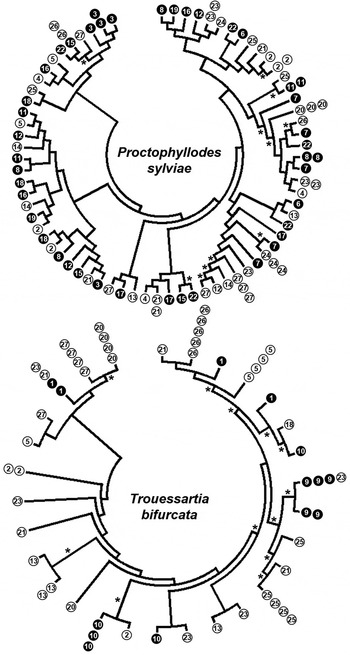
Genetic diversity among hosts was very high: for P. sylviae, we only found one haplotype shared by mites on two host individuals, whereas for T. bifurcata we found one haplotype shared by mites on three hosts and another shared by mites on two hosts. In contrast, individual mites more frequently shared the same haplotype at the infrapopulation level (Fig. 1). This trend was stronger for T. bifurcata: an AMOVA analysis revealed that, whereas in P. sylviae more than 80% of the genetic variance could be explained by differences within mite infrapopulations, this value was only roughly 50% for T. bifurcata (Table 1). This pattern held true when analysing only T. bifurcata males (Table 1).
Evolutionary relationships among the cytochrome oxidase I (COI) haplotypes of feather mites sampled from wintering blackcaps. Optimal neighbour-joining (NJ) trees of the haplotypes of Proctophyllodes sylviae and Trouessartia bifurcata found in this study, calculated after 1000 bootstrap replications. * indicates bootstrap support on nodes > 50%. The numbers in the circles indicate individual hosts of origin of each haplotype (open circles represent resident blackcaps and filled circles migratory blackcaps). The connections between haplotype and host ID's can be seen in Table S1.

Results of analyses of molecular variance (AMOVA) for population genetic structure of the feather mites Proctophyllodes sylviae and Trouessartia bifurcata in migratory and resident blackcap populations

The analyses partition total molecular variance into different components, whose significance was obtained by randomization after 1000 permutations.
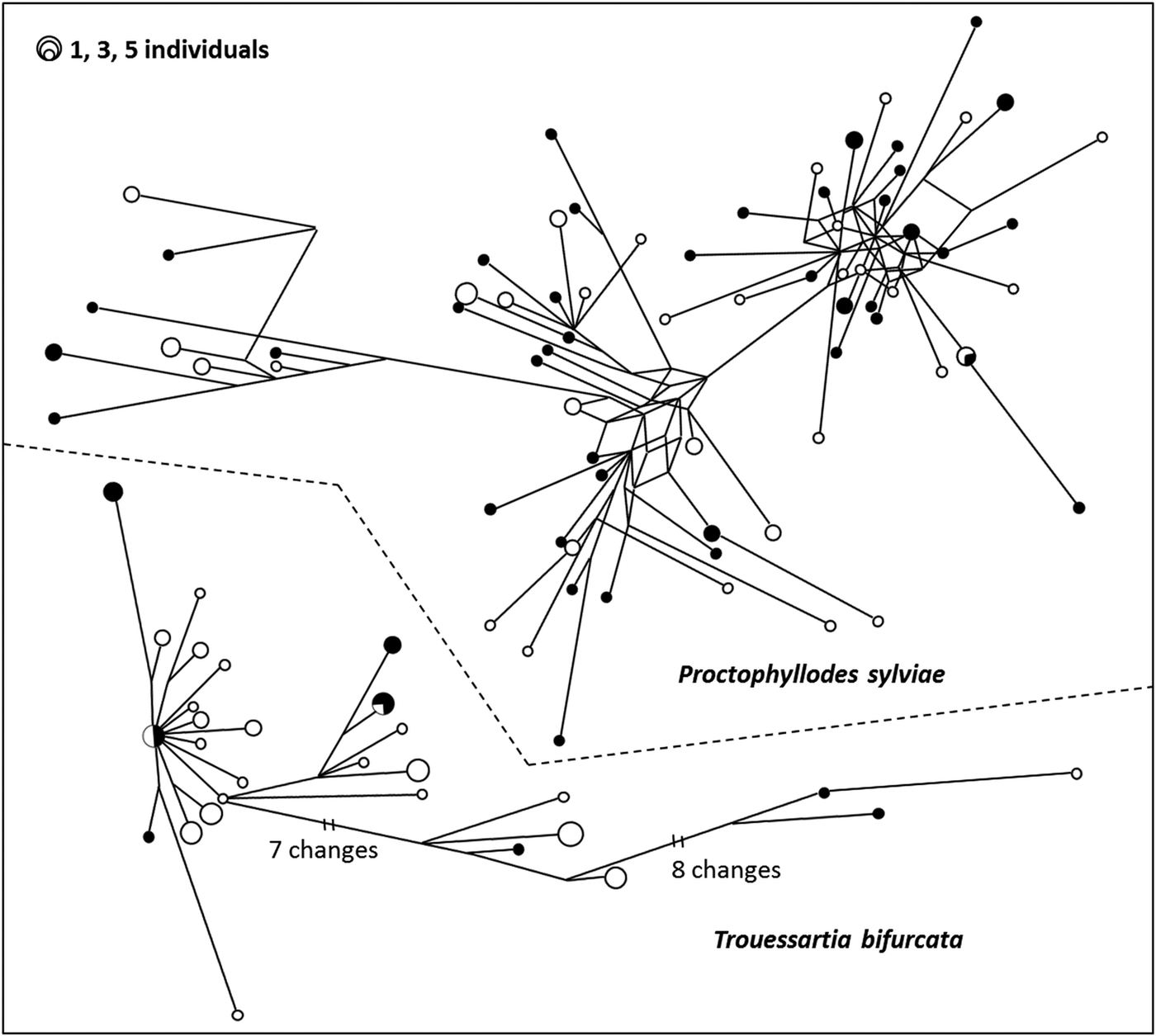
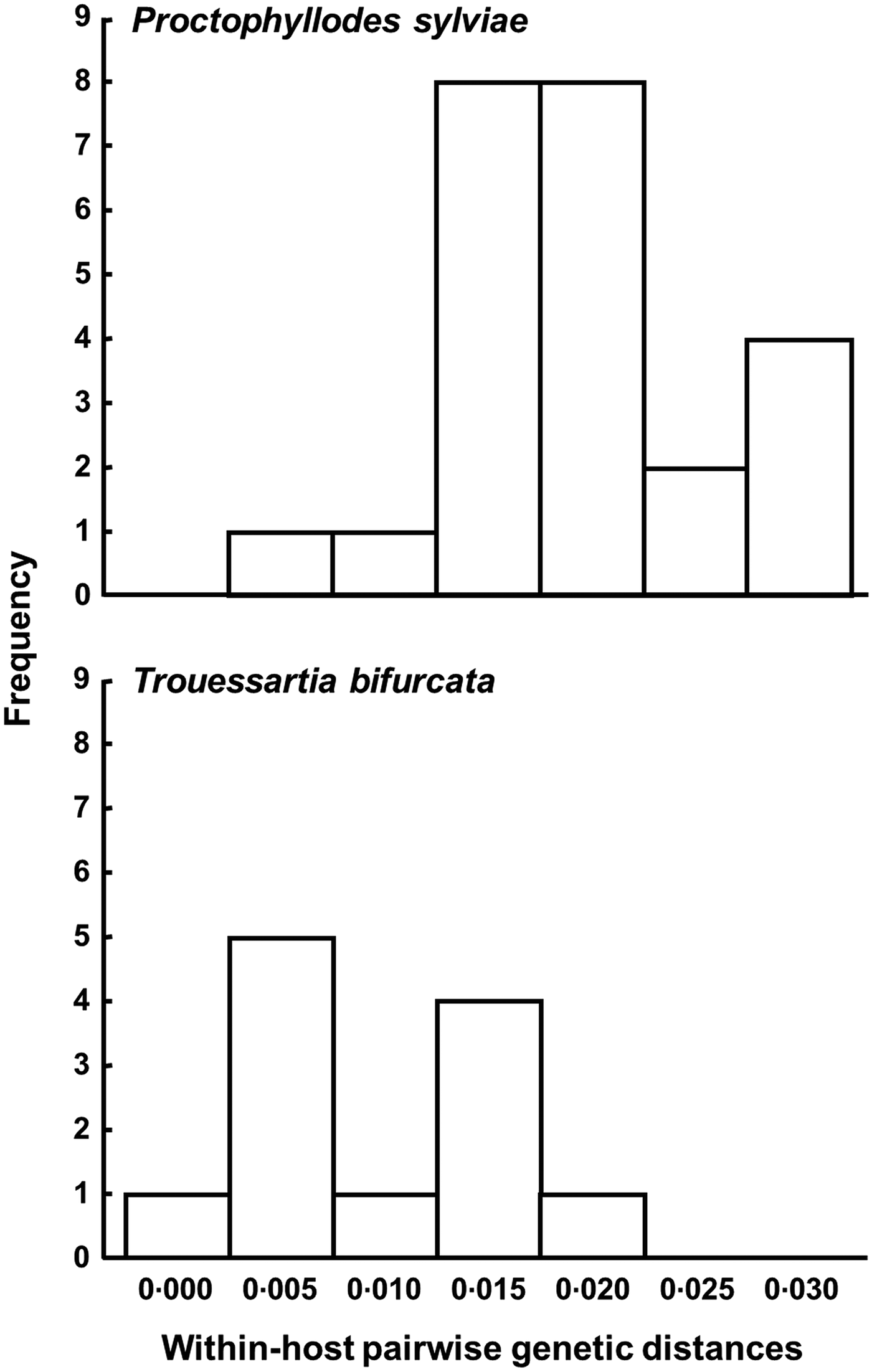
When the same test was conducted with individual hosts classified as migratory or resident in a hierarchical AMOVA, a similar amount of genetic variance was explained by differences among infrapopulations of the same host group (Table 1). However, no genetic structure was detected between populations of mites sampled on migratory or resident blackcaps (Table 1). This was supported also by the phylogenetic reconstructions at the mite species level and the haplotype networks, where haplotypes coming from mites sampled on resident or migratory hosts do not form any sort of clustering (Figs 1 and 2). The distribution of average within-host pairwise genetic distances among feather mites revealed that blackcaps harboured unrelated mites as a rule (Fig. 3).
Haplotype networks for the feather mites Proctophyllodes sylviae and Trouessartia bifurcata sampled from wintering blackcaps. Shading in the circles indicates resident (white) or migratory (black) blackcaps. The shortest link between haplotypes sets the scale for 1 bp sequence difference, and the size of circles is proportional to haplotype frequency.

Frequency distribution of average within-host pairwise genetic distances among haplotypes of the feather mites Proctophyllodes sylviae and Trouessartia bifurcata sampled from blackcaps.

Discussion
Our analyses unveiled high within-host genetic diversity of two feather mite species living on migratory and resident blackcaps. Remarkably, this genetic diversity was not structured between host types, despite the fact that resident and migratory birds have contrasting population histories and phenotypic attributes. The specific identity of all the sampled mites was ascertained both by microscopy and by molecular means, ruling out the possibility that our samples contained a mix of cryptic mite species that could distort our estimates of genetic diversity. At the infrapopulation level, genetic diversity was significantly greater for one of the two mite species (P. sylviae), what shows that the pattern of genetic structuring of mite populations may differ among mite species that share hosts in the same environment.
Large levels of intraspecific COI gene genetic diversity had already been reported by Doña et al. (Reference Doña, Moreno-García, Criscione, Serrano and Jovani2015a) for P. sylviae, as well as several other species of European feather mites, although their sampling was not designed to detect genetic structuring among discrete bird populations (samples of P. sylviae included in the analyses, for instance, came from breeding birds sampled in Russia and from wintering birds of unknown origin captured in Spain; R. Jovani, personal communication). It is important to recall that the resident blackcaps sampled in this study represent a distinctive population within the host's range. They show genetic evidence of reproductive isolation from other populations, and a number of phenotypical traits of potential relevance for feather mite biology that make them different from migratory blackcaps (Pérez-Tris and Tellería, Reference Pérez-Tris and Tellería2002a; Pérez-Tris et al. Reference Pérez-Tris, Bensch, Carbonell, Helbig and Tellería2004; Fernández-González et al. Reference Fernández-González, De la Hera, Pérez-Rodríguez and Pérez-Tris2013). Contrary to our expectations, we did not find any genetic structuring of mites inhabiting resident blackcaps in relation to those sampled from migratory hosts: terminal nodes within each mite species’ COI tree were randomly distributed among host individuals and host types. Neither was there any trace of a founder effect in the haplotype networks, what on the contrary is clearly shown by mites sampled elsewhere (Dabert et al. Reference Dabert, Coulson, Gwiazdowicz, Moe, Hanssen, Biersma, Pilskog and Dabert2015; Doña et al. Reference Doña, Moreno-García, Criscione, Serrano and Jovani2015a).
The absence of mite genetic structure between host types suggests that the coexistence of blackcaps from different geographic origins in sympatric wintering areas promotes the interchange of mites outside the host's breeding season. Nevertheless, mechanisms of transmission different from parent–offspring transmission, which could explain the exchange of mites between hosts outside the breeding season, are yet to be explored. Several groups of feather symbionts (some groups of feather lice and mites) are known to be transmitted phoretically by louse flies (Hippoboscidae), but this behaviour has not been found for the mites under study (Jovani et al. Reference Jovani, Tella, Sol and Ventura2001). In our study region, blackcaps do protect small feeding territories around particularly attractive bushes, and do engage in the odd fight (personal observation). Fighting has been posited by Dabert et al. (Reference Dabert, Coulson, Gwiazdowicz, Moe, Hanssen, Biersma, Pilskog and Dabert2015) as a potential mechanism of mite exchange between skua species, despite the fact that feather mites display a number of morphological adaptations directed to avoid the dislodging of feather mites from their hosts (Doña et al. Reference Doña, Potti, De La Hera, Blanco, Frías and Jovani2017a).
Incomplete lineage sorting could also explain this pattern, because the actual haplotype sharing between resident and migratory blackcaps is reduced to one haplotype of P. sylviae and two of T. bifurcata. Still, a few dispersal events each winter might represent a number of migrant mites per generation large enough to erase any structure associated with host population (Slatkin, Reference Slatkin1987). On the other hand, the lack of genetic clustering found among the mites of some fully sedentary birds species studied by Doña et al. (Reference Doña, Díaz-Real, Mironov, Bazaga, Serrano and Jovani2015b) suggest that in spite of the apparent genetic isolation of sedentary blackcaps, a stepwise transmission of mites following short-distance host dispersal could be sufficient to dilute the genetic structuring of mite populations. Actually, differences between the effective population sizes of both blackcaps and mites might explain that the degree of genetic structuring found among blackcaps is not mirrored by their symbionts (Criscione, Reference Criscione2008).
Once acquired, the high genetic diversity of mite infrapopulations revealed in our study seems incompatible with the existence of severe bottlenecks during mite transmission. Fledglings are colonized by large numbers of mite nymphs coming from their parents (Doña et al. Reference Doña, Potti, De La Hera, Blanco, Frías and Jovani2017a), so that mite infrapopulation genetic diversity would likely be preserved across bird generations. At the infrapopulation level, some individuals sampled on the same host shared COI haplotypes, which is to be expected if related mites from the same founder stock are sampled. Some degree of genetic homogeneity at the infrapopulation level has been described recently in other feather mite species (Dabert et al. Reference Dabert, Coulson, Gwiazdowicz, Moe, Hanssen, Biersma, Pilskog and Dabert2015; Doña et al. Reference Doña, Moreno-García, Criscione, Serrano and Jovani2015a); however, we still found a great genetic diversity of mite infrapopulations, even if our small sample size (five mites per host) somewhat limits our capacity to detect many different haplotypes in the same infrapopulation.
Differences in infrapopulation genetic diversity between both mite species also call for an explanation. Trouessartia bifurcata is much more mobile along the feathers than P. sylviae (personal observation), so that in theory it could switch between individual hosts more easily, yet it is the species with the lower infrapopulation genetic diversity. In line with the findings of Dabert et al. (Reference Dabert, Coulson, Gwiazdowicz, Moe, Hanssen, Biersma, Pilskog and Dabert2015), differences between the infrapopulation genetic diversity of the two mite species could be related to their degree of host specificity. Trouessartia bifurcata occurs very rarely on migratory hosts, while P. sylviae is equally frequent in both host types (Fernández-González et al. Reference Fernández-González, De la Hera, Pérez-Rodríguez and Pérez-Tris2013; Reference Fernández-González, Pérez-Rodríguez, de la Hera, Proctor and Pérez-Tris2015). Even though P. sylviae is much more abundant in migratory hosts (Fernández-González et al. Reference Fernández-González, De la Hera, Pérez-Rodríguez and Pérez-Tris2013, Reference Fernández-González, Pérez-Rodríguez, de la Hera, Proctor and Pérez-Tris2015), its infrapopulation genetic diversity did not change between host types. Furthermore, even in sedentary birds, the average number of T. bifurcata individuals per host is lower than that of P. sylviae, so that differences between the effective population sizes could be behind these differences in genetic diversity (Criscione, Reference Criscione2008). Although we are aware of the problems of interpreting two-species comparisons from an adaptive perspective (e.g. Garland and Adolph, Reference Garland and Adolph1994), our results show that peculiarities of each symbiont species may shape the patterns of genetic structuring of different symbionts that share host species.
Since feather mites are obligate symbionts, their populations are subjected to environmental changes associated with host phenotypic diversity and host habitat use (Proctor, Reference Proctor2003). Our results suggest a scenario in which a mite that lives on a resident blackcap may sometimes have its offspring living on a migratory host, which differs in evolutionary history, geographic origins and ecological attributes. This scenario in which mites with different ancestry can end up sharing a host may have important implications in intra-host mite interactions. Previous research on the same study system analysed here has revealed a non-random distribution of feather mites among wing feathers and sectors of the same feather in blackcaps (Jovani and Serrano, Reference Jovani and Serrano2004; Fernández-González et al. Reference Fernández-González, Pérez-Rodríguez, de la Hera, Proctor and Pérez-Tris2015), suggesting that some areas of the bird plumage may be preferred and others may be avoided by different species. If competition determines the distribution of mites among host microhabitats of different quality, our results suggest a scenario in which mites are unable to compensate for the costs of occupying poor sectors through inclusive fitness returns, because in genetically diverse mite populations there is no guarantee that the best sectors will always be occupied by close kin. Still, whether different mite families segregate among sectors of the host plumage, or freely mix among host microhabitats, remains an open question for future research.
As a final remark, it should be taken into account that both P. sylviae and T. bifurcata have been reported from several other host species (see records in Doña et al. Reference Doña, Proctor, Mironov, Serrano and Jovani2016). Whether the amount of genetic variation observed in our study may be associated with their degree of host specialization can only be answered with broader comparative analyses. Since the very few studies analysing genetic diversity within feather mite species have documented cases of both cryptic speciation and of mites with no genetic structuring whatsoever between different hosts (Dabert et al. Reference Dabert, Coulson, Gwiazdowicz, Moe, Hanssen, Biersma, Pilskog and Dabert2015; Doña et al. Reference Doña, Moreno-García, Criscione, Serrano and Jovani2015a; Szudarek et al. Reference Szudarek, Kanarek and Dabert2017), the exploration of how population structure varies among different mite species on different host species is a promising research field. This study makes thus a significant contribution to our understanding of the evolutionary implications of competitive asymmetries among symbionts that share an individual host, as well as of the factors that may promote or hamper the genetic structuring of symbiont communities among different host populations.
Supplementary material
The supplementary material for this article can be found at https://doi.org/10.1017/S0031182017002360.
Acknowledgements
We thank Miroslawa and Jacek Dabert for advice on DNA extraction and genotyping of mites, Roger Jovani for comments on the sampling of his papers, and Alejandro Llanos for inspiring discussions. Kaylee Byers revised our English. The comments of Staffan Bensch, Jorge Doña and three anonymous reviewers improved earlier versions of this manuscript. All samples were collected under license from Junta de Andalucía (SGYB-AFRCMM). This is a contribution from the Moncloa Campus of International Excellence of the Complutense and the Polytechnic Universities of Madrid.
Financial support
This study was funded by the Ministry of Science and Innovation (grants CGL2007-62937/BOS, CGL2010-15734/BOS and CGL2013-41642-P/BOS, and a FPI studentship to SFG), the Ministry of Education (FPU studentship to APR), the Basque Government (BFI04-33 and 09-13 studentships to IH) and a Natural Sciences and Engineering Research Council of Canada (NSERC) Discovery Grant to HP.