China's rapid economic growth over the past three decades has astounded most observers and transformed the world in multiple ways. The country attracts massive foreign investment, its exports dominate much of the world's retail consumer markets, and its growing power is increasingly giving the Chinese government a more prominent voice in international affairs. While this is a familiar narrative to many, what is often less appreciated is that China's macro-level economic rise has also generated an incredible amount of private individual wealth. Forbes maintains a special website called China's Rich List, which, as of early 2014, lists 168 US-dollar billionaires in China.Footnote 1 The billionaires on Forbes' list include Chinese men and women who have made their fortunes in industries as varied as beverages, internet searches, energy, automobiles and real estate.
Having amassed these impressive fortunes in a relatively short amount of time, some newly wealthy Chinese have begun to consider how they might put their private wealth to public good. Chen Guangbiao 陈光标, a billionaire who made his fortune in recycled construction materials, is perhaps one of the most generous, but also one of the quirkiest, members of this new club of philanthropists. Chen is known for giving away goats, pigs and farm equipment after headlining his own one-man singing show in rural China,Footnote 2 and for making ostentatious shows of giving money away to poor families in Taiwan on a trip there in 2011.Footnote 3 He is also a patriot and, in 2014, attempted to purchase The New York Times in order to ensure it provided more favourable coverage of China.Footnote 4
Alongside Chen's very personal form of philanthropy, however, is a more institutionalized form of new and distinctly modern philanthropy in China. Since the official promulgation of the Regulations on Foundations (jijinhui guanli tiaoli 基金会管理条例) in 2004, the Chinese government has made it possible for private foundations (fei gongmu jijinhui 非公募基金会) to be set up in the name of the public good. The result of this official approval for the revival of private philanthropy has been impressive. Between 2005 and 2012, the number of private foundations increased six-fold.Footnote 5
We describe this form of philanthropy as “modern” for a number of reasons. Philanthropy – understood as financial support offered by the wealthy for those less fortunate or for common welfare projects – has a long history in China. As far back as the late Ming, social elites were funding and managing benevolent societies, famine relief projects, and other social programmes readily understood as “charity” by today's definitions.Footnote 6 On top of these domestic traditions, in the late 1800s, John D. Rockefeller and his descendants began their long-term engagement with China, eventually helping to build medical schools and train a cohort of influential scientists in China.Footnote 7 These American efforts came on the heels, of course, of decades of Catholic and Protestant missionary schools, hospitals and orphanages that had already been making their mark on late imperial China. Not long after the founding of the People's Republic in 1949, however, “charity” (cishan 慈善) as a term was lost from the lexicon of the new China because there was no private funding to be distributed. In the 1990s, newly emergent actors had to “rehabilitate” the term (itself an invention of late 19th-century missionaries) and re-introduce it to the Chinese population.Footnote 8 Since the mid to late 2000s, the term gongyi 公益 (public benefit) has caught on among activists and others in China, and is alternatively translated into English as “philanthropy” or “charity.”Footnote 9
Given the massive amounts of new private wealth in China and the global influences encouraging the creation of forms modelled on the US private foundation, we expected we might find a strong trend towards establishing family-led foundations and corporate foundations that serve the priorities of individual philanthropists. As we elaborate below, however, it is clear that while the private foundation structure provides the legal form necessary for wealthy individuals to manage their own personal charity projects, most charitable giving through private foundations is circulating in what might broadly be considered the “state” domain. Hospitals, universities and other public service government entities (PSGEs hereafter) are actually the most common co-originators and beneficiaries of these new private foundations. We discuss these findings in more detail below. First, however, we describe the data and elaborate on the key questions underlying the survey: where in China are private foundations most common and what kinds of people or organizations are starting them? How much money is actually in play? We also look at what issues or problems the foundations aim to address and whether the foundations are running their own programmes or giving grants to support civil society and emergent non-governmental organizations (NGOs). We conclude with some brief reflections on the implications of our findings for Chinese philanthropy and civil society development more broadly.
Our Data
According to the Beijing-based Foundation Center, at the end of 2010 there were 1,096 private foundations registered in China. In this study, we present analyses of a sample of 214 of these, using data collected through telephone interviews and email exchanges in 2012. We piloted our survey questionnaire with five different foundations and revised it as necessary. A team of ten graduate students were trained to conduct telephone interviews. Three attempts to contact and collect data from each foundation were made. Our efforts generated a total of 238 questionnaires, of which 214 were found to be valid. Given our initial list of 1,096 foundations, the survey's response rate was thus 21.7 per cent.
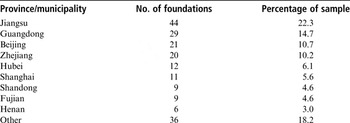
Of the 214 foundations included here, 17 (7.9 per cent) were registered at the national level with the Ministry of Civil Affairs.Footnote 10 They were, therefore, allowed to engage in grant-giving across all of China. The remaining 197 foundations (92.1 per cent of the sample) were registered at the provincial level or below.Footnote 11 Table 1 displays the geographic distribution of the 197 provincial foundations. Most are located in the prosperous southern and eastern coastal regions, including Jiangsu, Guangdong, Beijing, Zhejiang, Shanghai, Shandong and Fujian. Foundations in these seven locations accounted for 72.7 per cent of the total provincial foundation sample. Clearly, the distribution of philanthropic foundations is closely correlated with these provinces' economic strength.
Geographic Distribution of Provincial Foundations (n = 197)

Note:
Here we only show provinces and municipalities with five foundations or more.
Who Starts Foundations?
In October 2010, it appeared that philanthropy in China was about to gain a massive injection of legitimacy, if not funds, as Bill Gates and Warren Buffett invited a number of Chinese billionaires to a private banquet in Beijing. The event – much touted in the press – was, however, somewhat of a disappointment, at least if the goal was to get China's richest under one roof to discuss why they should give away a share of their fortunes. Not all chose to come, including China's richest man at the time.Footnote 12 While a more detailed study of their considerations is deserved, we suggest that their reluctance may in part be due to the frequently murky origins of new private wealth. Some would-be philanthropists are surely reluctant to invite a close investigation of potentially ill-gotten gains.
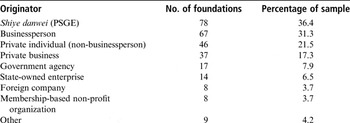
We had nonetheless expected that many new private foundations would be the personal projects of individual business owners keen to boost their reputation in the eyes of the public or to curry favour with government officials. However, we found that almost a quarter (22.9 per cent) of foundations actually had more than one originator (see Table 2).Footnote 13
Main Originators of Private Foundations (n = 214)

Note:
Since many foundations reported more than one originator, the percentages here add up to over 100 per cent.
Overall, just under one-third (31.3 per cent) of foundations included businesspeople amongst their originators, while one-fifth (21.5 per cent) were founded, at least in part, by individuals from a non-business background, for example, celebrities, retired government officials and famous academics, amongst others. The single most common originator was a kind of non-profit organization run by the government, known as a shiye danwei 事業單位. Not technically a government agency but also not privately owned, most hospitals and universities in China are registered as this sort of PSGE. Over one-third (36.4 per cent) of foundations reported that their originators included a PSGE.
PSGEs are eager to generate donations and establish a channel for dedicated funding that allows them to capitalize on China's newly created wealth. Chinese universities, in particular, are eager to use private foundations to develop relatively independent endowments of the sort that support top universities in the United States and other countries. Government funding, which still comprises the vast majority of financing for most PSGEs, is typically restricted to specific purposes mandated or approved by the government. Privately raised money, on the other hand, not only supplements PSGEs' budgets but also allows them to spend on new projects of their own choosing. Moreover, affiliated private foundations allow PSGEs to invest funds and plan for long-term goals whilst continuing to receive government financing for their traditional purposes and programmes. While the full ramifications of these developments are yet to be seen, the introduction of private foundations into the PSGE funding structure holds forth the possibility of transforming PSGEs from solely government-controlled entities into organizations that wield substantial and independent resources of their own. If such a development were to play out along its current trajectory, one implication of this finding is that PSGEs with private foundations may eventually expect to have a bigger say in determining their internal governance mechanisms and even their broader social roles.
How Much Money is in Play?
In terms of absolute amounts, the average private foundation is perhaps not particularly impressive, especially when we consider the number of US-dollar millionaires and billionaires who call China home. While the average foundation expenditure in 2011 was 9.35 million yuan (US$1.5 million), this figure is skewed to the high side by an imbalance in foundation expenditures, as the total expenditure in our sample of over 200 foundations was only 208 million yuan (US$34.3 million).Footnote 14
Upon closer inspection, we find a more telling number: half of the foundations in our sample spent less than 1.66 million yuan (US$275,000) in 2011. Digging deeper, we found that over a third (37.4 per cent) of our sample spent only 1 million yuan or less, while the majority (73.4 per cent) did not exceed 5 million yuan (US$825,000) in total expenditures. Here, again, we see that while newly accumulated private wealth is often touted in the media as heralding a new era in Chinese philanthropy, almost three-quarters of Chinese foundations expended less than US$1 million each in 2011. Of the 57 foundations that did spend more than 5 million yuan, fully half of them (56.1%) were set up to support universities or other institutions of higher education. In a separate statistical analysis, we also found that foundation income and expenditures were significantly and highly correlated, in essence meaning that foundations spent almost the same amount as they took in as investment income or donations.Footnote 15 In sum, we believe that the small scale of most foundation giving reflects the newness of the foundation form but also the tentativeness with which China's newly rich are approaching charitable philanthropy.
Areas of Focus for Private Foundations
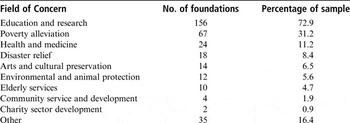
We used open-ended questions when asking what areas and issues the foundations sought to address, coding these after all the data was gathered. As shown in Table 3, almost three-quarters (72.9 per cent) of private foundations reported that their core areas of concern included education and research. This is perhaps not surprising, considering that, as noted above, over a third were created in part or in whole by PSGEs, including universities. This overwhelming interest in education was also anticipated in earlier research by Anthony J. Spires et al., which noted that both foreign corporations and China's own philanthropists strongly favoured education issues.Footnote 16 Given the potential sensitivities of shining the spotlight on any issue of social concern or contention in China, education is generally viewed as a politically safe bet for both individuals and institutional donors.Footnote 17
Private Foundations' Self-reported Fields of Concern (n = 214)

Note:
Since many foundations reported more than one core field of concern, the percentages here add up to over 100 per cent.
Where Does the Money Actually Go?
As in the USA, private foundations in China can be broadly divided into two types: operating foundations and grant-making foundations. There is no regulation requiring one or the other, however. In our sample, we found that most Chinese private foundations strongly favoured operating their own programmes rather than giving grants to NGOs or other groups. Only 41.3 per cent (n = 88) of the foundations in our study gave any grants to support other groups' programmes in 2011. By contrast, the vast majority (73.2 per cent) reported that their staff directly operated the foundation's own charitable programmes in 2011.Footnote 18
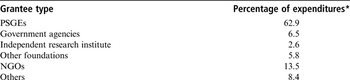
Given that there are many questions about the connections between China's new philanthropy and its growing civil society, we asked the 88 foundations that gave grants to other groups what sorts of grantees they chose. As shown in Table 4, about two-thirds (62.9 per cent) of expenditures by private foundations to support other groups went to universities, high schools and other PSGEs. An additional 6.5 per cent went directly to government agencies, and 5.8 per cent of total grant monies went to support other foundations. Only about 13.5 per cent of their grants were made to “popular-sphere charitable organizations” (minjian gongyi zuzhi 民间公益组织), or NGOs. This broad category may include the sorts of mostly unregistered, bottom-up grassroots NGOs studied by others.Footnote 19 It may also include government-organized NGOs (GONGOs), that is, grantees that are essentially government creations registered as charitable non-profit organizations.Footnote 20
Types of Organizations Favoured by Grant-making Foundations

Note:
*This is the mean of the foundations' self-reported percentage of expenditures.
What we found may disappoint those who are eager to see expansive, substantive ties between grassroots NGOs and China's new private foundations. Of the 88 foundations that made grants to other groups, the majority (71.6 per cent) made grants to PSGEs and only 21.6 per cent made grants to NGOs. Indeed, within the entire sample of 214 foundations, only 19 (8.9 per cent) made any grants to NGOs. Moreover, of the 88 grant-making foundations, almost half (48.9 per cent) gave all of their grants to PSGEs. As discussed earlier, many of these were set up as foundations to support fundraising for institutions of higher education, so their grant-making preferences are to be expected. By comparison, only eight private foundations (3.7 per cent of the total sample) gave all of their grant monies to NGOs. These grant-making oriented foundations included the SEE Foundation, the Narada Foundation and the Guangdong Harmony Foundation, all of which were started by groups of private entrepreneurs, some together with retired government officials and intellectuals.
According to our observations, the founders of these organizations are those who have the closest connections to NGO leaders from outside of China, and especially from the United States. They are also the most active advocates for grant-making foundation development in China today. Despite these signs of support, though, at the time of our survey, NGOs were not the favoured recipients of Chinese foundation largesse.
Conclusions and Implications for Civil Society Development
Our survey finds that public service government entities are the most common originators of private foundations in China today. Moreover, a majority of private foundations are supporting only relatively “safe” educational institutions, particularly the country's top universities, and other PSGEs. There is little evidence of widespread formal linkages between China's growing grassroots NGO community and the country's new philanthropic institutions. Direct grant-making to NGOs is, at this stage at least, extremely limited. In this, we should perhaps not be surprised, given the government's perennial concern with controlling both the social agenda and the resources directed towards resolving social concerns.
For Chinese civil society to develop beyond a handful of small NGOs operating in a self-limiting fashion, greater integration of China's newly wealthy elites and “average” people's organizations will be essential.Footnote 21 The outlook for this sort of cooperation may not be very bright, however, if we take the case of billionaire Wang Gongquan 王功权 as an example. Wang's public support for legal activist Xu Zhiyong 许志永 led to Wang's detention and arrest in late 2013. That such a “big fish” can meet with such an ignominious fate is surely a deterrent to other wealthy potential supporters of NGOs.
Although much private philanthropic wealth is currently channelled through government-approved PSGEs, the field could develop in unpredictable ways. While government control of PSGEs is currently seldom questioned, as PSGEs amass their own privately raised funds they will surely expect a large degree of control over the use of those funds. Despite recent tightening under Xi Jingping 习近平, given the overall fragmentation of China's governance system, a non-unified government may find itself unable to regulate the mission and operational practices of these increasingly wealthy and assertive PSGEs tightly.
Looking forward, the number of private foundations in China seems sure to increase even further. We expect that more of the country's newly wealthy will seek to establish their own foundations and will continue to show a strong willingness to focus on officially approved issues and to donate primarily to government-controlled entities. For its part, the government continues to show an abiding concern with setting the agenda for charitable giving and controlling any private resources put towards the public good. Against this backdrop, anyone hoping to establish an autonomous field of philanthropy in China faces an uphill climb of considerable magnitude.