Introduction
Recent years have seen growing interest in the varied interconnections between ageing and migration (for an overview, see Torres and Karl Reference Torres and Karl2016). In this article we are interested in the impacts of migration by younger generations on the family lives, care and support of older people in the country of origin (CoO) (Baldassar, Baldock and Wilding Reference Baldassar, Baldock and Wilding2006; Vullnetari and King Reference Vullnetari and King2008). Our perspective is that of the older non-migrant generation and its experiences of ageing within transnational family (TNF) constellations spanning Romania and Germany. We examine how family solidarity and care in later life are accomplished when traditional family-based care is disrupted by mobility. Existing literature on this may be caricatured as taking one of two extremes. One posits abandonment and vulnerability among ‘orphan pensioners’, the other conceptualises families as accomplishing ‘care from a distance’ and trading remittances for co-presence. Unsurprisingly, the reality lies between these poles. How well family relationships are maintained over time and across distances, and whether these relationships are sources of support and care, depend on an interplay of negotiations on three levels: individual families (micro), culture and local opportunities (meso), and migration and welfare regimes (macro) (Vullnetari and King Reference Vullnetari and King2016). This complexity is captured in recent theoretical conceptualisations on the ‘circulation of care’ (Baldassar and Merla Reference Baldassar and Merla2014b), and it is within this framework that we situate our present study.
Our focus is on the Transylvanian Saxons, one of many German ethnic minorities in Eastern Europe and central Asia, who witnessed mass exodus to Germany following socialism's collapse in 1990 (Rock and Wolff Reference Rock and Wolff2002; Sanders Reference Sanders2016). Saxon emigration led to far-reaching transformations of family and community networks and an aged population among the German minority in Romania. What makes the Transylvanian Saxons an interesting case for understanding the ‘circulation of care’ is their distinctive identity and cultural ethos of care, the existence of successive waves of emigration to Germany giving rise to long-standing transnational ties, Germany's ready absorption of the Saxons into its nation, and persistent disparities in wealth between Romania and Germany. These characteristics are conducive to the development of strong transnational family (TNF) ties and exchanges. Yet as we shall see, such ties are not inevitable, and our evidence on care and support flows to the older generation in Romania is mixed.Footnote 1
Our aims are to understand how families are transformed by large-scale emigration and, in turn, how the resultant transnational family constellations continue (or sometimes fail) to operate as sites of care for their elderly members in the CoO. Our research questions cover two interrelated domains, namely the nature of TNF networks and their role as sources of support. Firstly, what is the impact of large-scale emigration of younger generations on the family ties of older people in the CoO? What are challenges and facilitators to maintaining ‘familyhood’ across time and distance? Secondly, in what ways do migrant children and other absent kin engage in care exchanges with elderly relatives in the CoO, and how are these exchanges experienced by the elderly recipients? When and why does TNF care weaken? We approach these questions through qualitative interviews and participant observation with older people and key informants in Romania between 2008 and 2016, giving rise to rich data on older people's TNF ties and practices, and their evaluations of these.
Literature review
Amid the dramatic rise in research on international migration and transnationalism, studies examining the impact of migration on older people remain a small but growing field (Blakemore Reference Blakemore1999; Torres Reference Torres, Scharf and Keating2012; Walsh and Shutes Reference Walsh and Shutes2013; Warnes Reference Warnes, Dannefer and Phillipson2010). Three sub-bodies of this literature are relevant here: studies which examine the impact of large-scale migration on older people ‘left behind’; studies assessing the significance of migrant remittances for older non-migrants; and studies on TNFs and caring from a distance. We take each in turn before synthesising the literature into the framework used here.
Our understanding of the subjective impacts of family members’ emigration on the wellbeing of older people in the CoO owes much to Vullnetari and King's seminal ethnography of mass emigration from Albania post-1990 (King and Vullnetari Reference King and Vullnetari2006; Vullnetari and King Reference Vullnetari and King2008, Reference Vullnetari and King2016). They report feelings of abandonment, regret and vulnerability experienced by ‘orphan pensioners’ when millions of young Albanians left on labour migration to Italy, Greece and beyond. These departures resulted not only in material hardship, but also loss of normative intergenerational relationships – especially with grandchildren and adult sons – which hitherto gave meaning to older Albanians (see also Coles Reference Coles2001; Miltiades Reference Miltiades2002). The clandestine nature of Albanians’ migration to European Union (EU) countries long made difficult the coming and going of migrants, thus curtailing any semblances of normal family life. More recently ‘young-old’ parents of migrants have sometimes followed their sons abroad to look after grandchildren, while ‘old-old’ parents remain in Albania, but often reliant on the ‘wrong’ kind of care (e.g. paid care, daughters). As Vullnetari and King (Reference Vullnetari and King2016: 210) conclude, ‘[l]arge-scale migration … necessitated a renegotiation of cultures and practices of care’. Their study draws attention to aspects of wellbeing which are not purely material or related to care drain, but tap into questions of identity and social roles which may be disrupted through mobility. Our case shares similarities with the Albanian one in terms of magnitude of emigration, but differs in that movement was facilitated by the German state, thereby removing the institutional barriers to TNF links observed in Albania.
A contrasting second body of literature emphasises the benefits of migration through remittances from migrant family members.Footnote 2 Remittances have been particularly significant where migrants have left behind a spouse and/or children (Attias-Donfut Reference Attias-Donfut, Torres and Karl2016; Gamburd Reference Gamburd, Hoang and Yeoh2015; Rindfuss et al. Reference Rindfuss, Piotrowski, Entwisle, Edmeades and Faust2012); apparent flows to the older generation are often intended to cover the costs of grandchildren in skipped-generation households (Cook and Liu Reference Cook and Liu2016; Kreager and Schröder-Butterfill Reference Kreager, Schröder-Butterfill, Hoang and Yeoh2015). Material transfers targeted at elderly parents have mainly received attention in Asia. Knodel and Saengtienchai (Reference Knodel and Saengtienchai2007), for example, found around half of older parents with migrant children in rural Thailand receiving regular remittances (see also Nguyen, Liu and Booth Reference Nguyen, Liu and Booth2012), while in Indonesia, monetary gifts by migrant children to elderly parents varied by cultural context and families’ economic position (Kreager Reference Kreager2006). Poor migrants were often unable to send remittances and were more likely to lose all contact with their parents (Kreager Reference Kreager2006; Schröder-Butterfill and Kreager Reference Schröder-Butterfill and Kreager2005: 25). A study of older people in rural China, many of whom were caring full-time for migrant children's offspring, documented dissonances and tensions around remittances (Cook and Liu Reference Cook and Liu2016), and adds to a growing consensus that remittances are often not significant for the older people left behind (Attias-Donfut Reference Attias-Donfut, Troisi and von Kondradowitz2013; King et al. Reference King, Cela, Fokkema and Vullnetari2014). Our evidence on transnational material support for older people sheds further light on this issue.
Indirect benefits of remittances certainly accrue to elderly parents if they allow children to care from a distance by hiring paid care (Bettio, Simonazzi and Villa Reference Bettio, Simonazzi and Villa2006; van der Geest, Mul and Vermeulen Reference van der Geest, Mul and Vermeulen2004). Migrants’ arranging and paying for care are part of a broader phenomenon of TNF care-giving, which is the third body of literature reviewed here. Contemporary migration research posits that migrants are not either here or there, but ‘develop networks, activities, patterns of living, and ideologies that span their home and the host society’ (Basch, Glick Schiller and Szanton Blanc Reference Basch, Glick Schiller and Szanton Blanc1994: 4). Applied to families, this recognises that family members engage in intensive interactions across borders. Bryceson and Vuorela capture this in their influential volume on TNFs:
‘Transnational families’ are defined … as families that live some or most of the time separated from each other, yet hold together and create something that can be seen as a feeling of collective welfare and unity, namely ‘familyhood’, even across borders. (Reference Bryceson and Vuorela2002: 3)
In conceptualisations of TNFs, care does not require proximity. Hands-on care and instrumental support are two dimensions in a range of supportive behaviours, which also include emotional, informational and material support and housing (Finch and Mason Reference Finch and Mason1993; Kilkey and Merla Reference Kilkey and Merla2014; Zontini Reference Zontini, Philip, Rogers and Weller2012). A useful distinction for separating care requiring proximity from care that does not is the contrast between ‘caring for’ and ‘caring about’ (Fisher and Tronto Reference Fisher, Tronto, Abel and Nelson1990; Zechner Reference Zechner2008). While ‘caring for’ captures hands-on care and practical assistance, ‘caring about’ includes taking an interest, keeping in touch, providing emotional support and advice, participating in decisions, arranging care, paying for services. Gerontology's understanding of how this distinction plays out in transnational care for elderly parents owes much to seminal research on European migrants to Australia (Baldassar and Baldock Reference Baldassar, Baldock and Agozino2000; Baldassar, Baldock and Wilding Reference Baldassar, Baldock and Wilding2006; Baldock Reference Baldock2000). This demonstrated the importance of letters, phone calls and visits (‘caring about’) for a sense of family solidarity. Visits often increased in frequency and length as parents’ care needs increased and facilitated hands-on care (‘caring for’) while giving respite to local siblings. The conclusion of this research is that TNF networks are capable of enduring and adapting to members’ changing circumstances (Baldassar Reference Baldassar2007a).
While the contribution by the TNF care literature to migration studies and social gerontology cannot be overstated, it presents a rather positive account of distance care, possibly due to a bias towards the perspective of migrants, a neglect of heterogeneity and of wider structures. Recent research develops the TNF care literature by adding dimensions often neglected or only implicit in earlier work. The resultant ‘circulation of care’ framework is better equipped to explain heterogeneities and tensions in transnational care constellations (Baldassar and Wilding Reference Baldassar, Wilding, Baldassar and Merla2014). Care circulation is defined as
the reciprocal, multidirectional and asymmetrical exchange of care that fluctuates over the life course within transnational family networks subject to the political, economic, cultural and social contexts of both sending and receiving societies. (Baldassar and Merla Reference Baldassar, Merla, Baldassar and Merla2014a: 22)
This conceptualisation recognises that care in TNFs not only flows from migrant to non-migrant or young to old, but connects members of entire networks (Baldassar and Merla Reference Baldassar and Merla2014b). Moreover, it is through the exchange of care and support that families maintain a sense of familyhood over time and distance: caring is constitutive of TNF life (Zontini Reference Zontini2007, Reference Zontini2015), and examining practices of care can therefore act as a lens for understanding kinship and belonging. The corollary is that where caring has ceased, family solidarity weakens (Baldassar and Merla Reference Baldassar, Merla, Baldassar and Merla2014a: 11).
Differences between families and transnational spaces in their ability or willingness to sustain transnational care move centre-stage on this approach (Bilecen and Sienkiewicz Reference Bilecen and Sienkiewicz2015), and understanding these differences requires examination of factors at different levels over time (Baldassar and Merla Reference Baldassar, Merla, Baldassar and Merla2014a). At the micro-level, differential access to social and material capital is an important dimension (Reynolds and Zontini Reference Reynolds, Zontini, Baldassar and Merla2014), and as we see in our material, the existence of property in the CoO can represent an important type of capital binding TNFs together (Wall and Bolzman Reference Wall, Bolzman, Baldassar and Merla2014: 76). Cultural norms and expectations (meso-level) and institutional contexts (macro-level) shape both the nature of migration and TNF practices. Key institutional contexts are care regimes, which influence the division of labour between families, state and market; and migration regimes, which determine entry, exit and residence entitlements of different migrants (Kilkey and Merla Reference Kilkey and Merla2014). The former determine the availability of alternative sources of care, while the latter may limit or expand options for hands-on care through return visits or bringing dependent family members into destination countries (King et al. Reference King, Cela, Fokkema and Vullnetari2014). TNF practices and the nature of TNF links change over time, not only via migration duration, but also actors’ lifecourse or migration stages (Ariza Reference Ariza, Baldassar and Merla2014; Baldassar and Baldock Reference Baldassar, Baldock and Agozino2000). Wall and Bolzmann (Reference Wall, Bolzman, Baldassar and Merla2014), for example, show that in early stages of a family's migration history, support often flows to migrants, and expectations of remittances are muted, while contact builds the foundations for future reciprocal support. Our study documents both intensification of exchanges at key moments of crisis and weakening of TNF practices over time.
In answering our research questions about impacts of migration on family networks of older people ‘left behind’, and the extent to which TNFs are sources of support, we draw on this framework of care circulation. Rather than taking TNF constellations as given, we argue that it is caring (broadly defined) which maintains networks in migration contexts. The extent to which families sustain a sense of common purpose depends on family histories and resources; on cultural framings of what families do and on locally available support; and on the migration and citizenship regimes within which our case study is located. We respond to demands in the care circulation literature to broaden the focus from dyads to kinship networks by including evidence from childless elders whose transnational ties involve siblings, nephews and nieces. Our study, moreover, provides a counterweight to the overly positive literature on TNF care by highlighting the frustrations, regrets and weakening of support that can accompany families’ long-term dispersal.
The next section briefly presents the history and migration record of the Transylvanian Saxons as necessary background to understanding the characteristic nature of the study population in Romania and its ties with Germany.
The Transylvanian Saxons and their emigration
The Transylvanian Saxons are a German ethnic group living in the Transylvania region of modern-day Romania since the 12th century. They were initially recruited from western Germany and Luxemburg to populate and fortify the area. Subsequent waves of migration and natural growth swelled their numbers to 260,000 in 1939 (Weber et al. Reference Weber, Nassehi, Weber-Schlenther, Sill, Kneer, Nollmann and Saake2003: 461). Several factors contributed to their distinctive ethnic identity over the centuries: privileges of self-government; concentrated settlement in particular towns and villages; mass conversion to Lutheranism; German-language schools; and avoidance of inter-ethnic marriages until the Second World War (Gündisch and Beer Reference Gündisch and Beer2005; Verdery Reference Verdery1985).
The Transylvanian Saxons rapidly lost their privileged status and demographic significance at the end of the war. In 1945, 30,000 working-age Saxons were deported to Russian labour camps as reparation for Nazi war damages (Weber et al. Reference Weber, Weber-Schlenther, Nassehi, Sill and Kneer1996). Many of the survivors were then released to Eastern Germany, rather than Transylvania, thereby adding to the many Saxons who had ended up in Germany as refugees or prisoners of war and creating the first large set of TNFs separated by borders and regimes. The constitution of the Federal Republic of Germany recognises as German the estimated eight million ethnic Germans living in East and Central Europe after 1945 (Sanders Reference Sanders2016; Sienkiewicz, Sadovskaya and Amelina Reference Sienkiewicz, Sadovskaya and Amelina2015; Weber et al. Reference Weber, Nassehi, Weber-Schlenther, Sill, Kneer, Nollmann and Saake2003: 461: 145ff.). Thus were created not only the motivation for Saxons to emigrate to Germany on account of family reunification, but also the legal means by which they would gain citizenship upon arrival. The desire to emigrate was further fuelled by discrimination in the early years of socialism in Romania (e.g. expropriation of houses and land among the rural German population in 1945; Gündisch and Beer Reference Gündisch and Beer2005) and by economic and political hardships of the Ceausescu regime (1965–1989). From the 1960s, West Germany ‘ransomed’ thousands of ethnic Germans from Romania in exchange for currency (Hüsch, Baier and Meinhardt Reference Hüsch, Baier and Meinhardt2013), thus contributing to a steady stream of émigrés over several decades. Economic conditions deteriorated sharply during the 1980s. When in December 1989 the socialist regime was toppled and the borders opened, the majority of Romania's remaining German population bolted. Pent-up frustrations, coupled with doubt whether the borders and German citizenship would remain open to them, prompted an exodus which saw Saxon numbers plummet from 96,000 in 1989 to just 14,000 today, many of whom are elderly (Gabanyi Reference Gabanyi2000; Weber et al. Reference Weber, Nassehi, Weber-Schlenther, Sill, Kneer, Nollmann and Saake2003). In recent years emigration by Saxons has ceased, while labour migration by ethnic Romanians to Western Europe has expanded dramatically (Piperno Reference Piperno2012).
Two implications arise from Transylvanian Saxon migration history for their TNF ties and support. Firstly, unlike the movement of labour from Eastern Europe since EU enlargement, the Saxon movement has not been primarily motivated by employment, although their language skills and personal networks often facilitated labour market integration (Bauer and Zimmermann Reference Bauer and Zimmermann1997; Hihn and Schenk Reference Hihn and Schenk1996).Footnote 3 Their intention was to relocate permanently to Germany, rather than make money with an eye to eventual return (Weber et al. Reference Weber, Nassehi, Weber-Schlenther, Sill, Kneer, Nollmann and Saake2003); this is true for other German minorities throughout Eastern Europe who have moved to Germany since 1990 (e.g. Sienkiewicz, Sadovskaya and Amelina Reference Sienkiewicz, Sadovskaya and Amelina2015).Footnote 4 Secondly, migration has typically involved families rather than individuals. As a result, many Saxon families in Germany no longer have any close relatives in Romania. This puts these migrants at odds with their Romanian (or Albanian) migrant counterparts, the vast majority of whom have family members in the CoO for whose benefit, in part, they work abroad (Hărăguș and Telegdi-Csetri Reference Hărăguș, Telegdi-Csetri, Crespi, Meda and Merla2017). We argue that these factors, which represent an important dimension of the macro-scale within which our TNFs are located, contribute to the weakening of TNF ties over time.
Methodology and study population
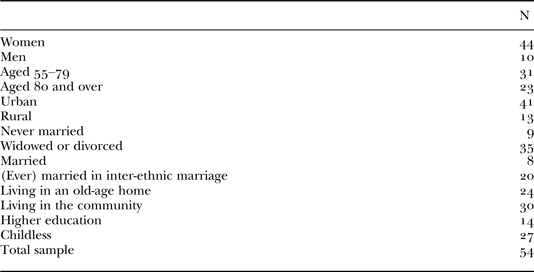
Our research uses a qualitative methodology combining semi-structured interviews, informal conversations and participant observation in Transylvania (Romania) in 2008, 2015 and 2016. As we are interested in the impacts of emigration from the perspective of stayers, our main target participants were older Transylvanian Saxons. We used purposive sampling to capture a diverse set of experiences and situations among the older population in terms of residence (urban/rural, independent/institutionalised), age, care needs, family networks (predominantly local/distant/transnational; inter-ethnic or not) and socio-economic status. Interviews were conducted in two urban locations (Hermannstadt/Sibiu and Mediasch/Mediaş) and five villages, including in an urban and rural old-age home for the German population. We recruited by accompanying a Lutheran meals-on-wheels delivery round and volunteers on home visits, attending church and cultural events, and following up on recommendations by stakeholders and interviewees. Table 1 provides an overview of the older interview sample.
Characteristics of older interviewees

As is evident from Table 1, our study population is heterogeneous, but captures well four key groups into which today's older Transylvanian Saxons in Romania fall. The first, captured by those with higher education in Table 1, consists of members of the Saxon elite who have remained because they hold or held important positions within academia, the church, politics, business or the arts; their most prominent (non-elderly) representative is Klaus Iohannis, Romania's President. The second are Saxons who have inter-married with Romanians, Hungarians or Roma. Such inter-ethnic couples often decided to remain due to family networks in Romania, although some of their children have emigrated. The third are childless Saxons who lacked the confidence or impetus to start a new life in Germany without adult children. Childlessness and never-marriage are common among the oldest cohort, affected by the privations of deportation and the shortage of men after the war (Weber et al. Reference Weber, Weber-Schlenther, Nassehi, Sill and Kneer1996). The remainder are a mixed group who have stayed for a variety of reasons, including preferring the Romanian way of life. Inclusion of two broad cohorts (under and over 80) allows us to distinguish those who were near or over retirement age at the time of the exodus from those still working at the time.Footnote 5
As we wanted to understand older people's TNF constellations and support flows, our interviews collected life and migration histories, kinship data, and data on contact and exchanges.Footnote 6 We probed into participants’ reasons for remaining in Romania and their attitudes towards family members’ departure. We also conducted semi-structured interviews with 20 key informants among the German-speaking population in Romania with the aim of capturing their views on the older population's situation and the role of local institutions as sources of support.Footnote 7 We interviewed representatives of the Lutheran church, journalists, academics, politicians, old-age home staff and individuals active in welfare services; five key informants were themselves elderly.
Our interviews were complemented by participant observation and countless informal conversations which helped form a more holistic impression of older Saxons’ lives and circumstances. For example, we took part in church services, craft circles, concerts and talks, Saxon reunions and church fêtes. The observational data yielded insights into the nature of older people's networks and social interactions in Romania, which informed our understanding of their identity and culture, and illustrated the persistence of ties with Germany. For example, during several interviews visiting relatives from Germany were present, and cultural and religious events attracted large numbers of German visitors. Especially our fieldwork in villages revealed starkly the decimation of the German population in rural areas, but also the value placed on maintaining typical Saxon houses.
All interviews were conducted by the authors in German and took between 20 and 120 minutes.Footnote 8 The majority were audio-recorded and transcribed; the remainder were noted and typed-up. The data were analysed using a case study and thematic approach. The transcripts and field notes were coded in NVivo using a mix of pre-determined and emerging themes and case attributes to compare data across sub-groups (Ritchie et al. Reference Ritchie, Lewis, Nicolls and Ormston2014), while case studies allow a more holistic analysis of individuals’ family networks and exchanges over time. In this article we draw on the interviews with older people who have children or other close relatives in Germany and key informants’ accounts of the role of TNF support. All names have been changed.
In what follows we first present evidence and interpretations relevant to answering the first set of research questions, on the impact of emigration on TNF ties. We then discuss the evidence on remittances and care to clarify the ways in which absent family members support their older relatives in Romania, and how this has changed over time. Finally, the discussion draws out the implications of our evidence for understanding the circulation of care in mature migration streams.
Transnational family ties and their maintenance
Without exception the older people we interviewed are part of TNF constellations. No-one is without a relative in Germany, and 38 (of 54) respondents have close kin – child, sibling or both – abroad. Of the 27 older parents, 15 have children in Germany, and for most all children have left. Indeed, seven older parents were left without any relatives in Romania as a result of emigration:
Interviewer: Do you have any relatives here?
Frau Matei: Absolutely no-one.
Interviewer: Not even distant cousins?
Frau Matei: Nobody! Everyone went to Germany, all are gone, I have no-one.
The scale of the post-1989 emigration profoundly affected local kin networks and imposed a transnational mode of family life on those remaining in Transylvania. To this day, Saxons complain that the exodus undermined a German way of life in Romania, with its associated customs, religious life and neighbourliness. Kin and neighbours’ decision to leave was reluctantly accepted and caused grief. One woman, for example, admitted suffering depression after both her sons left. In one case loss of all contact with children was reported, and several respondents mentioned severed ties with siblings. Contact with nephews, nieces and grandchildren in Germany was generally less pronounced than with children and siblings, and many admitted not knowing their names. However, the majority of older people whose family networks span Romania and Germany engage in regular communication with absent relatives. Since the earliest separations after the war, family members have exchanged letters and cards. Accompanying these are often photographs, proudly produced during our interviews to illustrate ongoing embeddedness in family networks. In recent years telephone calls have become an additional means of contact, and some younger elders were using email and Skype. In short, the evidence underlines the pervasiveness of family ties to Germany and good contact with absent kin, especially children and siblings. Our data on visits reveal their significance in sustaining solidarity in TNF networks.
The importance of visits
Family visits to and from Germany featured prominently in older people's interviews and revealed them to be the most significant means of maintaining a sense of ‘familyhood’ across borders. The following excerpt from a childless widow in her eighties attests to the intensity that visits take in some family networks:
Interviewer: Do your relatives [from Germany] visit you in Transylvania?
Frau Gunesch: Yes, yes, they come. Last year the brother of my husband came … and my niece with her younger son and my nephew with his whole family, his wife had a school reunion, and then also a second cousin, so, thank goodness, there's always motion, and now this summer my niece, the daughter of my cousin, she's coming in May with her husband and father-in-law. They are both coming for the first time … In general, since my husband is dead, they make a big effort.
Only a handful of older people reported never having been to Germany; caring commitments, a spouse's language barrier or family conflict were reasons given. Most had made several visits to see children or siblings. Among younger respondents such visits were ongoing, often lasting several months and involving stints of looking after grandchildren or sick relatives. Clearly, those able to participated in multi-directional exchanges of care.
Respondents no longer capable of travel were dependent on visits from Germany to participate actively in family life. Many enjoyed at least yearly visits by children and grandchildren:
The children and grandchildren gladly and regularly come … and the one grandchild recently did a year's internship here. (Frau Peters, married, mid-eighties)
Interviewer: Was there never a year when you didn't see your sons?
Frau Kloos: They always came, either one or the other, after all, there were four of them … Once they were all here together … It was when they worked on the house. (Widowed, early seventies)
Visits on occasion of crisis or celebration were particularly emphasised. However, not all elders receive regular visits by their children, and a few receive none at all. Some excused their children's prolonged absence by reference to their work, economic constraints, poor health or child-care responsibilities. Yet respondents’ disappointment and powerlessness were unmistakable, especially when they reflected on declining frequencies of visits coinciding with their own growing inability to travel to Germany. One widow in her seventies recalled how often her son visited in the early years:
Yes, then they used to come often, they suffered hugely from homesickness. They came often, the whole family. But now my son comes alone, the children go on holidays with their friends.
She reflected sadly that when her son comes by himself, he does not stay long. Her case captures a disjuncture common among our respondents, who were relatively young when their children first left, between family members’ changing visiting patterns as homesickness wears off and grandchildren grow up, and non-migrants’ increased need for support. The migration stage in which visits are most intensive is not the lifecourse stage in which care needs are typically greatest. An elderly father admitted that his children now at best came every two years; he had not yet met the youngest grandchild who is two or three years old. His children's apparent lack of commitment to ‘doing family’ finds reflection in merely sporadic phone calls and a bleak prognosis about his long-term care options: ‘Then there's the old-age home!’ The maintenance of ties through visits and phone calls is felt to be a precondition for receiving care when the need arises.
The role of houses
A recurrent theme in connection with visits was the existence of a family home in Transylvania.Footnote 9 Older stayers’ houses have gained significance as a means of rooting the TNF. Many respondents recalled at length the renovations that had been made to the family home by absent children, and how these homes were being used during holidays. Interviewees who live in an institution are often collected by visiting children so that the family can be together in the family home, like in the days before emigration. Clearly, property in Transylvania can become an important focal point for TNFs around which to enact continued family life (cf. Wall and Bolzman Reference Wall, Bolzman, Baldassar and Merla2014).Footnote 10 Such families agree that the property should stay in the family, even if this means having to pay towards nursing home fees.Footnote 11
However, the existence of property in Transylvania is clearly not sufficient to attract absent kin, as cases show in which a house has become the focus of parents’ disappointment about unrealised dreams of familyhood. Several older parents pointed to the existence of a house belonging to a child which did not translate into that child making regular use of it. One widower, for example, recalled that he and his wife had bought a bigger house in the 1970s, as they have two children, and had converted a barn into a flat for their son. ‘In those days we didn't yet know that the big exodus was coming!’ The son has not visited for three years, the daughter comes at best once a year. Another man in his late seventies, who lovingly tends his and his absent brother's house and garden, was under no illusion that his children in Germany would want to take over his house. In the event of his entering an institution, the property would be lost.
We have discussed visits and the significance of houses because the accounts people gave of their children's visiting habits were indicative of the strength of their TNF ties. In TNF constellations, family life is enacted through contact and visits; where these are lacking, family solidarity weakens. Older people who reported infrequent visits were often oriented strongly towards local ties or expressed uncertainty about future care.Footnote 12 How the intensity of ties impacts support flows is examined next.
Material support and remittances
Before embarking on our research, we expected TNF support for older Saxons to be a significant element of their survival strategies and a strong manifestation of family solidarity. This assumption was not only informed by the remittance literature, but also by persistent economic disparities between Romania and Germany. In 2008, when our research commenced, wages and pensions were four to five times higher in Germany than Romania (Migration Watch UK 2013), while comparative price levels stood at 63 per cent of the EU average (Eurostat 2016). Consequently, difficulties with making ends meet were a common interview theme. This was the response of an informant who organises home visits to our question of how older people cope:
By saving … They heat one room and in addition they ‘sleep cold’ [in an unheated room], something the Saxons never used to be able to do … [This couple] have two pensions, yes, and between the two of them they can use this one room, and that's why they manage quite well. But only by saving, saving, saving.
Despite this backdrop of economic constraints, we found material support not to be a significant element of TNF relations. Questions about support from relatives in Germany typically elicited reference to ‘parcels’. Parcels from Germany containing food and clothing commenced under socialism:
In the 1980s the situation was so bad with food and medicines, we practically lived on the parcels which my brother sent. If you have to queue at 4 am for a litre of milk, well, you couldn't do that if you had a job, and my mother was also no longer fit enough. (Frau Gunesch, childless, mid-eighties)
While parcels were a lifeline, dependence on them also caused shame:
Tears shot into my eyes, I got a whole suitcase full of milk, sugar, pasta, and I thought: How wretched we are here! … In that moment I realised what it means, when it says in the Bible: to give is more blessed than to receive! Really, only ever to receive gifts is not good in the long run! (Frau Kirschner, childless, late seventies)Footnote 13
The significance of parcels even during the difficult 1980s and 1990s varied between families and should not be overstated. At best they involved gifts of foodstuffs on two or three occasions a year. Only one elderly woman, living alone and on a small pension, was still receiving parcels in 2008. Her son in Germany has links to lorry drivers who take parcels to Romania for free. For other older people material support now chiefly takes the form of consumables on the occasion of family visits. Even such instances are declining as visitors increasingly come by air, and there is nothing that cannot be obtained in Romania today, albeit at high prices. Moreover, visits by relatives are also occasions when older people like to give gifts of local produce, traditional delicacies and crafts. While this does not devalue the consumables received from relatives abroad, it suggests that they should be interpreted as instances of gift exchange rather than ‘material support’.
The evidence on monetary support points to an even lower intensity of exchanges. Only eight elders with adult children abroad made reference to monetary support, some in the negative. Reliance on bank transfers was never mentioned; instead monetary assistance appears dependent on face-to-face contact. The following case study is revealing of monetary support for elderly Saxons today.
Frau Matei, aged 80, is a widow living on her own. She married a Romanian, and the couple had one son. Her husband extended the family home which Frau Matei had inherited, and when her son married he, too, invested in the house and built an extension. In the early 1990s he emigrated to Germany with his Romanian wife and two daughters. One granddaughter has done very well, while Frau Matei's son works as an electrician. Frau Matei receives meals on wheels from the church and a state winter fuel subsidy on account of her small pension. During the cold months she only heats her kitchen and bathroom and sleeps in the kitchen. She admits that it is difficult to get by:
It is very tight, I receive a small subsidy from the church, 27 Lei per month [less than €10 at 2008 rates], and … I manage.
When asked whether her son would help if she didn't manage, her reply is anything but confident:
Frau Matei: To be honest, I don't know. I don't know, but I hope!
Interviewer: Has he ever left money, in case there are extraordinary expenses, a repair or…
Frau Matei: Well, so far nothing has been repaired, everything stands just as it has done…
Interviewer: Have you ever had to ask him for help with anything?
Frau Matei: Well, that's the thing … I have always struggled through. I am very frugal, I don't buy myself anything. So I have received a pair of shoes from him and … well so.
Interviewer: But the gas bill and electricity and telephone, that is paid…?
Frau Matei: That is all paid by myself. And whatever is used at the back [in his part of the house], we settle up for that.
Frau Matei's case bears many characteristics that would lead us to expect significant material support flows: she is a widow, not in good health, living alone and on a small pension. While the frequency of her son's visits has declined, he still comes once a year. Having migrated in middle age, he did not find it easy to settle, but he and his wife now have steady jobs that would appear to allow them to support his elderly mother with a monthly sum.Footnote 14 Instead, she reports minimal support. Reference to the tiny amount she receives from the church only emphasises the lack of support from her son. Yet Frau Matei does not complain. She is not alone in expressing modest expectations of support from family members in Germany. The following responses offering excuses for insignificant support were typical:
Well, [my sons send money] just as they are able to. But they left with just a suitcase. They invested everything they had. (Widow, early seventies)
The son has to pay €800 a month in rent and he has children, and the daughter no longer works. (Widower, early seventies)
[My siblings in Germany] also don't have money. They bring me a little coffee, some sweets, or so, when they come. They … are also poor, they rent [as opposed to living in their own home], … everything is expensive, it's also difficult for them. I am not without means, I don't need money from them. (Never married woman, early eighties)
Even stakeholder interviewees whose responsibilities include the welfare of older Saxons, and whose jobs would be easier if more support from kin in Germany was forthcoming, were not critical about ungenerous migrants:
Generally speaking there is support [from German relatives] in one form or another, so we can assume that every Saxon living in Germany tries to support someone, even if it's not parents, it may be a neighbour. But, it must be said … the support is not a large sum of money … It is simply an improvement of the living conditions for those in receipt of the support, but it is not a strategy for survival. (Herr Theiss, head of local government)
Judging from our data, this politician overstates the significance of support from Germany. Only three older people reported regular transnational monetary support from family, and this involved modest payments directly to the care home. Another widow reported that her four children in Germany, all of them university graduates, sometimes give her €100–200; until recently most went towards her husband's hospital bills. Moreover, money does not exclusively flow to Romania. One poor father recounted scraping together his modest savings to assist his divorcée daughter in Austria.
To sum up, transnational material support is a recognisable facet of family relationships spanning Germany and Romania, and one which was particularly significant during and just after socialism when shortages in Romania were severe. Judging from our respondents’ accounts, material support has declined in the last two decades, and where it occurs today it is partly offset by counter-gifts. Although large income differentials between Germany and Romania persist, there is nothing approaching a ‘remittance culture’ among relatives in Germany. This observation supports other studies which have noted declining trends over time in migrant remittances to their families (e.g. Ariza Reference Ariza, Baldassar and Merla2014; Attias-Donfut Reference Attias-Donfut, Troisi and von Kondradowitz2013; Bilecen and Sienkiewicz Reference Bilecen and Sienkiewicz2015).Footnote 15
Transnational family care
Material support is only one aspect of TNF assistance, which also covers practices of physical, instrumental and emotional care from a distance. In this section we review evidence on transnational care, drawing on the distinction in the literature of ‘caring for’ and ‘caring about’.
‘Caring for’
Old-age care is traditionally a quintessential family responsibility among Transylvanian Saxons (Bruckner Reference Bruckner and Schuster1990). Most older respondents recalled having lived with parents and grandparents when they were younger and having cared for parents, grandparents, even childless uncles and aunts. In rural areas the normative manner of providing old-age care was through co-residence of the generations, with the elderly couple typically moving into an annexe, and responsibility for house and farm passing to an adult child. In urban settings, intergenerational co-residence was more difficult, but several elderly women recalled having taken in their mother even though this involved sharing a small flat or even room. The imperative to provide family care was sufficiently strong that in ten (of 54) cases respondents gave caring for an elderly or ill family member as the reason for not emigrating in 1990. Clearly familial responsibility for old-age care is deeply entrenched in Saxon culture and in people's understanding of ‘what families do’.
Among older Saxons with children still living in Romania, family-based old-age care survives. Only two of 24 respondents living in an old-age home have local children, all others are in the home because they lack local kin. The strong sense of family responsibility for care is not lost in the process of emigration, but distance is acknowledged as a significant barrier to providing satisfactory care. The challenge is captured well in this excerpt, where two elderly sisters reflect on an elderly, frail friend whose children have emigrated:
Interviewer: And do the children in Germany careFootnote 16 for him?
Sister 1: They care, but what can one do for an old person, who is in bed all day…
Sister 2: …who needs help?
Sister 1: It is in vain to send him money or food or…
There is a tension between a willingness to show responsibility for a person's care and constraints on what can be accomplished from afar. Only if either the giver or recipient of care moves, can ‘caring for’ occur (Kilkey and Merla Reference Kilkey and Merla2014).
The practice, often mentioned in the literature on TNF care (Coles Reference Coles2001; King and Vullnetari Reference King and Vullnetari2006), of older parents following their children to the migration destination country for care, did not emerge as a contemporary solution in our study. As noted above, the Saxon emigration to Germany often involved whole families, and until the mid-1990s older parents frequently accompanied their children or were fetched soon after. In those days there were few institutional barriers to such migration: ethnic Germans received German citizenship and German welfare entitlements upon arrival (Weber et al. Reference Weber, Nassehi, Weber-Schlenther, Sill, Kneer, Nollmann and Saake2003). In recent years, however, emigration has all but ceased, and relocation of a frail relative with the aim of receiving care in Germany was described as extremely rare. Respondents expressed reservations about ‘uprooting an old tree’ and referred to the incompatibility of familial old-age care with German work-life, housing and individualism. Immigration has become more restrictive (Sienkiewicz, Sadovskaya and Amelina Reference Sienkiewicz, Sadovskaya and Amelina2015), and there were concerns about escalating costs should an elderly relative need institutional care in Germany.Footnote 17
An alternative to the older person moving is for a migrant relative to return to provide care. The following is a case study of far-reaching hands-on care by a relative normally resident in Germany.
Frau Fröhlich is 86, her husband died some months before we interviewed her. She has a son, aged 62, and a daughter, 58. Both children left for Germany with their families in 1990. At the time, Frau Fröhlich and her husband were caring for an elderly neighbour. The elderly couple visited their children on several occasions, and the children and grandchildren in turn visited Romania nearly every summer. In recent years the daughter developed debilitating health problems necessitating countless operations. This coincided with the elderly couple's declining health, a fact which they managed to hide from their children in Germany. On the phone Frau Fröhlich merely said that they were ‘taking it easier’, which the daughter took as a good sign. It was only when former neighbours, living in Germany but on a visit to Transylvania, called on the elderly couple and found them bed-bound that the children were informed. Within two days the granddaughter, who worked as a nurse in Germany, had taken unpaid leave and arrived to care for her frail grandparents. She eventually stayed for more than a year and saw the couple's transition into an old-age home.
In all our interviews this case stands out as an exceptional instance of intensive and long-term TNF care. Caring for others is a defining theme running through Frau Fröhlich's account of her life and family, including her mother's care for her children when she was working, the intimate care Frau Fröhlich provided for her neighbour over years, her son-in-law's care for his chronically ill wife and her granddaughter's exemplary care for Frau Fröhlich and her husband. The only comparable case in our sample involves an unmarried daughter returning to Transylvania in the wake of her mother's illness. Although the mother has largely regained her independence, the daughter has decided to stay as she has found work in Romania and welcomes the opportunity to be near her mother. In most instances, hands-on ‘caring for’ by family members in Germany, if it occurs, takes the form of short visits around episodes of ill health or to provide respite to the routine carer.
The barriers to absent children providing comfort and care are sometimes experienced as deeply distressing by parents in need of care. One widow, aged 70, living in a home and of poor health, lamented:
Whenever they [her children from Germany] came, it was such joy, but then the parting was so bitter. When I realised, ‘today you have to say goodbye’, I thought: ‘I'd rather die!’ You think you have children, grandchildren, but then they are all gone, and there is no-one to feed you even a spoonful of water when you are ill!
In her case, all four children live in Germany. Although they are exemplary in keeping in touch and visiting, she still feels sharply the loss of normative family care as a result of their emigration (cf. Vullnetari and King Reference Vullnetari and King2008). Her case is poignant as she only remained in Romania because her husband suffered poor health. She also helped to care for a childless sister until her death. When finally she was free of caring responsibilities she visited her children in Germany but quickly determined that she did not wish to be a burden as they have family and work responsibilities. She decided instead to enter an old-age home in Romania. The existence since the mid-1990s of good, affordable care homes in Transylvania targeted at the German population has provided an acceptable alternative to family care. As a result, TNF care more commonly takes the form of ‘caring about’ an elderly relative.
‘Caring about’
There are multiple ways in which families show that they ‘care about’ their relatives abroad. As noted, phone calls, letters and particularly visits are the means by which TNFs continue to ‘do family’ and manifest interest and care. By keeping in touch, absent relatives are able to intervene when the need arises. For example, one daughter arranged for her mother to receive meals-on-wheels after her release from hospital; another hired a woman willing to come in daily to provide necessary care. Sons typically make repairs to the house when they visit, stock up on bulky items and accompany parents on visits to the doctor. Such manifestations of ‘caring about’ an elderly family member were not limited to adult children. As our sample included many childless older people we were able to record care provided by siblings, nephews and nieces. For example, Frau Lienert, a childless woman in her late eighties, when asked how she and her husband had ended up in an old-age home, recounted:
My husband had a stroke, and then my sister-in-law came [from Germany] and helped us a little bit at home and in the end she decided that we would be best off in the old-age home.
The sister-in-law made the arrangements and helped with the transition into the home. Her son later procured a second-hand electric wheelchair for his uncle. Years later, after her brother had died, the sister-in-law came again to help Frau Lienert move into a smaller room, notwithstanding the fact that she had recently recovered from ill health. The sister-in-law also thoughtfully ensured that Frau Lienert got an embroidered wall hanging belonging to her mother-in-law for her room. In a similar case a brother ‘rescued’ his childless, impoverished and recently widowed sister from a decrepit house in a village. ‘Why should I have to worry about you from Germany? You have to go into the home!’, he apparently gruffly told her and made appropriate arrangements. He is also making small co-payments to the home to cover the shortfall on his sister's pension: ‘Everything is arranged, you do not have to take care of anything!’ This example reminds us that worrying is a manifestation of caring about someone, and anticipating and reducing worries are reciprocal acts of caring (Baldassar Reference Baldassar2007b). In this light, Frau Fröhlich and her husband's effort to conceal their considerable care needs from their children in Germany can be interpreted as an instance of caring by not adding to their worries. Other examples include making one's own funeral arrangements to spare absent relatives the bother, or children reassuring parents that a beloved family home will not be sold.
Discussion and conclusion
This article has presented evidence on TNF ties and care among older Germans in Romania on the basis of interviews and observations. Our main findings can be summarised as follows. The older people we interviewed are without exception part of TNF networks bridging Romania and Germany. Most have experienced the departure of close relatives, such as children and siblings, and many have been left without any close kin locally as a result of mass emigration to Germany. Nonetheless they do not present themselves as abandoned. With few exceptions, transnational links are actively maintained through letters, phone calls and visits. Where family homes have been preserved in Romania, these serve as focal points in which families congregate and re-enact family life. Contrary to expectations, material TNF support is not significant and has declined over time. Care, by contrast, remains an important part of what most TNFs provide. Nowadays caring by bringing an elderly relative to Germany is not a popular solution, nor is migrants returning to Romania to care common. Instead, the existence of old-age homes and other local alternatives (e.g. paid care) promotes opportunities for absent relatives to provide care indirectly. Instances of care, concern and support connect not just parent–child dyads but a range of relatives across generations and locations, and those without children often rely on siblings, nephews and nieces. Older Saxons in Romania are not passive recipients of care and support: those still able to travel visit and care for family members in Germany; those in possession of a house lovingly preserve it for visits by family; those largely dependent on others try to keep in touch through letters and phone calls and manage information flows to avoid worrying absent kin. The short answer to our research questions is that emigration has transformed older people's family networks in ways which cause regret, but only rarely has curtailed a sense of familyhood across time and distance. Where ties are actively maintained, they result in the exchange of care and gifts, but only rarely significant material support.
Several factors are likely to account for the paucity of remittances. A macro-level reason lies in the specific type of migration giving rise to the TNF constellations observed. Unlike contemporary Romanian labour migration within the EU which produces significant remittance streams, the Saxon migration to Germany was never conceptualised as labour migration but as ethnically motivated permanent emigration. Relatives in Romania are thus neither perceived primarily as beneficiaries of economic success in Germany – in most cases they have remained against the advice of migrant family members – nor as anchors to which migrants hope one day to return. Meso-level reasons include cultural norms and expectations shaping exchanges within families. One element of this may be the proverbial Saxon stinginess to which four respondents spontaneously referred. (Note also the book-keeping language (‘settle up’) used by Frau Matei around her arrangement with her son over utility bills.) At least as important are statements revealing normative aversion to dependence on others, as when a respondent is shamed by receiving a suitcase of food. Independence is highly valued and underpinned by a strong ethos of work and ‘making do’ among the Transylvanian Saxons (Verdery Reference Verdery1983). This is reflected in statements of managing without help. The value of balanced relationships is further manifested in return gifts and common reference to relatives’ reciprocal hardship in Germany. We lack the perspective of the migrants in our data, and can thus not assess economic constraints on their ability to support relatives financially, although Romanian–German income differentials and a generally favourable integration of Saxon migrants into Germany's labour market would suggest such constraints are limited (Hihn and Schenk Reference Hihn and Schenk1996; Ingenhoven Reference Ingenhoven2003).
By contrast with material support, we found the traditional emphasis on familial care among Transylvanian Saxons to have survived emigration, albeit transformed. Not only are manifestations of care common, caring also appears prominently in respondents’ accounts of the kind of family they are. As has been observed in other studies, care can act as a lens for understanding personal and group identities (Schröder-Butterfill and Fithry Reference Schröder-Butterfill and Fithry2014; Twigg Reference Twigg2004). Caring – like being stingy, independent and hard-working – is portrayed as part of Saxon identity. The literature on care circulation in transnational networks emphasises that reciprocal exchanges of care fuel a sense of belonging and solidarity across borders and time (Baldassar and Merla Reference Baldassar, Merla, Baldassar and Merla2014a; Reynolds and Zontini Reference Reynolds, Zontini, Baldassar and Merla2014). This was evident in our material, with those older people engaged in active transnational exchanges feeling embedded in family networks and cared for from a distance. Through visits, absent relatives provided emotional, instrumental and physical care, and families temporarily enacted normal family life. It is no accident that those who had not seen their relatives for years were uncertain about future care. Our evidence underlines the fact that the quality and supportiveness of ties are inextricably linked: care weakens where ties weaken.
Countering over-optimistic accounts of TNF care in the literature, we argue that the difficulties and challenges for older people of being cared for by distant family members remain fundamental (cf. Vullnetari and King Reference Vullnetari and King2008). Elderly respondents railed against the absence of their loved ones in times of dependence and need, and only reluctantly submitted to the pragmatic solution that care homes now offer. Caring from a distance is better than being ‘orphan pensioners’, but when it comes to physical and emotional care, institutions and strangers are perceived as imperfect substitutes for what families have provided for centuries.
A neglected aspect in the literature is the importance of houses in sustaining TNF ties (cf. Wall and Bolzman Reference Wall, Bolzman, Baldassar and Merla2014). Family homes are concrete manifestations of a family's history and continued presence in the community of origin. Homes have symbolic significance as the locus of shared memories, and they serve the pragmatic purpose of providing spatially dispersed families a place to meet. This is particularly important for older people no longer able to travel. We contend that houses have heightened significance in contexts of permanent emigration, where the long-term survival of a family network or even ethnic group is called into question by exodus and where the continued investment in family property thus acts as a positive counter-statement. In the case of the Transylvanian Saxon diaspora, there are certainly those who see no future for the German community in Romania and who have given up on the Transylvanian Saxon project.Footnote 18 Where families actively maintain and invest in a property in Romania, and use it for family reunions, this can be seen as preserving not only individual family capital but also broader cultural capital (Reynolds and Zontini Reference Reynolds, Zontini, Baldassar and Merla2014). In the context of an ageing and decimating population of stayers, this kind of care for cultural heritage and ethnic identity may come with time to replace the care for people (H. Baier, personal communication).
The German emigration from Romania is an extreme case which raises historical questions about cultural continuity. However, our data allow us to suggest a general point about TNF networks over time, which indicates a need for caution regarding their durability. By taking a long view of migration, we find that strong TNF ties are not an inevitable outcome, even where there are minimal restrictions on movement. Twenty-five years or more after their relatives’ departure, a few older people we encountered are no longer in close contact with absent kin, and they certainly do not expect support and care from them. We also observed a decline in the importance of transnational support and the frequency of visits. What explains this decline and loss of ties? Consideration of the lifecourse, as invoked in recent literature on the circulation of care, may provide a partial answer. As noted in the literature review, support from migrants is often rare in the early stages of a family's transnational existence, and migrants may even receive assistance (Wall and Bolzman Reference Wall, Bolzman, Baldassar and Merla2014). There follows a stage of active support, when migrants remit, invest in their communities of origin and visit regularly. In our respondents’ accounts, this stage saw renovations and repairs to family homes and regular visits with grandchildren. The nature of a possible third stage has received much less attention in the literature, not least because most contemporary migration streams are not of sufficient duration.Footnote 19 Judging from our data, one possibility is that fatigue, estrangement and loss of genealogical memory are elements in mature TNF networks. Not only has the older generation left behind in Romania aged, but members of their TNF network are also experiencing morbidity and mortality, making the maintenance of active and supportive ties more difficult. The younger generation, comprising grandchildren, nephews and nieces, is often less familiar and less interested in their families’ origins. Unless transnational familyhood has become part of a family's identity and habitus, as appears to be the case with Frau Fröhlich's, TNF networks as sources of support and care will not necessarily survive the test of time.
Acknowledgements
We gratefully acknowledge the funding by the University of Southampton. We obtained ethics approval from the Faculty Ethics Committee and the Research Governance Office of the University of Southampton (ERGO15584) and from the Sociology Department of Lucian Blaga University in Sibiu, Romania. We are grateful to Melanie Schoger, two anonymous reviewers and, above all, the many people in Transylvania who talked to us with openness and warmth.