The Fontan operation is usually the final palliative procedure in patients with the so-called “single ventricle physiology”. The proper functioning of the total cavopulmonary connection is influenced by several factors such as a good systolic and diastolic ventricular function, the presence of sinus rhythm, low pulmonary vascular resistances, and appropriate respiratory tree anatomy.Reference Choussat, Fontan, Cesse, Anderson and Shinebourne 1
The performance of a pre-Fontan haemodynamic study has been considered a necessary part of pre-intervention evaluation. In fact, pre-Fontan catheterisation could permit to select high-risk patients for surgery and to perform interventional procedures that could improve post-operative outcome of these patients.Reference Choussat, Fontan, Cesse, Anderson and Shinebourne 1 – Reference Mendoza, Albert and Ruiz 6 Among the factors determining the outcome of Fontan patients, the pressure of the total cavopulmonary anastomosis plays an important role.Reference Choussat, Fontan, Cesse, Anderson and Shinebourne 1 – Reference Mendoza, Albert and Ruiz 6
Some authors advocate the use of a dedicated empirical formula to predict the pressure in the total cavopulmonary anastomosis (Pfontan) starting from pre-Fontan catheterisation dataReference Nicoson and Steven 5 , Reference Mendoza, Albert and Ruiz 6 :
 $${{\rm{P}}_{{\rm{fontan}}}} = {{\rm{P}}_{{\rm{glenn}} - {\rm{atria}}}} + {\rm{ }}{{{\rm{TP}}{{\rm{G}}_{{\rm{glenn}}}}} \over {{{\left( {{\rm{Qp}}/{\rm{Qs}}} \right)}_{{\rm{glenn}}}}}}$$
(1)
where Pglenn-atria is the pressure in the single atrium, the TPGglenn is the trans-pulmonary gradient, and (Qp/Qs)glenn is the pulmonary-to-systemic flow ratio evaluated at the pre-Fontan catheterisation.
To our knowledge, this formula is used in few centres, but it has not been validated. Therefore, the aim of this work was to test the mathematical and clinical values of the mentioned formula through a retrospective clinical study evaluating:
AIM 1: The capability of the mentioned formula in predicting the pressure into the Fontan system in non-fenestrated patients.
AIM 2: The capability of the mentioned equation in predicting the needs for fenestration.
Materials and methods
Data of patients undergoing pre-Fontan catheterisation and Fontan completion in our institution were retrospectively collected including:
(1) patients’ gender, diagnosis, age, and weight at the Fontan completion;
(2) pre-Fontan haemodynamic data: atrial pressures, ventricular pressures, systemic pressures, pressures in the Glenn system, trans-pulmonary gradient, pulmonary vascular resistances, and pulmonary-to-systemic flow ratio. All data were collected under general anaesthesia and in intubated patients.
(3) pressure into the Fontan system was measured in the operating room soon after cavopulmonary anastomosis, after sternal closure, through right or left internal jugular vein cannulation. Data were collected under general anaesthesia and in intubated patients.
Patients were excluded from the study in the following cases:
the pressure into the Fontan system was not measured during the total cavopulmonary connection realisation,
the need for ECMO implantation at the time of surgery,
the need for Fontan take down within the first 24 hours,
Kawashima operation,
pre-Fontan catheterisation data were not available.
The objectives of the study were as follows.
AIM 1: Correlate the predicted Fontan pressure with the actual measured Fontan pressure in the operating room for non-fenestrated Fontan patients. To this aim, haemodynamic data collected at the pre-Fontan catheterisation were used to calculate the predicted pressure in the Fontan system using equation (1). The obtained values were compared with the pressure in the Fontan system measured after the cavopulmonary anastomosis completion through superior caval vein central venous catheter soon after sternal closure.
AIM 2: Evaluate the performance of the predicted pressure to identify subsequent need for fenestration. As in other centres, the decision to fenestrate the extra-cardiac conduit in our patients was made in a joint commission on the basis of several considerations such as the pressure into the Glenn system, the presence of collaterals, the pulmonary artery anatomy, the Nakata index, the trans-pulmonary gradient, and the pulmonary vascular resistances. In fact, in literature, multiple variables with several cutoffs were proposed to identify patients requiring fenestration such as a Nakata index <150 mm2/BSA or a pressure in the Glenn >14 mmHg. However, these cutoffs are not universally established. Therefore, different centres can prefer one parameter instead of another or can use different cutoffs.Reference Choussat, Fontan, Cesse, Anderson and Shinebourne 1 – Reference Trezzi, Cetrano and Giannico 11 We correlated, using ROC curves, the needs for fenestration with the predicted Fontan pressure.
Statistical Analysis: Data were expressed as mean values and standard deviation or as median values and interquartile range, where appropriate. Correlation and linear regression analysis were performed between the measured and predicted Fontan pressures together with the Bland–Altman analysis for non-fenestrated patients. Finally, the ROC curves were elaborated, and the area under the curve (AUC) was calculated to assess the validity of the formula in predicting the pressure in the Fontan system for non-fenestrated patients and to predict the likelihood of receiving conduit fenestration at the time of surgery for the overall population. p value below 0.05 was considered statistically significant.
This study is in accordance with principles expressed in the Declaration of Helsinki, and the research was conducted with the approval of the Institutional Review Board that waived the need for informed consent, due to the retrospective nature of the protocol.
Results
A total of 182 patients from 1993 to 2017 were analysed for this retrospective clinical study with a median age and weight at the Fontan procedure of 35.00 [31.00–41.25] months and 13.00 [11.68–14.10] kg, respectively. Of these patients, 48% underwent cardiopulmonary bypass during the Fontan completion. A total of 58 patients were excluded because of the lack of the measured pressure into the Fontan system and/or because of the realisation of a Kawashima connection.
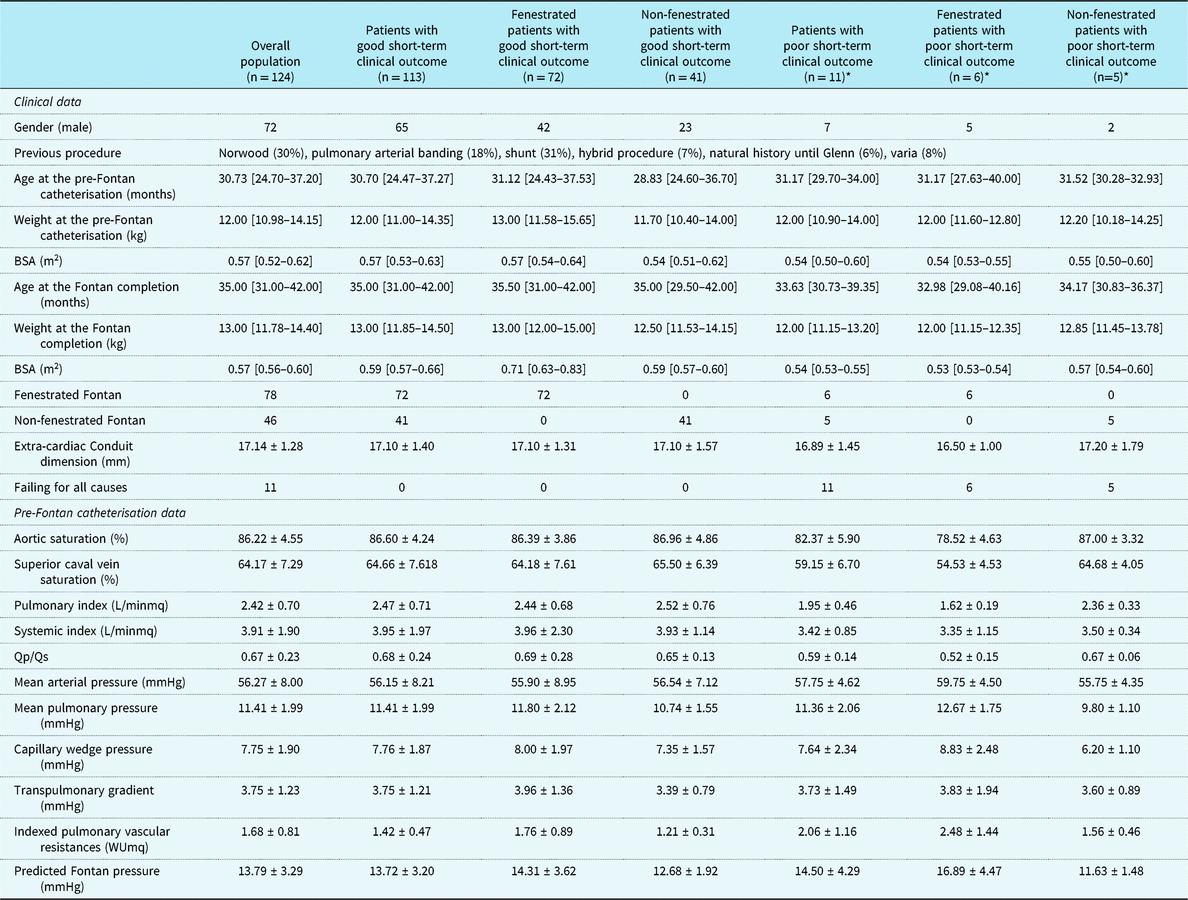
Therefore, 124 patients were retrospectively enrolled in this clinical study with a median age and weight at the Fontan procedure of 30.73 [24.70–37.20] months and 12.00 [10.98–14.15] kg, respectively. Patients’ demographic and baseline data are summarisedin Table 1. The heart anatomy of these patients was double-inlet left ventricle (20%), tricuspid atresia (19%), hypoplastic left heart syndrome (23%), pulmonary atresia with intact interventricular septum (7%), heterotaxy syndrome or isomerism (10%), double-outlet right ventricle (10%), unbalanced atrio-ventricular canal (3%), and others (8%). Surgical procedures preceding Glenn, included Norwood palliation (30%), pulmonary artery banding (18%), systemic-to-pulmonary shunt (31%), hybrid palliation (7%), natural history before the Glenn procedure (8%), and other procedures (10%). Fenestrated Fontan was realised in 78 patients (62.9%). Fontan failure was observed in 11 (8.8%) patients (6 fenestrated and 5 non-fenestrated patients).
Patients characteristics

BIV=two patients with multiple ventricular septal defects and one with a Criss-cross heart; LV=single ventricle with a left ventricular morphology; RV=single ventricle with a right ventricular morphology.
* Negative clinical outcome: composite outcome of death, heart transplant, take-down Fontan within 3 months from the Fontan completion.
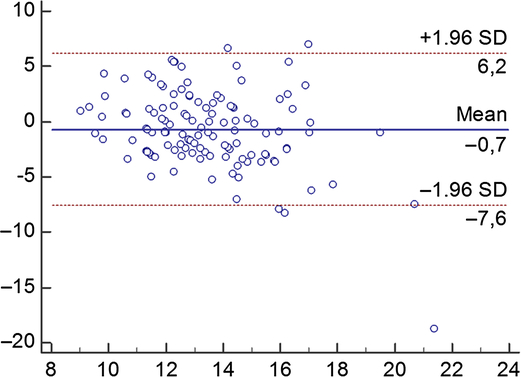
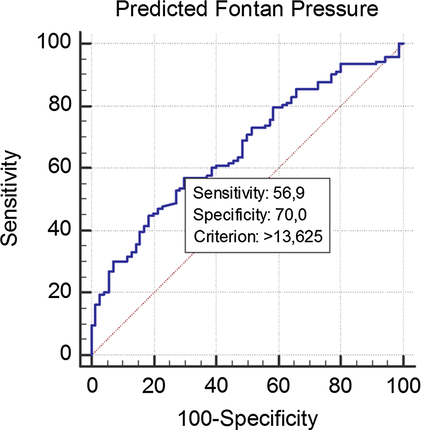
Correlation analysis performed for non-fenestrated patients (n = 46) showed a weak, though statistically significant relationship between the measured and predicted data for the overall population (r2 = 0.05128; p = 0.0114). Moreover, also for non-fenestrated patients having a short-term clinical positive outcome (r2 = 0.04118, p = 0.0311), a statistically significant relationship between the measured and predicted data was found. Bland–Altman analysis plotting the results of equation (1) with intraoperative Fontan system pressures (Fig 1) showed a bias of −0.7 mmHg (SD, 1.96 mmHg) with limits of agreement from +6.2 to −7.6 mmHg. The ROC performance of predicted pressure showed a fair discriminative capability of subsequent need for fenestration in the overall population (AUC 0.66; p = 0.003) with a cutoff at 13.7 mmHg (sensitivity 55% and specificity 70%) (Fig 2).
Bland–Altman analysis comparing the measured and predicted Fontan pressures.

ROC curve showing the capacity of the predicted Fontan pressure to discriminate the need for fenestration at the time of Fontan completion.

Discussion
Patients with univentricular heart physiology undergoing Fontan palliation are a heterogeneous group characterised by different diagnoses and different risk factors that could affect the Fontan outcome. Moreover, the performance of the Fontan system itself depends on several variables such as a good systolic and diastolic function, the sinus rhythm, low pulmonary pressure and vascular resistances, and good respiratory function.Reference Choussat, Fontan, Cesse, Anderson and Shinebourne 1 – Reference Adachi, Yagihara and Kagisaki 20 It is also debated if the Fontan outcome is influenced by pre-Fontan haemodynamic data.Reference Mendoza, Albert and Ruiz 6 , Reference Banka, McElhinney and Bacha 13 – Reference Adachi, Yagihara and Kagisaki 20 In fact, even if some studies underlined that the pre-Fontan haemodynamic data do not affect short-term post-Fontan outcome,Reference Banka, McElhinney and Bacha 13 – Reference Hirsch, Goldberg and Bove 15 the majority of the authors agree on the importance of performing a pre-Fontan haemodynamic assessment to obtain the valuable data as the need for fenestration and anticipate the need for peri-operative systemic or pulmonary vasodilators.Reference Mendoza, Albert and Ruiz 6 , Reference Harada, Uchita and Sakamoto 16 , Reference Albert, Del Cerro, Carrasco and Portela 17 Mendoza et alReference Mendoza, Albert and Ruiz 6 evidenced that high pre-Fontan pulmonary pressure is associated with late mortality and post-Fontan pulmonary pressure >15mmHg is associated with the need of fenestration. Senzaki et al demonstrated on 40 patients that smaller pulmonary artery size causes more disadvantageous haemodynamics after the Fontan operation, with resultant effects of the rise in central venous pressure and the increase in afterload to the single ventricle.Reference Senzaki, Isoda, Ishizawa and Hishi 18 Bridges et al underlined that the pulmonary artery size could not be considered alone as the major determinant of Fontan outcome.Reference Bridges, Farrell, Pigott, Norwood and Chin 19 , Reference Adachi, Yagihara and Kagisaki 20 These considerations challenge the selection of the optimal anatomical and clinical conditions for Fontan completion and/or fenestration. The evaluation of multiple parameters is considered in our group and the decision is made on a patient-by-patient basis.
Finally, among the variables that affect the Fontan outcome, several authors identified the Fontan system pressure as one of the major determinants of the proper functioning of the total cavopulmonary connection.Reference Choussat, Fontan, Cesse, Anderson and Shinebourne 1 , Reference Nicoson and Steven 5 In particular, several papers underlined that higher Fontan system pressure is associated with an increased risk of failure or death.Reference Gentles, Mayer and Gauvreau 7 – Reference Cazzaniga, Fernández Pineda and Villagrá 10 Salvin et al report about the relation between the Fontan pressure system and the duration of effusions.Reference Salvin, Scheurer and Laussen 12
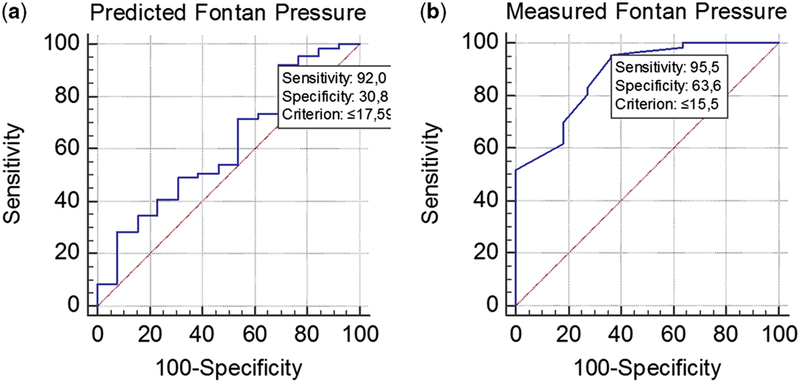
With all these premises, the use of a dedicated formula to predict the pressure in the Fontan system starting from pre-Fontan catheterisation data could be an additional information in this group of patients.Reference Planché, Serraf and Bruniaux 4 , Reference Nicoson and Steven 5 Although this formula is not very widespread, in our work, we aimed at retrospectively testing this equation, as in literature there are no studies focused on the formula validation. To this aim, we retrospectively enrolled 124 consecutive Fontan patients. The results showed a poor relationship between the measured and predicted pressures for the non-fenestrated patients. Bland–Altman analysis on non-fenestrated patients showed that the formula did not systemically overestimate nor underestimate the actual Fontan pressure, but it displayed wide limits of agreements, regardless of the Fontan pressure value. As in other centres, the decision to fenestrate the extra-cardiac conduit in our patients was made in a joint commission on the basis of several variables such as the pressure into the Glenn system, the presence of collaterals, the pulmonary artery anatomy, the Nakata index, the trans-pulmonary gradient, and the pulmonary vascular resistances. In literature, multiple variables with several cut-offs were proposed to identify patients requiring fenestration such as a Nakata index <150 mm2/BSA or a pressure in the Glenn >14 mmHg. However, these cutoffs are not universally established.Reference Choussat, Fontan, Cesse, Anderson and Shinebourne 1 – Reference Trezzi, Cetrano and Giannico 11 Therefore, a formula that can support the decision on fenestration could be useful. However, our results showed that the formula had a poor capability in identifying patients’ need for fenestration. Finally, we observed that the formula cannot detect in advance patients with negative short-term clinical outcomes after Fontan completion (composite outcome of death, heart transplant, take-down Fontan within 3 months). Differently, the intraoperative measure of pressure in the Fontan system (both for fenestrated and non-fenestrated patients) correlated significantly with the acute clinical outcome (AUR 0.88, p = 0.0001) and the cutoff of 16 mmHg showed a sensitivity of 63.6% and a specificity of 94.7% (Fig 3).
ROC curves showing the relation between the ( a ) predicted Fontan pressure and ( b ) measured Fontan pressure and the short-term clinical outcome.

In accordance with the literature data, the results of our study evidenced that if the predicted pressure is lower than 17.59 mmHg, the sensitivity of the equation in identifying patients with a positive acute clinical outcome is 92%. This result is likely of limited value, since a prediction of Fontan pressure of above 17 mmHg, per se, identifies a high-risk procedure.
Limitations
Our study showed a series of weaknesses and some strengths: we conducted a retrospective study enrolling patients treated in a very long period (1993–2017), even if we were able to include a relatively high number of patients, we excluded a few patients because of the incomplete data set. In fact, from some analysis, we excluded almost 30% of operated patients due to the absence of a reliable superior caval vein pressure measurement: these were patients without a retrievable recording of superior caval vein measurement after sternal closure, likely due to the presence of a femoral catheter as a main central line. These patients measured the Fontan pressure intraoperatively, but we did not collect the venous pressure data before sternal closure nor through femoral catheter. Even if it is unlikely that the excluded population may have significantly changed our results, we cannot exclude that they could represent a peculiar subgroup with particularly a small Glenn system who had contraindication to internal jugular vein cannulation. Furthermore, considering that the majority of our patients required a fenestration, this might imply that we enrolled a high-risk population, and therefore, the external validity of these results can be somehow limited. As a consequence of the high number of fenestrated patients, the capability of the equation in predicting the measured Fontan pressure could be tested only in the subgroup of patients not receiving fenestration (n = 46). The formula, in fact, was elaborated in principle for non-fenestrated patients, because it assumes that the Qp/Qs of the Fontan circulation is equal to one, and therefore, the presence of shunts (as fenestration) is neglected.Reference Cazzaniga, Fernández Pineda and Villagrá 10 The predicting formula did not show a good performance in the subgroup of non-fenestrated patients or predict accurately the need for subsequent intraoperative fenestration procedures. Finally, Fontan pressure measurements in the acute phase after total cavopulmonary anastomosis realisation could be affected by several variables such as circulatory volume and ventilatory parameters. A prospective study is necessary to definitely test the mentioned equation.
Conclusions
Unfortunately, the formula predicting Fontan pressure from the pre-Fontan data showed a poor capability in estimating the actual pressure after the Fontan completion and in identifying patients needing fenestration.
The pressure into the Fontan system is determined by multiple factors, which sometimes are patients-related and which are not taken into account by the equation. Therefore, just in a multi-parametric approach, the tested formula could be an additional data to consider in the evaluation of pre-Fontan patients.
Financial Support
No funding was received for this work.
Conflicts of Interest
The authors have no conflicts of interest to declare.