Implications
Affiliated for a long time to high-quality meat, Charolais heifers meat tends to become commonplace and to spread both in traditional butchers’ shops and in supermarkets. This phenomenon could be linked both to the female rarefaction (because of the reduction of the suckling herd) and to the search for lighter carcasses. In this context, suckling heifers offer a large panel of slaughter age and carcass weight, which allow an adaptation to numerous marketing circuits. Results indicate that within the range of weight and age under study, these factors have no negative consequences on heifer’s meat quality. Thus, even if heifer’s performances at slaughter are various, the supply chain operators can insure the consumer a constant quality of meat samples.
Introduction
Since 2002, French labelling has provided consumers with information about the birth and rearing country of an animal. For beef with specifications, breed type (dairy or beef breed) and animal type (heifer, steer, young bull or cow) may also be added to the label. However, these indications do not guarantee the meat quality, as beef on the French market comes from various types of animal, different breeds and ages, reared and finished in various conditions. The history of animals being unknown at the slaughter-house level, the only way for meat wholesalers to correctly assign carcasses to the most suitable customer is to select animals according to carcass characteristics. As inconsistent tenderness may lead unsatisfied consumers to switch from purchasing beef to another meat, it appeared necessary to clearly identify carcass indicators of high-quality meat in order to increase overall meat quality.
Among the characteristics of beef cattle, carcass weight and slaughter age were described as potential factors of tenderness in the literature. For young bulls, negative correlation coefficients have been demonstrated between the age at slaughter of 15 to 18-month-old animals and m. longissimus thoracis initial/overall tenderness (−0.26/−0.29; Renand et al., Reference Renand, Picard, Touraille, Berge and Lepetit2001). The increase in age may have a negative impact on meat quality traits and associated muscular properties, but tenderness is not obviously related to age in a linear relation (Wulf et al., Reference Wulf, Morgan, Tatum and Smith1996) as meat tenderness hardly changes at the young age, but decreases quite quickly when the animals became adults. As concerns heifers, tenderness and shear force do not seem to be affected by increasing slaughter age between 12 and 35 months (Garcia-de Siles et al., Reference Garcia-de Siles, Wilson, Ziegler and Watkins1982; Waggoner et al., Reference Waggoner, Dikeman, Brethour and Kemp1990; Field et al., Reference Field, McCormick, Balasubramanian, Sanson, Wise, Hixon, Riley and Russell1996).
The link between carcass weight and meat quality traits has produced various results depending on experimental conditions. Some authors, such as Shorthose and Harris (Reference Shorthose and Harris1990) have indicated that heavier cattle have less tender m. longissimus dorsi than lighter ones. Most of these studies concentrated on extensive systems. Some other authors observed that meat from heavier animals was significantly more tender than meat from lighter carcasses with slight variations depending on the breed and animal type (Sanudo et al., Reference Sanudo, Santolaria, Maria, Osorio and Sierra1996 and Reference Sanudo, Macie, Olleta, Villarroel, Panca and Alberti2004). Finally, the literature concerning non-continental breeds reveals no significant correlation (phenotypic or genetic) between carcass weight and either tenderness (0.02 to 0.15; Gregory et al., Reference Gregory, Cundiff and Koch1995), texture or firmness (0.10 to 0.20; Hocque et al., Reference Hocque, Arthur, Hiramoto and Oikawa2006), nor shear force (−0.10 to −0.07; Gregory et al., Reference Gregory, Cundiff and Koch1995). Sanudo et al. (Reference Sanudo, Macie, Olleta, Villarroel, Panca and Alberti2004) explained these conflicting results by total and insoluble collagen contents, which were either similar or different at various slaughter weights.
The beef sector uses two complementary ways to obtain heavier carcasses: either modulating growth rate for a given slaughter age or increasing rearing length for a given growth rate. Thus, it could be hypothesized
-
∙ that within a usual range of age (26 to 36 months) and weight (350 to 450 kg carcass weight), the modification of animal performances in terms of weight and age has no negative impact on meat quality traits,
-
∙ that various breeding practices leading to various performances could be used without impacting the homogeneity of meat quality traits.
Therefore, the purpose of the present study was to analyze the impact of increasing carcass weight and/or slaughter age in young Charolais heifers on meat quality traits and associated muscular characteristics.
Material and methods
Animals
Charolais heifers were selected according to two criteria: slaughter age and carcass weight. All slaughters occurred in the same industrial slaughterhouse in order to standardize slaughtering, chilling and storing procedures.
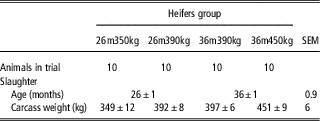
A total of 40 heifers were selected, split into two groups of age: young heifers were slaughtered between 24 and 28 months (average 26 months±1) and the old heifers between 34 and 38 months (average 36 months±1). Young heifers were sampled at two different carcass weights (349±12 and 394±8 kg). Old heifers were also sampled at two different carcass weights (397±6 and 451±9 kg). Thus, the 40 heifers were divided into four groups named: 26m350kg, 26m390kg, 36m390kg and 36m450kg (Table 1).
Carcass characteristics depending on age and carcass weight of heifers

Average±SD.
The information of slaughter age and carcass weight was provided at the slaughterhouse by weight tickets, 24 h postmortem. Only carcasses corresponding to the range previously indicated were sampled.
Animal and carcass measurements
Carcass conformation was evaluated according to the EUROP classification. Fat score was evaluated between 1 and 5. Twenty-four hours postmortem, samples of m. rectus abdominis were removed from carcasses for muscular analysis. This muscle can be easily excised, without bringing about any carcass value depreciation. It was also chosen because this muscle may be broiled and also need only a short time to be cooked. Finally, this muscle seems to be more reactive to the variations of rearing practices than the m. longissimus thoracis. However, this muscle does seem to have some specificities. These particularities concern especially mean fibre cross-sectional area and particularly type I fibres, which have the higher areas, whereas the IIX fibres have the lower ones. This hierarchical organization is generally opposite in the other muscles of the carcass. Moreover, in m. rectus abdominis, IIA fibres have a low oxidative activity; consequently, they cannot be classified by histochemistry with the revelation of succinate dehydrogenase (SDH) activity (Oury et al., Reference Oury, Dumont, Jurie, Hocquette and Picard2010).
Sensory assessment and texture measurements
The m. rectus abdominis was vacuum-packaged and chilled for 14 days at +4°C. After ageing, the m. rectus abdominis was trimmed and cut into 1.5-cm thick homogeneous steaks, then vacuum-packaged a second time and frozen at −20°C awaiting sensory analysis. The frozen samples were thawed at 4°C for 15 h. The steaks were grilled at a temperature of 300°C for 1 min and 45 s to an internal temperature of 55°C. After cooking, the steaks were cut into 20 mm cubes, placed on a plastic plate and immediately served to panellists. The jury consisted of 12 panellists trained in meat assessment. The evaluation concerned initial and overall tenderness, juiciness and flavour intensity. Each attribute was rated on a 10-point non-graduated scale on which a score of 0, on an ascending scale of quality for each attribute, was equivalent to tough, lacking juiciness and low flavour, and a score of 10 equivalent to tender, extremely juicy and high flavour. The sensory sessions were carried out in a sensorial analysis room equipped with individual booths under artificial non-coloured lighting. At each session, a monadic presentation of four samples was carried out selected in random order from the four groups of heifers.
Samples of m. rectus abdominis destined for textural property assessment on raw and broiled meat were vacuum-packaged, aged at 4°C for 14 days postmortem and frozen. The frozen samples were thawed at 4°C for 15 h. Broiled samples were processed in the same way as for sensory assessments. Shear force was measured according to the Salé method (Reference Salé1971). A total of 25 measurements were captured of different thickness from 0.8 to 1.5 cm for each muscle. Each sample was sheared using a Salé shear attachment (V-notch blade) connected to a MTS testing machine (MTS Systems Corporation, Eden Prairie, Minnesota, USA). The reported values of shear force correspond to a 1-cm thick shear force, obtained by linear regression.
Muscle characteristics
The muscle characteristics were measured on m. rectus abdominis excised 24 h after slaughter. Samples intended for biochemical analysis were cut in small cubes, frozen in liquid nitrogen and packaged at −80°C before grinding. For total collagen, soluble collagen and intramuscular fat content assessment, samples were collected 24 h postmortem, in the middle of the muscle, vacuum-packed and frozen at −20°C until measurement. M. rectus abdominis pH was recorded at 24 h postmortem.
Dry matter (DM) content was measured on 10 g of ground meat by oven drying at 103°C for 48 h. The intramuscular lipid content was determined after hydrolysis with hydrochloric acid and extraction with petroleum ether (Soxhlet standard method). The collagen content was evaluated by measurement of hydroxyproline content according to the method of Bergman and Loxley (Reference Bergman and Loxley1963). The insoluble part of collagen was determined according to a procedure established by Bonnet and Kopp (Reference Bonnet and Kopp1992). Collagen solubility was expressed as the percentage of heat-soluble collagen to total collagen content.
The muscle metabolic type was determined by measuring enzyme activities. Anaerobic glycolytic metabolism was assessed by lactate dehydrogenase (LDH) activity (Ansay, Reference Ansay1974). Aerobic oxidative metabolism was assessed by isocitrate dehydrogenase (ICDH) and cytochrome-c oxidase (COX) activities according to the methods of Briand et al. (Reference Briand, Tamant, Briand, Monin and Durand1981) and Piot et al. (Reference Piot, Veerkamp, Bauchart and Hocquette1998).
The various types of myosin heavy-chain (MyHC) isoforms were determined on the basis of a previously determined migration pattern (Young and Davey, Reference Young and Davey1981; Picard et al., Reference Picard, Barboiron, Duris, Jurie and Geay1999) on SDS-PAGE performed using the Laemmli method (Reference Laemmli1970).
Statistical analysis
Data were analyzed using R software. Three different one-way ANOVA were carried out using either weight (for 26m350kg v. 26m390kg and 36m390kg v. 36m450kg comparisons); or age (for 26m390kg v. 36m390kg comparison) depending on the available data. Qualitative results were studied using χ 2 test. Duncan’s test was used to separate group means and they were considered to be significantly different when P⩽0.05.
Results
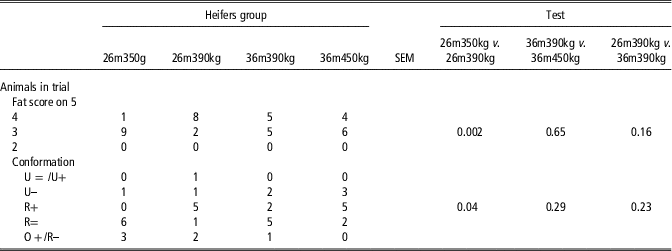
Heifers of 26m390kg and 36m390kg groups were slaughtered at an equivalent EUROP conformation score (P=0.23) and an equivalent fat development score (P=0.16): most carcasses were scored R for conformation (n=16/20) and 4 for fat development (n=13/20) (Table 2).
Number of heifers in the various age and weight categories×carcass conformation and fat score

The fat score of 3 was over-represented in the 26m350kg group, whereas most of 26m390kg heifers were mostly scored 4 (P=0.002). Moreover, 26m350kg heifers were predominantly classified R= and not R+, 26m390kg heifers were mostly classified R+ (P=0.04) (Table 2).
Increasing carcass weight of 36-month-old heifers has no impact either on EUROP conformation (P=0.29) or on fat score (P=0.65) (Table 2).
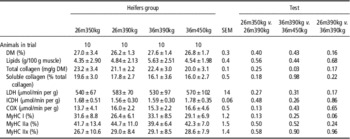
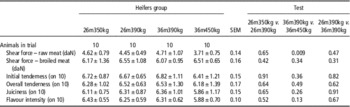
Meat quality traits of initial/overall tenderness, juiciness and flavour of samples from 26m390kg and 36m390kg heifers samples were evaluated in the same manner (0.62<P<0.91). This result might be related to the high variability of these sensory descriptor but also to the similar lipid content of muscle samples (P=0.68). Shear force on raw (P=0.47) and broiled meat (6.3±1.0 daN; P=0.31) but also connective tissue properties of total collagen content (P=0.17) and soluble collagen proportions (P=0.22) were not significantly different between 26m390kg and 36m390kg groups (Tables 3 and 4).
Rectus abdominis characteristics depending on age and carcass weight of heifers

DM=dry matter; LDH=lactate dehydrogenase; ICDH=isocitrate dehydrogenase; COX=cytochrome-c oxidase; MyHC=myosin heavy chain.
Average±SD.
M. rectus abdominis meat quality traits depending on age and carcass weight of heifers

Average±SD.
Quality traits of meat from 26m350kg heifers were found to be equivalent for all sensory descriptors to those of 26m390kg: initial and overall tenderness (P=0.91 and P=0.64), juiciness (P=0.65) and flavour intensity (P=0.52; Table 4). Moreover, no significant differences were observed in shear force on raw or broiled meat (P=0.65 and P=0.42) nor on connective tissue content and solubility (P=0.25 and P=0.18). The high variability in lipid content (39% to 69% of DM) led to no significant differences between slaughter weight groups (P=0.56; Table 3).
The raw samples from 36m390kg heifers were characterized by significantly higher shear forces than those of 36m450kg ones (P=0.009), coupled with a higher total collagen content (P=0.03; Table 3). These two conclusions point in the direction of a lower tenderness for 36m390kg samples. Nevertheless, meat quality traits (initial and overall tenderness, juiciness, flavour) were judged equivalent whatever the slaughter weight of 36-month-old females (0.13<P<0.49; Table 4). The high variability in lipid content (39% to 69%) led to no significant differences between slaughter weight groups (P=0.44).
Metabolic enzyme activities (ICDH, COX, LDH; 0.17<P<0.86) and MyHC distribution were also found equivalent in the 26m390kg and 36m390kg groups (0.06<P<0.96; Table 3).
Muscle oxidative (ICDH, COX) and glycolytic (LDH) metabolism did not appear to be affected by slaughter weight for 26-month-old heifers (0.13<P<0.48). MyHC distribution was not significantly different between 26 months heifers whatever their carcass weight, the m. rectus abdominis being characterized by an average of 29±8%, 43±12% and 28±9% of MyHC I, IIa and IIx (Table 4).
MyHC distribution and muscle metabolism appear also to be unaffected by slaughter weight in 36-month-old heifer muscles (0.25<P<0.90; Table 4).
Discussion
Age impact on muscle characteristics and meat quality traits was assessed at equivalent lipid contents even though older animals have slightly higher intramuscular fat content. This difference being rather tenuous, it is not astonishing that the positive correlation between intramuscular fat and meat quality traits (Park et al., Reference Park, Cho, Yoo, Kim, Lee, Joung and Kim2000; Kim and Lee, Reference Kim and Lee2003) was not found in the present study. Indeed, although increase in marbling is associated with increase in consumer preference due to increase in juiciness (Schönfeldt and Strydom, Reference Schönfeldt and Strydom2011a and Reference Schönfeldt and Strydom2011b; Ngapo et al., Reference Ngapo, Riendeau, Laberge and Fortin2013), consensus on the increase in tenderness is older animals due to marbling has not been reached (Hall et al., Reference Hall, Schönfeldt and Pretorius2016).
Likewise, no significant difference was found between groups on shear force values and collagen properties, as previously observed when evaluating the impact of increased age at slaughter on shear force of meat of heifer samples (see review of Oury et al., Reference Oury, Picard, Istasse, Micol and Dumont2007b). The higher growth rate of 26m390kg heifers than that of 36m390kg heifers could be in favour of a greater tenderness in 26-month-old heifer samples. Indeed, growth rate appears to be positively correlated with tenderness (Shorthose and Harris, Reference Shorthose and Harris1990; Renand et al., Reference Renand, Picard, Touraille, Berge and Lepetit2001 and Reference Renand, Larzul, Le Bihan-Duval and Le Roy2003; Oury et al., Reference Oury, Agabriel, Agabriel, Micol, Picard, Blanquet, Roux and Dumont2007a and Reference Oury, Picard, Briand, Dransfield, Blanquet and Dumont2009; Dufey, Reference Dufey2008) and explains a major part (21.5% out of 33.7%) of tenderness variability (Oury et al., Reference Oury, Picard, Briand, Dransfield, Blanquet and Dumont2009). Nevertheless, this impact appeared especially visible when comparing animals at extreme ages or with extreme daily gains. Indeed, although tenderness is negatively correlated to animal age when evaluated using a wide range of ages (Schönfeldt and Strydom, Reference Schönfeldt and Strydom2011a and Reference Schönfeldt and Strydom2011b), a less clear association is observed when comparing smaller ages ranges (Guerrero et al., Reference Guerrero, Velandia Valero, Campo and Sañudo2013; Lucero-Borja et al., Reference Lucero-Borja, Pouzo, de la Torre, Langman, Carduza, Corva, Santini and Pavan2014; Coleman et al., Reference Coleman, Hickson, Schreurs, Martin, Kenyon, Lopez-Villalobos and Morris2016).
Slaughter age had no significant impact on MyHC content, even if a trend appeared in MyHC I content, 36m390kg samples having a slight higher MyHC I proportion than 26m390kg ones (P=0.06). This results lead to the hypothesis that increasing age after 12 months leads to a replacement of glycolytic fibres into oxidative fibres, a result already indicated by Picard et al. (Reference Picard, Jurie, Duris and Renand2006). Thus, older animals often have higher proportions of MyHC I isoforms and slow oxidative fibres than younger ones, that have rather more MyHC IIx isoforms and fast glycolytic fibres (Cassar-Malek et al., Reference Cassar-Malek, Listrat and Picard1998). According to Brandstetter et al. (Reference Brandstetter, Picard and Geay1997), this switch towards oxidative metabolism could facilitate protein synthesis based on the use of increasingly abundant fatty acids. Oxidative muscles generally contain higher levels of lipids, which could favour better flavour (Picard et al., Reference Picard, Lefaucheur, Berri and Duclos2002). We can hypothesize that, in the present study, the lack of difference in lipid amounts among 390 kg carcass weight heifers is linked to a higher use of these lipids for protein synthesis in the m. rectus abdominis, because of its rather oxidative metabolism in comparison with other muscles. In some muscles such as the m. longissimus thoracis, oxidative metabolism appears to be negatively linked to meat tenderness (Renand et al., Reference Renand, Picard, Touraille, Berge and Lepetit2001), probably related to reduced availability of oxidative fibres for proteolysis (Ouali, Reference Ouali1990). The more glycolytic and less oxidative meat samples, such as those from younger animals could also be more tender that those from older animals. But in other muscles (m. rectus abdominis, m. triceps brachii) and other breeds (Angus, indigenous breeds, Friesian), broiled meat tenderness increases with oxidative metabolism (Ockerman et al., Reference Ockerman, Jaworek, Van Stavern, Parrett and Pierson1984; Strydom et al., Reference Strydom, Naude, Smith, Scholtz and Van Wyk2000; Therkildsen et al., Reference Therkildsen, Melchior Larsen, Bang and Vestergaard2002; Dransfield et al., Reference Dransfield, Martin, Bauchart, Abouelkaram, Lepetit and Culioli2003; Oury et al., Reference Oury, Picard, Briand, Dransfield, Blanquet and Dumont2009).
Slaughter weight have a significant effect on shear force of 36-month-old heifers but no significant impact on shear force of 26-month-old heifers. Thus, as previously indicated (Guerrero et al., Reference Guerrero, Velandia Valero, Campo and Sañudo2013; Lucero-Borja et al., Reference Lucero-Borja, Pouzo, de la Torre, Langman, Carduza, Corva, Santini and Pavan2014), increasing young heifer slaughter weight did not impact negatively on beef shear force on tenderness level. This limited effect of slaughter weight on raw/broiled shear force may be due to the fairly small weight difference between lighter and heavier animals (around 40 to 60 kg on average). Nevertheless, the difference in raw meat shear force observed in 36-month-old heifer samples confirms previous results. Indeed, Sanudo et al. (Reference Sanudo, Macie, Olleta, Villarroel, Panca and Alberti2004) established on young bulls that a greater live slaughter weight (550 v. 300 kg) is associated with a lower shear force value, implying more tender meat for consumers. According to these authors, the variation in shear force values in term of slaughter weight is more dependent of the myofibrillar content than the collagen content or solubility, especially when considering shear force on cooked meat. These conclusions confirm those of Chriki et al. (Reference Chriki, Gardner, Jurie, Picard, Micol, Brun, Journaux and Hocquette2012) that indicated, by using a large data set (n=765), that total and insoluble collagen content were negatively correlated with tenderness, but only with a small coefficient (r=−0.15 to −0.20). In the present case, the difference in shear force is associated with neither fibre distribution nor metabolic activity. In the same study, Sanudo et al. (Reference Sanudo, Macie, Olleta, Villarroel, Panca and Alberti2004) indicated that weight effect is not significant for total and insoluble collagen. Other authors have indicated that when slaughter weight differences are linked to genetics, the amount and the solubility of collagen are equivalently distributed among lighter and heavier animals, whatever the muscle (m. rectus abdominis or m. semitendinosus) and the animal type (bulls or steers) (Sudre et al., Reference Sudre, Cassar-Malek, Listrat, Ueada, Leroux, Jurie, Auffray, Renand, Martin and Hocquette2005; Bernard et al., Reference Bernard, Cassar-Malek, Renand and Hocquette2009; Ellies-Oury et al., Reference Ellies-Oury, Renand, Perrier, Krauss, Dozias, Jailler and Dumont2012). Thus, collagen solubility appears to be determined mainly by slaughter age and relatively little by slaughter weight. Whereas collagen content is mainly dependent on the animal itself. That is why, when considering shear force on raw meat, other results indicate that shear force in m. longissimus thoracis and m. rectus abdominis could also be positively correlated with total collagen content (Silva et al., Reference Silva, Patarata and Martins1999; Renand et al., Reference Renand, Picard, Touraille, Berge and Lepetit2001; Rhee et al., Reference Rhee, Wheeler, Shackelford and Koohmaraie2004; Oury et al., Reference Oury, Picard, Briand, Dransfield, Blanquet and Dumont2009). In the present case, shear force differences established in 36-month-old heifer samples concerned only raw meat and could be related to collagen content as 36m390kg samples were characterized by both lower shear forces and lower collagen content. Sanudo et al. (Reference Sanudo, Macie, Olleta, Villarroel, Panca and Alberti2004) have indicated that the differences in meat tenderness depending on weight could be related more to the connective tissue structure than collagen content, being the structure stronger in the heavier animals. Nevertheless, this conclusion was not confirmed in the present study, possibly because of the specificities of m. rectus abdominis previously reported by Oury et al. (Reference Oury, Dumont, Jurie, Hocquette and Picard2010).
Previous studies have indicated that genetic selection of young bulls in favour of muscle growth potential is associated with changes in gene expression profile, and especially with a regulation of many glycolytic genes (Bernard et al., Reference Bernard, Cassar-Malek, Renand and Hocquette2009) leading to a negative correlation between weight and LDH activity (Renand et al., Reference Renand, Picard, Touraille, Berge and Lepetit2001).
Conflicting results have been indicated concerning oxidative metabolism. Indeed, if high muscle growth potential might associated with a less oxidative metabolism (Arthur, Reference Arthur1995; Hocquette et al., Reference Hocquette, Ortigues-Marty, Pethick, Herpin and Fernandez1998; Sudre et al., Reference Sudre, Cassar-Malek, Listrat, Ueada, Leroux, Jurie, Auffray, Renand, Martin and Hocquette2005), no significant impact of increasing slaughter weight appeared on oxidative metabolism (ICDH and COX) (Renand et al., Reference Renand, Picard, Touraille, Berge and Lepetit2001; Bernard et al., Reference Bernard, Cassar-Malek, Renand and Hocquette2009; Ellies-Oury et al., Reference Ellies-Oury, Renand, Perrier, Krauss, Dozias, Jailler and Dumont2012). Thus, it could be hypothesized that slaughter weight impact on muscle metabolism is dependent on both animal age and sex. The impact of genetic selection for muscle growth capacity on meat quality traits warrants further investigation.
One of the expected effects of an increase in slaughter weight is an increase in fatness scores (Renand et al., Reference Renand, Picard, Touraille, Berge and Lepetit2001; Keane, Reference Keane2003). The high variability in lipid content, already indicated for the m. rectus abdominis of various Charolais animals (Micol et al., Reference Micol, Oury, Picard, Hocquette, Briand, Dumont, Egal, Jailler, Dubroeucq and Agabriel2008; Oury et al., Reference Oury, Picard, Briand, Dransfield, Blanquet and Dumont2009; Ellies-Oury et al., Reference Ellies-Oury, Renand, Perrier, Krauss, Dozias, Jailler and Dumont2012), led to a lack of positive connection between weight and m. rectus abdominis lipid content.
Indeed, weight was found to have no significant effect on m. rectus abdominis lipid content, as previously noted in the case of 31-month-old steers age selected by growth rate, with slaughter weight having no impact either on fatness score or on fat content (Ellies-Oury et al., Reference Ellies-Oury, Renand, Perrier, Krauss, Dozias, Jailler and Dumont2012). Tenderness has been identified as a characteristic closely related to overall acceptability, the lack of tenderness being often the cause of consumer disaffection with beef. Therefore, factors affecting meat tenderness warrant attention.
In the present work, slaughter weight had no significant impact either on tenderness scores or on other sensory descriptors (juiciness, flavour intensity), confirming previous observations regarding m. rectus abdominis (Oury et al., Reference Oury, Picard, Briand, Dransfield, Blanquet and Dumont2009) and m. longissimus thoracis (Cepin et al., Reference Cepin, Cepon and Skorjanc1992; Gregory et al., Reference Gregory, Cundiff and Koch1995; Chambaz et al., Reference Chambaz, Scheeder, Kreuzer and Dufey2003). Nevertheless, according to Hedrick et al. (Reference Hedrick, Paterson, Matches, Thomas, Morrow, Stringer and Lipsey1983), carcasses that weighed less and had less subcutaneous fat might be more subject to cold shortening, which is a phenomenon contributing to differences in tenderness especially in lean young bull meat. In the present case, the high content in lipids (17.9±8.6% DM) in DM reduces the risk for cold shortening apparition.
On the other hand, no significant differences were observed in the shear force of broiled meat when the carcass weight of 26-month-old heifers was increased, confirming that muscle shear force is not linked to carcass weight in young animals (Gregory et al., Reference Gregory, Cundiff and Koch1995; Renand et al., Reference Renand, Picard, Touraille, Berge and Lepetit2001; Oury et al., Reference Oury, Picard, Briand, Dransfield, Blanquet and Dumont2009).
Increasing carcass weight might be obtained either by differing slaughter age (from 26 to 36 months for heifers), or by speeding up growth rate (for a slaughter at a given age). This increase is not accompanied by a decrease in meat quality traits or associated muscle characteristics. Some parameters, such as shear force on raw meat and total collagen content, even show a tendency to be beneficial to heavier and older heifers. Moreover, lengthening the cycle of the high potential heifer by about 10 months does not automatically lead to an increase in lipid content, which is always a risk for females because of their precociousness. In this context, suckling heifers appears to be able to offer a large panel of slaughter age and carcass weight, which allow an adaptation to numerous marketing circuits without variation of meat quality traits. Results indicate that within the range of weight and age under study, these factors have no negative consequences on heifer’s meat quality. Thus, even if heifer’s performances at slaughter are various, the supply chain operators can insure the consumer a constant quality of meat samples.
Acknowledgements
The work was carried out with the financial support of AgroSupDijon. The authors wish to thank F. Delamarche, M. Jouanno, J. Lambert for muscular property analyses and muscle sampling and the Venarey-Les-Laumes slaughterhouse for animals sampling.