Introduction
Milk fat plays a central role in dairy products and farm efficiency. Fat is a major contributor to the energy density of whole milk and is essential to many of the physical properties, manufacturing qualities and organoleptic characteristics of dairy products. Traditionally, saturated fatty acids (FA) in milk fat have caused concern among human health experts, although more recently milk fat has garnered appreciation as a functional food due to the health-promoting potential of some FA found specifically in ruminant-derived products (Bauman et al., Reference Bauman, Lock, Corl, Ip, Salter and Parodi2006).
From the producers’ perspective, milk fat represents a major component of the value of milk, but it is also a significant portion of the energy cost of lactation. Fat is the most variable component of milk and is affected by many factors including genetics, physiological state and environment. However, milk fat is especially responsive to nutrition, providing a practical tool to alter its yield and composition. First described over 150 years ago, diet-induced milk fat depression (MFD), or low-fat milk syndrome, is characterized by a decrease in milk fat yield of up to 50%, with no change in milk yield or in the yield of other milk components (Bauman and Griinari, Reference Bauman and Griinari2001). MFD is classically observed in ruminants fed highly fermentable diets or in diets that contain plant or fish oil supplements. MFD is also observed in pasture feeding and, although not well studied, appears to be related to increased fermentability and passage rates that occur at some stages of plant growth and possibly slug feeding of grain under some management schemes. Varying levels of MFD are commonly experienced today in both intensively and extensively managed dairy herds, and this represents a level of milk fat production below the genetic potential of the cow. MFD is also a useful variable for evaluating herd management; in many cases onset of diet-induced MFD is an indication of modified ruminal fermentation and in more pronounced cases this can be associated with ruminal acidosis and reduced ruminal efficiency.
Diet-induced MFD involves an inter-relationship between ruminal fermentation and mammary tissue metabolism. This phenomenon has been of research interest over the past century, and has been extensively investigated over the last quarter of the century. The discovery that changes in milk fat yield were negatively correlated with milk fat concentration of trans FA provided key insight in understanding MFD (Davis and Brown, Reference Davis and Brown1970). Based on this, Bauman and Griinari (Reference Bauman and Griinari2001) proposed the ‘biohydrogenation theory’, which states that diet-induced MFD relates to an inhibition of mammary lipid synthesis by specific FA that are intermediates in the biohydrogenation of dietary polyunsaturated fatty acid (PUFA), and these are only produced under certain conditions of altered ruminal fermentation. Recent investigations have verified this theory, and over the last decade, research has focused on (1) identifying the causative biohydrogenation intermediates, (2) describing the metabolic phenotype of MFD, (3) delineating dietary risk factors to aid in troubleshooting and mitigating MFD on farms and (4) defining the mechanism(s) by which these bioactive FA isomers are able to regulate mammary synthesis of fat. Broad aspects of the relationship between nutrition and milk fat have been extensively reviewed elsewhere (Chilliard et al., Reference Chilliard, Ferlay, Mansbridge and Doreau2000; Bauman and Griinari, Reference Bauman and Griinari2001 and Reference Bauman and Griinari2003; Lock and Shingfield, Reference Lock and Shingfield2004; Shingfield and Griinari, Reference Shingfield and Griinari2007). In the following sections, we will provide background and discuss recent advances and the current understanding of MFD based on investigations of diet-induced and conjugated linoleic acid (CLA)-induced MFD, including recent insight provided by molecular approaches.
Background
Ruminant milk fat is estimated to include over 400 individual FA that differ primarily in chain length and number and orientation of unsaturated bonds (Jensen, Reference Jensen2002). Over 95% by mass of the FA are esterified in triglycerides while the remaining are found in phospholipid, cholesterol ester, diglyceride, monoglyceride and free FA fractions. Short- and medium-chain FA (4 to 14 carbons) and a portion of the 16-carbon FA are derived from de novo synthesis from acetate and to a lesser extent β-hydroxybutyrate. On a molar basis, about one-half of milk FA are synthesized de novo (see review by Bauman and Davis, Reference Bauman and Davis1974). Preformed FA account for the remaining 16-carbon and all of the longer-chain FA (>16 carbons), and are taken up from the circulating plasma pool. These FA originate from absorption from the digestive tract or mobilization from body reserves. Adipose tissue mobilization accounts for less than 10% of preformed FA in milk fat, except during periods of negative energy balance when their proportion increases substantially (Bauman and Griinari, Reference Bauman and Griinari2001). Lastly, due to the hydrophobic nature of esterified FA, milk fat is secreted from the mammary epithelial cell as a lipid droplet surrounded by a protein-rich polar lipid coat called the milk fat globule membrane (MFGM; see reviews by Mather and Keenan (Reference Mather and Keenan1998), Keenan (Reference Keenan2001) and Olivier-Bousquet (Reference Olivier-Bousquet2002)). The origin of the MFGM and the mechanism of cellular milk fat secretion continue to be areas of intense investigation. Proteomic approaches have identified many of the associated proteins (Reinhardt and Lippolis, Reference Reinhardt and Lippolis2006; Cavaletto et al., Reference Cavaletto, Giuffrida and Conti2008), and knock-out mouse models have demonstrated the essential role for some of these proteins in milk fat secretion including butyrophilin (Ogg et al., Reference Ogg, Weldon, Dobbie, Smith and Mather2004) and xanthine oxidoreductase (McManaman et al., Reference McManaman, Palmer, Wright and Neville2002).
Historically, nutrition researchers identified an association between diet and milk fat yield, and reports over the last century provide evidence of the interaction between ruminal fermentation and milk fat synthesis (see reviews by Davis and Brown, Reference Davis and Brown1970; Doreau et al., Reference Doreau, Chilliard, Rulquin and Demeyer1999; Bauman and Griinari, Reference Bauman and Griinari2001). Davis and Brown (Reference Davis and Brown1970) categorized two types of diets that induce MFD: (1) those that contained high levels of fermentable carbohydrate and low levels of fiber and (2) those that contained high concentrations of unsaturated oils. The extent of MFD with such diets is modified by many factors including associative dietary effects, feed management practices and animal physiological state (see reviews by Sutton, Reference Sutton1989; Grummer, Reference Grummer1991; Palmquist et al., Reference Palmquist, Beaulieu and Barbano1993; Chilliard et al., Reference Chilliard, Ferlay, Mansbridge and Doreau2000; Lock et al., 2006a). Researchers quickly realized that many diets that caused MFD also resulted in alterations in ruminal environment and fermentation, most notably a decrease in pH and a decrease in the acetate to propionate molar ratio (Bauman and Griinari, Reference Bauman and Griinari2001).
Biohydrogenation intermediates
Ruminant diets contain a low percentage of fat, although a significant intake of PUFA is generated from forages and oilseeds and in some cases from fat supplements. Dietary FA are metabolized by ruminal microbes resulting in a large difference between the dietary profile and the profile of FA absorbed from the small intestine (Doreau and Chilliard, Reference Doreau and Chilliard1997; Chilliard et al., Reference Chilliard, Ferlay, Mansbridge and Doreau2000). Ruminal FA metabolism was summarized in the classic review by Harfoot and Hazlewood (Reference Harfoot and Hazlewood1988) and more recently by others (Palmquist et al., Reference Palmquist, Lock, Shingfield and Bauman2005; Jenkins et al., Reference Jenkins, Wallace, Moate and Mosley2008). Most dietary FA are esterified, and they are almost completely hydrolyzed to free FA in the rumen. Unsaturated free FA are then isomerized (double-bond position or orientation changed) and reduced (saturation of double bond), although the exact mechanisms are not well established (Wallace et al., Reference Wallace, McKain, Shingfield and Devillard2007). The resulting saturated FA and some of the biohydrogenation intermediates escape the rumen and are subsequently absorbed.
Davis and Brown (Reference Davis and Brown1970) recognized that trans-C18:1 FA were increased in milk fat of cows with low-fat milk syndrome. They suggested that these trans FA originated from incomplete ruminal biohydrogenation of unsaturated FA and might contribute to the development of MFD. Subsequent studies have demonstrated a clear relationship between trans FA and MFD (see reviews by Bauman and Griinari, Reference Bauman and Griinari2001 and Reference Bauman and Griinari2003; Shingfield and Griinari, Reference Shingfield and Griinari2007). Briefly, although feeding unsaturated oils induced MFD, feeding completely hydrogenated (saturated FA) oils had minimal effects on milk fat yield. Moreover, abomasal infusion of unsaturated FA did not reduce milk fat yield, but abomasal infusion of partially hydrogenated FA (high trans FA) did reduce milk fat yield.
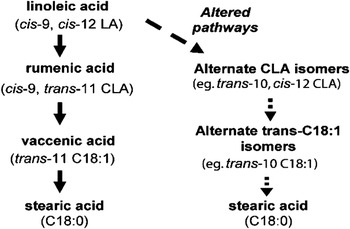
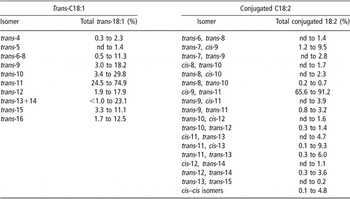
Trans-11 C18:1 and cis-9, trans-11 CLA are the predominant trans FA intermediates produced from the ruminal metabolism of linoleic acid (Figure 1; Harfoot and Hazlewood, Reference Harfoot and Hazlewood1988); however, ruminal biohydrogenation pathways are dynamic, allowing the production of a wide range of positional and geometric isomers as well as modified FA such as hydroxy and keto derivatives (Palmquist et al., Reference Palmquist, Lock, Shingfield and Bauman2005; Jenkins et al., Reference Jenkins, Wallace, Moate and Mosley2008). These isomers are absorbed and incorporated into milk fat, thereby allowing the milk FA profile to be used as a proxy of changes occurring in the rumen. The concentration of trans-18:1 and CLA isomers in milk fat is very dynamic as summarized in Table 1; however, the high values for many of these FA isomers represent experimental conditions involving less-typical diets (Lock and Bauman, Reference Lock and Bauman2004; Shingfield and Griinari, Reference Shingfield and Griinari2007). The predominant metabolic pathways and the microbial capacity for isomerization and biohydrogenation depend on the microbial population and the ruminal environment (Allen, Reference Allen2000; Palmquist et al., Reference Palmquist, Lock, Shingfield and Bauman2005; Jenkins et al., Reference Jenkins, Wallace, Moate and Mosley2008). Dietary factors that affect ruminal fermentation (e.g. high carbohydrate fermentability, high oil, rumensin) modify ruminal FA metabolism through complex associative effects that result in altered ruminal microbial populations, altered pathways of PUFA biohydrogenation (Figure 1), and ruminal outflow of a wide range of biohydrogenation intermediates, and this is reflected in the milk FA composition (Table 1). Although we have focused our discussion on the products of linoleic acid, other PUFA including the long-chain n-3 FA are also biohydrogenated and likely produce unique FA intermediates.
Pathways of ruminal biohydrogenation of linoleic acid (LA) and conjugated linoleic acid (CLA) under normal and altered ruminal fermentation. Adapted from Griinari and Bauman (Reference Griinari and Bauman1999).

Range of trans-C18:1 and conjugated C18:2 concentrations reported for milk fatFootnote 1

Values less than 0.1% are shown as not detected (nd).
1 Adapted from summary by Lock and Bauman (Reference Lock and Bauman2004) and Shingfield et al. (Reference Shingfield, Chilliard, Toivonen, Kairenius and Givens2008a).
Advances in lipid analysis and renewed interest in trans FA identified a correlation between MFD and an increase in trans-10 C18:1, rather than trans-C18:1 FA in general (Griinari et al., Reference Griinari, Dwyer, McGuire, Bauman, Palmquist and Nurmela1998). Based on this evidence, Bauman and Griinari (Reference Bauman and Griinari2001) postulated that altered ruminal fermentation experienced in some diets resulted in a shift in biohydrogenation pathways and that either trans-10 C18:1 or related metabolites could be the cause of MFD (Bauman and Griinari, Reference Bauman and Griinari2001). Based on biochemical evidence and a strong relationship between milk trans-10 C18:1 and trans-10, cis-12 CLA, a putative altered biohydrogenation pathway was proposed where linoleic acid was isomerized to trans-10, cis-12 CLA followed by reduction to trans-10 C18:1 and finally a second reduction to C18:0 (Figure 1; Bauman and Griinari, Reference Bauman and Griinari2001). Increased trans-10 C18:1 and trans-10, cis-12 CLA in duodenal flow and milk demonstrates altered ruminal FA metabolism and are hallmarks of diet-induced MFD. These isomers are normally formed at low rates but ruminal outflows of trans-10 C18:1 and to a lesser extent trans-10, cis-12 CLA are substantially increased during diet-induced MFD (Bauman and Griinari, Reference Bauman and Griinari2003). Increased ruminal outflow could result from the increased formation or less-complete biohydrogenation of these isomers.
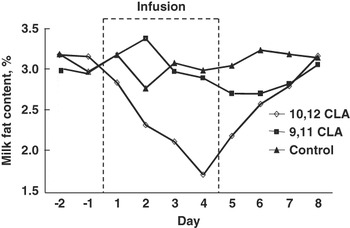
The relationship between specific ruminal FA isomers and milk fat yield is strong and highly repeatable, but it is simply correlative evidence, indicating a possible direct role in MFD. For example, Kadegowda et al. (Reference Kadegowda, Piperova and Erdman2008) recently suggested MFD was caused by trans-7 C18:1 or trans-7, cis-9 CLA based on correlations with milk fat percent. Because diet-induced MFD is associated with altered rumen fermentation and biohydrogenation pathways, the rumen outflow and milk fat content of many trans-C18:1 and CLA isomers are correlated with MFD (e.g. Loor et al., Reference Loor, Ferlay, Ollier, Doreau and Chilliard2005; Kadegowda et al., Reference Kadegowda, Piperova and Erdman2008). To demonstrate causative relationships, specific isomers must be tested and since few are commercially available this has often required that they be chemically synthesized and purified by investigators. This approach has been extensively used for CLA isomers and evaluations of bioactivity have included biomedical models. Early experiments with animal models have demonstrated a range of positive biological responses including anti-carcinogenic effects (reviewed by Ip et al., Reference Ip, Dong, Ip, Banni, Carta, Angioni, Murru, Spada, Melis and Saebo2002; Kelley et al., Reference Kelley, Hubbard and Erickson2007) and reduced adiposity (reviewed by Pariza, Reference Pariza2004), although only a mixed preparation including both cis-9, trans-11 and trans-10, cis 12 CLA was available in the original experiments. Similarly, this mixed CLA preparation also reduced milk fat yield in dairy cows (Loor and Herbein, Reference Loor and Herbein1998; Chouinard et al., Reference Chouinard, Corneau, Saebo and Bauman1999a and Reference Chouinard, Corneau, Barbano, Metzger and Bauman1999b). Subsequently, the ability to prepare relatively pure CLA isomers allowed the seminal demonstration by Baumgard et al. (Reference Baumgard, Corl, Dwyer, Saebo and Bauman2000) that trans-10, cis-12 CLA markedly reduced milk fat synthesis, whereas cis-9, trans-11 CLA had no effect (Figure 2). Multiple experiments including dose titrations have shown a clear curvilinear relationship between abomasal infusion of trans-10, cis-12 CLA and the reduction in milk fat yield. de Veth et al. (Reference de Veth, Griinari, Pfeiffer and Bauman2004) summarized data from abomasal infusion experiments and showed that milk fat response to trans-10, cis-12 CLA best fit an exponential decay curve with maximal response of ~50% reduction in milk fat at ~7.5 g/day and a one-half maximum response at ~3.5 g/day (de Veth et al., Reference de Veth, Griinari, Pfeiffer and Bauman2004); a recent updated analysis by Shingfield and Griinari (Reference Shingfield and Griinari2007) found the same relationship.
Temporal pattern of milk fat content during abomasal infusion of conjugated linoleic acid (CLA) supplements. Infusions were for 4 days and treatments were control, cis-9, trans-11 CLA (10 g/day), and trans-10, cis-12 CLA (10 g/day). Used with permission from Baumgard et al. (Reference Baumgard, Corl, Dwyer, Saebo and Bauman2000).

Diet-induced MFD results in ruminal outflow of a large number of FA isomers, not just trans-10, cis-12 CLA. The milk fat concentration of trans-10, cis-12 CLA is linearly related to the abomasally administered dose, and milk fat trans-10, cis-12 CLA concentration is curvilinearly related to the decrease in milk fat yield during abomasal infusion (de Veth et al., Reference de Veth, Griinari, Pfeiffer and Bauman2004). Therefore, milk fat trans-10, cis-12 CLA concentration can be used to predict the expected extent of MFD contributable to the trans-10, cis-12 CLA isomer during diet-induced MFD (Peterson et al., Reference Peterson, Matitashvili and Bauman2003). Although there is a relationship between milk fat concentration of trans-10, cis-12 CLA and milk fat yield during diet-induced MFD, it is clear this CLA isomer only accounts for a modest portion of the MFD observed during most diet-induced MFD conditions (Peterson et al., Reference Peterson, Matitashvili and Bauman2003; Griinari and Bauman, Reference Griinari and Bauman2006; Shingfield et al., Reference Shingfield, Chilliard, Toivonen, Kairenius and Givens2008a). Furthermore, there is often little or no change in trans-10, cis-12 CLA in the milk fat when MFD is induced by feeding fish oils (reviewed by Shingfield and Griinari, Reference Shingfield and Griinari2007). These observations have provided the impetus to identify additional bioactive FA isomers.
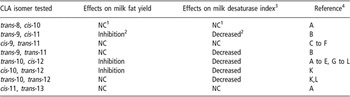
Purified or highly enriched preparations of other CLA isomers have been tested in the dairy cow and results are summarized in Table 2. Thus far, three CLA isomers have been identified as inhibitors of milk fat synthesis, although the examination of two of these has involved only a single study conducted at a single dose. Nevertheless, it is clear that small differences in FA structure can result in striking differences in FA action and potency. For example, trans-10, trans-12 CLA and trans-9, trans-11 CLA do not reduce milk fat synthesis, but both are potent inhibitors of stearoyl-CoA desaturase (SCD; Δ9-desaturase) as indicated by changes in the desaturase index; the desaturase index represents the relationship between product and precursor for SCD and is commonly used as a proxy for SCD activity. Likewise, trans-9, cis-11 CLA and cis-10, trans-12 CLA reduce milk fat yield, but the former appears less effective and the latter appears more effective than trans-10, cis-12 CLA (Table 2; Saebo et al., Reference Saebo, Saebo, Griinari and Shingfield2005a; Perfield et al., Reference Perfield, Delmonte, Lock, Yurawecz and Bauman2006 and Reference Perfield, Lock, Griinari, Saebo, Delmonte, Dwyer and Bauman2007). The biologically active isomers identified to date elicit distinct responses (e.g. 50% decrease in milk fat) with doses less than 10 g/day in the dairy cow. Given the potency of these FA, it is clear that low concentrations of additional unidentified biohydrogenation intermediates could be responsible for a portion of the response observed during diet-induced MFD.
Conjugated linoleic acid (CLA) isomers tested for their effect on milk fat yield and milk desaturase index in dairy cows

1NC = no change when abomasally infused at a dose comparable to trans-10, cis-12 CLA.
2Inhibited milk fat yield or decreased desaturase index when abomasally infused at a dose comparable to trans-10, cis-12 CLA.
3Desaturase index is the ratio of product/(substrate + product) for Δ9-desaturase.
4Reference citations are as follows: A = Perfield et al. (Reference Perfield, Saebo and Bauman2004); B = Perfield et al. (Reference Perfield, Lock, Griinari, Saebo, Delmonte, Dwyer and Bauman2007); C = Baumgard et al. (Reference Baumgard, Corl, Dwyer, Saebo and Bauman2000); D = Baumgard et al. (Reference Baumgard, Corl, Dwyer and Bauman2002a); E = Loor and Herbein (Reference Loor and Herbein2003); F = Shingfield et al. (Reference Shingfield, Ahvenjarvi, Toivonen, Vanhatalo and Huhtanen2007); G = de Veth et al. (Reference de Veth, Griinari, Pfeiffer and Bauman2004); H = Baumgard et al. (Reference Baumgard, Sangster and Bauman2001); I = Peterson et al. (Reference Peterson, Baumgard and Bauman2002); J = Harvatine et al. (Reference Harvatine, Dwyer and Bauman2006); K = Saebo et al. (Reference Saebo, Saebo, Griinari and Shingfield2005a); L = Perfield et al. (Reference Perfield, Delmonte, Lock, Yurawecz and Bauman2006).
Trans-C18:1 FA have received much less attention due to the technical challenges of making purified preparations. Traditionally, partially hydrogenated vegetable oils (PHVO) have been used to represent an enriched preparation of a range of trans-C18:1 FA, and abomasal infusion of 300 to 750 g/day of PHVO caused a reduction in milk fat (Astrup et al., Reference Astrup, Vik-Mo, Ekern and Bakke1976; Selner and Schultz, Reference Selner and Schultz1980; Gaynor et al., Reference Gaynor, Erdman, Teter, Sampugna, Capuco, Waldo and Hamosh1994; Romo et al., Reference Romo, Casper, Erdman and Teter1996). Calcium salts of PHVO (100 to 400 g/day) have also been fed and milk fat yield was modestly reduced (5% to 15%) in one study (Piperova et al., Reference Piperova, Moallem, Teter, Sampugna, Yurawecz, Morehouse, Luchini and Erdman2004) and unaffected in another (Selberg et al., Reference Selberg, Lowe, Staples, Luchini and Badinga2004). The observed milk fat decrease from PHVO has routinely been attributed to trans-18:1 FA; however, trans-C18:1 represent only about 40% to 60% of the total FA in PHVO, and many other unusual FA isomers, including CLAs, are formed in the production of PHVO (Banni et al., Reference Banni, Day, Evans, Corongiu and Lombardi1994; Jung and Ha, Reference Jung and Ha1999). Thus, when one considers the potency of trans-10, cis-12 CLA, it is clearly possible that the PHVO-induced reduction in milk fat could be due to small amounts of unique FA other than the trans-C18:1 isomers.
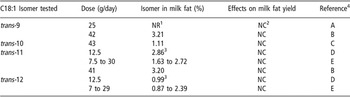
To establish causative roles for trans-C18:1 isomers on milk fat synthesis, purified preparations of the isomers must be tested and studies that have directly examined the effects of trans-C18:1 isomers are summarized in Table 3. In investigating the bioactivity of trans-C18:1 FA, the effects of trans-10 C18:1 were of special interest because the reduction in milk fat is highly correlated both with rumen outflow and with the milk fat content of trans-10 C18:1 (Loor et al., Reference Loor, Ferlay, Ollier, Doreau and Chilliard2005; Hinrichsen et al., 2006; Kadegowda et al., Reference Kadegowda, Piperova and Erdman2008). Duodenal flow of trans-10 C18:1 is very dynamic and the maximal reduction in milk fat appears to correspond to a rumen outflow of ~20 to 40 g/day, although much higher outflows can occur, especially in experimental diets that are high in fish oil (Lock et al., Reference Lock, Tyburczy, Dwyer, Harvatine, Destaillats, Mouloungui, Candy and Bauman2007; Shingfield and Griinari, Reference Shingfield and Griinari2007). Likewise, a near-maximal reduction in milk fat yield is observed at a milk fat concentration of ~1.5% to 2.5% trans-10 18:1, although much higher concentrations do occur with certain experimental diets (Loor et al., Reference Loor, Ferlay, Ollier, Doreau and Chilliard2005; Hinrichsen et al., 2006; Shingfield and Griinari, Reference Shingfield and Griinari2007; Kadegowda et al., Reference Kadegowda, Piperova and Erdman2008). Of specific importance is a recent study that abomasally infused 43 g/day of trans-10 C18:1 (Lock et al., Reference Lock, Tyburczy, Dwyer, Harvatine, Destaillats, Mouloungui, Candy and Bauman2007). Although trans-10 C18:1 was incorporated into milk fat at a concentration predicted to decrease milk fat concentration by 0.4 to 0.5 percentage units (Kadegowda et al., Reference Kadegowda, Piperova and Erdman2008), well within the power of the controlled abomasal infusion experiment, there was no effect on milk fat yield, and milk fat concentration was numerically increased by 0.07 percentage units (Lock et al., Reference Lock, Tyburczy, Dwyer, Harvatine, Destaillats, Mouloungui, Candy and Bauman2007). Likewise, no MFD was observed when the milk fat concentration of trans-10 C18:1 was increased by feeding high-oleic sunflower oil (Hinrichsen et al., 2006). Abomasal infusions of other trans-C18:1 isomers have also reported no effect on milk fat synthesis.
Trans-C18:1 fatty acids tested for their effect on milk fat yield in dairy cowsFootnote 1

1 NR = not reported.
2 NC = no change in milk fat yield when abomasally infused.
3 Estimated from graphical presentation.
4 Reference citations are as follows: A = Rindsig and Schultz (Reference Rindsig and Schultz1974); B = Tyburczy et al. (2008); C = Lock et al. (Reference Lock, Tyburczy, Dwyer, Harvatine, Destaillats, Mouloungui, Candy and Bauman2007); D = Griinari et al. (Reference Griinari, Corl, Lacy, Chouinard, Nurmela and Bauman2000); E = Shingfield et al. (Reference Shingfield, Ahvenjarvi, Toivonen, Vanhatalo and Huhtanen2007).
Phenotype of milk fat depression
The characteristics of MFD provide insights into the mechanism(s) by which biohydrogenation intermediates are able to regulate milk fat synthesis. First, MFD is a specific reduction in milk fat yield with no change in the yields of milk or milk protein; this phenotype is sustainable for long periods as shown by studies involving CLA-induced MFD (Perfield et al., Reference Perfield, Bernal-Santos, Overton and Bauman2002; Bernal-Santos et al., Reference Bernal-Santos, Perfield, Barbano, Bauman and Overton2003; Castañeda-Gutiérrez et al., Reference Castañeda-Gutiérrez, Benefield, de Veth, Santos, Gilbert, Butler and Bauman2007). In addition, milk fat synthesis is rescued after termination of CLA treatment, with the time course for recovery being similar to the progressive pattern of decline (Baumgard et al., Reference Baumgard, Corl, Dwyer, Saebo and Bauman2000). Likewise, dietary modifications allow for a return to normal milk fat production following diet-induced MFD. These results demonstrate that the mechanisms of MFD are specific for cellular processes related to lipid synthesis and do not include broader effects such as a generalized impairment of cellular function or induction of apoptosis. Second, the mammary reduction in milk fat synthesis during MFD is rapid. This has been most clearly demonstrated with abomasal infusion of trans-10, cis-12 CLA in dairy cows where milk fat percent progressively decreased with a significant reduction by 10 h (Harvatine and Bauman, 2007b) and a nadir was achieved by 3 to 4 days (Baumgard et al., Reference Baumgard, Corl, Dwyer, Saebo and Bauman2000). Diet-induced MFD develops over a longer interval (~7 to 18 days) consistent with the adaptations in ruminal fermentation that are required to produce altered biohydrogenation products (Shingfield et al., Reference Shingfield, Reynolds, Hervas, Griinari, Grandison and Beever2006b); however, MFD was induced more rapidly when cows switched to a low-forage diet and also had ruminal contents exchanged with a cow already adapted to the diet (Satter and Bringe, Reference Satter and Bringe1969). Third, the maximal reduction in milk fat yield observed with trans-10, cis-12 CLA and diet-induced MFD is ~50% (Bauman and Griinari, Reference Bauman and Griinari2003). It appears that either CLA can only down-regulate its target-signaling molecule(s) by 50% or the target-signaling pathway is only responsible for the regulation of about one-half of milk fat yield. Redundant regulation of biological processes is a characteristic of mammalian biology and such redundancy would be logical for milk fat synthesis because of the importance of milk fat as an energy source for the nursing young. Finally, yields of FA of all chain lengths are decreased during MFD. However, de novo-synthesized FA are decreased to a greater extent, especially in conditions of more pronounced MFD, and this results in a shift in milk FA profile such that the proportion of short- and medium-chain FA are decreased and longer-chain and unsaturated FA increased (Bauman and Griinari, Reference Bauman and Griinari2001).
Mechanism of milk fat depression
Whole animal metabolism
Investigations with trans-10, cis-12 CLA infusions offer the opportunity to evaluate the whole animal metabolic phenotype during MFD without the confounding effects associated with diet. CLA-induced MFD had no effects on the plasma concentration of metabolites including glucose, nonesterified fatty acids (NEFA) and β-hydroxy butyrate, or metabolic hormones including insulin, IGF-I and leptin during short- (<1 week) and longer-term (up to 20 weeks) treatment (Baumgard et al., Reference Baumgard, Corl, Dwyer, Saebo and Bauman2000 and Reference Baumgard, Corl, Dwyer and Bauman2002a; Perfield et al., Reference Perfield, Bernal-Santos, Overton and Bauman2002; Castañeda-Gutiérrez et al., Reference Castañeda-Gutiérrez, Overton, Butler and Bauman2005; de Veth et al., Reference de Veth, Castañeda-Gutiérrez, Dwyer, Pfeiffer, Putnam and Bauman2006). In addition, CLA-induced MFD did not alter plasma NEFA response to an epinephrine challenge or plasma glucose response to an insulin challenge; thus, homeostatic responses associated with the regulation of lipolysis and glucose uptake were unaltered (Baumgard et al., Reference Baumgard, Corl, Dwyer and Bauman2002a; de Veth et al., Reference de Veth, Castañeda-Gutiérrez, Dwyer, Pfeiffer, Putnam and Bauman2006). Hepatic triglyceride concentration was also unaffected during CLA-induced MFD (Bernal-Santos et al., Reference Bernal-Santos, Perfield, Barbano, Bauman and Overton2003; Castañeda-Gutiérrez et al., Reference Castañeda-Gutiérrez, Overton, Butler and Bauman2005). The mechanism of CLA is also independent of the stage of lactation as trans-10, cis-12 CLA reduces milk fat yield during all phases of the lactation cycle (Perfield et al., Reference Perfield, Bernal-Santos, Overton and Bauman2002; Bernal-Santos et al., Reference Bernal-Santos, Perfield, Barbano, Bauman and Overton2003; Castañeda-Gutiérrez et al., Reference Castañeda-Gutiérrez, Overton, Butler and Bauman2005), although a larger dose is required in early lactation (Moore et al., Reference Moore, Hafliger, Mendivil, Sanders, Bauman and Baumgard2004; Odens et al., Reference Odens, Burgos, Innocenti, VanBaale and Baumgard2007).
Mammary metabolism
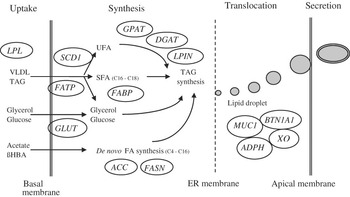
Synthesis of milk fat requires the coordination of multiple biochemical processes and cellular events in the mammary epithelial cell (Figure 3). Piperova et al. (Reference Piperova, Teter, Bruckental, Sampugna, Mills, Yurawecz, Fritsche, Ku and Erdman2000) reported decreased mammary enzyme activity of acetyl-CoA carboxylase (ACC) and fatty acid synthase (FASN) during diet-induced MFD and Baumgard et al. (Reference Baumgard, Matitashvili, Corl, Dwyer and Bauman2002b) observed decreased mammary lipogenic capacity during CLA-induced MFD based on 14C acetate incorporation into FA by mammary tissue explants. This demonstrates an inhibition of milk fat synthesis in the mammary gland and is in agreement with the decrease in de novo-synthesized FA previously discussed. Mammary lipogenic capacity may be regulated at multiple levels including transcription, translation, protein turnover and enzyme activity. Decreased mammary expression of genes for key enzymes and proteins involved in FA uptake, synthesis, transport and esterification occurred during both diet- and CLA-induced MFD (Piperova et al., Reference Piperova, Teter, Bruckental, Sampugna, Mills, Yurawecz, Fritsche, Ku and Erdman2000; Ahnadi et al., Reference Ahnadi, Beswick, Delbecchi, Kennelly and Lacasse2002; Baumgard et al., Reference Baumgard, Matitashvili, Corl, Dwyer and Bauman2002b; Peterson et al., Reference Peterson, Matitashvili and Bauman2003; Harvatine and Bauman, Reference Harvatine and Bauman2006). Combined, these observations define MFD as a decreased mammary capacity for lipid synthesis due to a coordinated transcriptional down-regulation of enzymes and proteins involved in milk fat synthesis.
Diagram representing activities and pathways coordinated during the synthesis and secretion of milk fat. Key proteins are shown in ovals: lipoprotein lipase (LPL); stearoyl-CoA desaturase (SCD); fatty acid transport proteins (FATP); glucose transporters (GLUT); glycerol phosphate acyltransferase (GPAT); diacylglycerol acyltransferase (DGAT); lipin (LPIN); fatty acid binding proteins (FABP); acetyl-CoA carboxylase (ACC); fatty acid synthase (FASN); mucin 1 (MUC1); butyrophilin (BTN1A1); xanthine oxidoreductase (XO) and adipophilin (ADPH). FA = fatty acid; UFA = unsaturated fatty acid; SFA = saturated fatty acid; VLDL = very low-density lipoprotein; TAG = triacylglycerol and βHBA = β-hydroxybutyrate. Adapted from McGuire and Bauman (Reference McGuire and Bauman2002).

Sterol response element-binding protein-1
The regulation of lipid synthesis and the role of long-chain PUFA in this regulation have been extensively studied in rodent models and cell culture systems, especially hepatocyte-based systems (see reviews by Duplus and Forest, Reference Duplus and Forest2002; Jump et al., Reference Jump, Botolin, Wang, Xu, Christian and Demeure2005; Sampath and Ntambi, Reference Sampath and Ntambi2005). These investigations have provided insight that may be applicable to the mechanism by which biohydrogenation intermediates regulate milk fat synthesis. Although many factors interact to determine tissue rates of lipid synthesis, expression of the genes for key enzymes and proteins in the process is highly regulated by a few well-characterized transcription factors known as ‘master regulators’ (Duplus and Forest, Reference Duplus and Forest2002; Salter and Tarling, Reference Salter and Tarling2007). A role for sterol response element-binding protein 1 (SREBP1) in MFD was proposed by Baumgard et al. (Reference Baumgard, Matitashvili, Corl, Dwyer and Bauman2002b) based on the function of this transcription factor family as global regulators of lipid metabolism (reviewed by Eberle et al., Reference Eberle, Hegarty, Bossard, Ferre and Foufelle2004). SREBP1 is expressed as two isoforms with SREBP1a predominantly involved in the regulation of cholesterol metabolism while SREBP1c predominantly regulates FA synthesis. SREBP1c signaling is inhibited by PUFA in cell culture and rodent models, and this reduction mediates a major portion of the anti-lipogenic response to PUFA (Hannah et al., Reference Hannah, Ou, Luong, Goldstein and Brown2001; Moon et al., Reference Moon, Latasa, Griffin and Sul2002). SREBP1 is highly expressed in the mammary gland where it is highly correlated with the expression of FASN and lipoprotein lipase (Harvatine and Bauman, Reference Harvatine and Bauman2006).
The molecular activation of SREBP1 is well described (see reviews by Horton et al., Reference Horton, Goldstein and Brown2002; Eberle et al., Reference Eberle, Hegarty, Bossard, Ferre and Foufelle2004; Goldstein et al., Reference Goldstein, DeBose-Boyd and Brown2006). Briefly, the full-length inactive SREBP1c protein is complexed with the SREBP chaperone protein (SCAP) and anchored in the endoplasmic reticulum through association with a third protein, either insulin-induced gene 1 or 2 (INSIG1 or INSIG2). SREBP is activated by the dissociation of INSIG from the SREBP/SCAP complex, allowing translocation to the Golgi where it is proteolytically cleaved to nuclear SREBP1 (nSREBP1), the transcriptionally active fragment. nSREBP1 translocates to the nucleus where it binds to sterol-regulatory elements (SRE) in the promoter/enhancer regions of target genes, recruits co-activators, and stimulates the transcription of genes involved in lipid synthesis. While the sequence of SREBP1 activation and the ability of PUFA to effect this activation are well established, the initial steps in PUFA–SREBP1 interaction are not characterized.
Peterson et al. (Reference Peterson, Matitashvili and Bauman2004) were the first to investigate SREBP1 signaling in the bovine and reported decreased abundance of nSREBP1 during trans-10, cis-12 CLA inhibition of FA synthesis in MAC-T mammary epithelial cell cultures. Subsequently, Harvatine and Bauman (Reference Harvatine and Bauman2006) demonstrated decreased expression of SREBP1 and the proteins involved in the translocation and activation of SREBPs in mammary tissue from cows during CLA- and diet-induced MFD. SREBP1 stimulates its own transcription, so SREBP1 expression provides an index of nSREBP1 abundance (Amemiya-Kudo et al., Reference Amemiya-Kudo, Shimano, Yoshikawa, Yahagi, Hasty, Okazaki, Tamura, Shionoiri, Iizuka, Ohashi, Osuga, Harada, Gotoda, Sato, Kimura, Ishibashi and Yamada2000).
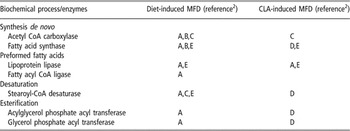
Key enzymes involved in lipid synthesis that are down-regulated during CLA- and diet-induced MFD contain an sterol response element (SRE) response element in their promoter, and are known to be regulated by SREBP1 (Table 4; Harvatine and Bauman, Reference Harvatine and Bauman2006). In mice, SREBP1 is up-regulated at the initiation of lactation, and disruption of the SREBP1c gene results in a 41% decrease in milk fat concentration when fed a low-fat diet (Rudolph et al., 2005). Interestingly, this inhibition approximates the maximum reduction in milk fat synthesis observed during bovine MFD as discussed earlier. Overall, decreased expression of SREBP1, SREBP1 activation proteins and SREBP1-regulated genes for key enzymes involved in lipid synthesis provides strong evidence for SREBP1 as a central signaling pathway in the regulation of fatty acid synthesis in bovine mammary epithelial cells.
Summary of SREBP1-regulated genes involved in milk fat synthesis in bovine mammary tissue for which expression is coordinately reduced during diet-induced or trans-10, cis-12 CLA-induced milk fat depression (MFD)Footnote 1

1 From Harvatine and Bauman (Reference Harvatine and Bauman2006).
2 Reference citations are as follows: A = Peterson et al. (Reference Peterson, Matitashvili and Bauman2003); B = Piperova et al. (Reference Piperova, Teter, Bruckental, Sampugna, Mills, Yurawecz, Fritsche, Ku and Erdman2000); C = Ahnadi et al. (Reference Ahnadi, Beswick, Delbecchi, Kennelly and Lacasse2002); D = Baumgard et al. (Reference Baumgard, Matitashvili, Corl, Dwyer and Bauman2002b); E = Harvatine and Bauman (Reference Harvatine and Bauman2006).
Thyroid hormone responsive spot 14
Mammalian regulation typically includes redundant systems for signal amplification and for regulation of biochemical processes. We identified thyroid hormone responsive spot 14 (S14) as a trans-10, cis-12 CLA responsive gene in the microarray analysis of bovine mammary cultures (Harvatine and Bauman, Reference Harvatine and Bauman2006). The S14 gene encodes a nuclear protein that is closely associated with the regulation of lipid synthesis in lipogenic tissues, including the bovine mammary gland (Cunningham et al., Reference Cunningham, Moncur, Huntington and Kinlaw1998; Harvatine and Bauman, Reference Harvatine and Bauman2006). Furthermore, we established that the expression of S14 in the bovine mammary gland is down-regulated in both CLA- and diet-induced MFD (Harvatine and Bauman, Reference Harvatine and Bauman2006). Although its exact biochemical function is not known, S14 is found in the nucleus and is a putative transcriptional coactivator (Cunningham et al., Reference Cunningham, Moncur, Huntington and Kinlaw1998; Chou et al., Reference Chou, Cheng, Ho, Liu, Liu, Kuo, Chang, Chen, Chang and Huang2007 and 2008) that is highly responsive to pro-lipogenic signals including SREBP1 activation (Martel et al., Reference Martel, Bingham, McGraw, Baker, Morganelli, Meng, Armstrong, Moncur and Kinlaw2006).
The expression of S14 is positively associated with conditions of excessive lipid synthesis, including human obesity, chicken lines selected for increased growth and adiposity, muscle of cattle selected for marbling and high lipogenic cancers (summarized in Harvatine and Bauman, Reference Harvatine and Bauman2006). Studies of the function of S14 have provided interesting insight, and also many inconsistencies (see review by LaFave et al., Reference LaFave, Augustin and Mariash2006). Knock-down of S14 in hepatocyte culture resulted in decreased expression of lipogenic enzymes (reviewed by Cunningham et al., Reference Cunningham, Moncur, Huntington and Kinlaw1998), but the S14 knock-out mouse had increased hepatic lipogenesis (Zhu et al., Reference Zhu, Mariash, Margosian, Gopinath, Fareed, Anderson and Mariash2001). Of special interest in considering possible relevance to MFD, S14 knock-out mice had a 62% reduction in mammary lipogenesis and a 26% reduction in milk clot triglyceride concentration, which was predominantly due to decreased de novo fatty acid synthesis; however, activities of mammary lipogenic enzymes were unaltered (Zhu et al., Reference Zhu, Anderson, Mucha, Parks, Metkowski and Mariash2005).
Nuclear receptor family proteins
Genes from the nuclear hormone receptor (NR) family are also central regulators of metabolism (Francis et al., Reference Francis, Fayard, Picard and Auwerx2003). The peroxisome proliferator-activated receptors (PPARs), in particular, have been speculated to play a role in MFD (Baumgard et al., Reference Baumgard, Matitashvili, Corl, Dwyer and Bauman2002b; Bernard et al., Reference Bernard, Leroux and Chilliard2006 and Reference Bernard, Leroux and Chilliard2008). Cellular free FA are natural ligands for the PPARs and CLA is a potent agonist of PPARα and PPARγ. However, PPARα and PPARγ are activated equally well by trans-10, cis-12 CLA, which induces MFD, and by cis-9, trans-11 CLA, which does not (Moya-Camarena et al., Reference Moya-Camarena, Vanden Heuvel, Blanchard, Leesnitzer and Belury1999; Yu et al., Reference Yu, Correll and Vanden Heuvel2002).
Any suggested roles for nuclear receptors must take into consideration their tissue-specific expression pattern. Using a panel of bovine tissues, we have surveyed the expression of possible PUFA-responsive nuclear receptors as a means to provide an initial assessment of their potential role in bovine mammary lipid synthesis. For example, expression of HNF4α, a member of the nuclear receptor family, is 15 500-fold higher in bovine liver than in lactating mammary tissue, and the expression in mammary tissue does not differ between lactating and nonlactating tissue (Harvatine and Bauman, Reference Harvatine and Bauman2007a). In the case of the PPARs, PPARα was predominantly expressed in tissues with high rates of FA oxidation (e.g. liver, muscle, heart), PPARγ was predominantly expressed in adipose tissue, and PPPARβ/δ expression was not different between lactating and nonlactating mammary tissue. Furthermore, mammary tissue expression was not modified by CLA- or diet-induced MFD for any of the PPAR genes (Harvatine and Bauman, Reference Harvatine and Bauman2007a).
Nuclear receptor activity and function is modified by ligand-binding, post-translational modifications and by association with various co-repressors and co-activators (Tan et al., Reference Tan, Michalik, Desvergne and Wahli2005; Feige et al., Reference Feige, Gelman, Michalik, Desvergne and Wahli2006). Ligand binding of PPARα and PPARβ/δ increases FA oxidation, and ligand binding of PPARγ increases FA transport and lipogenesis; none of these changes are consistent with the phenotype of MFD. Kennedy et al. (Reference Kennedy, Chung, LaPoint, Fabiyi and McIntosh2008) recently reported that trans-10, cis-12 CLA antagonized ligand activation of PPARγ in adipocyte cell culture, presumably via extra cellular signal-regulated kinases (ERK), specifically ERK-stimulated phosphorylation of PPARγ. Ligand-dependent and -independent repressor mechanisms are well described for the PPARs, but they function primarily to reduce inflammatory and immune responses (Ricote and Glass, Reference Ricote and Glass2007); indeed a hematopoietic and endothelial cell-specific PPARγ knock-out resulted in increased levels of inflammatory molecules in milk (Wan et al., Reference Wan, Saghatelian, Chong, Zhang, Cravatt and Evans2007). Lastly, CLA treatment reduced body fat in PPARα knock-out mice, demonstrating a PPARα-independent mechanism for CLA in growing mice (Peters et al., Reference Peters, Park, Gonzalez and Pariza2001). Overall, these results and patterns do not offer support for HNF4α or the PPARs in the regulation of milk fat synthesis in the bovine mammary gland.
Protein kinase B/Akt
Numerous growth factors and hormones, including insulin and IGF1, activate phosphoinositide 3-kinase (PI3K), which subsequently results in phosphorylation and activation of protein kinase B/Akt (Yang et al., Reference Yang, Tschopp, Baudry, Dummler, Hynx and Hemmings2004). In the mouse, expression of Akt1 is up-regulated at the initiation of lactation. Deletion of the Akt1 gene in mice decreased milk yield, presumably due to a failure to stimulate glucose uptake and metabolism in the mammary gland during the initiation of lactation, but had no effect on milk fat concentration (Boxer et al., Reference Boxer, Stairs, Dugan, Notarfrancesco, Portocarrero, Keister, Belka, Cho, Rathmell, Thompson, Birnbaum and Chodosh2006). However, mammary-specific over-expression of a constituently active Akt1 more than doubled the milk fat concentration (Schwertfeger et al., Reference Schwertfeger, McManaman, Palmer, Neville and Anderson2003). Activation of Akt1 increases lipid synthesis through modification of multiple levels of SREBP1 regulation (Porstmann et al., Reference Porstmann, Griffiths, Chung, Delpuech, Griffiths, Downward and Schulze2005). First, Akt1 promotes processing of SREBP1, increasing nSREBP1 synthesis (Porstmann et al., Reference Porstmann, Griffiths, Chung, Delpuech, Griffiths, Downward and Schulze2005; Du et al., Reference Du, Kristiana, Wong and Brown2006). Secondly, nSREBP1 is targeted to proteosomal degradation by GSK3β-dependent phosphorylation, and Akt1 may increase nSREBP1 abundance by inactivating GSK3β (Rudolph et al., Reference Rudolph, Neville and Anderson2007; Jump et al., 2008). Botolin et al. (Reference Botolin, Wang, Christian and Jump2006) reported that n-3 PUFA decreased insulin-stimulated activation of Akt1 and increased proteasome degradation of nSREBP1, although a constituently active Akt1 did not overcome this effect. In addition, long-chain PUFA induced GSK3β phosphorylation (Jump et al., 2008). Overall, these investigations raise the possibility that Akt1 could mediate effects of bioactive FA on SREBP1 signaling, but its regulation has not yet been investigated in MFD.
Primary and secondary mechanisms
The regulation of milk fat synthesis has predominantly involved animals that were established in MFD. This approach cannot differentiate between causative mechanisms and responses that may have occurred as secondary adaptations to the reduction in milk fat synthesis. Recently we conducted an in vivo investigation that involved sequential mammary biopsies during trans-10, cis-12 CLA infusion; we observed that SREBP1 and S14 were early-phase responders during MFD and down-regulation of their expression was extensive by 30 h after the initiation of CLA treatment (Harvatine and Bauman, 2007b).
The initial cellular steps by which PUFA or CLA modifies SREBP1 signaling have not been elucidated, although this is currently an area of intense investigation. In the case of CLA, an active metabolite derived from trans-10, cis-12 CLA is a possibility given the well-established pathways for the metabolism of long-chain PUFA to produce eicosanoids. The initial enzyme in metabolism of trans-10, cis-12 CLA is Δ6 desaturase that forms cis-6, trans-10, cis-12 C18:3. We have examined this conjugated diene 18:3 isomer at a concentration comparable to that found effective for the trans-10, cis-12 CLA reduction of milk fat synthesis; while it was taken up and incorporated into milk fat, cis-6, trans-10, cis-12 C18:3 had no effect on milk fat yield (Saebo et al., Reference Saebo, Perfield, Delmonte, Yurawecz, Lawrence, Brenna and Bauman2005b). Thus, this metabolite and by inference related down-stream metabolites do not appear to have a direct effect or be involved in the mechanism for the regulation of milk fat synthesis by trans-10, cis-12 CLA.
Milk fat fluidity and milk fat synthesis
Milk fat fluidity is primarily determined by the FA chain length and by the number and orientation of FA double bonds. Fluidity is an important consideration in secretion of milk fat from the mammary epithelial cell (Timmen and Patton, Reference Timmen and Patton1988) and it is affected by the profile of the FA that is available for use in the synthesis of milk fat triglycerides. In diet-induced MFD the profile of FA is markedly altered and this is a characteristic of the biohydrogenation theory. Collectively, these changes would reduce the fluidity of milk fat and they include the following: an increase in trans-C18:1 FA originating from rumen biohydrogenation processes; a decrease in short- and medium-chain FA due to the inhibition of mammary de novo FA synthesis; and a shift in oleic acid (decrease) and stearic acid (increase) due to the inhibition of SCD.
SCD plays an important role in the supply of unsaturated FA for milk fat synthesis. SCD is dynamically regulated and this has functional consequences in metabolic regulation as highlighted by the work of Ntambi and coworkers with the SCD1 null mouse that is protected from obesity and insulin resistance (Ntambi and Miyazaki, Reference Ntambi and Miyazaki2004; Miyazaki et al., Reference Miyazaki, Flowers, Sampath, Chu, Otzelberger, Liu and Ntambi2007). Alterations in milk fat desaturase index are not always observed in MFD, but it is altered in many situations of diet-induced MFD and with higher doses of trans-10, cis-12 CLA (>25% decrease in milk fat; summarized by Perfield et al., Reference Perfield, Delmonte, Lock, Yurawecz and Bauman2006). Furthermore, the alteration in the desaturase index is acute during CLA-induced MFD occurring within 6 h after treatment is initiated (Harvatine et al., Reference Harvatine, Dwyer and Bauman2006). The rapid changes in the desaturase index occur prior to any reduction in milk fat synthesis and this relates to the very short half-life of SCD (2 to 4 h; Oshino and Sato, Reference Oshino and Sato1972; Toyama et al., Reference Toyama, Kudo, Mitsumoto, Hibino, Tsuda and Kawashima2007) relative to key enzymes involved in de novo synthesis (48 to 76 h; Craig et al., Reference Craig, Nepokroeff, Lakshmanan and Porter1972; Volpe and Vagelos, Reference Volpe and Vagelos1973; Volpe and Marasa, Reference Volpe and Marasa1975).
Based on correlative evidence, a decreased activity of SCD and the resulting decrease in oleic acid have been proposed to cause diet-induced MFD (Loor and Herbein, Reference Loor and Herbein2003; Loor et al., Reference Loor, Ferlay, Ollier, Doreau and Chilliard2005). Recently, Shingfield and Griinari (Reference Shingfield and Griinari2007) proposed this as an extension of the biohydrogenation theory of MFD, suggesting that the specific inhibition of SCD over extended periods would induce MFD through changes in the mammary supply of stearic and oleic acids. They based this proposal primarily on Bickerstaffe and Johnson (Reference Bickerstaffe and Johnson1972), who reported an immediate change in the desaturase index and a progressive decrease in milk fat percentage when sterculic acid, an inhibitor of SCD, was infused. The report by Bickerstaffe and Johnson (Reference Bickerstaffe and Johnson1972) represents observations of a single goat with no replication or controls; however, our calculations from their graphic representation indicate that milk fat percent was decreased ~20% by day 6 and ~33% by day 16 of sterculic acid infusion. A number of well-controlled studies with lactating cows have altered the desaturase index through inhibition of SCD, and none have observed any effects on milk fat yield even though the milk fat contents of oleic and stearic acids were markedly altered. These have all been shorter term, 4 to 9 days, and have included abomasal infusions of sterculic oil (Griinari et al., Reference Griinari, Corl, Lacy, Chouinard, Nurmela and Bauman2000; Corl et al., Reference Corl, Baumgard, Dwyer, Griinari, Phillips and Bauman2001; Kay et al., Reference Kay, Mackle, Auldist, Thomson and Bauman2004), trans-9, trans-11 CLA (Perfield et al., Reference Perfield, Lock, Griinari, Saebo, Delmonte, Dwyer and Bauman2007) or trans-10, trans-12 CLA (Saebo et al., Reference Saebo, Saebo, Griinari and Shingfield2005a; Perfield et al., Reference Perfield, Delmonte, Lock, Yurawecz and Bauman2006a), and dietary administration of the rumen marker CoEDTA (Shingfield et al., Reference Shingfield, Toivonen, Vanhatalo, Huhtanen and Griinari2006a and Reference Shingfield, Arola, Ahvenjarvi, Vanhatalo, Toivonen, Griinari and Huhtanen2008b). In addition, the anti-lipogenic effects of CLA in the growing mouse were found to be independent of SCD1 using the SCD1 null mouse (Kang et al., Reference Kang, Miyazaki, Ntambi and Pariza2004). Thus, while changes in SCD will impact milk fluidity, the mammary gland must have a remarkable ability to maintain milk fat secretion over a substantial range in FA profile. Clearly, decreased activity of the SCD is not a prerequisite for MFD, and there is no direct evidence supporting the inhibition of SCD as a specific, independent causative factor in diet-induced MFD.
Consideration of historical theories to explain milk fat depression
The investigation of diet-induced MFD has a rich history that has included many theories to explain reduced milk fat synthesis. Most of these theories postulated that limitations in substrate supply for milk fat synthesis caused MFD, generally based on changes in absorbed metabolites as a consequence of alterations in ruminal fermentation. Over several decades, researchers have tested theories based on substrate limitations and found little to no evidence in their support; these theories will be briefly discussed here but have been comprehensively reviewed elsewhere (Bauman and Griinari, Reference Bauman and Griinari2001; Griinari and Bauman, Reference Griinari and Bauman2006; Shingfield and Griinari, Reference Shingfield and Griinari2007).
The first documented theory appeared over a century ago and proposed that MFD was caused by a limitation in supply of FA due to low dietary fat (Van Soest, Reference Van Soest1994); however, subsequent work showed that limiting dietary fat reduces milk yield but has very little effect on milk fat percent (Virtanen, Reference Virtanen1966; Storry et al., Reference Storry, Rook and Hall1967; Banks et al., Reference Banks, Clapperton, Ferrie and Wilson1976). Another theory based on substrate supply proposed that a deficiency of acetate caused MFD (Davis and Brown, Reference Davis and Brown1970; Doreau and Chilliard, Reference Doreau and Chilliard1997). A reduction in the ruminal molar ratio of acetate to propionate is highly correlated with MFD in diets that are high in fermentable carbohydrate. However, the reduced ratio of acetate to propionate is predominantly due to an increased ruminal production of propionate (Bauman and Griinari, Reference Bauman and Griinari2001 and Reference Bauman and Griinari2003), and ruminal infusion of acetate to cows that were MFD had only a marginal impact on milk fat yield (Davis and Brown, Reference Davis and Brown1970).
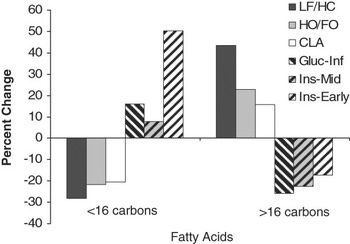
Lastly, the glucogenic-insulin theory of MFD proposed that increased ruminal propionate and increased hepatic gluconeogenesis stimulated insulin secretion, resulting in an inhibition of adipose tissue lipolysis and increased uptake of lipogenic precursors by extra-mammary tissues that are insulin sensitive (McClymont and Vallance, Reference McClymont and Vallance1962; Annison et al., Reference Annison, Bickerstaffe and Linzell1974). Direct testing of the theory by infusion of propionate found variable responses from no effect to a maximal milk fat reduction of 16% (summarized by Davis and Brown Reference Davis and Brown1970; Bauman and Griinari, Reference Bauman and Griinari2001). The effect of insulin was also directly tested using hyperinsulinemic–euglycemic clamps and multiple experiments with well-fed cows showed that a four-fold increase in plasma insulin had a minimal effect (average 5% reduction) on milk fat yield (McGuire et al., Reference McGuire, Griinari, Dwyer and Bauman1995; Griinari et al., Reference Griinari, McGuire, Dwyer, Bauman and Palmquist1997; Mackle et al., Reference Mackle, Dwyer, Ingvartsen, Chouinard, Lynch, Barbano and Bauman1999). In contrast, hyperinsulinemic–euglycemic clamp of cows in early lactation resulted in a 35% reduction in milk fat yield (Corl et al., Reference Corl, Butler, Butler and Bauman2006). The difference in magnitude of response for cows in established and early lactation can be explained by the effect of energy balance on the contribution of preformed FA to milk fat; only 4% to 8% of milk FA originate from body fat reserves when cows are in a positive energy balance (Palmquist and Mattos, Reference Palmquist and Mattos1978; Pullen et al., Reference Pullen, Palmquist and Emery1989), but the contribution is much greater during negative energy balance because of mobilization of body fat reserves. Most experimental and commercial instances of CLA- and diet-induced MFD occur in cows in positive energy balance and result in a much greater reduction in MFD than observed in testing of the glucogenic-insulin theory. Secondly, the reduction in milk fat observed during testing of the glucogenic-insluin theory represents a different mechanism than classical MFD; the pattern of change in milk composition for several situations where milk fat is reduced is presented in Figure 4. In the case of hyperinsulinemic–euglycemic clamp experiments, the reduction in milk fat was predominantly long-chain preformed FA, consistent with insulin’s well-established anti-lipolytic effects. This contrasts with classical diet-induced and CLA-induced MFD that is characterized by a more pronounced decrease in de novo-synthesized FA. Overall, the historical theories of MFD were developed from concepts based on observational data, but they failed to be supported by direct experimentation and mechanistic investigations.
Change in the concentration of de novo synthesized (<16 carbon) and preformed (>16 carbon) FA in milk fat that occur with diet-induced and CLA-induced milk fat depression (MFD) and treatments testing glucogenic-insulin regulation of MFD. Examples of classical MFD include a low-forage/high-concentrate diet (LF/HC) that reduced milk fat yield ~60% (Storry et al., Reference Storry, Rook and Hall1967), a high-oil plus fish oil diet (HO/FO) that reduced milk fat yield 38% (Harvatine and Bauman, Reference Harvatine and Bauman2006) and abomasal infusion of 14 g/day of trans-10, cis-12 CLA that reduced milk fat yield 50% (Baumgard et al., Reference Baumgard, Sangster and Bauman2001). Treatments testing the glucogenic-insulin theory include duodenal infusion of 1500 g/day of glucose (Gluc-Inf) that reduced milk fat yield 16% (Hurtaud et al., Reference Hurtaud, Rulquin and Verite1998), hyperinsulinemic–euglycemic clamp during mid lactation (Ins-Mid) that reduced milk fat yield 7% (Griinari et al., Reference Griinari, McGuire, Dwyer, Bauman and Palmquist1997), and hyperinsulinemic–euglycemic clamp during early lactation (Ins-Early) that reduced milk fat yield 27% (Corl et al., Reference Corl, Butler, Butler and Bauman2006). Figure development was based on Bauman and Griinari (Reference Bauman and Griinari2001).

Insights gained from milk fat depression
Research in the regulation of milk fat synthesis has focused on investigations of MFD rather than on situations or models where milk fat synthesis is enhanced. Nevertheless, MFD represents a biologically significant and physiologically relevant example where a metabolite(s) produced in digestive processes is regulating metabolism, and the basis for this regulation can be explained at the molecular level. Many cows do not achieve their genetic potential for milk fat synthesis because of subtle diet-induced MFD. The study of MFD may arguably be the most complete and successful example of nutri-genomics in present-day animal science research and provides many valuable applications. For example, knowledge of the basis for MFD allows the development of feeding strategies and provides the opportunity to troubleshoot commercial problems in low milk fat production. Investigations of MFD have highlighted key regulatory mechanisms in mammary lipid synthesis and this provides a platform for the development of methods to enhance milk fat yield and improve the fatty acid profile of milk fat. For example, SREBP1 and the SREBP1 regulatory proteins are being used as candidate genes for identification of single-nucleotide polymorphisms that may explain genetic differences in milk fat yield (Medrano and Rincon, Reference Medrano and Rincon2007) and FA composition of bovine fat (Hoashi et al., Reference Hoashi, Ashida, Ohsaki, Utsugi, Sasazaki, Taniguchi, Oyama, Mukai and Mannen2007).
Under certain marketing systems and management schemes, it may be advantageous to reduce milk fat yield (Griinari and Bauman, Reference Griinari and Bauman2003), and in some feeding and management systems the reduction in milk fat yield has allowed for a repartitioning of nutrients to support increased milk and milk protein yield (e.g. Bernal-Santos et al., Reference Bernal-Santos, Perfield, Barbano, Bauman and Overton2003; Mackle et al., Reference Mackle, Kay, Auldist, McGibbon, Philpott, Baumgard and Bauman2003; Lock et al., Reference Lock, Teles, Perfield, Bauman and Sinclair2006b; Odens et al., Reference Odens, Burgos, Innocenti, VanBaale and Baumgard2007). Producers may also find it advantageous to induce MFD during periods of limited feedstuff availability such as inadequate rainfall in pasture-based systems or for a short period while breeding. Changes in body weight (BW) or body composition are difficult to adequately quantify in ruminants, but increased rumen-empty BW gain has been reported during diet-induced MFD (Harvatine and Allen, Reference Harvatine and Allen2006). In agreement with increased energy balance, we have also observed increased expression of enzymes and protein involved in lipid synthesis and lipogenic signaling in adipose tissue during short-term CLA-induced MFD (Harvatine et al., Reference Harvatine, Dwyer and Bauman2007). Inducing MFD during breeding periods may also be a useful management practice to improve short-term energy balance and subsequently reproductive efficiency, although caution is important in application of classical MFD diets.
Conclusion
MFD results from an interaction between ruminal fermentation processes and mammary tissue metabolism. Investigation of milk fat synthesis over the past 100 years has resulted in numerous theories based on observational differences in dietary associations, alterations in ruminal fermentation, and adaptations in animal metabolism. To date, the biohydrogenation theory is the only proposed mechanism that has provided causative evidence and withstood rigorous examination. The mechanism by which biohydrogenation intermediates reduce milk fat synthesis has and will continue to provide insight into the regulation of milk fat synthesis. MFD continues to be a real-world condition that reduces the efficiency and productivity of dairy cows, but understanding its fundamental basis will allow for effective management and intervention strategies. Furthermore, advances in understanding the regulation of fat synthesis will undoubtedly have broader implications and applications.
Acknowledgments
This review is based on an invited presentation at the 58th Annual Meeting of the European Association for Animal Production held in Dublin, Ireland during August 2007. This work was supported in part by the National Research Initiative Competitive Grant no. 2006-35206-16643 from the USDA Cooperative State Research, Education, and Extension Service and the Cornell Agricultural Experiment Station.