INTRODUCTION
The genus Taenia consists of nearly 50 species (Loos-Frank, Reference Loos-Frank2000; Hoberg, Reference Hoberg2006; Rossin et al. Reference Rossin, Timi and Hoberg2010; Haukisalmi et al. Reference Haukisalmi, Lavikainen, Laaksonen and Meri2011), including three currently identified ‘human Taenia’ spp. (Hoberg, Reference Hoberg2006), Taenia solium, T. saginata and T. asiatica. T. solium is one of the most important cestodes concerning human health, but T. saginata and T. asiatica are also important for the zootechnical and veterinary sciences due to their being a common source of economic loss; their larval stages, T. saginata parasitize the muscle of cattle, while those of T. asiatica parasitize the viscera of pig.
It has been a long-standing puzzle that adult taeniid tapeworms expelled from people in Asian countries seemed to be T. saginata, although these people ate pork rather than beef (Fan, Reference Fan1988; Simanjuntak et al. Reference Simanjuntak, Margono, Okamoto and Ito1997; Ito et al. Reference Ito, Nakao and Wandra2003). Taiwan, Indonesian and Korean researchers energetically studied the T. saginata-like tapeworm, including experimental infections, and concluded that this parasite was an independent new species (Chao and Fan, Reference Chao and Fan1986; Fan et al. Reference Fan, Kosman, Kosin, Depary and Napitupulu1990a, Reference Fan, Soh and Kosinb, Reference Fan, Chung, Lin and Wuc). Several others working on molecular differences between ‘Asian Taenia’ and T. saginata rejected this idea (Zarlenga et al. Reference Zarlenga, McManus, Fan and Cross1991; Bowles and McManus, Reference Bowles and McManus1994; Simanjuntak et al. Reference Simanjuntak, Margono, Okamoto and Ito1997). In 1993, Eom and Rim (Reference Eom and Rim1993) described this Asian Taenia as a new species, T. asiatica, based on morphological observations. However, due to the morphological similarity and a very small difference in the mitochondrial DNA sequences between T. saginata and T. asiatica, it has been debated whether these two taxa belong to the same species or are indeed two distinct species (Eom et al. Reference Eom, Jeon, Kong, Hwang, Yang, Li, Xu, Feng, Pawlowski and Rim2002; Hoberg, Reference Hoberg2002; Flisser et al. Reference Flisser, Viniegra, Aguilar-Vega, Garza-Rodriguez, Maravilla and Avila2004; Okamoto et al. Reference Okamoto, Nakao, Tachi, Sako, Sato, Yamasaki, Nakaya and Ito2007).
Because there are many species concepts, the definition of a species is also varied. Of these, the biological species concept is the most widely accepted. It defines species in terms of their ability to interbreed. For instance, Mayr (Reference Mayr1996) defined a species as follows: ‘species are groups of interbreeding natural populations that are reproductively isolated from other such groups.’ In other words, if reproductive isolation is incomplete, hybridization between species that were considered to be distinct species should occur. And if hybridization occurred once, nuclear-mitochondrial discordance should be detected in their descendants.
In previous reports, four adult worms showing nuclear-mitochondrial discordance were found in areas in which these taxa are sympatrically endemic (Okamoto et al. Reference Okamoto, Nakao, Blair, Anantaphruti, Waikagul and Ito2010; Yamane et al. Reference Yamane, Suzuki, Tachi, Li, Chen, Nakao, Nkouawa, Yanagida, Sako, Ito, Sato and Okamoto2012). The data presented in those reports clearly showed that reproductive isolation between T. saginata and T. asiatica was incomplete. Based on Mayr's biological species concept, it can thus be considered that T. asiatica is the same species as T. saginata. Concrete evidence is still lacking, however, because only 4 worms of hybrid origin have yet been identified. In addition, only two nuclear loci were examined in these previous studies. Examination of other nuclear loci should lead to the further discovery of the evidence of nuclear-mitochondrial discordance. To this end, we developed further polymerase chain reaction (PCR) and sequencing methods for the pold gene and examined the pold loci from both taxa in this study. Our results suggest complicated relationships between T. saginata, T. asiatica and their hybrids which we discuss here.
MATERIALS AND METHODS
Parasite samples
In this study, we examined a total of 67 adult tapeworms which were morphologically similar to T. saginata collected from humans in 11 countries (Brazil, Ecuador, Ethiopia, Japan, South Korea, Philippines, China, Taiwan, Cambodia, Thailand and Indonesia). Those worms did not necessarily have a scolex and often we were only able to obtain just a few proglottids, then species were not identified exactly. Approximately two-thirds of the samples came from individuals who provided samples in our previous studies (Okamoto et al. Reference Okamoto, Nakao, Blair, Anantaphruti, Waikagul and Ito2010; Yamane et al. Reference Yamane, Suzuki, Tachi, Li, Chen, Nakao, Nkouawa, Yanagida, Sako, Ito, Sato and Okamoto2012). Samples were stored in 70% ethanol until they were required for DNA extraction.
DNA preparation
Genomic DNA was individually extracted from mature or immature proglottids using a QIAamp DNA Mini Kit or a DNeasy tissue kit (QIAGEN, Germany) in accordance with the manufacturer's instructions, and then used as a template for PCR.
Multiplex PCR for Taenia species identification
Multiplex PCR based on the mitochondrial cytochrome c oxidase subunit 1 (cox1) gene is an easy method for identification of human taeniid cestodes (Yamasaki et al. Reference Yamasaki, Allan, Sato, Nakao, Sako, Nakaya, Qiu, Mamuti, Craig and Ito2004; Anantaphruti et al. Reference Anantaphruti, Yamasaki, Nakao, Waikagul, Watthanakulpanich, Nuamtanon, Maipanich, Pubampen, Sanguankiat, Muennoo, Nakaya, Sato, Sako, Okamoto and Ito2007). Samples were screened by this method for the tentative identification of species.
DNA sequencing
Partial sequences of the DNA polymerase delta (pold) gene were amplified from the total DNA by PCR using the primer pair: pold/F_169: ATCCTGCACCTCCATAATGC and pold/R_1417: GCTTGATGGGGTTCACAAAT. PCR was carried out in 15 μl reaction mixtures containing 1 μl template, 200 μ m of each dNTP, 0·2 μ m of each primer, 0·3 U of Ex Taq polymerase (TaKaRa, Japan) and manufacturer-supplied reaction buffer. Thermal cycling was performed for 35cycles of denaturation (94 °C for 30 sec), annealing (60 °C for 30 sec), and extension (72 °C for 90 sec). The PCR products were purified using MinElute PCR Purification Kits (QIAGEN) or were enzymatically cleaned with calf intestine alkaline phosphatase (TOYOBO) and Exonuclease I (TaKaRa). Direct sequencing was performed with a Dye Terminator Cycle Sequencing Kit and an ABI 3130xl Generic Analyzer (Applied Biosystems, USA). At least two independent PCR products were used for sequencing.
In cases of double peaks in the sequencing reaction, thermal cycling was performed using PrimeSTAR GXL DNA polymerase according to the manufacturer's instructions. PCR products were subjected to cloning using TArget Clone-Plus- (TOYOBO, Japan), and more than ten clones were sequenced per sample.
Data analysis
DNA sequences obtained were aligned using the CLUSTAL W computer program (Thompson et al. Reference Thompson, Higgins and Gibson1994). Phylogenetic trees were constructed by the neighbor joining (NJ) method (Saitou and Nei, Reference Saitou and Nei1987) using the MEGA5.1 computer program (Tamura et al. Reference Tamura, Peterson, Peterson, Stecher, Nei and Kumar2011). Evolutionary distances were computed using the Maximum Composite Likelihood Method (Tamura et al. Reference Tamura, Nei and Kumar2004). Phylogenetic tree was evaluated using a bootstrap test based on 1000 resamplings (Felsenstein, Reference Felsenstein1985). Sequences of Taenia ovis (Acc. No.: FN568374), T. multiceps (Acc. No.: FN568373) and T. serialis (Acc. No.: FN568372) were used as out-groups to indicate the location of the root of the in-group. For presentation purposes, the long branch leading to the out-group is not shown in the tree.
The parsimonious network of pold haplotypes was drawn by using TCS 1.2 software (Clement et al. Reference Clement, Posada and Crandall2000) using statistical parsimony (Templeton et al. Reference Templeton, Crandall and Sing1992). The network estimation was run at 95% connection limit.
RESULTS
The mtDNA-based multiplex PCR assigned our samples to T. saginata (n = 28) or T. asiatica (n = 39). Since it is certain that there are some worms which originated from hybridization between T. saginata and T. asiatica (Okamoto et al. Reference Okamoto, Nakao, Blair, Anantaphruti, Waikagul and Ito2010; Yamane et al. Reference Yamane, Suzuki, Tachi, Li, Chen, Nakao, Nkouawa, Yanagida, Sako, Ito, Sato and Okamoto2012), we could not identify the species of those samples using only mitochondrial genotypes. According to the results, the codes ‘Tasi’ (T. asiatica) or ‘Tsag’ (T. saginata) were added to the sample ID. It is important to note that these codes refer to the identification determined by the mitochondrial genome.
Partial sequences of pold gene (1200 bp in length) were obtained from all except 8 samples by direct sequencing of PCR products. There was no indel among all samples. Unfortunately, consistent sequences could not be obtained from the remaining 8 samples (TasiA209Kancha_TH, TasiA170Luzon_PH, TasiA171Luzon_PH, TasiA174Luzon_PH, TasiA175Luzon_PH, TsgT038Sichuan_CN, TsagT039Sichuan_CN, TsagT043Sichuan_CN), because there were double peaks at several nucleotide positions in electropherograms. After cloning and sequencing, two independent sequences (haplotypes) were obtained from each of these 8 samples. Each haplotype was distinguished by adding ‘a’ or ‘b’.
Fig. 1 shows the neighbor-joining phylogenetic tree inferred from pold gene sequences. Four haplotypes, which corresponded to four alleles, (poldA, poldB, poldC, poldD) were detected at the pold locus. These haplotypes were clearly divided into two clades (Clade I, Clade II), which differed by five to seven nucleotides from each other. ‘Most of the Tsag’ were included in the Clade Ia (poldA), while ‘Most of the Tasi’ were included in the clade Ib (poldB). On the other hand, Clade IIa (poldC) and Clade IIb (poldD) included only ‘Tasi’ samples.
Neighbor-joining phylogenetic trees of the partial sequence of the nuclear the DNA polymerase delta (pold) gene. Samples in bold type show nuclear-mitochondrial discordance. Samples in italic type represent heterozygotes that displayed two alleles (red: Tasi represents heterozygous with poldB and plodC; blue: Tsag represents heterozygous with poldA and plodB; green: Tasi represents heterozygous with poldA and plodB; aqua: Tasi represents heterozygous with poldC and plodD). Numbers on the nodes represent bootstrap values. Scale bar represents the evolutionary distances. The number after the species code (e.g. A030) identifies the sample ID used in the Asahikawa Medical University or Tottori University. Each sample code is followed by a locality name (absent from some) and country name (abbreviated). Abbreviations of country names are as follow: BR, Brazil; CN, China; EC, Ecuador; ET, Ethiopia; ID, Indonesia; JP, Japan; KH, Cambodia; KR, South Korea; PH, Philippines; TH, Thailand; TW, Taiwan. See the text for abbreviations of mitochondrial types and alleles.

Fig. 2 shows the parsimonious network of pold haplotypes of human Taenia examined. It indicates that the poldB haplotype was derived from the poldA haplotype by the occurrence of single nucleotide substitution. Similarly, the poldD haplotype was derived from the poldC haplotype.
The parsimonious networks of pold gene haplotypes of T. saginata-like human Taenia. Samples in bold type show nuclear-mitochondrial discordance. Samples in italic type represent heterozygotes that displayed two alleles (red: Tasi represents heterozygous with poldB and plodC; blue: Tsag represents heterozygous with poldA and plodB; green: Tasi represents heterozygous with poldA and plodB; aqua: Tasi represents heterozygous with poldC and plodD). The size of the circles indicates the frequency of the haplotypes, and the actual numbers of haplotypes (>1) are shown in parentheses.
DISCUSSION
We previously found four adult T. saginata-like worms that showed nuclear-mitochondrial discordance (Okamoto et al. Reference Okamoto, Nakao, Blair, Anantaphruti, Waikagul and Ito2010; Yamane et al. Reference Yamane, Suzuki, Tachi, Li, Chen, Nakao, Nkouawa, Yanagida, Sako, Ito, Sato and Okamoto2012). Namely, some individuals had T. saginata-type mitochondrial DNA but had alleles originated from T. asiatica in some nuclear loci and vice versa. In light of these results, we came to four conclusions. First, phylogenetic analyses of both mitochondrial and two nuclear genes yielded trees consisting of two rather uniform clades corresponding to either T. asiatica or T. saginata and considerable differences between the mitochondrial lineages indicated a long period of separation between these two taxa. Second, although taeniid cestodes are primarily self-fertilizers, the presence of a few heterozygous individuals suggests that out-crossing also occurs. Third, since these four worms showed nuclear-mitochondrial discordance, reproductive isolation between T. saginata and T. asiatica remains incomplete, and hybrid breakdown has not yet occurred. Finally, since some nuclear loci remain heterozygous, hybridization might have occurred recently, and probably continues in areas where T. saginata and T. asiatica are sympatrically endemic.
In the present study, pold gene sequences were also clearly divided into two clades (Clade I and Clade II), differing from each other in five to seven nucleotides (Fig. 1). Since Clade II included only ‘Tasi’ samples, we might consider that Clade II corresponds to the allele from T. asiatica and that the other (Clade I) corresponds to that from T. saginata. Since the presence of several nucleotide substitutions in nuclear genes means prolonged separation after speciation, there is little doubt that T. saginata and T. asiatica were once separated into two distinct taxa as has been concluded in previous studies. On the other hand, we demonstrate here one significant difference from the results of these previous reports; i.e. that ‘Most of the Tasi’ are homozygous for plodB allele. As indicated in the haplotype network tree (Fig. 2), there is no doubt that poldB derived from poldA with a single nucleotide substitution. Since all ‘Tsag’ except TsagA199Kancha_TH showed the poldA allele, poldA should be the original allele from ‘pure T. saginata’. In contrast, it appears that poldC and poldD originated from ‘pure T. asiatica’, because each is found only in ‘Tasi’ collected from Taiwan and Philippines.
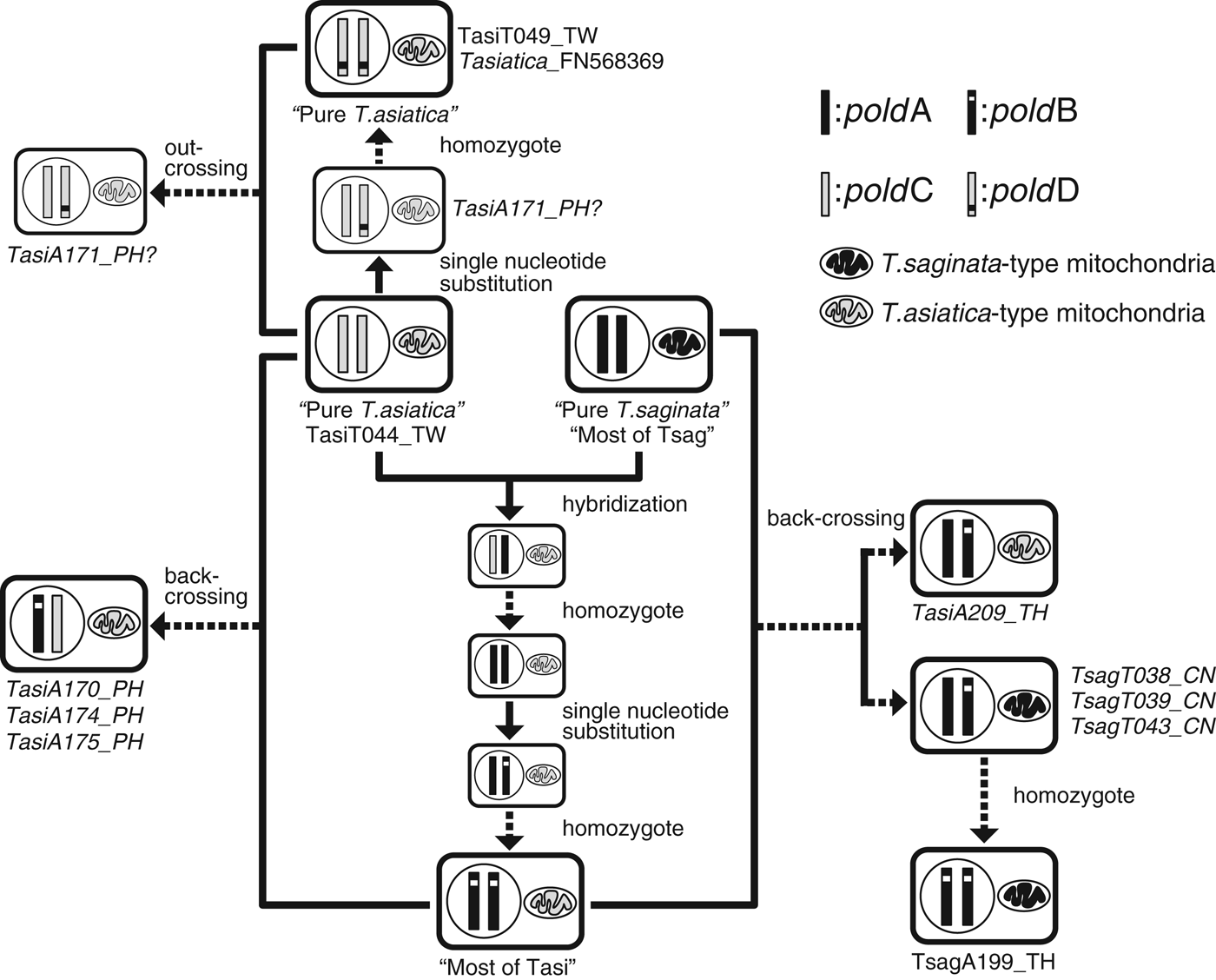
These results indicate that most of the adult worms which had been called T. asiatica are not actually ‘pure T. asiatica’ but instead originated from the hybridization of ‘pure T. saginata’ and ‘pure T. asiatica’, even if previously identified as T. asiatica using mitochondrial DNA. In other words, worms distributed everywhere other than the Philippines and Taiwan are all descendants of this hybridization. The genotypes of worms were examined and some of their possible relationships were inferred from the results of the present and previous studies (Okamoto et al. Reference Okamoto, Nakao, Blair, Anantaphruti, Waikagul and Ito2010; Yamane et al. Reference Yamane, Suzuki, Tachi, Li, Chen, Nakao, Nkouawa, Yanagida, Sako, Ito, Sato and Okamoto2012) are shown in Fig. 3. A likely scenario for this event is as follows. At some point in the past, hybridization between ‘pure T. saginata’ and ‘pure T. asiatica’ occurred, producing a worm with T. asiatica-type mitochondrial DNA and heterozygous at the pold locus with the poldA and poldC alleles. When alternation of generations was repeated by self-fertilization, the pold locus was fixed at the poldA allele in some worms due to genetic drift. At the same time, the poldA allele mutated to poldB via single nucleotide substitution. The descendants of such worms, which had T. asiatica-type mitochondrial DNA and the poldB alleles, have since spread throughout southeast Asia. Of course, our results do not allow dismissal of the possible retention of ancestral polymorphism within ‘pure T. saginata’, but this is unlikely because, with the exception of TsagA199, no ‘Tsag’ were homozygous for poldB allele at all. Finally, ‘pure T. asiatica’, which would only have the alleles poldC and poldD, probably remains only in the Philippines and/or Taiwan, even if it still exists.
Genotypes of worms examined and their possible relationships. Relevant genotypes appeared after hybridization between ‘pure T. saginata’ and ‘pure T. asiatica’. Samples in italics represent heterozygotes that displayed two alleles. For details see text.
We found several adult worms whose pold locus was heterozygous. Of these, four worms, TasiA209Kancha_TH, TsagT038Sichuan_CN, TsagT039Sichuan_CN, TsagT043Sichuan_CN, were heterozygous with the poldA and poldB alleles. As mentioned above, the poldA allele is considered to be a major allele of ‘pure T. saginata’. Although the poldB allele is a major allele of ‘Tasi’, it is not an allele from ‘pure T. asiatica’ but originated instead from the descendant of hybridization between ‘pure T. saginata’ and ‘pure T. asiatica’. Therefore, it is highly possible that heterozygosity at the pold locus in these four worms cannot have been caused by hybridization between ‘pure forms’ but instead by the back-crossing between ‘pure T. saginata’ and ‘Tasi’ with the poldB allele (‘Most of Tasi’). In general, when hybridization happens once and alternation of generations is repeated, their descendants show various genotypes. In the cases of T. asiatica and T. saginata, since a variety of descendants must have been produced after hybridization, we cannot deny the possibility that relevant genotypes have occurred in such descendants. In previous studies, both the ef1 and elp loci of all ‘Tasi’ examined, except one individual (TasiT041), were homozygous for T. asiatica-type alleles. This fact indicates that ‘Tasi’ spread in southeast Asia have limited variation as a result of a population bottleneck. It is thought that the above-mentioned scenario with relevant genotypes coming from back-crossing is not irrelevant.
In previous reports, both the ef1 and elp loci in TasiA209Kancha_TH and TsagT038Sichuan_CN were homozygous, so at least in these cases the two adults did not result from the back-cross 1 (BC1) generation. Three other adults examined from Luzon, Philippines (TasiA170Luzon_PH, TasiA174Luzon_PH and TasiA175Luzon_PH) also originated from the back-crossing between ‘pure T. asiatica’ and ‘Tasi’ with the poldB allele.
TasiA171 was also heterozygous but had the poldC and poldD alleles, which were alleles originated from ‘pure T. asiatica’. Although we cannot confidently determine which allele was original, the parsimonious network indicates that poldC was likely to be original (Fig. 2). If alternation of generations was repeated by self-fertilization after single nucleotide substitution, the pold locus should be fixed at two plodD alleles in some worms (e.g. TasiT049). And it might be still heterozygous for poldC and plodD alleles in others. TsagA171 is possibly such an individual or the descendant of out-crossing. In any case, we cannot say that TasiA171 was an individual derived from hybridization between two taxa.
In previous studies, we had concluded that four worms (TsagA199Kancha_TH, TsagT017Kancha_TH, TsagT038Sichuan_CN and TasiT041Sichuan_CN), obtained from areas where T. saginata and T. asiatica are sympatrically endemic, originated from hybrids between those two taxa (Okamoto et al. Reference Okamoto, Nakao, Blair, Anantaphruti, Waikagul and Ito2010; Yamane et al. Reference Yamane, Suzuki, Tachi, Li, Chen, Nakao, Nkouawa, Yanagida, Sako, Ito, Sato and Okamoto2012). Since all four of those worms had the poldB allele (Fig. 1), there is a high possibility that they were not direct descendants of the ‘pure T. saginata’ and ‘pure T. asiatica’ hybrid, but were instead the product of back-crossing between a descendant of the hybrid and ‘pure T. saginata’. At present, we have yet to find a direct descendant of the ‘pure T. saginata’ and ‘pure T. asiatica’ hybrid, which should have the poldA and poldC or poldD alleles. Although it is certain that hybridization between pure forms once occurred, it is unclear whether or not such hybridization still occurs today. Further investigations are therefore necessary to clarify the relationship between T. saginata, T. asiatica and their hybrids, especially in Philippines and Taiwan.
ACKNOWLEDGEMENTS
We are grateful to the many colleagues who have joined our research and collected taeniid worms. We also acknowledge colleagues who have contributed to genetic analyses of taeniid worms, especially Y. Suzuki, E. Tachi and Y. Doke.
FINANCIAL SUPPORT
This work was supported by a Grant-in-Aid for Scientific Research (A) (21256003, 24256002) to AI and (B) (21406009, 24406011) to MO, from the Japan Society for the Promotion of Science (JSPS); a grant from the Japan–China Medical Association (2012) to YS and by JSPS-Asia/Africa Scientific Platform Fund (2006–2011) and the Special Coordination Fund for Promoting Science and Technology from the Ministry of Education, Culture, Sports, Science and Technology in Japan (MEXT) (2003–2005, 2010–2012) to AI.