


%20--%3e%3c!DOCTYPE%20svg%20PUBLIC%20'-//W3C//DTD%20SVG%201.0//EN'%20'http://www.w3.org/TR/2001/REC-SVG-20010904/DTD/svg10.dtd'%3e%3csvg%20version='1.0'%20id='Layer_1'%20xmlns='http://www.w3.org/2000/svg'%20xmlns:xlink='http://www.w3.org/1999/xlink'%20x='0px'%20y='0px'%20width='64px'%20height='64px'%20viewBox='5.5%20-3.5%2064%2064'%20enable-background='new%205.5%20-3.5%2064%2064'%20xml:space='preserve'%3e%3cg%3e%3ccircle%20fill='%23FFFFFF'%20fill-opacity='0'%20cx='37.785'%20cy='28.501'%20r='28.836'/%3e%3cpath%20fill='%23595959'%20d='M37.441-3.5c8.951,0,16.572,3.125,22.857,9.372c3.008,3.009,5.295,6.448,6.857,10.314%20c1.561,3.867,2.344,7.971,2.344,12.314c0,4.381-0.773,8.486-2.314,12.313c-1.543,3.828-3.82,7.21-6.828,10.143%20c-3.123,3.085-6.666,5.448-10.629,7.086c-3.961,1.638-8.057,2.457-12.285,2.457s-8.276-0.808-12.143-2.429%20c-3.866-1.618-7.333-3.961-10.4-7.027c-3.067-3.066-5.4-6.524-7-10.372S5.5,32.767,5.5,28.5c0-4.229,0.809-8.295,2.428-12.2%20c1.619-3.905,3.972-7.4,7.057-10.486C21.08-0.394,28.565-3.5,37.441-3.5z%20M37.557,2.272c-7.314,0-13.467,2.553-18.458,7.657%20c-2.515,2.553-4.448,5.419-5.8,8.6c-1.354,3.181-2.029,6.505-2.029,9.972c0,3.429,0.675,6.734,2.029,9.913%20c1.353,3.183,3.285,6.021,5.8,8.516c2.514,2.496,5.351,4.399,8.515,5.715c3.161,1.314,6.476,1.971,9.943,1.971%20c3.428,0,6.75-0.665,9.973-1.999c3.219-1.335,6.121-3.257,8.713-5.771c4.99-4.876,7.484-10.99,7.484-18.344%20c0-3.543-0.648-6.895-1.943-10.057c-1.293-3.162-3.18-5.98-5.654-8.458C50.984,4.844,44.795,2.272,37.557,2.272z%20M37.156,23.187%20l-4.287,2.229c-0.458-0.951-1.019-1.619-1.685-2c-0.667-0.38-1.286-0.571-1.858-0.571c-2.856,0-4.286,1.885-4.286,5.657%20c0,1.714,0.362,3.084,1.085,4.113c0.724,1.029,1.791,1.544,3.201,1.544c1.867,0,3.181-0.915,3.944-2.743l3.942,2%20c-0.838,1.563-2,2.791-3.486,3.686c-1.484,0.896-3.123,1.343-4.914,1.343c-2.857,0-5.163-0.875-6.915-2.629%20c-1.752-1.752-2.628-4.19-2.628-7.313c0-3.048,0.886-5.466,2.657-7.257c1.771-1.79,4.009-2.686,6.715-2.686%20C32.604,18.558,35.441,20.101,37.156,23.187z%20M55.613,23.187l-4.229,2.229c-0.457-0.951-1.02-1.619-1.686-2%20c-0.668-0.38-1.307-0.571-1.914-0.571c-2.857,0-4.287,1.885-4.287,5.657c0,1.714,0.363,3.084,1.086,4.113%20c0.723,1.029,1.789,1.544,3.201,1.544c1.865,0,3.18-0.915,3.941-2.743l4,2c-0.875,1.563-2.057,2.791-3.541,3.686%20c-1.486,0.896-3.105,1.343-4.857,1.343c-2.896,0-5.209-0.875-6.941-2.629c-1.736-1.752-2.602-4.19-2.602-7.313%20c0-3.048,0.885-5.466,2.658-7.257c1.77-1.79,4.008-2.686,6.713-2.686C51.117,18.558,53.938,20.101,55.613,23.187z'/%3e%3c/g%3e%3c/svg%3e)
%20--%3e%3c!DOCTYPE%20svg%20PUBLIC%20'-//W3C//DTD%20SVG%201.0//EN'%20'http://www.w3.org/TR/2001/REC-SVG-20010904/DTD/svg10.dtd'%3e%3csvg%20version='1.0'%20id='Layer_1'%20xmlns='http://www.w3.org/2000/svg'%20xmlns:xlink='http://www.w3.org/1999/xlink'%20x='0px'%20y='0px'%20width='64px'%20height='64px'%20viewBox='5.5%20-3.5%2064%2064'%20enable-background='new%205.5%20-3.5%2064%2064'%20xml:space='preserve'%3e%3cg%3e%3ccircle%20fill='%23FFFFFF'%20fill-opacity='0'%20cx='37.637'%20cy='28.806'%20r='28.276'/%3e%3cg%3e%3cpath%20fill='%23595959'%20d='M37.443-3.5c8.988,0,16.57,3.085,22.742,9.257C66.393,11.967,69.5,19.548,69.5,28.5c0,8.991-3.049,16.476-9.145,22.456%20C53.879,57.319,46.242,60.5,37.443,60.5c-8.649,0-16.153-3.144-22.514-9.43C8.644,44.784,5.5,37.262,5.5,28.5%20c0-8.761,3.144-16.342,9.429-22.742C21.101-0.415,28.604-3.5,37.443-3.5z%20M37.557,2.272c-7.276,0-13.428,2.553-18.457,7.657%20c-5.22,5.334-7.829,11.525-7.829,18.572c0,7.086,2.59,13.22,7.77,18.398c5.181,5.182,11.352,7.771,18.514,7.771%20c7.123,0,13.334-2.607,18.629-7.828c5.029-4.838,7.543-10.952,7.543-18.343c0-7.276-2.553-13.465-7.656-18.571%20C50.967,4.824,44.795,2.272,37.557,2.272z%20M46.129,20.557v13.085h-3.656v15.542h-9.944V33.643h-3.656V20.557%20c0-0.572,0.2-1.057,0.599-1.457c0.401-0.399,0.887-0.6,1.457-0.6h13.144c0.533,0,1.01,0.2,1.428,0.6%20C45.918,19.5,46.129,19.986,46.129,20.557z%20M33.042,12.329c0-3.008,1.485-4.514,4.458-4.514s4.457,1.504,4.457,4.514%20c0,2.971-1.486,4.457-4.457,4.457S33.042,15.3,33.042,12.329z'/%3e%3c/g%3e%3c/g%3e%3c/svg%3e)
%20--%3e%3c!DOCTYPE%20svg%20PUBLIC%20'-//W3C//DTD%20SVG%201.0//EN'%20'http://www.w3.org/TR/2001/REC-SVG-20010904/DTD/svg10.dtd'%3e%3csvg%20version='1.0'%20id='Layer_1'%20xmlns='http://www.w3.org/2000/svg'%20xmlns:xlink='http://www.w3.org/1999/xlink'%20x='0px'%20y='0px'%20width='64px'%20height='64px'%20viewBox='5.5%20-3.5%2064%2064'%20enable-background='new%205.5%20-3.5%2064%2064'%20xml:space='preserve'%3e%3cg%3e%3ccircle%20fill='%23FFFFFF'%20fill-opacity='0'%20cx='36.924'%20cy='28.403'%20r='28.895'/%3e%3cpath%20fill='%23595959'%20d='M37.442-3.5c8.99,0,16.571,3.085,22.743,9.256C66.393,11.928,69.5,19.509,69.5,28.5c0,8.992-3.048,16.476-9.145,22.458%20C53.88,57.32,46.241,60.5,37.442,60.5c-8.686,0-16.19-3.162-22.513-9.485C8.644,44.728,5.5,37.225,5.5,28.5%20c0-8.762,3.144-16.343,9.429-22.743C21.1-0.414,28.604-3.5,37.442-3.5z%20M12.7,19.872c-0.952,2.628-1.429,5.505-1.429,8.629%20c0,7.086,2.59,13.22,7.77,18.4c5.219,5.144,11.391,7.715,18.514,7.715c7.201,0,13.409-2.608,18.63-7.829%20c1.867-1.79,3.332-3.657,4.398-5.602l-12.056-5.371c-0.421,2.02-1.439,3.667-3.057,4.942c-1.622,1.276-3.535,2.011-5.744,2.2%20v4.915h-3.714v-4.915c-3.543-0.036-6.782-1.312-9.714-3.827l4.4-4.457c2.094,1.942,4.476,2.913,7.143,2.913%20c1.104,0,2.048-0.246,2.83-0.743c0.78-0.494,1.172-1.312,1.172-2.457c0-0.801-0.287-1.448-0.858-1.943l-3.085-1.315l-3.771-1.715%20l-5.086-2.229L12.7,19.872z%20M37.557,2.214c-7.276,0-13.428,2.571-18.457,7.714c-1.258,1.258-2.439,2.686-3.543,4.287L27.786,19.7%20c0.533-1.676,1.542-3.019,3.029-4.028c1.484-1.009,3.218-1.571,5.2-1.686V9.071h3.715v4.915c2.934,0.153,5.6,1.143,8,2.971%20l-4.172,4.286c-1.793-1.257-3.619-1.885-5.486-1.885c-0.991,0-1.876,0.191-2.656,0.571c-0.781,0.381-1.172,1.029-1.172,1.943%20c0,0.267,0.095,0.533,0.285,0.8l4.057,1.83l2.8,1.257l5.144,2.285l16.397,7.314c0.535-2.248,0.801-4.533,0.801-6.857%20c0-7.353-2.552-13.543-7.656-18.573C51.005,4.785,44.831,2.214,37.557,2.214z'/%3e%3c/g%3e%3c/svg%3e)
%20--%3e%3c!DOCTYPE%20svg%20PUBLIC%20'-//W3C//DTD%20SVG%201.1//EN'%20'http://www.w3.org/Graphics/SVG/1.1/DTD/svg11.dtd'%3e%3csvg%20version='1.1'%20id='Layer_1'%20xmlns='http://www.w3.org/2000/svg'%20xmlns:xlink='http://www.w3.org/1999/xlink'%20x='0px'%20y='0px'%20width='64.000977px'%20height='64px'%20viewBox='0%200%2064.000977%2064'%20enable-background='new%200%200%2064.000977%2064'%20xml:space='preserve'%3e%3cg%3e%3ccircle%20fill='%23FFFFFF'%20fill-opacity='0'%20cx='32.064453'%20cy='31.788086'%20r='29.012695'/%3e%3cg%3e%3cpath%20fill='%23595959'%20d='M31.943848,0C40.896484,0,48.476562,3.105469,54.6875,9.314453C60.894531,15.486328,64.000977,23.045898,64.000977,32%20s-3.048828,16.457031-9.145508,22.513672C48.417969,60.837891,40.779297,64,31.942871,64%20c-8.648926,0-16.152832-3.142578-22.513672-9.429688C3.144043,48.286133,0,40.761719,0,32.000977%20c0-8.723633,3.144043-16.285156,9.429199-22.68457C15.640137,3.105469,23.14502,0,31.943848,0z%20M32.060547,5.771484%20c-7.275391,0-13.429688,2.570312-18.458496,7.714844C8.381836,18.783203,5.772949,24.954102,5.772949,32%20c0,7.125,2.589844,13.256836,7.77002,18.400391c5.181152,5.181641,11.352051,7.770508,18.515625,7.770508%20c7.123047,0,13.332031-2.608398,18.626953-7.828125C55.713867,45.466797,58.228516,39.353516,58.228516,32%20c0-7.3125-2.553711-13.484375-7.65625-18.513672C45.504883,8.341797,39.333984,5.771484,32.060547,5.771484z%20M44.117188,24.456055%20v5.485352H20.859863v-5.485352H44.117188z%20M44.117188,34.743164v5.481445H20.859863v-5.481445H44.117188z'/%3e%3c/g%3e%3c/g%3e%3c/svg%3e)
In 1946, Shriman Narayan Agarwal, a disciple of Mahatma Gandhi (and later the governor of Gujarat), wrote a proposal laying out the principles for a future Indian constitution.Footnote 1 In the introduction to his proposal, Agarwal argued that India should not base its constitution on Western models. Instead, it should create a “swadeshi” (that is, made in India) constitution, one which would reflect “our national genius, culture and traditions.” India, he explained, “is a very ancient land.” It experimented with various forms of government “at a time when Europe and the New World had not even come within the pale of civilization.” It would be “a great insult to India” to create a constitution that would be based on a mixture of rules taken from the West. “Administrative systems cannot and should not be transplanted,” he asserted. Each nation “has its unique culture and civilisation which may be called its ‘Soul.’ … we have aped the West for long,” he concluded, “let us now be proud of our Indian culture and institutions.”Footnote 2
Benegal Narsing Rau was one of India’s leading jurists and diplomats in the early postcolonial period. He also served as an advisor to the Indian Constituent Assembly. In an article he wrote in 1949, Rau discussed the choice that faced the Indian Constituent Assembly between a presidential and parliamentary system of government. Rau chose to analyze this topic not by turning to Western constitutional models. Instead, he suggested that it would be profitable to “take a peep into the history of India … and see how far her people have been accustomed to the theory and practice of parliamentary modes of government.” Rau then remarked that while ancient Indian states were mostly monarchies, kings were expected to heed the advice of their ministers, who, in turn, were responsible to the people. He also noted that one can find ancient Indian texts dealing with procedures in assemblies, which “anticipate to an astonishing extent” the rules prevalent in modern parliaments. Therefore, he concluded, parliamentarism was a concept that was familiar to the ancient Indians.Footnote 3
The particularist and historicist approach to constitution-making evident in both Agarwal’s and Rau’s works expressed, in the realm of public law, the Western historicist jurisprudential notions about the relationship between the “spirit” of a people and its laws that we encountered in the previous chapters. Montesquieu already argued, in the eighteenth century, that each nation had its own unique constitutional forms.Footnote 4 This idea later appeared in the works of the leader of the German Historical School, Friedrich Carl von Savigny, who declared that “in the earliest times to which authentic history extends, the law will be found to have already attained a fixed character, peculiar to the people, like their language, manners, and constitution [verfassung].”Footnote 5 It was also common among nineteenth-century English political thinkers.Footnote 6 In India, these ideas can be traced back to a body of works that emerged in the early decades of the twentieth century in connection with the newly reformed University of Calcutta. These works – which can be collectively called the “Hindu polity” literature – analyzed the history of ancient Indian political ideas and institutions and also sometimes discussed ancient Indian public law, or more specifically, constitutional and international law.Footnote 7 Both Agarwal and Rau cited the Hindu polity literature.Footnote 8 In this chapter, I explore this literature.Footnote 9
I begin with a brief description of how constitutional law and international law were taught in England and India in the late nineteenth century. I will then offer a group portrait of the authors who produced the Hindu polity literature. Next, I turn to several significant themes in these works, which stood at the intersection of history, political science, and constitutional law.Footnote 10 I conclude by analyzing the general characteristics of this literature and the context which gave rise to it.
The Study of Constitutional and International Law in England and India
Constitutional law gradually emerged as a distinct subject in English legal education only in the second half of the nineteenth century. Before that time, it was intertwined with other subjects. Thus, the first book of Blackstone’s Commentaries on the Laws of England, published in 1765, which was based on lectures that Blackstone delivered at Oxford, dealt with subjects that we would now regard as belonging to constitutional law but also discussed administrative law, family law, labor law, and corporate law.Footnote 11
The first professor of “English law and jurisprudence” at King’s College, London, was John James Park, appointed in 1831. His book, The Dogmas of the Constitution, was published in 1832. However, shortly thereafter, in 1833, Park died, and subsequent professors of law at King’s College had little interest in constitutional law.Footnote 12 Decades later, in the 1870s, Sheldon Amos served as the University of London examiner in constitutional law and history and wrote on the topic.Footnote 13 Constitutional law was also taught, beginning in 1850, at Queen’s College, Birmingham and at Haileybury College, where the East India Company trained its administrators until 1858.Footnote 14
Five Readers teaching both constitutional law and legal history were appointed at the Inns of Court in 1852 – the same year that a Bachelor of Civil Law degree was introduced at the University of Oxford.Footnote 15 At Oxford, too, English constitutional law was first taught solely as part of the exam on the history of English law. It was only in 1886 that a paper on constitutional law per se was required of students.Footnote 16 During this period, English history professors such as William Stubbs and Edward Freeman published leading works on English constitutional history.Footnote 17 In the first decades of the twentieth century, the emphasis on history in the study of constitutional law at Oxford declined; administrative law was also added to the curriculum, and more attention was paid to the analysis of the case law relevant to modern constitutional law.Footnote 18
The teaching of a topic related to constitutional law – international law – at English universities followed a similar trajectory of gradual growth. A Chair in International Law and Diplomacy was established at Oxford in 1859, and international law was one of the four examination topics at the Oxford School of Law and Modern History in the last decades of the century.Footnote 19 At King’s College, international law was taught in the second half of the nineteenth century by Leone Levi, who wrote mainly on commercial law but also published two books on international law in 1855 and 1887.Footnote 20
In India, too, the teaching of constitutional law developed gradually. At the beginning of the twentieth century, constitutional law was not taught at any of the law colleges affiliated with the University of Calcutta, although Indian constitutional law was taught at the Madras Law College.Footnote 21 By the 1920s, however, constitutional law had become one of the four topics of the preliminary exams for bachelor of law students at the University of Calcutta.Footnote 22 Constitutional and administrative law also became part of the curriculum of the MA program in Political Philosophy and Political Economy.Footnote 23 In addition, the MA program in Ancient Indian History and Culture required extensive study of ancient Indian constitutional history. Several Tagore Law Lectures delivered during the first decades of the twentieth century dealt with various topics related to modern constitutional and administrative law.Footnote 24
Public international law was not taught at the University of Calcutta College of Law in the early decades of the twentieth century, although private international law was a compulsory subject of the Master of Law degree.Footnote 25 However, public international law was mandatory for all postgraduate students in History and those studying Political Philosophy and Economics at the university. A Chair in International Law, held by Arthur Brown, was established in the 1920s. Foreign international law scholars such as Harvard University professors Manley O. Hudson and George Grafton Wilson also lectured on the topic there in the 1920s.Footnote 26 International law, too, was the subject of several University of Calcutta lecture series.Footnote 27
Some constitutional law teachers at the University of Calcutta focused mainly on the modern era – that is, on the constitutional arrangements of colonial India. For example, Naresh Chandra Roy, a professor of history and political science at City College Calcutta and a lecturer at the University of Calcutta, published several works on the constitutional and administrative structure of British India.Footnote 28 Jyoti Prasad Sarvadhikari, who taught constitutional law and Hindu law at the University of Calcutta College of Law, also published a book on modern constitutional law in the late 1920s.Footnote 29 However, there were many people affiliated with the University of Calcutta whose research was devoted to the study of ancient Indian constitutional history, often as part of a broader interest in the nature and institutions of ancient Indian states.
Authors
This section offers a collective portrait of the authors of the Hindu polity works.Footnote 30 Unlike Pal and Eisenstadt, discussed in Part II of this book, there is less biographical information about most of the authors that I will discuss here. Nevertheless, they seem to have shared some similar traits. Many belonged to the same age group – born in or around the 1880s and coming of age in the first decade of the twentieth century. Most were educated in colleges affiliated with the University of Calcutta, and many later taught there or were associated in some other way with this institution. A few authors worked in other locations, but even in this case, they often had some link with the University of Calcutta.
Indian historians were already writing works on the history of India, inspired by Western models, in the nineteenth century.Footnote 31 Interest among Indian scholars in ancient Indian constitutional history became evident in the first decade of the twentieth century.Footnote 32 However, this interest received a significant boost with the discovery, in the South Indian city of Mysore, of the most important ancient Indian treatise on statecraft, the Arthashastra (translated as “the science of government” or “the science of wealth”) in the first decade of the twentieth century. This treatise was traditionally attributed to the fourth-century BC Indian philosopher and statesman Chanakya (also called Kautilya), an advisor to the first Mauryan Emperor, Chandragupta. The manuscript of this treatise was discovered sometime before 1905 by Rudrapatna Shamasastry, the Chief Librarian of the Mysore Government Oriental Library. Shamasastry began publishing translations of sections of the Arthashastra in 1905, and an English translation of the entire work was published in 1915.Footnote 33
The founding father of the Hindu polity literature was Kashi Prasad Jayaswal. Jayaswal, born in 1881, came from a low-caste (kalwar) but wealthy family. He studied history at Oxford and was also called to the English Bar. In England, he also came into contact with Indian nationalist revolutionaries and became a follower of the Hindu nationalist activist V. D. Savarkar. Jayaswal returned to India and settled in Calcutta in 1910, working there as a lawyer. He accepted the invitation of the Vice Chancellor of the University of Calcutta, Asutosh Mookerjee, to join its Department of Postgraduate Studies, but the British blocked his appointment because of his “seditionist” political views. Jayaswal moved to Patna in 1914, working there as a lawyer, journalist, and scholar.Footnote 34 Despite the move to Patna, Jayaswal’s affiliation with the University of Calcutta continued even after his relocation, ultimately resulting in an invitation to deliver the Tagore Law Lectures in 1917.Footnote 35
In 1913, Jayaswal published an article entitled “An Introduction to Hindu Polity” in the Calcutta nationalist magazine, The Modern Review (based on earlier articles published in 1911 and 1912). Here, he sought to show that, until the modern era, Indian governmental institutions had been “at par if not superior” to Western ones.Footnote 36 Such was the response to the publication that it prompted a trend of similar works.Footnote 37 Jayaswal continued working on the topic, publishing a two-volume book on Hindu polity in 1921.Footnote 38
Other authors followed in Jayaswal’s footsteps. Many of these were scholars who were educated and then taught at the University of Calcutta: Narendra Nath Law taught law, history, and philosophy at the university.Footnote 39 Pramathanath Bandyopadhyay (or Banerjee) also taught law and history. He was the Principal of the College of the Law in the late 1930s, and in 1946 he replaced Radhabinod Pal as the Vice-Chancellor of the university.Footnote 40 Pramatha Nath Banerjea, who studied at the Inns of Court, and also obtained a doctorate in economics from the University of London, was a professor of Economics.Footnote 41 Benoy Kumar Sarkar was a leading nationalist and pan-Asian intellectual in early twentieth-century Bengal. He became actively involved in the National Education Movement, the educational wing of the nationalist Swadeshi Movement which emerged in Bengal in 1905 in response to the British decision to partition the province. He later taught at the Department of Economics of the University of Calcutta, becoming head of the department in 1947.Footnote 42 Devadatta Ramakrishna Bhandarkar was the second Carmichael Chair of Ancient Indian History and Culture at the Department of History of the University of Calcutta, a chair established by Asutosh Mookerjee in 1912.Footnote 43 Bhandarkar’s successor as the Carmichael Chair was Hemchandra Raychaudhuri.Footnote 44 Upendranath Ghoshal was a professor of history at Presidency College in Calcutta and a lecturer at the Departments of History and Politics at the University of Calcutta.Footnote 45 Narayan Chandra Bandyopadhyaya lectured at the University of Calcutta Departments of History and Anthropology.Footnote 46
Interest in ancient Indian political ideas and institutions was not limited to the law professors, economists, and historians teaching at the University of Calcutta. Scholars teaching at other Indian higher education institutions during the last decades of British rule in India were also interested in the topic. Often, these scholars were affiliated in some way with the University of Calcutta, either because they studied there during the heyday of interest in the subject in the 1910s or because they were invited to teach or lecture on the topic at Calcutta. This group included three scholars who completed their doctoral dissertations at the University of Calcutta during the 1910s. Radhakumud Mookerji earned his doctorate in 1915. He taught at the Bengal National College, a nationalist institute of education in Calcutta, moving in 1916 to Benares Hindu University, then to Mysore University, and finally to Lucknow University, where he served as the head of the History Department. He also served as a vice-president of a Hindu nationalist political party, the Hindu Mahasabha party.Footnote 47 Mookerji’s younger brother, Radhakamal Mukerjee, taught economics and sociology at Lucknow University.Footnote 48 Ramesh Chandra Majumdar wrote a doctoral dissertation at the University of Calcutta, published as a book in 1918. He was then appointed as the Dean of the Faculty of Arts at Dacca University.Footnote 49
Three other scholars who wrote works on ancient Indian constitutional history had some affiliation with the University of Calcutta. As mentioned above, Rudrapatna Shamasastry was the person who discovered Kautilya’s Arthashastra. He was a librarian and historian based in Mysore. In 1919, he was invited by Asutosh Mookerjee to deliver a ten-lecture series on subjects connected with the Arthashastra as part of the postgraduate lecture series at the University of Calcutta.Footnote 50 K. V. Rangaswami Aiyangar was a professor of history and economics at the Maharaja’s College in Trivandrum in South India. In 1916, he published a book on ancient Hindu polity.Footnote 51 Aiyangar had various ties to the University of Calcutta. He served as an examiner on ethnology and anthropology there, and, in 1934, he delivered a series of lectures at the university on Indian cameralism.Footnote 52 Sivaswamy Aiyer was the Advocate-General of the Madras presidency and, later, Vice Chancellor of Madras University and Benares Hindu University.Footnote 53 In 1929, he delivered the Kamala Lectures at the University of Calcutta entitled “The Evolution of Moral Ideas in India.”Footnote 54
All the authors I have mentioned thus far had some affiliation with the University of Calcutta. There were other scholars not affiliated with the university whose works were also part of the corpus of works on Hindu polity. For example, Beni Prasad, who taught history, politics, and civics at the University of Allahabad, published two works in the late 1920s on ancient Indian theories of government and ancient Indian political institutions.Footnote 55 V. R. Ramachandra Dikshitar was a professor of History and Archaeology at the University of Madras. He published a book on Hindu administrative institutions.Footnote 56 Anant Sadashiv Altekar, too, was a historian and archaeologist. He taught at Benares Hindu University and later at Patna University.Footnote 57 His works include a book on the position of women in ancient India, and an article about the lessons that ancient Indian constitutional history holds for the drafters of India’s future constitution.Footnote 58 Finally, K. A. Nilakanta Sastri, who was trained at the University of Madras and ultimately became a professor of History there also displayed an interest in Kautilya’s Arthashastra.Footnote 59
Themes
The authors of the Hindu polity literature saw the study of ancient Indian statecraft as a way to show “the genius of Hindu culture.”Footnote 60 To do so, they sought to refute conventional negative Western images of ancient (and modern) India and, instead, to emphasize various positive aspects found (or purportedly found) in ancient Hindu texts. In the following paragraphs, I explore some common themes found in their works. My interest does not lie in asking whether the early twentieth-century works accurately interpreted the authentic meaning of the ancient texts and correctly depicted the true nature of early Indian institutions. This is a question for historians of ancient South Asia. I am interested in how Indian scholars in the early twentieth century used the ancient texts to undermine negative Western images of India and to further their nationalist agendas.
Ancient Indian Political Theory: Practical, Secular, Innovative
Western Indologists in the late nineteenth and early twentieth centuries often portrayed Indians as inherently spiritual and religious, suggesting they lacked aptitude for practical and secular pursuits. For example, the nineteenth-century German-English Indologist Max Müller argued that the Indians were “a nation of philosophers” and that “India has no place in the political history of the world.”Footnote 61 Arthur Berriedale Keith, who taught Sanskrit and constitutional law at the University of Edinburgh in the first decades of the twentieth century, condescendingly acknowledged that one could find in India a “pedantic” and “intensive study of the practical aspect of government.” Still, he also disparagingly noted that “the subtle and profound spirit of India … is alien to the conception of man as a political organism, whose true end can be found only in and through membership of a social community. Hence, India offers nothing that can be regarded as a serious theory of politics in the wider sense of that term.”Footnote 62 A related argument was that Indians, unlike Westerners, lacked a sense of nationalism and patriotism. Both arguments, said the Indian historian Sharma, were used to justify Western imperialism.Footnote 63
The Hindu polity writers sought to show that India had its own pragmatic political tradition.Footnote 64 Narendra Nath Law, for instance, began his 1914 book with the statement that the Arthashastra proved the “secular and practical achievements of the ancient Hindus, as distinguished from the[ir] spiritual and intellectual [achievements].”Footnote 65 Ghoshal noted that the study of statecraft separated from the general Vedic culture at an early stage and became, in some sense, “an independent branch of knowledge which might be called a secular science.” He, therefore, rejected Western images of the ancient Indians as uninterested in politics, arguing that they reflected a hollow “half-truth.”Footnote 66 Banerjea turned the Western argument about the impractical nature of Indian thought on its head by comparing Kautilya to Machiavelli, noting that Kautilya “far surpassed his Italian rival” because, unlike Machiavelli, he was an active statesman and because his works were not merely abstract discussions of politics but were actually followed in practice.Footnote 67
A related argument advanced by Western scholars was that the pervasive influence of religion in ancient India led to the uncritical acceptance of political ideas as dogma. This perception, argued Ghoshal, needed to be corrected because Buddhist political thought and the political theories found in the Arthashastra appealed to human reason rather than religious dogma. Ancient Indian political thinkers, said Ghoshal, were “earthy” and concerned with concrete problems of administration. They were not interested in speculative discussions of ideal polities.Footnote 68 Sarkar, too, argued that ancient Indian states were “thoroughly secular.”Footnote 69
Nationalist movements often claim that the national past was glorious. Jayaswal argued that “the constitutional progress made by the Hindu has probably not been equaled, much less surpassed, by any polity of antiquity.” Jayaswal could not ignore the fact that, when he was writing these words, the British ruled India. The Golden Age of the Hindus, he therefore comforted his readers, “lies in the future” because “the [Hindu] race which evolved the greatest constitutional principles in antiquity” had now come into contact with “the greatest constitutional polity of modern times [i.e. Britain],” and this contact could “rejuvenate the race.”Footnote 70
The argument about the glorious nature of ancient Indian political theory was not only made abstractly. The Hindu polity authors also argued that certain major modern political concepts had an ancient Indian pedigree.Footnote 71 One such concept was the social contract theory. Thus, Bhandarkar noted that while Europeans believed that the social contract theory originated with Hobbes, one could already find it in the Arthashastra. Indeed, according to Bhandarkar, the Hindu version of the theory was superior to the European one. Hobbes’ social contract transferred absolute power irrevocably from the people to the king, while, in the Indian version, the king did not enjoy unlimited power and was deemed a servant of the people. This was evident from the fact that taxes paid by the people to the king were seen as a wage that he received in return for providing security.Footnote 72
Another claim about the originality of ancient Indian statecraft texts had to do with international law. Historians of international law are aware of the fact that international law’s pedigree does not begin with Grotius in Europe in the early modern era but has non-European antecedents, including Indian ones.Footnote 73 However, when discussing the first scholars in the twentieth century who attempted to undermine the Eurocentric narrative about the history of international law, the existing scholarship ignores the works of early twentieth-century Indian scholars.Footnote 74
The main argument of Bandyopadhyay’s 1920 book International Law and Custom in Ancient India was that contrary to Western claims that international law was a modern European invention, it had in fact existed in the ancient world. Specifically, Bandyopadhyay argued that ancient Indians created rules for the governance of interstate relations 2,000 years before Europe.Footnote 75 Based on sources such as the Arthashastra and the Code of Manu, Bandyopadhyay claimed that the religious norms governing interstate relations in ancient India could be defined as “laws” and were not just theoretical but were followed in practice. He admitted that certain topics (such as maritime warfare and blockades or rules about extradition and naturalization) were not dealt with by ancient Indian international law, but he insisted that the field itself did exist.Footnote 76 Bandyopadhyay’s book went on to discuss the sources of international law, sovereignty, rules regarding ambassadors, rights, and duties of states, treaties, and alliances, the laws of war, norms regarding enemy persons and property, and the notion of neutrality.
Bandyopadhyay not only sought to show that the ancient Indians had created a body of international law rules. He also argued that “the rules of interstate relationships followed in ancient India were much more humane and much more elaborate than the rules followed by all nations of antiquity, and even by nations of modern Europe down perhaps to the time of the French Revolution.”Footnote 77 Thus, while the ancient Greeks and Chinese (as well as modern Europeans) used the idea of “the family of civilized nations” to justify their mistreatment of the “barbarians,” the ancient Indians saw even “wild tribes” and non-Aryans as deserving of the respect and protection of the law.Footnote 78
A related theme found in the Hindu polity literature was the claim that ancient Indian states were, in some ways, similar to modern states in the scope of their intervention in the life of their subjects. Narendra Nath Law noted that the state described in the Arthashastra “anticipated” some of the functions of modern states by protecting “the disabled, the helpless and the infirm” and also “lower animals.”Footnote 79 Radhakumud Mookerji argued that “socialism and communism (representing advanced democratic ideals of the modern age)” were to be found in ancient Indian self-governing organizations.Footnote 80 Hemchandra Raychaudhuri wrote an article claiming that “the ideal state depicted by Kautilya is far from one of laissez-faire, and the functions of such a state do not consist simply in protecting the personal freedom and property of the individual.”Footnote 81
An article by Dikshitar, published in 1939, argued that the goals of ancient Indian states were to “ensure the liberty of the citizens and to secure the general moral welfare.” The Indian kings sought to protect the whole world, including all creatures, and their states were not despotic. Unlike modern totalitarian states, whether communist or fascist, ancient Indian states were tolerant and did not crush the individual.Footnote 82 Another theme that Dikshitar emphasized – perhaps because it was significant in works on the nature of Hinduism, because of the growing political rift between Hindus and Muslims, or in response to the rise of racist states in Europe at the time – was that: “… tolerance was the corner-stone of the Hindu national state. It was a commonwealth composed of different groups, each allowed to develop its ideas and ideals and to follow its religious faith. Political rights were not denied to these groups, enabling their members to rise to their full stature in the discharge of their duties and the enjoyment of their rights.”Footnote 83
Altekar also argued (in 1947) that “the ancient Indian state was not merely a tax-gathering corporation, interested only in preserving law and order.” The state in ancient India, he said, “interested itself in a number of ministrant activities of the nation-building type, which are being undertaken by the modern governments only in relatively recent times.” The example he provided was in the realm of public education: state funding for “non-official colleges and universities.”Footnote 84 Similarly, and at about the same time, the South Indian historian K. A. Nilakanta Sastri claimed that the administrative innovations discussed in Kautilya’s Arthashastra proved that “under Kautilya’s guidance the Mauryan Empire was attempting to evolve into a new type of state, more ubiquitous and far-reaching in its concern for the welfare of the people than anything known in India before, a state which we should now call the ‘social-welfare State.’”Footnote 85
While many Hindu polity authors uncritically sought to create an Indian pedigree to modern Western political ideas, others were more tentative in their claims. Like other Hindu polity writers, Upendranath Ghoshal argued that ancient Indian works introduced, for the first time, the idea of a social contract as the foundation of the political order.Footnote 86 However, generally speaking, Ghoshal was less infatuated with the ancient Indian texts; in the appendix to his book, in which he compared Indian and Western theories, he noted that Indian thinkers were less sophisticated than Western philosophers such as Hobbes, Grotius, Locke, or Rousseau. According to Ghoshal, the Indian works were unsystematic and were less rational than Western ones; and, while concepts such as the social contract were, indeed, found in ancient Indian works before they emerged in the West, the Indian writers fell “below the level attained by the [early modern] European exponents of these theories.”Footnote 87
Democracy, Republics, and Constitutional Limits on the Power of Monarchs
The attempt to refute the Western notion of Oriental despotism was another central theme in the Hindu polity literature. The image that dominated modern European thought about politics in ancient India was that of states ruled by absolute kings, who were considered divine.Footnote 88 Western texts describing ancient Indian political theories often repeated Manu’s statement that kings were “God[s] in human form.”Footnote 89 As for Kautilya’s Arthashastra, S. G. Vesey-FitzGerald, who taught Oriental law at Oxford and London, observed in 1923 that:
Rome, or rather Byzantium, forgot her popular principles in a despotism … [whereas] Hindu polity seems never to have had any popular principles to forget. If the Arthashastra … can be accepted as giving a fair picture, the Maurya Empire rested on a system of … espionage as paralysing as that of Tiberius or Domitian. For all that we mean by self-government, the world is indebted to the barbarians of the North, to the Frank, the Anglo-Saxon, and the Dane. To many of the best Hindu minds, even to-day, the idea of popular election to public office is an indecency.Footnote 90
Already in the nineteenth century, liberal Indian thinkers sought to show that precolonial Indian governments had democratic aspects, such as the separation of powers.Footnote 91 Many Hindu polity works were animated by the same desire to refute the notion that Indian states were governed by despots and to prove the democratic credentials of these states.Footnote 92 Here, one can distinguish between two subthemes: the existence of republics in ancient India and the fact that Indian monarchs did not enjoy absolute power because institutional checks constrained them, or because they were constrained by law.
Some Hindu polity authors sought to show that non-monarchical states were not a Western invention. This argument was already present in Jayaswal’s 1913 article, in which he asserted that monarchies were not the only form of government known in ancient India. Republics also existed.Footnote 93 Jayaswal was not the first to note the existence of such republics. The English Indologist T. W. Rhys Davids mentioned them in a 1903 book. However, Jayaswal certainly created a widespread interest in studying these republics.Footnote 94
Jayaswal associated republics with the term gana (previously translated by European scholars as “corporation” or “tribe”).Footnote 95 His book discussed the appearance of republics in Buddhist sources, in the Arthashastra, and in the works of ancient Greek writers on India. Indian republics, Jayaswal argued, took various forms, some of them being democracies in which there were “parliaments,” where every man could cast his vote to elect the state’s leaders and where decisions were made by majority rule, based on procedures similar to those of modern parliamentary systems.Footnote 96 Jayaswal also claimed that at least some Hindu republics were based on the notion of political equality.Footnote 97 His book argued that Hindu republics were characterized by their morality, justice, discipline, efficient administration, and equality. They represented, he believed, a successful and long-standing governmental form.Footnote 98
The same arguments can be found in Banerjea’s 1916 book. Banerjea mentioned examples of republics that had existed during the Vedic era and noted that, as late as Alexander’s invasion of India, some Indian states lived under democratic institutions, and the government of others was aristocratic rather than monarchical.Footnote 99 Through a detailed analysis of the sources, Bhandarkar, too, sought to provide a more granular discussion of the nature of ancient Indian republics, marshaling philological evidence to distinguish between different republican forms (oligarchy, aristocracy, and democracy).Footnote 100
In 1919, Radhakumud Mookerji sought to challenge the image of Oriental despotism by highlighting the history of local organizations in ancient India. He argued that village communities and other local organizations, such as guilds, were “little republics,” independent from state intervention, and thus able to preserve and develop Hindu culture even during the period of “alien” Islamic rule. Muslim rulers, Mookerji said, were unable to impose on the Hindus the “Semitic” model of a society governed by a single absolute ruler.Footnote 101 Conventional accounts of early Indian society depicted it as based on “respect for tradition and authority,” but in fact, it was characterized by “the democratic principle,” a principle which was manifested in the way village communities governed themselves and also in the existence of many “self-governing, ‘kingless’ states.”Footnote 102 Shamasastry observed in his 1919 lectures (published in 1920) that the earliest Aryan societies in the West and the East had been democratic and that republics had existed in Vedic India.Footnote 103 Narendra Nath Law also argued in 1921 that some ancient Indian states were republics, and some of these republics were based on a democratic form of government.Footnote 104
Unlike all these authors, Ghoshal cautioned in his 1923 book against the anachronism of “crediting the Hindus with notions of popular sovereignty and the like.” However, he, too, was interested in countering the “Oriental despotism” notion. He stressed that “Indian states were not, contrary to the usual view, modeled after a uniform pattern, that of despotic monarchy.” Instead, republics had existed in ancient India from the earliest periods until at least the fifth century AD. One could also find rival political theories in ancient India. The Brahmanical theory about the divine nature of kings existed side by side with the contractual Buddhist theory of society. Ghoshal did admit, though, that while republics existed, it was monarchies that “dominated the scene.”Footnote 105
According to Jayaswal, republics disappeared at a certain point in Hindu history, partly because they could only function well when states were small. As the territory of Indian states grew, republics were replaced by monarchies. However, Jayaswal assured his readers that Hindu monarchies also reflected laudable modern democratic notions. During Vedic times (and even later), monarchies were contractual, and kings, who were not considered divine, were elected by popular assemblies.Footnote 106 Such assemblies, said Jayaswal, were “national assembl[ies] of the whole people.” They were tasked with electing kings (or re-electing them in the case of banishment), and everyone could participate in their work (unlike, for example, the folk assemblies of Western Europe).Footnote 107 Public opinion and the opinions of councils of ministers checked the power of kings – the king was seen as a servant or slave of the state, shackled by strictly enforced limitations on his power.Footnote 108
Banerjea, too, noted that, gradually, monarchies replaced other forms of government, mainly due to the growing size of Indian states, which made it difficult for popular assemblies to govern. He also argued that the king’s power in these monarchies was limited. During Vedic times, kings were elected and deposed according to the will of the people. Later, kingship became hereditary. However, even then, the power of kings was constrained by the authority of their ministers and priests. Indian kings were, therefore, constitutional monarchs, and there were very few instances of Indian kings who could be described as despots. Another facet of absolute monarchy, the idea of the divinity of kings, was indeed present in India. However, unlike medieval European kings, who could do no wrong, in India, kings were considered divine only if they were righteous. Furthermore, kings were not owners of the territories of their state; the state existed for the well-being of the people, and the king was supposed to be the servant of his subjects and to further that well-being. Kingly power was never absolute (at least in theory).Footnote 109 Banerjea also discussed the history of popular assemblies and noted their gradual decline over time, again due to the growing size of states (as well as the increasing rigidity of caste structures).Footnote 110
Shamasastry argued that, while there were already kings in Vedic India, sovereign power was not hereditary. Kings were elected and could be expelled.Footnote 111 Early Indian kingdoms were characterized by a unique institution – non-hereditary bachelor kings, who were required to consult with a “people’s assembly” composed of representatives of all classes of society. The power of the early kings was kept in check by this assembly, which could banish or demote kings by majority vote. These constitutional checks were, he argued, employed against tyrannical kings in “a calm and peaceful” way, in contrast to the bloody revolutions against despotic kings “in other nations.”Footnote 112 The king had a duty to consult frequently with the assembly and also with the members of the priestly aristocracy.Footnote 113
According to Shamasastry, Dravidian kingdoms were first established in the Middle Ages in reaction to Jainism and Buddhism. Their rise was accompanied by a new model of kingship: theocratic monarchies. The deification of kings freed them from popular checks. However, while these types of kings have usually been viewed as despotic, Shamasastry argued that they, too, were restrained: their power was reined in by religion and priestly power. The Islamic conquest, Shamasastry said, had stopped the further evolution of Indian polities. Had the Indians been able to continue their political evolution, Shamasastry assured his readers, they would have developed “a limited monarchy subject to popular will,” just as Britain had done.Footnote 114 Despotism was, thus, according to Shamasastry, only a mark of one (late) period in the history of Indian political institutions; and, even during this period, it was checked by religion and by priestly power.
Narendra Nath Law repeated the theme of the elective rather than hereditary nature of ancient kings and noted the fact that the people could sometimes expel kings. He also said that the king’s power was curbed by an assembly or state council, which, at least during the Vedic era, was “more or less of a democratic character.” Monarchies rather than republics were the standard form of government in India. However, this resulted from the fact that the Aryans in India were surrounded by hostile races.Footnote 115
Bhandarkar noted that while kings were considered divine, they were also seen as servants of the people, and their power was not absolute. There were many checks on the king’s power – for example, the fact that society was made up of various self-governing communities whose rules and regulations the king did not have the luxury of ignoring.Footnote 116
Again, a more critical approach was found in Ghoshal’s 1923 book. Ghoshal did note that, during the Vedic period, tribal assemblies checked the king’s power.Footnote 117 He also observed that Hindu thinkers developed principles and maxims limiting the king’s arbitrary exercise of power and regarding his role as being that of servant of the people. However, while some scholars have viewed this idea of the king as the people’s servant as an indication of the development of notions of popular sovereignty in India, Ghoshal was not willing to go so far. He believed that while there were “germs of the idea of the sovereignty of the people in Hindu [political] theory, these were never worked out into an independent and logically complete system.”Footnote 118
Law as a constraint on the power of monarchs was also a major theme in the Hindu polity works. According to Jayaswal, kings were seen as protectors of the law. The rituals undertaken during their coronation ceremony portrayed them as being not above the law but under the law. The law was thus “the king of kings,” and it, rather than the king, reigned supreme.Footnote 119
Ghoshal quoted the Brihadaranyaka Upanishad, which said that “the Brahman created law which is the Kshattra of the Kshattra. Therefore, there is nothing higher than the Law. Thenceforth, even a weak man rules stronger with the help of the Law …”Footnote 120 Ghoshal also commented that, while the king in ancient India was entrusted with “the highest executive function,” the concept of sacred law, interpreted by the Brahmans, was wholly separate from the power of the king. The king was tasked with duties such as protecting the traditional rights of individuals and groups – rights that were enshrined in sacred law. Thus, kingship, even when the doctrine of the divine nature of kings was dominant, was perceived as “an office and not a lordship,” and the king was viewed as subject to law, like any other person.Footnote 121
Not all scholars accepted this natural law version of ancient Hindu jurisprudence. In the works of Banerjea, we find an argument about the gradual growth in the power of kings to legislate. According to him, the law was first viewed as being higher than society and of divine origin. Kings had to abide by the laws and the customs of the country and were not seen as above the law but as its servants.Footnote 122 However, bodies of priests, as well as the king, subsequently began to create new norms indirectly, in a way somewhat similar to modern legislation.Footnote 123 Similarly, Nilakanta Sastri argued in 1947 that, at least in Kautilya’s Arthashastra, monarchical legislation was placed above all other sources of law: royal decrees were seen as superior to the three other sources of norms: Dharma, contract, and custom.Footnote 124
Equality
When discussing legal procedures, Banerjea noted that one feature of the legal system of ancient Indian states that was “not … very pleasing to note” was that “the idea of equality before the law was not fully developed in Ancient India … The law was not the same for all but depended upon the status of the person concerned.” Thus, people belonging to one of the higher castes were immune from some of the punishments imposed on lower-caste criminals.Footnote 125
How did Indian authors deal with the problem of caste? Sometimes, the tactic regarding castes was to argue that Western observers misunderstood the ideals of Hindu society. S. S. Setlur, a judge and Professor of Law at the Government Law College in Bombay, explained in 1907 that because “the oriental and the occidental are as poles asunder in their mental outfit,” Westerners misunderstand Hindu society. In this society, duty instead of right governs social life, and the higher one is on the social scale, the more restrictions and duties one has.Footnote 126
Other authors argued that ancient Indian political theory actually contained egalitarian notions. For example, Shamasastry argued that the modern Western principles of “equality, fraternity, and liberty” had counterparts in ancient India’s Jain and Buddhist states.Footnote 127 The rise of Jainism and Buddhism, calling for the equality and fraternity of men (and also “charity to man and beast alike”), was accomplished with neither violence nor destruction. Jainism and Buddhism sought to reform India’s religious and social order, creating an order without distinctions between persons and classes and with no priestly oligarchy. Unlike similar social revolutions in the West, which were accompanied by much loss of life, the social revolutions of Jainism and Buddhism occurred “with no trace of bloodshed” – due, perhaps, to the uniquely peaceful temperament of the ancient Indians.Footnote 128
A chapter of Aiyer’s 1935 book on Hindu moral ideas discussed slavery. Aiyer began the chapter by pointing out that slavery was a common phenomenon in most countries including civilized ones, and then went on to discuss in detail various rules which mitigated the lot of slaves in ancient Hindu law. For example, masters had a duty to treat their slaves kindly, and slaves could inherit and acquire property and also redeem themselves. During Buddhist times, the position of slaves further improved, and in any event, the slaves of “oriental countries” were “generally free from the cruelty and inhumanity which attended the treatment of negro slaves by the Christian nations of Europe.” Indeed, specifically speaking of the British, “the system of slavery which prevailed in the British colonies and in the slave states of North America surpassed in cruelty the slavery of any pagan country, ancient or modern.”Footnote 129
Another problematic issue was the way ancient Hindu law treated women. Sarkar devoted a part of his book, The Political Institutions and Theories of the Hindus, to “the Hindu Constitution.” In this part, he discussed, among other topics, women’s rights, arguing that ancient Hindu law reflected views on women comparable to those in modern legal systems. In ancient Hindu law, Sarkar said, one could discern two important attributes associated with modern law: that individuals were treated as independent of collective entities such as the family; and that women were seen as self-standing individuals whose rights were not dependent on their husbands’ will. Sarkar compared the rules regarding marital property in modern European states with the Hindu rules and concluded that modern European rules would have fallen short of the rules protecting women’s rights in ancient India. For example, in ancient Hindu law, the husband had no right to his wife’s property. Similarly, discussing ancient Hindu criminal law, Sarkar argued that, in contrast to the criminal legislation of the Maurya Empire (which was extremely severe), that of the Gupta and Vardhana Empires was extremely mild. Indeed, the fact that there was no use of judicial torture and that capital punishment was extremely rare meant that “the modern world is still behind the conscience of the Hindu world of the fifth century.” Sarkar also claimed that one of the most significant Western institutions fostering liberty, the jury, was not a uniquely European concept because juries were also found in ancient Hindu law.Footnote 130
Dikshitar argued in a 1939 article that the Western critique of the ancient Indian society as unequal was wrong. A conventional image of Hindu society was that Hindu women were treated as slaves – but, in fact, they were honored and could possess wealth and own property. As for the role of castes in Hindu society, Dikshitar contended that the modern argument that all were equal was purely theoretical. In ancient Indian society, “there was nothing too high, nothing too low, in that social organisation. Each individual rose to his full mental vigour in his own sphere and made his mark.” Indeed, “the cry of equal rights for all men would confuse the social relationship. We can speak only in theory of the equal worth of persons.” In practice, argued Dikshitar, “persons are not equally worthy.” Furthermore, he observed that Hindu society was similar to the ideal Platonic society, which was divided into three classes according to their respective social functions.Footnote 131
Pan-Asianism and Islam
The discovery of Kautilya’s Arthashastra in 1905 coincided with Japan’s victory in the Russo-Japanese War. Some Indian intellectuals linked the two events, seeing the discovery as yet more proof of the fact that Asia could compete with the West.Footnote 132 One manifestation of this idea is evident in Sarkar’s works.Footnote 133 In his article “Democratic Ideals and Republican Institutions in India,” published in 1918 in American Political Science Review, Sarkar offered a comparative study of political institutions in Asia. He argued that the democratic conception of the equality of all men, which in the West was rooted in the Bible, had its equivalent in Hindu, Chinese, and Muslim works.Footnote 134 Another aspect of democracy that Sarkar found in both the West and Asia was the non-absolutist concept of kingship. According to Chinese political theory, a king was subject to deposition if he misbehaved. In India, too, kings were not regarded as divine and were subject to fines or expulsion if they violated the law.Footnote 135 While these two aspects of the ideal of democracy surfaced, according to Sarkar, in both China and India, other features (the existence of republics, popular assemblies, councils of ministers, village assemblies, and decentralization) were only to be found, it seems, in ancient India. Therefore, most of Sarkar’s article focused on these institutions in India during the Vedic and later periods, relying on earlier works by Jayaswal and Law.Footnote 136
Like Sarkar, Ghoshal argued that the one reason for the study of the ancient Indian literature was that it could serve as a contribution to the creation of a truly global study of politics by furnishing “the data, from an Eastern point of view, of a true science of Comparative Politics, a science taking cognisance of distinct types of institutions and theories conceived to be rooted in different conditions of existence and forms of race-consciousness, and involving the fullest recognition of the multilinear evolution of human social organisations.”Footnote 137
However, pan-Asian notions of solidarity were not shared by all the scholars I mentioned. As I noted before, Radhakumud Mookerji identified “alien” Islamic rule with the “Semitic” model of a society governed by a single absolute ruler, and Shamasastry argued that the Islamic conquest of India stopped the evolution of Indian political institutions toward constitutional monarchy and popular government.
The relationship between Islamic law and political theory and notions such as popular sovereignty, republicanism, liberal values, and other topics that I explored in this chapter was, of course, also of concern across the Muslim world in the nineteenth and twentieth centuries, and Islamic religious scholars, intellectuals, and politicians devoted much attention to them.Footnote 138 It is not surprising, therefore, that simultaneously with the appearance of the Hindu polity literature, one could find Indian Muslim legal scholars exploring the nexus between Islam and Western political ideas, and that these scholars, like the Hindu compatriots, argued that the notion of the rule of law, constitutional constraints on executive power, popular sovereignty, and republicanism were compatible with Islamic law.Footnote 139
For example, the Madras judge, Abdur Rahim, devoted a chapter of his 1911 book on Islamic jurisprudence to a discussion of Islamic constitutional, administrative, and international law. He noted that the supreme executive head of the Islamic state, the Caliph, Imam, or Sultan, was bound by the law and by the decisions of the courts like any other citizen. The “true Islamic idea” (though, unfortunately, not the practice) was of a “vast Muslim republic”: the Caliph was supposed to be elected by the notables of the community, and he could be deposed if he did not follow the law. Abdur Rahim did not claim that Islamic societies were based on egalitarian notions, but he did mention examples of egalitarian norms regarding women – for example, the fact that according to Islamic law, women could be appointed as judges (although they could not adjudicate criminal law matters). As for international law, the Islamic law of war allowed Muslims to kill or enslave prisoners of war, but women, children, the aged, and the diseased were not to be killed or maltreated. International treaties between Muslim and non-Muslim states were respected (in most circumstances).Footnote 140
Salahuddin Khuda Bukhsh, an Oxford-educated barrister and lecturer on the history of Islam at the University of Calcutta, translated several German works on the political history of Islam. Khuda Bukhsh described Islamic law as “second only to Roman law in breadth of view, in refinement, in humanity, and wisdom” and argued that Arab political discourse was more impressive than that of “Hobbes or Locke or the revolutionary scribes of France and Germany.”Footnote 141 In an essay on the notion of sovereignty in Islam, Khuda Bukhsh discussed at length the idea of elected rather than hereditary rule in Islam, attempting to prove the dominance of this notion based on early Islamic history but also based on the writing of medieval Muslim philosophers such as al-Mawardi, who, he claimed, espoused an early version of the social contract theory.Footnote 142
There were also works dealing specifically with Islam and international law. For example, in 1912, Syed H. R. Abdul Majid, an English-trained barrister, published an article on Islamic international law. In it, he claimed that the Muslim laws of war were humane and “compared favourably” with those of other nations of antiquity, and with those of the medieval West. Muslim warriors were forbidden from destroying enemy property or killing prisoners of war, and the Christian and Jewish residents of towns conquered by the Muslims were granted religious freedom.Footnote 143
Characteristics
The Rise and Decline of the Hindu Polity Literature
As we have seen, among the factors that led to the appearance of the Hindu polity literature was the discovery of Kautilya’s Arthashastra by Shamasastry. However, interest in the topic was not merely the result of the scholarly opportunities afforded by the discovery of a new historical source. The emergence of the Hindu polity literature was also spurred by personal and political factors at work in early twentieth-century Bengal.
The first factor was the personal influence of Asutosh Mookerjee, who, in many respects, was the instigator of the academic interest in studying ancient Indian history and society, including ancient Hindu constitutional history and law, at the University of Calcutta. Jayaswal, it should be recalled, moved to Calcutta from the United Kingdom in 1910, and it was there that he wrote his pioneering 1913 article. He did so while in close contact with Asutosh Mookerjee, who asked him to join the University of Calcutta Department of Postgraduate Studies. The manuscript of the book that Jayaswal published on the topic was deposited with Mookerjee and was supposed to be published by Calcutta University Press. Due to an attempt to plagiarize the book, Jayaswal ultimately published it in Patna. Nevertheless, he retained his links with the University of Calcutta and Mookerjee, even after leaving the city in 1914.Footnote 144 The books written by Bhandarkar, Shamasastry, Majumdar, and Ghoshal contained dedications to Mookerjee or lavish praise of Mookerjee’s support and contributions to the study of the history of ancient India.Footnote 145
Mookerjee himself, in his 1922 convocation address, mentioned the attempts of “narrow-minded and unsympathetic” Western scholars to disparage Indian cultural achievements. Specifically, he mentioned the claim by the Oxford historian Vincent Smith that India was unfit for self-government because representative institutions did not exist in ancient India and then mentioned the works of Bhandarkar, Jayaswal, Radhakumud Mookerji, Majumdar, and Law, who he said “demolished” this argument.Footnote 146
A second factor leading to the appearance of the Hindu polity literature was related to political trends in Bengal and in India, more generally, during the first decade of the twentieth century. As Aiyangar noted in an article published in the late 1920s, the study of ancient Indian political forms has blossomed “mainly as the result of national feeling, and the natural desire to seek in our past history the justification for current political reforms and ideals.”Footnote 147
In Chapter 1, I discussed several factors that led to changes in the nature of education at the University of Calcutta in the first decade of the twentieth century: the 1904 Indian Universities Act, which sought to strengthen government control of Indian universities and thus undermine their independence and was vehemently opposed by Indian nationalists; the British decision in 1905 to partition Bengal, resulting in the Swadeshi Movement leading to the creation of the National Council of Education in Bengal; and the appointment in 1907 of Asutosh Mookerjee as the Vice Chancellor of the University of Calcutta.
The emergence of the Hindu polity literature, associated chiefly with scholars affiliated with the University of Calcutta, can be viewed as one specific manifestation of the more general idea that animated the Swadeshi Movement, the concept of Indian self-building.Footnote 148 This link between politics and the Hindu polity literature did not go unnoticed. A review of Jayaswal’s book by Arthur Berriedale Keith, published in 1925, noted the “large number” of works recently published on the history of Indian political thought and organization and stated that the appearance of this literature was a result of “the growth of interest in India in political reform.”Footnote 149 Keith’s words here may have referred to Indian demands for self-government, of which the Swadeshi Movement was just one manifestation, or he may have been thinking of the various constitutional changes that the British embarked on in response to these demands in the first decades of the twentieth century. Specifically, two such major changes were the 1909 Morley–Minto Reforms (the Indian Councils Act of 1909), which increased the participation of Indians in the executive and legislative branches of the government of India, and the Montagu–Chelmsford Reforms (the Government of India Act of 1919), which sought to promote “self-governing” institutions and introduced a system of dyarchy in India, with some areas of government at the provincial level transferred from British control to the control of Indians elected through an expanded system of voting.Footnote 150 Indeed, as historian Milinda Banerjee has noted, in the debates regarding the Government of India Act of 1919, the Hindu polity literature was cited by the only Indian member of the Viceroy’s Executive Council, C. Sankaran Nair.Footnote 151
The peak of interest in the topic of Hindu polity came in the second half of the 1920s and was followed by a sharp decline. This can be observed in Figure 5.1, which shows a Google Ngram Viewer chart of the frequency of the appearance of the term “Hindu Polity” in books written in English between 1800 and 2020.Footnote 152
The frequency of the appearance of the term “Hindu Polity” in books in English.
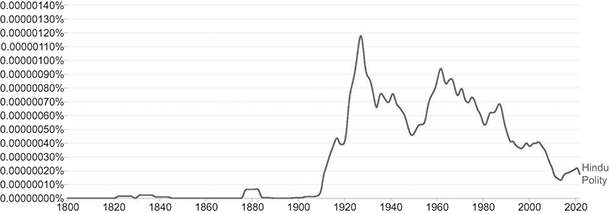
What can explain this decline? One reason may have been the death of Asutosh Mookerjee in 1924. Other, broader, reasons were mentioned by historians Ram Sharan Sharma and Maria Misra. Sharma noted the restricted social appeal of the Hindu polity literature. These works mainly attracted the educated middle classes and members of the upper castes; they could not appeal to members of the lower castes or Muslims.Footnote 153 According to Misra, the social values associated with a major source of the Hindu polity tradition, Kautilya’s Arthashastra, did not accord with the ideas of two important groups of Indian nationalists: Hindu revivalists such as Bal Gangadhar Tilak disliked the secular and amoral nature of the Arthashastra, its lax attitude toward the Hindu caste-based social hierarchy and Brahmin dominance, and its relatively pro-female values. Nationalist politicians such as Gandhi and Nehru disliked its cynical and unethical tone.Footnote 154 Interest in ancient Indian political theory, Misra concludes, thus reflected one specific phase in the history of pre-independence Indian nationalism, the phase associated with the Swadeshi Movement and Hindu activists in Bengal.
Apologetics
Within the Hindu polity literature, one can identify two opposite trends. Many works were driven by an anachronistic and apologetic desire to counter Western images of ancient India and to instill pride in the Hindu past by highlighting the similarities between ancient India and the modern West. However, some scholars looked askance at this apologetic motivation. The critique came from Western scholars but also from Indian ones. One example of the former can be found in Keith’s review of Jayaswal’s book, in which he argued that Jayaswal’s desire to find indications of democracy in ancient India was unsupported by the evidence. Keith said that the claim that republics existed during the Vedic period was based on a mistranslation. Republics did exist during later periods but they were aristocratic rather than democratic. The description of kings as elected, subject to law, and bound by the advice of their ministers was not the actual reality, Keith added, but merely “Brahmanical speculation.”Footnote 155
However, critique was not limited to Western scholars. In his 1921 book, Sarkar expressed the view that much of the existing literature did not clearly distinguish between actual institutions and “pious wishes or ideals of [political] theorizers.”Footnote 156 Echoing this skepticism, Bhandarkar remarked that Jayaswal’s work was “unfortunately vitiated by the patriotic bias” and by the fact that he was known “not only for misquotations but also experiments at translation.”Footnote 157 Ghoshal’s work, too, was far less celebratory than other Hindu polity works. Rejecting the anachronism embedded in the attempt to trace the origins of modern Western institutions back to ancient India, Ghoshal was willing to compare ancient Indian political notions unfavorably with early modern Western ones and also keen to reject apologetic theories such as the elected rather than divine nature of Vedic kings, the popular and democratic nature of Vedic assemblies, the existence of republics in the Vedic era, or the contractual nature of the state described in ancient Indian texts.Footnote 158
Nevertheless, Ghoshal did emphasize the originality of certain aspects of Hindu statecraft literature, such as the fact that Buddhist texts contained perhaps the earliest version of the social contract theory (albeit in a less systematic and developed form than in early modern European political theories). In an article entitled “The Genius of Indian Polity,” Ghoshal first identified two contradictory approaches to the history of Indian political thought. He associated one of these approaches with Western scholars (such as Vincent Smith, the author of The Oxford History of India, or Henry Herbert Dowell, the editor of The Cambridge History of India). These scholars regarded Indian political thought as uninteresting because, they claimed, it did not evolve and because autocracy was the dominant form of government. In contrast, scholars like Jayaswal, Radhakumud Mookerji, Altekar, and Majumdar advanced the opposing view that the Indian king was “virtually a constitutional slave” and ancient India a “vast rural democracy.” Ghoshal adopted an intermediate position, rejecting the argument that the ultimate disappearance of republics in ancient India meant that democratic institutions were somehow alien to its culture (Ghoshal reminded his readers that, in Europe, too, republican forms of government were not universal and that, for most of European history, monarchical forms had dominated the continent). While self-governing institutions existed during Vedic times, said Ghoshal, they tended to be replaced by centralized bureaucracies. Therefore, the picture of India as a “vast rural democracy” was inaccurate. It would also be wrong to conceptualize Dharma rules regarding the duties of kings as equivalent to modern constitutional law since these rules were not based on popular consent, and there was no human mechanism to enforce them. More generally, Ghoshal argued, it would be wrong to claim that ancient Indian states had a system of checks and balances to limit monarchical power.Footnote 159
The Role of Law
The Hindu polity literature was the product of lawyers, historians (and archaeologists), and social scientists. However, several of the historians and social scientists also possessed legal training. For example, Pramatha Nath Banerjea was a professor of Economics but was also called to the English Bar. Several chapters of his 1916 book Public Administration in Ancient India were devoted to legal matters, such as the structure, procedure, and rules of evidence of ancient Indian courts.Footnote 160 He also discussed various sources of law in ancient India, including custom and legislation.Footnote 161
Nevertheless, naturally, each professional group approached the topic of Hindu polity with its own emphasis. Historians such as Bhandarkar invested much intellectual effort in philological questions about the exact meaning of specific Sanskrit terms.Footnote 162 Social scientists like Sarkar were drawn to the ancient Hindu polity texts as sources for creating a non-Eurocentric (or, as Sarkar put it, non-“Eur-American” [sic]) science of comparative politics.Footnote 163 Lawyers were keen to examine specific rules governing ancient Indian institutions, and one can sometimes find in their works arguments that the topic was important because of its relevance to the constitutional law of modern India.
Jayaswal’s 1921 book can be seen as an example of an effort to extract norms relevant to modern constitutional law from ancient sources, even when this was problematic because of the lack of sources and the anachronism involved. The book included a chapter dealing with what might be called parliamentary procedures in the assemblies of ancient Hindu republics. Jayaswal could locate only one historical reference to this topic, a story about members of the sixth century BC Shakya republic deciding by majority vote whether to surrender to the Kingdom of Kosala. Jayaswal, therefore, suggested an “indirect” way of reconstructing parliamentary procedures in ancient Indian republics. The rules for making decisions in Buddhist monastic assemblies (samgha or sangha), he argued, were copied from the rules of decision-making in political communities. Hence, by studying the rules of these monastic assemblies, one could arrive at an idea of the rules of political ones. Jayaswal then embarked on a highly detailed discussion of the procedural rules dealing with decision-making in Buddhist monasteries, which he took from works such as the collection of Buddhist texts edited in the late nineteenth century by T. W. Rhys-Davids and Hermann Oldenberg.Footnote 164 Topics analyzed by Jayaswal included the exact language of the motions that started deliberations in the assembly, requirements regarding quorum, the existence of an assembly “whip,” rules regarding votes of members present in the assembly and absentee members, the use of ballots, delegations of decisions to ad-hoc committees, res judicata, censuring members of the assembly, the role of clerks and recorders of the House, and the use of referenda.Footnote 165
A similar interest in reconstructing the detailed rules of ancient Hindu law is found in Narendra Nath Law’s 1914 book. This book was divided into two halves. The first half was devoted to non-legal topics discussed in Kautilya’s Arthashastra (mining, irrigation, livestock, communications, and public utilities). The second half dealt directly with legal matters, beginning with courts and their procedure (including rules related to evidence). Law then turned to a long and detailed examination of various aspects of ancient Indian contract law based on the Arthashastra and many other sources. Contract law, a private law topic, was not discussed by other Hindu polity authors, and it is not clear what prompted Law to devote a sizeable portion of the book to it. The discussion included topics such as the requisites of a valid contract (dealing with norms regarding the parties, the role and use of witnesses, the time, the place, and the identity of the contracting parties, rules regarding undue influences, and consideration). Additional issues discussed were contracts for the sale of immovable property, the antiquity of the right of pre-emption, the sale of moveable property, loans, deposits, pledges, mortgages, bills of exchange, contracts of service, and partnerships.Footnote 166
Outcome
In discussing the impact of the Hindu polity literature, one can distinguish between, on the one hand, its academic impact in the West (that is, how Western Indologists and other Western scholars viewed it) and, on the other, its practical impact in India. Reactions to the Hindu polity literature in the West were mixed. Jayaswal’s pioneering 1913 article – which was based on a historical approach to Hindu law characterized by viewing this legal system as dynamic and comprehensive, not confined to personal law only – was praised by the German comparative lawyer Josef Kohler, who was perhaps the most important comparative law scholar in the first decades of the twentieth century.Footnote 167
However, many Western scholars in the early twentieth century continued to view ancient Indian states through the conventional nineteenth-century Western lens, associating them with despotism.Footnote 168 Accordingly, the nationalist tone of the Hindu polity literature was received with suspicion.Footnote 169 In a 1925 review of the Hindu polity literature, the Indologist Julius Jolly argued that it was not scientific enough. The nationalist tendencies and desire for Indian independence had led Indian scholars to mix history and politics, and, therefore, their conclusions were to be received with caution, he claimed.Footnote 170 Similarly, Arthur Berriedale Keith stated in 1927 that “the interest and value of the theme [of Hindu polity] have suffered unhappily from the unwise enthusiasm of some writers who have attempted to prove that India made notable contributions to the theory of politics, and that constitutional monarchy was early recognised.”Footnote 171
The same attitude can be found in Western discussions of Indian works that dealt with ancient Hindu international law. In a 1922 article, a British lawyer, W. S. Armour, criticized those Indian authors who argued that “there was a complete system of international law in ancient India.” The use of a term such as “international law,” said Armour, “with a history wholly modern” was inappropriate because:
… the territories of Indian Rajas could scarcely be called states at all in the modern sense of the term. Non-Indian peoples do not come within the scope of the Hindu religion or social system, and the rules I have cited could scarcely be called laws. It is doubtful whether some were even customs, as the evidence does not show that they were observed.Footnote 172
Western scholars adopted a critical attitude toward the Hindu polity literature. Within India, one could distinguish between those scholars who were focused only on the historical significance of the ancient Indian texts and those who were keen to explore their practical application to modern constitutional debates. Some Hindu polity works were based on a “scientific” or antiquarian approach, with no explicit call to apply their lessons to the present. However, other works, such as those by Radhakumud Mookerji, called for applying Indian constitutional history to modern constitutional debates. In his 1919 book, Mookerji stated that studying the history of ancient Indian institutions would be useful not just for teaching the people “national self-respect” but also for more practical reasons. Such study would enable the government to “shape” new governmental institutions “upon the lines of the old.”Footnote 173
Non-academic writers echoed this approach. In 1934, an Indian lawyer, Achintya Mukherjee, published an article that urged the makers of the future constitution of India to study ancient Indian constitutional history. “Every nation,” Mukherjee explained, “builds up a polity of its own, which reflects its own distinctive type of culture.” Constitutional changes, if introduced, “should be congenial to the nature of the political evolution of the nation.” He then went on to briefly discuss some significant themes found in the Hindu polity literature: kings were elected; the Danda Neeti – that is, “the Constitutional Law of the land” – was placed above the kings, who had a duty to protect their subjects; there was an “Aryan Constitution,” according to which kings did not have absolute power but had to fulfill the instructions of their assemblies and councils, in which all segments of society were represented; and, generally speaking, the ancient Indian monarchy was a constitutional rather than an absolute monarchy.Footnote 174
The 1940s saw additional calls to use the Hindu polity literature as a source of inspiration for the Indian Constitution. At the beginning of this chapter, I mentioned Agarwal’s and Rau’s works, but there were other examples. An article by Anant Sadashiv Altekar of Benares Hindu University published in 1947 stated that: “India is at present engaged in framing a new constitution. It will, therefore be not uninteresting to survey ancient Indian polity and its achievements. If we take an impartial survey of it we may learn some important lessons for the present and the future.”Footnote 175
What lessons were offered by Altekar? First, he noted the existence of republics in ancient India and argued that they disappeared because they were only appropriate in smaller states united by tribal loyalty. However, he argued, modern India could become a democratic republic despite its massive size because “distances have been annihilated now,” and the idea of representative government could replace the need for tribal loyalty. A further reason for the decline of republics was internal strife within their assemblies. This should be a lesson to the future Indian Parliament, Altekar contended.Footnote 176
Moving on to Indian kings, Altekar noted that ancient Indian monarchs were seen as trustees and were celebrated only if they promoted the well-being of their subjects. Modern Indian monarchs could continue to rule Indian (princely) states, but only if they were virtuous, he reasoned. One of the problems with ancient Indian kings was that the mechanisms designed to restrict tyrannical tendencies were weak. Popular assemblies were one such mechanism, but they disappeared after the Vedic era, leaving mainly the fear of divine punishment as a constraint on tyranny. Modern India, he said, should, therefore, develop secular, practical remedies to control the actions of tyrannical rulers.Footnote 177 Another mechanism to constrain tyranny in ancient India was decentralization, as evident in the need to obtain the consent of town and village councils for many governmental actions. The complexity of modern life, Altekar observed, made the reliance on village councils more problematic. Nevertheless, he did recommend using them in some instances.Footnote 178
Altekar discussed the fact that ancient Indian states accepted and promoted the caste system and that, therefore, the idea of the equality of all citizens before the law did not exist in ancient India. However, he assured his readers that “inequalities existed in all civilisations, eastern and western, and have not completely disappeared even in modern times.” In this sense, India was not unique.Footnote 179 Finally, Altekar noted that ancient Indian empires were based on a model of a central government that also permitted the existence of local governments enjoying relative autonomy. This idea of a strong and united India that also granted full autonomy to its provinces should be followed now, he urged.Footnote 180
Conclusion
The Hindu polity literature was a result of a specific time and place: Calcutta in the 1910s and 1920s. This body of works had a close affinity with the Swadeshi Movement in Bengal. Many of the Hindu polity authors were lawyers by training, but their writings were not taught at the College of Law of the University of Calcutta. Instead, their works became part of the curriculum in related fields such as History, Political Science, and Economics. While historians were naturally interested in this literature, it also had some contemporary relevance. It echoed Indian nationalist themes prevalent in the first decades of the twentieth century, and it was also mentioned in (although it had little impact on) Indian constitutional discourse in the period leading up to and immediately following Indian independence in 1947.
The depictions of ancient Indian political theory and institutions found in the Hindu polity works may have been anachronistic, and, as more critical observers already noted in the 1920s, the nationalist ideology of the authors may have led them to describe the nature of ancient Indian states inaccurately. Nevertheless, the Hindu polity literature is interesting as an expression of Indian and Hindu cultural nationalism during the first decades of the twentieth century. Similar things can be said about works dealing with Jewish public law that appeared during the same period in Europe, North America, and Mandatory Palestine. These works will be discussed in the next chapter.
In 1944, Ya‘acov Berman, a Religious Zionist rabbi living in Mandatory Palestine, published a book in Hebrew on Jewish political thought. In this book, Berman urged his readers to adopt a historicist approach to constitutional law. Quoting the nineteenth-century German legal scholar Rudolf von Jhering on the “national spirit” that underlies the legal system of every nation, Berman argued that ancient Jewish traditions could serve as the basis of the constitutional law of the future Jewish state. Jewish law, he claimed, had an answer to all the problems facing modern constitutional and international lawyers. “We are standing on the threshold of great and decisive events,” he explained, and the Jews of Palestine would soon need to create a constitution for themselves. When the time came, Berman proclaimed, secular Zionists would turn to “Assyria and Egypt” – or, more accurately, to their modern equivalents, “Switzerland and Albania.” They would thus seek to create a borrowed constitution, he warned, that would not include any trace of Jewish heritage, despite the fact that the greatest non-Jewish constitutional thinkers had borrowed their ideas from the Jews.Footnote 1
Despite Berman’s suggestion that secular Zionists were uninterested in Jewish constitutional traditions, some secular Zionist intellectuals also embraced the historicist approach that Berman advocated. For instance, in 1946, Eliezer Livneh, a secular socialist Zionist journalist, argued that the future Jewish state should draw on Jewish political thought rather than Western models, contending that the Jewish nation was fundamentally distinct from all others. He further maintained that key features of modern Western states, such as democracy and the protection of social rights, had their origins in Jewish political tradition.Footnote 2
The State of Israel was established four years after Berman published his book. The months before and after Israel’s declaration of independence, on May 14, 1948, saw intensive constitution-making efforts (although, ultimately, these efforts would fail, rendering Israel one of the few countries in the world that, to this day, does not have a comprehensive single-document constitution). The official drafter of the Israeli constitution was a German-Jewish Zionist lawyer called Leo Kohn, who prepared three consecutive drafts.Footnote 3 Kohn was an observant Jew, and his commentaries on these drafts included references to the influence of Jewish constitutional traditions. In a commentary Kohn wrote on the final draft of his proposed constitution, published in January 1949, he stated – in words that echo those of S. N. Agarwal and B. N. Rau, with which I opened Chapter 5 – that “if a Constitution is to command the enduring loyalty of a people, it must be rooted in its moral and political traditions.”Footnote 4
Some Jewish constitution-makers, it seems, espoused historicist ideas about constitutional law similar to those we saw Indian scholars using in Chapter 5. In this chapter I explore these ideas. I examine works on Jewish public law, focusing mainly, but not exclusively, on scholars working in Mandatory Palestine during the period of the British Mandate. I begin by describing how constitutional law and international law were taught in the academic institutions of Palestine and then briefly introduce the scholars writing on Jewish constitutional history. The next part of the chapter summarizes some of the major ideas found in the texts produced by those authors. Finally, I analyze the general characteristics of the works discussed in this chapter and the context which gave rise to them. Like the previous chapter, my interest does not lie in debating whether the early twentieth-century Jewish works accurately interpreted the authentic meaning of the ancient texts they examined and correctly depicted the true nature of Jewish political institutions and law. Instead, my goal is to understand how the nationalist ideology of some Jewish scholars in the early twentieth century influenced their writings on Jewish public law.
The Study of Constitutional and International Law in Mandatory Palestine
The three institutions that offered modern legal education in Mandatory Palestine taught various aspects of constitutional and international law. In the 1920s, students at the Jerusalem Law Classes were required to take a course entitled Constitutional History, a course on political science, and another on public international law.Footnote 5 In the 1930s, the course title was changed to Constitutional Law, and it was restructured, now containing three parts. Students first studied “the law and custom of the English constitution,” including a discussion of constitutional rights such as personal freedom and freedom of speech. They then learned the constitutional law of the British Empire, focusing on the Dominions and British India. In the third part, they studied the constitutional law of Mandatory Palestine. Additional relevant topics (the League of Nations and the mandates system) were taught as part of the course on public international law.Footnote 6 The lecturer teaching the course on Constitutional Law, Ephraim Salant, was the author of one of the first books on the constitutional law of the British Empire.Footnote 7 While Jewish students at the Law Classes also studied a course on Jewish law, it seems that this course focused only on the specific area of Jewish law that had practical application in Mandatory Palestine: Jewish family law.Footnote 8
Students at the Tel Aviv School of Law and Economics were required to take two constitutional law courses, one on the constitutional law of Great Britain and the British Empire and another on the constitutional law of Palestine. They were also offered a course on the mandates systems and a course on international law.Footnote 9 Constitutional law was taught by Shmuel Ussishkin, who had studied law at the Universities of Odessa and Cambridge.Footnote 10 During the Mandatory period, Ussishkin published three books on the topic in Hebrew.Footnote 11 He had a strong affinity to English constitutional traditions. Readers of his books were told that “England and its [political] regime have served as the epitome of democracy … a classic example of an ideal regime which promises the citizen freedom and security, unafraid of the tyranny of government officials … a country where the ideals of popular rule and civic freedom have been realized.”Footnote 12 Beyond Ussishkin’s books, students at Tel Aviv were also assigned English textbooks dealing with constitutional law (such as Dicey, Ridges, and Chalmers).Footnote 13
International law was also taught at the Tel Aviv School of Law and Economics. The compulsory course on international law there included a discussion of the Jewish contribution to international law, focusing on the biblical period. Thus, the first part of the course on the topic, taught in 1939 by Max Laserson, dealt with themes such as international relations between the countries of the ancient Near East: Egypt, Babylon, Assyria, and Canaan; the Israelite notions of agreement, treaty, and covenant; elements of international relations in the relationship between the tribes of Israel during the periods of the biblical judges, and the period of the first Israelite kings, David and Solomon.Footnote 14
In addition to these courses, an extensive course on Jewish law and its history was offered at the Tel Aviv School of Law and Economics. This course was divided into three sections dealing with Jewish private law, Jewish family law, and Jewish public law. The latter section on Jewish public law included topics such as biblical kings and their wars, the Jewish courts during the Second Temple period, and the institutions of Jewish communities in the medieval and early-modern periods.Footnote 15 Another required course at the Tel Aviv School dealt with political science (torat ha-medinah). Most of this course was devoted to studying universal political concepts such as the social contract, sovereignty, imperialism, and the separation of powers, but it seems that there was also some effort to relate these topics to Jewish constitutional history. Thus, topics covered in this course included biblical pre-monarchical society and the nature of Jewish theocracy in the Bible, the Talmud, and the works of the medieval Jewish scholar Maimonides.Footnote 16
Finally, while the Faculty of Law of the Hebrew University of Jerusalem was only established in 1949, some courses dealing with international law had already been taught at the university during the Mandatory period. In the early 1930s, the university received a donation from an English Jewish industrialist, Sir Montague Burton, who was interested in “the causes of international and industrial peace” and donated funds to establish Chairs on these subjects at the Hebrew University and several English universities. At the Hebrew University, the Chair was devoted to “the international law of peace” and was held by the former Attorney General of Palestine, Norman Bentwich.Footnote 17 Bentwich had been involved in the activities of the Jewish Law Society in Palestine in the 1920s, and was interested in the nexus between religion and international law. His course of lectures on the topic, later published as a book, included discussions on the impact of Jewish law (as well as Christianity, Islam, Hinduism, and Far Eastern religions) on international law.Footnote 18
A major aspect of teaching and research at the Hebrew University was the study of Jewish history, undertaken by members of the Institute of Jewish Studies, one of the three original research institutes of the University.Footnote 19 Shortly before his appointment as a lecturer at the Institute, Simha Assaf, a Russian-Jewish scholar, had published two books dealing with topics related to public law: Jewish criminal law and Jewish courts and their procedures.Footnote 20 However, Assaf did not pursue these topics later. Another Jewish Studies scholar who taught at the Hebrew University was Asher Gulak. Unlike Assaf, who had no legal training, Gulak studied law at the University of Dorpat (now Tartu) during the final years of the Russian Empire, graduating in 1911. Gulak was one of the founders of the Jewish Law Society established in Moscow in 1917. One of Gulak’s earliest articles, published in several installments, focused on Jewish public law.Footnote 21 However, in his landmark four-volume Principles of Jewish Law, published between 1913 and 1922, he focused on private law and only briefly mentioned Jewish public law.Footnote 22 Later, while teaching at the Hebrew University in the 1920s and 1930s, Gulak also focused on the study of Jewish private rather than public law.Footnote 23
The interest that some of the lecturers in constitutional and international law in Mandatory Palestine showed toward teaching and studying Jewish law was part of a broader scholarly interest in the topic, manifested in works by Jews and non-Jews alike in Palestine and abroad. I will now describe some of these scholars.
Authors
My discussion of the Hindu polity literature in Chapter 5 focused on Calcutta in the first decades of the twentieth century. Such a geographical and temporal focus is not possible in the Jewish case. The Jewish community in Palestine was merely one of several centers of Jewish intellectual and cultural life during the interwar period. Some scholars interested in Jewish public law lived in Palestine, but many did not. Any discussion of the literature produced in Palestine must therefore take into account parallel works emerging from major Jewish intellectual centers in Europe and North America. Moreover, interest in Jewish public law did not appear in the twentieth century. Given the Jewish roots of Christianity, it is not surprising that Christian scholars were interested in Jewish political institutions and public law. Thus, early-modern Christian Humanists, influenced by the ideas of the Reformation, wrote about the rules of Jewish law regarding kings, courts, the poor, women, slaves, and converts. These scholars published works on Jewish law in Latin, often utilizing Roman law concepts to describe Jewish law. Later, the American Founding Fathers showed a similar interest in Jewish political thought, and this interest continued into the nineteenth and early twentieth centuries.Footnote 24 As for traditional Jewish religious scholars, despite the loss of Jewish political independence and the destruction of the Second Jewish Temple (70 AD), Jews in later periods lived in autonomous communities governed by their own rules. Jewish law, therefore, developed an extensive body of norms to deal with the collective aspects of Jewish life, and generations of rabbis studied, discussed, and developed these rules (as well as studying the rules that would govern the ideal Jewish polity of the future).Footnote 25
Beginning in the seventeenth century with the works of Baruch Spinoza, efforts were made to turn Judaism into a “religion” in the Protestant sense – a private affair divorced from political life and law – thus allowing individual Jews to fit into the new European political framework of secular nation-states. These attempts continued in the works of eighteenth- and nineteenth-century German-Jewish scholars. However, following the appearance of Zionism in the late nineteenth century, some Zionist (and non-Zionist) thinkers started questioning the view that Judaism was merely a matter of individual religious choice and emphasized the collective, national aspects of Judaism, thus gradually leading to a renewed interest in the Jewish political institutions and the norms governing them.Footnote 26
In the early decades of the twentieth century, at least three distinct groups were writing on the topic of Jewish public law: (i) Orthodox rabbis using traditional halakhic idioms and genres; (ii) Jewish scholars working in the Diaspora, writing Western languages; and (iii) Cultural Zionists (both observant and secular), writing mainly in Hebrew. These Cultural Zionists were often associated with the movement for the revival of Jewish law and the Tel Aviv School of Law and Economics, and they sought to use the ancient materials as a source of inspiration for the law governing future Jewish political entities in the Diaspora and Palestine. Let us now turn to each of these groups.
Orthodox Rabbis Using Traditional Halakhic Idioms
In the early decades of the twentieth century, several Diaspora rabbis wrote significant works on Jewish public law. Among the most prominent was Rabbi Haim Hirschensohn, who was born in Palestine in the mid nineteenth century, and immigrated to the United States in 1903.Footnote 27 Influenced by the democratic culture of the United States (which, he argued, was influenced by the Bible), Hirschensohn envisioned a future democratic Jewish state based on Jewish law. In works such as his multi-volume collection of responsa, Malki ba-Kodesh, published between 1919 and 1928, Hirschensohn argued that democracy was in complete accord with the commandments of Jewish law, demonstrating his argument by reference to the biblical idea of the covenant between God and his people, and the legislative role given to laymen in post-biblical Diaspora Jewish communities. Hirschensohn rejected claims that Jewish law required a monarchical regime. He also argued that the conventional view that Jewish law prevented women from voting or holding public office was incorrect.Footnote 28 Hirschensohn’s works also included discussions of topics related to international law.Footnote 29
Rabbis active in Mandatory Palestine produced similar works devoted to applying Jewish law to address the challenges and needs of a modern society and state. This literature, which was also mostly written in traditional halakhic idioms, dealt with many concrete practical problems, such as how to adjust the rules of Jewish law to the needs of modern agriculture. The rabbis also dealt with more abstract questions, including the possibility of reviving ancient Jewish political institutions such as the central Jewish judicial institution of the Second Temple period, the Sanhedrin. Prominent rabbinical figures such as Ben-Zion Meir Hai Uziel, the Sephardi Chief Rabbi of Palestine, and Isaac Herzog, the Ashkenazi Chief Rabbi, played key roles in shaping this body of literature. Neither Uziel nor Herzog had formal legal training. However, the rabbinic discourse on Jewish public law in Mandatory Palestine also included legally trained contributors, such as Rabbi Isaac Breuer, a Hungarian-German Jew, who studied law in Frankfurt and practiced there until immigrating to Palestine in 1936.Footnote 30
As historian Alexander Kaye has argued, by the 1940s, some of these rabbis had gradually come to embrace a radical take on the role of Jewish law in a future Jewish state: the idea of a Jewish theocracy. Jewish law, they believed, would not merely constitute one historical source of institutions and norms of the future Jewish state, nor would the legal system of this state be a pluralist one, in which Jewish law and courts would coexist alongside courts using secular law. Instead, swayed by the profoundly modern and novel notion of Jewish theocracy – one with no real precedent in Jewish history – these rabbis were convinced that the future Jewish state would be governed by a single centralized legal system based on Jewish law, which would be declared in the future Israeli constitution as the fundamental law of the state.Footnote 31
Jewish Scholars in the Diaspora Writing in Western Languages
Jewish scholars in the Diaspora also wrote extensively on Jewish public law with the intention of addressing broader audiences, Jews but perhaps also Gentiles. One example of such works, from Germany, is a 1914 volume that was part of a series called Monumenta Talmudica. The volumes of this series contained digests of passages translated from the Talmud. The volume dealing with law, edited by a young historian, Salomon Gandz, dealt with Jewish public law and included passages on kings, courts, priests, and the rules pertaining to the administration of Jewish communities.Footnote 32
Jewish-American authors writing in English also belonged to this group. Mayer Sulzberger, a Philadelphia judge, published two relevant books in the early 1910s, one on biblical parliamentarism and the other on “the polity of the ancient Hebrews.”Footnote 33 Israel Friedlaender, a professor at the Jewish Theological Seminary of America in New York, wrote an essay on the political ideals of the prophets. Another essay of his sought to refute the notion, common among “Aryan” scholars, and also some Jewish ones, that Jews (specifically) and Semites (generally) were incapable of self-government and that the biblical Jewish states were characterized by “bad government, tyranny, and oppression,” just like every other “little oriental state.”Footnote 34 Nathan Isaacs, a law professor at Harvard University, published a book chapter devoted to the “Legacy of Israel,” in which he analyzed the influence of Judaism on various aspects of public and private Western law. Here, Isaacs argued, for example, that Judaism was the source of the Christian idea of the separation of Church and State.Footnote 35
A 1928 book by Abba Hillel Silver, an American Reform Rabbi and Zionist leader, provided a detailed discussion of Jewish democracy. In this book, Silver argued that ancient biblical Jews, as well as post-biblical ones, were animated by a democratic spirit: when the Jews wandered in the Sinai Desert, they were not governed by kings; nor were kings present during the initial period of Israelite settlement in Canaan. Later in biblical history, kings did appear, explained Silver, but, unlike kings in other ancient monarchies, they were not deified. Silver claimed that the Bible generally displayed a critical approach to the idea of monarchy, as is evident by the stories about the prophets and their critique of both kings and the priestly class. Once Jewish independence was lost, Silver said, kings and temples were replaced by democratic institutions: the synagogue, led by lay leaders, and the religious school, open to all Jews and based on the notion of popular rather than elite education. During later periods of Jewish history, an aristocracy of legal scholars emerged, but the Jewish masses rebelled time and again against this aristocracy, as is evident by the appearance of movements such as medieval Karaism or early-modern Hasidism.Footnote 36 A later work by Silver contained an extensive discussion of Jewish attitudes to the notion of equality based on the Bible and on post-biblical sources such as the Talmud. In this work, Silver claimed that Judaism was characterized by its egalitarian nature, unlike religions such as Hinduism, with its caste system. More generally, Silver argued that the notion of social hierarchy was “an Aryan concept.”Footnote 37
In the middle decades of the twentieth century, an American law professor, Helen Silving, wrote several articles on Jewish public law. Silving was born in the Galician part of the Austro-Hungarian Empire to an orthodox Jewish family. She studied law at the University of Vienna, becoming one of the first female students associated with the intellectual circle which formed around the leading Austrian legal theorist, Hans Kelsen. With the rise of Nazism, she fled to the United States, later earning a law degree from Columbia University. In 1956, she became a professor of law at the University of Puerto Rico and, thus, one of the first female law professors in the United States. An expert in criminal law, Silving also taught in South Korea, where her husband, Paul K. Ryu, who was a prominent legal scholar, served as President of Seoul National University.Footnote 38
In her articles on Jewish law, Silving argued that the Old Testament was a political document containing various fundamental concepts that had shaped modern Western democracy. In particular, she pointed to the belief that legal rules should be based on the consent of the governed; the notion of the rule of law; the concept of the social contract; the idea of constitutional constraints on monarchical power; the principle of equality of all citizens before the law; the claim that laws should be accessible to all the members of the polity and should be studied by all its members; freedom of thought; due process; equal protection; and respect for popular will (but not respect for popular will embodied in the notion of majority rule).Footnote 39
Cultural Zionists
The final group of authors that will be the focus of this chapter comprised Cultural Zionists working in both the Diaspora and Mandatory Palestine. Unlike the first group of authors, orthodox rabbis, this group of scholars analyzed Jewish public law using Western historical and legal concepts. Unlike the writers belonging to the second group of authors, the works of the Cultural Zionist authors were mainly written in Hebrew. In addition, Cultural Zionist authors sought to convince their readers not only that Jewish law was a source of modern political institutions and law but also that it could be used in the present.
Several Polish-born Zionist scholars working in the Diaspora belonged to this group. They included Jacob Zuri who studied philosophy, linguistics, history, sociology, and law in France, Germany, and Switzerland, immigrated to Palestine in 1912 and taught at the Jerusalem Law Classes and the Hebrew University, but returned to Europe in the late 1920s, where he remained active until his death in 1943.Footnote 40 Jacob Mikliszanski studied law in France and obtained a doctoral degree from the Sorbonne in 1935. During the Second World War, he fled to the United States, where he taught at Dropsie College in Philadelphia and at Hebrew College in Massachusetts.Footnote 41 Mikliszanski published several works on Jewish law and international criminal law and the law of war.Footnote 42 Simon Federbusch was ordained in Poland as a rabbi and later studied at the Universities of Krakow, Lwow, and Vienna, where he obtained a doctorate in law. Federbusch was a member of the Polish Parliament in the 1920s and served as the president of the Religious Zionist Party, Mizrahi, in Galicia. In 1931, he moved to Finland, serving as the Chief Rabbi there until 1940, when he immigrated to the United States.Footnote 43 In 1952, inspired by the establishment of the State of Israel, Federbusch published a book in Hebrew containing a comprehensive discussion of Jewish public law.Footnote 44
Moving to scholars based mainly in Palestine, three of the four founders of the Tel Aviv School of Law and Economics, Samuel Eisenstadt, Paltiel Dikshtein, and Max Laserson, wrote on Jewish public law.Footnote 45 Another notable figure associated with this school was Shimshon Rosenbaum. A Russian Jew, Rosenbaum studied law in Vienna and Odessa during the 1880s before establishing a legal practice in Minsk. He played a significant political role in early twentieth-century Russia, serving as a member of the country’s first elected parliament, the State Duma, formed after the 1905 Revolution. After the First World War, he was an important figure in the political development of the newly independent Lithuanian state. His roles included Deputy Foreign Minister, member of the Lithuanian Constituent Assembly, Member of Parliament, and Minister for Jewish Affairs. In 1924, Rosenbaum moved to Palestine. There he led the Tel Aviv Branch of the Jewish Law Society, served as President of the Jewish Courts of Arbitration, and was involved in the early stages of the creation of the Tel Aviv School of Law and Economics.Footnote 46 While mainly a lawyer and politician, Rosenbaum was also a legal scholar. He wrote about the impact of Jewish law on international law, and on the secular, non-theocratic nature of ancient Jewish states.Footnote 47
Two other persons connected to the Jewish Law Society were Rabbi Arye L. Grajewsky and Rabbi Ya‘acov Berman. Grajewsky, born in Poland, immigrated to Palestine as a child. He pursued legal studies in Egypt, at the Cairo Law School, and later completed his legal education in the Sorbonne in Paris, where he also studied philosophy. In 1935, he returned to Palestine and worked as both a teacher and a lawyer.Footnote 48 Berman studied law at Saint Petersburg University and later taught, like Eisenstadt, at the Odessa Rabbinical Seminary. In 1921, he moved to Palestine, where he served as a General Inspector in the school system affiliated with the Religious Zionist Mizrahi movement. In 1944, he published the book on Jewish political theory cited at the beginning of this chapter.Footnote 49 Finally, interest in ancient Jewish political institutions and law was also evident in a 1946 collection of Jewish sources titled The Hebrew State, published in Mandatory Palestine.Footnote 50 This book contained a long introduction by Eliezer Liebenstein (Livneh), a secular journalist associated with the Zionist Socialist MAPAI political party, whose historicist approach to constitutional law closely paralleled Berman’s.Footnote 51
Themes
Jewish Public Law: Developed, Secular, Innovative
A preliminary challenge that scholars of Jewish public law had to address before discussing specific topics was that most of the development of Jewish law had occurred after the Jews lost their political independence following the destruction of the Second Temple by the Romans in 70 AD. While Jewish communities in the Diaspora did have communal institutions, these never resembled those of a modern state. Therefore, it was perfectly feasible to claim that Jewish public law did not exist.Footnote 52
In an article published in Moscow in the inaugural 1918 volume of the journal Ha-Mishpat ha-‘Ivri, Samuel Eisenstadt traced the development of Jewish public law from the biblical period onward. He argued that it had already existed, in embryonic form, in the periods of the biblical patriarchs and that it had continued to develop until the end of the Second Temple period. Even after the Jews lost their political independence, Eisenstadt added, Jewish public law did not disappear because Jewish communities in the Diaspora enjoyed a certain level of autonomy and, thus, rules were created by individual Jewish communities, as well as by supra-community organizations such as the Council of Four Lands (the central body representing Jewish communities in the early-modern Polish–Lithuanian Commonwealth).Footnote 53
Jewish law was often compared to another ancient legal system, Roman law. The common view of Roman law was that the private law part of Roman law was far more developed than its public law dimension. In his article, Eisenstadt noted this common view of Roman law and referred to the work of Theodor Mommsen, the nineteenth-century German historian. Mommsen had rediscovered Roman public law, which had long remained obscured within the great sixth-century Roman law text, the Corpus Iuris Civilis, in the interstices of private law. Referring to Mommsen’s approach, Eisenstadt declared that the same task awaited scholars of Jewish law, who, like the German Romanists, should endeavor to rediscover the original rules of Jewish public law.Footnote 54 The study of Jewish public law, he said, was important not only for scholarly reasons but also because it would serve a practical goal, assisting in the creation of a new Jewish political life that would not be reliant on foreign sources but based on Jewish ones.Footnote 55
Eisenstadt’s article also addressed a second major objection to the existence of Jewish public law – namely, the claim that Jewish law, being inherently religious, could not serve as the basis for public legal norms. In the modern Western context, religion is typically confined to the private sphere, while law, especially public law, is seen as belonging to the public sphere and is expected to operate independently of religious influence. This separation is seen as essential to the functioning of the modern secular state.Footnote 56 In response to this objection Eisenstadt argued that Jewish law was not really religious. Religion was merely a “mask” hiding its secular nature.Footnote 57
A connected idea, whose origins date back to the works of the Roman-Jewish historian Josephus, was that ancient Jewish kingdoms were theocracies. Asher Gulak spent most of his career writing on private law. In his monumental book Principles of Jewish Law, published in the period immediately before and after the First World War, Gulak stated that, unlike other legal systems, Jewish law developed independently of the existence of a state. Moreover, he claimed that even when the Jews enjoyed political independence, the goal of Jewish law was not to enable governance but to further just relationships between individuals. Once Jewish independence was lost, constitutional, administrative, and criminal law became defunct, and only private law continued to develop.Footnote 58 However, in 1917, Gulak published a four-part article in a Jewish-Russian newspaper on the history of ancient Jewish politics. In this article, he argued that the conventional view of ancient Jewish kingdoms as theocracies was wrong: the Israelite and Jewish kingdoms of the First and Second Temple periods were secular. One could find two forces contending within these kingdoms – kings implementing ordinary secular policies; and religious prophets, independent and critical of the kings, who were animated by a vision of ethical politics based on justice. This division also appeared in the realm of legislation, according to Gulak. Kings legislated, just as those in other ancient Near Eastern kingdoms did, but the prophets criticized royal legislation because they saw it as unjust and oppressive.Footnote 59
Another scholar, Shimshon Rosenbaum, wrote in a 1930s article entitled “Common Errors” that the Christian tradition erroneously argued that Jewish polities were theocracies. Initially, Rosenbaum said, Jewish priests did have some influence on politics, as was the case with all other peoples in their early history, but this influence waned. Between the second century BC and the first century AD, the Hasmonean dynasty ruled Judea. While the Hasmoneans were a priestly family, they ruled the Jewish state not because of their priestly lineage but because they were associated with the fight for Jewish independence. The assumption that Jewish polities were theocracies, said Rosenbaum, was echoed in the belief that Jewish law was religious, but upon examining the content of Jewish law, it would become clear that it was secular.Footnote 60
Another aspect of the debate over the religious nature of Jewish law can be found in discussions of legal dualism – the notion that secular and religious courts and secular and religious law should exist side by side. Simon Federbusch devoted a chapter of his 1952 book to a distinction between “the law of the Torah” and “the law of the kingdom” (mishpat ha-melukhah). Federbusch argued that Jewish law recognized the king’s power to create rules to deal with myriad public matters in the realms of administrative, civil, and criminal law as long as these rules were not in direct contravention of the rules of the Torah. He traced this idea to the era of Moses and the period of the biblical kings and argued that this distinction also legitimized communal enactments in Jewish communities in the Diaspora (takanot ha-kahal). One could also use this distinction, Federbusch said, to provide halakhic legitimacy to the norms created by the secular legislature and the secular courts of the new State of Israel.Footnote 61
The argument that Jewish public law was irrelevant to a modern Jewish state was also based on the image of Jewish law as an inferior, and perhaps also barbaric, legal system. There were two facets associated with this image. One facet was the argument, found in the works of German non-Jewish biblical scholars in the nineteenth and twentieth centuries, that biblical laws (as well as biblical theological and moral concepts such as monotheism or social justice) were copied from the laws of more developed Near Eastern nations. Yerucham (Philip) Korngruen, a teacher at the Tel Aviv School of Law and Economics (who also served as a District Judge in Mandatory Palestine), wrote a book comparing Mosaic law with the laws of Babylonia, Assyria, and the Hittite Empire to refute this argument.Footnote 62
The second facet of the image of Jewish law as inferior stemmed not from comparisons with other ancient legal systems, but with modern ones, based on the claim that Jewish law was antiquated and, thus, irrelevant to modern needs. In the works of the scholars discussed here, a common response to this claim was to show that Jewish law was not antiquated but dynamic and innovative and, therefore, on par with modern legal systems. Specifically, it was argued that two major legal fields often regarded as “modern” were already present in ancient Jewish law: social law, meant to protect the rights of the weakest groups in society; and international law.
Early Zionist political leaders, when discussing their vision of a future Jewish state in Palestine, sometimes mentioned biblical rules that had a socio-economic dimension. For example, the rules regarding land redemption, slave emancipation, and debt forgiveness during the Jubilee year, or the idea of the Sabbath as a model for the protection of workers’ rights. Zionist leaders pointed to these laws as models for legislation in the future Jewish state, a state that they envisioned as founded on the principles of social justice.Footnote 63
Similarly, the Jewish legal scholars I analyze in this chapter also turned to the biblical prophets and their notions of social justice. For example, in his book on the prophets, Eisenstadt, whose political views were on the spectrum between socialism and communism, explained that they were actually secular social reformers. The prophets, he claimed, saw God as a source of “social truth and justice” and as the “defender of the poor and of the weak, the punisher of every brute and oppressor,” furthering a “humanist, universal worldview.”Footnote 64 Jewish law was thus a revolutionary law, which contained, even in ancient times, ideas commonly believed to have appeared only in the modern era.
A detailed discussion of Jewish social and labor laws is found in Federbusch’s book. He argued that the social legislation that characterizes modern progressive states can be traced back to ancient Jewish law. Jewish law imposed various duties designed to assist the poorest and weakest members of society, such as the duty of universal education. It created the notion of progressive taxation, and developed various regulations designed to protect the health and safety of workers and all other persons. Jewish law sought to limit the right of private property, and ancient Jewish social movements (such as the Essenes) embraced notions of communal property. Furthermore, Federbusch noted that Jewish law prohibited usury, celebrated the dignity of manual labor and laborers, pioneered the concept of social insurance, and recognized the right of workers to strike and unionize.Footnote 65
International law, often seen as a distinctly modern legal field, was also viewed by some early twentieth-century scholars as having roots in the principles of ancient Jewish law. This claim appeared in the works of both non-Jewish and Jewish scholars. One non-Jewish scholar who argued that Jewish law in antiquity (as well as other ancient legal systems) contained rules dealing with international law was the German comparative law scholar Josef Kohler. In 1918, Kohler published a book that included a discussion of the history of ancient international law. Kohler devoted several pages of his book to describing biblical international law. Much of this discussion dealt with the laws of war, which Kohler analyzed in all their rather gory detail (killing of male captives, distribution of captive women and children as the spoils of war, and so on). Kohler also mentioned the vision of universal peace found in the Book of Isaiah but argued that such a vision could not be seen as part of international law because it was a utopian messianic idea divorced from earthly politics.Footnote 66
In contrast to Kohler’s relatively objective approach, Jewish authors often claimed that the Jews invented international law and that the international law norms they created were more humane and, therefore, more “modern” than those of other nations in antiquity.Footnote 67 For example, in 1917, Gulak wrote an article tracing the notion of universally just law applicable to all nations to the biblical prophets. Gulak also noted that the biblical prophets created the ideal of perpetual peace and contrasted this ideal favorably with modern pacifism, which, he said, was based on the notion that peace would only result from legal coercion by an alliance of powerful nations.Footnote 68 Eisenstadt, too, published an article in the 1920s discussing in detail the Jewish (and, more generally, ancient Near Eastern) roots of international law.Footnote 69 The same volume in which Eisenstadt’s article appeared also contained a brief report on a lecture delivered in 1925 at the Tel Aviv branch of the Jewish Law Society by Shimshon Rosenbaum, in which Rosenbaum had argued that international law first appeared in the Bible.Footnote 70
International law was taught at the Hebrew University in the 1930s by Norman Bentwich. In his 1932 inaugural lecture, Bentwich claimed that the ideas of universal peace and one universal law applicable to all nations – principles upon which modern international law and its institutions (the League of Nations) were based – had their roots in the prophecies of the biblical prophets.Footnote 71 In an article published during the same year, Bentwich discussed the Bible as the source of the international laws of war. The Bible, he said, was one of the major fonts of international law in the early modern period. Christian legal scholars such as the early-modern English jurist John Selden were inspired by the Bible (and also by medieval Jewish scholars such as Maimonides and Nachmanides) when distinguishing between just and unjust wars. According to Bentwich, Jewish law was also the source of inspiration for the Muslim laws of war – for example, the idea that Muslims should fight infidels but should protect the “people of the book” (Jews and Christians), provided they submit to Muslim rule.Footnote 72
The Jewish-Polish-French-American scholar Jacob Mikliszanski published detailed discussions of two subfields of international law: international criminal law; and the laws of war. In a 1937 article, Mikliszanski claimed that, unlike all other ancient legal systems, Jewish law was able to create a just and moral system of international criminal law. This general claim was not original. It was based on an observation made in a 1922 book by the French international law professor Henri Donnedieu de Vabres, who had supervised Mikliszanski’s doctoral dissertation.Footnote 73 However, the discussion that Mikliszanski offered in his article regarding Jewish rules dealing with international crimes was far more detailed than that presented in Donnedieu’s book.Footnote 74
In articles published in the 1940s, Mikliszanski dealt with the Jewish laws of war. He claimed that, while the ancient Jews were a peace-loving people, the need to defend themselves, coupled with their love of legality and justice, led them to create the first international law rules governing war. These rules dealt with topics such as the declaration of war, siege, prisoners of war, conquest, treatment of enemy women, ceasefires, and the cession of war.Footnote 75
Mikliszanski repeatedly stressed the humanitarian and progressive nature of the Jewish laws of war. One notable (and problematic) example that he offered to illustrate this claim was his discussion of the biblical rule dealing with the treatment of captured enemy women. The rule on the topic stated that:
… when you take the field against your enemies, and the Lord your God delivers them into your power and you take some of them captive, and you see among the captives a beautiful woman and you desire her and would take her to wife, you shall bring her into your house, and she shall trim her hair, pare her nails, and discard her captive’s garb. She shall spend a month’s time in your house lamenting her father and mother; after that you may come to her and possess her, and she shall be your wife. Then, should you no longer want her, you must release her outright. You must not sell her for money: since you had your will of her, you must not enslave her.Footnote 76
Most modern readers would view this rule with horror. However, Mikliszanski claimed that this was actually a progressive rule. Captive women were not to be immediately raped and enslaved (as they would have been if caught by non-Jewish nations in antiquity). Instead, they were to be treated in what Mikliszanski apologetically argued was a (comparatively) humane manner: they would be given time for mourning and would be married to their captor.Footnote 77
Ya‘acov Berman also argued that the roots of modern international law could be found in the Bible. These roots included the general biblical notion that justice and mercy constitute the basis of law, as well as specific biblical norms regarding foreigners, international alliances, and the laws of war. Some observers, said Berman, would argue that biblical rules were not “legal” because they were not backed by sanctions. However, Berman insisted that they should be seen as “law” because the mutual interests of nations necessitated them, despite the fact that they were more similar to the norms of morality than to law. In any event, there could be no doubt, claimed Berman, that early-modern Western international law scholars publicly acknowledged their debt to Judaism.Footnote 78
Max Laserson, too, argued that international law had Jewish roots. In an article published in 1948, he stated that the two founding figures of modern international law, Hugo Grotius and John Selden, both acknowledged “the importance of Jewish religio-juridical teachings.” Grotius was influenced by the natural law ideas found in the Old Testament. Selden was also influenced by the Bible but he was also inspired by the Talmud. Both Grotius and Selden referred to the Jewish notion of a universal law applicable to all human beings as embodied in the concept of the seven Noahide laws.Footnote 79
Finally, Federbusch argued that Judaism was unique among ancient religions in its pursuit of the idea of universal peace and that the original idea of the need for rules constraining war was a Jewish one. He justified his stance by alluding to the fact that the Jewish God was not seen as a national God but as a universal one, giving birth, in turn, to the concept of the fraternity of all God’s creatures. Federbusch then discussed various Jewish rules dealing with the declaration of war and its pursuit (prohibition on total war, protection of and compassion toward enemy civilians, siege, prisoners of war, the annexation of enemy territory, treaties, and neutrality).Footnote 80 Like Mikliszanski, Federbusch, too, discussed the biblical rule regarding the treatment of captured enemy women, and he too argued that the fact that women captives were not killed and that their captors were instructed to deal with them in a (relatively) honorable manner was an indication of the moral superiority of Jewish law. Like Mikliszanski, then, Federbusch positioned Jewish law favorably compared to the laws of war of other ancient nations, which sanctioned the outright “murder, without compunction, of all prisoners of war.”Footnote 81
Democracy, Constitutional Limits on the Power of Monarchs, and Republics
Indian authors devoted considerable effort to challenging the Western portrayal of ancient Indian states as ruled by Oriental despots, seeking instead to highlight parallels between Indian political structures and modern democratic institutions. In the Jewish case, the “Oriental despotism” trope was not overly problematic because, for most of their history, Jews had not had a state of their own and, thus, by definition, were not governed by despotic rulers. However, the question did arise in relation to the biblical period during which independent Jewish states did exist. Many Jewish scholars working during the first decades of the twentieth century were keen to emphasize that Judaism and democracy were compatible or, indeed, that Judaism was, in fact, one of the very sources of the modern concept of democracy. This topic figured prominently in the works of American rabbis Hirschensohn and Silver, but it also appeared in works published in Mandatory Palestine and Israel. Eliezer Livneh argued in 1946 that a permanent attribute of Jewish political thought was its resistance to autocracy, whether by a dictator or by a monarch.Footnote 82 While Western democracy was considered a major achievement of European nations, Livneh observed, the historical sources of European democracies were found in the Protestant Reformation; and the essence of Protestantism was an attempt to return to the Bible. Without the Bible, he reasoned, democracy would not have been established in countries such as England or Switzerland.Footnote 83
In his 1950s book, Federbusch argued that the democratic nature of the Jewish state was, somewhat paradoxically, related to its theocratic nature. The Jewish state was not a theocracy, Federbusch said, if that term was used to designate a state where the priests ruled and their followers enjoyed special privileges. Indeed, the Jewish state was one in which all people, no matter their religion or ethnicity, were perceived as equal and in which rulers and priests, Church and State, had always been kept separate from the earliest days of Moses and Aaron until the days of the last King of Judea. The Jewish state was a theocracy, argued Federbusch, only in the sense that it was based on the notion that God ruled all the people in the world; in practice, however, it was a democracy in which all people were equal. The despotic idea was foreign to Jews because it implied a human ruler and, thus, a rejection of the power of God.Footnote 84 A concrete manifestation of this principle was found in the fact that no halakhic punishments even existed for the crimes of lèse majesté and treason. Jewish law sought to punish persons for rejecting God or the Torah but not for opposing a human ruler.Footnote 85
Jewish democracy, argued Federbusch, was the result of the fact that Israelite society began as a non-hierarchical democratic tribal society. The biblical idea of a covenant between God and his people – which, according to Federbusch, was the source of the modern social contract concept – was an additional source of the democratic idea because it was based on the consent of the people. Similar democratic notions, Federbusch continued, could be found in the Talmud and in Maimonides, for example, in the Talmudic rule that “we make no decree upon the community unless the majority are able to abide by it.” In addition, the assent of the community was required for the appointment of Israelite kings and, later, for the appointment of leaders of Jewish communities in the post-biblical period.Footnote 86
Discussions of democracy were often accompanied by discussions of the limitations placed on the power of rulers through the mechanisms of the rule of law, separation of powers, and constitutional monarchy. One author, located in Russia and using what seems to have been a pseudonym, Y. Yehoshafat, published an article in the late 1920s in the journal of the Jewish Law Society in Palestine, Ha-Mishpat ha-‘Ivri, on the rule of law in non-Jewish and Jewish law. Yehoshafat noted that unlike other ancient Oriental nations, the Jews did not see their kings as divine and did not believe that God spoke to his people through their kings. Monarchs were limited and bound by law. This idea was preserved in the period after the return from the Babylonian exile. In the post-exilic Jewish state, the priests, together with the members of the Supreme Court (Great Sanhederin), limited the power of rulers in the name of the law, thus strengthening the democratic inclination of the Jews, based on their respect for the humanity of each individual.Footnote 87
Grajewsky depicted Jewish kings as devoid of any legislative power. Although the king was regarded as responsible for applying the law, the legislative power per se was in the hands of the guardians of the Torah, which could, therefore, be understood as a “constitution.” The king himself was subject to the rules of the Torah, and if he “betrayed” these rules, the prophet would dethrone him and pass the monarchical power to another person. It was time, Grajewsky urged, that humanity freed itself from the rules of Roman law – a system that only imposed order using overwhelming force – and adopted instead Jewish law, the law of justice and equity, imbued with superior moral and social concepts.Footnote 88
Ya‘acov Berman’s 1944 book used the biblical story of Naboth’s vineyard to argue that the notions of the rule of law, generally, and of laws constraining the power of kings, specifically, were prevalent in biblical times. Unlike other Near Eastern kings and even modern ones, King Ahab was powerless to confiscate Naboth’s vineyard, which was protected by the concept of private property. The only way that King Ahab could obtain the vineyard he so desired was by hiring two witnesses to falsely accuse Naboth of being a blasphemer. Furthermore, Berman argued, in the ancient world, including Greece and Rome, the monarch was usually a military leader and, therefore, often a tyrant with unlimited legislative power. Modern European nations inherited Roman law and thus followed the same tradition, the only exception being England, where the king’s power was limited by law. Biblical kings, like English ones, were not free to legislate, their role being to implement the law rather than create it. The biblical priests, prophets, elders, and people had the power to remove kings, Berman explained. Indeed, he argued that the terms “the people” and “priests and elders” might actually have been used to designate various types of assemblies whose decisions the kings had to follow. In addition, monarchical power was limited by prophets exercising the right of free speech to criticize kings when they deviated from the laws of the Torah, thus inspiring the modern English notion of free speech and, indeed, other modern English and American constitutional notions.Footnote 89
Eliezer Livneh, too, discussed in detail how Jewish political traditions constrained the power of kings and argued that the notion of the separation of powers was not an early-modern idea that originated with Montesquieu or the American Founding Fathers (or even ancient Greece and Rome) but, rather, had its origins in the Bible. Livneh found evidence supporting this claim in the biblical story of Judge Abimelech’s despotic rule and Jotham’s fable. He also cited provisions taken from the Book of Deuteronomy that commanded that the future King of the Israelites should not “consider himself better than his fellow Israelites and turn from the law to the right or to the left.” In addition, said Livneh, according to the Bible, priests and prophets were supposed to constrain kings – kings were not seen as divine and were expected to further the causes of justice and law.Footnote 90
In 1946, the same year Livneh published his work, Zeev Falk, a young law student at the Jerusalem Law Classes, published an article comparing the rule of law in English and Jewish law. Falk began his article by noting that one of the marks of a nation’s development was the appearance of the notion of the rule of law. In primitive nations (and modern dictatorships), autocratic rulers have absolute power. In contrast, in developed countries, political leaders are subject to the law. English law, observed Falk, was an example of a legal system in which the notion of the rule of law was most fully developed; but, even in English law, there was a rule according to which “the king can do no wrong” because kings were seen – following the positivist approach to law – as the source of the law. Judges were merely the servants of kings. In Jewish law, an equivalent rule, discussed in the Babylonian Talmud in Tractate Sanhedrin, was that “a king can neither act as a judge nor can he be judged.” According to the Talmud, this rule originated in the Hasmonean period, when King Yannai refused to be judged by the Supreme Court (Great Sanhedrin). However, kings of the Davidic line, traditionally perceived as the only true and lawful kings of Israel, were subject to the law. Jewish law, Falk added, was based on the natural law notion according to which the king does not create law. Instead, the law embodies eternal godly justice, to which the king, like any other person, was subject.Footnote 91
Finally, Federbusch, summarizing the ideas mentioned above, argued that, in the Jewish state, kings were not perceived as divine, did not enjoy special privileges, and were viewed as equal to all other citizens. They were subject to law, enjoyed no legal immunity, and could not confiscate the property of ordinary citizens.Footnote 92 State and religion were separated in the history of the Israelite states, beginning with the time of Moses who, according to Federbusch, appointed Joshua as the head of a civil court system, and Aaron as the head of a religious court system. This separation continued later. The Talmud and Maimonides recognized the legislative power invested in the Israelite kings – and, later, in the democratic bodies of the Jewish communities in the Diaspora – to create norms in all areas of law. However, the norms they enacted could not violate what Federbusch saw as the basic norm of Jewish law: equality between all citizens.Footnote 93
Indian scholars devoted much effort to proving that some ancient Indian states were republics rather than monarchies. There were fewer references to republican forms of government in the works of Jewish scholars, but such references could sometimes be found. In 1927, discussing the origins of the notion of the separation of powers, Grajewsky referred to it as “the basis of the modern republic.” The fact that the biblical kings were subject to the laws of the Torah and that they could be removed if they transgressed these laws meant that the biblical kingdom was “a quasi-republic, subject to divine guidance, not based on power and servitude [to the king] but on justice and equity.”Footnote 94
Livneh’s 1946 work also connected the notion of the separation of powers with the republican mode of government. According to him, “out of a general disdain for the monarchy,” some Jewish political thinkers embraced republican notions. In this context, he referred to two examples: first, the fact that the Hasmonean leader (nasi) was not an absolute ruler but merely the head of a body called “the Jewish assembly” (hever ha-yehudim); and, second, the argument by the fifteenth-century Jewish leader and scholar Don Isaac Abarbanel that “if leaders are good, we better have many rather than one, and if they are bad, the one is more dangerous than the many.”Footnote 95
A more developed discussion of the attitude of Jewish law to republics is found in Federbusch’s 1952 book. Federbusch argued, based on the biblical story about the reluctance of the prophet Samuel to anoint Saul as the King of Israel, that monarchy was incompatible with Judaism, because it contradicted one of its core tenets, the inherent equality of all individuals. The Torah, Federbusch said, taught believers to hate despotism and condemn monarchical rule because of its potential to hinder personal freedom. Drawing on the pro-republican sayings of Don Isaac Abarbanel, Federbusch argued that monarchy was not a necessary attribute of Judaism and that Judaism also envisioned other types of government: by judges and prophets.Footnote 96 Federbusch also claimed that Jewish law prevented the appointment of a king as the head of the recently established State of Israel. According to Maimonides, a king could only be appointed by a court of seventy ordained elders and a prophet. As rabbinical ordination and prophets no longer existed, the State of Israel could not become a monarchy according to Jewish law.Footnote 97
Equality
Works of scholars in the Diaspora and Mandatory Palestine often argued that equality was a basic characteristic of Jewish law.Footnote 98 For example, in 1946, Livneh argued that the notions of equality and dignity were to be found in the Bible and that these were the source of various social laws protecting slaves, salaried workers, and the poor. Livneh also argued that the Bible was the source of the notion of liberty, which emerged out of the story of the liberation of the Jews from Egyptian bondage, as well as out of the words of the prophets.Footnote 99
Similarly, Federbusch claimed in his 1952 book that the ancient Jewish state was unique because it was based on the idea that the goal of the state was not conquest and power but the furtherance of morality. One consequence was that the Jewish state was founded on the concept of social justice: it was the first to treat all its inhabitants – poor and rich, master and slave, citizen and foreigner – equally, and this idea inspired both the eighteenth-century French revolutionaries and the American Founding Fathers.Footnote 100
In a 1950s article that compared Mosaic laws and those of the Babylonian King Hammurabi, Paltiel Dikshtein argued that the laws of Moses were morally advanced compared to those of other ancient Near Eastern nations. Absolute equality, he said, did not exist even in the contemporary world, but if one compared the Jews to other nations of the ancient Near East, one would find that the Jews treated slaves and foreigners better than other nations. Israelite society was not class-based like ancient Indian or Egyptian society; and while the laws of Hammurabi were based on distinctions between various categories of persons, Mosaic law emphasized the notion of equality.Footnote 101
Moving from general principles to specific topics, discussions of the attitude of Jewish law toward slaves, women, and foreigners echoed the arguments made about equality generally. Let me turn first to the topic of slaves in Jewish law. One type of argument about slavery found in the works of Jewish scholars was the claim that, since early Israelite society was an undeveloped, un-hierarchical, nomadic, shepherd society, slaves were treated less harshly by their masters than slaves in the developed urban societies of the ancient world. The slaves of the early Israelites shared the living quarters and the food of their masters. They were unshackled because their work required freedom of movement, and they were treated no more harshly by the head of the family than by his own sons. This argument was made in 1917 by Eisenstadt. It was repeated in a book on the comparative laws of the nations of the ancient Near East, written by another Tel Aviv School teacher, Yerucham Korngruen, which was published in 1944.Footnote 102
In 1944, Ya‘acov Berman argued that the most important innovations of biblical law were the twin notions of liberty and equality. Many biblical commandments, he said, were based on the “memory of Egypt” – that is, on the fact that the Israelites were slaves in Egypt. The Egyptian experience led the Israelites to reject the idea of a hierarchical society. Jews, he claimed, were the only nation in antiquity that did not recognize the special privileges of classes or tribes, and even the Israelite kings were urged not to see themselves as more privileged than “ordinary” people since the only master of the Israelites was God. Slavery, Berman said, was actually abolished by biblical law since Jewish slaves were indentured servants who had to be freed after six years, and non-Jewish slaves were protected from abuse by their masters. This led Berman to assert that, in fact, “the Torah seeks to abolish slavery completely.”Footnote 103
Federbusch also discussed slavery in his book. He took an apologetic stance, conceding that Jewish law did recognize slavery but arguing that this was because total abolition was impossible, given that slavery had existed in the ancient world (and also, until recently, even in modern states like the United States). He then listed the various rules meant to protect slaves from abuse in Jewish law and also claimed that the Talmud envisioned the abolition of slavery as a desirable goal.Footnote 104
Moving to women, Jacob Teplicki, a lawyer based in Saint Petersburg, claimed in an article published in 1918 that there were almost no differences in the legal capacities of men versus women in post-biblical Jewish law.Footnote 105 In a 1920s article about the right of women to serve as guardians of minors or invalids, Simha Assaf argued – against the conventional view of the majority of Jewish law scholars – that, according to Jewish law, a court could appoint women as guardians.Footnote 106
In 1950, Paltiel Dikshtein published a pamphlet on behalf of the main feminist organization in Israel at the time, the Jewish Women’s Equal Rights Association. This was a practical work meant to inform lay readers about women’s legal rights. However, in the introduction, Dikshtein argued that, while “in some details,” women were undeniably considered inferior to men in Jewish law, these details were “secondary.” In principle, he contended, Jewish law viewed men and women as equals, citing passages in which women were described as equal to men – for example, in their respective relationships with their children.Footnote 107
Federbusch discussed women’s rights in a chapter of his book dealing with the appointment of public officers such as kings and judges. The conventional halakhic rule was that women could not be appointed to public office, but Federbusch questioned this rule, noting that there were biblical counter-examples (the prophetess and judge Deborah, for instance). In addition, some rabbinical commentators argued that women could be appointed to public office and could also (again, contrary to conventional halakhic opinion) serve as witnesses. Federbusch also stated that, according to Jewish law, women were obliged to serve in the army during defensive wars.Footnote 108
Jewish law scholars invested much effort in showing that Jewish law treated “foreigners” – that is, non-Jews – equitably. The legal status of foreigners was not a major concern of the Indian scholars discussed in Chapter 5, but it played a major role in Jewish apologetics.Footnote 109 Mikliszanski, whose works focused on Jewish international law, naturally devoted attention to the question of how foreigners were treated by Jewish law, an issue that touched on both international criminal law and also private international law. He listed various terms used to designate foreigners in Hebrew. He then noted that the laws of other ancient nations did not treat foreigners as equal to natives: legal duties were imposed more strictly on foreigners, and they did not enjoy the same rights granted to persons belonging to the nation. Unlike the laws of other ancient Near Eastern nations, however, biblical Jewish law declared that “the same laws and regulations will apply both to you and to the foreigner residing among you.”Footnote 110
Mikliszanski also rejected a claim made by his doctoral supervisor, Henri Donnedieu de Vabres, that in contrast to biblical law, Talmudic law diverged from the principle of equality between Jews and non-Jews. The Talmud, said Mikliszanski, also followed the spirit of biblical law. As an example, he cited the Jewish notion of universal law enshrined in the seven Noahide laws. In addition, Mikliszanski noted that, according to the Talmud, foreigners were protected by Jewish criminal law almost like Jews. In Jewish civil law of the Talmudic period, there were certain contractual and tort rules that only applied to Jews. However, Mikliszanski justified this difference, citing Maimonides, by saying that these rules did not apply in inter-Gentile transactions and, therefore, Jewish law was justified in not using them in civil cases involving Jewish–Gentile transactions.Footnote 111
Pan-Asianism and Islam
Some of the Indian authors that I discussed in the previous chapter, such as Benoy Kumar Sarkar, sought to place the study of ancient Indian history within a wider comparative context that would lead to the creation of a non-Western, pan-Asian (Hindu, Chinese, and Muslim) history of democratic institutions. Another broader comparative framework used by Indian authors was the “Aryan legal family” notion employed to contrast democratic Aryan political institutions with what was claimed to be the Semitic approach to government, characterized as top-down and despotic.
As we saw in the Introduction, pan-Asian notions appeared in the early works of Samuel Eisenstadt. Generally speaking, however, pan-Asian ideas played only a very minor role in Zionist thought and, consequently, also in the works of the authors that I analyze in this chapter. As for the Aryan–Semitic contrast, it was mentioned in the works of two Jewish-American scholars that I examined in this chapter, but in the opposite sense to that of the Indian works. Israel Friedlaender argued that absolutism and tyranny were neither Jewish nor general Semitic traits, and Abba Hillel Silver argued that the notion of social hierarchy was an Aryan rather than a Jewish notion.Footnote 112
In the case of Jewish public law, the broader comparative context was provided not by pan-Asianism or the linguistic/racial Aryan-Semitic binary contrast but by Christianity. Christianity grew out of Judaism, and Jewish authors, therefore, claimed that legal doctrines – and, indeed, entire legal fields – identified with the modern Christian West (the notion of the separation of Church and State, the idea of limits on monarchical power, or the field of international law) originated in Jewish sources, first and foremost in the Bible. In this sense, the Jewish scholars were more ambitious than their Indian contemporaries. Indian scholars only sought to underscore the similarity of their ancient political institutions to those of the West (and perhaps also prove their greater antiquity compared to the West). The Jewish scholars, on the other hand, made a bolder claim, arguing that Judaism influenced the very creation of modern Western political institutions and law.
As for Islam, while it sometimes figured (negatively) in the Hindu polity literature as the force arresting the development of Indian political thought, there was almost no mention of it in the Jewish works, and when it did appear, it was depicted in a way similar to the way Christianity was portrayed, that is, as an inheritor of ideas that first appeared in Judaism. This is what was claimed by Norman Bentwich when he discussed Judaism as the source of inspiration for the Muslim laws of war.Footnote 113
Finally, one can ask whether the Arabs of Mandatory Palestine produced works on Islamic public law comparable to the works on Jewish public law that were analyzed here. As I noted in Chapter 2, the Arabs of Mandatory Palestine did not create a formal system of academic legal education similar to the one that the Jews of Palestine did, and the scholarly output of works on law written by Arab lawyers and intellectuals in Palestine was far smaller than that of the Jews. However, some of the ideas I discussed here also appeared in works in Arabic. First, there were several articles published in the Arabic periodical al-Huquq devoted to constitutional law, focusing specifically on civil rights such as freedom of expression and freedom of the press in modern law.Footnote 114 One could also find articles arguing against applying the rules of international law only to the supposedly “civilized” European nations since, for example, Chinese civilization was older than European civilization.Footnote 115
Al-Huquq also published articles discussing the relationship between religion (in this case, Islam) and modern institutions and values. One article published in the journal was a translation from Turkish to Arabic of an excerpt from a 1913 book by the Ottoman politician and constitutional law scholar Babanzade İsmail Hakkı. This excerpt discussed the concept of the Islamic Caliphate. It rejected the European view that the Caliphate was a despotic state, noting (just like Salahuddin Khuda Bukhsh did in India) that, at first, the office of the caliph was not hereditary and that the first caliphs were elected.Footnote 116 One could also find in al-Huquq articles in which it was argued that Islam espoused liberal values, for example, religious freedom, or articles that apologetically defended Islam from the accusation that it saw women as inferior.Footnote 117 Such arguments also appeared in non-legal works. A primary school textbook written by Palestinian educator ‘Izzat Darwaza and used in the an-Najah school in Nablus, where Darwaza served as a principal, noted that, unlike medieval Christianity, Islam promoted religious freedom. An Egyptian textbook used for religious instruction in the secondary school classes at an-Najah discussed the Islamic notion of consultation (shura) as a proof that early Islamic societies were not autocratic.Footnote 118
Characteristics
Causes Leading to the Appearance of the Jewish Public Law Scholarship
Works on Jewish public law were far more varied than the Indian works. For example, they were dispersed geographically between Europe, North America, and Mandatory Palestine; there was greater ideological diversity among the authors writing them; and they were written in more than one language. Nevertheless, it is still possible to inquire into the causes leading to the appearance of these writings.
As in the Indian case, one factor leading to the publication of the Jewish works may have been the personal biography of the authors involved. For example, it would seem natural to expect Jewish lawyer-politicians, possessing both traditional halakhic knowledge and also experience serving in interwar European parliaments, to engage with and write about Jewish public law. Such was the case of Shimshon Rosenbaum (who was a Member of the Lithuanian Parliament and a Minister of the Lithuanian Government during the interwar period), Max Laserson (who was a Member of the Latvian Parliament), and Simon Federbusch (who was a Member of the Polish Parliament). Other authors had less formal political credentials but were nevertheless highly involved in politics, as was the case with rabbi Isaac Breuer, one of the leaders of the ultra-Orthodox political party Agudath Yisrael. Unlike Breuer, Rabbi Isaac Herzog was not a member of any political party. However, he was exposed to constitutional politics when, before immigrating to Palestine, he served as Chief Rabbi of the Irish Free Republic. In that role, he befriended Ireland’s Prime Minister, Éamon de Valera, and was involved in drafting the Irish Constitution of 1937.Footnote 119 Finally, more prosaic personal factors may also have played a role. For example, Jacob Mikliszanski wrote a doctoral dissertation on international law as a student in France. It is, therefore, unsurprising that he would follow this dissertation with articles discussing international law and Jewish law.
Apart from personal factors, political events also played a role in the appearance of the works on Jewish public law. It seems that there were minor peaks in interest in the topic of Jewish public law, peaks that were associated with changing political prospects for the establishment of a Jewish state in Palestine. One event that may have prompted a heightened interest was the Balfour Declaration of 1917, in which the British declared their support for the creation of a Jewish “national home” in Palestine. The Balfour Declaration, a major milestone in the process leading to the establishment of the State of Israel in 1948, was mentioned in the lectures delivered at the founding conference of the Jewish Law Society in Moscow. In the introduction to the first issue of the journal of that society, published in Moscow in September 1918, the editors explained that the study of Jewish law was of academic but also practical importance because:
… in recent days, our nation is slowly acquiring political freedoms and the right of self-determination in some aspects of its public life in the Diaspora while simultaneously creating a free national center in our country [Palestine] … and both the autonomy in the Diaspora and the center in Palestine require rules that will define the outward forms of the life of the nation.Footnote 120
A second peak of interest in the topic was associated with the decade preceding the establishment of a Jewish state in Palestine in 1948. One early manifestation of this interest was a memorandum on the constitution of a future Jewish state written by Isaac Breuer, following the recommendations of Britain’s Peel Commission in 1937 to partition Palestine into two states, Jewish and Arab.Footnote 121 Later that decade, increased interest in such questions was evident in the writings of observant Orthodox rabbis and scholars such as Herzog.Footnote 122 The late 1940s also saw secular authors such as Eliezer Livneh writing on Jewish public law. A 1949 newspaper article reviewing recently published works in Hebrew on political science noted the surge in publications on the subject.Footnote 123 Arguably, works by American authors such as Federbusch and Silving in the early 1950s, immediately after Israeli independence, were also part of the same trend.
Apologetics
Most of the works I have discussed in this chapter sought to demonstrate that Jewish political institutions and norms were compatible with modern Western democratic and liberal values, thus defending Jewish law from its detractors and also bolstering Jewish self-pride.Footnote 124 In the Indian case, the critique of this literature took the form of arguments questioning its historical accuracy. In the Jewish case, it seems the critique was mainly ideological. One can identify three different types of critique associated with three different ideologies: secular liberalism, secular right-wing anti-liberalism, and religious anti-liberalism.
An example of the first type of critique can be found in an article written by Haim Cohn, a German-Jewish lawyer in Palestine. Cohn, who would later become Israel’s Attorney General and a leading Supreme Court Justice, came from an orthodox Jewish family. However, in the 1940s, he gradually renounced his religious convictions in favor of liberal secularism. In 1946, as a young lawyer, Cohn wrote an article attacking the idea of using Jewish law (both private and public) as the law of the future Jewish state. In this article, he rhetorically asked whether it would be right to adopt the rules of Jewish law, which had been created in the medieval Jewish ghettos of Europe by oppressed communities separated from their neighbors by “dark and tall walls.” The supposed “judicial independence” of Jewish communities in the Diaspora was not genuine sovereign independence, he said, but more reminiscent of the “wretched” independence of a prisoner sitting in his prison cell, with no present or future, just a past.Footnote 125
The second type of critique was tied to secular right-wing non-liberal ideology. Here are three examples of such sentiments. The first example of such a non-liberal critique of Jewish apologetics can be found in a report by an anonymous author on a 1925 lecture delivered by Shimshon Rosenbaum to the Tel Aviv Branch of the Jewish Law Society. According to this report, Rosenbaum claimed that, unlike all other ancient nations, the ancient Israelites recognized the rights of other nations and those of foreigners, thus creating, in effect, international law. The report then noted that some of the audience at Rosenbaum’s lecture objected to his apologetic approach and argued that it was easy to find biblical passages attesting to feelings of hatred and revenge that the ancient Israelites harbored toward their enemies – feelings that these anonymous commentators praised because they saw them as natural and common in any “healthy nation.” Our Torah, said these commentators, did not create laws based on “abstract morality that can only exist in a utopia.”Footnote 126
A far more radical critique of Jewish apologetics was evident in the reactions of right-wing fascist Jewish students to Norman Bentwich’s 1932 inaugural lecture at the Hebrew University, entitled “Jerusalem: City of Peace.” In this lecture, it will be recalled, Bentwich claimed that the vision of peace and the idea of one universal law applicable to all nations, upon which modern international law and its institutions (the League of Nations) were based, had their roots in the words of the biblical prophets.Footnote 127
During the lecture, young radical right-wing Zionist activists, some of them students at the university, rioted. Catcalls were shouted, stink bombs were thrown, physical violence ensued, and twelve rioters were arrested.Footnote 128 The leader of the rioters was Abba Ahimeir, a member of the Jewish clandestine fascist organization Brit ha-Biryonim (the Alliance of Hoodlums).Footnote 129 In a viciously worded article published after the event in the newspaper with which the rioters were affiliated, Ahimeir attacked Bentwich for espousing universalist messages and for his praise of Islam and Christianity, calling him a radical assimilationist and Christian propagandist. An anonymous editorial published in the same newspaper called the new Chair “a work of the devil himself” and argued that, instead of a Chair devoted to world peace, the Hebrew University should have established a military academy.Footnote 130 In the trial of the twelve rioters, one of their lawyers, in reaction to the argument of the prosecutor that the deeds of his clients reminded one of the behavior of the Nazis in Germany, retorted that, had the Nazis abandoned the anti-Jewish plank of their program, he would have supported them, since “Hitler saved Germany.”Footnote 131
The third example of critiques tied to non-liberal ideology is found in an article on Jewish public law published by Paltiel Dikshtein.Footnote 132 Dikshtein began this piece with a jurisprudential discussion of the relationship between law and the state. Law, he said, was Janus-faced. It strives for order, government, discipline, stability, security, and public needs, but it also seeks peace, justice, equity, morality, and virtue, based on respect for the needs of individuals. The former goals rely, Dikshtein said, on the existence of a strong state that could utilize its means of coercion to achieve them. Dikshtein then used this observation to distinguish between Roman and Jewish law. The Roman state, he explained, was the strongest in the world. Its conquests were due to the discipline of the Roman Army, and this discipline was transferred to the civic realm, generating obedience among Roman citizens to a legal system that ensured a stable and secure order of life. Jewish law, on the other hand, was the exact opposite of Roman law because it preferred justice, equity, and morality over stability and security.Footnote 133
These attributes of Jewish law, Dikshtein reasoned, were not something that should be praised. They represented a major weakness of Jewish law as a system divorced from the needs of the state. Unlike the Romans, the Jews never managed to create a strong state. Their states were not only weak militarily but also structurally. Truly independent and successful Jewish states, such as David’s and Solomon’s kingdom or the Hasmonean kingdom, were short-lived. These states could not create a strong internal order that unified all members of the nation around a common discipline, which led to internal quarrels. One reason for these quarrels, Dikshtein said, was institutional. Thousands of years before Montesquieu had discussed the notion of separation of powers, it existed in the Hasmonean kingdom, where the two institutions at the head of the state, the king and the Supreme Court (the Great Sanhedrin), fought each other, but this separation did not lead to a better functioning state, quite the opposite.Footnote 134
Dikshtein asserted that because of the weakness of the Jewish states and, later, the complete loss of Jewish independence, Jewish law could not rely on state coercion and, therefore, had to resort to other means of pressure, such as moral and religious persuasion, social ostracism, and the coercive power of the non-Jewish states in which the Jews of the Diaspora lived. As a result of the political weakness of the Jews, major parts of Jewish public law (constitutional law, international law, administrative law, and tax law) remained in a rudimentary and underdeveloped state. Other areas of public law (criminal law and civil and criminal procedure) that are on the borderline between public and private law did develop, although they, too, were affected by the lack of Jewish political independence.Footnote 135
Finally, the third type of critique appeared in the works of ultra-Orthodox thinkers. This critique was based on the rejection of democracy and the liberal notion of equality. Following the Peel Commission’s 1937 partition plan for Palestine, Rabbi Isaac Breuer wrote a memorandum on the constitutional arrangements of a future Jewish state, which envisioned a state governed by Jewish law and categorically stated that “the applicability of Jewish law, as the law of the Israeli nation, is not dependent upon its acceptance or non-acceptance by the Israeli people.”Footnote 136
Breuer also rejected the assumption that Jewish law shared modern law’s commitment to the idea of equality. In one of his early articles, written while he was still living in Germany in 1910, Breuer argued that the very structure of Jewish law was based on a distinction between various categories of persons (Jews and non-Jews, men and women, masters and slaves) with unequal duties and, therefore, also unequal rights. Being an ultra-Orthodox Jew, Breuer did not criticize this fact but saw it as justified because the animating principle of Jewish law was not humanism but the duty to serve God.Footnote 137 It is, therefore, no wonder that, in his final work, Nahali’el, published posthumously in 1951, Breuer envisioned a utopian state based on the Torah, in which slavery was permitted and non-Jews were discriminated against.Footnote 138
A similar endorsement of slavery could be found in a 1947 newspaper article by another leader of the ultra-Orthodox community in Palestine, Kalman Kahana. In this article, Kahana claimed that the institution of (Jewish) slavery was actually a required aspect of the law of the ideal Torah state. Slavery was not merely a matter of a “chance agreement” between master and slave. Its existence was required since enslavement was one of the punishments used by ancient Jewish criminal law. Kahana explained that it was also needed, relying here on Maimonides – to set in motion the redemption clauses of the Jubilee year. When there were no slaves to emancipate during a Jubilee year, land could not be restored to its original owner. Kahana, therefore, concluded that since the commandment of the Jubilee year was an important feature of the economic legislation of the Torah, the existence of Jewish slavery was required in the ideal halakhic state.Footnote 139
The Role of Law
The authors of the works discussed in this chapter had different educational backgrounds. Some, such as Rabbis Hirschensohn or Herzog, had no formal legal training (other rabbis, including Berman, Breuer, and Grajewsky, did). Another group of authors – among them Gulak, Zuri, Federbusch, and Mikliszanski – had some legal training or even formal law degrees but were not active lawyers or law professors. Some, such as Rosenbaum, were trained lawyers and practiced law but were also politicians. Others were law professors: Bentwich, Eisenstadt, Dikshtein, and Silving.
Whether the Jewish law authors had legal training or not, the discussions in the works examined in this chapter were often legal because the Jewish law sources were rule-oriented. The ancient Indian sources that served the Hindu polity literature discussed in the previous chapter were often government manuals, meaning that detailed legal rules could only be extracted from them indirectly and with some difficulty (as was the case, for example, with Jayaswal’s discussion of ancient Indian “parliamentary procedures”). In contrast, although the Bible includes a mix of different genres (law codes, but also historical narratives, poetry, prophecy, and so on), later Jewish texts were mostly legal, and these later texts easily lent themselves to discussions that focused not only on describing Jewish political ideas and institutions but also on describing the rules governing them.
Outcome
Just as in the Indian case discussed in the previous chapter, in the Jewish case, too, references to the works on Jewish constitutional history appeared in the writing of Israel’s would-be constitution-makers in the period leading to Israeli independence in 1948. Major examples of such references are found in the writing of the official drafter of the Israeli constitution, Leo Kohn. At the beginning of this chapter, I mentioned the 1949 commentary that Kohn wrote on his draft constitution, in which he stated that “if a Constitution is to command the enduring loyalty of a people, it must be rooted in its moral and political traditions.” What were these traditions? As Kohn explained:
From its early beginnings, Judaism aimed not merely at individual perfection, but at the shaping of a social order. [Judaism’s] aim was the evolution of a “Kingdom of Priests and a Holy People” ruled … by the Deity itself, [… thus embodying] justice to be accorded equally to the rich and to the poor; the sanctity of the Sabbath, but no less so the holiness of the working day; freedom of contract, but, above that, the greater freedom of the Sabbatical and the Jubilee Years which restore liberty to the slave and give back to the poor man his lost heritage … [These] timeless ideals [should be reflected in Israel’s constitution, which must be based on] … the spiritual order of the ancient Hebrew theocracy under which the divinely granted rights of man were immune from royal interference, under which prophets defied kings and governors, under which the holiness of life and the rights of the orphan and the widow were protected by the authority of the Invisible King.Footnote 140
In the Hebrew version of his commentary, Kohn added a quote from an essay entitled Moses by the nineteenth-century American political economist Henry George, which argued that human rights were a Jewish invention: “from between the paws of the rock-hewn Sphinx [the Egyptian despotic state] rises the genius of human liberty, and the trumpets of the Exodus throb with the defiant proclamation of the rights of humanity.”Footnote 141
In February 1950, Prime Minister David Ben-Gurion delivered a speech before the Israeli Parliament in which he opposed the creation of a rigid, comprehensive constitution for Israel. In an attempt to rescue his constitutional project, Kohn wrote a letter to Ben-Gurion in which he sought to connect the future Israeli constitution with Jewish constitutional history. Knowing that Ben-Gurion admired the Bible, Kohn attempted to convince him to continue with the constitution-drafting project by stating that the source of modern Western constitutionalism was the biblical notion of a covenant between God and his people. The authors of modern constitutions in America and Europe, Kohn wrote, sought to prevent arbitrary government. They were “greatly inspired by the limits placed on the power of the king in the ancient Israelite kingdom, and by the bold attitude of the prophets of Israel which declared the sovereignty of moral law, standing above kings and ministers.” Citing Mayer Sulzberger’s 1910 book on ancient Jewish parliamentarism, Kohn argued that a body similar to a parliament existed in the Bible side by side with the authority of the king.Footnote 142
In 1952, the Jerusalem Post reported on the establishment of a collaborative comparative law project jointly undertaken by the Israeli Ministry of Justice and Harvard Law School. This project was meant to provide Israeli legislators with comparative information about legal arrangements in different countries that could be used in drafting future Israeli enactments.Footnote 143 When Kohn read about this project, he was furious. He wrote a long letter to the Israeli Minister of Justice, Bernard (Dov) Joseph. The newspaper article, he said, had caused him “real pain.” Jews were not “some backward tribe in Central Africa” that had “suddenly emerged from a primitive existence into the full glare of twentieth-century statehood.” Jews had an ancient, highly developed, and unparalleled legal tradition, one that:
… embodied the bold concept of a social order utterly repugnant to that of the Ancient East – an order under which rich and poor, kings and priests, were subject to one law, under which the rights of the common man were immune from royal interference, where prophets upbraided and defied arbitrary rulers and a misguided populace, and the holiness of life and the rights of the orphan and widow were protected by the authority of an Invisible king.Footnote 144
This unique heritage was preserved after the loss of Jewish independence, continued Kohn, because the Jews had maintained a “state in exile” in their communities in the Diaspora, upholding but also developing their law, and their legal traditions immensely influenced Western law (quoting here Nathan Isaacs’ work). Now that “we have again a state of our own,” Kohn argued, we (the Jewish people) should go “back to our own sources, trying to evolve the law of the State in accordance with our own moral and legal traditions,” and not abandon “our own vineyards” by ignoring Jewish legal history and blindly mimicking foreign law.Footnote 145
Despite the lip service paid to Jewish constitutional traditions, the main sources of inspiration for Kohn’s drafts were modern constitutions. As legal historian Amihai Radzyner has noted, regarding Kohn’s ongoing work on a proposed constitution, the actual impact of Jewish traditions on the drafting process was relatively limited and mostly symbolic. Indeed, although Kohn responded to criticisms from rabbis and politicians by amending his later drafts to link his proposed constitution more closely to Jewish traditions, his various modifications were mainly symbolic.Footnote 146
In any event, Kohn’s work had little lasting impact. Israel never promulgated a comprehensive single-document constitution, not least because politicians were unable to reach a consensus on its content. Their disagreements partly derived from religious–secular tensions in Israel’s first Parliament (which was also its constituent assembly). In June 1950, after two years of work on the drafts prepared by Kohn, the Israeli Parliament decided to abandon the project and instead declared that a series of “basic laws” would be gradually enacted, each dealing with a different part of the future Israeli constitution.Footnote 147
Conclusion
Just as the premises of the Hindu polity literature were in some sense anachronistic and therefore problematic, so, too, were the attempts to gloss over the differences between Jewish law and modern democracy and liberalism. While Jewish traditions certainly had an impact on Christianity and, more generally, Western civilization, including an influence on Western liberal and democratic thought in the early modern and modern periods, one can find Jewish texts that conveyed contrary messages. For example, if one seeks to counter the argument that Judaism and republicanism are compatible, one can easily find sources implying that monarchy is actually the only possible Jewish mode of government.Footnote 148 Nevertheless, the attempt to study Jewish public law is interesting for various reasons. One of them is the uncanny resemblance between the Indian and Jewish works published during the first half of the twentieth century. This resemblance will now be discussed.
Indian and Jewish works on ancient public law shared many similar traits. The works produced in India and Palestine were based on the assumption that political institutions and public law were not universal but were particular to each nation and that history should be used in their study. Constitutional structures and constitutional law, both Indian and Jewish scholars believed, were a reflection of the “spirit” of the people.
The similarity was not confined to the particularist and historicist approach that Indians and Jews adopted to study their ancient constitutional laws. The two groups made similar claims about their respective systems: that they were characterized by ancient, sophisticated, and secular political institutions and law; that fundamental concepts associated with modern Western political thought (the social contract theory, the separation of powers, the idea of international law) had Indian or Jewish antecedents; and that one could find in these ancient systems the notions of democracy, republicanism, constitutional monarchy (where the power of the ruler to govern and legislate at will was limited), and the idea of the rule of law. Despite evidence to the contrary, both groups of scholars argued that legal and social equality was not a modern invention but could be found (admittedly, with some effort) in Hindu and Jewish law. In both the Indian and Jewish case, one could also find more critical voices: Benoy Kumar Sarkar, Devadatta Ramakrishna Bhandarkar, and, above all, Upendranath Ghoshal adopted a more critical and less celebratory attitude. In Mandatory Palestine, Haim Cohn and Paltiel Dikshtein were similarly skeptical about some of the claims made by their Jewish counterparts.
There were, of course, also differences between Hindu and Jewish authors. The Hindu polity literature was mostly the product of a specific time and place. It was created by scholars mainly affiliated with the University of Calcutta in the first decades of the twentieth century. The Jewish public law literature, in contrast, was more diverse. Temporally, the roots of this literature go back to traditional medieval Jewish thinkers and to the early-modern Humanists. Its geographical scope in the early twentieth century was also broader as it was produced in multiple locations and written by Jewish authors based in Europe, North America, and Palestine.
Professionally, the Hindu polity authors were academics affiliated with law, history, archaeology, and the social sciences departments. The Jewish authors belonged to a more heterogeneous group. Some were linked to Jewish higher education institutions such as the Hebrew University in Jerusalem or the Tel Aviv School of Law and Economics, but many had other non-academic occupations: rabbis, practicing lawyers, and politicians. As a result of their university affiliation, the ideas of the Hindu polity scholars mostly appeared in academic monographs. In the Jewish case, academic works were accompanied by popular books and articles aimed at lay readers (for example, Berman’s 1944 book) and halakhic texts.
Linguistically, the Jewish works were also more diverse. While the Indian works were written in English, the Jewish works were written in a variety of languages, including English, German, and Hebrew.Footnote 1 The linguistic differences also reflected the different audiences that the Indian and Jewish authors were endeavoring to address. In the case of Jewish scholars, the works written in Hebrew were meant to convince skeptical Jewish readers that the study of Jewish legal institutions could inspire and contribute to modern constitutional law. When writing in other languages, the audience that Jewish scholars were addressing was not necessarily Jewish. Therefore, the contemporary relevance of Jewish public law (whether it was fit for revival or not) was not necessarily one of the main goals of the non-Hebrew works.
The comparative framework used by the authors of the Hindu polity literature was based on the notion of an “Aryan legal family” or, in a few cases, on pan-Asianism. These comparative frameworks did not play an important role in the Jewish case. Instead, Jewish scholars sometimes compared Jewish public law to Roman law and sometimes argued that Jewish law shaped major public law notions found in Christianity.
The Indian and Jewish works were based on different primary sources. In the Indian case, the use of ancient texts was sometimes augmented by including archaeological evidence. For example, Radhakumud Mookerji’s book on local government referred to ancient coins, seals, and inscriptions. The Jewish works relied only on manuscripts and published texts. Another difference was found in the periods examined. In the Indian case, the major turning point in the history of Hindu political independence only occurred in the Middle Ages when Islamic states were established in India. In the Jewish case, the pivotal shift occurred earlier with the Roman conquest of Palestine, followed by the Second Temple’s destruction in 70 AD. Consequently, the Indian sources used were often connected to the actual political reality of the time in which they were created, while the post-Biblical Jewish sources were divorced from practical political concerns, and were describing ideal rather than actual polities. The difference in the periods examined was related to a substantive difference. At least for some of the Hindu polity authors, Islam, representing, according to Radhakumud Mookerji, the “Semitic” model of a society governed by a single absolute ruler, was the “other” against which they defined themselves. In the Jewish case, Islam was almost totally absent from the discussion.
It is not always clear what the exact political affiliations of the Hindu polity authors were, although some of them certainly had links with Hindu nationalism. A few scholars, such as Radhakumud Mookerji and Hemchandra Raychaudhuri, also expressed some affinity to socialist ideas, but socialism was not a major factor influencing the Hindu polity works per se. In the case of the Jewish writers, as we have seen, three groups could be distinguished based on their commitment to religion and nationalism (Orthodox rabbis, Jewish scholars in the Diaspora writing in Western languages, and Cultural Zionists). Another possible way to subdivide the Jewish authors would have been to distinguish between anti-nationalists (such as the anti-Zionist Breuer) and Zionists of different sorts: Religious Zionists (such as Federbusch), socialists (such as Livneh), and even communists (such as Eisenstadt). Thus, while the main Western ideology that shaped the Indian works was nationalism, in the Jewish case, nationalism was certainly the main ideology but Marxism, too, played a role.
Regarding motivation, both Indians and Jews sought to prove that Western images of their political institutions and thought were erroneous. However, in the Indian case, the motivation of the authors seems to have been mainly to foster pride in a national past (although one can also sometimes find calls for the practical application of ancient Indian constitutional history in the design of contemporary constitutional arrangements). In the Jewish case, too, one can discern a desire to refute Western images of Judaism and its political institutions, implicitly driven by a wish to drum up pride in the past. Arguably, though, the vision of reviving Jewish public law was an even stronger motivation. Such motivation can be found in the works of Religious Zionist scholars, including Berman and Federbusch, and secular scholars, such as Eisenstadt. As a consequence, while the Hindu polity literature was not part of the law school curriculum in colonial India, Jewish students, at least at the Tel Aviv School, were required to study not only modern constitutional and international law but also ancient Jewish public law.
Turning to the details of the substantive content of the Indian and Jewish works, it seems that, while similar themes appeared throughout these works, there were also some differences in emphasis. For example, the Indians were greatly concerned with the “Oriental despotism” image. This image also appeared in Jewish works (in Israel Friedlaender’s writings, for instance), but the main problem that concerned Jewish authors was not that of strong despotic political institutions but the opposite: how to refute the image of weak Jewish states and institutions, and the image of Jewish public law as antiquated and therefore irrelevant. Similarly, while Indians invested much effort in discussing democracy and the existence of republics to counter Western views of ancient Indian states as absolute monarchies, the Jews, though sometimes discussing these topics, were less concerned with them.
There were other substantive differences in emphasis. In discussions of equality, Indian scholars devoted effort to the problematic category of caste, which had no parallel in Jewish society. Jewish scholars, meanwhile, endeavored to prove that Gentiles were not subject to discrimination, while the topic of the legal rights of foreigners was of little concern to Indian scholars. Another difference between Indian and Jewish authors had to do with economic equality. Perhaps because of the greater influence of socialist ideology on certain Jewish scholars, they took great pains to prove that Jewish law sought to further workers’ rights and economic equality. In the Indian writings, economic equality was a minor theme.
Finally, there seems to have been a difference in how law was presented in the works of the two groups. While many of the Indian scholars were lawyers by training, the Hindu polity works were primarily historical and devoted to describing political ideas and institutions rather than detailing the rules governing them. In the Jewish case, legal topics were more prominent. This, perhaps, resulted from the different nature of the sources used. In the Indian case, the sources used (such as the Arthashastra) were government manuals, not legal codes. In the Jewish case, the oldest source used, the Bible, was also not primarily a legal code. However, later sources were mainly legal (the Talmud, or the section of Maimonides’ code dealing with the rules about kings and wars (hilkhot melakhim)). Another reason for the more legal orientation of the Jewish works had to do with the motivation of the authors. As noted earlier, the Indian works were mostly driven by the desire to instill pride in the national past. In the Jewish case, this motivation existed side by side with the vision of harnessing the ideas and institutions found in Jewish constitutional history as building blocks for the constitutional law of the future Jewish state.
Was there any interaction between the scholars of Mandatory Palestine and India? The authors of the Hindu polity literature did not mention Jewish political traditions (apart, perhaps, from a reference found in Sarkar’s work to the biblical roots of Western conceptions of equality). Jewish authors seem to have been equally oblivious to the Indian works. They did not allude to India except, perhaps, for passing references contrasting Jewish egalitarianism and the “Aryan” hierarchical concept of society expressed in the Indian caste system.Footnote 2
Although there was no direct dialogue between the Indian and Jewish scholars, there are subtle indications of an indirect and circuitous constitutional exchange between them. At the beginning of Chapter 5, I mentioned a 1949 article by B. N. Rau, one of the leading drafters of the Indian Constitution, in which he turned to the Hindu polity literature to bolster an argument about the choice between a presidential and a parliamentary system in the future constitution of India. Rau then published a subsequent article that same year on the future of the Indian constitution. This later article appeared in the journal of the Indian Council of World Affairs, India Quarterly.Footnote 3
In 1953, another article dealing with the constitution of a newly established postcolonial state, Israel, appeared in the same journal, India Quarterly. This piece was written by the drafter of Israel’s would-be constitution, Leo Kohn, and it described the constitution-making efforts of the State of Israel after independence in 1948.Footnote 4 At one point in the article, Kohn described his draft constitution and noted that, in the chapter dealing with human rights, “an effort was made to embody some of the characteristic spiritual traditions of the Jewish people.”Footnote 5 Kohn then affirmed that “the sanctity of human life and the dignity of man were postulated as major objects of the State’s solicitude. The death penalty was to be abolished.” This remark, perhaps, did indeed indicate the influence of Jewish traditions on the draft Israeli constitution since one can find post-biblical Jewish sources expressing a hostile attitude to capital punishment.Footnote 6 However, following these words, Kohn continued to list many other constitutional rights that seem to have stemmed from modern constitutional and human rights discourse rather than from Jewish law (habeas corpus, prohibition of preventive detention and military courts, right to form trade unions, and so on). As Kohn himself later noted, “Western parliamentary democracy” was the actual model he had followed in drafting the Israeli Constitution; and, while Kohn himself was well aware of the literature on Jewish constitutional traditions, his Indian readers could learn little from his article about them, or about their potential influence on Israeli constitutional drafting, because Kohn did not describe these traditions in detail.Footnote 7
Both Rau’s and Kohn’s articles paid lip service to the literature analyzed in Chapters 5 and 6. Yet, when the moment came to actually use constitutional traditions, the mid-century drafters of the (successful) Indian constitution and the (failed) Israeli constitution opted not to use them. As a result, the actual impact of the scholarly works discussed here proved more limited than it might have otherwise been, and in this respect, too, India and Israel were similar.
This chapter describes the development of legal education and legal theory in Egypt and China during the first decades of the twentieth century. Egypt was under indirect British rule during this period, while China was an independent state (although its sovereignty was compromised due to the intervention of foreign powers in its affairs in various ways). Despite these differing political circumstances, both countries experienced comparable trends in the development of legal education and legal theory. These developments also reflected the patterns that I discussed in the previous chapters when analyzing India and Palestine.
I do not aim to provide an exhaustive analysis of the history of legal education and legal theory during the early twentieth century in Egypt and China. Rather, I seek to demonstrate that the history of legal theory in India and Palestine was not unique. These two territories were part of a broader global jurisprudential wave that emerged more or less simultaneously in many different parts of the world, including Egypt and China.
Egypt
The origins of European-inspired legal education in Egypt can be traced back to the nineteenth century. Early and mid nineteenth-century Egypt was formally a province of the Ottoman Empire but was, de facto, ruled by a local dynasty established by the Ottoman Governor, Muhammad Ali. In 1882, the British occupied Egypt in response to a local revolt; and, between 1914 and 1922, Egypt was a British protectorate. In 1922, Egypt became nominally independent, but British presence (and influence) continued until the Suez Crisis of 1956. Against this backdrop, Egypt developed one of the most advanced systems of modern legal education in the British Empire.
Beginning in 1868, students could enroll in law courses at the Cairo School of Languages and Administration. Later, a fully fledged public institution, the Khedivial Law School, was established. The name of this school and its institutional status changed several times until it became Cairo University Law Faculty. Here, I will call it “The Cairo Faculty.”Footnote 1 French professors and French law dominated the curriculum at the Cairo Faculty due to the strong French influence on modern Egyptian law. In 1907, the British managed to dismiss the French dean of the school, Édouard Lambert. Courses were subsequently taught in English by British professors, although the British could never fully eliminate the French influence. English dominance waned toward the mid-1920s when the school became part of the Egyptian University (later called King Fuad I University and now Cairo University), an institution inspired by Egyptian nationalist ideology (see Figure 7.1). In 1890, another Cairo-based law school, run by French missionaries and supported by the French government, provided Egyptian students with an alternative venue for legal education. There were also institutions teaching Islamic law. These included Al-Azhar University, established in the tenth century, but also new institutions such as Dar al-‘Ulum, a teacher-training school, whose judicial section was established in 1887, and the School for Shari‘a Judges, which operated between 1907 and 1930, when it was integrated into Al-Azhar University.Footnote 2
Cairo University, 1940 (the law school building is visible on the right-hand side).
In Chapter 2, I discussed the jurisprudence textbook that Frederic Goadby wrote while teaching in Cairo. Goadby was just one of several theoretically minded European law professors who taught at the Cairo Faculty, such as Maurice Amos or Léon Duguit. Just as in the case of Palestine, alongside the works of European law teachers, jurisprudence textbooks written by local law scholars began to be published. Two such Egyptian books, both written in Arabic, will be mentioned here. The first was a textbook by Muhammad Kamil Mursi and Sayyid Mustafa, published in 1923.Footnote 3 After studying law in Egypt, Mursi obtained a doctorate in law from the University of Dijon in France in 1914. In 1920, he began teaching at the Cairo Faculty (delivering his lectures in Arabic rather than English). Later, he became the Egyptian Minister of Justice, the Head of Egypt’s Supreme Administrative Court, and the President of Cairo University.Footnote 4 His co-author, Sayyid Mustafa, was an Egyptian judge who eventually became the President of the Egyptian Court of Cassation.Footnote 5
The second textbook was published by ‘Abd al-Razzaq al-Sanhuri and Ahmad Hishmat Abu Sittit in 1941.Footnote 6 Sanhuri was the most important Arab legal scholar of the first part of the twentieth century. He graduated from the Cairo Faculty in 1917 and later studied in France at the University of Lyon. He subsequently taught at the Cairo Faculty and served in various judicial positions, ultimately being appointed the Head of the Egyptian State Council. He was associated with Egyptian nationalist politics and, specifically, with the Sa‘adist party, an offshoot of the nationalist Wafd party, representing middle-class, educated professionals. He also showed an affinity with socialist ideology.Footnote 7
Beginning in the early 1930s, Sanhuri called for replacing the nineteenth-century Egyptian Civil Codes, which were mainly based on French law, with a new code based on Islamic law and inspired by French jurisprudential ideas. The new code, which was ultimately enacted in 1948 and entered into force in 1949, later served as the model for the civil codes of many other Arab countries.Footnote 8 Sanhuri’s works were influenced both by a nationalist desire to see Islamic law used as the basis of modern Egyptian law and also by his socialist commitment to promoting distributive justice in Egyptian society.Footnote 9
The jurisprudential cosmopolitanism that characterized Egypt at the time was related to the fact that the country, including its legal system, was a battleground between French and English influences. The English saw the French – whose culture was espoused by young Egyptian nationalists as an antidote to British rule – as their main rivals. This French–English cultural tension had multiple manifestations, including the aforementioned competition over control of the Cairo Faculty.Footnote 10
Traces of the battle between English and Continental legal influences can be found in Egyptian jurisprudence textbooks. Mursi and Mustafa’s textbook used leading English jurisprudence works (by T. E. Holland, John Salmond, and the aforementioned book by Goadby). However, it also relied on French authors, including anti-formalist thinkers such as François Gény, and German and other Continental writers – for example, the Russian legal scholar Nikolai Korkonuv.Footnote 11 Mursi and Mustafa compared how nineteenth-century English and German scholars defined law, focusing specifically on the difference between the definition offered by the English analytical scholar John Austin (law as the “command of a human sovereign”) and that adopted by the German Historical School (law as a reflection of the “spirit of the people.”) They declared the definition of the Historical School to be superior to Austin’s definition because it allowed one to see Islamic law as a legal system, whereas Austin’s understanding was incompatible with the existence of Islamic law (and other “Eastern” legal systems such as Hindu law) since Islamic law was not created by the commands of a human sovereign.Footnote 12
French legal thinkers such as Léon Duguit (who visited the Cairo Faculty in 1925–26) developed the notion that the law was related to social solidarity.Footnote 13 Such ideas also appeared in Mursi and Mustafa’s book – for example, when discussing the argument that legislators should strive to further distributive justice and social solidarity by “protecting the weak, assisting the poor, spreading education, defending minorities such as workers … [and] seeking to further the welfare of the nation even if this comes at the expense of some individuals.”Footnote 14
The textbook written by Sanhuri and Abu Sittit also included a survey of various European approaches to jurisprudence, providing readers with a broad account of both English and Continental theories. Here, too, one could find discussions of John Austin’s approach to the definition of law, side by side with surveys of the different approaches of nineteenth-century Continental schools, such as the French école de l’exégèse, the German Historical School, or the purpose theory of law developed by German jurist Rudolf von Jhering. References to equivalent Islamic approaches often accompanied such theoretical discussions. For example, the discussion by Sanhuri and Abu Sittit of natural law theories included a note on natural law in the thought of the medieval Mu‘tazilah school, and Austinian positivism was equated to the approach of the medieval Ash‘ari school.Footnote 15 As with Mursi and Mustafa’s book, modern French approaches were dominant in Sanhuri and Abu Sittit’s book. In particular, the authors emphasized figures such as Gény and Duguit, who represented then-fashionable anti-formalist, sociological approaches to law. Sanhuri and Abu Sittit also devoted special attention to favorably describing Duguit’s notion of social solidarity as the foundation of society and law.Footnote 16
Just as Indian and Jewish scholars sought to compare their religious legal systems with Western ones in their jurisprudence textbooks, so did their Egyptian counterparts. Mursi and Mustafa claimed in their book that there were just three fundamental legal systems in the world – Islamic, Roman, and English law – and that these could be considered the source of all modern positive law. They added that Islamic law was, through conquest, the source of the laws of many countries (Egypt, Syria, Persia, Turkey, Central Asia, North Africa, Spain, and India). Surprisingly, they also included China in the list of countries influenced by Islamic law.Footnote 17
Sanhuri and Abu Sittit’s book also contained an argument about the pioneering nature of Islamic law. One of the first topics discussed by these authors was the attitude of various legal systems toward jurisprudence. After mentioning different modern legal systems (English, American, and French), the book moved to Roman law, noting its technical superiority but also remarking on the fact that Roman jurists did not display any great interest in legal philosophy. Sanhuri and Abu Sittit then noted that Islamic jurists, just like their Roman counterparts, excelled in the precision and logic of their technical discussions of law. Islamic jurists, they then added, “surpassed the Romans – and also non-Romans … in creating a science similar to [modern] jurisprudence.” This science (usul al-fiqh) was devoted to “the study of the sources of the shari‘a and the ways in which detailed rulings could be extrapolated from these sources.”Footnote 18 Thus, Islamic scholars, Sanhuri and Abu Sittit claimed – not Roman scholars – were the forerunners of modern jurisprudence.Footnote 19
Western depictions of non-Western religious legal systems described them as outdated and static. Mursi and Mustafa counter-argued that the antiquity of Islamic law did not impede its modern application. Contrary to common Western depictions of Islamic law, this was not a fixed system, unmalleable and inapplicable to modern society. Islamic law, Mursi and Mustafa explained, could be legitimately applied to any time and any place because Islamic rulers could create norms to deal with new conditions and, more generally, because it contained rules dealing with topics that modern legal systems also addressed (such as contract law, family law, property law, criminal law, procedural law, and so on). Thanks to this comprehensiveness, the authors reasoned, Islamic law, unlike other religious legal systems, was “legal” in the modern, positivist, sense.Footnote 20
Given their favorable stance toward Islam, it is not surprising that Sanhuri and Abu Sittit’s book also portrayed it positively when discussing the role of religion as a source of law. Religion, the authors said, adopts customary norms but discards those elements of customs that are “corrupt, upholding what is good, violently shaking what is old, tearing down what cannot hold, and [thus] moving humanity forward.” Religion was, therefore, a progressive force.Footnote 21 Islamic scholars could collaborate with professional jurists, explained Sanhuri and Abu Sittit, and use the consensus of the community (ijma‘) as a fertile source for the revival of Islamic law in a way that would bring its rulings in line with contemporary needs and new circumstances. Such a revival was to be desired because Islamic law contained some of the “most modern and finest” legal principles.Footnote 22
Sanhuri and Abu Sittit lamented the fact that both modern Egyptian legal scholars and, to a lesser degree, Egyptian judges were still heavily influenced by French law and that Egyptian law, therefore, lacked a unique Egyptian character. This, they continued, was true not only of the judges belonging to the civil and mixed courts of Egypt but also the judges of the Islamic courts, who were only “imitators and not independent interpreters.” Given that shar‘i judges were mere imitators, it was not surprising that they could not advance the Shari‘a and assist in its evolution to enable it to meet the requirements of the current age. Similarly, Islamic legal scholars were depicted in Sanhuri and Abu Sittit’s book as imitators, too, unwilling to adapt the Shari‘a to the spirit of the times.Footnote 23
However, Islamic law was not merely seen by these authors as a resource that could be used for practical legal reforms. Sanhuri and Abu Sittit also believed in its global jurisprudential impact. After discussing the contemporary state of Egyptian jurisprudence, they cited, in a footnote, a passage from Sanhuri’s book General Theory of Obligations, in which he said:
We must first “Egyptianize” jurisprudence (fiqh) … see in it our national imprint, and feel in it the impact of our mentality. Our jurisprudence remains occupied today by the French foreign occupation … [and we] still seek guidance in French jurisprudence and barely deviate from its course, as if [we] were its shadow and loyal minion. If we are destined to have our own independent jurisprudence … we must take one final step; we must move beyond the national bounds into the global ones in order to pay some of what is due to humanity … to advance global jurisprudence or what jurists call comparative law … and the most important means to help us reach this goal is to be concerned with Islamic law, the law of the East, God’s revelation, and the product of the minds of its intellectuals grown in its desert, its plains and valleys, for it is a flame of the soul of the East, and a lantern of Islamic light, where the East meets Islam, the former is bathed in the light of the latter, and the soul of the latter is breathed into the former until they fuse to become one. This is Islamic law, and should it spread its wings … we would be able to use this [Islamic] legacy to infuse the spirit of independence into our jurisprudence, and our judiciary, and our legislation, and then we would be able to share this new light with the world to enlighten one facet of the global culture of law.Footnote 24
Moving to works dealing specifically with Islamic public law, one can find an interest in this topic in the works of Sanhuri, who, despite his reputation as primarily a private law scholar, also contributed to the study of Islamic public law. This was evident, for example, in one of his two doctoral theses that he wrote in France. In this work, which dealt with both Islamic international law and constitutional law, Sanhuri examined the past and future of the Islamic caliphate.Footnote 25 The rules of Islamic law regarding the caliph and the caliphate, Sanhuri argued, proved the democratic nature of Islam: Islamic political thought was familiar with the notion of the social contract, separation of powers, and public opinion. The caliph was (ideally) supposed to be elected rather than holding a hereditary position and was a constitutional ruler rather than an absolute despot who enjoyed unlimited power (as some observers mistakenly believed, according to Sanhuri). The caliph was bound by the rules of Islamic law and could not act in any way that might contravene this law.Footnote 26 Furthermore:
The principle [in Islamic law] that the community’s agreement (consensus) constitutes a source of law embodies the essence of the democratic spirit. This agreement becomes, in a way, the expression of divine will … God’s will cannot be expressed by the caliph, who does not have legislative power. It can only be expressed by the entire community, by the Muslim Nation. What could be more democratic than to affirm that the will of the Nation is the expression of God’s will itself? … within the limits of the Quran and the Hadith, constituting in a certain way a constitutional law from which one cannot derogate, the Nation alone, and not the caliph, can legislate. This is the very basis of the modern parliamentary system, with the difference, however, that in the Muslim system, the representatives of the Nation are not elected; they are self-appointed by virtue of their expertise in legal science (ijtihad); the Muslim government is a government of scholars.Footnote 27
Similarly, Sanhuri’s diary contained musings on the nature of Islam as a political religion (unlike Christianity); on the need to create an organization devoted to the study of Islamic international and constitutional law; and on the nature of Islamic democracy, which he viewed as superior to Western democracy.Footnote 28
Liberalism was the dominant ideology of the Egyptian legal profession during the early decades of the twentieth century.Footnote 29 It is, therefore, not surprising to find attempts by Sanhuri to show the compatibility of Islam with liberal values. Several entries in his diary discussed the notion of equality, including statements about Islam as a religion whose essence is equality between people and nations and calls for minimizing gender inequality. Sanhuri also claimed apologetically in his diary that Islam did not seek to permit slavery and polygamy but, on the contrary, sought to restrict their scope in a world in which they were taken for granted and commonplace.Footnote 30
Sanhuri and Abu Sittit’s textbook also included discussions of Islamic law and the notion of equality, focusing specifically on gender relations. Thus, when discussing the Islamic rules regarding marriage, the textbook claimed that husbands were not permitted to “violently strike” their wives. Regarding monetary affairs, wives could freely dispose of their own property and enter into contractual relations without their husbands’ consent. In this sense, the authors contended, Islamic law differed from many Western legal systems where a wife did not enjoy full legal personality and, therefore, her legal acts required her husband’s permission, and where, following the marriage, the wife’s property was combined with that of her husband rather than kept separate.Footnote 31
Along with liberal values, Sanhuri’s thought was influenced by socialist ideology. Like other Egyptian jurists of the time, Sanhuri believed that progressive values identified with the rise of socialism had antecedents in Islamic law.Footnote 32 Thus, his diary contained entries on the compatibility of the socialist and “Oriental” spirits.Footnote 33 Sanhuri and Abu Sittit’s textbook also discussed socialism. It included an examination of the relative merits of individualism and socialism, declaring that the former, despite some advantages, was ultimately based on false premises, and the latter was the dominant approach of the modern era because the role of the state – and law – in regulating everyday life was growing.Footnote 34 While Sanhuri and Abu Sittit’s book did not include explicit doctrinal reform proposals based on Islamic law, Sanhuri’s doctrinal works did. In these writings, Sanhuri thoroughly discussed specific private law doctrines taken from Islamic law that, he argued, should be adopted in contemporary Egyptian law. Many of these doctrines were meant to protect weaker parties, such as debtors or peasants, and thus lessen inequality between Egypt’s rich and poor.Footnote 35
China
Unlike India, Palestine, or Egypt, early twentieth-century China remained a formally independent state. However, beginning in the middle of the nineteenth century, Britain, along with other foreign powers, established a series of quasi-colonial enclaves in China. In these enclaves, foreigners enjoyed sweeping privileges that significantly eroded Chinese sovereignty. The earliest and most important British outpost in China was Hong Kong, which the British ruled from 1841.
Hong Kong was also a center of English culture and law in China. At the University of Hong Kong, established in 1911, a Faculty of Law was only created in 1969, but commercial and international law courses were taught at the Faculty of Arts from 1915. A course on jurisprudence was also taught from 1917 onward. Between 1924 and 1927, this course was taught by George W. Keeton, a graduate of Cambridge University, who later became the Dean of the Faculty of Laws at University College London.Footnote 36
Keeton had an ambitious and theoretically oriented vision of the role of legal education. In the inaugural issue of Hong Kong University Law Journal, a periodical he had helped establish together with some of his students, Keeton published a lecture in which he envisioned the creation of a “true philosophy of law,” which would be based on studying and comparing Western law to Hindu and Chinese law. As the journal’s table of contents attests, the articles published there were mostly theoretical, dealing with legal history, comparative law, and jurisprudence.Footnote 37
Keeton’s lectures on jurisprudence, taught to a class of “Chinese … Hindoos, and Japanese” students, were ultimately published in 1930 as a book entitled The Elementary Principles of Jurisprudence. In the preface to this book, Keeton noted that it was influenced by “informal discussions” with his students about the topics he had taught them and mentioned some differences between Western and non-Western conceptions of law. According to Keeton, his students saw the notion of duty as more important than the notion of right, and custom as more important than the notion of “law as the creature of the State.”Footnote 38 The book was also dotted with examples taken from Chinese law, some of which were used to critique Western jurisprudential concepts. For example, when discussing the Austinian notion of sovereignty, Keeton noted that some scholars rejected the idea that sovereignty was essential for the existence of law, arguing that law could exist even without the backing of a sovereign. In support of this proposition, Keeton mentioned the third-century BC Chinese Book of Lord Shang, which, he claimed, recognized the existence of the notion of the Law of Nature.Footnote 39 In another place in his book, Keeton noted that Henry Maine believed that one of the stages through which every legal system passes is one in which law becomes associated with religion. However, he said, the Chinese never went through such a stage.Footnote 40
Moving from Hong Kong to mainland China, the history of Westernized legal education there began during the last years of the Qing Dynasty.Footnote 41 One of the first institutions in China to offer a comprehensive program of Western-style legal education was Peiyang University, established in 1896 in Tientsin (Tianjin). The first professor of law there, James Bromley Eames, was a graduate of Oxford University, and the curriculum was therefore influenced by English legal education and included a course on “general jurisprudence.” Many additional institutions were established in China in the first decade of the twentieth century, their emergence being a direct result of the legal reforms of the 1890s and 1900s, which sought to introduce a Western-style legal system, mainly inspired by Continental law, to China.Footnote 42 Many of these law schools were called “schools of law and politics” since legal studies were often combined with the study of political science and economics.Footnote 43
The first years of the Republican era, which began in 1912, were characterized by unstable political conditions, leading to the closure of some law schools. One estimate mentions sixty-four Chinese schools, colleges, and universities offering law degrees in 1912, declining to thirty-three in 1924. Another estimate mentions forty-nine law colleges in 1915 declining by half by 1921. In any event, the end of the Warlord era in 1928 saw a rise in the number of institutions and students.Footnote 44
Many of the law schools of the Republican era were staffed by Chinese teachers who studied law in Japan, a country whose own legal system had been Westernized during the second half of the nineteenth century. As a result, the textbooks they used were mainly translated from Japanese. However, there were also law schools where European and American law teachers taught alongside Chinese professors. Two of these schools were established by Christian missionaries in Shanghai. The first was the Faculty of Law of Aurora University, a Catholic institution established by Jesuits. This law school was inaugurated in 1912, and law studies there were based on the French codes.Footnote 45
The second Shanghai law school established by Christian missionaries was Soochow University Law School, also known as the Comparative Law School of China, established in 1915. Founded by American Protestant missionaries, this school sought to provide its students with “a thorough mastery of the fundamental principles of the world’s chief legal systems” and to educate students “who [could] contribute to the making of a new and better jurisprudence for China.”Footnote 46 The model upon which this school was based was the Harvard model of legal education, including the use of casebooks, a requirement for prior undergraduate studies, a large law library (containing over 30,000 books), and the production of student-edited law reviews. The teachers were American lawyer-missionaries such as the first dean, Charles Rankin, French and German lawyers and judges based in Shanghai, and Chinese graduates of Chinese and foreign law schools.Footnote 47
Many of the courses taught at Soochow were devoted to legal theory. The curriculum included courses on both Western and Chinese jurisprudence and legal philosophy, as well as courses on legal history. In addition, various comparative law courses were offered, including modern Continental law (French and German but also Japanese, Soviet, and Italian-Fascist), Roman law, and Anglo-American law. The school also offered an advanced graduate degree in law (LLM) requiring courses on Japanese, Swiss, Anglo-American, Soviet, and French law as well as a thesis. Some of the graduates of Soochow Law School also pursued advanced legal degrees outside China.Footnote 48
The Comparative Law School was a unique institution. The fact that China’s legal system was in flux during the interwar period created a niche for a school focused mainly on comparative law and legal theory rather than on the technical details of local law. The cosmopolitan nature of the legal community in interwar Shanghai and the fact that Soochow University was a place where Western and Chinese scholars interacted also contributed to the unique nature of the school. No other law school in the world at the time was comparative to such an extent.Footnote 49 However, in a certain sense, Soochow was merely a radical version of the law schools of India, Palestine, and Egypt that I previously discussed.
Turning from the history of legal education to the history of legal theory reveals a similar pattern. In the nineteenth century, articles and books by Western and Japanese scholars discussing Western jurisprudential ideas were translated into Chinese. In the first decades of the twentieth century, Chinese legal scholars began to write books and articles on jurisprudence. Indeed, hundreds of such works were written. These included books on jurisprudence, legal history, comparative law, and translations of the works of classical Western legal theorists, such as Montesquieu, and modern ones, such as Roscoe Pound.Footnote 50 Some of these works dealt with ancient Chinese law, arguing that the Chinese should be proud of their ancient law, or used Chinese legal history to critique Western theories about law – for example, by comparing the unitary Western concept of law to the more subtle Chinese distinction between the notions of li and fa.Footnote 51
Focusing specifically on works produced at Soochow, the texts that teachers at this school wrote were, naturally, cosmopolitan and theoretical. Discussions of jurisprudence in the China Law Review, published at Soochow between 1922 and 1940, reflected state-of-the-art developments in Western jurisprudence. In the volumes of this law review, one could encounter articles that outlined cutting-edge Western anti-formalist ideas of thinkers such as Duguit or Pound.Footnote 52 Other late nineteenth- or early twentieth-century American proponents of anti-formalist and sociological jurisprudence, such as Oliver Wendell Holmes, Benjamin Cardozo, Felix Frankfurter, and the American Legal Realists, were also discussed.Footnote 53
The China Law Review also published works on other areas of legal theory, such as comparative law and legal anthropology. A leading author of works on these topics was Charles S. Lobingier, who taught at Soochow. Lobingier had been a classmate of Roscoe Pound at the University of Nebraska in the 1880s and then served as a judge and taught law in Nebraska, the Philippines, and China. He was a prolific author who wrote extensively on legal history, legal anthropology, and comparative law, discussing in his works American law, Continental law (Roman, Spanish, French, and German), and the law of several Far Eastern countries (the Philippines, Japan, and China).Footnote 54 There were other authors, too, whose works showed a similar interest in comparative law and legal history, for example, by comparing ancient Chinese, Hindu, and Jewish law to other legal systems of the ancient world.Footnote 55
China did not have a religious legal system equivalent to Hindu, Jewish, or Islamic law. The dominant Chinese philosophical traditions, Confucianism, Daoism, and Buddhism, did not posit a divine lawgiver or a revealed body of law to govern human affairs. Confucianism emphasized social harmony through moral cultivation rather than law. Classical Daoism, with its focus on the spontaneous natural order, tended to reject rigid legal frameworks, while Buddhism influenced broader Chinese culture primarily through its ethical notions.Footnote 56 However, these ancient philosophical traditions did provide some guidance for individual moral conduct and also for the political ordering of society, and could thus be used (in addition to the very long tradition of Chinese positivist jurisprudence) by local legal scholars seeking jurisprudential inspiration in their own national traditions.
As was the case in other non-Western countries, some late nineteenth- and early twentieth-century Chinese intellectuals sought to meld ancient Chinese traditions with new ideas from the West.Footnote 57 Similarly, some Chinese legal scholars, just like the Indian and Jewish scholars I discussed in the previous chapters, were interested in the legal aspects of these ancient traditions and, indeed, claimed that they were sometimes more “modern” than Western legal approaches. For example, Chinese scholars argued that modern notions about the non-autonomous nature of law echoed ancient Chinese ideas about the harmonious relationship between law and the universe, describing this approach as both “typically Chinese” but also “modernistic.”Footnote 58
One of the scholars interested in blending Western and Chinese approaches to law was John C. H. Wu (Wu Jingxiong). Born in 1899, Wu began his law studies at Peiyang University, but after only one semester, he moved to the Comparative Law School to complete his law degree. There, influenced by the Bible and the fundamentalist views of the school’s first dean, Charles Rankin, he converted to Christianity, becoming a Methodist and, later, a Catholic. After graduating in 1920, Wu pursued post-graduate studies, first at Michigan Law School, then at the Universities of Paris and Berlin, and finally at Harvard Law School. During his time abroad, he established academic contacts with some of the leading legal thinkers of the period, including Oliver Wendell Holmes, Benjamin Cardozo, Roscoe Pound, and John Wigmore in the United States, François Gény in France, and Rudolf Stammler in Germany. In 1924, Wu returned to China to a position at the Comparative Law School, where he taught several subjects, including jurisprudence, continuing and deepening his engagement with Western legal theory, and with Western legal scholars (see Figure 7.2). Later, he also taught in the United States – first, in 1930, at Northwestern and Harvard, then, after the Communist takeover of China in 1949 and until his retirement in 1967, at the University of Hawaii and Seton Hall Law School in New Jersey. In addition to his academic career, Wu served as a judge, lawyer, Member of the Chinese Parliament, constitutional drafter, and diplomat.Footnote 59
Wu’s legal training and scholarly interests were as cosmopolitan as those of the Indian and Jewish scholars I discussed in the previous chapters. However, unlike most of the Indian and Jewish scholars I have analyzed (with the possible exception of Pal and Sanhuri), Wu was a well-known and internationally recognized legal theorist. One remarkable indication of his international visibility is found in an English translation of a book by the leading German legal theorist Rudolf Stammler (published by the American Modern Legal Philosophy Series in 1925). This book included two appendices discussing and critiquing Stammler’s thought, one of which was written by François Gény – the leading French legal philosopher of the period, and the other by Wu. That Wu would be asked to write the other appendix is extraordinary, considering that, at twenty-six years old, he was only beginning his teaching career at Soochow.Footnote 60
Wu was a prolific author who wrote about Catholicism, Confucianism, Daoism, Zen Buddhism, poetry, and law. His legal works included summaries and discussions of the ideas of Western scholars, which he published both in China and in the United States.Footnote 61 However, he also wrote original works on comparative law and jurisprudence, including a book on the Law of Nature and a jurisprudence textbook, which he published after moving to the United States.Footnote 62
Many of Wu’s works did not refer specifically to Chinese law.Footnote 63 However, as a young law graduate, he was interested in comparing Western and Chinese jurisprudential theories. Thus, in a 1921 article he published while still a student at Michigan Law School, he proudly noted that “China is the oldest nation that flourishes on the globe today. Her civilization had already attained a high stage of development when that of Rome was still in its cradle.” Wu then argued that the jurisprudential ideas of the major Western schools – Natural Law, Positivism, and the Historical School – were all present in ancient Chinese legal thought; that Chinese legal history could provide materials for the study of the evolution of law; and that the “Chinese legal mind” was perfectly receptive to the ideas of modern sociological jurisprudence.Footnote 64
Other works by Wu mentioned Confucianism, employed examples from Chinese legal history to prove general points about the nature of law or its history, criticized inadequate Western surveys of ancient Chinese political philosophy, and discussed Chinese legal and political thought.Footnote 65 It seems that a major driver of Wu’s interest in Chinese law was his acceptance of the cultural nationalist and historicist assumptions of the German Historical School about the unique nature of the law of every nation. Wu observed:
I do not believe, with the German jurists of the historical school, that each nation has a soul of its own called the “Volksseele.” But I do believe that every nation has a way of living and thinking which is more or less peculiar to it, constituting, as it were, its distinctive spirit. This spirit permeates all the main channels of its activities … [including] law …Footnote 66
Discussions of constitutional law in interwar China were often also informed by historicist tendencies and references to the country’s unique constitutional traditions (even when these were combined with calls to Westernize Chinese governmental institutions and Chinese law). One could find them in the work of Western experts sent to China to advise on constitution-making during the Republican period – for example, in the writings of the American scholar Frank Goodnow, who taught constitutional law at Peking University and served between 1913 and 1914 as an advisor to Yuan Shikai, the second provisional President of the Republic of China. Such discussions were also evident in Roscoe Pound’s 1940s works on the constitutional history of China.Footnote 67
Chinese politicians, too, were influenced by the belief that ancient Chinese political philosophy and constitutional traditions were relevant to modern Chinese constitutional reform. A notable example of such an influence can be found in the constitutional thinking of Sun Yat-sen, who led the revolution that ended the rule of the Qing dynasty and established the Republic of China. Sun’s constitutional ideas fused Western and Confucian political thought. One aspect of the mixed nature of Sun’s approach was his rejection of Western liberal individualism in favor of a commitment to collectivism. Another manifestation of the influence of traditional Chinese political theory on his viewpoint was his suggestion that China should create a Five Powers Constitutional Government – that is, a governmental structure based on five, not three, branches of government. This approach followed the traditional Chinese structure of government, which, in addition to the legislative, executive, and judicial branches, also included “control” and “examination” branches.Footnote 68 An article published in 1924 in the China Law Review discussing this idea declared that “law, in order to be effective, must be able to accommodate itself to the traditional mode of life of the country in which it operates” and that, therefore, China, with its “five thousand years of civilization,” should not be expected to simply adopt “a new constitution and new codes without having regard to the customary rules and mode of life of the people.”Footnote 69 Further, in a way reminiscent of the scholars of India, Mandatory Palestine, and also of Egypt, Sun claimed that Western concepts such as democracy were already present in ancient Chinese political theory.Footnote 70
The practical melding of Western and Chinese norms and political traditions was also expressed in the draft constitution produced by Wu in 1933 and in the final version of this text, the 1946 Constitution of the Republic of China (which is the basis of the current Constitution of Taiwan).Footnote 71 The 1946 Constitution adopted the very five-powers structure of government that Sun had suggested at the beginning of the twentieth century. In addition, the fusion between Western and Chinese traditions could be seen in the sections dealing with civil rights. The Constitution did contain a list of individual rights, but these could be easily infringed by the government, thus reflecting a collectivist understanding of the relationship between individuals and the state. This understanding was influenced by Chinese political traditions, which contained both proto-liberal individualist strains and also collectivist ones.Footnote 72
The interest in ancient Chinese political and legal thought was also evident in the academic works of Chinese interwar scholars. These scholars analyzed ancient Chinese political theories.Footnote 73 They argued that liberal notions such as human rights were compatible with classical Chinese philosophy, traditions, and values.Footnote 74 They also claimed that some ancient Chinese philosophers, such as Confucius and Lao Tzu, rejected the notion of absolutism, instead viewing rulers as trustees working on behalf of the people, and subject to the Higher Law of Heaven.Footnote 75
Finally, just as interwar Indian and Jewish scholars claimed that international law was not invented in Europe in the early modern era and sought to prove the ancient pedigree of this field of law, so, too, did Chinese scholars. Following arguments made by the nineteenth-century American missionary W. A. P. Martin, early twentieth-century Chinese scholars wrote works on ancient Chinese international law, claiming that international law already appeared in China during the Spring and Autumn period, or, more generally, that international law originated “in the East” rather than in the West.Footnote 76
Conclusion
The institutional history of legal education in Egypt and China and the history of the texts produced by legal scholars in Egyptian and Chinese law schools shared many common features with the history of institutions and the texts produced in India and Palestine. Egyptian and Chinese institutions and works were cosmopolitan: they were influenced by Western theories, both Anglo-American and Continental, including anti-formalist sociological theories fashionable during the interwar period in the West. Egyptian and Chinese authors depicted their traditional legal and political systems as superior to Western law, and they referred to these traditional systems when discussing public law, specifically constitutional and international law.
There were also some differences. In colonial India, the influence of English jurisprudence was stronger than in Mandatory Palestine, Egypt, or China. The strength of this influence was due to the fact that Britain’s interaction with India was longer and made a deeper impact on local legal culture. The relatively strong French influence on works produced in Egypt was due to the fact that the modern Egyptian legal system had been heavily shaped by French law since the nineteenth century. In the Chinese case, the British influence on Hong Kong was similar in scale to that found in India. There were British law professors in mainland China too, such as James Bromley Eames of Peiyang University, but the British academic influence was weaker than that of American professors. Another distinguishing characteristic of the Chinese case was the involvement of American missionary law professors, such as Charles Rankin, the first dean of the Comparative Law School.
The differences between India, Palestine, Egypt, and China were not limited to the impact of different Western jurisprudential traditions. There were also distinctions in how local legal traditions were imagined and used. I already noted in Interlude 1 that there were almost no calls to replace British colonial laws with Hindu law in colonial India. In China, too, legal reform during the Republican era was based on a desire to Westernize Chinese law. In contrast, in Egypt, just as in Palestine, the legal revival of non-Western law was an ideal espoused by many scholars. While in Palestine, the actual impact of this ideal was ultimately negligible, in Egypt, the calls for the revival of Islamic law were implemented. Here, the study of Islamic law using Western jurisprudential tools ultimately led to the enactment of the 1949 Egyptian Civil Code, which was influenced by Islamic law. This code later served as a model for civil law codification in many other Arab countries.
To what extent can we attribute the similarities in all the places discussed in this book to mutual influence? Anti-colonial nationalist activists often interacted with one another, and anti-colonial ideas were spread through academic and ideological networks in Europe and the colonies.Footnote 77 However, it seems that the anti-colonial interaction did not expand to the realm of legal theory. One possible avenue of interaction would have been law studies in the metropole, but while many Indian law students studied in Britain, there were far fewer Chinese, Egyptian, or Palestinian law students (either Jewish or Arab) studying there.Footnote 78
Another possible avenue of influence was through books. Were Egyptian scholars aware of the books written by Indian and Jewish scholars, and vice versa? The theoretical Indian works I analyzed in previous chapters do not appear to have been available in Egypt. The Egyptian textbooks analyzed here cited many Western works in their footnotes and bibliographies but not Indian works on either Hindu or Islamic law.Footnote 79 As for the influence of Egyptian works on Indian scholars, given that the Egyptian books I discuss were written in Arabic, scholars such as Pal, who did not read Arabic, would have found them inaccessible. Indian scholars of Islamic law were more aware of developments in the Middle East, and many of them could also read Arabic.Footnote 80 However, the early twentieth-century Islamic-Indian works on jurisprudence that I discussed in Chapter 1 – for example, Abdur Rahim’s book – while making use of Egyptian editions of classical Islamic texts, did not cite modern Egyptian works. As I showed in Chapter 2, Palestinian-Arab lawyers were aware of developments in Egypt. However, it does not seem that Egyptian legal scholars were aware of (or interested in) the works of Palestinian-Arab lawyers. As for the relationship between Egyptian and Jewish scholars, the language barrier would have prevented Egyptian legal scholars from reading publications in Hebrew written by the Jewish scholars of Palestine. Some Jewish scholars (Bentwich, who taught at the Cairo Law School, or Grajewsky, who studied there) might have been aware of developments in Egypt, but there is no indication in their works of Egyptian influence.
What about China? China and India have a long history of entanglement. During the first decades of the twentieth century, pan-Asian ideas reinforced the keenness among intellectuals in both countries to interact with one another.Footnote 81 Comparative law works written by Chinese scholars sometimes mentioned Hindu law.Footnote 82 However, there does not seem to have been any mutual interaction between legal scholars in places such as Soochow or Calcutta. As for the Middle East, the founder of the Comparative Law School, Charles Rankin, was a deeply religious man keen to have his students read the Old Testament.Footnote 83 As a result, some Chinese scholars teaching at Soochow became interested in Jewish law.Footnote 84 There were also scholars in interwar China who were interested in Islamic legal traditions, such as Peng Chun Chang (Zhāng Péngchūn), a philosopher, writer, and diplomat who became involved in drafting the Universal Declaration of Human Rights. Chang spent two years in Turkey in the early 1940s and wrote about the similarities and mutual influences between China and the Islamic world.Footnote 85 However, I did not encounter any indications of awareness among Chinese legal scholars of the works of Egyptian scholars such as Sanhuri (and vice versa), and certainly no awareness among Chinese writers of interwar Zionist legal thought.
Given the lack of mutual influence between the four places I have examined, one is left to conclude that the similarities between them were the result not of influence but of similar institutional and intellectual environments. The appearance of Western-style law schools in the late nineteenth and early twentieth centuries as a direct or indirect result of European colonialism exposed local legal scholars to Western jurisprudential theories. The legal reality in European colonies and non-Western states, and also the emergence of anti-European cultural nationalism among Indians, Jews, Egyptians, and Chinese (as well as many other non-Western societies), led local legal scholars to study local ancient legal traditions, producing works that married state-of-the-art Western jurisprudential ideas with local traditions, often in ways that were critical of Western legal theories. Together, the works that I have analyzed in this book were all part of a single interwar non-Western jurisprudential wave that appeared simultaneously in many places across the globe in the first decades of the twentieth century.
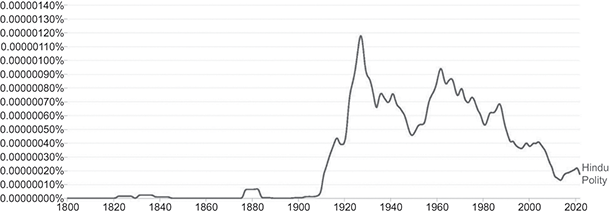

 Open access