Importance of Mass Vaccination in a Medical Center
Seasonal infectious diseases such as influenza are often spread among health care personnel (HCP) and to patients.Reference Schultz, Awoslka, Hodgson and Martinello1-Reference Seale, Mak, Razee and MacIntyre5 In medical centers, this occurrence can have significant adverse effects, not only on the delivery and quality of health care, but on the training, research, and critical functioning of these complex organizations. Medical centers are highly interactive settings where students, faculty, staff, clinicians, patients and their families comingle thereby providing opportunities for widespread dissemination of infectious disease agents. Most medical centers advocate for influenza vaccination of all personnel to reduce the chance of cross-infection because they all play a critical role in the day-to-day functioning of the organization.
In the context of an epidemic or pandemic, once vaccine is available, mass vaccination of all health care facility personnel is recommended.Reference Stroud, Altevogt, Butler and Duchin3 The timeliness of mass vaccination is critical; as reported by the Centers for Disease Control and Prevention (CDC), the recent pandemic influenza virus spread rapidly.4 During the first wave of the 2009 novel influenza pH1N1 pandemic, 50% of the cases of infection among HCPs was acquired in the workplace.4 To rapidly undertake a mass vaccination campaign, preplanning is necessary.
In general, influenza vaccination rates among HCP in the United States have been historically quite low. During the 2005–2006 and 2006–2007 influenza seasons, HCP vaccination rates were reported as 42% and 44%, respectively.Reference Babcock, Gemeinhart, Jones, Dunagan and Woeltje6-Reference Fiore, Shay and Broder8 Even in the most recent postpandemic season (2011–2012), the CDC reported that overall 67.9% of HCPs (regardless of work setting) had received the influenza vaccine.9 However, vaccination coverage was higher (approximately 77% ) in HCPs working in hospitals. In hospitals where vaccination was mandatory, vaccine coverage was 95%, as compared to 68% in hospitals without mandatory vaccination. The CDC found that among people declining the vaccine, the most frequently cited reasons included “a belief they did not need it,” “concern about effectiveness,” and “concern about side effects.”9
Based on these findings, the CDC recommended that health care facilities adopt vaccination strategies to increase HCP coverage and minimize the risk for acquired influenza infection. Unfortunately, even though various strategies have been implemented, compliance with influenza vaccination recommendations remains generally suboptimal, with the exception of HCPs employed in health care facilities that have mandatory vaccination. The complex issue of mandatory influenza vaccination policies is beyond the scope of this report and has been published elsewhere.Reference Tilburt, Mueller, Ottenberg, Poland and Koenig10 Clearly, mandatory vaccination is a strategy that results in high uptake rates.9 A large Midwestern health care system successfully vaccinated over 98% of employees, more than 25 000, after instituting a mandatory vaccination policy,Reference Babcock, Gemeinhart, Jones, Dunagan and Woeltje6 but only a few US hospitals currently endorse this policy. The current epidemic of H3N2 influenza (2012–2013) may result in more hospitals and other health care facilities adopting a mandatory vaccine policy.11
In recognition of the difficulty health care facilities have in improving influenza vaccine uptake in response to a pandemic, the Institute of Medicine (IOM) sponsored regional workshops on successful campaign strategies.Reference Stroud, Altevogt, Butler and Duchin3 Experts in the field of vaccination health promotion stressed that barriers and facilitators may vary by the target population,Reference Stroud, Altevogt, Butler and Duchin3 and therefore vaccination campaigns should be targeted to be successful.
One way to tailor vaccination campaigns is to engage front-line stakeholders in the intervention process. A well-regarded methodology for encouraging this type of engagement is through participatory action research (PAR).Reference Gershon, Rubin, Qureshi, Canton and Matzner12-Reference Greenwood, Whyte and Harkavy17 Although this approach, to our knowledge, has not been used before in the context of vaccination campaigns, previous research documents its effectiveness in the field of occupational health, specifically in health care workplace settings. PAR methodology has also been effectively used in disaster preparedness studies.Reference Gershon, Rubin, Qureshi, Canton and Matzner12
The objective of this study was to adapt this methodology to identify novel strategies to improve pandemic vaccination uptake in all personnel affiliated with a medical center. The PAR methodology is described in more detail here.
Participatory Action Research
The framework of action research comprises a “range of applied research methodologies that promote change and empowerment at the group, organizational, and societal levels.”Reference Gershon, Rubin, Qureshi, Canton and Matzner12 Under the action research canopy, researchers actively engage and work in partnership with the study population; PAR is one example of that type of approach.Reference Whyte, Greenwood and Lazes15, Reference Israel, Parker and Rowe16 The rationale is that when stakeholders are involved in the development of risk reduction recommendations, based on risk assessment data, they are more likely to be acceptable. Also, because PAR often includes the involvement of the organization's administration, interventions generated in this manner have a greater likelihood of being incorporated system-wide.Reference Gershon, Rubin, Qureshi, Canton and Matzner12
Action research is steered by a number of principles, as developed by early researchers in this field, including Israel and coworkers and Greenwood and colleagues.Reference Israel, Schulz, Parker and Becker14, Reference Greenwood, Whyte and Harkavy17, Reference Israel, House, Schurman, Heaney and Mero18 These principlesReference Israel, Parker and Rowe16, Reference Israel, Schurman and House19 include performing research that incorporates the following:
1. Is participatory—study participants are involved in all phases.
2. Is collaborative—researchers and study participants contribute their expertise.
3. Fosters co-learning—skills and knowledge are exchanged in a reciprocal manner, with emphasis given to the expertise that study participants have regarding their perspective.
4. Involves system development—the group may use study participant competencies (strengths and resources) to engage in a research process.
5. Is empowering—study participants may gain influence and control through their participation.
6. Integrates and achieves a balance between knowledge generation and intervention – resulting in mutual benefits for all.
7. Disseminates results to study participants and may involve long-term processes with a commitment to sustainability.
In the field of occupational safety and health, the use of PAR methodology is empowering because it emphasizes collaboration and co-learning among workers and researchers.Reference Seale, Mak, Razee and MacIntyre5, Reference Israel, Schurman and House19, Reference Cargo and Mercer20 Workers are often an untapped resource with respect to workplace hazards and how best to address them, and their ideas and suggestions often lead to systems improvement in occupational settings.Reference Gershon, Rubin, Qureshi, Canton and Matzner12 Input from workers also increases the capacity for long-term sustainability of interventions, since the solutions are developed and implemented within a climate of trust between participants and management. Data-driven PAR team recommendations are therefore likely to be more acceptable to all stakeholders as a result of stakeholder representation in the process.
Using the PAR approach to identify targeted interventions to improve influenza vaccination uptake is appropriate for several reasons. First, the US national health objectives for 2020 include an HCP influenza vaccination rate of 90%.21 To reach this robust national goal,Reference Blasi, Aliberti, Mantero and Centanni22 innovative ideas for addressing barriers to vaccination across work populations are needed. Second, competing demands on busy HCPs require novel solutions to make vaccination as fast and easy as possible. Finally, and in response to the IOM's recommendation to tailor vaccination strategies, input from front-line personnel representing the 2 major workgroups (clinical and nonclinical) in health care facilities is valuable.
Methods and Materials
Medical center personnel from the study's target populations were recruited to join 1 of 2 PAR teams. One team comprised clinical personnel, defined as persons providing, directly or indirectly, clinical care (eg, clinical faculty and students), and the clinical research enterprise (eg, animal care). The other team comprised nonclinical personnel, defined for the purposes of this study as those providing essential support services that are necessary to keep the medical center functioning (eg, public safety, facilities management, and key administrative staff) during a major pandemic event. The team members were recruited through flyers that were posted at various locations (eg, break rooms and common areas) of numerous departments representing essential clinical service delivery and operations of the medical center. The PAR team representing clinical personnel had 7 participants, and the nonclinical team had 11 participants. Even though this was a small number of participants, they represented a good cross-section of medical center personnel, which is in keeping with standard PAR methodology. Following an introduction, including the purpose of the PAR team, signed consent was obtained (IRB-AAAF0398: Columbia University Institutional Review Board) from each participant.
The PAR teams were planned and managed following standard procedures and methods.Reference Israel, Schulz, Parker and Becker14, Reference DeJoy, Gershon and Schaffer23, Reference Scholtes, Joiner and Streibel24 Sessions were held at convenient times and places and included a healthy lunch. Every effort to have a wide range of representation in each group was made so that representative work groups also included underrepresented ethnic and racial minority workers. Participants were given an incentive to enroll with scratch-off lottery game tickets. In addition to a PAR facilitator, each meeting also had a research staff member present to assist in note taking.
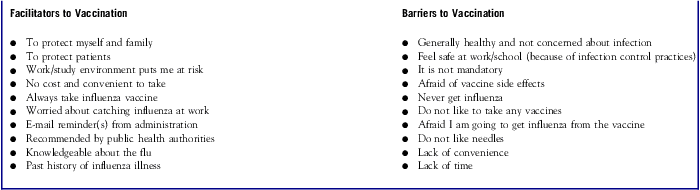
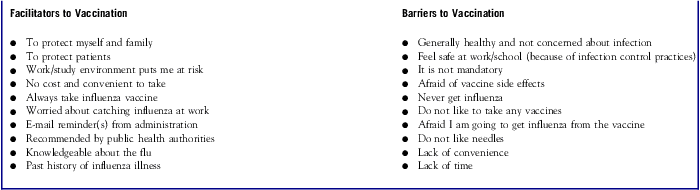
Data from our recent facility-wide influenza vaccination surveyReference Crowley, Myers, Magda, Morse, Brandt-Rauf and Gershon25 was provided to the PAR team members. The survey addressed influenza (seasonal, combination, and pandemic) vaccination rates, as well as barriers and facilitators to vaccination. As is typical for PAR teams, data were provided in a format designed to explain and present data to nonscientists. A summary list of the major facilitators and barriers (by work group) that were presented to the PAR teams is shown in Table 1 (copies of all research materials are available from R.R.M.G.).
Factors Influencing Influenza Vaccination Among Medical Center Personnel
After reviewing the data, the team members discussed the study findings specific to their work group. This discussion was followed by a brainstorming session to identify strategies that they thought would be most effective in improving influenza vaccination uptake rates for their particular work group.
Results
In general, PAR team members agreed with the overall survey findings and the findings specific to their work group. Pertaining to facilitators for vaccine uptake, both teams agreed on basic interventions that the medical center should support, such as quick and easy access, including fast-track access (ability to quickly obtain an influenza vaccine at the occupational health service office), a flu-vaccine cart (that comes directly to specific work areas), and flu-vaccine tables (tables set up in a cafeteria or building lobby); no cost; and encouragement from their immediate supervisor.
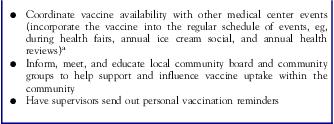
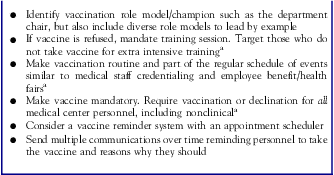
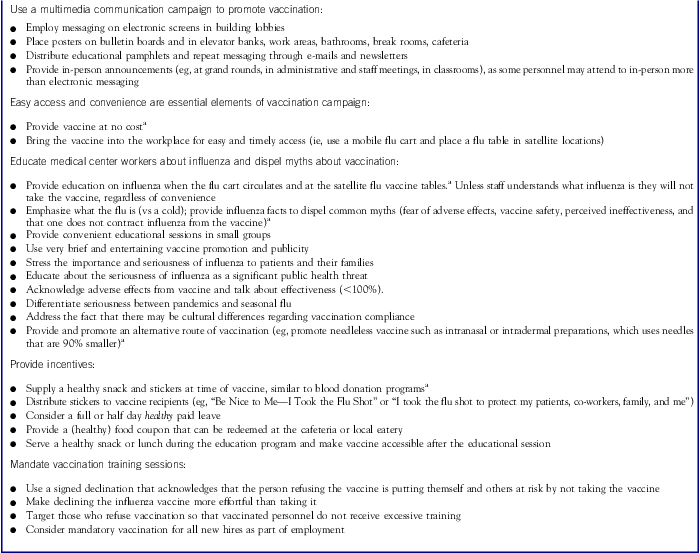
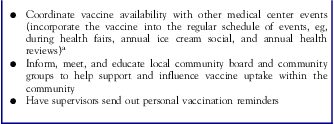
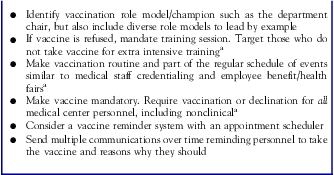
With respect to addressing barriers to taking an influenza vaccine, recommendations fell into 3 categories: those made by the nonclinical PAR group (Table 2), those made by the clinical PAR group (Table 3), and overlapping recommendations made by participants in both groups (Table 4).
Summary of Recommendations for Increasing Vaccine Uptake by Nonclinical Personnel
aStrategies most highly recommended by the team members.
Summary of Recommendations for Increasing Vaccine Uptake by Clinical Personnel
aStrategies most highly recommended by the team members.
Summary of Recommendations for Increasing Vaccine Uptake by Clinical and Nonclinical Personnel

aStrategies most highly recommended by the team members.
Although both PAR teams noted major overlapping themes, the specific interventions often differed. For example, while both groups recommended incentives for vaccination, the clinical group suggested token incentives, such as stickers that identified them as vaccine takers. The nonclinical group, however, suggested more tangible incentives, including half a day off from work in exchange for undergoing vaccination (and in recognition of their decreased likelihood of their needing sick days). Similarly, while both groups suggested that messages from public health authorities outside of the workplace should supplement the medical center's vaccination campaign, the clinical group recommended advertisements in major magazines encouraging vaccination, while the nonclinical group recommended vaccine messaging on public transportation.
Discussion
PAR team recommendations may be valuable to medical center vaccination campaign programs. The PAR strategies were often easy to implement, innovative, and resulted from on-the-ground experiences of employees. This process can result in interventions that are more likely to be effective in improving uptake rates. The implementation aspect of the recommendations was not addressed by the teams, as the feasibility (including cost) of implementing interventions is the responsibility of the administration. However, the recommendations of the PAR teams were shared with the medical center's influenza planning committee, which is charged with making recommendations for improving vaccine uptake to senior medical center leadership.
Recommendations
Emphasize the Benefits of Vaccination
Both PAR teams recommended organized influenza vaccination campaigns that emphasize the benefits of vaccination. Vaccination campaigns could be promoted with use of electronic screens and posters (placed on bulletin boards and in elevator banks and lobbies, work areas, bathrooms, break rooms, and the cafeteria). Conveniently held educational sessions should also be considered. Several PAR team members stated that as a result of their PAR team participation, in which they learned about influenza and vaccination, they now were more likely to obtain the influenza vaccine. The opportunity to speak in small groups with medical center personnel about influenza vaccination was therefore seen as highly motivating and should be considered as a possible intervention strategy.
Several PAR recommendations were innovative. For example, the nonclinical PAR team suggested outreach to the local community board and community groups to help support and influence vaccine uptake within the community. Many medical center personnel, including both students and staff, live in the community where the medical center is located. The PAR team thought that similar messages coming from both the medical center and their own community would be doubly effective.
Promote Vaccine Use With Role Models
The clinical PAR team suggested that the medical center identify and deploy vaccination role models, including diverse role models, to lead by example. Organizational newsletters or facility-wide e-mails depicting the vaccination of senior leadership are a simple way to communicate and promote vaccination. While e-mail messaging can be overloading, the clinical PAR team recommended “sending multiple emails over time, reminding all personnel not only to take the influenza vaccine but also why.” As one team member noted, “bombard people from every direction with messages so they can't miss it.” The clinical PAR team also recommended more influenza-related education, both in small groups and during influenza vaccine outreach efforts.
Disseminate Information Widely
Convenient and easy access to vaccination, with information disseminated on the location and time of vaccine availability, was recommended by both teams. Similarly, both stated that vaccination at no cost was deemed essential. The clinical PAR team recommended that influenza vaccination should be combined with an event such as grand rounds, large lecture hall classes and presentations, and health and benefit fairs, and made routine by aligning it with medical staff credentialing and annual health reviews. The clinical PAR team also recommended a vaccine-reminder system whereby a vaccination appointment could be made, similar to blood donation programs. The nonclinical PAR team emphasized support from supervisors and managers, such as reminders and release time to get vaccinated.
Mandate Influenza Training
For personnel who choose not to take the vaccine, both PAR teams concurred that these individuals should then be mandated to attend influenza training. This training should include education on what is influenza (versus a common cold). Personnel who have never previously had influenza may not appreciate the seriousness of it as an illness and the considerable morbidity and mortality associated with it. It was said that if staff do not understand what the influenza is or what the vaccine does, they will not take the vaccine regardless of convenience and no cost. As a nonclinician remarked, “when it comes to a pandemic, differentiate this from seasonal influenza in terms of seriousness.” Education should stress the fact that this is a respiratory disease. As one clinical PAR team member noted, “while we can access hand gel at work, this does not help if someone sneezes in your face.” Both PAR teams also suggested that education programs should dispel vaccine myths and address attitudes, fears, and misunderstandings related to vaccination (ie, fear of side effects, vaccine safety, and perceived ineffectiveness). This suggestion is especially critical for personnel who decline vaccine because “I am generally healthy” and “I am not concerned about getting infected with the influenza.”
Provide Incentives
In addition, it was recommended that organizational-level incentives, such as a healthy snack or lunch or food coupon that could be redeemed at the cafeteria or local eatery, should accompany the influenza vaccine educational programs to encourage attendance. Another recommended organizational-level incentive for increasing vaccination uptake was the consideration of providing a half or full day “healthy” paid leave. This suggestion was rationalized by considering that an unvaccinated worker could spread the disease to patients and coworkers and/or also lose work time through illness, perhaps for an extended period. Last, a sticker for vaccine recipients should be developed and implemented (eg, “Be nice to me, I took the flu shot,” or “I took the flu shot to protect my patients, co-workers, my family, and me”).
Develop Vaccination Campaigns
Vaccination campaigns that build on education, availability, and role modeling are usually most successful.Reference Kraut, Graff and McLead26 Different educational strategies for clinical compared to nonclinical personnel may be needed. Clinical personnel may need to appreciate the seriousness of influenza not only to themselves but to their patients (ie, patient safety). They need to appreciate the fact that vaccination is an ethical obligation to their patients and a way to keep their own family healthy. One participant commented, “It would be awful if I got the flu and took it home with me or passed it on to someone immunocompromised.” Nonclinical personnel need to appreciate the seriousness of influenza as a significant health threat. For both groups, the important role they play in the organization should be emphasized; without the influenza vaccination, their availability to work or go to school could be jeopardized.
Provide Alternative Routes of Vaccine Administration
For those who are averse to needles, the clinical PAR team recommended that an alternative route of vaccination be promoted and made available, such as the intranasal (IN) or intradermal preparations. The IN preparation uses a live attenuated vaccine, which can only be given to healthy, nonpregnant personnel younger than age 50 years, should be made available (and well-advertised) to those requesting it, unless contraindicated. In addition, the intradermal (ID) route (licensed in 2012), uses a very fine and much shorter needle, 90% smaller than those used for regular influenza injections. It is also packaged in single-dose, preservative-free, prefilled syringes. This may also be more acceptable to those averse to needles.
Promote Public Service Communications
Recommendations by the public health authorities was a recurring theme. In addition to recommendations from “health care providers, departments of health, and the CDC,” the clinical PAR team shared that “people want to read about pandemics and influenza vaccines” in the lay press such as Ladies Home Journal and the New York Times. In addition, it was recommended that more public service announcements be made regarding influenza and vaccination on the radio and television akin to stop smoking campaigns. The nonclinical PAR team noted that “influenza is bigger than our employer and that education needs to be city wide.” The nonclinical PAR team also stated that they would like to see “department of health-sponsored mobile vans distributing influenza vaccines,” similar to the approach taken during the mid-century polio outbreak.
Consider Mandatory Vaccination
Last, as recommended by both PAR teams, consideration should be given to making the influenza vaccine mandatory. The nonclinical PAR team thought that mandatory influenza vaccination be considered for all newly hired personnel as part of their employment and “unless contraindicated, required prospectively in subsequent years.” Short of making the vaccine mandatory, the PAR teams recommended mandatory influenza training before vaccine could be declined. Further, it was suggested that the declination of the influenza vaccine “acknowledge that the individual is putting themself and others at risk” by not taking it. In addition, declining the influenza vaccine should require more effort than taking it. One clinician noted, “During the H1N1 pandemic [2009], losing clinical privileges was threated if vaccination was not taken, unless a note was provided from a clergy or health care professional, and this was very effective.”
These suggestions were shared with senior administration at the medical center and were taken under advisement for the current 2012–2013 influenza season. The medical center has since implemented several of these recommendations, including the development of fast-track access for influenza vaccination within the medical center health services; deployment of a flu-vaccine cart to patient care and administrative units so that all medical center personnel can be vaccinated in their work site; and conveniently placed flu-vaccine tables in satellite locations, such as building lobbies and cafeteria, to enable medical center personnel to easily receive the influenza vaccine.
In addition to increasing access and convenience, the medical center also adopted the concept of coordinating the vaccination campaign with other medical center events; use of a multimedia communication campaign to promote vaccination; and an educational campaign to dispel myths about vaccination. This year, a needleless IN influenza vaccine was made available as an alternative administrative route. Training sessions were also mandated before hospital personnel could refuse vaccination.
Conclusions
We found that the engagement of front-line workers using a PAR framework (ie, using risk assessment data to identify risk reduction strategies) was helpful in identifying creative strategies to promote influenza vaccination. A review of the PAR team recommendations identified several unique, innovative, and easily implementable suggestions. While specific suggestions often differed by the 2 PAR teams, the understanding and knowledge of the team members provided important and imaginative perspectives on practical and often low-cost strategies. Their suggestions were of great interest and importance to the medical center's influenza planning committee. This approach may have similar utility to other medical centers and health care facilities interested in identifying strategies that could potentially increase influenza vaccine uptake in their work populations. Similarly, the PAR approach may also have utility beyond influenza vaccination, and might be a helpful method for identifying strategies to increase personnel uptake of other recommended vaccines. In conclusion, the use of the PAR approach in this context was an efficient mechanism for focusing the collective efforts of front-line personnel on influenza vaccination strategies.
Disclaimer
The findings and conclusions in this report are those of the authors and do not necessarily represent the views of the organizations for which they work.
Acknowledgments
The research team members participated in the study and Qi Zhi, MPH, provided expert administrative assistance.