Introduction
In tropical soils, management practices such as no-till (NT) and crop rotation have the potential to increase soil organic carbon (SOC), either through the retention of crop residues on the soil surface (Kaye and Quemada, Reference Kaye and Quemada2017; Poeplau and Don, Reference Poeplau and Don2015) or by changes in the soil caused by roots (Castro et al., Reference Castro, Crusciol, Calonego and Rosolem2015; Garcia et al., Reference Garcia, Li and Rosolem2013), especially if legumes such as Sunn hemp (Crotalaria juncea) are included in the crop rotations (Raphael et al., Reference Raphael, Calonego, Milori and Rosolem2016).
Under tropical climate, usually, soil C accumulation is lower than in temperate regions because of the fast crop residue decomposition caused by the higher average temperatures (Bolliger et al., Reference Bolliger, Magid, Amado, Skóra Neto, Ribeiro, Calegari, Ralisch and de Neergaard2006; Powlson et al., Reference Powlson, Stirling, Thierfelder, White and Jat2016), leading to higher greenhouse gas (GHG) emission rates. In this case, cover crops play an important role in the supply of C via crop residues (Le et al., Reference Le, Jha, Jeong, Gassman, Reyes, Doro, Tran and Hok2018), mainly when under NT (Rigon et al., Reference Rigon, Franzluebbers and Calonego2020). Legumes are an important source of N and are recognized as essential for soil C sequestration (Sisti et al., Reference Sisti, Dos Santos, Kohhann, Alves, Urquiaga and Boddey2004). A recent study observed that Sunn hemp has a lower potential for nitrous oxide (N2O) emissions than other leguminous crops (Sant’Anna et al., Reference Sant’Anna, Martins, Goulart, Araújo, Araújo, Zaman, Jantalia, Alves, Boddey and Urquiaga2018). Conversely, grass residues have greater recalcitrance due to higher lignin and cellulose concentrations than legumes, leading to a lower soil organic matter (SOM) mineralization rate and N2O emission (Pimentel et al., Reference Pimentel, Weiler, Pedroso and Bayer2015).
The GHG mitigation potential of conservation agriculture has been frequently ignored (Powlson et al., Reference Powlson, Stirling, Jat, Gerard, Palm, Sanchez and Cassman2015), and the effect of crops cultivated in each system on GHG emissions has been little studied. As the composition of crop residues and C and N input in the soil are recognized as N2O (Pugesgaard et al., Reference Pugesgaard, Petersen, Chirinda and Olesen2017) and CO2 emission modulators (Rigon et al., Reference Rigon, Calonego, Rosolem and Scala2018), each species in the rotation has a different potential for GHG emission mitigation and C sequestration (Kaye and Quemada, Reference Kaye and Quemada2017; Lal, Reference Lal2015; Rigon et al., Reference Rigon, Franzluebbers and Calonego2020). Thus, the hypotheses of this study were: (i) GHG emission modulation depends on the plant species originating the residues on the soil surface; (ii) the use of cover crops with a high C and N input, despite increasing CO2 and N2O emissions, has the potential to reduce the emission of these gases and increase soil C and N. The objective of this study was to evaluate GHG emissions, and soil C and N accumulation as affected by species grown in rotation with soybean in a long-term cropping system under NT (2003–2013).
Materials and Methods
Location and edaphoclimatic characterization of the experimental area
The study was conducted in a long-term NT system, where soybean was grown in rotation with fall–winter crops and spring cover crops for over 10 years. Each plot was cropped following the same crop rotation every year. The experiment was started in 2003 in Botucatu, SP (22°49'S and 48°25'W), at an altitude of 780 m, on a Typic Rhodudalf (Soil Survey Staff, 2014), with 655 g clay kg−1, 237 g silt kg−1, and 108 g sand kg−1 at 0–0.2 m soil depth. The soil chemical (Raij et al., Reference Raij, Andrade, Cantarella and Quaggio2001) and physical (Smith and Mullins, Reference Smith and Mullins1991) characteristics at the 0–0.1 m soil depth were as follows: pH CaCl2 (5.1), Al+3 (0.2 mmol dm−3), Ca (43 mmol dm−3), Mg (36 mmol dm−3), K (1.8 mmol dm−3), and P (33 mg dm−3); bulk density (1.32 Mg m−3), microporosity (0.42 m3 m−3), and macroporosity (0.12 m3 m−3). The tropical climate is mesothermal with a well-defined dry fall–winter season from May to August. The wet season usually starts in September, extending through late March/April. The average annual rainfall is 1450 mm.
Experimental design
The experiment was laid out as a split-plot in a randomized complete block design with eight treatments and four replications (Figure 1). The main plots consisted of species grown in the fall–winter, after soybean harvest (April–September) and subplots consisted of cover crops grown in the spring (September–December). Soybean was grown in all plots from December to March. The experiment was started in 2003 with the fall–winter crops triticale [X Triticosecale (Wittmack)] and sunflower [Helianthus annuus (L.)] grown in the fall–winter in 32 m × 5 m plots. After the termination of these fall–winter crops, the cover crops pearl millet [Penninsetum glaucum (L.)], Sunn hemp [Crotalaria juncea (L.)], and sorghum [Sorghum bicolor (L.)] were sown, plus a fallow treatment during the spring, in 8 m × 5 m subplots. Soybean [Glycine max (L.) Merrill] was grown each year over the entire area in the summer (December–April). The species grown in the fall–winter, spring, and summer seasons were repeated annually from 2003 to 2013, as shown in Supplementary Table S1.
Scheme of experimental design of crop rotation according to fall–winter and spring treatments: Sunflower/Pearl millet, Sunflower/Forage sorghum, Sunflower/Sunn hemp, Sunflower/Fallow, Triticale/Pearl millet, Triticale/Forage sorghum, Triticale/Sunn hemp, Triticale/Fallow. Soybean is the main crop in the summer.

Crop management
Each year triticale and sunflower were sown in the plots in April at 0.17 and 0.34 m spacing, using 165 and 22 kg ha−1 of seeds, respectively, without fertilizers. The harvest was carried out each year in September using a plot harvester. In October, around 1 week after chemical desiccation of the standing plant residues with glyphosate, the spring crops were sown in the subplots over the crop residues, except for the area kept under fallow. The row spacing was 0.17 m, using 15, 25, and 30 kg ha−1 of seeds of sorghum, pearl millet, and Sunn hemp, respectively. The spring species were cultivated without fertilizers up to around 60 days after sowing (DAS) when the plants were desiccated with glyphosate.
Soybean (Monsoy M7211 RR) was sown each year in December, in rows 0.45 m apart from each other, using 430,000 seeds ha−1. Yearly fertilization consisted of 50 kg ha−1 of K2O and 50 kg ha−1 of P2O5, as potassium chloride and triple superphosphate, respectively. Soybean was harvested each April from three 5.0 m long central rows of each subplot using a plot harvester, and the yield was calculated at grain moisture of 13%.
Assessment of C and N in soil and above-ground crop residue (straw)
The assessments for this experiment were made through the 2012–2013 cropping season. At sowing of the fall–winter, spring, and soybean crops, two samples of above-ground crop residues were collected randomly from the soil surface (0.25 m2 each) in each subplot. The samples were dried to constant weight at 60 °C. Then the samples were ground and homogenized, and part of them was used to determine the biochemical composition (Silva and Queiroz, Reference Silva and Queiroz2002), which results are shown in Table 1. The other part of the samples was used to analyze C and N concentrations using an elemental analyzer (LECO-TruSpec® CHNS).
Biochemical compositions of the crops used in the rotations

* Postharvest residue left on the soil.
Before sowing the fall–winter crops, three soil subsamples were collected on 16 April, 2012 from each experimental unit at 0–0.1 m depth using an auger. The samples were air-dried, ground in a ball mill, and analyzed for total organic carbon (SOC) and total soil nitrogen (TN) in an elemental analyzer (LECO-TruSpec® CHNS).
Greenhouse gases sampling and analysis
The GHG were always sampled from 8:00 to 10:00 AM at 1, 3, 8, 15, 30, and 50 DAS for the crops grown in spring, and at 1, 3, 8, 15, 30, 60, and 90 DAS for the plant species grown in fall–winter and summer. Closed chambers were constructed according to Bowden et al. (Reference Bowden, Steudler, Melilo and Aber1990); these chambers consisted of a cylindrical steel drum measuring 30 cm in diameter by 13 cm in height, and they were inserted 7 cm into the soil. The drums remained in the area for the entire period of the experiment and were removed only for sowing and harvesting, and they were placed again in the soil at least 24 hours before the next sampling. At the time of sampling, the drums were hermetically sealed with polyvinyl chloride (PVC) lid, 9 cm in height and the same diameter as the drum. The lids were equipped with an 8 mm rubber septum through which air samples were collected from inside the chambers. For determination of the GHG flux, air samples were collected at 0, 10, 20, and 40 minutes after the chamber closure using 20 mL polypropylene syringes (BD20-mL syringe Luer-Lok™, US) with a three-way valve. Immediately after sampling, the samples were placed in coolers with ice and sent to the laboratory where CO2, N2O, and CH4 concentrations were analyzed no more than 24 hours after sampling to ensure the integrity of the samples (Rigon et al., Reference Rigon, Calonego, Guimarães and Rosolem2017). The gas chromatograph (GC-2014, Shimadzu, Columbia, MD, EUA) used was equipped with a Porapak Q column and two detectors: an electron capture detector (ECD) that quantifies the N2O and a flame ionization detector (FID) that quantifies the methane and carbon dioxide indirectly. The chromatographic conditions employed were as follows: packed column set at 80 °C, FID set at 250 °C, and EDC detector set at 325 °C, with carrier gas N 5.0 and P5 gas (95% argon and 5% methane) for improved efficiency of EDC; methanator set at 350 °C; and the Porapak Q column set at 80 °C, with N2 as the carrier gas enriched with N2O gas in ‘back-flush’ system and with manual injection. The chromatograph was calibrated with the standard gases (White Martins®) (CO2: 270, 648, 2063, and 7164 µmol mol−1; CH4: 0.69, 2.06, 3.05, and 9.05 ηmol mol−1; N2O: 305, 693, 1092, and 1885 ηmol mol−1).
The variation of the gas concentration inside the chamber with time was used to calculate the GHG fluxes (Hutchinson and Mosier, Reference Hutchinson and Mosier1981) according to equation 1 (Kim et al., Reference Kim, Harazono, Baten, Nagai and Tsuruta2002):
 $$f = {{\Delta C} \over {\Delta t}}x{v \over a}x{m \over {Vm}}$$
where ƒ is the flux of CO2 (mg m−2 h−1), N2O (µgm−2 h−1), or CH4 (µgm−2 h−1); ΔC is the change in the GHG concentration as a function of the variation in the chamber closure time (Δt), where ΔC/Δt is the slope of the line equation; v is the chamber volume (0.0128 m3); a is the soil area covered by the chamber (0.071 m2); m is the molar mass of CO2 (44.01 g mol−1), CH4 (16.04 g mol−1), or N2O (44.01 g mol−1); and Vm is the molar volume of the gases, which was corrected using the air temperature inside the chamber, according to the ideal gas equation.
The accumulated emissions were calculated by trapezoidal integration of the daily emission using Origin software (OriginLab, Ltd., Northampton, MA, USA). The relative C-CO2 and N2O-N emissions were obtained by dividing the accumulated C-CO2 and N2O-N emissions, by the accumulated C and N in the above-ground crop residues on the soil surface (Qin et al., Reference Qin, Wang, Hu, Oenema, Li, Zhang and Dong2012).
The gravimetric water content (Msoil) and the soil temperature (Tsoil) at 5 cm depth were measured simultaneously with the GHG samplings, using a 5 TM sensor (Decagon Devices). The soil gravimetric moisture was converted to volumetric moisture according to previous calibration (data not shown), thus enabling calculation of the water-filled pore space (WFPS) using equation 2, according to Linn and Doran (Reference Linn and Doran1984):
 $$WFSP = {{Msoil} \over {TP}} \times 100$$
where WFSP is the water-filled pore space (%); Msoil is the volumetric soil water content (m3 m−3); and TP is the total porosity of the soil (m3 m−3), as determined by physical analysis with volumetric rings and reported in the results of Calonego et al. (Reference Calonego, Raphael, Rigon, Oliveira Neto and Rosolem2017).
The CO2 equivalent (CO2-eq) is a metric used to compare GHG emissions based on their global warming potential (GWP), where the CO2 is typically taken as the reference gas, and an increase or reduction in emission of CH4 and N2O is converted into ‘CO2-equivalents’ through their GWPs. For CH4 the GWP (IPCC, Reference Pachauri and Meyer2014) is assumed to be 25, and the GWP for N2O is 298 over 100 years based on the gas mass and atmosphere lifetime. Thereafter, greenhouse gas intensity (GHGI) (Mosier et al., Reference Mosier, Halvorson, Reule and Liu2006) was calculated by dividing GWP by soybean grain yield, with the results presented in kg kg−1 of grain.
Statistics
Data were analyzed using a split-split plot design in randomized complete blocks with four replicates. After testing for homogeneity and normality ANOVA was performed using SAS version 9.2 (SAS, Inc., 2009), and the mean differences were compared by the t-test (LSD, p < 0.05). For soil temperature; WFPS; and C-CO2, C-CH4, and N2O-N emissions, the standard deviation of the mean was calculated for each period.
Results
Carbon and nitrogen inputs by crop rotations
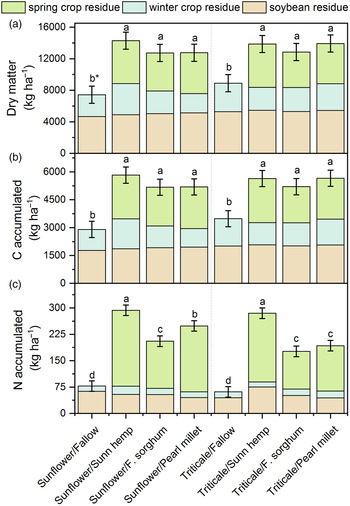
The amount of crop residue on the soil surface, as well as its C and N contents, was impacted by the species grown in each crop season. As expected, the amount of residues accumulated with fallow was lower than with the spring crops, which did not differ from each other (Figure 2a and b). Cropping species in the spring season reached, on average, 13.5 Mg ha−1 of residue on the soil surface, surpassing in 5.2 Mg ha−1 the residues observed under fallow (Figure 2a). The amount of C in by crop residues followed the same trend as the biomass. Regardless of the species, spring crops accumulated an additional 2.1 Mg ha−1 of C compared with fallow (Figure 2b).
Dry matter (a), carbon (b), and nitrogen (c) are accumulated from residues on the soil surface, according to crop rotations in each growing season. Letters in the columns differ from each other by the t-test (p < 0.05) of the cumulative values, and the vertical bars correspond to LSD (p < 0.05).

The N accumulated in the crop residues of the cover crops grown in the spring ranged from 100 to 215 kg ha−1 depending on the species, which represented a 57–73% increase in the N accumulated in crop rotations including fallow. Rotations where Sunn hemp was grown in the spring resulted in the highest N accumulation in residues (approximately 290 kg ha−1), regardless of the fall–winter crop. In this case, Sunn hemp contribution was 208 kg ha−1 on average. The cover crops grown after sunflower accumulated, on average, 180 kg ha−1 of N in the plant residues, surpassing the N accumulated in succession to triticale by 30 kg ha−1 (Figure 2c).
Soil organic carbon and nitrogen
The SOC in the uppermost soil layer was affected by the crop rotations, but total N (TN) was not. SOC content was 7% higher when triticale was grown in fall–winter instead of sunflower. The absence of a spring cover crop (fallow) reduced SOC by 8 % and 6 %, with Sunn hemp and pearl millet, respectively. Although no significant differences were observed in TN (p = 0.38), the nominal values proportionally followed the SOC results; that is, TN was 10% higher for triticale than for sunflower (Table 2).
Soil organic carbon (SOC) and total soil nitrogen (TN) concentrations at 0–0.1 m soil depth, cumulative greenhouse gases (C-CO2, C-CH4, and N2O-N), relative N2O-N and C-CO2 emissions, and greenhouse gas intensity (GHGI) according to the fall-winter and spring crops.

* Means followed by different letters differ from each other by the paired t-test (LSD, p < 0.05).
GHG flux
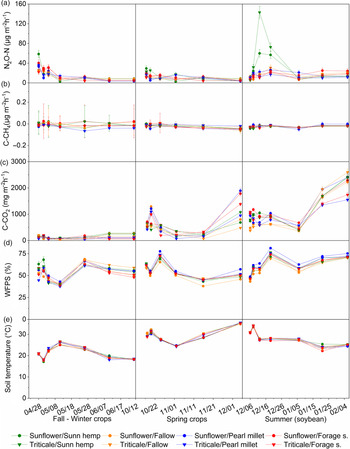
The weather conditions during the experiment were typical of the region, validating the pattern of GHG emission in the fall–winter, spring, and summer seasons (Figure 3). N2O emission peaks occurred at the beginning of the fall–winter season (up to 8 DAS) and early summer season (between 8 and 15 DAS), especially in crop rotations with Sunn hemp in spring (Figure 3a). However, in the fall–winter, the emissions did not exceed 60 µg m−2 h−1, which is much lower than the maximum flux of 140 µg m−2 h−1 observed with the triticale/sunn hemp rotation in the summer. For the CO2 fluxes (Figure 3c), emission peaks were observed at 3 and 50 DAS in the spring season. At 3 DAS, the highest CO2 emissions occurred with the crop rotations sunflower/fallow, sunflower/pearl millet, triticale/sorghum, and triticale/pearl millet, with an average flux of 1300 mg m−2 h−1. At 50 DAS, the highest CO2 emissions were observed with pearl millet and sorghum in plots previously cropped to sunflower, with an average mean flux of 1900 mg m−2 h−1.
N2O-N (a), C-CH4 (b), C-CO2 emissions (c), water-filled pore space (d), and soil temperature at 5 cm depth (e) of the crop rotations. Vertical bars correspond to the standard error of the mean.

In the summer season (soybean), an increase in CO2 emissions was observed only at 60 DAS, especially in crop rotations with sunflower (regardless of the spring crop used) and with triticale followed by fallow or Sunn hemp, with an average mean flux of 2500 mg m−2 h−1. Conversely, the crop rotations triticale/sorghum and especially triticale/pearl millet showed the lowest CO2 emissions, with fluxes 31% and 52% lower than the maximum emissions observed, respectively.
The CH4 emission was practically nonexistent (Figure 3b), or even negative, during the experiment, regardless of the crop rotation or the soil water-filled pore space (d), and soil temperature (e).
GHG emissions, GWP, and GHGI
Cropping sunflower during the fall–winter increased the cumulative C-CO2 emission by 21 % compared with triticale. The highest CO2 emission from sunflower resulted in higher GWP, GHGI, and higher relative CO2 emissions. Concerning the spring crops, the highest N2O-N emission was observed with Sunn hemp, which was 30% higher than fallow, but no different from the annual GWP and GHGI. Although the cumulative N2O and C-CO2 emissions were not higher under fallow, the low accumulation of N and C in the residues resulted in relative emissions of 8.66 g kg−1 and 1.82 kg kg−1, respectively, which were approximately 2.5 and 1.5 times higher than the average obtained with millet, Sunn hemp, and sorghum (Table 2).
Discussion
C and N in crop residue and soil
The amount of C and N accumulated on the soil surface mainly from the spring crop residues is very important in NT cropping systems because the amount and quality of residues are determinants of the success of the system (Büchi et al., Reference Büchi, Wendling, Amossé, Necpalova and Charles2018; Rigon et al., Reference Rigon, Franzluebbers and Calonego2020; Chen et al., Reference Chen, Liu, Tian, Yan and Zhang2014), and these species were allowed to grow for only 60 days. These cover crops resulted in the accumulation of 5.1 Mg ha−1 of residues on average, which represents around one-third of the cumulative dry matter input during the entire year. Considering the importance of keeping soil under NT covered most of the time (Büchi et al., Reference Büchi, Wendling, Amossé, Necpalova and Charles2018; Tonitto et al., Reference Tonitto, David and Drinkwater2006), the additional crop residue produced by the spring cover crops before planting soybean in the summer provide an additional ecosystem service to soybean cultivation option under NT (Rigon et al., Reference Rigon, Calonego, Rosolem and Scala2018). This condition is even more important in tropical regions with dry winters combined with the fast decomposition rates under high temperatures (Jantalia et al., Reference Jantalia, Resck, Alves, Zotarelli, Urquiaga and Boddey2007; Lal, Reference Lal2002). In weathered tropical soils, the heterotrophic microorganisms almost always find optimal environmental conditions for intense oxidation of SOM, causing high rates of substrate mineralization and consequent CO2 emission (Sanchez and Logan, Reference Sanchez and Logan1992). Hence, C losses must be offset by an increase in the amount of crop residues on the soil surface, which will increase SOC and TN, either by cover or cash crops. Although the similar C accumulation in the residues of the spring species, the highest N input with Sunn hemp explains the increase in SOC content with the use of this legume. Crop residue characteristics are essential to increase SOC under NT (Frasier et al., Reference Frasier, Quiroga and Noellemeyer2016; Kaye and Quemada, Reference Kaye and Quemada2017; Lal, Reference Lal2004; Schipanski et al., Reference Schipanski, Barbercheck, Douglas, Finney, Haider, Kaye, Kemanian, Mortensen, Ryan, Tooker and White2014), which confirms the importance of N input for SOC sequestration (Boddey et al., Reference Boddey, Jantalia, Conceiçao, Zanatta, Bayer, Mielniczuk, Dieckow, Dos Santos, Denardin, Aita, Giacomini, Alves and Urquiaga2010; Rigon and Calonego, Reference Rigon and Calonego2020; Van Groenigen et al., Reference Van Groenigen, Van Kessel, Hungate, Oenema, Powlson and Van Groenigen2017). The high C and N in crop residues is considered one of the most important factors in increasing soil carbon retention (Yang et al., Reference Yang, Huang, Yu, Song, Ma, Xu and Zhang2018). Sunn hemp was able to supply, on average, 190 kg ha−1 of N in only 60 days, confirming that it is one of the species with a greater capacity to fix N (Chikowo et al., Reference Chikowo, Mapfumo, Nyamugafata and Giller2004). This result is important considering cropping systems with the absence of N fertilization and may help in enhancing the sustainability of agriculture in tropical regions (Rigon et al., Reference Rigon, Franzluebbers and Calonego2020). In addition to being the nutrient most taken up by plants, N is involved in the assimilation of C in stable and humified SOM fractions (Cyle et al., Reference Cyle, Hill, Young, Jenkins, Hancock, Schroeder and Thompson2016). Furthermore, the crop residue of Sunn hemp has a low C/N ratio, providing an excellent substrate for soil microbial activity and improve soil quality (Ferrari Neto et al., Reference Ferrari Neto, Franzluebbers, Crusciol, Rigon, Calonego, Rosolem, do Nascimento and Ribeiro2020; Raphael et al., Reference Raphael, Calonego, Milori and Rosolem2016; Rigon et al., Reference Rigon, Franzluebbers and Calonego2020, Reference Rigon, Calonego, Capuani and Franzluebbers2021; Zhao et al., Reference Zhao, Zhang, Müller and Cai2018). The well-defined dry season limited the growth of sunflowers leading to an insufficient cover of the soil surface by residues compared with triticale (Rigon and Calonego, Reference Rigon and Calonego2020). In addition, the high C/N and lignin/N ratios of the triticale residues compared with sunflower (Table 1) resulted in lower N mineralization rates and higher persistence of these residues (Rigon et al., Reference Rigon, Calonego, Rosolem and Scala2018; Rigon and Calonego, Reference Rigon and Calonego2020). Grass residues are recognized by the presence of lignocellulose complexes that are acetylated or esterified by coumaric and ferulic acids, hindering their mineralization (del Río et al., Reference del Río, Gutiérrez, Rodríguez, Ibarra and Martínez2007). According to several authors (Chen et al., Reference Chen, Liu, Tian, Yan and Zhang2014; Palm et al., Reference Palm, Gachengo, Delve, Cadisch and Giller2001; Rigon and Calonego, Reference Rigon and Calonego2020), the biochemical characteristics of the crop residue, such as high levels of lignin and hemicellulose, cellulose, C/N ratio, and lignin/N ratio, are important indicators of its quality. These characteristics allow us to predict the persistence of crop residue on the soil surface and also the potential of C stabilization into SOM (Castellano et al., Reference Castellano, Mueller, Olk, Sawyer and Six2015; Cotrufo et al., Reference Cotrufo, Wallenstein, Boot, Denef and Paul2013).
The high C/N ratio of triticale residue may pose a limitation to decomposers, which maintain soil covered for a longer time (Rigon et al., Reference Rigon, Calonego, Rosolem and Scala2018). Besides, the low residue decomposition rate results in lower C-CO2 emissions to the atmosphere. This may explain the SOC increase by triticale, even with similar C accumulation by sunflower.
The SOC increase depends on the amount and quality of the residues (Frasier et al., Reference Frasier, Quiroga and Noellemeyer2016; Rigon et al., Reference Rigon, Calonego, Capuani and Franzluebbers2021), which are essential for conservation agriculture systems (Derpsch et al., Reference Derpsch, Franzluebbers, Duiker, Reicosky, Koeller, Friedrich, Sturny, Sá and Weiss2014). However, when fallowing is introduced in the rotation system, despite the low labile C and microbial respiration (Bell et al., Reference Bell, Smith, Bailey and Bolton2003; Qiao et al., Reference Qiao, Schaefer, Blagodatskaya, Zou, Xu and Kuzyakov2014), loss of C-CO2 is a continuous process (Novelli et al., Reference Novelli, Caviglia and Melchiori2011), decreasing SOM over the years. We found evidence that the maintenance of the soil covered with crops and crop residues throughout the year is a good strategy to mitigate GHG emissions basically because less soil carbon can be respired by soil microorganisms because it is more efficiently maintained in the biomass. Thus, depending on their residue quality, spring cover crops, besides keeping the soil covered, can lead to an increase in SOC in systems under NT.
The balance between the C inputs and outputs in the soil determines C stabilization, which is a parameter that allows assessing the cropping systems management quality from the perspective of the soil conservation and sustainability, and GHG mitigation potential.
In tropical weathered soils, Fe and Al oxides can provide additional protection of SOC against decomposition under low pH (Lal, Reference Lal2002; Six et al., Reference Six, Conant, Paul and Paustian2002). Thus, sustainable agricultural intensification, i.e. crop rotations under conservation management focusing on the maintenance of soil cover is an interesting tool to restore and increase SOC (Lal, Reference Lal2015). It is important to note that the potential of SOC increase varies according to the crop rotation species and its residue characteristics under NT.
GHG emission
The GHG emissions were associated with the weather variations across the seasons, which regulate microbial activity and SOM mineralization (Khalil and Baggs, Reference Khalil and Baggs2005; Zhang et al., Reference Zhang, Zhang, Zheng, Guan, Li, Xie, Chen, Hang, Jiang, Deng, Afreh and Zhang2017). WFPS and soil moisture and temperature are recognized as the main factors controlling GHG fluxes (Oertel et al., Reference Oertel, Matschullat, Zurba, Zimmermann and Erasmi2016) and help to explain the low GHG emissions during fall–winter (Figure 3). The N2O emission from the crop residues depends on their N content (IPCC, 2006) and quality, i.e. their biochemical composition (Pimentel et al., Reference Pimentel, Weiler, Pedroso and Bayer2015). Legume plant residues with high N content, low C/N ratio, and low levels of recalcitrant compounds (Shahbaz et al., Reference Shahbaz, Kuzyakov, Sanaullah, Heitkamp, Zelenev, Kumar and Blagodatskaya2017) stimulates N2O emissions (Pugesgaard et al., Reference Pugesgaard, Petersen, Chirinda and Olesen2017), explaining the highest cumulative N2O-N emission by Sunn hemp (Table 2). However, the effect of crop residues on N2O emission is more complex due to the interactions of soil moisture, temperature, and microbial activity (Gonzaga et al., Reference Gonzaga, Carvalho, Oliveira, Soares and Cantarella2018).
Similarly, crop residue quality may also affect CO2 emission, as it was observed in this experiment in rotations with triticale and sunflower (Figure 2), and reported previously (Rigon et al., Reference Rigon, Calonego, Rosolem and Scala2018). High C/N and lignin/N ratios in the crop residues such as in triticale, results in a limited source of C for soil decomposers and, consequently, lower emissions of both N2O (Yang et al., Reference Yang, Huang, Yu, Song, Ma, Xu and Zhang2018) and CO2 (Sainju et al., Reference Sainju, Caesar-TonThat, Lenssen and Barsotti2012).
Cropping systems that keep soil surface uncovered, such as fallow, may show temporary lower N2O emissions owing to the lack of substrate. According to Šimek et al. (Reference Šimek, Elhottová, Klimeš and Hopkins2004), one reason is that the consumption of O2 during the residue decomposition results in an anaerobic environment prone to N2O emission. Several studies in tropical regions show that keeping the soil covered is essential for improving the sustainability of the system (Gomes et al., Reference Gomes, Bayer, de Souza Costa, de Cássia Piccolo, Zanatta, Vieira and Six2009; Jantalia et al., Reference Jantalia, Dos Santos, Urquiaga, Boddey and Alves2008; Raphael et al., Reference Raphael, Calonego, Milori and Rosolem2016; Rigon et al., Reference Rigon, Calonego, Rosolem and Scala2018). Thus, despite the higher N2O emissions in rotations including legume species (Gomes et al., Reference Gomes, Bayer, de Souza Costa, de Cássia Piccolo, Zanatta, Vieira and Six2009), it is essential to consider also the effects on SOC, which is increased due to the greater availability of soil N. Thus, the emissions can be eventually offset by the retention of C in the SOM under tropical conditions (Bayer et al., Reference Bayer, Gomes, Zanatta, Vieira and Dieckow2016).
Cumulative and relative emissions of GHG
The mean cumulative N2O-N emission can be considered low (0.7 kg ha−1), given the mean N input from residues of 192 kg ha−1, representing 0.36% of the direct N2O-N emission rate of 1% considered by the IPCC methodology (IPCC, 2006). In our experiment, the N2O emission rate was similar to the direct emission of Brazilian agricultural soils, estimated at 0.3% (MCTI, 2010). Studies with crop rotation systems carried out in Brazil also observed the same tendency to overestimate the N2O emission when using IPCC emission factors (Gomes et al., Reference Gomes, Bayer, de Souza Costa, de Cássia Piccolo, Zanatta, Vieira and Six2009; Jantalia et al., Reference Jantalia, Dos Santos, Urquiaga, Boddey and Alves2008; Sant’Anna et al., Reference Sant’Anna, Martins, Goulart, Araújo, Araújo, Zaman, Jantalia, Alves, Boddey and Urquiaga2018). In our experiment, even when we considered the highest cumulative N2O-N emission, which was 0.82 kg ha−1 year−1 in the crop rotation with Sunn hemp (Table 2), the cumulative emission represented only 0.28% of the total N accumulated in the crop residues, and these values were approximately half that observed by Rochette and Janzen (Reference Rochette and Janzen2005), who, in a similar study with this same legume, found an N2O-N emission of 1.97 kg ha−1 y−1, representing 0.58% of the total N accumulated in crop residues. The low N2O emissions in Brazilian soils are explained by the good drainage of most agricultural soils, with poor anaerobic activity (Jantalia et al., Reference Jantalia, Dos Santos, Urquiaga, Boddey and Alves2008).
Despite N2O emission peaks with Sunn hemp, the cumulative effect of the legume crop rotations throughout the year did not differ from other crops, as suggested by Peyrard et al. (Reference Peyrard, Mary, Perrin, Véricel, Gréhan, Justes and Léonard2016), with the addition of plants of this type. Notably, the biological N fixation (BNF) by legumes does not influence the N2O emission and is not counted as a source of N2O to the atmosphere in the revised methodology of the IPCC (2006). Therefore, Sunn hemp is an important source of N in agricultural production systems, without impacting the GWP. Our results are in agreement with the approach taken in a recent review of the potential of cover crops to mitigate climate change, mainly due to the increase in SOC, and the reduction in the need for fertilizer use, especially after the cultivation of legumes as cover crops (Kaye and Quemada, Reference Kaye and Quemada2017). Similarly, Bayer et al. (Reference Bayer, Gomes, Zanatta, Vieira and Dieckow2016) found that under tropical NT with legumes as cover crops, the soil behaves as a sink for the GWP. According to the authors, CO2 retention rates were approximately six times larger than those of the cumulative N2O emissions. This outcome confirms our results in which, despite greater N2O emission by Sunn hemp, no effect on the GWP was observed.
The GHGI values were similar to the values observed in other studies with soybean in the absence of nitrogen fertilization (Langeroodi et al., Reference Langeroodi, Osipitan and Radicetti2019; Zhang et al., Reference Zhang, Zhang, Zheng, Guan, Li, Xie, Chen, Hang, Jiang, Deng, Afreh and Zhang2017). The different N input from spring crop residues was expected to have a differential effect on GWP, as well as to influence the GHGI, but these effects were not observed. The low C N ratio of sunflower residues was the main driver for the higher GHG fluxes compared with triticale. Hence, crop rotations with triticale emitted a lower GHG to produce the same soybean yield (3.1 Mg ha−1, data not shown), compared with sunflower. The low amount of crop residues in a dry fall–winter season associated with the fast decomposition of sunflower residues helps to explain the high GHGI (Corbeels et al., Reference Corbeels, Hofman and Van Cleemput2000; Rigon et al., Reference Rigon, Calonego, Rosolem and Scala2018; Saviozzi et al., Reference Saviozzi, Scagnozzi and Riffaldi1995). According to Wang et al. (Reference Wang, Baldock, Dalal and Moody2004), the decomposition of residues occurs in two distinct phases. Initially, approximately 70% of the C is lost in the form of CO2, followed by a slower phase, in which more recalcitrant compounds, depending on the residues, are decomposed. Thus, in tropical regions with dry winter, triticale would be a suitable option for SOC increase with low GHG emission in crop rotation under NT.
It is important to highlight the higher relative N2O and CO2 emissions under fallow than with the spring crops, regardless of the species. This result confirms the conclusions of a recent meta-analysis on N2O emissions, which showed that cover crops have lower emissions compared with fallow.
According to Jeuffroy et al. (Reference Jeuffroy, Baranger, Carrouée, De Chezelles, Gosme, Hénault, Schneider and Cellier2013), legume crops emit around 5–7 times less GHG per unit area compared with other crops. The introduction of legumes in agricultural rotations helps in reducing the use of fertilizers and energy in arable systems and consequently lowers GHG emissions (Reckling et al., Reference Reckling, Preissel, Zander, Topp, Watson, Murphy-Bokern and Stoddard2014; Tongwane and Moeletsi, Reference Tongwane and Moeletsi2018). In addition, is important to consider the effects on the C retention and increase of SOC (Van Groenigen et al., Reference Van Groenigen, Van Kessel, Hungate, Oenema, Powlson and Van Groenigen2017; Wieder et al., Reference Wieder, Cleveland, Smith and Todd-Brown2015). Cover crops in production systems are considered a key element in the reduction of C footprints due to the positive effect on SOC (Plaza-Bonilla et al., Reference Plaza-Bonilla, Álvaro-Fuentes, Bareche, Pareja-Sánchez, Justes and Cantero-Martínez2018), in addition to being a potential CO2 mitigation strategy.
Our findings show that plant residues with high N contents, such as pearl millet and Sunn hemp, even with occasional high short-term N2O emissions, did not lead to an increase in GWP. It indicates that GHG emissions in agriculture should be relativized because these emissions can be compensated by proportional C inputs from crop residues, as observed in rotations with triticale/pearl millet, where the C input exceeded GWP. Therefore, in assessing the efficiency of cropping systems as to GHG emissions, it should be always considered the relative emission, i.e. how much is emitted to produce 1 kg ha−1 of grains. These results are important in enhancing the sustainability of agriculture in tropical regions.
Conclusion
Crop rotations under NT affect GHG emissions according to the species. The N2O emissions increase with the use of legumes in the spring season, although they remain markedly below the standard IPCC emission factor. Growing cover crops in the spring, even for only 60 days, is essential to decrease the relative emissions of N2O and CO2, in addition to increasing SOC content on the soil surface compared to those under fallow. From the standpoint of conservation agriculture, triticale would be the best option for the fall–winter season because it increases not only SOC, but also the crop rotation efficiency with lower GHG emission without a penalty in soybean grain yields.
Acknowledgments
This work was supported by the São Paulo Research Foundation - FAPESP [grant number: 11/15361-3 and 11/02117-7].
Supplementary material
To view supplementary material for this article, please visit https://doi.org/10.1017/S0014479721000156.