Introduction
In 2015 the United Nations High Commission for Refugees (UNHCR) reported that there are currently 58 million persons of concern to the High Commissioner, this includes 15 million refugees, 2.3 million asylum seekers and 34.0 million internally displaced persons (UNHCR, 2015). The developing world hosts over 80% of refugees. While large refugee populations are not new, what has changed is where they are being hosted. The Syrian crisis has resulted in huge numbers of displaced individuals looking to Europe for help. Since 2014 Turkey’s refugee population has tripled making it the leading refugee hosting country in the world, with over 1.8 million refugees. This has had a knock on effect for other European countries. Germany has seen rates of asylum application double from 2014 to 2015, with nearly 160 000 asylum applications in the first half of 2015 (UNHCR, 2015).
From the mid-1990s onward, Ireland experienced a dramatic rise and fall in the number of asylum applications; from 39 applications for refugee status in 1993 to a peak of almost 12 000 applications in 2002, followed by a steady decline to under 1000 in 2013 [Office of the Refugee Applications Commissioner (ORAC), 2013]. This trend changed in 2015, when the number of asylum seekers in Ireland more than doubled (ORAC, 2016 a ) and in 2016 we started to see large populations of Syrian asylum seekers arriving in Ireland (ORAC, 2016 b ). The government has also committed to taking Syrian refugees and small numbers have started to arrive.
Conflict, persecution and human rights violations are the main reasons for forced migration (UNHCR, 2013). Persecution includes acts of abuse, oppression, maltreatment and torture. Estimates of the prevalence of torture among asylum seekers range from 30% to 84% (Laban et al. Reference Laban, Gernaat, Komproe, Schreuders and De Jong2004; Masmas et al. Reference Masmas, Møller, Buhmannr, Bunch, Jensen, Hansen, Jørgensen, Kjaer, Mannstaedt, Oxholm, Skau, Theilade, Worm and Ekstrøm2008; Piwowarczyk et al. Reference Piwowarczyk, Keane and Lincoln2008; British Refugee Council, 2012). Interpretation of prevalence rates is complicated by the frequent use of non-representative samples and variability in the definition of torture across studies (Green et al. Reference Green, Rasmussen and Rosenfeld2010; Kalt et al. Reference Kalt, Hossain, Kiss and Zimmerman2013). The United Nations (UN, 1984) defines torture as:
…any act by which severe pain or suffering, whether physical or mental, is intentionally inflicted on a person for such purposes as obtaining from him or a third person information or a confession, punishing him for an act he or a third person has committed or is suspected of having committed, or intimidating or coercing him or a third person, or for any reason based on discrimination of any kind, when such pain or suffering is inflicted by or at the instigation of or with the consent or acquiescence of a public official or other person acting in an official capacity. It does not include pain or suffering arising only from, inherent in or incidental to lawful sanctions.
The psychiatric and psychological effects of torture are complex, pervasive and substantial (Duffy & Kelly, Reference Duffy and Kelly2015). Post traumatic stress disorder is 10 times more common in refugees compared with the general population (Crumlish & O’Rourke, Reference Crumlish and O’Rourke2010). Asylum seekers, in particular, experience higher levels of anxiety, depression and reduced physical well-being, compared with those who have been granted refugee status (Burnett & Peel, Reference Burnett and Peel2001; Gerritsen et al. Reference Gerritsen, Bramsen, Devillé, van Willigen, Hovens and van der Ploeg2006), the potential for deportation and especially return to a country in which an asylum seeker experienced torture can produce severe anxiety in an individual (Drotbohm & Hasselberg, Reference Drotbohm and Hasselberg2015).
The wider social, cultural and political consequences of torture are also substantial (Silove, Reference Silove1999; Burnett & Peel, Reference Burnett and Peel2001; Johnson & Thompson, Reference Johnson and Thompson2008; Steel et al. Reference Steel, Chey, Silove, Marnane, Bryant and van Ommeren2009; Jaranson & Quiroga, Reference Jaranson and Quiroga2011) and clearly indicate a need for comprehensive services to provide appropriate psychological, physical, social and legal support [Jaranson & Quiroga, Reference Jaranson and Quiroga2011; International Rehabilitation Council for Torture Victims (IRCT), 2012]. Asylum seekers are also commonly faced with significant challenges in accessing health care, at individual and systemic levels, necessitating particular consideration of their needs (Asgary & Segar, Reference Asgary and Segar2011).
Internationally, much of the work in this field is linked with the IRCT, an umbrella organisation made up of about 150 non-governmental organisations in over 70 countries (www.irct.org). These member organisations treat over 100 000 survivors of torture every year (IRCT, 2012). Ireland’s national centre for the treatment of survivors of torture is Spirasi which was established in 1999 to address the needs of the growing number of asylum seekers and refugees in Ireland (www.spirasi.ie). As member of the IRCT, Spirasi provides assistance to survivors of torture through a number of core services relating to physical, psychological, social and occupational well-being. The aim of this study was to examine the demographic profile of the population of asylum seekers and refugees attending Spirasi since it was established in 2001, up until 2012. We also hope to explore the clinical implications of our findings.
Methods
Participants
We retrospectively studied data relating to all survivors of torture who had attended Spirasi from 1 January 2001 to 31 December 2012 inclusive. Referrals to Spirasi are predominantly from general medical practitioners or the Health Service Executive. All participants were aged between 15 and 78 years, and were survivors of torture, as determined by Spirasi staff using the UN (1984) definition of torture (outlined above).
Procedure
Ethical approval for this study was obtained from the Research Ethics Committee of the Mater Misericordiae University Hospital, Dublin. This study was performed in accordance with the Declaration of Helsinki (World Medical Association, 2008) and Irish Data Protection Guidelines on Research in the Health Sector (Data Protection Commissioner, 2007). Data were stored on a password-protected research computer, in a locked research office. Data were anonymised and encrypted. Appropriate data protection legislation was adhered to and patient confidentiality was protected at all times. People who attend Spirasi sign a consent form to allow for demographic data to form the basis of research studies. The data in this paper were obtained from the clinical database located at the Spirasi Dublin office. The information on the database contains no direct subject identifiers. Client charts were tracked by means of an identification number. We also conducted a chart review and retrospective analysis of the Spirasi socio-demographic questionnaire. Data that were not available were considered to be ‘missing’ and not included in descriptive or analytic statistics. We recorded, stored and analysed data using Predictive Analytics SoftWare (PASW) (Version 18).
Results
Participant characteristics
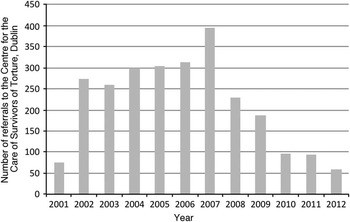
Over the 12-year period studied 2590 people presented to Spirasi. A majority (71%) were male. Mean age was 31.9 years [standard deviation (s.d.) 8.8, range: 15–78) and did not differ between males and females (t=−0.307, p=0.772). Participants originated from 100 different countries. The top five countries of origin were African: Somalia (n=224), the Republic of Congo (202), Nigeria (174), Sudan (173) and the Democratic Republic of Congo (141). There were 112 different languages spoken as a first language; the top five languages were Arabic (15%), English and French (14% each), Somali (8%), and Lingala (5%). An interpreter was required by 58% of clients. The number of first attendees increased from 2001 to 2007, but decreased steadily from 2008 onwards (Fig. 1).
Number of referrals to Spirasi, Dublin, Ireland (2001–2012).

Asylum seekers accounted for the majority of referrals (88%), followed by refugees (9%) and others (3%). ‘Others’ included people who had been granted Irish citizenship or residency, and those who were European Union (EU) nationals.
Region of origin
For all 12 years studied, the number of participants coming from Africa was higher than that from all other regions combined, accounting for almost 75% of new referrals in 2001, decreasing to just over 50% of all new referrals in 2012. The proportions presenting from the Middle East and Europe (including the EU) rose in the most recent years of the study, to 20% in 2011 and 2012. However, this rise reflects the reduction in the numbers from other regions rather than an influx from the Middle East and Europe.
Number of asylum applications nationally and number of first presentations to Spirasi
Between 2001 and 2007, the total number of asylum applications lodged in Ireland fell from 10 325 to 3895, a decrease of 62% (ORAC, 2013). During the same period, the number of first presentations to Spirasi increased from 78 to 396, an increase of 408%. Since 2008 the number of formal applications for asylum has continued to fall (75% reduction), this may reflect Irelands relatively low approval rates of application for refugee status (Barthel & Neumayer, Reference Barthel and Neumayer2015). During this period, there was a decline of similar magnitude in first presentations to Spirasi, from 396 to 59, a decrease of 85%. While the absolute number has reduced the percentage of all Irish asylum seekers presenting to Spirasi has remained relatively stable since 2007, at ~6%.
Gender composition
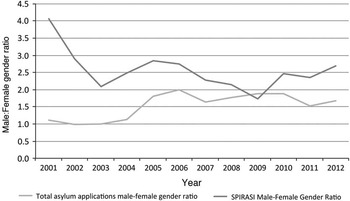
The overall male to female ratio among participants remained relatively stable across the 12-year period, with mean of 2.6 males for every female (s.d.=0.58). There were, however, regional variations: females accounted for 33% and 35% of the African and European groups (respectively), but only 13% and 11% of the Middle Eastern and Asian groups.
Due to the small numbers from certain countries, a more detailed comparison of male to female ratio is difficult, but it is notable that males comprised especially high proportions of persons presenting from Algeria (100% males), Afghanistan (99%), Guinea (93%), Islamic Republic of Iran (79%), Iraq (84%) and Sudan (85%).
A comparison of male to female ratios among those presenting to Spirasi and the total asylum-seeking population, demonstrates that every year, with the exception of 2009, the male to female ratio among those presenting to Spirasi was higher than that of the total asylum-seeking population (Fig. 2).
Male to female ratios among all asylum applicants in Ireland and those presenting for the first time to Spirasi, Dublin, Ireland (2001–2012).

Discussion
Our study showed that 97% of individuals attending Spirasi were in or had come through the asylum process. Africa was the main region of origin but a recent rise has occurred in the those coming from Middle Eastern countries. The majority of attending individuals required interpretation services. In terms of overall referral rates, our data show that, despite the falling numbers of asylum applications lodged in Ireland in recent years, the rate of first presentations to Spirasi, as a percentage of the asylum-seeking population as a whole, has stabilised, at ~6%. Our data indicates that females are underrepresented in referrals to Spirasi.
The prevalence of torture among asylum seekers in many countries is estimated at over 50% (Duffy & Kelly, Reference Duffy and Kelly2015), much greater than the 6% being referred to Spirasi. Our research and other international research highlights some of the potential barriers migrants may face accessing health care. This may partly explain the discrepancy between the numbers expected to have experienced torture and the numbers referred to Spirasi.
A total of 58% of those attending Spirasi require interpretation services. Interviewing refugees and asylum seekers without appropriate interpretation services may lead to missing vital clinical and historical information. The HSE (2009) has compiled helpful guidelines for using interpreting services.
Our study highlights that women are particularly underrepresented in Spirasi. Males accounted for almost three-quarters (71%) of those attending Spirasi for the first time, despite the fact that, since 2001, only 56% of people applying for asylum each year are male. In addition, there is evidence of regional variation within this disparity, with significantly fewer first-time female attenders coming from Middle Eastern and Asian populations. Women, especially those caring for children, may be more impacted by the financial limitations of direct provision. Cultural factors may also reduce female presentations (Honeyball, Reference Honeyball2016) these may include the lack or perceived lack of gender sensitive treatment, higher levels of poverty and discrimination. Rape and other sexual violations are commonly experienced by female asylum seekers (Burnett & Peel, Reference Burnett and Peel2001; IRCT, 2012; Kalt et al. Reference Kalt, Hossain, Kiss and Zimmerman2013). Survivors of such sexual trauma frequently experience stigma and intense feelings of shame (IRCT, 2012) and, in some cultures, are shunned by family and community following disclosure (Hinshelwood, Reference Hinshelwood1997). These factors can lead to reluctance on the part of survivors to report their experiences and seek help. Prior research has also highlighted that women are underrepresented in studies of migration (Lutz, Reference Lutz2010). Future research must be targeted at female populations.
Other barriers have been suggested and may include debilitating physical and psychological health problems, lack of awareness of services, differing cultural attitudes to health and social care, and problems attending services that are geographically distant (Stanciole & Huber, Reference Stanciole and Huber2009; Asgary & Segar, Reference Asgary and Segar2011). This last point is a particular concern for Spirasi which has no centres outside of Dublin.
Many asylum seekers who have experienced torture are not linked with specialist services, as such, it is important for clinicians to have an understanding of the Irish asylum process. Immigration status can mediate or modulate health outcomes (Burnett & Peel, Reference Burnett and Peel2001; Gerritsen et al. Reference Gerritsen, Bramsen, Devillé, van Willigen, Hovens and van der Ploeg2006). In Ireland over 90% of applications for refugee status are declined in Ireland (ORAC, 2016 a ). These survivors of torture are often living in very uncertain conditions, with limited access to occupation, supports and money. These factors may be complicating the treatment and presentation of any mental health problems and Amnesty International (2016) have raised concerns about the impact of these living conditions. Even asylum seekers who have not experienced torture, have been noted to be more likely to experience mental illness than refugees (O’Connell et al. Reference O’Connell, Duffy and Crumlish2016).
Irish policy on the mental health of refugees and asylum seekers is limited. From 2003 to 2006 there were over 20 000 asylum applications in Ireland. Despite this fact, A vision for change makes only one reference to refugee mental health stating that there should be culturally appropriate care. Subsequent reports have highlighted the need to address the health care needs of asylum seekers living in Ireland (Nwachukwu et al. Reference Nwachukwu, Browne and Tobin2009; HSE, 2014). Nwachukwu et al.’s (Reference Nwachukwu, Browne and Tobin2009) report on the mental health needs of refugees and asylum seekers in Ireland recommended:
-
1. Establishing multidisciplinary teams with a special interest in the mental health of asylum seekers and refugees.
-
2. Training in the transcultural aspects of psychiatry.
-
3. Training courses on the preparation of psychiatric reports on asylum seekers.
As these steps have yet to be fully implemented and as the number of people seeking asylum is growing again it is vital that more is done to meet the mental health needs of this vulnerable population (British Refugee Council, 2012).
It is possible that individuals arriving in Ireland are less traumatised than the populations being studied in other countries. Without high quality research on the mental health of asylum seekers estimates of the needs of this population are not possible.
From a methodological perspective, our study has several strengths, including its focus on an important, neglected issue (refugees and asylum seekers in Ireland who have experienced torture) and its location at Ireland’s national centre for the treatment of survivors of torture (Spirasi). Limitations include the fact that not all survivors of torture necessarily present to Spirasi (e.g. they may present to local mental health services or community groups, or not present at all), and that information about economic status, occupational well-being, clinical symptoms or diagnoses was not available for this study; it is hoped to gather and analyse such data in the future and on an ongoing basis.
Conclusions
This study of survivors of torture attending Spirasi over a 12-year period highlights three key trends. First, Spirasi has been accessed primarily by asylum seekers rather than refugees, indicating higher need and/or greater care-seeking behaviour among this group. Clinicians should have an awareness of the practicalities of the asylum process and the impact that it can have on individuals. Second, although the number of persons seeking asylum in Ireland has fallen in recent years, the proportion attending Spirasi has remained relatively stable (6%). This attendance rate that is significantly lower than expected given international estimates of torture prevalence (over 50%). Health care providers working with populations of displaced people should have a high index of suspicion for torture and trauma. Third, this study has also highlighted potential barriers asylum seekers, refugees and migrants face in accessing health care. These include gender, language, financial and practical restraints of direct provision and cultural expectations and values. Clinicians need to be proficient in using interpreting services and should be sensitive to cultural issues especially in female populations. The reasons women are underrepresented requires further investigation, possibly through qualitative research.
Acknowledgements
The authors acknowledge the support of the clients, staff and board of Spirasi.
Funding
This research received no specific grant from any funding agency, commercial or not-for-profit sectors.
Conflicts of Interest
None.
Ethical Standards
The authors assert that all procedures contributing to this work comply with the ethical standards of the relevant national and institutional committee on human experimentation with the Helsinki Declaration of 1975, as revised in 2008. The study protocol was approved by the institutional review board of each participating institution.