Introduction
Employees are often among the first people to encounter issues in day-to-day operations and thus have access to unique information that may otherwise go unnoticed or be overlooked by managers at higher levels of the organizational hierarchy (Park, Tangirala, Hussain, & Ekkirala, Reference Park, Tangirala, Hussain and Ekkirala2022). Employee voice, which is defined as employees’ upward expression of work ideas, opinions, or concerns regarding work-related issues to their supervisors (Detert & Burris, Reference Detert and Burris2007; Li & Tangirala, Reference Li and Tangirala2021), is crucial for team and organization development. Employee voice behavior can offer many benefits, such as improving work inefficiencies, reducing errors, improving decision quality, and enhancing innovation, resilience, and performance (e.g., Burris, Reference Burris2012; Li, Liao, Tangirala, & Firth, Reference Li, Liao, Tangirala and Firth2017; Li & Tangirala, Reference Li and Tangirala2022; Liang, Farh, & Farh, Reference Liang, Farh and Farh2012). However, given that voice emphasizes the expression of constructive challenges aimed at improving or even upsetting the status quo (Van Dyne & LePine, Reference Van Dyne and LePine1998), employees balance the risks and benefits of speaking up. Thus, it is crucial to improve our understanding of the conditions that favor or inhibit voice behavior and to identify people who are more inclined to provide or avoid providing valuable information (Park et al., Reference Park, Tangirala, Hussain and Ekkirala2022).
Leadership behaviors play a vital role in enabling employees to engage in voice behaviors (e.g., Burris, Reference Burris2012; Burris, Detert, & Chiaburu, Reference Burris, Detert and Chiaburu2008; Detert & Burris, Reference Detert and Burris2007; McClean, Burris, & Detert, Reference McClean, Burris and Detert2013). Indeed, voice represents a form of social interaction between employees and the environment (e.g., leaders) (Li, Li, Chen, & Crant, Reference Li, Li, Chen and Crant2022). In other words, employees calculate their perceived benefits and potential costs based on their leader’s actions and signals. We focus on leader inclusiveness, which is characterized by openness, accessibility, and availability in the context of interactions with followers (Carmeli, Reiter-Palmon, & Ziv, Reference Carmeli, Reiter-Palmon and Ziv2010; Nembhard & Edmondson, Reference Nembhard and Edmondson2006). Employees are more likely to speak up when their leaders are perceived to be open to subordinates’ input (Detert & Burris, Reference Detert and Burris2007; Tangirala & Ramanujam, Reference Tangirala and Ramanujam2012) and when the employees themselves feel welcomed and appreciated by their leaders (Edmondson, Reference Edmondson2003; Nembhard & Edmondson, Reference Nembhard and Edmondson2006).
Previous research has demonstrated that leader inclusiveness is conducive to employee voice behavior (Guo, Zhu, & Zhang, Reference Guo, Zhu and Zhang2022; Jiang, Ding, Wang, & Li, Reference Jiang, Ding, Wang and Li2022; Weiss, Kolbe, Grote, Spahn, & Grande, Reference Weiss, Kolbe, Grote, Spahn and Grande2018; Ye, Wang, & Guo, Reference Ye, Wang and Guo2019). For example, Jolly and Lee (Reference Jolly and Lee2021), drawing on basic needs satisfaction theory, found that inclusive leaders are associated with employee voice through the satisfaction of followers’ basic needs for relatedness and competence. Jiang et al. (Reference Jiang, Ding, Wang and Li2022) demonstrated that inclusive leaders influence employee voice indirectly via leader–member exchange. However, recent studies have posited that inclusive leaders are not effective in all situations. A common saying in China stipulates that ‘a kind mother makes a wastrel’, and some scholars have proposed that leader inclusiveness also has an adverse effect on employee behavior (Korkmaz, van Engen, Knappert, & Schalk, Reference Korkmaz, van Engen, Knappert and Schalk2022; Zhu, Xu, & Zhang, Reference Zhu, Xu and Zhang2020). For instance, leader inclusiveness is negatively related to psychological availability (Busse & Regenberg, Reference Busse and Regenberg2019) and challenge-related stress (Zhu et al., Reference Zhu, Xu and Zhang2020), and it thereby ultimately limits employee behavior.
Therefore, although at first glance, it might appear that the influence of leader inclusiveness is straightforward—namely, it stimulates voice—we propose that a closer examination suggests that the issue is more complex. Some leadership behaviors can have two different consequences, leading to autonomous/independent versus compliant/dependent employees (Krause, Goncalo, Tadmor, & Processes, Reference Krause, Goncalo, Tadmor and Processes2021; Wang & Howell, Reference Wang and Howell2010). Hence, we argue that leader inclusiveness has two paradoxical effects on employee voice behaviors through perceived autonomy and cognitive dependency. Specifically, by providing subordinates with assistance and guidance, sharing decision-making, and establishing an inclusive climate, inclusive leaders offer their subordinates perceived autonomy, which in turn enhances their voice. Furthermore, an employee’s perception of his or her leader as inclusive may cause the employee in question to become dependent on the leader in terms of constant availability and accessibility (Kark, Shamir, & Chen, Reference Kark, Shamir and Chen2003), a situation that in turn inhibits employee voice.
Furthermore, the extent to which leader inclusiveness influences voice may be specific to the individual. To elaborate on leaders’ role in employee voice, we integrate the perspectives of individual differences in goal orientation with the goal of examining the boundary conditions associated with the mediation process. Given the limited resources and increasingly competitive environments they face, employees must often outperform their peers to obtain rewards or promotions. Therefore, we focus on performance-prove goal orientation. Performance-prove goal orientation focuses on obtaining favorable evaluations and avoiding negative judgments from others (Gong, Wang, Huang, & Cheung, Reference Gong, Wang, Huang and Cheung2017). However, individuals who exhibit a strong performance-prove goal orientation and who are driven by a self-centered agentic orientation tend to remain more silent than others (Chae, Park, & Choi, Reference Chae, Park and Choi2019; Marinova, Moon, & Kamdar, Reference Marinova, Moon and Kamdar2013). We thus propose that performance-prove goal orientation may influence subordinates’ reactions to leader inclusiveness.
In this study, we integrate the hitherto disjointed literature on inclusiveness and voice to investigate why and when leader inclusiveness is related to employee voice. Accordingly, this study contributes to the literature in several ways. First, we adopt a more comprehensive perspective on the complex mediating mechanism underlying the effect of leader inclusiveness on employee voice. Leader inclusiveness provides fertile ground for the enhancement of subordinates’ perceived autonomy and cognitive dependence, which in turn have a paradoxical effect on subordinates’ voice. Hence, this study explains how leader inclusiveness serves as both a benefit and a detriment to subordinates’ voice and responds to the call for further research on the possible downsides of leader inclusiveness (Korkmaz et al., Reference Korkmaz, van Engen, Knappert and Schalk2022; Randel et al., Reference Randel, Galvin, Shore, Ehrhart, Chung, Dean and Kedharnath2018). Second, this study reveals that performance-prove goal orientation serves as a boundary condition that can weaken the positive indirect effect and strengthen the negative indirect effect of leader inclusiveness on employee voice, thereby advancing previously proposed explorations of the vital role played by individual factors in shaping the effect of leader behavior. This study can also remind organizational managers of the double-edged impact of inclusive leadership and help them develop strategies to promote employee voice behavior in practice. Our proposed theoretical framework is summarized in Figure 1.
Theoretical model.

Theoretical background and hypothesis development
Leader inclusiveness
Leader inclusiveness was initially introduced into the context of management studies by Nembhard and Edmondson (Reference Nembhard and Edmondson2006) and was defined as ‘words and deeds by a leader or leaders that indicate an invitation and appreciation for others’ contributions’ (p. 947). Based on this foundation, Carmeli et al. (Reference Carmeli, Reiter-Palmon and Ziv2010) proposed that leader inclusiveness, as a specific form of relationship leadership, refers to the openness, accessibility and availability exhibited by leaders in their interactions with their followers. More specifically, inclusive leaders tend to be highly approachable and willing to listen and pay attention to the needs of their subordinates. In addition, the literature has emphasized the unique attributes of leader inclusiveness that distinguish it from other similar leadership styles (Nguyen, Nguyen, Nong, & Nguyen, Reference Nguyen, Nguyen, Nong and Nguyen2024). For instance, unlike in participative leadership, leader inclusiveness intentionally values each team member’s unique and often divergent perspectives, thus ensuring that these views are considered rather than overlooked (Mitchell et al., Reference Mitchell, Boyle, Parker, Giles, Chiang and Joyce2015). Furthermore, leader inclusiveness is distinguished from transformational leadership by its dual focus on addressing employees’ needs (Hollander, Reference Hollander2012) and facilitating a process of reciprocal influence between leaders and followers (Carmeli et al., Reference Carmeli, Reiter-Palmon and Ziv2010). These nuanced differences indicate that leader inclusiveness is a strategy that uniquely fosters an environment of respect, consideration, and mutual engagement.
Leader inclusiveness has been increasingly viewed as a critical determinant of employees’ behaviors (Hirak, Peng, Carmeli, & Schaubroeck, Reference Hirak, Peng, Carmeli and Schaubroeck2012; Mitchell et al., Reference Mitchell, Boyle, Parker, Giles, Chiang and Joyce2015). Previous studies have generally shown that inclusive leaders can encourage employees to share their ideas and concerns, thereby contributing to the establishment of a work atmosphere that is characterized by trust, openness, and mutual respect and promoting a more vocal workforce (Jiang et al., Reference Jiang, Ding, Wang and Li2022; Ye et al., Reference Ye, Wang and Guo2019). Clearly, when leaders actively seek and value input from their followers, thereby embracing diverse perspectives, they typically lead those employees to feel more empowered to develop innovative solutions or voice their concerns at work. Several scholars, however, have offered a novel perspective by introducing a caveat regarding the possible unintended outcomes of leader inclusiveness (Busse & Regenberg, Reference Busse and Regenberg2019; Korkmaz et al., Reference Korkmaz, van Engen, Knappert and Schalk2022). For example, Zheng, Yang, Diaz and Yu (Reference Zheng, Yang, Diaz and Yu2018) found that in highly inclusive environments, employees may become less concerned about being excluded and may even begin to question their supervisor’s assertiveness, thus potentially diminishing their effort in the workplace. Moreover, Zhu et al. (Reference Zhu, Xu and Zhang2020) demonstrated that inclusive leaders may cause employees to be less afraid of being punished for mistakes and thus reduce their sense of responsibility for their work, thereby undermining their creativity. These studies have suggested that excessive inclusiveness might, in certain situations, weaken decision-making processes or blur the lines of accountability. In conclusion, previous research has indicated that the impact of leadership inclusiveness on employee behaviors may be multifaceted and not uniformly beneficial. Unfortunately, insufficient attention has been given to the double-edged sword effect of leadership inclusiveness on employee voice, a topic that deserves further exploration.
Leader inclusiveness, perceived autonomy, and voice
Perceived autonomy has been conceptualized as the extent to which employees feel that they have substantial control over the performance of their work (Deci & Ryan, Reference Deci and Ryan2013). This construct is also synonymous with self-determination, one of the four dimensions of psychological empowerment, and involves an individual’s perception of choice regarding the initiation and regulation of actions related to immediate work behaviors and processes (Balkin, Roussel, & Werner, Reference Balkin, Roussel and Werner2015; Spreitzer, Reference Spreitzer1995). Consequently, the terms perceived autonomy and self-determination are used interchangeably throughout this study. Perceived autonomy captures the essential individual self as an autonomous and independent actor in the context of work-related activities (Zhang & Chen, Reference Zhang and Chen2013). Notably, perceived autonomy is not the same as job autonomy, which results from job design factors that have been identified in job characteristics research (Balkin et al., Reference Balkin, Roussel and Werner2015). A common situation is that an employee may occupy a position that is characterized by a high degree of job autonomy—which is structured through job design—but nevertheless experience low self-determination as a result of rigorous time constraints on the completion of a difficult task or other restrictions on outcomes based on a performance rating system (Balkin et al., Reference Balkin, Roussel and Werner2015).
Work environment factors, particularly leadership styles, have significant impacts on employees’ perceptions of autonomy (Lee, Tao, Li, & Sun, Reference Lee, Tao, Li and Sun2021; Zhang & Chen, Reference Zhang and Chen2013). The majority of the literature on leader inclusiveness has, at various points, referenced the concept of autonomy (e.g., Carmeli et al., Reference Carmeli, Reiter-Palmon and Ziv2010; Choi, Tran, & Kang, Reference Choi, Tran and Kang2017; Fang, Chen, Wang, & Chen, Reference Fang, Chen, Wang and Chen2019). In reference to previous studies, we argue that leader inclusiveness can promote employees’ perceptions of autonomy in two ways. First, leader inclusiveness encourages employees to participate in decision-making. Leader inclusiveness is committed to the development of a process of reciprocal influence between leaders and subordinates (Carmeli et al., Reference Carmeli, Reiter-Palmon and Ziv2010; Roberson & Perry, Reference Roberson and Perry2022). This approach transcends mere directive leadership by fostering actions that guarantee subordinate engagement in decision-making processes (Nembhard & Edmondson, Reference Nembhard and Edmondson2006), thereby augmenting subordinates’ sense of control over work-related activities. Second, leader inclusiveness fosters a supportive work environment that encourages risk-taking, provides guidance, and nurtures personal and professional growth. In such an environment, subordinates experience an elevated sense of freedom in their performance of their roles, which is enhanced by the assurance of steadfast support from their leaders; this, in turn, bolsters their perceptions of autonomy (Spreitzer, Reference Spreitzer1996). Therefore, we propose the following hypothesis:
Hypothesis 1: Leader inclusiveness is positively related to perceived autonomy.
Furthermore, we argue that subordinates who experience autonomy are characterized by free choice, enhanced intrinsic motivation, and positive moods, thus leading to stronger voice behaviors. Perceived autonomy allows employees not only to find and cultivate novel ideas but also to put those ideas into practice (Shakil, Memon, & Ting, Reference Shakil, Memon and Ting2023). Hence, during this process, subordinates exhibit high self-determination, and they are more likely to identify work-related problems and generate work-related solutions. This process is very important because it is an integral part of voice. Voice emphasizes the expression of constructive opinions and challenges that are intended to improve rather than merely to criticize (Van Dyne & LePine, Reference Van Dyne and LePine1998). Accordingly, the development of better solutions that challenge the status quo is the first step in voice.
The second step in voice is to express this information to the leader. A general consensus indicates that when employees have the autonomy to decide how to perform their work, they are more intrinsically motivated than in situations in which they are merely told what to do (e.g., Chiniara & Bentein, Reference Chiniara and Bentein2016; Eisenberger & Aselage, Reference Eisenberger and Aselage2009; Schneider, Nebel, Beege, & Rey, Reference Schneider, Nebel, Beege and Rey2018; Zuckerman, Porac, Lathin, & Deci, Reference Zuckerman, Porac, Lathin and Deci1978). When employees act based on intrinsic motivation, they internalize work standards, thus rendering them willing to engage in pro-organizational behaviors, such as voice behavior (Zhang & Chen, Reference Zhang and Chen2013). In addition, by allowing their subordinates to complete a task in their own style, leaders may convey that they trust their subordinates’ ability, skills, and judgment (Eisenberger, Rhoades, & Cameron, Reference Eisenberger, Rhoades and Cameron1999). Such experiences enhance subordinates’ perceived leader support and positive moods at work (Eisenberger et al., Reference Eisenberger, Rhoades and Cameron1999), thus promoting their extra-role performance (Balkin et al., Reference Balkin, Roussel and Werner2015). This situation is conducive to an increase in the perceived efficacy of voice, which is one reason for promoting employee voice behavior. Therefore, we propose the following hypotheses:
Hypothesis 2: Perceived autonomy is positively related to employee voice.
Hypothesis 3: Perceived autonomy positively mediates the relationship between leader inclusiveness and employee voice.
Leader inclusiveness, cognitive dependence, and voice
Dependence on a leader takes several forms, and it includes both cognitive and motivational components (Eisenbeiß & Boerner, Reference Eisenbeiß and Boerner2013; Kark et al., Reference Kark, Shamir and Chen2003). In general, cognitive dependence indicates how a subordinate is restricted in terms of his or her ability to continue working and to make decisions without a leader’s direction. In contrast, motivational dependence indicates that a subordinate’s drive is contingent upon acknowledgment and endorsement from the leader. In this study, we aim to capture this cognitive dependence on a leader, specifically regarding the uncritical acceptance of a leader’s ideas and directions.
Although inclusiveness is considered a virtue across various cultures and philosophical traditions, it may have downsides. A Chinese saying expresses the following point: ‘ci mu duo bai er’ (a fond mother spoils the son). This saying conveys the same meaning as the phrase ‘spare the rod, spoil the child’. Moreover, this logic applies to the relationship between leaders and subordinates; that is, some leaders’ behaviors may cause their subordinates to become dependent on them (Shamir, Reference Shamir1991). Leader inclusiveness conveys a clear signal to subordinates that it is safe to approach leaders and that leaders are always available and accessible to subordinates to discuss issues (Carmeli et al., Reference Carmeli, Reiter-Palmon and Ziv2010). To demonstrate inclusiveness, a leader remains in a state of readiness. In such a context, regardless of the problem at hand, a subordinate can turn to the leader and obtain a solution. This situation reduces the opportunities for subordinates to think independently. Over time, these followers begin simply to admire and obey their leader’s instructions and orders. Accordingly, cognitive dependence on the leader is established.
Furthermore, while leader inclusiveness encourages and embraces diverse contributions, an inclusive leader does not punish subordinates for failing to contribute or even for making mistakes. The fault tolerance exhibited by an inclusive leader entails that when employees make a mistake, the leader tends to forgive them and to avoid disowning them entirely (Wang, Chen, & Li, Reference Wang, Chen and Li2021). Although such toleration of subordinates’ failures and mistakes is associated with certain benefits, it can also contribute to passivity on the part of subordinates. It can also lead to compliance and dependence on the part of subordinates because they face no negative consequences. In contexts featuring inclusive leaders, then, it is possible for subordinates to become passive and uncritical; in this context, subordinates who lack initiative or any sense of responsibility are nevertheless accepted (Kelley, Reference Kelley1988). Such subordinates simply perform the tasks they are assigned and then stop working without reflection or criticism. Over time, they become unambitious and trapped in a muddle-along mentality. Therefore, we propose the following hypothesis:
Hypothesis 4: Leader inclusiveness is positively related to cognitive dependence on leaders.
When subordinates’ cognitive dependence on their leader increases, such subordinates tend to focus more on in-role behavior. Namely, they are expected to perform tasks that are within the scope of their job requirements without engaging in thought or criticism. This situation is detrimental to subordinates’ voice behaviors. Voice behavior is an important component of extra-role behavior, and while voice offers a wide range of benefits, it is not required by organizations (Walumbwa & Schaubroeck, Reference Walumbwa and Schaubroeck2009). That is, subordinates who are dependent on their leader do not pay attention to the importance of making innovative suggestions regarding change or recommending modifications to standard procedures. In addition, voice is a change-oriented behavior (Morrison, Reference Morrison2014) that may challenge and upset the status quo of a team and its power holders (Detert & Burris, Reference Detert and Burris2007). Dependence on a leader can thus limit a subordinate’s ability to advance at work and make decisions (Kark et al., Reference Kark, Shamir and Chen2003), let alone challenge the status quo.
Another concern is that cognitive dependence may result in unconditional and blind trust in a leader (Kollmann, Stöckmann, Krell, Peschl, & Buchwald, Reference Kollmann, Stöckmann, Krell, Peschl and Buchwald2013). With such trust, a leader is free to guide subordinates without any constraints. In such a situation, it is difficult for subordinates to detect the mistakes made by their leader and the problems that exist within their team in a timely manner. They may be satisfied with the status quo of their organization, believing that their leader is capable of doing anything well. Therefore, they are less willing to communicate information upward because they feel that their leader may already have taken such information into account. Thus, we propose the following hypotheses:
Hypothesis 5: Cognitive dependence on leaders is negatively related to employee voice.
Hypothesis 6: Cognitive dependence on leaders negatively mediates the relationship between leader inclusiveness and employee voice.
The moderating role of performance-prove goal orientation
A goal orientation reflects the individual’s underlying goal preference in an achievement situation (Dietz, van Knippenberg, Hirst, & Restubog, Reference Dietz, van Knippenberg, Hirst and Restubog2015; VandeWalle, Reference VandeWalle1997). The literature has identified three types of goal orientation based on differences in competence‐relevant striving (VandeWalle, Reference VandeWalle1997). One such goal orientation is the performance-prove goal orientation. Individuals who exhibit a high level of performance-prove goal orientation desire to demonstrate their competence, perform excellently, and receive positive feedback from others (VandeWalle, Reference VandeWalle1997). Such a performance-prove goal orientation emphasizes proving oneself and engaging in competition (Dietz et al., Reference Dietz, van Knippenberg, Hirst and Restubog2015; Zhu, Chen, Wang, Jin, & Wang, Reference Zhu, Chen, Wang, Jin and Wang2019). In this context, we focus only on the performance-prove goal orientation (Dietz et al., Reference Dietz, van Knippenberg, Hirst and Restubog2015). Given that Chinese enterprises have limited resources, this situation often requires employees to compete with their colleagues for promotions and rewards. In most cases, enterprises do not have clear criteria for promotions, and even in cases in which certain criteria have been established, employees must compete with colleagues who have already met all these criteria. Accordingly, meeting these criteria necessarily leads to rewards or promotions. For example, when the top 10% of employees can obtain a monthly performance evaluation of A, employees tend to achieve short-term results because only by performing better than their colleagues can they obtain access to limited resources. Therefore, in the current situation of increasingly fierce competition in China, it is critical to consider the influence of performance-prove goal orientation on employee performance, especially regarding extra-role performance (Kakkar, Tangirala, Srivastava, & Kamdar, Reference Kakkar, Tangirala, Srivastava and Kamdar2016).
We suggest that a strong performance-prove goal orientation weakens the positive effects of leader inclusiveness on employee voice. Subordinates who exhibit a strong performance-prove goal orientation focus on demonstrating the adequacy of their abilities or avoiding negative judgments from others (Gong et al., Reference Gong, Wang, Huang and Cheung2017). They typically select easier work or exert less effort because they believe that their mistakes or defeats are the result of their own lack of capability (Dweck & Leggett, Reference Dweck and Leggett1988). Easier work is more closely associated with mechanical work, which reduces the possibility of perceived autonomy. This fact implies that although inclusive leaders offer subordinates more freedom and share their decision-making power, these subordinates are inclined to minimize possible negative judgments or punishments (Seijts, Latham, Tasa, & Latham, Reference Seijts, Latham, Tasa and Latham2004). Freedom indicates that leaders believe in their subordinates’ abilities, thus instilling in them a greater sense of uncertainty and risk. To reduce such uncertainty, these subordinates reject partial autonomy from their leaders and instead seek to engage in more deterministic activities, thus proving their competence. It can thus be inferred that a performance-prove goal orientation weakens the positive relationship between leader inclusiveness and perceived autonomy, which in turn weakens employee voice. Therefore, we propose the following hypotheses:
Hypothesis 7: Performance-prove goal orientation moderates the relationship between leader inclusiveness and perceived autonomy such that this positive relationship is stronger when performance-prove goal orientation is lower.
Hypothesis 8: Performance-prove goal orientation moderates the indirect relationship between leader inclusiveness and employee voice through perceived autonomy such that the positive indirect relationship is stronger when performance-prove goal orientation is lower.
In addition, performance-prove goal orientation has the potential to strengthen the negative effects of leader inclusiveness on employee voice. Specifically, individuals who are performance-oriented, that is, those who are driven by a desire to excel or motivated by the fear of failure, are more likely to engage in unethical behaviors, such as cheating. This propensity can further lead to sycophantic tendencies toward leaders as they seek to secure their position or gain favor through underhanded means. In some cases, it is understandable that performance-oriented people view cheating as a viable means to achieve their performance goals (Van Yperen, Hamstra, & van der Klauw, Reference Van Yperen, Hamstra and van der Klauw2011). Similarly, flattery and unreserved acceptance of a leader’s views can also be viewed as paths to success. Moreover, dependence on and obedience to a leader can effectively meet the needs of inclusive leaders, that is, accessibility and availability. This approach also satisfies their need to maintain close relationships with their subordinates. Thus, performance-prove goal orientation reinforces the positive relationship between leader inclusiveness and cognitive dependence on a leader. In addition, performance-oriented employees are driven by a self‐centered agentic orientation, which encourages them to help others only when doing so serves their self‐interest (Marinova et al., Reference Marinova, Moon and Kamdar2013). These employees focus more on personal performance and less on the well‐being and benefit of others or teams (Chae et al., Reference Chae, Park and Choi2019). They also remain silent regarding topics that are unrelated to their interests. Therefore, we propose the following hypotheses:
Hypothesis 9: Performance-prove goal orientation moderates the relationship between leader inclusiveness and cognitive dependence such that this positive relationship is stronger when performance-prove goal orientation is higher.
Hypothesis 10: Performance-prove goal orientation moderates the indirect relationship between leader inclusiveness and employee voice through cognitive dependence such that the negative indirect relationship is stronger when performance-prove goal orientation is higher.
Methods
Participants and procedures
Our participants were recruited online via Credamo (https://www.credamo.com/), a Chinese survey platform that is similar to MTurk and provides professional data collection services to researchers and institutions; this platform has been widely used in China (e.g., Zhang, Chen, Liu, He, & Cheng, Reference Zhang, Chen, Liu, He and Cheng2021; Zhang, Wang, Nerstad, Ren, & Gao, Reference Zhang, Wang, Nerstad, Ren and Gao2022). Compared to other sampling approaches, data collection platforms offer several advantages, such as a large and diverse participant pool (e.g., Credamo features 1.5 million strictly censored registered users) and high-quality data due to anonymity (Aguinis, Villamor, & Ramani, Reference Aguinis, Villamor and Ramani2021).
We used the following steps to ensure data quality. First, we asked Credamo to send online invitations only to full-time employees in its subject pool. Individuals who were interested in participating in our study were asked to send their immediate leader or subordinate another web link, which invited them to participate in our study, thereby forming a dyad. If both people in the dyad were willing to participate in our study, they were invited to register in the system and answer a series of screening questions. Both the leader and subordinate in a dyad were asked to provide their company name and the final four digits of both their own phone number and that of the corresponding leader or subordinate. Individuals who provided mismatched information in response to any of these questions were removed from subsequent data collection. A total of 544 dyads passed the screening tests and participated in the study. Second, to ensure response quality, we included an attention check question (e.g., ‘For this item, please select the ‘strongly disagree’ option’) and a reverse-scored question in each online survey. If the participants did not pass the above checks, their data were removed from subsequent analyses.
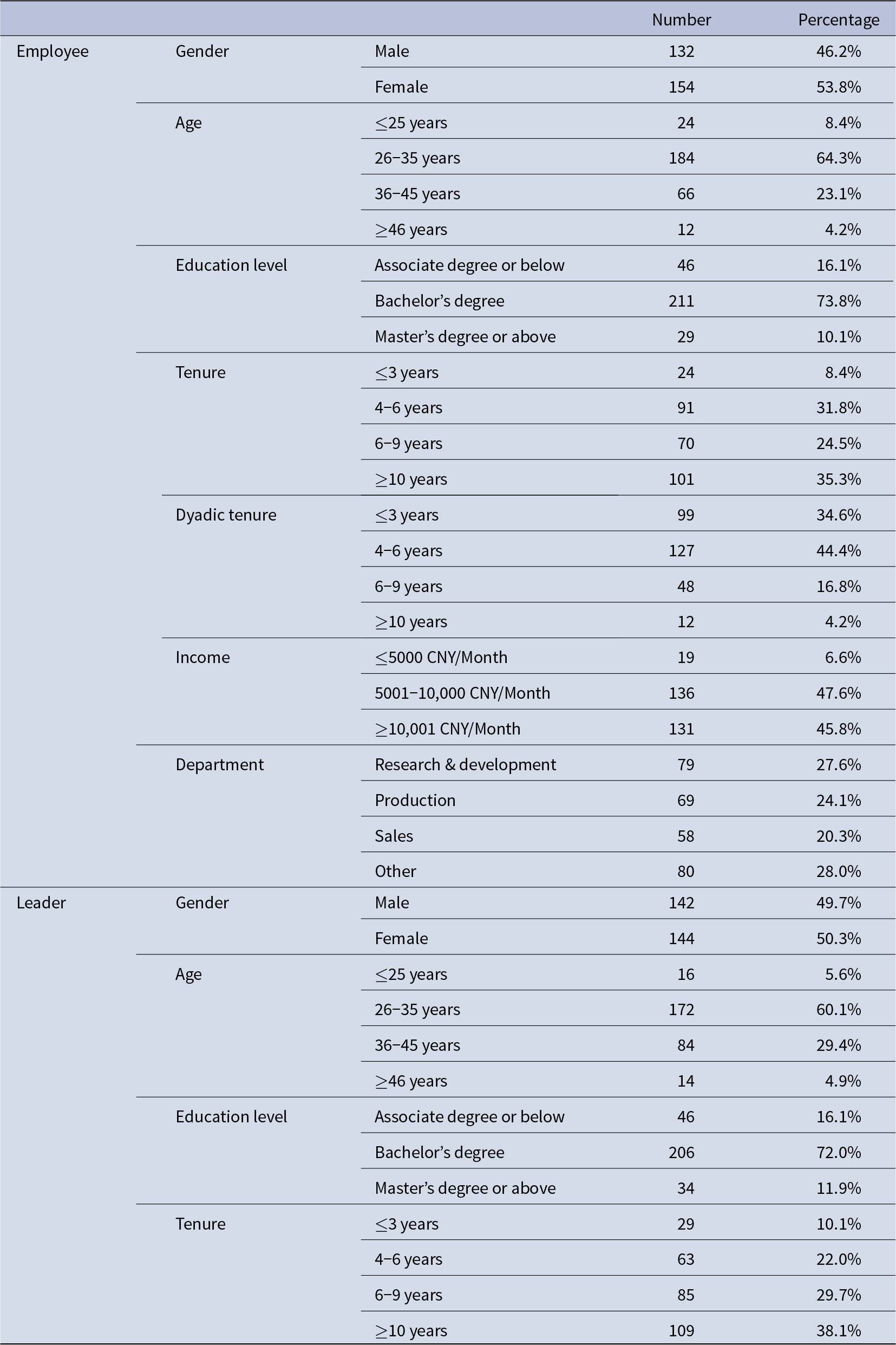
We collected data at two time points from different sources (i.e., leaders and their subordinates) separated by intervals of approximately 1 month. At time 1, subordinate participants reported their demographic information, leader inclusiveness, perceived autonomy, cognitive dependence, and performance orientation. We obtained 408 valid responses from subordinate participants at time 1, for a response rate of 75.0%. At time 2, the subordinates’ immediate leaders reported their demographic information and rated their subordinates’ voice. We received 357 valid leader responses, for a response rate of 65.6%. We ultimately obtained 286 valid responses from leader-subordinate dyads, for an overall response rate of 52.6%. Among the 286 subordinate participants, 53.8% were female. A total of 50.3% of the leader participants were female. Table 1 provides the demographic information of the survey participants.
Sample demographic information (N = 286)

Measures
Given that all the items used in this research were originally written in English, we used the standard back-translation procedure to translate the measures into Chinese. Unless otherwise indicated, a 7-point Likert scale (ranging from 1 = ‘strongly disagree’ to 7 = ‘strongly agree’) was used to score the items. We used the 9-point scale (α = 0.831) developed by Carmeli et al. (Reference Carmeli, Reiter-Palmon and Ziv2010) to assess leader inclusiveness. Two items that exhibited loading values below 0.6 were deleted. Example items are ‘The leader is open to hearing new ideas’ (openness), ‘The manager is available for consultation on problems’ (availability), and ‘The manager encourages me to access him or her to address emerging issues’ (accessibility).
We used three items (α = 0.797) based on Hackman, Hackman and Oldham (Reference Hackman, Hackman and Oldham1980) to assess perceived autonomy. The items are ‘I have significant autonomy in determining how I do my job’, ‘I can decide on my own how to go about doing my work’, and ‘I have considerable opportunity for independence and freedom in how I do my job’.
We used three items (α = 0.788) drawn from Eisenbeiß & Boerner (Reference Eisenbeiß and Boerner2013) to assess cognitive dependence on a leader. The items are ‘I don’t question the leader’s orders’, ‘I accept my direct supervisor’s viewpoints and do not challenge them’, and ‘Before carrying out my direct supervisor’s orders, I consider whether they are reasonable (reverse-scored)’.
Performance-prove goal orientation was measured using a 4-point scale (α = 0.722) developed by VandeWalle (Reference VandeWalle1997). The items are ‘I am concerned with showing that I can perform better than other colleagues’, ‘I try to figure out what it takes to prove my competence to other colleagues’, ‘I like it when other colleagues are aware of how well I am doing’, and ‘I like to work on projects where I can prove my competence to other colleagues’.
We used four items (α = 0.723) drawn from Van Dyne and LePine (Reference Van Dyne and LePine1998) and Li and Tangirala (Reference Li and Tangirala2021) to measure employee voice behavior. The items are ‘I challenge my leader to deal with problems around here’, ‘I give suggestions to my leader about how to make this team better, even if others disagree’, ‘I speak up to my leader to express ideas about addressing employees’ needs and concerns’, and ‘I stay well informed about issues concerning which my opinion might be useful’.
We also included some control variables. First, consistent with previous studies on voice, we controlled for employees’ gender (0 = male, 1 = female), age (1 = 25 years or younger, 2 = 26–35 years, 3 = 36–45 years, 4 = 46 years or older), education level (1 = associate degree or lower, 2 = bachelor’s degree, 3 = master’s degree or above), and tenure (1 = 3 years or less, 2 = 3–6 years, 3 = 6–9 years, 4 = 9 years or more) following the suggestions of Detert and Burris (Reference Detert and Burris2007). Second, we investigated dyadic tenure information (the same measurements as tenure), that is, the number of years spent working with the subordinate’s current immediate supervisor, as has been suggested by previous studies (Avey, Wernsing, & Palanski, Reference Avey, Wernsing and Palanski2012; Thompson & Klotz, Reference Thompson and Klotz2022). Third, we included employee income (1 = 5,000 CNY or less per month, 2 = 5,001–10,000 CNY per month, 3 = 10,001 CNY or more per month) because employees with higher salaries are difficult to replace and are more loyal (Davis-Blake, Broschak, & George, Reference Davis-Blake, Broschak and George2003). Fourth, we included a dummy control variable for department categorization (Detert & Burris, Reference Detert and Burris2007; Thompson & Klotz, Reference Thompson and Klotz2022), which divided departments into four types: research & development, production, sales, and other. Finally, we accounted for supervisors’ gender, age, education level, and tenure using the same metrics that we used for employees. The survey items are specified in the Appendix.
Results
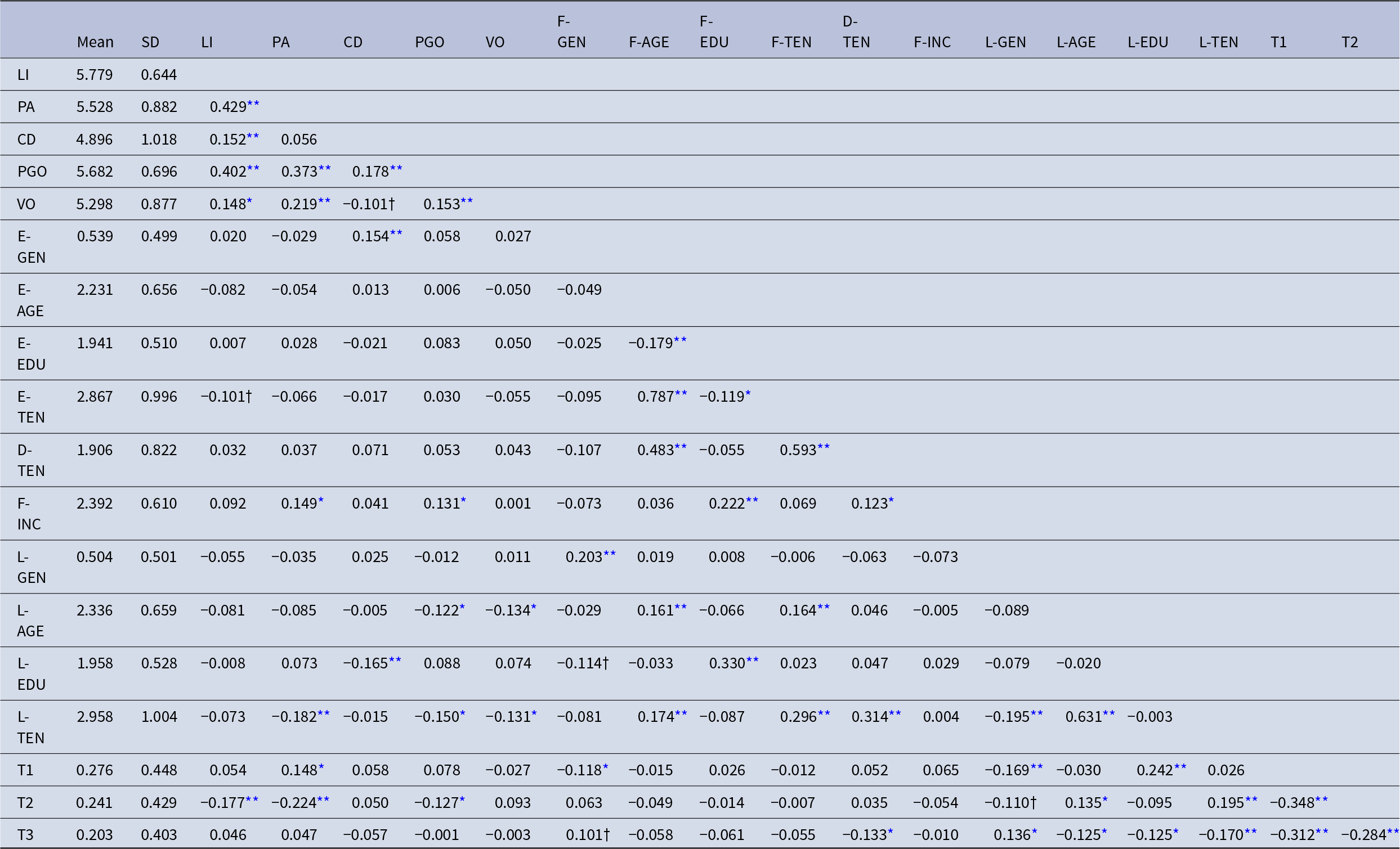
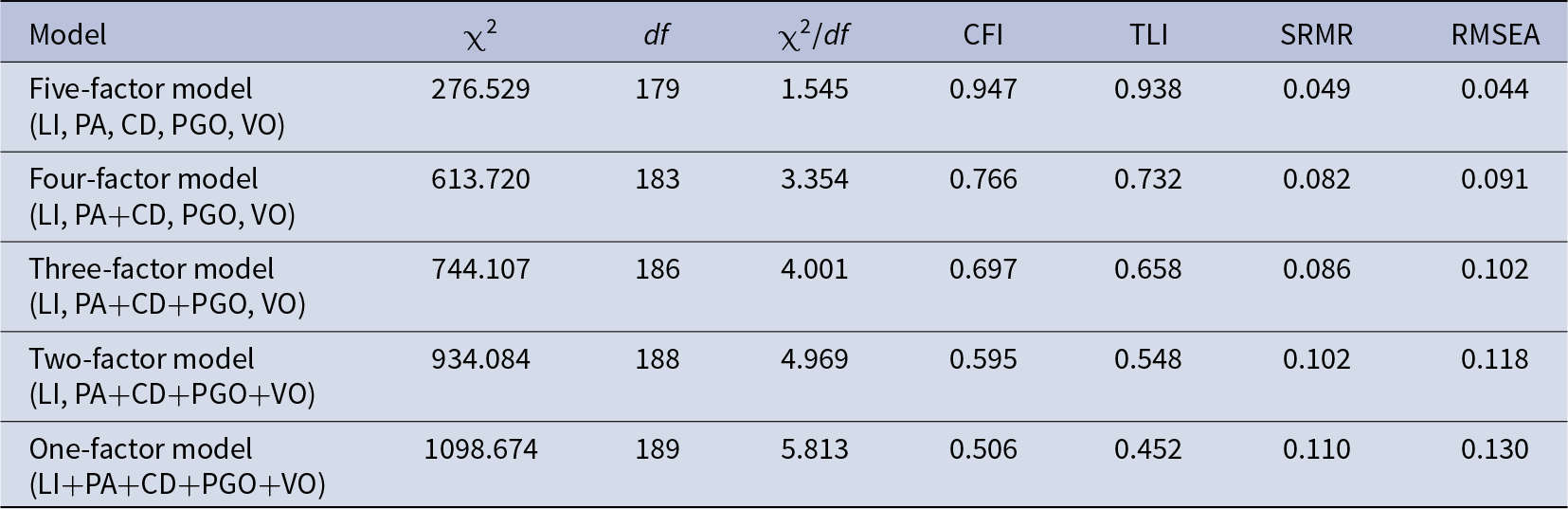
Table 2 reports the means, standard deviations, and inter-scale correlations of the variables. Before testing our hypotheses, we tested the validity of the measurement model in our data by performing confirmatory factor analysis (CFA). The CFA results shown in Table 3 indicate that the expected five-factor model exhibited a good fit, χ2 = 276.529, df = 179, CFI = 0.947, TFI = 0.938, SRMR = 0.049, RMSEA = 0.044, and that this model was significantly better than the alternative models. This finding confirmed the divergent validity of the variables used in the current study.
Descriptive statistics and correlations

Notes: LI = leader inclusiveness, PA = perceived autonomy, CD = cognitive dependence, PGO = performance-prove goal orientation, VO = voice, E- = employee, L- = leader, INC = income, D-TEN = dyadic tenure, T1= research & development team, T2 =production team, T3 =sales team; †p < .10,
* p < .05,
** p < .01.
Results of the confirmatory factor analyses

Notes: N = 286, CFI = Comparative Fit Index, TLI = Tucker–Lewis Index, SRMR = Standardized Root Mean Square Residual, RMSEA = Root Mean Squared Error of Approximation; LI = leader inclusiveness, PA = perceived autonomy, CD = cognitive dependence, PGO = performance-prove goal orientation, VO = voice.
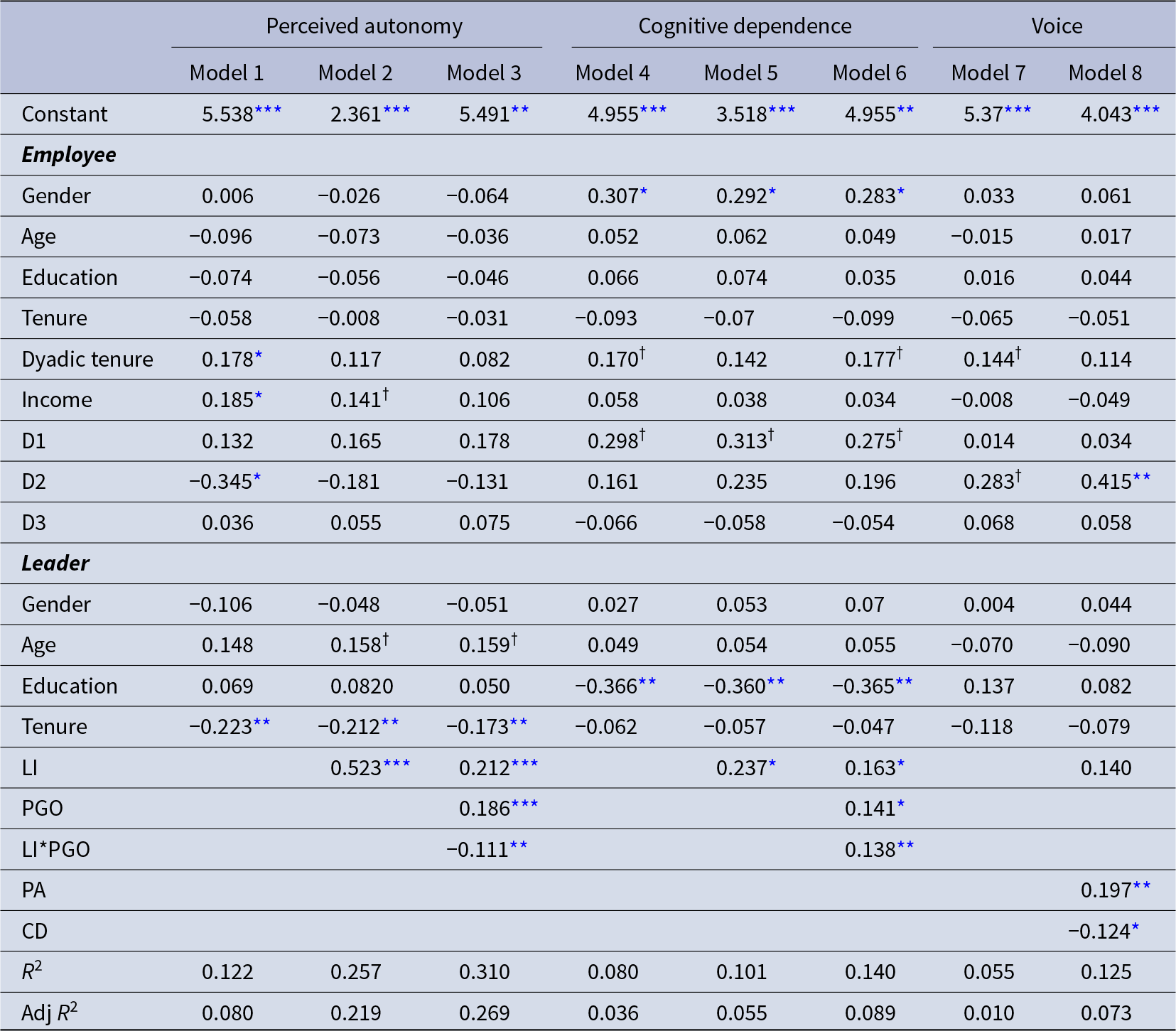
As Table 3 shows, leader inclusiveness was related to perceived autonomy (Model 2: b = 0.523, p < .001) and cognitive dependence (Model 5: b = 0.237, p < .05). In addition, according to Model 8, perceived autonomy (b = 0.197, p < .01) and cognitive dependence (b = −0.124, p < .05) were both related to voice behavior. Thus, Hypotheses 1, 2, 4, and 5 are supported. PROCESS analysis was used to test the mediating effects (Hayes, Reference Hayes2013) since this approach allows multiple mediators to be included in model testing and can recognize competitive mediation regardless of the presence of a nonsignificant relationship between the independent and dependent variables (Xiao, Zhang, & Cervone, Reference Xiao, Zhang and Cervone2018; Zhao, Lynch, & Chen, Reference Zhao, Lynch and Chen2010). Based on the bootstrapping results, the indirect effects of leader inclusiveness on voice behavior through perceived autonomy (a × b = 0.103, SE = 0.049, 95% CI = [0.028, 0.216]) and cognitive dependence (a × b = − 0.029, SE = 0.017, 95% CI = [−0.070, − 0.003]) were both significant. Additionally, the signs of the two indirect effects were opposite. Thus, Hypotheses 3 and 6 are supported.
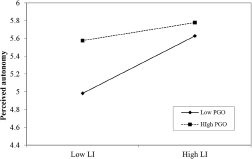
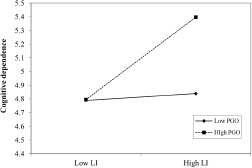
Hypothesis 7 posits that performance-prove goal orientation moderates the relationship between leader inclusiveness and perceived autonomy. The regression results pertaining to Model 3 in Table 4 indicate that the interaction between leader inclusiveness and performance-prove goal orientation is a significant, negative predictor of perceived autonomy (b = − 0.111, p < .01). We drew an interaction plot following the procedures suggested by Dawson (Reference Dawson2014). Figure 2 illustrates the interaction patterns. The results of a simple test reveal that when performance-prove goal orientation is lower, leader inclusiveness is positively related to perceived autonomy (simple slope = 0.323, p < .001), and leader inclusiveness exhibits a nonsignificant relationship with perceived autonomy (simple slope = 0.101, p > .05) when performance-prove goal orientation is stronger. Hence, Hypothesis 7 is supported. Hypothesis 9 posits that performance-prove goal orientation moderates the relationship between leader inclusiveness and cognitive dependence. As expected, the interaction term between leader inclusiveness and performance-prove goal orientation positively predicted cognitive dependence (b = 0.138, p < .01). As shown in Figure 3, the simple slope test results indicate that the effect of leader inclusiveness on cognitive dependence is more pronounced and positive at a high (simple slope = 0.301, p < .01) rather than low (simple slope = 0.023, p > .05) level of performance-prove goal orientation, thereby supporting Hypothesis 9.
Interaction plot of leader inclusiveness (LI) and performance-prove goal orientation (PGO) regarding predicting perceived autonomy.

Interaction plot of leader inclusiveness (LI) and performance-prove goal orientation (PGO) regarding predicting cognitive dependence.

Regression results

Note(s): N = 286. †p <.10,
* p <.05,
** p <.01,
*** p <.001. D1 = research & development, D2 = production, D3 = sales, LI = leader inclusiveness, PA = perceived autonomy, CD = cognitive dependence, PGO = performance-prove goal orientation.
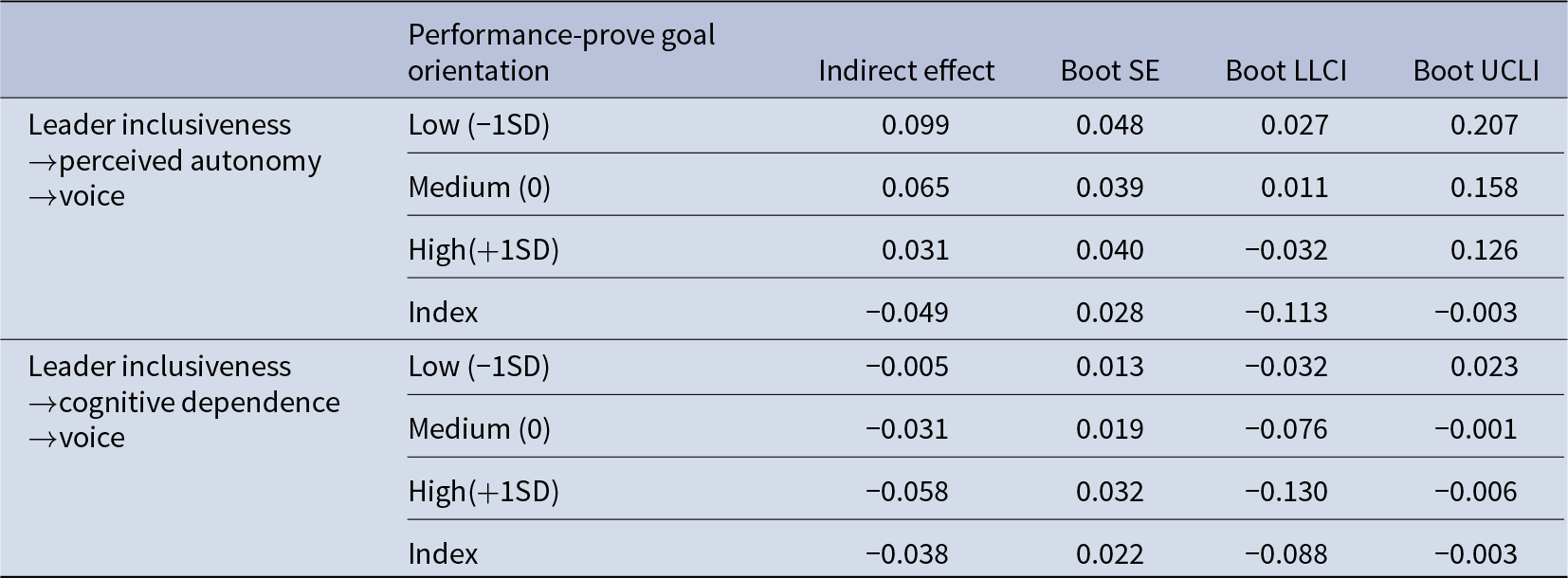
Hypothesis 8 suggests that the indirect effect of leader inclusiveness on employee voice through perceived autonomy is weaker when employee performance-prove goal orientation is stronger. A moderated mediation test was performed using PROCESS. According to Table 5, when performance-prove goal orientation is low, the indirect effect is 0.099 and significant (SE = 0.048, 95% CI = [0.027, 0.207]). In contrast, when performance-prove goal orientation is high, the indirect effect is 0.031 and not significant (SE = 0.040, 95% CI = [−0.032, 0.126]). Moreover, the overall index of the moderated mediation used to test the differences in indirect effects at high and low levels of the moderator is −0.049 and significant (SE = 0.028, 95% CI = [−0.113, −0.003]). Thus, Hypothesis 8 is supported. Hypothesis 10 suggests that the indirect effect of leader inclusiveness on voice through cognitive dependence is weaker when performance-prove goal orientation is stronger. According to Table 5, when performance-prove goal orientation is low, the indirect effect is −0.005 and not significant (SE = 0.013, 95% CI = [−0.032, 0.023]). In contrast, when performance-prove goal orientation is high, the indirect effect is −0.058 and significant (SE = 0.032, 95% CI = [−0.130, −0.006]). We thus found that the overall index of the moderated mediation was − 0.038 and significant (SE = 0.022, 95% CI = [−0.088, − 0.003]). Hence, Hypothesis 10 is supported.
Results of the moderated mediation analyses

Discussion
In this study, we sought to shed light on the complex role played by leader inclusiveness in influencing employee voice through two mediating factors that lead in opposing directions. Our results indicate that leader inclusiveness has a positive effect on voice through perceived autonomy and a negative effect on voice through cognitive dependence. These results also reveal that a high level of performance-prove goal orientation buffers the positive effect and exacerbates the detrimental effect of leader inclusiveness on employee voice. The following sections highlight the theoretical and practical implications of our findings, discuss the limitations of our work, and propose some directions for future research.
Theoretical implications
This study makes several contributions to the literature. First, this study enriches the literature on the consequences of leader inclusiveness by investigating the dual-path mediating mechanism underlying the impact of leader inclusiveness on employee voice. Prior studies have indicated that inclusive leaders, who are open to subordinates’ ideas and value their input (Carmeli et al., Reference Carmeli, Reiter-Palmon and Ziv2010; Ye et al., Reference Ye, Wang and Guo2019), establish an environment that is conducive to employee voice (Weiss et al., Reference Weiss, Kolbe, Grote, Spahn and Grande2018). Previous research has generally recognized the positive role of inclusive leadership styles in the workplace, such as by enhancing task performance (Gong, Zhang, & Liu, Reference Gong, Zhang and Liu2023), heightening creativity (Jia, Jiao, & Han, Reference Jia, Jiao and Han2022), and improving innovative work behaviors (Sürücü, Maslakçı, & Şeşen, Reference Sürücü, Maslakçı and Şeşen2023). However, the influence of leader inclusiveness on employee voice, especially its double-edged sword effect, requires further exploration (Alang, Stanton, & Rose, Reference Alang, Stanton and Rose2022; Guo et al., Reference Guo, Zhu and Zhang2022). By combining the literature on inclusive leadership outcomes with the literature on the antecedents of voice behavior, this study provides a new and nuanced perspective on the ability of leader inclusiveness to enhance and impair employee voice by stimulating employees’ perceived autonomy and cognitive dependence, respectively. In addition to reinforcing the claim that leader inclusiveness can serve as a supportive organizational practice, these findings also respond to growing calls for investigations of its possible threatening consequences (Korkmaz et al., Reference Korkmaz, van Engen, Knappert and Schalk2022; Randel et al., Reference Randel, Galvin, Shore, Ehrhart, Chung, Dean and Kedharnath2018). Based on the discussion of the dual mediation pathway, this study further strengthens our understanding of the ways in which the bright and dark sides of inclusive leadership may coexist (Zhu et al., Reference Zhu, Xu and Zhang2020).
Second, this study expands our knowledge of the boundary conditions associated with inclusive leadership by identifying the moderating role of employee performance-prove goal orientation in the impact of inclusive leadership on voice behavior. While previous studies have acknowledged that employee characteristics, such as power distance (Guo et al., Reference Guo, Zhu and Zhang2022), achievement value (Jiang et al., Reference Jiang, Ding, Wang and Li2022), and regulatory focus (Li, Guo, & Wan, Reference Li, Guo and Wan2019), influence the effect of leader inclusiveness on employee behavior, the role of performance-prove goal orientation has been notably overlooked in this context. Therefore, this study constructs an integrated theoretical framework for these moderated mediating effects and examines the regulating effects of employees’ performance-prove goal orientation, thus improving our understanding of the complex influence of leadership inclusiveness on employee voice behavior. Interestingly, the results suggest that the indirect effects of leader inclusiveness on voice via perceived autonomy and cognitive dependence are contingent on employees’ performance-prove goal orientation. A high level of performance-prove goal orientation weakens the positive indirect effect and strengthens the negative indirect effect of leader inclusiveness on employee voice. Subordinates who exhibit a high level of performance-prove goal orientation typically select easier work or exert less effort in their work (Dweck & Leggett, Reference Dweck and Leggett1988). They are likely to choose inaction over the possibility of making a mistake. They prefer to pursue certainty, which reduces their perceptions of autonomy and voice, even in contexts featuring inclusive leaders. In addition, such employees place more emphasis on individual accomplishment and less emphasis on the welfare and benefits of other people and teams. When their leaders indicate that timely help and guidance are available, they actively use these resources and grow more dependent on them. Their tendency to avoid opposing their leader or offering opposing opinions can also be viewed as a path to success (Chae et al., Reference Chae, Park and Choi2019). Hence, our findings concerning the interaction effects suggest that paying attention to individual differences in this context may be important. This study therefore expands our knowledge of the impacts of differences in individual goal orientation on the relationship between leader behaviors and voice.
Managerial implications
In addition to the theoretical contributions mentioned above, this research has two key practical implications. First, we highlight the need for organizations to understand the impact of leader inclusiveness. Our findings suggest that leader inclusiveness has a positive effect on voice through perceived autonomy and a negative effect on voice through cognitive dependence. Managers may therefore consider using inclusive leader behaviors to promote voice by enhancing subordinates’ perception of autonomy. Nevertheless, the adoption of this approach requires careful consideration given that leader inclusiveness can set in motion a multifaceted process. To effectively leverage the benefits of inclusivity, leaders must maintain vigilant awareness of their subordinates’ levels of dependency and their acceptance of ideas without reservations. Managers should ensure that some reward and punishment programs are implemented to weaken employees’ dependence and minimize the dark side of leader inclusiveness. We cannot deny the positive impacts of leader inclusiveness, such as enhanced psychological safety (Hirak et al., Reference Hirak, Peng, Carmeli and Schaubroeck2012). However, leader training programs must also mention the possible negative effects of inclusiveness, such as the lack of pressure to challenge leaders (Zhu et al., Reference Zhu, Xu and Zhang2020) and the corresponding increase in dependence. In practice, inclusiveness is not always effective, just as ‘the moon waxes only to wane, and water surges only to overflow’. We therefore encourage managers to consider the negative implications of leader inclusiveness.
Another implication for organizations pertains to the role that performance-prove goal orientation plays in the process of leader inclusiveness. Our research suggests that a strong performance-prove goal orientation is not conducive to the impact of leader inclusiveness on employee voice. Performance-prove goal orientation mitigates the benefits and enhances the drawbacks of the effects of leader inclusiveness on voice. In contexts featuring scarce resources and heightened competition, the practice of rewarding or promoting a single employee is frequently employed in organizational settings (Poortvliet, Anseel, Janssen, Van Yperen, & Van de Vliert, Reference Poortvliet, Anseel, Janssen, Van Yperen and Van de Vliert2012). Such dynamics can lead to negative organizational consequences, including the obstruction of information flow or the dissemination of misinformation. To achieve constructive outcomes, it is imperative for managers to obtain insights into the goal orientations of their employees. Simultaneously, organizations should explore strategies to decrease the competitive inclinations exhibited by colleagues. Specifically, managers should be more active regarding encouraging cooperation and a shared vision; in addition, they should be wary of a culture that focuses on purely competition-driven goals.
Limitations and directions for future research
We acknowledge several limitations of the present study. First, we addressed the shortcomings entailed by the cross-sectional design, thus enabling the temporal precedence of leader inclusiveness/perceived autonomy/cognitive dependence and employee voice. However, our design did not allow us to determine the causal relationships among leader inclusiveness, perceived autonomy/cognitive dependence, and employee voice. To resolve this issue, future studies should replicate our results using well-controlled experiments.
Second, the findings of this study could be distorted by social desirability bias (i.e., participants’ inclination to make themselves look good), which could affect our evaluation of leader behaviors, dependence, and goal orientation (Ma, Peng, & Wu, Reference Ma, Peng and Wu2021). Although we minimized the impact of social desirability bias by ensuring data confidentiality and collecting data via an online platform, future research could assess these variables from the perspectives of leaders or coworkers to further improve the robustness of our findings.
Third, the participants in this study were recruited from China, which may limit the generalizability of our theoretical framework. Compared with people from Western countries, Chinese people are more reluctant to express themselves (Jiang et al., Reference Jiang, Ding, Wang and Li2022). In addition, in Eastern cultures, hierarchy plays an important role. Employees in China are therefore less inclined to argue with their managers (Korkmaz et al., Reference Korkmaz, van Engen, Knappert and Schalk2022). It is thus easy to speculate that compared to employees in Western countries, employees in Eastern countries are more likely to accept their leaders’ opinions and become dependent on their leaders. Therefore, it is important to improve our understanding of how cultural values affect the function of leader inclusiveness.
Finally, the present research focused on performance-prove goal orientation as a key contingent factor in the relationship between leader inclusiveness and employee voice. Although we explained why we focused on this goal orientation, we did not distinguish between individual- and group-focused performance, which can shape the nature of both intra- and intergroup oriented competitive expression (Zhu et al., Reference Zhu, Chen, Wang, Jin and Wang2019). In addition, we did not include any other types of goal orientation (i.e., learning goal orientation or performance-avoidance goal orientation). Hence, future studies should consider additional types of goal orientation to enrich our understanding of the contextual factors that are relevant in this context.
Appendix. Key constructs and items of the questionnaire
Leader inclusiveness
• The manager is open to hearing new ideas
• The manager is attentive to new opportunities to improve work processes
• The manager is open to discussing the desired goals and new ways to achieve them
• The manager is available for consultation on problems
• The manager is an ongoing ‘presence’ in this team—someone who is readily available
• The manager is available for professional questions I would like to consult on with him/her
• The manager is ready to listen to my requests
• The manager encourages me to access him/her on emerging issues
• The manager is accessible for discussing emerging problems
Perceived autonomy
• I have significant autonomy in determining how I do my job
• I can decide on my own how to go about doing my work
• I have considerable opportunity for independence and freedom in how I do my job.
Cognitive dependence
• I don’t question the leader’s orders
• I accept my direct supervisor’s viewpoints and do not challenge them
• Before carrying out my direct supervisor’s orders, I consider whether they are reasonable (reverse)
Performance-prove goal orientation
• I am concerned with showing that I can perform better than other colleagues
• I try to figure out what it takes to prove my competence to other colleagues
• I like it when other colleagues are aware of how well I am doing
• I like to work on projects where I can prove my competence to other colleagues
Voice
• I challenge my leader to deal with problems around here
• I give suggestions to my leader about how to make this team better, even if others disagree
• I speak up to my leader to express ideas about addressing employees’ needs and concerns
• I stay well informed about issues concerning which my opinion might be useful
Lei Gong received the Ph.D. degree in Management from University of Science and Technology of China. He is currently a lecturer in the Alibaba Business School, Hangzhou Normal University. His research interests include innovation management and leadership.
Shuqin Zhang received the Ph.D. degree in Management from University of Science and Technology of China. She is currently a lecturer in School of Finance, Nanjing University of Finance & Economics. Her research interests include social media, knowledge management and IT-supported collaboration.
Zhiying Liu received the Ph.D. degree in Economics from Nanjing Agricultural University in 2006. He is currently a full professor with the Department of Business Administration, School of Management, University of Science and Technology of China. His research interests include innovation management and industrial economy.