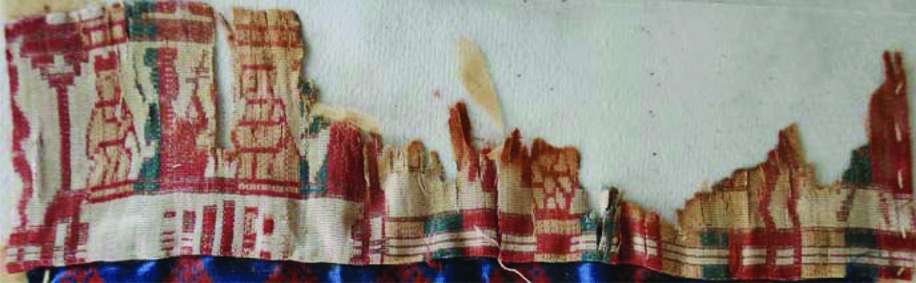
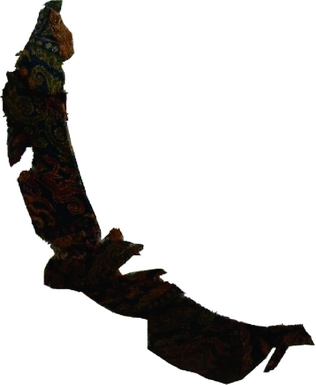
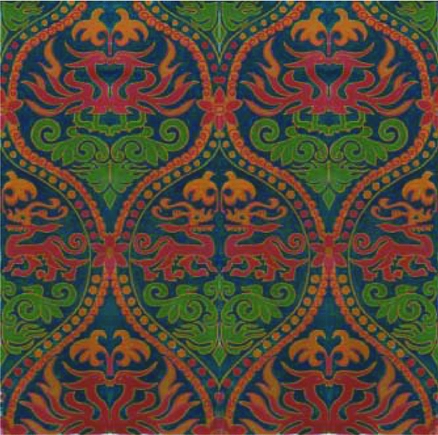
The excavation of tombs in the Astana graveyard, Turfan, has provided a wealth of evidence for studying everyday life on the Silk Road. Manuscripts and textiles constitute two major groups of the excavated finds. Among the manuscripts are over 60 burial inventories (yiwushu), listing items that would accompany the deceased to the afterlife.Footnote 1 Some of the items on the inventories were real and can be identified with objects found in the tombs; some were represented symbolically: for example in miniature form;Footnote 2 and others, probably included for formulaic purposes, were imagined.Footnote 3 Although there have been several studies on the burial inventories and textiles from Turfan,Footnote 4 the two are usually considered separately, with little attention to their correlation, mainly because burial inventories tend to be studied by specialists working on documents, and textiles are usually studied by textile specialists. In 2005 we were fortunate to be able to examine all the textiles from a mid-sixth century tomb at Astana (72TAM170), and to study the three burial inventories found in that tomb.Footnote 5 Comparing the physical textile remains against the burial inventories from the same tomb offered us a rare opportunity to test the accuracy of the burial inventories,Footnote 6 and also to identify the physical textile remains with the textile terminology of that time. This article is arranged in four parts which present a brief description of the tomb, details of the burial inventories, a comparison of the textile remains against the burial inventories and a closer look at the silk textiles found in the tomb.
A Brief Description of the Tomb
The full archaeological reference for tomb no. 170 in the Astana graveyard in Turfan is 72TAM170, excavated in 1972 by an archaeological team from the Xinjiang Museum and the Turfan Institute of Cultural Heritage (TAM is an acronym for Turfan Astana mu, where mu means ‘tomb’).Footnote 7 The tomb is located in the middle of the northern part of the graveyard, and appears to be one of a group of four tombs (the others are 72TAM168, 72TAM169 and 72TAM186).Footnote 8 All four tombs were of the Gaochang period, oriented at 240–270°, with a sloping entrance leading down to a more-or-less rectangular tomb chamber. Tombs of this period typically contain burial goods such as painted pottery (which look as though they were made specifically for burials), paintings on silk, foodstuffs such as small cakes and dried fruits, “five-grain” bags, chicken-head pillows, wooden ducks, wooden handgrips, items made of silk and hemp, and paper caps and shoes made from recycled documents. Many tombs also contain documents, stone epitaphs and/or burial inventories written on paper, which confirm the names and dates of the occupants.Footnote 9
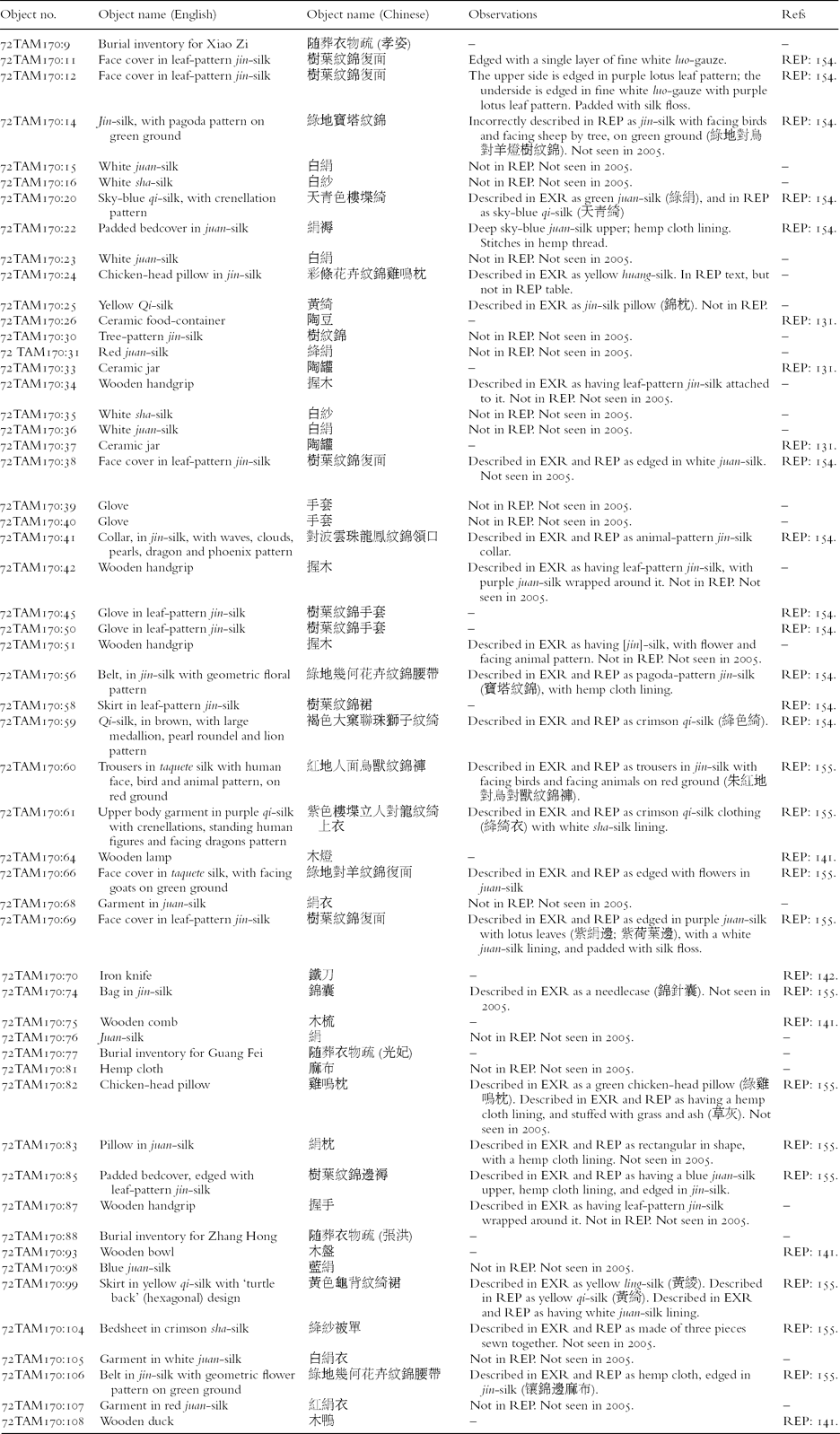
Tomb 170 was oriented at 265°, and had a sloping entrance leading down to a tomb chamber measuring 3.50 × 3 m (narrowing to 1.5 m). The tomb had been disturbed prior to excavation. Three bodies were found in the tomb: one male and two female. Epitaphs and burial inventories from the tomb identified the occupants as General Zhang Hong 張洪 (Buddhist name Xiao Yin 孝寅, d. 562); his first wife, of the Jiao 焦 clan (Buddhist name Xiao Zi 孝姿, d. 543) and his second wife Guang Fei 光妃 (d. 548). The objects found in the tomb were typical of the period. As part of our research in 2005, we made our own thorough examination of the textile remains from this tomb, and also checked them against the original excavation notes made in 1972 and the summary report published in 2000. A list of objects found in the tomb is presented in Table 1; it has been compiled from the short excavation report of 2000, and from our research in 2005, and includes notes of any discrepancies between the excavation record, the short report and our observations in 2005.Footnote 10 As part of our detailed examination of the textiles, we have at times corrected and suggested improvements for the descriptive names for textiles.
List of objects found in Tomb 72TAM170, Astana. EXR = Excavation Report (1972); REP = Published Report (2000)
The object names and textile terminology are those used by authors in 2005. Discrepancies with earlier reports are noted under observations

The Burial Inventories from 72TAM170
Three burial inventories were recovered from 72TAM170.Footnote 11 As the inventories are quite long, only the parts relevant to textiles and clothing are presented below. They list clothing and bedding made in various kinds of silks (jin, juan, ling, lian), cotton and hemp, as well as silk floss, silk by the sheet, and silk, hemp and cotton by the bolt, and juan-silk by the bundle.
The Burial Inventory for Zhang Hong
Zhang Hong's Buddhist name, Xiao Yin, is used in the title of his burial inventory (72TAM170:88). He died in 562, the 2nd year of the Yanchang period of the Gaochang Kingdom. The burial inventory was originally written in rows from top to bottom. The lower part is damaged, and some text is missing.
右練脚靺一具。右練裈衫一具。右 [下缺]
右被辱(褥)一具。右履一双。右面衣一颜 [下缺]
有珠衣【车卡】寰,领带具。
支一枚。右杂锦百匹。右杂 [下缺]
右绢七百匹。右绵六百斤 [下缺]
右叠千五百匹。右金钱 [下缺]
右银钱千文。右笔砚一具 [下缺]
As used by the owner. lian-silk sock and legging – 1 set.
As used by the owner, lian-silk trousers and shirt – 1 set.
As used by the owner [text missing]
As used by the owner, bedcover/mattress – 1 set.
As used by the owner, shoes – 1 pair.
As used by the owner, face cover – 1 piece [text missing]
Clothing with beads (uncertain), with collar tie - 1 set.
Zhi (uncertain) – 1 piece.
As used by the owner, various kinds of jin-silk – 100 bolts.
As used by the owner, various [text missing]
As used by the owner, juan-silk – 700 bolts.
As used by the owner, silk-floss – 600 jin [text missing]
As used by the owner, die-cotton – 1,500 bolts.
As used by the owner, gold coins – [1,000] [text missing]
As used by the owner, silver coins – 1,000 coins.
As used by the owner, brush-pen and inkstone – 1 set [text missing]
The Burial Inventory for Jiao (Xiao Zi)
Jiao's Buddhist name, Xiao Zi, is used in the title of her burial inventory (72TAM170:9). She died in 543, the 13th year of the Zhanghe period of the Gaochang Kingdom.
故树叶面衣一枚。故绣罗当一枚。故锦襦一枚, 领带具。故锦褶一枚, 领带具。故绯绫襦二枚, 领带具。故紫绫褶二枚, 领带。故绯绫袄三枚, 领带具。故白绫大衫一枚, 领带具。故白绫少衫一枚, 领带具。故黄绫裙一枚, 攀带具。故【糹支】绫裙一枚, 攀带具。故合蠡文锦袴一枚, 攀带具。故白绫中衣一枚, 攀带具。故脚靡一枚。故绣鞾二枚。故树叶锦丑衣二枚。故金银钏二枚。故金银指环六枚。故挝扮耳抱二枚。故绫被辱(褥)四枚。故绯红锦鸡鸣枕一枚。故波斯锦十张。故魏锦十匹。故合蠡大绫十匹。故石柱小绫十匹。故白绢卌匹。故金钱百枚。故银钱百枚。故布叠二百匹。故手【未已】二枚。攀天糸万万九千丈。
As used by the owner, leaf-pattern face cover – 1 piece.
As used by the owner, embroidered vest – 1 piece.
As used by the owner, jin-silk short coat – 1 piece, with collar tie – set.
As used by the owner, jin-silk long jacket – 1 piece, with collar tie – set.
As used by the owner, red ling-silk short coat – 2 pieces, with collar tie – set.
As used by the owner, purple ling-silk long jacket – 2 pieces, with collar tie.Footnote 12
As used by the owner, red ling-silk padded jacket – 3 pieces, with collar tie – set.
As used by the owner, white ling-silk large size shirt - 1 piece, with collar tie – set.
As used by the owner, white ling-silk small size shirt – piece, with collar tie – set.
As used by the owner, yellow ling-silk skirt – 1 piece, with belt tie – set.
As used by the owner, patterned ling-skirt – 1 piece, with belt tie – set.
As used by the owner, symmetrical heli-pattern taquete-silk trousers – 1 piece, with belt tie – set.
As used by the owner, white ling-silk middle size garment – 1 piece, with belt tie – set.
As used by the owner, stocking – 1 piece.
As used by the owner, embroidered boots – 2 pieces.
As used by the owner, leaf-pattern jin-silk gloves – 2 pieces.
As used by the owner, gold/silver bracelets – 2 pieces.
As used by the owner, gold/silver finger-rings – 6 pieces.
As used by the owner, wo-ban-er-bao (uncertain) – 2 pieces.
As used by the owner, ling-silk bedcover/mattress – 4 pieces.
As used by the owner, red jin-silk chicken-head pillow – 1 piece.
As used by the owner, ‘Sasanian’ woven silk – 10 sheets.
As used by the owner, ‘Wei’ jin-silk – 10 bolts.
As used by the owner, symmetrical heli-pattern ling-silk of broad width – 10 bolts.
As used by the owner, ‘stone column’-pattern ling-silk of narrow width – 10 bolts.
As used by the owner, white juan-silk – 40 bolts.
As used by the owner, gold coins – 100 pieces.
As used by the owner, silver coins – 100 pieces.
As used by the owner, cotton fabrics – 200 bolts.
As used by the owner, hand-(uncertain) – 2 pieces.
Silk thread for climbing to heaven – 100,009,000 decafeet.
The Burial Inventory for Guang Fei
Guang Fei (burial inventory 72TAM170:77) died in 548, the 18th year of the Zhanghe period of the Gaochang Kingdom.
脚释一枚。脚靡一枚。履一双。帛练中衣一枚。□□□。树叶锦袴一枚, 腰带具。黄绫裙一枚, 腰攀具。□□汗衫一枚, 领带具。锦罗当一枚。紫绫褶一枚, 领□□。玉【犭屯】(豚)一双。丑衣两双。大文锦面衣。两烧结一枚。金钗一双。团花一枚。烟(胭)支(脂)胡粉、青黛、黑黛、眉蜱、眉纸、竟(镜)敛(奁)一枚, 一切具。鸡鸣枕一枚。金钱十千。银钱百万。大锦千张。大练万匹。绵千斤。绢万束。针衣、路囊, 一切备具。攀天糸万万九千丈。
Foot-(uncertain) – 1 piece.
Foot-(uncertain) – 1 piece.
Shoes – 1 pair.
Bolian-silk middle-size garment – 1 piece.
[text missing]
Leaf-pattern jin-silk trousers – 1 piece, with waist tie – set.
Yellow ling-silk skirt – 1 piece, with waist belt – set.
[text missing] undershirt – 1 piece, with collar tie – set.
Jin-silk vest – 1 piece.
Purple ling-silk long jacket – 1 piece, collar [tie – set].
Jade pigs – 1 pair.
Gloves – 2 pairs.
Large-size patterned jin- brocaded silk face cover.
Liang-shao-jie (uncertain) - 1 piece.
Gold hairpins – 1 pair.
Tuan-hua (uncertain) – 1 piece.
Foreign powder [rouge], indigo [make-up], black [eyebrow-paint], eyebrow-(uncertain), eyebrow paper (uncertain), mirror, cosmetics case – 1 piece, making 1 complete set.
Chicken-head pillow – 1 piece.
Gold coins – 10,000.
Silver coins – 1,000,000.
Jin-silk of broad width – 1,000 sheets.
Lian-silk of broad width – 10,000 bolts.
Silk floss – 1,000 jin.
Juan-silk – 10,000 bundles.
Needlecase, travel-purse (uncertain) - 1 complete prepared set.
Silk thread for climbing to heaven – 100,009,000 decafeet.
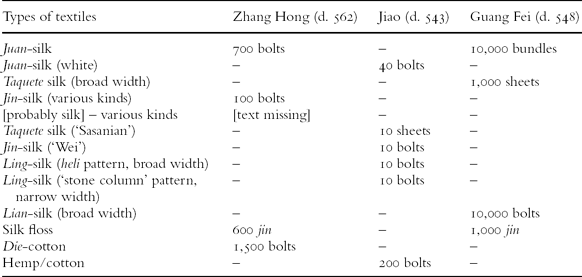
As other articles in this special issue show, the textiles used as money were measured in regular units – bolts, sheets and by weight. In the burial inventories, the smaller quantities are more likely to be descriptions of real items and larger quantities probably represent desired amounts for use in the next world. These items also appear adjacent to the gold and silver coins in the inventories, further suggesting their association with items of high value. Although the three occupants died within a 20-year period, and their burial inventories include items that can be considered as textile money, these items are not presented in a consistent way (see Table 2). Indeed, the only item that is immediately comparable is silk floss. Juan-silk is presented in bolts and bundles; jin-brocaded silk is presented in bolts and sheets. At this stage, we cannot know whether the differences in the silk items are related to gender, age, status, background, date or other factors.
Textiles Listed in Regular Units/Quantities in the Burial Inventories

Cotton fabrics are measured in bolts, but they are described in different ways. However, as Eric Trombert has pointed out elsewhere, cotton and hemp were treated in the same way for accounting purposes, and it is possible that they may have been more generally linked together in this way.
The use of jin-brocaded silk on the four wooden handgrips (womu 握木) may be significant in a spiritual way. These objects must be associated with the “the thread for climbing up to heaven” (pantianxi 攀天系) that appear in burial inventories of the mid-sixth to mid-seventh centuries at Turfan.Footnote 13 In 1915, Aurel Stein found two ‘wooden cylinders’ wrapped in silk in tomb Ast.i.6 at Astana. Similar to 72TAM170, this was the tomb of General Zhang Xin[?] 張新[. . .], who died in 632, and his wife. Although the tomb had previously been disturbed, Stein found Zhang with a wooden cylinder wrapped in silk still clasped in his hand; the other cylinder was found lying between Zhang and his wife.Footnote 14 Stein also observed that “in the south-western corner of the [tomb] chamber, which was only 4½ feet in height, there hung fastened to the ceiling by a twig a rag of completely rotten material, apparently silk”, and linked this to the “striped coloured silk and damask [Ast.i.1..09–10], found clinging to the wall in the north-western and south-eastern corners of the chamber [of tomb Ast.i.1]”.Footnote 15 Perhaps these were also associated with the threads of climbing to heaven? Pantianxi are typically recorded as being 100,009,000 zhang – a formulaic length.Footnote 16
Comparing the Textile Remains in 72TAM170 against the Burial Inventories
It is unfortunate that Tomb 170 was found in a disturbed condition. The excavation record made in 1972 includes a significant amount of textiles that may once have functioned as money, but many of these were missing or unavailable to us during our research in 2005. This means that we cannot know for certain how these items were placed in the tomb, or whether they were full-size burial objects, or miniature representations.
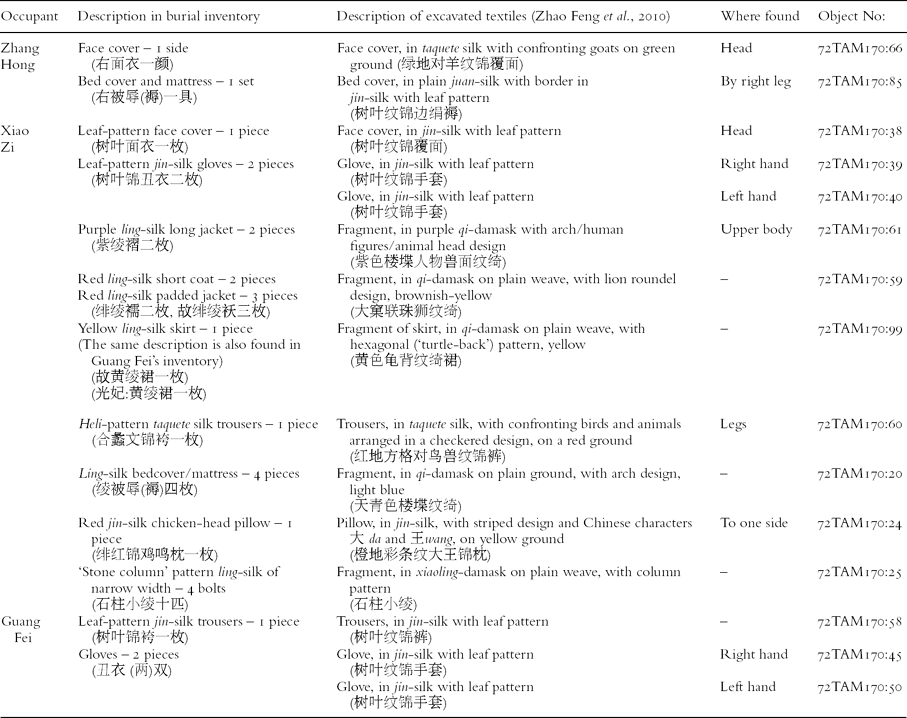
However, we had considerable success in comparing the surviving textiles and clothing against the burial inventories. We were able to match some of the surviving textiles to the names of textiles in the burial (see Table 3), and, by extension, to textiles mentioned in documents relating to the sixth century. Fuller details of these textiles are given below with illustrations.Footnote 17
Comparing the Textiles Remaining in 72TAM170 against the Burial Inventories

Jin-silk with Leaf pattern (树叶纹锦) (Figs 1–4)
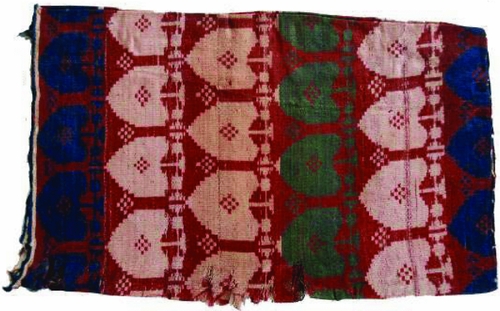
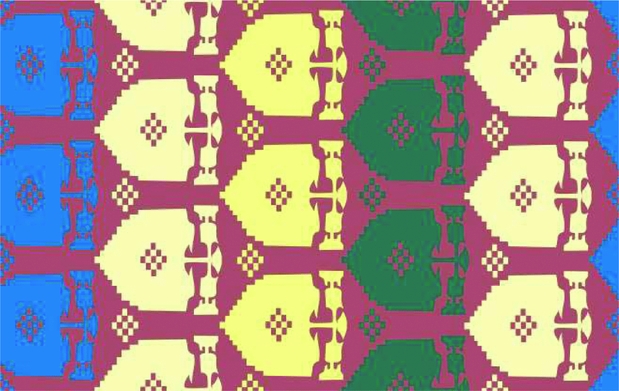
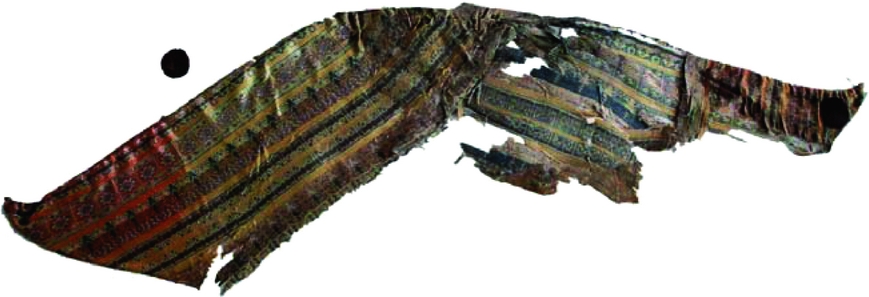
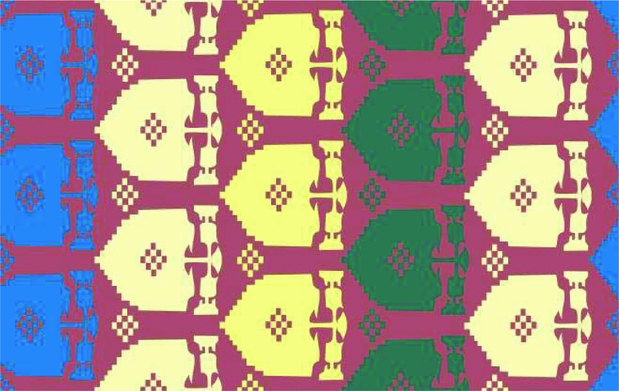
Leaf patterns were common motifs in north-western China and further to the west. They have been seen on Persian textiles excavated at Antinoe, Egypt,Footnote 18 and it is possible that they are of western origin. Jin-silk with a leaf pattern is the most frequently occurring textile in this tomb, and appears on a wide range of objects: face covers (Fig. 1), strips attached to, or wrapped around, wooden handgrips, gloves (Fig. 2), trousers (Fig. 3) and as the edging on a bedcover. This silk uses a 1:2 warp-faced compound plain weave, with red for the ground, while blue, green, white and yellow are used for the alternating pattern. The leaf pattern has a unit of 1.5 cm in the warp and 3.5 cm in the weft, and there is a selvedge of 0.3 cm (Figs 3–4). Some of the burial inventories from other tombs at Astana list specific forms of leaf-patterned jin-silk: for example, jin-silk with a cypress leaf pattern (baishuye jin 柏樹葉錦)Footnote 19 and jin-silk with a large leaf pattern (dashuye jin 大樹葉錦).Footnote 20 The documentary and textile evidence both indicate the popularity of jin-silk with a leaf pattern in the Gaochang Kingdom in the sixth century.
Face cover in jin-silk with leaf pattern (72TAM170:11).

Glove in jin-silk with leaf pattern (72TAM170:45).

Trousers in jin-silk with leaf pattern (72TAM170:58).

Reconstruction of jin-silk with leaf pattern (72TAM170:58)
Red jin -silk (绯红锦) (Figs 5–6)
The chicken-head pillow associated with Xiao Zi (Figs 5–6) is one of two such pillows listed in the burial inventories from Tomb 170. Xiao Zi's inventory describes her pillow as being made of red jin-silk. The pillow found in the tomb appears at first glance to have a yellow ground, but closer examination of one corner confirmed that the entire piece was originally red and that the yellow is the result of colour fading. It may have been coloured with a safflower dye, which is known to fade easily. There is also a very small pattern in the weave. The pillow listed in the burial inventory was therefore an accurate description of the actual pillow in its original state. Thus, the pillow from the tomb provides us with a real example of red jin-silk.
Chicken-head pillow in red jin-silk (72TAM170:24).

Reconstruction of floral pattern with the characters da 大 and wang 王 (72TAM170:24).

This particular piece of red jin-silk has patterns in green, brown and white, on a ground of red and yellow stripes. The motifs are mostly small flowers, either a full-view of rosettes or of flowers in profile. Placed among the floral motifs are small squares, containing the character da 大 (“great”) or wang 王 (“king”), and each character appears twice and symmetrically in the pattern. For this reason, the modern Chinese name for this textile is da wang jin 大王錦. The pattern has a short unit in the warp direction but is symmetrical in the weft direction; thus the pattern unit is half of the loom width.
Taquete silk with Symmetrical Pattern (合蠡文锦) (Figs 7–8)
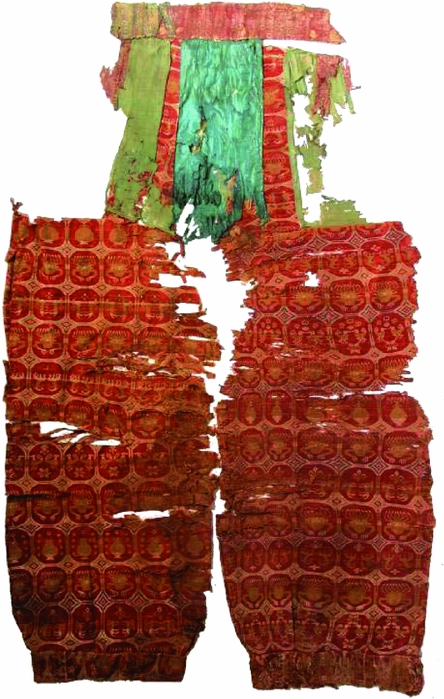
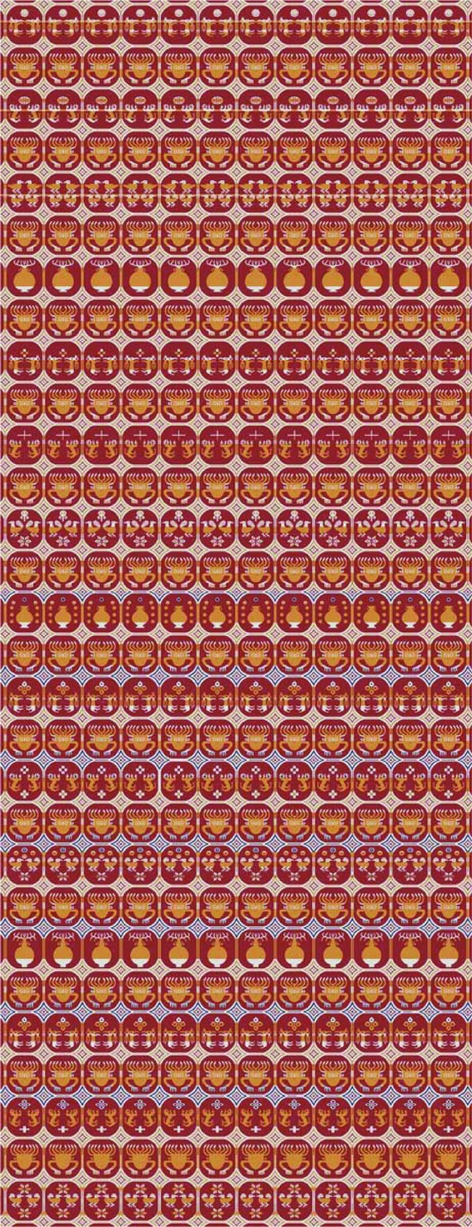
The trousers, in taquete silk with confronting birds and animals arranged in a checked design, on a red ground (Fig. 7) are the largest and best preserved item of clothing in the tomb.Footnote 21 They were found by Xiao Zi's legs and appear to match the description of the heli-pattern taquete silk trousers in her inventory. As Wu Zhen has suggested, the term heli probably referred to a symmetrical pattern, as he means coming together and li means moving apart.Footnote 22
Trousers in red jin-silk (taquete) (72TAM170:60).

Reconstruction of the heli pattern (72TAM170:60).

This is a weft-faced compound plain weave (also known as taquete), which uses thick Z-twisted warps, sometimes in pairs for the inner warp but always single for the outer warp, and similar wefts, sometimes in red, white and purple. Originally, this textile should have had a width of about 65 cm, with 12 lines of checks repeated along the loom width; and a length of 170 cm with 29 rows of checks. Each square encloses one motif. The mask motif appears in every second row, and confronting birds or animals appear in the intervening rows (Fig. 8). There is no pattern repeat along the warp direction because each row is different.Footnote 23
Further details of these trousers can be found in Wang Le's detailed study,Footnote 24 in which she describes the jin-silk (taquete) with a symmetrical pattern used for the front of the trousers; the pieces of blue juan-silk, green ling-silk, and jin-silk (taquete) with animal and phoenix design that were attached to the front; the white juan-silk that was used for the lining of the trousers; and the white hemp fabric that was used for the lining of the waistband.
Purple ling -silk (damask) (紫绫) (72TAM170:61) (Figs 9–10)
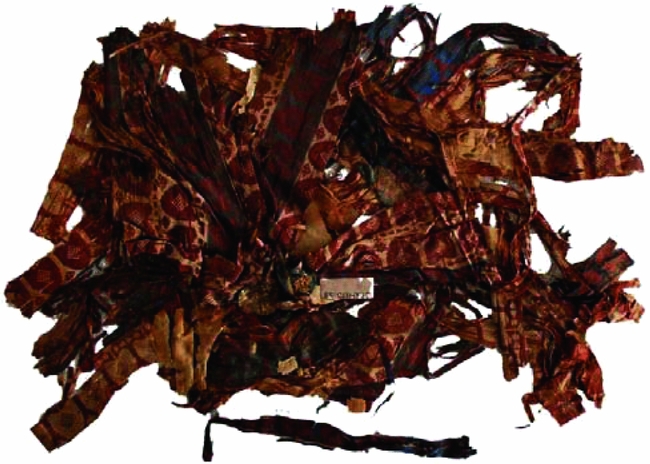
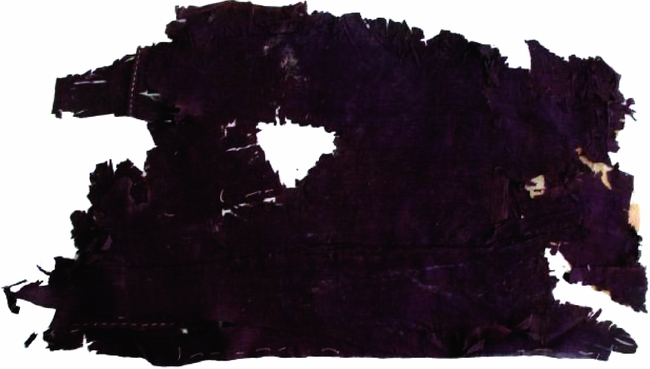
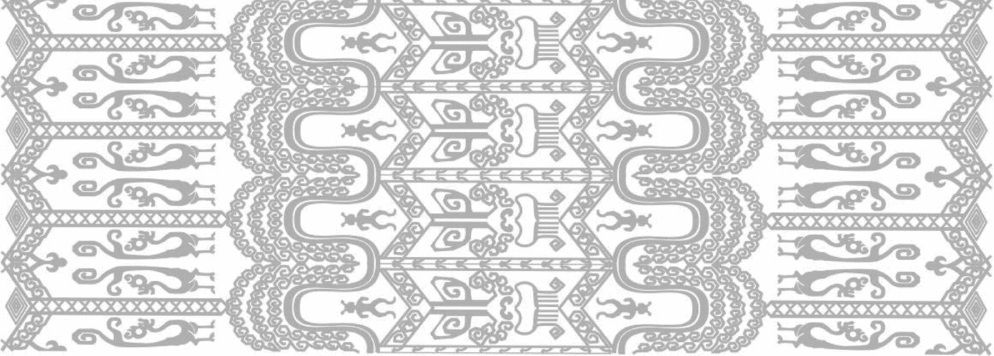
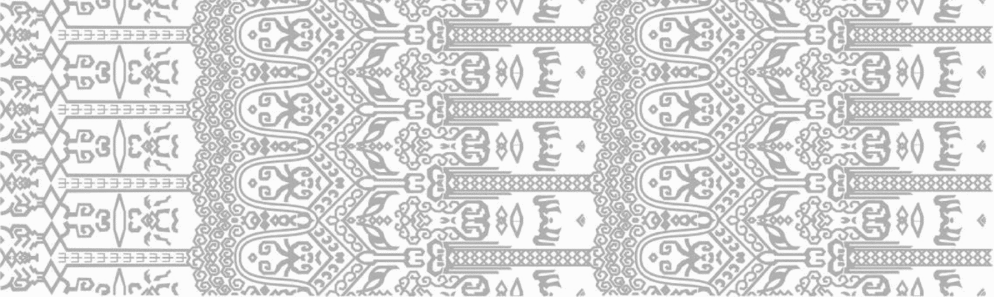
Many fragments of purple ling-silk (damask) were found on Xiao Zi's upper body: some with thread stitching, and some with selvedges (Fig. 9). As the burial inventory mentions purple ling-silk leggings, and nothing else in a purple colour, we can assume that these fragments are from those leggings. The reconstructed design reveals a pattern with arches, figures and dragons (Fig. 10). This pattern was very popular during the Northern Dynasties, and there are other examples of surviving textiles with this pattern.Footnote 25
Purple ling-silk with arch, figure and dragon pattern (72TAM170:61).

Reconstruction of the arch, figure and dragon pattern of the purple ling-silk (72TAM170:61).

This piece was woven with warp floats, using the 2-2 method on a plain ground weave, a popular technique that was widely used between the fourth and seventh centuries.
Yellow ling-silk (damask) (黄绫) (72TAM170:99) (Figs 11–13)
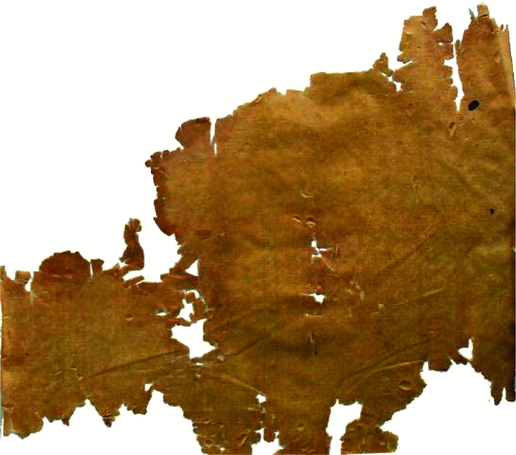
Two fragments found in the tomb were originally from a skirt made with yellow ling-silk (damask). As both Xiao Zi and Guang Fei had a yellow damask skirt in their inventories, the skirt could have belonged to either of them.
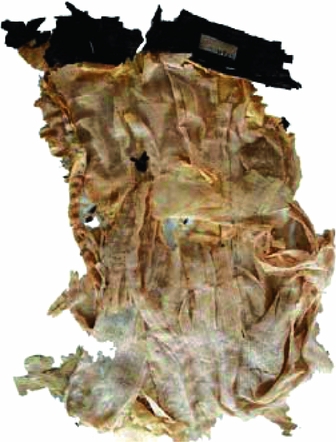
Yellow ling-silk skirt (72TAM170:99).

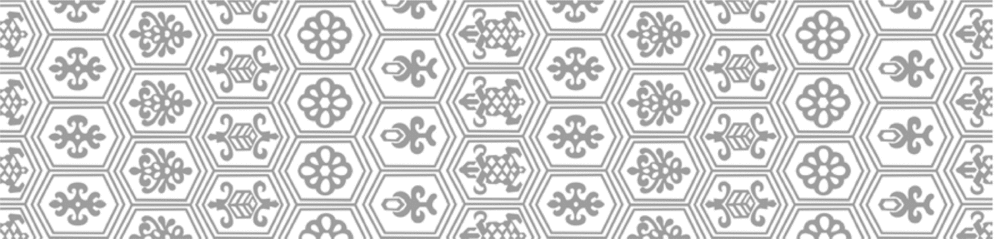
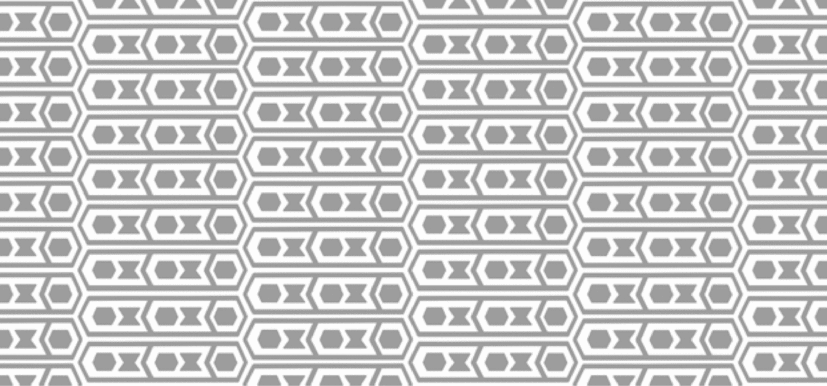
Yellow ling-silk with hexagonal pattern in the weave (72TAM170:99).

Pattern reconstruction of the yellow ling-silk with hexagonal pattern (72TAM170:99).

One of the fragments has yellow ling-silk for the front, white juan-silk (possibly sha-silk) for the lining and purple juan-silk at the waist (Fig. 11). The other fragment is of yellow ling-silk with a hexagonal pattern, showing a full loom width of 48.5 cm (Fig. 12). This has plain weave (also known as tabby) as the ground, and a 2–2 patterning weave to create the hexagonal pattern. Within the hexagons are turtle, rosette and geometrical motifs (Fig. 13). A similar pattern has also been seen in the textiles from Dulan, Qinghai and at the Shoso-in, Japan.Footnote 26
Light Blue Qi-Silk (天青色楼堞纹綺) (72TAM170:20) (Fig. 14)
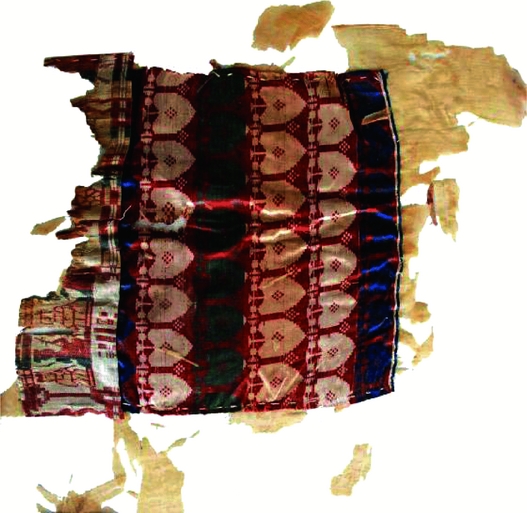
This is a large piece, with a full loom width of 51 cm, and its length in the warp direction. According to archaeologists, this textile was probably from a silk bedcover, which would link it to the ling-silk bedcover listed in Xiao Zi's burial inventory. The pattern shows architectural arches and columns, with tiny motifs such as banners and birds (Fig. 14).
Pattern reconstruction of the light blue ling-silk with arch and column.

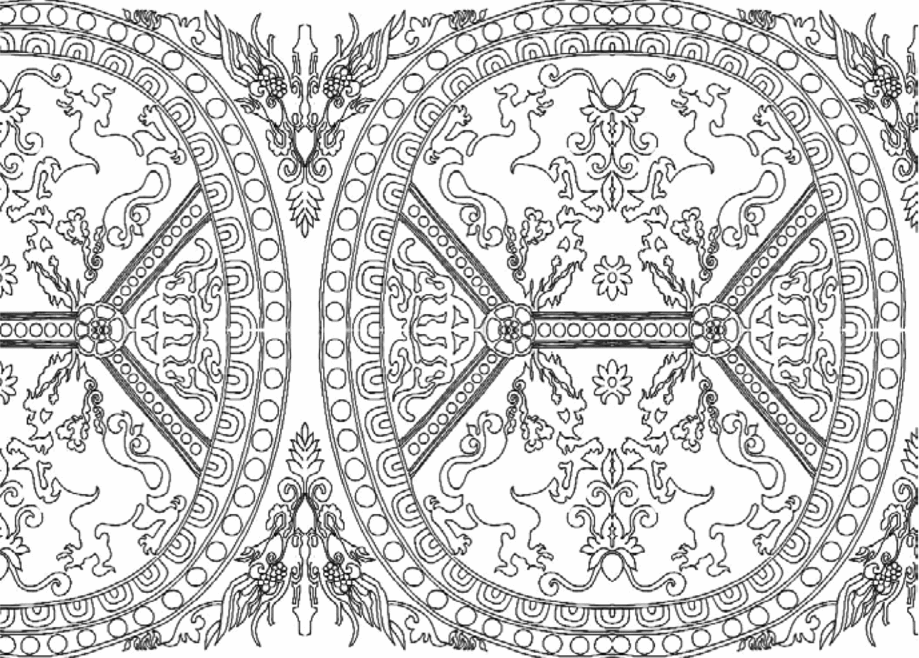
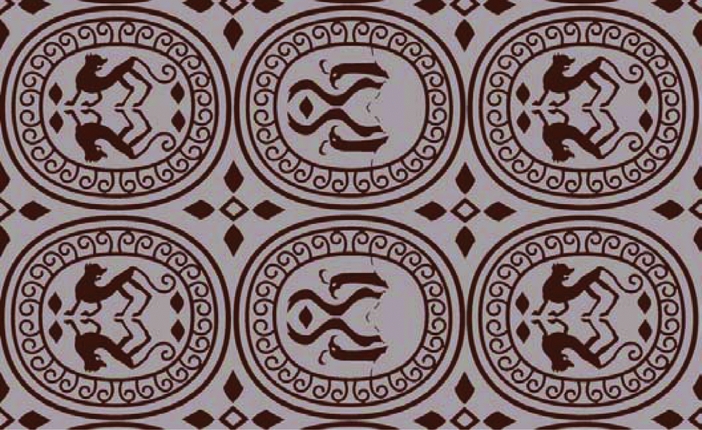
Red qi -silk (damask) with Lion Roundel (大窠联珠狮纹绮) (72TAM170:59) (Fig. 15)
This appears to correspond with the red damask short coat or jacket in Xiao Zi's burial inventory. Although it now appears yellow-brown in colour, this is probably the result of a red dye that has faded. The pattern has roundels with double rings, pearls for the outer ring and petals for the inner ring, and the two pairs of confronting lions in the central section of the roundel (Fig. 15), depicting confronting lions within very large roundels, is unusual. However, a remarkably similar pattern is seen in the lacquer paintings on a coffin found in a fifth- to sixth-century tomb in Guyuan, Ningxia.Footnote 27
Pattern reconstruction of lion roundel (72TAM170:59).

The 2/2 method was used to make the pattern on a plain weave (tabby) ground, with a roundel diameter of 50 cm and loom width 50 cm.
Ling -silk (damask) with Column Motif (石柱小绫) (72TAM170:25) (Fig. 16)
The fragment was found among the fragments of yellow ling-silk with a hexagonal pattern. It appears to match the ling-silk with a “stone-column” pattern listed in Xiao Zi's burial inventory. The column pattern is quite simple (Fig. 16). Similar columns containing pearls, or dots, positioned between the dragons, are seen in many other examples of dragon-patterned ling-silk from the Tang dynasty.Footnote 28
Pattern reconstruction of yellow damask with column and pearls (72TAM170:25).

“Sasanian” taquete silk (波斯锦) and “Wei” jin -silk (魏锦)
Among the polychrome textiles found in the tomb, there are two types of weave structures that appear to match the descriptions of “Sasanian” silk and “Wei” silk listed in Xiao Zi's burial inventory. The first is a weft-faced compound plain weave (a weave well known in Central Asia in the third to fifth centuries), which would be Xiao Zi's “Sasanian” silk. The Chinese term is given as “Persian” (i.e. Sasanian) and refers to Sasanian influence in its widest sense, including in Central Asia and Sogdia. Indeed, most instances of “Sasanian” silk seen in historical texts and in documents from Turfan probably refer to Sogdian silk. The second is a warp-faced compound plain weave, and would be Xiao Zi's “Wei” silk. “Wei” refers to the area, near the centre of the Wei kingdom in the same period, and can be understood more generally as referring to the northern part of China. Xiao Zi's burial inventory shows that both “Sasanian” and “Wei” silks were in use in Turfan in the mid-sixth century. It is notable that in her inventory, “Sasanian” silk is measured by the sheet, and “Wei” silk is measured by the bolt. This reflects the differences between the two types of woven silk: they were made on different looms, and have different weave structures – one weft-faced, one warp-faced – and different patterning methods.Footnote 29
“Sasanian” silk taquete with Roundel Design (波斯锦: 绿地对羊纹锦) (72TAM170:60) (Fig. 17)
This piece was found on the back of the waist of the red trousers. Technically, it is a typical taquete, being weft-faced compound plain weave, in red and white. Neither warp nor weft was twisted. The textile survives in a worn condition, making it difficult to reconstruct the pattern. We can see that there was a roundel with curved clouds for the border, enclosing a pair of confronting animals or peacocks.
Reconstruction of the roundel pattern with animal and peacock (72TAM170:60).
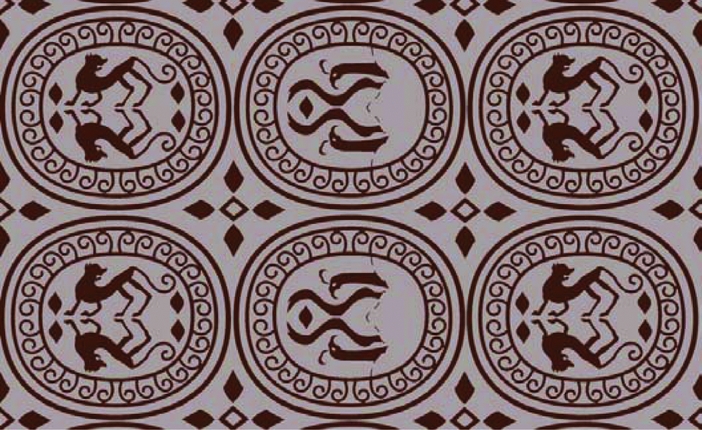
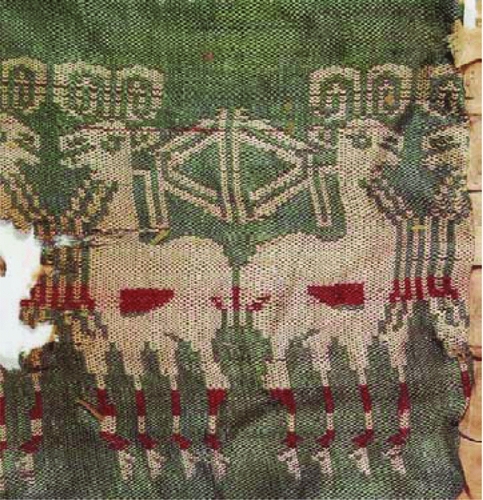
“Sasanian” silk taquete with confronting goats (波斯锦: 绿地对羊纹锦) (72TAM170:66) (Fig. 18)
This piece was used in Zhang Hong's face cover. It has a weft-faced compound plain weave (taquete) with green weft for the ground, and white and red for the pattern. The goat, or sheep, is a common motif in Sasanian and Central Asian arts, and the pattern, repeated in the weft direction without any frame, was also typical of Central Asia. It continued to be popular in the Tang dynasty. This piece may have been locally produced in Xinjiang, imitating the western style.Footnote 30
Taquete silk with goat on green ground (72TAM170:66).

“Wei” jin -silk with Parade (魏錦: 吹奏人物紋錦) (72TAM170:11) (Fig. 19)
This fragment, originally part of a face cover made of a jin-silk with a leaf pattern, has a warp-faced compound weave structure. The design shows three people in a building, all seated on the ground, one playing a flute, one playing a pipa-lute and the other listening (Fig. 19). Comparing it with a similar piece in the China National Silk Museum collection we can determine that the whole piece would once have shown a parade, with some people walking, some on horseback, and some hunting. The one in the China National Silk Museum also had a four-character inscription reading da wang chu xing 大王出行 (‘the Great King makes a tour’).Footnote 31
“Wei” jin-silk with parade (72TAM170:11).

“Wei” jin -silk with Confronting Phoenixes and Dragons (魏錦: 對波雲珠龍鳳紋錦) (72TAM170:41) (Figs 20–21)
The fragment was found by Xiao Zi's neck, and may have been part of the collar of a garment. It was made in a warp-faced compound weave structure. The pattern can be reconstructed, and shows two curved lines, consisting of clouds and pearls that come together then separate to form the frame of the pattern, enclosing confronting dragons and phoenixes as the main motifs. This pattern was very popular during the sixth century and typical of traditional Han-Chinese style. A similar pattern is seen in the lacquer paintings on a coffin found in the fifth- to sixth-century tomb in Guyuan, Ningxia. The dotted pattern of the pearl roundel has been adapted to follow the wavy lines that make up the enclosure. On this textile fragment, six-petalled flowers mark where the wavy lines meet; on the lacquer paintings two dots/knots mark where the wavy lines meet.Footnote 32
Fragment with confronting dragons and phoenixes (72TAM170:41).

Pattern reconstruction of the confronting dragons and phoenixes (72TAM170:41).

Conclusion
Our study of the textiles and burial inventories from Tomb 170 at Astana confirmed that the descriptions of the textiles in the excavation record and the brief report are satisfactory, although we did make some suggestions for improvement to reflect recent advances in the field of textile history. The names of textiles listed in the burial inventories match those seen in other contemporary documents and historical texts, indicating a good level of consistency in the use of terminology. It is unfortunate that the tomb had been disturbed and that we will never know its original contents; the surviving textiles must be seen as only a part of the original contents. Many of the textiles found in the tomb can be matched to items in the burial inventories, suggesting that at least some of the items on the burial inventories were real objects that were buried with their owners. The names of textiles given in historical texts and contemporary documents can only be confirmed with any degree of accuracy when we can match them with a real textile; the opportunity to examine textiles and burial inventories from the same tomb allowed us to do this.
In addition to listing specific items of clothing and other textile objects, the burial lists also record very large quantities of textiles: sometimes hundreds, or thousands, of bolts and lengths of specific types of woven textiles. Guang Fei's burial inventory, for example, includes 1,000 bolts of broad width jin-silk, 10,000 sheets of broad width lian-silk, 1,000 jins of silk floss, and 10,000 bundles of juan-silk. They are listed immediately after the 10,000 gold coins and 1,000,000 silver coins, and, like the coins, were probably imagined, and some quantities may have been formulaic. They were desirable items both in this world, and for the next world. Although we cannot study textiles that do not exist, we can ask why were they considered desirable? How did the owners conceive them? Did they have a monetary value? Were they a store of value? Were they are a measure of the owner's wealth? How would the owner use them in the next world? And, as the burial lists for Zhang Hong and Jiao identify them by their Buddhist names, we might ask if these imagined textiles were significant in a Buddhist context. In asking these questions about textiles that only ever existed in the abstract, we are reminded of their symbolic value as well as their potential monetary values.