In this research, ‘science’ refers to a system of addressing a hypothesis, using appropriate, replicable methods to investigate, experiment, observe and describe phenomena (Aikenhead, Reference Aikenhead2001; McKinley, Brayboy & Castagno, Reference McKinley, Brayboy and Castagno2008). Depending on the results, a hypothesis can eventually contribute to scientific theory, or a better description about the world, if it cannot be proven false. ‘School science’ or ‘western science’ refers to the hegemonic science methodology (as above) currently practised in western education systems to date.
Since the late 20th century, science in general has become increasingly focused on accessing traditional Indigenous knowledge systems as part of a suite of solutions needed to deal with global environmental issues (IAEWG, 2012; International Council for Science, 2002). Recognising the need for Indigenous perspectives, researchers are producing studies that formally engage with Indigenous knowledge (e.g., Davis & Wagner Reference Davis and Wagner2003; Grech et al., Reference Grech, Parra, Beasley, Bradley, Johnson, Whiting and Marsh2014; Hind, Reference Hind2015; Norris & Hamacher, Reference Norris and Hamacher2009). In the process, western researchers are illustrating the deep integrative connections between domains of knowledge that have tended to remain isolated in western science, for example, astronomy and ecology coupled with sustainability and environmental management (Bird, Bird, Codding, Parker & Jones, Reference Bird, Bird, Codding, Parker and Jones2008; Prober, O'Connor & Walsh, Reference Prober, O'Connor and Walsh2011).
Australia has not been isolated from these fresh approaches to science in general. In some cases, the nation's researchers and teachers have shown leadership by recognising and valuing Indigenous knowledge systems and the relationship cultural ways of knowing have to science (IAEWG, 2012; PMSEIC, 2003). While tensions certainly exist between science knowledge systems and Indigenous knowledge systems (Aikenhead, Reference Aikenhead1996; Ryan, Reference Ryan2008), the groundwork has been laid to introduce programs that integrate the two systems to produce outcomes, which are both, innovative and beneficial to the people they seek to serve.
Embedding cultural themes into the new National Science Curriculum (NSC) for schools is an approach adopted by the Australian Federal government. The NSC reflects an acknowledgement of Indigenous knowledge as a valuable resource to develop student competencies. This requires teachers to engage all students in science through the development of learning programs within which the students themselves want to be a part.
The need to act is driven by research (IAEWG, 2012; PMSEIC, 2003) that shows, to a large extent, Indigenous students find school science irrelevant and unrelated to their personal lives. This is reflected in the disparity between Indigenous and non-Indigenous engagement and learning outcomes across Australia, (IAEWG, 2012; MCEEYDA, 2010; PMSEIC, 2003). For example, the Trends in International Mathematics and Science Study (TIMSS) results and learning outcomes across Australia (IAEWG, 2012; MCEEYDA, 2010; PMSEIC, 2003) show that Australian Year 4 Indigenous students attained a lower mean score in science (458) compared with their non-Indigenous Australian counterparts (522) in 2011 (Thomson et al., Reference Thomson, Hillman, Wernert, Schmid, Buckley and Munene2012). Furthermore, Indigenous students’ mean score for science also fell below the international Intermediate benchmark set at 475. Students also responded to items about whether or not they liked learning science. Indigenous students scored significantly lower on this scale compared with their non-Indigenous counterparts. Similar results were reported for the scale measuring students’ levels of confidence within school science where a significantly higher number of Indigenous students indicated that they were not confident with science (Thomson et al., Reference Thomson, Hillman, Wernert, Schmid, Buckley and Munene2012). These trends were also present in the secondary school results.
This disconnect with school science seems to continue beyond the compulsory years of schooling where very few Indigenous students tend to pursue science in further study. In terms of science-related careers for school leavers, statistics show that Indigenous students are less likely to find employment in science- and technology-related jobs compared to their non-Indigenous peers (2% compared with 7%), (IAEWG, 2012). Given these results, and the fact that the new NSC which incorporates Indigenous knowledge is being implemented in Australian schools, it is timely to investigate the impact of a crosscultural science program on both Indigenous and non-Indigenous students.
To date, few Australian studies have been conducted on the impact of implementing a science curriculum configured by integrating Indigenous knowledge with western science concepts. Significant to the relevance of this research, we were unable to locate any Australian research that targets Year 5 and 6 primary school students interacting with crosscultural science programs about astronomy. Given the importance the NSC places on ensuring Indigenous perspectives are integrated into school science programs, it is anticipated that investigating the impact of such programs would be of value.
The purpose of this research, therefore, is to investigate the impact of a school science program, Indigenous Sky Stories (ISS) that is focused on the astronomy content of the Years 5–6 NSC and which integrates Indigenous knowledge and science concepts, on students’ perceptions and engagement of science. The pilot phase of this project involved 19 schools, identified as having high Indigenous student enrolments, drawn from the western region of New South Wales. The current paper focuses on one primary school involved in the pilot program. In-depth accounts of what happened during the implementation of the program at this school are shared and student reactions reported. We also examine students’ attendance patterns before and during their involvement in the project. Finally, we consider some of the implications for practice and further research.
Context for this Study
The case-study school was selected from 19 Central West schools in New South Wales participating in a broader research program entitled ISS. The school was selected based on the following criteria: the school had to contain a mix of Indigenous and non-Indigenous students; the school principal, teachers and students had to be amenable to being participants in this research; the school was located within a reasonable distance of our location; and the school was actively participating in the ISS program.
The broader research program, ISS, was a pilot project funded in part, by Indigenous Student Services at Charles Sturt University (CSU), the NSW Department of Education and Communities (NSW DEC) and the Binocular and Telescope Shop in Sydney. As part of the project, schools were provided with an 8-inch Dobsonian reflecting telescope, an 8-inch Solar Filter, an iPad mini loaded with planetarium software to view the night sky (Stellarium) and a set of educational projects to address components of the new NSC. Face-to-face professional learning days, held at three Central West locations, briefed teachers and Aboriginal Education Officers (AEO) on the project. Enquiry-based pedagogical approaches that are consistent with what is called for in the NSC were modelled to illustrate how the program could be implemented with their classes. Follow-up visits to the schools were undertaken on request and mainly to assist with observation nights.
The program implemented several of the key recommendations made in previous national reports (Goodrum, Hackling & Rennie, Reference Goodrum, Hackling and Rennie2001; Goodrum, Druhan & Abbs, Reference Goodrum, Druhan and Abbs2011; IAEWG, 2012; Tytler, Reference Tytler2007). These included recommendations such as follows: targeting the middle years of schooling, employing investigative science, integrating local knowledge systems and implementing a professional learning program designed for the long-term development of teachers’ pedagogical approaches and their scientific and mathematical content knowledge.
A mixed method, Type II Case Study design (Yin, Reference Yin2003) was employed in one pilot school participating in the ISS program and is presented in this article. A Type II Case study is one in which multiple data sources from one site are examined from multiple viewpoints to facilitate triangulation of evidence thus increasing the reliability of the data and the processes for gathering them. We share student reactions to cultural stories delivered by a local Aboriginal elder and, offer some insights into an ISS community event. Additionally, student attendance data are used to construct an argument supporting the notion that if students are engaged with a topic that interests them they will be motivated to attend school. Engagement with the ISS Project is also of interest in terms of Indigenous and non-Indigenous students’ participation in the educational activities.
Theoretical Framework
The theoretical basis upon which Indigenous science education should sit in a curriculum is influenced by the need to resolve the epistemological tensions between the hegemony of science and traditional Indigenous knowledge (Aikenhead & Ogawa, Reference Aikenhead and Ogawa2007; Hauser, Howlett, & Matthews, Reference Hauser, Howlett and Matthews2009; McKinley, Brayboy, & Castagno, Reference McKinley, Brayboy and Castagno2008; Ryan, Reference Ryan2008). A seminal article by Aikenhead (Reference Aikenhead1996) informed the future debate by advocating an alternative way to help Indigenous students navigate the space between science and Indigenous knowledge systems. Aikenhead provides a pathway for science teachers to reconceptualise themselves as cultural brokers tasked with acknowledging a student's personal perceptions and worldviews before introducing an alternative culture, i.e., a western science methodology. Aikenhead (Reference Aikenhead1996) maintains that this space exists in a crosscultural border. The metaphor firmly sets the two knowledge systems in two separate places.
A decade later, Nakata (Reference Nakata2007) advanced the debate by configuring the cultural interface as a legitimate meeting place between western and Indigenous epistemologies. Constituted by multiple sets of relationships and realities, Nakata (Reference Nakata2007) places the two systems alongside each other so perceived differences can be identified, barriers dismantled and a common ground established. The seminal conceptualisation remains the benchmark description of the overlapping and highly contested knowledge domain.
The common or ‘middle ground’ that allows such a co-existence of Indigenous knowledge and science, albeit in the field of mathematics, appears to come from the findings of Warren and Devries (Reference Warren and Devries2010) who showed that Indigenous learning outcomes and engagement were improved when programs were contextualised towards their environment, language was modified and the local community was included. That is to say, the middle ground is the socially constructed crosscultural space in which local Indigenous knowledge is informed, but not dominated, by science systems (Aikenhead, Reference Aikenhead1996).
The literature also concerns itself with the integration of Indigenous knowledge into the science curriculum in terms of how much or how little should be employed to effect successful outcomes. For example, in New Zealand, McKinley and Stewart (Reference McKinley and Stewart2012) take the position that Maori students should be fully immersed into science practices using the Indigenous dialect, practices and knowledge. On the other end of the spectrum, Larkin, King and Kidman (Reference Larkin, King and Kidman2012) report on a study that adheres to science investigative procedures that adopt only a superficial treatment of Indigenous knowledge.
Understanding the home worlds of students and establishing strong community relationships appears to be critical for the success of culturally-embedded curriculum design. This was shown by Mack et al. (Reference Mack, Augare, Coud-Jones, David, Gaddie, Honey and Wippert2012), who found that student engagement could be strengthened by using hands-on, locally sourced language, knowledge and practices informed by developing strong, collaborative relationships with the Indigenous community. Similarly, Bhathal (Reference Bhathal2008) showed that hands-on astronomy programs involving the community were a successful way to engage students with the high school science curriculum. Designed to help improve scientific literacy, a series of crosscultural, astronomy activities engaged 15 lower secondary Aboriginal students. Consistent with research that examined the benefits of community involvement with schools (Harrison & Greenfield, Reference Harrison and Greenfield2011; Oscar & Anderson, Reference Oscar and Anderson2009), the project's success was attributed, in part, to the attendance and participation of parents and the local community.
The tendency for academics to focus on the development of educational theory was challenged by Biermann and Townsend-Cross (Reference Biermann and Townsend-Cross2008), who articulated the need for further research into different Indigenised teaching strategies. They argue that one such alternative could be an Indigenous pedagogy based on the ideologies and belief systems of Indigenous Australians. While the teaching strategies employed to integrate Indigenous perspectives appeared sound for the sample of students presented in the study, providing content relevancy to Indigenous groups across the continent of Australia was thought to be problematic.
The theoretical and practical studies presented above appear to show that, in terms of student engagement and positive learning outcomes, local, socially constructed Indigenous knowledge involving hands-on activities with appropriately modified language which takes full advantage of existing science knowledge systems provided a workable “middle ground’ between the current hegemony of science and traditional Indigenous ways of knowing. Providing this ‘middle ground’ as part of an effective pedagogy appears to be impeded by the lack of professional training given to teachers.
Case-Study School and Data Collection
In this case-study, the unit representing the ‘case’ is a rural, co-educational primary school that accepted the invitation to participate in the broader ISS program and more specifically, the Year 5 and 6 students taught by their regular in-class teachers. In this paper, we refer to the case-study school as Ngaguwany-guwal Public school. We selected this name as it means ‘all together’ and we feel this is an appropriate reflection of the school community and is consistent with the project objectives.
The Ngaguwany-guwal Public school enrolment comprises 49% Indigenous students and is attended by children from mostly low socioeconomic family groups with an Index of Community Socio-Educational Advantage (ICSEA) value of 811 where 1000 is the national mean. The school's enrolment comprised 128 Indigenous students and 131 non-Indigenous students ranging from Kindergarten (Foundation) to Year 6. Specifically, this research involved one Year 6 and one Year 5/6 composite class. The class groups involved in this research comprised a similar representation to that of the school enrolment and were of mixed ability.
Ngaguwany-guwal Public school implemented the ISS program during the final school term (Term 4). The research team visited the school three times during the project implementation phase. Electronic communications were ongoing during the implementation of the program and have since continued. During two of the school visits, interviews were conducted with four different groups of students about their participation in the project. Students, in groups of four, were asked about ISS-related activities such as their interaction with telescopes, science investigations and whether they thought the program was worthwhile. Interviewees were selected by the classroom teachers and each group comprised two Indigenous students and two non-Indigenous students.
On learning about the ISS project, the school's young AEO initiated communication with the Local Elders though his parents. Their knowledge of the local networks led to the involvement of an Aboriginal storyteller. Without the involvement of the AEO and access to the extensive local network, it may have been unlikely that the Aboriginal storyteller would have become involved. Communication with the community is thus central to the educational enterprise described here. In all instances, the requests by the Aboriginal storyteller were met and led to what is described below.
The recorded interviews were transcribed and conditioned for analysis using Leximancer, which is a software program designed for lexical analysis. The program uses Bayes Theorem to determine the probability that something exists, given prior probabilities, of different complimentary events (Kaplan & Garrick, Reference Kaplan and Garrick1981; Smith & Humphreys, Reference Smith and Humphreys2006). That is to say, Leximancer progresses purely in examining the distances between words in order to identify ‘concepts’ and later ‘themes’ by examining the lexical distance between ‘concepts’. Importantly, it does this in a largely bias-free way without researcher intervention or interpretation.
Activity and participation at the ISS community event was documented using personal notes and photographs. Specifically, this involved taking notes and writing descriptions of events during the evening. At the night observation event, participants could manipulate two telescopes and use an iPad loaded with the planetarium application called Stellarium. The event also included cultural dancing, storytelling and a barbecue. The night observation event was attended by the students and their parents, staff and other members of the local community.
A digital camera was used to provide an indirect method to record student engagement by capturing images of student groups participating in classroom activities and of family groups using the telescopes and the associated digital equipment. Photographic evidence was collected for presentation in two ways. A screen shot was extracted from a digital movie made by the classes involved in the project from Ngaguwany-guwal Public school. Images were also captured during an impromptu daytime observation solar observing session and the organised night observation event using an iPad that has a digital camera fitted as standard equipment. The photographs chosen as evidence were downloaded onto a desktop computer. The images were manipulated using a cropping tool to resize the photographs and to obscure the identity of the participants. No other editing was carried out.
Absence data for the school year were supplied by the school principal to allow analyses of attendance before and during the implementation of the program. More specifically, the data identifies how many students were enrolled at the beginning of each term, their attendance prior to the introduction of the ISS project, and how many attended during the implementation of the project. The data were entered into an Excel spreadsheet for analysis and to calculate weighted mean absence rates to account for the different numbers of school days each term when students were required to attend class. An analysis of absence data is undertaken by examining sets of divided-bar graphs that show the weighted average number of absences for students in each of the four terms for the year during which the project was implemented.
Student Reactions to the Indigenous Sky Stories Program
Interviews were conducted with different groups of students on two separate occasions (a week apart) during the implementation of the program. On the first occasion, two student groups each containing four students were interviewed. The second occasion was conducted using the same student grouping arrangements of an Indigenous boy and girl and non-Indigenous boy and girl but comprising different students who were selected by their teacher. Students were asked about their involvement in, and perceptions of, the ISS program.
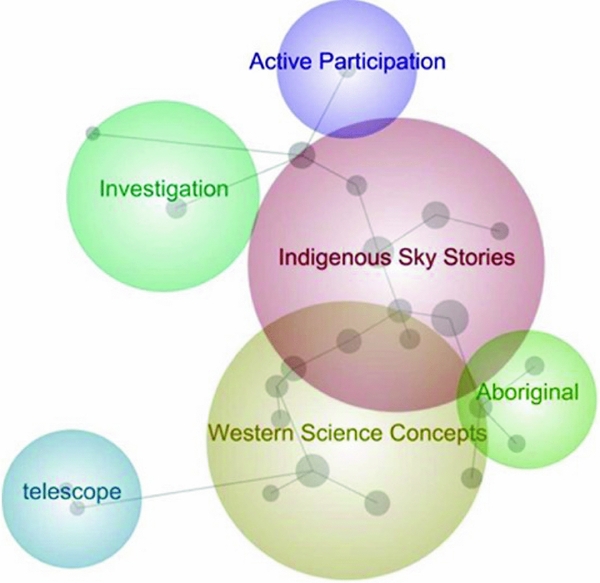
Figure 1 is a lexical analysis of four interviews conducted with a total of 16, Year 5 and Year 6 students. The diagram shows six themes. One, containing multiple concepts and identified as ISS, is very large and overlaps with another large theme identified as western science concepts also containing multiple concepts. Four smaller themes containing three or fewer concepts are identified as Aboriginal, Active Participation, Investigation and Telescope.
Lexical analysis of interviews conducted with Year 5 and Year 6 students.
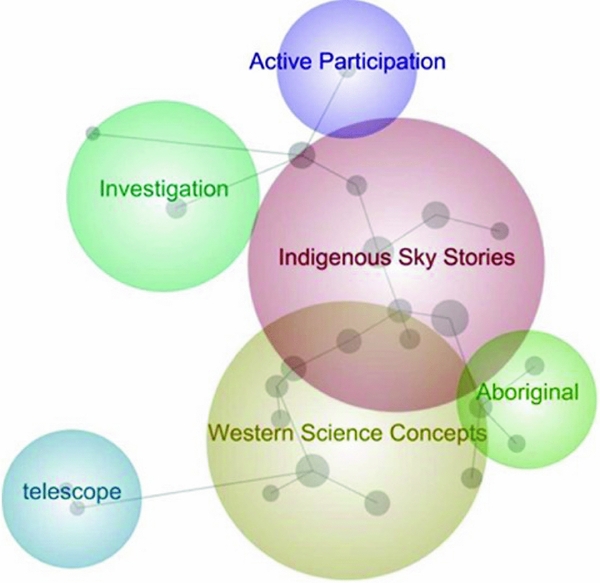
The overlapping themes in Figure 1 show that students appear to have embraced the cultural elements of the ISS program while making strong connections to western science concepts of astronomy. In all cases, students were able to recount Sky Stories told to them during a special event organised earlier in the school term by the AEOs. For example, S4, an Indigenous student, recounted a story he heard about the acronychal rising of the star Sirius which shines very brightly low on the eastern horizon just after the Sun has set in the West in late November and early December. The Aboriginal storyteller who recounted the story to the students had described this star as the ‘Christmas star’ having multiple colours. In addition, when this star was seen rising in the East, it was then possible to go fishing in the river for Murray Cod.
The story about the fish is when the bright star was out in the sky, and they knew, the Aboriginals would know that there was fish in the river, because the fish usually would come, they would come at a certain time of the year, and that star, the star told them, what time it was, when to do it.
The statement demonstrates one of many succinct accounts of the fishing story. The story appeared to capture the imagination of the students and suggests that placed-based cultural stories may assist with engaging student interest. Of greater interest to us was the observation of this star. What was it? Was it multicoloured? When was it visible? Was there a western scientific interpretation of this observation? These questions are taken up in the discussion.
Students also communicated their awareness of the differences between Aboriginal and western culture. For example, S1, a non-Indigenous student, commented on the way Indigenous Australians view the night sky:
It is different. It is kind of their culture and we have a different culture that we live in. It is a kind of different perspective than we are used to.
The statement offered by S1 provides valuable insight into the educational outcomes achieved by the ISS Project. That is to say, cultural explanations concerning the night sky were presented as an alternative to the hegemonic western science concepts usually taught and were viewed by this particular student as new, fresh information to consider.
The overlapping theme of Active Participation was apparent throughout the interview. For example, S3 recounted a request by the Aboriginal storyteller to prepare a physical backdrop to the stories so student learners could experience both oral and visual representations of the stories.
Our class and the other classes painted the Aboriginal flag, the fish, the Christmas star and the bright star, we all had goes at painting them.
Once the paintings were completed, students participated in the storytelling process. An example is provided by S6, an Indigenous student, who succinctly described the storytelling event.
About 15 people (were) holding (the pictures). We painted big A4 papers on the Moon, stars and fish and all that, and this traditional old, nice lady come in and told stories about it and half the hall sat down and we all enjoyed it.
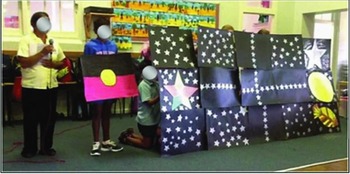
Figure 2 shows an extract from a movie that recorded the cultural storytelling event at Ngaguwany-guwal Public School. It can be seen that students are using the Aboriginal flag and artworks prepared in class related to the cultural stories concerning the morning star, the Southern Cross and the Christmas star as a backdrop for the Aboriginal storyteller.
Screen shot from sky storytelling event movie.

The value of using a local Aboriginal storyteller was a point of conversation during the interviews. For example, S5, an Indigenous student, attempted to explain why she could relate to the stories told at the Sky Stories event.
Probably would have been just as exciting but not as personal if she was not a local. We heard that she is around.
S5, referring to a respected member of the local Indigenous community, appears to reflect that because she and her peers knew the storyteller; a personal connection was able to take place.
Figure 1 also shows Investigation as a theme that connects with ISS. During the interview, students said that after learning about celestial objects such as the Moon in science class, coupled with listening to various sky stories, they attempted their own observations. For example, S7 recounted that he looked for the acronychal rising of the star Sirius:
She [the story teller] said around November and December you look up in the sky, you see the Christmas star, I looked up and tried to find it.
S8 gave an account of what she saw when observing the Moon
I was at my grandmothers. I looked up into the sky and saw a face, a smiley face on the Moon.
The observations by S7 and S8 appear to demonstrate an interest in finding celestial objects in the night sky in their own time. No causal attribution of the ISS program's influence is offered here however.
Figure 1 also shows Telescope as a satellite theme. At the time of the interview, students had not taken part in any formal observations using the donated telescope. Nonetheless, two weeks earlier the first author helped deliver and set up the telescope at Ngaguwany-guwal Public school, resulting in an impromptu observation session involving the Sun using the donated Solar Filter.
When asked to recount what he had looked at during the day, S9 offered the following comment:
We have been looking through the telescope out there [the school yard]. We looked at the Sun. It had black dots [sunspots].
The comment gives a clear account of what S9 observed through the solar filter on the telescope.
Comments made by students at the interviews, not reproduced here, included some exasperation that they had not yet used the telescope since the impromptu event held three weeks earlier.
Finally, an unexpected and wholly surprising outcome of the interview occurred when an Indigenous student was motivated to share a short sky story. The student had been discussing the ISS program with his father while they were travelling:
My dad told me on the way back from Walgett, because the Moon was red, my Dad said that “Remember, when an Aboriginal person dies it goes red” and that is what I believe.
This sharing of personal sky stories was not an isolated event during the ISS program. It appears that in some cases, the ISS program served as a catalyst for students to set aside their usually reserved manner and offer valuable insights into stories passed down to them by significant others.
Results from the Leximancer analysis of the interview data and the extracts presented above show that students made strong connections between ISS and western science concepts. Students discussed their involvement with the ISS program and particularly the Sky Stories event held in their school hall. Indeed, the cultural stories appeared to intrigue the students and clearly motivated some of them to search for stars and the Moon in the night sky. Students felt that listening to a local storyteller enhanced their appreciation of the event because it was more personal. Finally, an unexpected outcome of the program was the retelling of personal Sky Stories by some of the students as told to them by their parents.
Indigenous Sky Stories Community Event
Included in the ISS program was the expectation that each participating school would organise an early evening event that would involve their community. The ISS community event at Ngaguwany-guwal Public school began with observations of the Sun in the early evening followed by a barbecue, cultural dancing, watching the school-produced sky story movie and culminated in observations of phenomena in the night sky. Anecdotal records of what happened during the evening were recorded on a writing pad and later transcribed electronically. We note that the first author generated these data without triangulation by a second observer but feel it important to share as it helps illustrate the level of student participation and engagement generated by the community event.
One of two telescopes used at the community event was fitted with a Sun filter allowing observers to view the Sun safely. Students were astonished to find several sunspots in different positions on the Sun's surface. An Indigenous student (S1) took a particular interest in this phenomenon and was prompted to ask what the spots were. A student helper from the university suggested that he should track the sunspots. Observations of S1’s interest were recorded in the notes. It was suggested that he [S1] could record where they [the Sunspots] are located using a picture of the Sun as well as log the time he saw them.
The anecdotal notes also report that S1 counted the Sunspots and logged the time that he observed them. S1 was observed asking the time from adults and writing the results down diligently. After a period of time, S1 observed the Sunspots again and claimed that they had moved. S1 recorded the new positions and noted down the time obtained from passing adults. Interestingly, S1 appears to have developed a process methodology for collecting data based on scientific observation and time. The surprising aspect of this exchange was that S1 was known by his teachers to be semiliterate and had difficulties telling the time (statement by teacher). Despite this, S1 completed this task, albeit in an unorthodox manner. The student seems to have problems writing things down. He recorded all of this information on his hand and arm. We helped him write it out on paper.
It was also recorded that the university-student helper recognised the difficulties S1 was experiencing before helping him transcribe the information from the arm onto paper. Once the information was on the paper, S1 went and asked his teacher if he could present his findings to the assembled night observation participants but she did not appear to be interested at that point in time. It was noted later, however, that when the teacher did have time, she looked at S1’s work and was suitably impressed.
It was documented in the anecdotal records that the ISS community event participants were encouraged to take photographs of the Moon and Venus by placing their cameras at the eyepiece of the telescope. Students then tended to ‘monopolise’ the telescopes in order to get the ‘perfect’ shot.
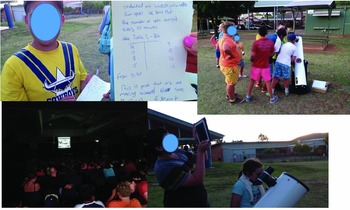
A further example of student engagement documented in the notes was when students were asked to form pairs and were challenged with the task of locating Venus using the planetarium software on their iPads (see Figure 3). Once found, students had to move the telescope to the same location, and focus it on Venus. This investigation took place during daylight when Venus was not easily visible against the blue sky backdrop.
Community event photo collage.

On the top left side of Figure 3 a student from Ngaguwany-guwal Public school can be seen posing with his Sunspot observation data with an amplified image of his work shown to his right. The top right side of the collage shows Indigenous and non-Indigenous students sharing the telescope to observe the Moon in the daytime. The image on the bottom left shows students, their parents and members of the community watching a sky stories movie made by the students at Ngaguwany-guwal Public school. The bottom right image shows two students working together to locate Venus using the donated iPad and telescope.
Absence Data
The school could not provide individualised absence data for each student. Rather, they provided the normal absence data sheets that are required to be returned to the central administration. An analysis of these global absence data for Kindergarten to Year 6 students was undertaken for each term of the school year. The raw absence data were not directly comparable across the individual school terms given that each contained different numbers of school days that students were required to attend. Thus, the weighted mean number of absences in each school term was calculated for each group of students (Indigenous, non-Indigenous, females, males for the Kindergarten to Year 6 groups). An analysis of these weighted data over the four terms was conducted to identify any patterns in the students’ absences in each term and the one in which the ISS project ran.
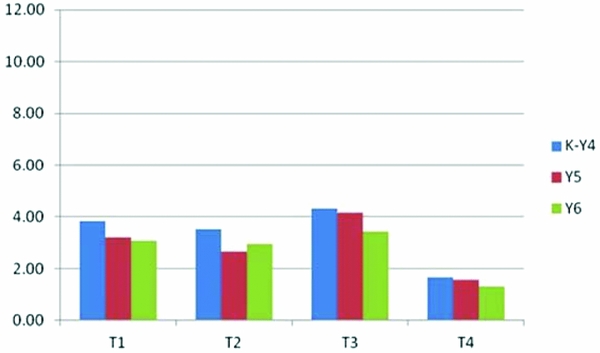
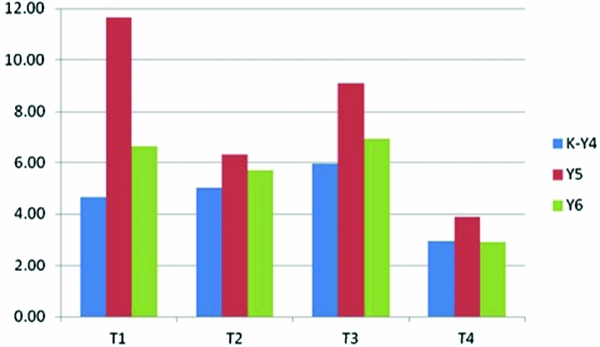
Both Figures 4 and 5 show the weighted mean number of absences for three groups of students in each of the four school terms: Grades Kindergarten to Year 4 combined, Year 5 and Year 6. The number of students in each grade remained stable from term to term. Specifically, Figure 4 shows absence data for the combined non-Indigenous Kindergarten to Year 4 students, and compared with Year 5 and Year 6, for each of four school terms (T1, T2, T3 and T4) during the year of program implementation. Figure 5 presents the same absence data for Indigenous students.
Mean weighted absences for non-Indigenous students K-4 combined, compared with Year 5 and Year 6, for each school term.
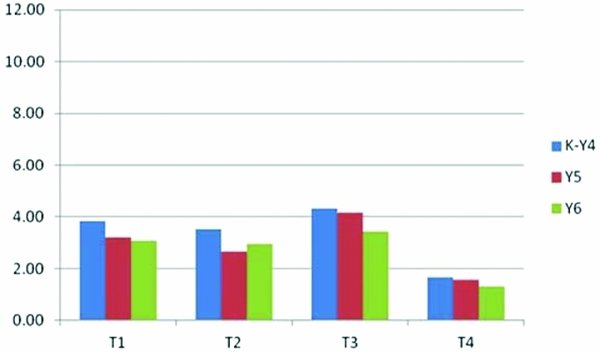
Mean weighted student absences for Indigenous students K-4 combined, compared with Year 5 and Year 6, for each school term.
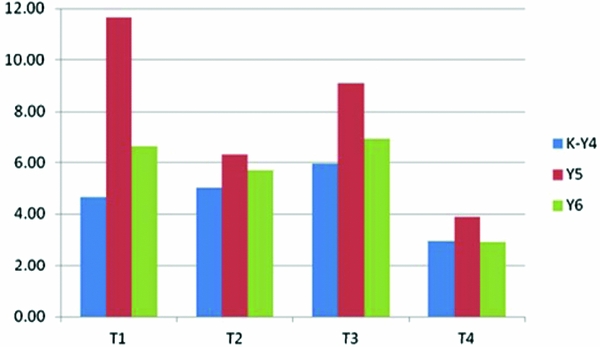
Figure 4 shows the average weighted absences for non-Indigenous students in Kindergarten to Year 4 combined (blue), compared with Year 5 (red) and Year 6 (green), for each of four school terms, T1, T2, T3 and T4. The data in Figure 4 shows a greater number of student absences in Term 3. It may be noted that Term 4 has a very low weighted mean average absence rate compared with the other three school terms.
Figure 5 shows the average weighted mean absences for Indigenous students in Kindergarten to Year 4 combined, compared with the Year 5 and Year 6 students, for each of four school terms, T1, T2, T3 and T4. When compared with the data in Figure 4, it appears that in all terms, Indigenous students have a higher average rate of absences than the non-Indigenous students. There is also a greater variation of absences in each of the four terms for the Indigenous students compared with the non-Indigenous students. Again, it can be seen that Term 4 has the lowest weighted mean average absence rate compared with the other three school terms.
The pattern that emerges from these data broadly suggests that Indigenous students overall, have a higher mean absence rate and a greater variation of absences than their non-Indigenous peers. It was also noted that Term 4 has a low weighted mean absence rate compared with the other three school terms. This begs the question: What is causing the apparent reduction in absences in Term 4?
While no attempt can be made to attribute causality, something appears to have motivated students to attend class during Term 4. A possible explanation for the decrease that occurred in Term 4 could be, in part, attributed to a school calendar that did not have as many fee-paying activities such as out-of-town excursions. One could also argue that students’ returning to school in Term 4 are over the winter sickness period and are motivated by ‘fun’ events that typically occur in Term 4. Nonetheless, these results suggest that attendance patterns are certainly worth investigating in future implementations of the program.
Discussion
This research was driven by literature that posits local, Indigenous knowledge involving hands-on activities with appropriately modified language and which takes full advantage of existing western knowledge systems, strengthens both non-Indigenous and Indigenous students’ engagement and learning outcomes. Having the local Indigenous community and its knowledge within the learning space was critical to the ISS intervention and served as inspiration to many. This provided an opportunity to deliver western science concepts mapped to the Australian National School Science Curriculum within an authentic knowledge context. This ‘middle ground’ was deemed the ideal setting for optimum engagement.
Implications for teaching practice showed a way that could potentially transform how Indigenous knowledge can be valued and used in the science classroom. The sharing of the local sky stories as a precursor to introducing western astronomy concepts inspired some students to articulate their own cultural sky stories and seek out further examples about the night sky. The cultural sky stories seemed to motivate some of the students to observe the actual night sky in their own time. Aikenhead (Reference Aikenhead1996) argues that if teachers provide a cultural ‘border-crossing’ that operates between Indigenous knowledge systems and new knowledge systems, that is, western astronomy concepts, positive student learning outcomes can emerge. More broadly, Rennie (Reference Rennie2006) maintains that curriculum development should include a negotiable space where teachers can mediate between traditional knowledge and practices and western ways of knowing. The results from our research highlight that this should be respectfully done with elders and other Indigenous community members.
The story of the ‘Christmas star’ and its acronychal rising signalling that it was time to go fishing for Murray Cod in the river was one such occasion where respect of traditional knowledge interrogated by western science led to a greater understanding by both communities. We were intrigued by this story and further questioning revealed that this star appeared multicoloured. It prompted the individual to use Stellarium to find the bright star and the date of its acronychal rising as well as undertake some research on the Murray Cod. It would appear that in the astronomical story, there is also embedded an environmental sustainability message. Sirius's acronychal rising occurs in late November. When it is very low in the sky in the East, it does appear multicoloured due to differential atmospheric refraction and turbulence. Moreover, the Murray Cod spawns in the colder months with spawning being completed by mid-October. The next generation of these baby fish is ensured if one waits until late November before fishing for the adults. The linking of astronomical events with environmental factors is one that requires observation and storytelling over the long term so that the connections can be made. The confluence of calendrical Aboriginal stories and their signal of environmental events ensured sustainability practices.
Moreover, students were able to articulate their fascination with the night sky after learning of these cultural stories and astronomy concepts they were being taught in the classroom. To some extent, our results are consistent with the findings of an Australian School Innovation in Science and Mathematics project Wildflowers in the sky (Tytler et al., Reference Tytler, Osborne, Williams, Tytler and Cripps Clark2008) and with research that posits establishing ties with the local community strengthens learning and engagement outcomes for students (Bhathal, Reference Bhathal2008; Howard & Perry, Reference Howard and Perry2005; Mack et al., Reference Mack, Augare, Coud-Jones, David, Gaddie, Honey and Wippert2012; Oscar & Anderson, Reference Oscar and Anderson2009). The night observation event was considered a success (statement by principal) due to the unexpectedly high attendance and participation of both Indigenous and non-Indigenous families. It was also interesting to note the pattern that emerged from the absence data, which broadly suggested that overall there were many more students at school in Term 4 than during any other term in the school year. Research (Hauser et al., Reference Hauser, Howlett and Matthews2009; McKinley et al., Reference McKinley, Brayboy and Castagno2008) suggests that keeping students within the school system can be achieved when curriculum-based science not only legitimises Indigenous knowledge systems but also foregrounds them.
The ISS program may have the potential to deliver significant and long-lasting changes to the way the astronomy content of the NSC is taught to Year 5 and 6 primary school students. The study showed that introducing cultural sky stories using local Indigenous community members engaged and primed Year 5 and 6 students to investigate astronomical content mapped to the NSC. Consistent with other research (Harrison & Greenfield, Reference Harrison and Greenfield2011; Mack et al., Reference Mack, Augare, Coud-Jones, David, Gaddie, Honey and Wippert2012; Oscar & Anderson, Reference Oscar and Anderson2009), developing collaborative relationships with the local Indigenous community to locate and deliver sky stories was key to the engagement of the students. The successful inclusion of local Indigenous knowledge into a science program has provided a valuable template for teachers to emulate and which can act as a model for the requirement in the NSC to include Indigenous perspectives. Furthermore, concepts from the program may also be useful as a basis for adoption in other subject areas included in the National Curriculum.
Our results indicate that when Indigenous knowledge is recognised and given space within the curriculum, positive engagement may be achieved. Students were fascinated with the cultural stories about the night sky and were motivated to seek out both cultural stories and scientific facts to broaden their knowledge. Further research, therefore, needs to be undertaken more broadly to investigate the efficacy of the inclusion of such Indigenous perspectives in other educational programs or interventions. An opportunity also exists to investigate the impact of the program on students’ science content knowledge in relation to the standards set by the NSC.
Note
If any reader wishes to get access to the educational materials that have been developed by the authors, they should email us. A link to the 1.2 Gigabyte zip file will be provided for download and unpacking. The materials are delivered as a digital book, and heavily hyperlinked. The materials are best run on a Windows computer. Some of the materials referred to in this paper cannot be supplied for ethical restrictions.
About the Authors
Nicholas Ruddell is a PhD student in the School of Teacher Education at Charles Sturt University. His dissertation is focused on working towards the conceptualisation of a contemporary school science framework. The research explores teachers’, students’ and their school community's experiences with science education programs that seek to integrate Indigenous knowledge systems and pedagogies. Nicholas is Project Manager and a chief investigator on the Sky Stories Project.
Dr Lena Danaia is a Lecturer in the School of Teacher Education at Charles Sturt University. She predominately works in the science and technology curriculum area. Her research focuses on science education and spans primary, secondary and preservice teacher education. She has had experience teaching in schools in both Australia and the United Kingdom. Lena is a key researcher on the Sky Stories Project.
David McKinnon is a Professor of Education at Edith Cowan University at Joondalup in Western Australia. He established and ran the Charles Sturt University Remote Telescope until his departure in July 2014. He has a profound interest in science education at all levels and especially involving astronomy, public outreach and teacher professional learning. He has been involved with Las Cumbres Observatory global telescope network and its predecessor Faulkes Telescopes UK since 2003 as an international education advisor and consultant as well as undertaking research into the impact of using the telescopes on students and teachers.