Despite the milking machine being introduced in dairy production more than 100 years ago, technical improvements are still needed to meet the demand for efficient milking of high-yielding dairy cows. The latest development in milking technology is automatic milking systems (AMS) and the use of these has been increasing world-wide since they were introduced in the late 20th century. In many AMS systems, each teat cup is detached individually when milk flow from the teat in question has reached the pre-set take-off level, which most likely reduces the risk of over-milking (Svennersten-Sjaunja & Pettersson, Reference Svennersten-Sjaunja and Pettersson2008). Since the teat cups in conventional milking systems are detached at the same time for all udder quarters, much of the data relating to conventional milking systems cannot be directly transferred to AMS.
Productivity is an important aspect in AMS production, which is dependent on around-the-clock production. If less time is spent on each milking occasion, more cows can be milked per 24 h, and consequently, more milk can be harvested. de Koning & Ouweltjes (Reference de Koning and Ouweltjes2000) found that the flow rate and the milk yield are the most important factors for maximising the number of milkings and the capacity of the AMS, and that increasing the handling time by 30 s can decrease the milking capacity by up to 8%.
During machine milking, when milk flow is established, there are four phases (a, b, c and d) of the pulsation cycle, which are divided into the milking phase (a + b) and the massage phase (c + d). During the b phase the liner is completely open and during the d phase the liner is completely closed. During the a and c phases, the liner is in the process of opening and closing, respectively (Mein et al. Reference Mein, Bramley, Dodd, Bramley, Bramley, Dodd, Mein and Bramley1992). An increase in b phase duration of from 200 to 800 ms, (with constant d phase length of 250 ms) increases peak milk flow (Bade et al. Reference Bade, Reinemann, Zucali, Ruegg and Thompson2009), while a decrease in d phase duration can negatively affect udder health. For example, in a field study (Østerås et al. Reference Østerås, Rønningen, Sandvik and Waage1995), it was observed that herds with a d phase duration shorter than 245 ms were significantly associated with an increased incidence of acute clinical mastitis compared with 331 ms, and the bulk tank SCC was higher in herds using a d phase duration shorter than 251 ms. Herds having a d phase duration longer than 327 ms had the lowest bulk tank milk SCC (Østerås et al. Reference Østerås, Rønningen, Sandvik and Waage1995). The relationship between the effects of d phase length and pulsation rate on udder health was also discussed in that field study, and it was recommended that a d phase length of about 300 ms with a pulsation of at least 55 cycles/min should be used.
The performance of the milking equipment used can have a major influence on teat treatment. According to Hamann & Mein (Reference Hamann and Mein1990), increased teat tissue thickness after milking is a sign of post-milking congestion in the teats. This might be an effect of inadequate massage phase. A milking machine-induced increase in teat tissue thickness can be a risk factor for mastitis, with cows in early lactation having an increased risk (Zecconi et al. Reference Zecconi, Hamann, Bronzo and Ruffo1992). A change in teat end thickness of 5% or more from start to end of milking is considered a risk factor for teat end bacterial colonisation (Zecconi et al. Reference Zecconi, Hamann, Bronzo and Ruffo1992).
In order to optimise milking performance in conventional milking systems, the effect of pulsation ratio on teat tissue has been studied. Hamann & Mein (Reference Hamann and Mein1996) showed that increasing the pulsation ratio from 50:50 to 80:20 caused increased teat tissue thickness, with the most marked increase from 70:30 to 80:20. The pulsation rate used in that experiment was 40, 60 or 80 cycles per min (cpm) and teat tissue thickness increased with increasing pulsation ratio, an effect observed for all three pulsation rates tested. However, in a more recent study, increasing the pulsation ratio from 60:40 to 67:33 with a pulsation rate of 60 cpm during three consecutive days had no effect on teat tissue (Gleeson et al. Reference Gleeson, O'Callaghan and Rath2004). Interestingly, no effect on milk somatic cell count (SCC) was observed when pulsation ratios 50:50, 60:40 and 70:30 were compared at a pulsation rate of 50 and 60 cpm (Thomas et al. Reference Thomas, Force, Bremel and Strasser1991); or when pulsation ratios of 50:50 and 70:30 were compared at a pulsation rate of 60 cpm in a large commercial herd (Thomas et al. Reference Thomas, Bray and DeLorenzo1993). Moreover, in a study where cows were subjected to a mastitis challenge combined with the pulsation ratios 50:50, 60:40 and 70:30, at three different vacuum levels (33·3, 41·6 and 50 kPa) and pulsation rate 60 cpm, no significant differences between pulsation ratio treatments were found in terms of number of infected quarters, while infected quarters increased as vacuum level increased (Mahle et al. Reference Mahle, Galton and Adkinson1982).
For conventional milking systems, the effects of pulsation ratio on milk yield, milking time and milk flow have also been evaluated. Increased pulsation ratio (70:30 or 67:33) can reduce milking time and increase average milk flow compared with 60:40 (Thomas et al. Reference Thomas, Force, Bremel and Strasser1991; Gleeson et al. Reference Gleeson, O'Callaghan and Rath2004; Spencer et al. Reference Spencer, Shin, Rogers and Cooper2007) and other lower ratios, such as 50:50 (Thomas et al. Reference Thomas, Force, Bremel and Strasser1991) or 65:35 (Spencer et al. Reference Spencer, Shin, Rogers and Cooper2007). This effect seems to be independent of pulsation rate (Thomas et al. Reference Thomas, Force, Bremel and Strasser1991). It has also been shown that milk yield can be increased by increasing the pulsation ratio from 50:50 to 70:30 (Thomas et al. Reference Thomas, Force, Bremel and Strasser1991) or from 60:40 to 67:33 (Gleeson et al. Reference Gleeson, O'Callaghan and Rath2004), In the study by Thomas et al. (Reference Thomas, Force, Bremel and Strasser1991), an increase in fat yield and 3·5% FCM was also found, indicating that the increase in milk yield may have been due to increased udder emptying, since fat content increases during milking (Johansson et al. Reference Johansson, Korkman and Nelson1952; Ontsouka et al. Reference Ontsouka, Bruckmaier and Blum2003).
Most previous studies on the effects of pulsation ratio on teat and udder health have been performed in conventional milking systems. As mentioned, there are benefits associated with the quarter milking in AMS that could counteract some of the risk factors for decreased teat condition, measured as change in teat tissue thickness with increased pulsation ratio. Despite SCC often being higher in milking systems with AMS (Dufour et al. Reference Dufour, Frechette, Barkema, Mussell and Scholl2011), it has been found that teat redness are lower in AMS than in conventional milking systems and that changes in teat thickness during milking are less likely to occur in AMS (Berglund et al. Reference Berglund, Pettersson and Svennersten-Sjaunja2002).
The aim of this study was to investigate the effects of different pulsation ratios on teat condition, milk SCC, milk yield, milk flow and milking time in an AMS, where each quarter is individually milked. It was hypothesised that pulsation ratio can be increased from 65:35 to 75:25 in quarter level milking without any negative effects on udder health or milking efficiency.
Materials and methods
The study was conducted on five commercial farms in Sweden and Denmark during the winter 2013. Experimental procedures and animal handling were approved by the Uppsala local ethics committee on animal experiments.
Animals and housing
In total, 356 cows of the breeds Swedish Holstein (n = 87), Swedish Red (n = 153) and Danish Jersey (n = 116), producing 29 ± 6 kg milk daily, were used in the trial. However, 36 cows were culled or dried-off during the experiment for reasons not related to the experimental treatment. Cows were randomly selected from the available cows on each farm and were in different lactation stages (average DIM 174 ± 120) and lactation numbers (range 1–8, average 2·1 ± 1·3). Each breed was represented on two farms (see Table 1). The cows were housed and managed according to the standard routines for each herd.
Farm location, dairy cow breed, number of cows included per farm, average milk yield per cow (mean ± sd) and liner specifications

† Round liners (DeLaval International AB, Tumba, Sweden).
Experimental design
Four treatments were applied in a half-udder design, where all cows received the control treatment (65:35) on one udder half and a pulsation ratio of 60:40, 70:30 or 75:25 was applied to the other udder half. The experiment lasted for a period of 6 weeks and the same treatment was applied during the whole treatment period. All treatments were applied on all farms and breeds. Cows and udder halves were randomly allocated to the treatments.
All cows were milked with the DeLaval Voluntary Milking System (VMS™, DeLaval AB, Tumba, Sweden), with varying milking intervals and quarter level take-off at a milk flow of 246 ± 39 g/min (delay time 2 s), pulsation rate of 60 cycles/min and system vacuum of 46·2 ± 1·2 kPa (mean ± sd). The drop between system vacuum and vacuum at the teat end was on average 7 kPa. Durations of the different phases of pulsation are shown in Table 2 and liner types in Table 1.
Duration of the four phases (a–d) of pulsation used in the study (pulsation rate 60 cycles/min, system vacuum 46 kPa

† Phase duration not measured, but estimated based on linear relationships between pulsation ratios
Measurements and recordings
Teat score and teat tissue thickness were measured on three occasions during the experiment: before the start of the treatment, 3 weeks into the experiment and in the last week of the experiment.
Milk yield, milking time, machine-on time and milk flow were recorded automatically by the VMS for each milking and quarter during the whole 6 week experimental period.
Strip milk samples were collected individually from each udder quarter immediately after milking on the measurement occasions. The milk samples were preserved using 10% bronopol (2-bromo-2-nitropropane-1·3-diol, VWR International AB, Stockholm, Sweden) and stored at 4 °C for no more than 5 d before analysis.
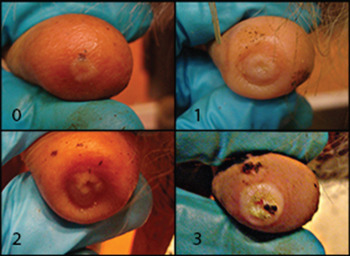
Teat scoring was performed using a simplified method based on Neijenhuis et al. (Reference Neijenhuis, Barkema, Hogeveen and Noordhuizen2000) (see Fig. 1). The teats were scored directly after milking on a four-grade scale where:
Teat scoring chart, grades 0–3.

0, No deviations, small soft ring may be visible; 1, Slightly more protruding ring, no cracks or wounds; 2, Protruding ring, abnormal teat opening; 3, Hardness, cracks, wounds.
Scoring of teat ends was performed by three different persons, the persons scoring were unaware of which treatment that was applied and inter-observer agreement was checked in the beginning and the end of the experiment. Teat tissue thickness was measured approximately 0·5 cm from the teat end immediately before and after milking with a spring-loaded calliper device, using the method of Hamann et al. (Reference Hamann, Mein and Burkhard1996).
Milk analyses
Strip milk fat content was analysed using mid-infrared spectroscopy (Fourier Transform Instruments, FT 120, Foss, Hillerød, Denmark) and strip milk SCC was determined using fluorescence-based cell counting (Fossomatic 5000, Foss, Hillerød, Denmark). All samples were analysed within a week of collection.
Statistical analyses
The half-udder design of the experiment allowed the animals to act as their own controls and thus most causes of variation were eliminated. Use of the half-udder design in studies investigating the local effects of milking has been validated by Wall & McFadden (Reference Wall and McFadden2007). However, due to the normal variation between the front and hind quarters (with the latter usually containing more milk; Berglund et al. Reference Berglund, Pettersson, Östensson and Svennersten-Sjaunja2007), in the present study the treated front and hind quarters were compared separately with the control front and hind quarter respectively, rather than comparing averages between udder halves. Thus all statistical analyses except for teat score were performed on the differences between the control and treated front/hind quarters. When comparisons with pre-treatment data were made, these comparisons were also made on the difference between the front and hind quarters, respectively. The categorical variable teat score was converted to a binomial value, where 1 indicated an impaired teat end compared with pre-treatment measurements (post-treatment difference > pre-treatment difference) and 0 indicated a non-impaired teat end compared with pre-treatment measurement (post-treatment difference ≤ pre-treatment difference).
The data were analysed using the MIXED and GLIMMIX procedures in SAS 9·3.
The MIXED model was used for the statistical analysis of teat tissue thickness, milk yield, fat content, SCC, machine-on time, peak flow and average flow. The milk SCC values were logarithmically transformed (log10) in order to achieve a normal distribution of the data. Treatment (three levels) and week (three levels) were included as fixed effects in all models, and milk yield was used as a covariate for analysis of milk flow measurements. Cow within herd acted as a repeated subject and variance component covariance structures were used to model repeated measures over time.
The GLIMMIX procedure with logistic regression and binomial distribution was used for statistical analysis of teat score. The effects of treatment (three levels) and farm (five levels) were included as fixed effects in the model.
Pairwise comparisons were made to evaluate significant differences and effects were considered significant at P < 0·05. Data presented are mean ± se unless otherwise stated.
Results
As noted above, in the statistical analyses the treated front and hind quarters were compared separately with the control front and hind quarters, respectively. However, all treatments in this study were applied on half udders and therefore the results in tables and figures are presented as average per udder half or udder quarter data, including both front and rear quarters.
Teat reactions and udder health
Teat score
There was no evidence that any of the treatments applied had significant effects on teat score (P = 0·280). The frequencies of different teat scores among the treatments are shown in Table 3. Teat scores did not differ between breeds.
Frequency table for teat scores after 6 weeks of treatment with different pulsation ratios. Values represent percentage of total number of quarters within the treatment group, n = 320

Teat tissue thickness
As expected, teat tissue thickness was very variable (CV = 19·7%) and no significant differences were found between treatments (P = 0·505). The average teat tissue thickness was 11·9 ± 2·6 mm (mean ± sd) before milking and 11·8 ± 2·5 mm after milking. The average difference in teat tissue thickness between before and after milking was 0·12 ± 2·07 mm.
Somatic cell count
Average SCC for the included cows on the six farms was 95 500 and 104 700 cells/ml at the first and last measuring occasion respectively. There was no significant effect of treatment on strip milk SCC (Table 4).
Milk yield, strip milk fat content and strip milk somatic cell count (SCC) in control (C) and treated (T) quarters after pulsation ratio treatments were applied, and p-values for the differences between pre- and post-treatment values. Values presented are mean ± se, n = 320

† Somatic cell count, Log10 values with antilog values within brackets
‡ Statistical significance of the difference between quarters compared with pre-treatment
Milking performance
Milk yield and udder emptying
None of the treatments significantly affected milk yield or fat content in strip milk, indicating an equal degree of udder emptying in treated and control quarters (Table 4).
Machine-on time
Machine-on time was affected by the pulsation ratios 60:40 and 75:25, with the 60:40 ratio significantly increasing machine-on time compared with pre-treatment values (data not shown) and the 75:25 ratio significantly decreasing machine-on time over the course of the treatment period (Table 5).
Machine-on time, peak and average flow in control (C) and treated (T) quarters after pulsation ratio treatments were applied, and p-values for the differences between pre- and post-treatment values. Values presented are Mean ± se, n = 320

‡ Statistical significance of the difference between quarters compared with pre-treatment
With the 60:40 pulsation ratio, treated udder quarters had on average 14·1 ± 2·2 s longer machine-on time at the end of the treatment period compared with the control udder quarters (P < 0·0001). In contrast, with the 75:25 ratio, treated udder quarters had on average 9·2 ± 2·1 s shorter machine-on time compared with control udder quarters (P < 0·0001).
Peak and average flow
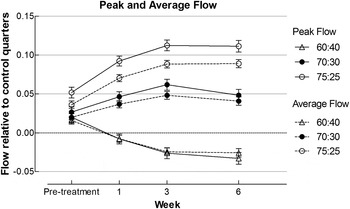
Average milk flow was significantly increased by the 75:25 and 70:30 pulsation ratios and decreased by the 60:40 ratio compared with the standard 65:35 ratio (Table 5, Fig. 2). A similar response was seen for peak milk flow, which was significantly increased by the 75:25 and 70:30 ratios and decreased by 60:40. As can be seen in Fig. 2, peak and average flow showed a similar response for all three pulsation ratios, which for 60:40 and 75:25 seemed to be an adaptation to the pulsation ratio applied until a plateau was reached at week 3. Week 1 differed significantly from week 6 for the 60:40 ratio (P = 0·013) and from week 3 for 75:25 (P = 0·036). There was also a tendency for a differences between weeks 1 and 3 for 60:40 (P = 0·056) and weeks 1 and 6 for 75:25 (P = 0·057).
Peak and average flows of treated quarters relative to control quarters for the different pulsation ratios tested. Peak flow is indicated by a solid line and average flow by a dashed line. Values shown are LSMeans, error bars show standard error of the mean.

Discussion
We found evidence of faster milking with a pulsation ratio of 75:25 and higher average and peak flows with a ratio of 75:25 or 70:30, which is in agreement with previous studies (Thomas et al. Reference Thomas, Force, Bremel and Strasser1991; Gleeson et al. Reference Gleeson, O'Callaghan and Rath2004; Spencer et al. Reference Spencer, Shin, Rogers and Cooper2007). We found no effect on milk yield and no effect on strip milk fat content, suggesting that the faster milking was not accompanied by more complete emptying of the udder or improved milk ejection. Theoretically, either of the treatments could have resulted in a higher degree of udder emptying due to better stimulation and maintenance of the milk ejection. As shown by Bruckmaier et al. (Reference Bruckmaier, Schams and Blum1994), milk needs to be continuously ejected during milking to get a good emptying of the udder. If milk ejection and/or udder emptying had been improved, a higher fat content of strip milk would have been expected, since it is well known that fat content in the milk increases during milking (Johansson et al. Reference Johansson, Korkman and Nelson1952; Ontsouka et al. Reference Ontsouka, Bruckmaier and Blum2003).
As shown by Ambord & Bruckmaier (Reference Ambord and Bruckmaier2009), the take-off level has a significant influence on the effects of pulsation ratio on average flow, since milk flow is limited by the milk ejection rate and the transfer of milk from the alveoli to the cisternal cavity in the latter part of milking (Pfeilsticker et al. Reference Pfeilsticker, Bruckmaier and Blum1995). In the AMS system used in the present study, take-off level was high compared with that used in conventional cluster milking and take-off was performed at quarter level. Milking at low flow rates was therefore avoided, enabling the effect of pulsation ratio on milking time and average flow to be compared. If the take-off level had been lowered a higher milk yield might have been obtained, but the risk of over-milking and teat injuries would also have increased. The primary advantage to be gained from applying a higher pulsation ratio is therefore faster milking, rather than higher milk yield per cow. Faster milking means higher milking efficiency, i.e. more cows milked per hour or more milk harvested per hour per milking unit, which is an important factor to consider with AMS. For example, De Koning & Ouweltjes (Reference de Koning and Ouweltjes2000) concluded that milk flow rate is important for number of milkings per day and AMS capacity. With the 75:25 pulsation ratio tested in the present study, the machine-on time was reduced by on average 9 s per milking. Thus in a standard AMS unit herd with 60 cows milked 2·7 times per day, about 24 min per day could be saved just by increasing the pulsation ratio. Conversely, using a lower than standard pulsation ratio (60:40) would increase milking time by 38 min per day compared to 65:35.
Both peak and average flow appeared to increase gradually towards a plateau that was reached at week 3 for the 60:40 and 75:25 pulsation ratios. This indicates some form of biological adaptation of milk flow to the new pulsation ratios, through a mechanism unknown to us. However, the measurements obtained for week 1 included the first days of treatment, which might have affected the results.
Teat score was generally high in this study, probably as an effect of the simplified classification scale. In the more complex scale used by Neijenhuis et al. (Reference Neijenhuis, Barkema, Hogeveen and Noordhuizen2000), teat ends are classified as either smooth or rough, and then further classified according to the severity of the callosity. In the simplified classification used in the present study, all teat ends that were rough, had cracks or wounds were classified as grade 3, irrespective of the degree of protrusion of the ring. This simplification resulted in more severe verdicts for all teats compared with Neijenhuis et al. (Reference Neijenhuis, Barkema, Hogeveen and Noordhuizen2001), but was necessary for practical reasons. Teat score for both control and treated quarters was higher on average at the end of the experiment. Neijenhuis et al. (Reference Neijenhuis, Barkema, Hogeveen and Noordhuizen2000) previously reported that teat end callosity increases with days in milk, so this finding was expected. It should also be noted that teats originally classified as score 0 only had potential to become worse while teats with score 3 could only become better during the course of the experiment. This is also an effect of the type of classification used.
Teat tissue thickness is a very variable measure. No differences could be found between treatments in this study, which is contradictory to findings by Hamann & Mein (Reference Hamann and Mein1996) for a conventional milking system with the four teat cups detached simultaneously. Since there were no differences between treatment and control regarding teat score and teat tissue thickness, this indicates that teat end condition was not negatively affected by increasing the pulsation ratio from 65:35 to 75:25 or 70:30 when milking is performed in AMS.
All the treatments in this study followed the ISO recommendations of d phase duration >150 ms. In contrast to the results from Østerås et al. (Reference Østerås, Rønningen, Sandvik and Waage1995), we found no increase in SCC due to d phase durations shorter than 300 ms. It is likely that this discrepancy is related to the use of quarter milking in this study. Most previous studies on pulsation ratio have been performed in systems with conventional cluster milking, where all four teat cups are detached at the same time and quarter level take-off is not used. This increases the risk of over- or under-milking of one or several udder quarters, since the milk yield (Berglund et al. Reference Berglund, Pettersson and Svennersten-Sjaunja2002) and thereby milking time generally differs between quarters within an individual udder. Over-milking can be a minor risk factor for intramammary infection (Natzke et al. Reference Natzke, Everett and Bray1982). In quarter-level milking, each teat cup is detached when milk flow reaches the pre-set level for take-off on each quarter and the risk of over-milking is significantly reduced, thereby reducing the risk of teat damage and increased SCC. Higher SCC is expected in strip milk compared to composite milk (Ostensson et al. Reference Ostensson, Hageltorn and Astrom1988), but despite this, the SCC levels in this study were found to be low.
Conclusions
In this study, peak and average milk flow increased with an AMS pulsation ratio of 75:25 and 70:30 (system vacuum 46 kPa, pulsation rate 60 cycles per min) and machine-on time decreased with a ratio of 75:25 compared with the standard pulsation ratio 65:35. However, there were no significant effects on milk yield. There seemed to be an adaptation of the peak and average flows, both of which changed gradually and reached a plateau on week 3 for a ratio of 75:25 or 60:40. The 60:40 ratio decreased peak and average milk flow and led to longer machine-on time. Extensive use of a 75:25 pulsation ratio is thus likely to decrease the milking time per cow and would enable a larger number of cows to be milked per AMS station in a 24-h period. Use of a 60:40 ratio may lower performance of the AMS, by enabling fewer milkings per milking unit per 24-h period. None of the three pulsation ratios tested here had a negative effect on teat condition or milk SCC. In conclusion, it is likely that a higher pulsation ratio can be used to increase productivity in AMS, where quarter milking is applied and take-off level is high, without causing negative effects on teat end condition or udder health.
DeLaval International AB is acknowledged for financial support of the study. The authors also wish to acknowledge the farmers for their participation in the study.