Of all the ethnic Chinese business conglomerates in colonial Asia, the Oei Tiong Ham Concern (OTHC) was by far the largest.Footnote 1 Oei Tiong Ham's wealth was tremendous and surpassed by far that of illustrious contemporaries such as Tan Kah-kee, the rubber baron in British Malaya, Lee Choon-guan, the shipping and real estate tycoon in the Straits Settlements, or the Khaw tin-mining dynasty in Thailand.Footnote 2 Other famous compatriots from the Indies like the Tjong brothers from the East Coast of Sumatra, Thio Tiauw Siat from Batavia and Penang, and Be Biauw Tjoan from Central Java, could not match the wealth and power Oei Tiong Ham acquired.Footnote 3 From the late 1890s until his death in 1924 kings, politicians and business tycoons from all over the world sought his favour. He entertained Prince Waldemar from Denmark, King Chulalongkorn from Siam, Joseph Chamberlain from Great Britain, Marquis Ito Hirobumi from Japan, and Yuan Shih-k'ai from Imperial China. He was nicknamed ‘the Rockefeller of China’, ‘The Wealthiest Chinese between Australia and Shanghai’, and ‘The Sugar King of Java’, epithets that signified his elevated status and prestige the world over: from the luxurious dining rooms of the aristocracy in London, Paris and New York to the peasant's kitchen in Java's hinterland.
Less is known about how this ‘Man of 200 Million’ from the mid-1890s onwards built up his sugar empire with the help of a profitable partnership with one Carel Willem Baron van Heeckeren, scion of a noble Dutch family, and according to some, the most brilliant lawyer in the Indies.Footnote 4 The important role of Van Heeckeren in the building of Oei Tiong Ham's business empire raises questions about the practices of colonial capitalism and how some elite Chinese entrepreneurs creatively seized the opportunities provided by the colonial state to advance their economic interests and status vis-à-vis other Chinese players. The collaboration between the Dutch lawyers and the Chinese elite of Semarang contrasts with earlier interpretations of the encounters between Overseas Chinese capitalists and the colonisers during the formative stages of Dutch economic imperialism. These are generally framed in terms of conflict and opposing economic interests or, more broadly, as a hostile struggle between corrupt, immoral Chinese towkays and modern, civilised colonial administrators. It is moreover argued that as the colonial state became more powerful and whiter, with European investments booming, European entrepreneurs increasingly sought the assistance of the colonial state to secure leverage against Chinese business rivals. Racial prejudice combined with economic self-interest and a superior morality made any alliance between the state and the Chinese elite subsequently anomalous.Footnote 5 It is thereby also understood that the Chinese-organised (mining) production and cash crop agriculture were largely autonomous of colonial regimes and Western entrepreneurs.Footnote 6 This article will show that the workings of colonial capitalism during the age of imperialism was far more complex and ambiguous. It argues that at this turning point in the formation of a modern, globalised economy in colonial Java profitable business partnerships were formed between official and quasi-official Dutch actors (lawyers) and key figures of the Chinese business elite of Semarang. Their relations were not marked by rivalry and competition, but rested upon mutually beneficial alliances based on trust and similar status.
The first part of this article deals with the role of Dutch lawyers in the making of colonial Java's modern economy from the late 1880s, especially that of Semarang and its hinterlands. As will be shown, the law office of Van Heeckeren, and his predecessor Caesar Voûte, became the centre of a close-knit group of Dutch lawyers who through interlocking directorships and seats in supervisory boards developed important sectors of the Central Javanese economy. Van Heeckeren was not just a lawyer but an entrepreneur and businessman. Oei Tiong Ham was one of his partners in the countless business undertakings he initiated and co-developed.
Many prominent Dutch colonial officials such as Minister of Colonies Th.B. Pleyte, W.G.F. Jongejan, A.W. Hartman and Ch.P. van Wijngaarden started their careers in Van Heeckeren's law firm and became his business associates. Arriving in Java as ambitious and idealistic young men, seeing themselves as ‘bearers of civilisation’ and bringing the ‘rule of law’, hoping to build promising careers in the judicial system, these jurists soon learned that the rules of the game in the Indies were different from what they were used to in the home country, and that more rewarding careers could be made by entering a private law firm, investing their capital in the burgeoning mining and agricultural sectors, and aligning themselves with the wealthy Peranakan Chinese business elite of Semarang in their legal battles with the colonial government.
The second part of the article details the relationship of this group of lawyers with the Chinese elite of Semarang, and more specifically with the Oei family. Semarang was the major commercial centre of Java in the nineteenth and early twentieth century, and had the largest and wealthiest Chinese community in the colony. Power in the Chinese communities rested with the cabang atas, an extended group of status-minded Peranakan elite families which controlled the opium market, had large stakes in Java's sugar industry, had produced Chinese officers for generations, and through their extensive family and patronage networks controlled important sectors of the Javanese economy.Footnote 7 In the last two decades of the nineteenth century this Peranakan Chinese elite saw its wealth and power shrinking due to the economic crises of the late 1880s and the dismantling of the opium farms since the 1890s. This led to bankruptcies, the loss of enterprises and property, as well as family feuds. Trying to overcome these setbacks the Chinese cabang atas sought the legal advice of Dutch lawyers, who were more than willing to assist them, given the financial benefits involved. These lawyers, such as Voûte and Van Heeckeren, were well connected in the highest echelons of the colonial administration, and if needed, took their cases (successfully) to the Supreme Court in Batavia.
Semarang lawyers in business
Unlike the British in India who adhered to a unified judiciary system, the Dutch applied a dual legal system in the Indies based on racial classification: Europeans and Natives. Cases involving Europeans were brought before the Council of Justice, and non-European or Native cases (Javanese, Chinese and Arabs) were brought before the Local Court (Native Court). Until the early 1870s the latter were presided by (assistant) residents, who often misused their administrative powers and were known for their arbitrary convictions. Guarantees against governmental arbitrariness, which existed for Europeans, were denied to non-Europeans. This overlapping of administrative and judicial powers was severely criticised and in 1869 the colonial government decided to appoint professional jurists as Local Court judges. The new policy came into effect in 1871 with the appointment of the first five independent judges, each assisted by a clerk with judicial training. The change of the colonial judicial system brought many young Dutch jurists to Java, among whom were Voûte and Van Heeckeren.Footnote 8
Voûte (1855–1941), born in Amsterdam and hailing from a family with Indies roots, studied law at the State University of Utrecht and was appointed lawyer and prosecutor at the Council of Justice in Semarang in June 1879. In March 1882 he was appointed state-attorney of Semarang.Footnote 9 As state-attorney Voûte had direct access to the Supreme Court and the General Secretariat in Batavia and could therefore pull some strings.Footnote 10 Just like other Semarang lawyers during the economic crisis of the early 1880s he became involved in legal disputes of Chinese, Arab and European planters and entrepreneurs who had defaulted or gone bankrupt. He was also an executor of agricultural enterprises, real estate and factories of Chinese and European entrepreneurs and as a government-appointed auctioneer responsible for the public sale of property and enterprises.
Auctioneers had a crucial position in the economy of Central Java. They had the right to decide who could participate in an auction, and when it concerned large estates or enterprises they wanted to make sure that the prospective bidder and his guarantors were trustworthy with enough capital to fulfil their financial obligations. Bribes and favouritism were general features of auctions, not only for household items, as discussed by James Rush, but also for estates and enterprises.Footnote 11 It was not uncommon that Voûte, and lawyer-auctioneers like him, called upon colleagues to pool their capital and establish a limited liability company to be able to make the highest bid at a public auction. In this way he and his associates, as well as other Semarang law firms, became shareholders in numerous plantations and industrial enterprises, thereby occupying a prominent position in Central Java's economy. Voûte was appointed secretary of the Semarang Chamber of Commerce in 1881, became secretary of the Supervisory Board of the Indo-Europeesche Landbouw Maatschappij (Indo-European Agricultural Society, est. 1887), which was specifically concerned with the plantation interests of the Eurasian population, and was a board member of the Savings Bank of Semarang.
In addition to having a foot in the European (and Eurasian) business community, the Semarang lawyers also entertained close relations with the powerful Chinese business elite of the port city. Race and ethnicity were not paramount in structuring these relations. On the contrary, in the Indies society of the nineteenth and early twentieth century, power and status was measured by class, wealth and lifestyles.Footnote 12 Through the traditional practice of sumbangan (contributions) the wealthy Chinese opium farmers and business elite upheld the luxurious lifestyles of the Javanese priyaji (elite) administrative corps and the Dutch colonial administrators. By offering expensive gifts to the colonial administrators on festive occasions and throwing lavish dinner parties at their huge mansions, members of the Chinese elite such as Oei Tiong Ham curried favour with colonial officials, including the Dutch lawyers.Footnote 13 The latter started to successfully defend well-paying Chinese clients at the local courts when they were accused of opium smuggling and other illegal activities.Footnote 14 One of these accused was Oei Tjie Sien, the father of Oei Tiong Ham, who sought Voûte's legal advice over a lawsuit against him by the local court.
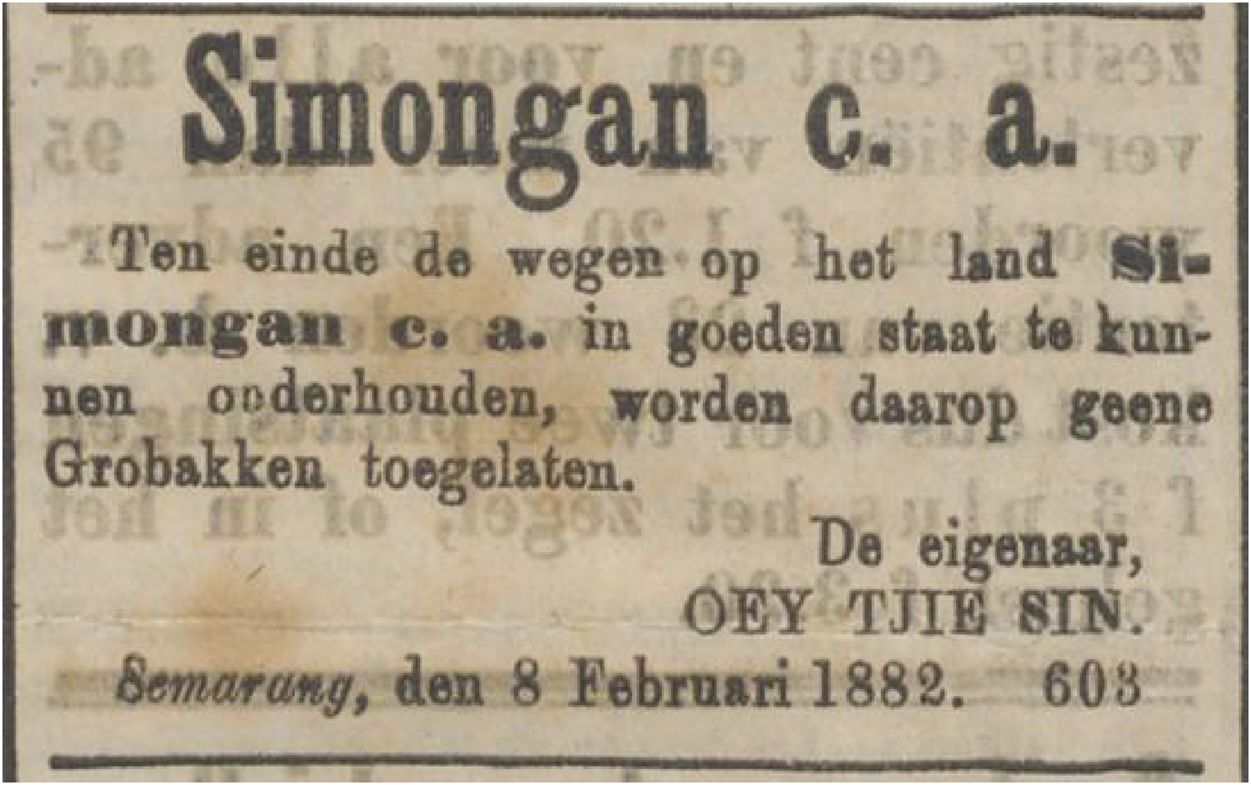
Oei Tjie Sien had come to Semarang in 1858 and established a flourishing trading firm, the Kian Gwan kongsi. Together with his nephew Oei Tjo Pie, who had moved to Surakarta to set up a trading business, he soon developed a thriving China trade. By the mid-1870s he had saved enough capital and had gained enough trust with the established Peranakan elite families to enter the opium market. He aligned himself with Be Kwat Kong of the powerful opium kongsi of Major Be Biauw Tjoan of Semarang to challenge Ho Yam Lo's opium syndicate and in 1876 obtained the licence to exploit the Surakarta opium farm, thereby entering the ranks of the cabang atas.Footnote 15 After making his first fortune Oei Tjie Sien started to invest in real estate. In August 1879 he bought the Simongan lands in the outskirts of Semarang for the sum of 180,010 guilders. This estate, just south of the main road between Semarang and Batavia, had belonged to the heirs of the late Armenian opium farmer Joseph Johannes and of Carapiet Andreas.Footnote 16 It also held the Villa Penggiling and at its boundary lay the venerated shrine of Sam Po Kong, dedicated to the famous Chinese admiral Zheng He. Oei Tjie Sien abolished the existing toll for Chinese pilgrims to pray there and started the construction of a family cemetery as well as his own tomb.Footnote 17 In 1880 he was given permission by the colonial authorities to live at Simongan, although it was located outside the Chinese Quarter. He spent substantial sums to develop and maintain the roads in Simongan. The Semarang River which bordered Simongan contained large amounts of clean and high quality gravel and sand that was used for the construction of roads, not only at Simongan but also other parts of Semarang residency. Tjie Sien soon recognised the economic opportunities of this gravel and in 1881 wanted to start a gravel business. Such a business was already being undertaken, however, by a European who used large and heavily laden grobaks (oxcarts) to transport the gravel. Not keen on seeing a competitor on his lands, Oei Tjie Sien, in February 1882, put up huge placards at the entrance of the estate, as well as advertisements in newspapers, that grobaks would no longer be allowed on his estate (see fig. 1). He complained that these heavy ox-drawn carts destroyed Simongan's roads and that he was therefore unable to maintain them properly, which he was legally obliged to do.
‘Simongan c.a. [cum annexis]: To be able to maintain the roads of Simongan c.a. properly, no grobaks will be allowed.’ Advertisement by Oei Tjie Sien, De Locomotief, 9 Feb. 1882.

When these warning signs did not produce the result he had hoped for, he put up a barrier at the main road of his estate. Alongside the barrier he left enough space for horses and pedestrians to pass through his estate. The barrier was against government regulations which stated that owners of private lands should allow the free traffic of people and goods over their estates.Footnote 18 Subsequently, colonial engineers, contractors and transport companies working on the improvement of Simongan's waterways began to complain to the residential authorities. Given these complaints Oei Tjie Sien was summoned to appear before the local court on 23 September 1882. The charges brought against him were that by placing the barrier he was in violation of Article 6, Government Gazette 1880, no. 5. He was represented by Caesar Voûte, who argued that Oei Tjie Sien could not have been guilty of a breach of Article 6, simply because this article only referred to waterways. His defence was not accepted, and Oei Tjie Sien was found guilty, ordered to pay a penalty of 100 guilders and to dismantle the barrier immediately. Should he not oblige, the barrier would be removed by the local authorities at his own expense and he would be sentenced to forced labour for at least one month.
Oei Tjie Sien was unhappy with the verdict and, on the advice of Voûte, appealed to the Supreme Court in Batavia. Much to the surprise of everyone involved, the Supreme Court accepted Voûte's defence, annulled the local court's verdict, and judged that Oei Tjie Sien had not violated Article 6, nor had he violated any other related law.Footnote 19
Although he had won his appeal, Oei Tjie Sien was eager to stay on a good footing with the residential authorities, and subsequently showed his goodwill by announcing that he would have no problems with opening the barrier to colonial officials and contractors working for the government to improve the waterways on his lands, provided that they submit a formal written request any time they wanted to cross his property with carts and other transport equipment. He insisted, however, that he had the right to refuse private persons with carts. Having no leeway whatsoever, the resident was forced to agree. With this agreement Oei Tjie Sien now had the legal means to charge the colonial office for damages caused to his roads, because only the government would have had formal access to his estate.
This court case was exemplary in demonstrating the power of the cabang atas vis-à-vis the local colonial government. They could afford to hire the best lawyers in the Dutch colony and were not afraid to bring their cases to the Supreme Court in Batavia where their Dutch advocates argued legal points before a committee of their peers to overturn the convictions.Footnote 20
Van Heeckeren: Lawyer-businessman
Soon after Voûte won the Simongan barrier case for Oei Tjie Sien, C.W. Baron van Heeckeren joined his law firm. Van Heeckeren had arrived in the Indies in August 1879 and was initially employed as a substitute clerk of the Supreme Court of the Netherlands East Indies posted at the landraad (Native Court) of Sumenep in Madura. The next year he was promoted to first substitute clerk of the Council of Justice at Semarang and in early 1882 appointed as president of the native court of Pati and Joana (Residency Japara). Here he most probably got well acquainted with the power of Chinese opium farmers and their henchmen. Joana was a key distribution centre for clandestine opium for all of Central Java and Van Heeckeren's appointment in Joana coincided with the posting of Charles TeMechelen as assistant-resident, who was specifically assigned to combat opium smuggling operations.Footnote 21 In October 1882 he asked to be discharged with honours as a member of the Council of Justice. This request was granted whereupon he associated himself with Voûte's private law firm in April 1883.
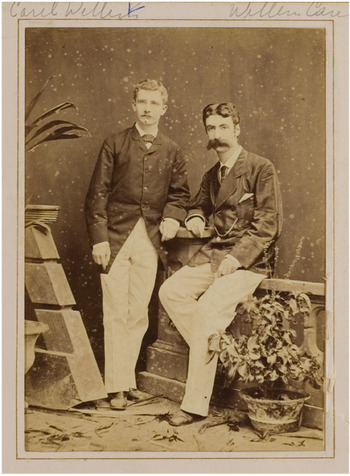
In 1885, when Voûte took a year's leave in Europe, Van Heeckeren temporarily took over his positions as state-attorney and as secretary of the Savings Bank of Semarang (fig. 2). From the mid-1880s Van Heeckeren, young, talented and ambitious, showed tremendous energy and a great ability for setting up (agricultural) enterprises and other business undertakings. Clearly a trustworthy and convincing business partner he was able to raise the necessary capital from Semarang's European and Chinese elite. The law firm he and Voûte represented became a central node in the establishment of numerous Chinese and European agricultural enterprises in the region, and often Van Heeckeren himself bought up low-priced premises and real estate. He also co-founded new businesses with Voûte and other partners in their law practice.Footnote 22 He became a member of the Board of the Indo-European Agricultural Society and in November 1889 was appointed member of the Chamber of Commerce of Semarang and, replacing Voûte, became acting-commissioner of the Borneo Tobacco Society (Borneo Tabak Maatschappij).Footnote 23 Being a partner of Caesar Voûte between 1883 and 1890 thus bore fruit and not only brought him material gain, but also enhanced his status and prestige in Semarang society and Batavia.
C.W. Baron van Heeckeren (l) and Caesar Voûte (r), c.1885. Taggesel & Schutz (Semarang-Soerakarta), KITLV A562, Leiden University Library, KITLV Southeast Asian & Carribean Collection. http://hdl.handle.net/1887.1/item:764450. Licensed under CC BY 4.0.

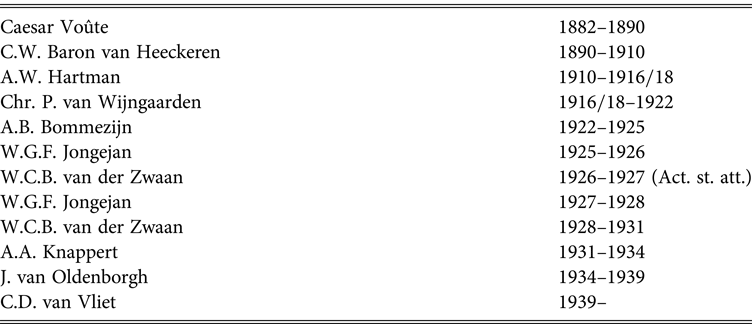
In 1890 Van Heeckeren succeeded Voûte as state-attorney of Semarang, a position he held until 1910. This turned out to be a lengthier period compared to the appointments of his predecessors and successors (see table 1). And it was during these 20 years that Van Heeckeren became closely involved in the businesses of Oei Tiong Ham, who in 1891 was appointed captain of the Chinese community in Semarang.
State-attorneys of Semarang, 1880–1942

Sources: H. Brugmans and N. Japikse, Persoonlijkheden in het Koninkrijk der Nederland in Woord en Beeld (Amsterdam: Van Holkema & Warendorf N.V., 1938), pp. 620, 659, 1545; De Java Bode, 11 Mar. 1882; HNDNI, 16 Nov. 1910, 16 Aug. 1928, 6 Sep. 1930, 24 Apr. 1934, 23 Mar. 1938; Bataviaasch Nieuwsblad, 10 Aug. 1916, 21 July 1925; Rotterdamsch Nieuwsblad, 21 Aug. 1925; De Indische Courant, 30 Jan. 1926; Haagsche Courant, 15 Aug. 1927; Soerabaijasch Handelsblad, 25 July 1931; De Telegraaf, 14 July 1939.
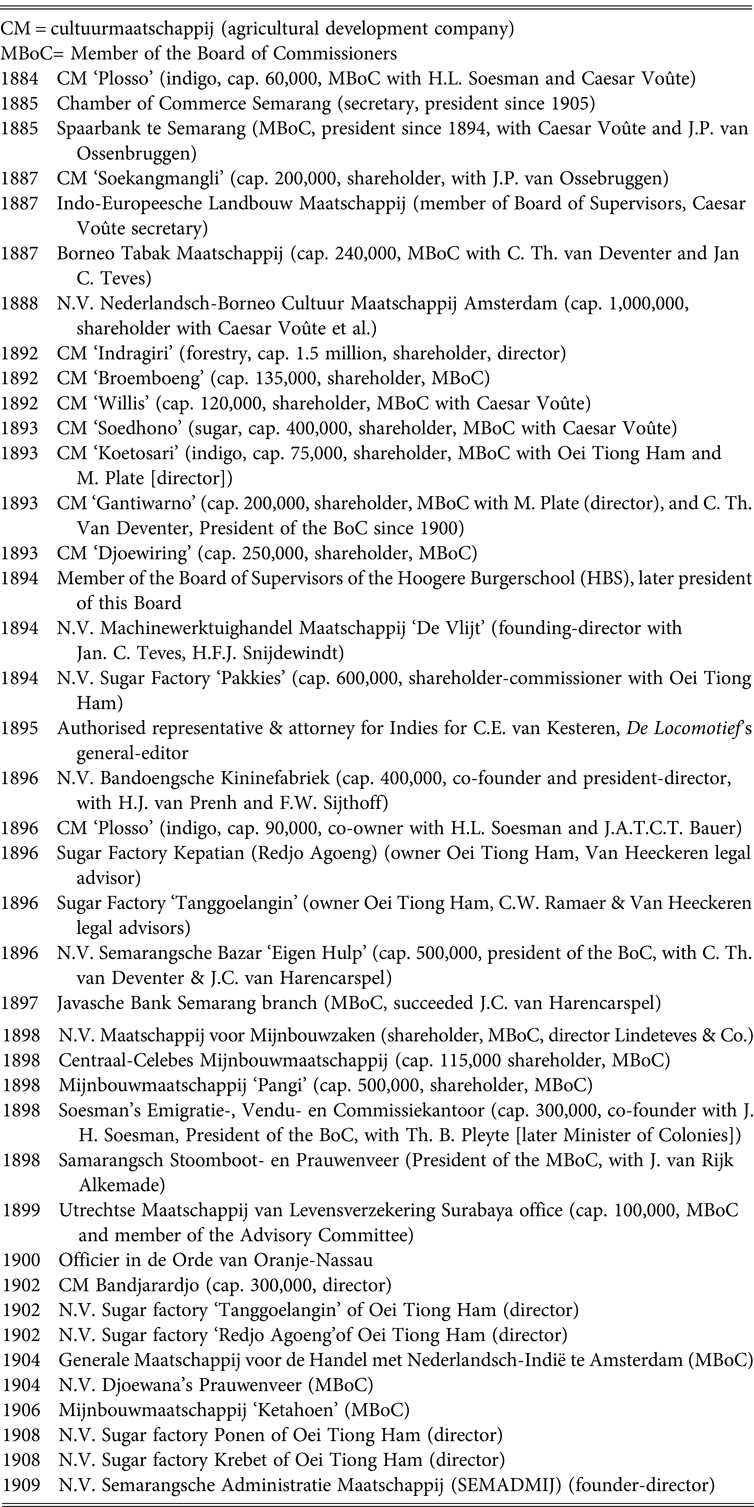
Having established himself as a reliable and creditworthy lawyer-businessman, Van Heeckeren was in 1892 appointed president of the Savings Bank of Semarang and a member of the Board of Supervisors of the HBS (Government High School) in the city.Footnote 24 The former appointment, which he held until 1921, was quite important because it allowed him to invest part of the bank's capital in mortgages and agricultural enterprises.Footnote 25 In the following years Van Heeckeren co-founded a large number of agricultural development companies (cultuurmaatschappijen) and industrial enterprises (see appendix table 2).
Around 1895 he embarked on a journey that would change the lives of people in the Indies and around the world forever, namely the founding of the Bandoengsche Kininefabriek (Bandung Quinine Factory). Together with a cinchona planter-chemist, H.J. van Prehn, and his business colleague, F.W. Sijthof, he submitted a plan to the governor-general to develop an independent quinine industry in Java that could compete with the powerful German industry on the world market. The colonial government supported these plans and on 8 September 1896 the Bandung Quinine Factory was officially incorporated.Footnote 26 Van Heeckeren was appointed general director, Van Prenh factory director, and Sijthoff general manager. During the early twentieth century the factory extended its scientific, technological and production capacities, which resulted in a tremendous output of almost 140,000 kilograms of quinine sulphate in 1910. It thereby became the largest producer of quinine sulphate in the world, surpassing its German competitors by far.Footnote 27 Its final products, mostly in the form of tablets, were used not only by the colonial health service in the Indies to fight malaria, but also by the military, hospitals, medical institutions, and doctors in all continents. The Bandung Quinine Factory's local and global success was mainly due to Van Heeckeren's untiring efforts and business acumen and established his fame in the Indies once more.
Lawyers in the Java coolie trade
Van Heeckeren's enterprising spirit apparently had no limits. Here I'd like to point out three other important enterprises he was involved in and helped establish, namely: N.V. Semarangsche Bazar ‘Eigen Hulp’, Soesman's Emigratie-, Vendu-, en Commissiekantoor, and the Semarangsche Stoomvaart en Prauwenveer.
All these enterprises were engaged in the profitable coolie-trade in which Oei Tiong Ham and other Chinese business elites also took part. The Semarangsche Bazar ‘Eigen Hulp’ was one of the largest and most modern department stores in the European quarter of Semarang by the turn of the twentieth century. Its fortunes were short-lived, from 1896 until 1908, but during this decade it was the place to go for the Semarang European, Chinese and Javanese elites and wealthy middle classes to buy modern and luxurious Western and Asian manufactured products. The department store radiated modernity and sold almost everything: from furniture to perfumery, from richly decorated Chinese fans to expensive French wines and Scotch whisky, from bicycles to paints, from toothpaste to silverware and wristwatches, from shoes to gramophone records, from cigars to socks, textiles and sarongs. Everything a person wanted to buy was available at the Eigen Hulp.Footnote 28
The Eigen Hulp was founded in August 1896 and continued the businesses of the Semarangsche Bazar owned by Eduard ‘t Sas. The latter also ran a recruiting agency for Javanese coolies to Deli. The first director of the new Bazar was the previous owner, whereas the board of commissioners consisted of C.Th. van Deventer (president), J.C. van Harencarspel (partner in Van Heeckeren's law firm) and several others.Footnote 29 In 1897 Van Deventer, who was to become the spokesman for the Ethical Policy, left for the Netherlands permanently, after which Van Heeckeren succeeded him as the Bazar's President of the Board of Commissioners.
Besides being a modern department store, the Eigen Hulp was also a major broker and a collecting point for Java's coolie trade to the East Coast of Sumatra in which Oei Tiong Ham was also interested. Between 1881 and 1900 the number of Javanese coolies working in the East Coast plantation sector increased from a mere 1,887 to 30,484 — or from around 8 per cent to almost one-third of the workforce — many of whom were shipped through Semarang.Footnote 30 Coolies from the Principalities and regions of East Java were brought to the Central Javanese port-city and assembled at one of the Eigen Hulp's buildings or the compounds of Soesman & Co., another major recruiting agency in the city. Here they were physically checked and had their names written down under the supervision of a police officer and the assistant-resident. The recruiting agencies then made up a coolie contract and took care of the shipment of coolies to Kutai, Menado, Benculen, Singapore and Deli, for which it chartered steamers of the Royal Dutch Packet Line (KPM) and the Singapore-based Tan Kim Tian S.S. Co. (TKT) (Giang Seng, Giang Ann, Penang).Footnote 31 Oei Tiong Ham was at that time already heavily involved in the Singaporean shipping company before taking over the fleet completely in 1903. TKT was also engaged in transporting coolies from South China to Sumatra and Java, as well as Kian Gwan Co.'s large rice imports from Rangoon and Saigon. It was managed during this period by the late Kim Tian's sons, Tan Hup Seng and Tan Hup Leong. The latter was Oei Tiong Ham's close business partner and friend, and accompanied him on his world tour in 1903.Footnote 32
In the Bazar's 1897 annual report Van Heeckeren was able to announce a net profit of 20,000 guilders to be divided among the shareholders,Footnote 33 profits that were largely realised through its involvement in the coolie trade.Footnote 34 When the Indies press started to criticise the dehumanising practices of coolie recruiters in Central Java, regularly mentioning the Bazar Eigen Hulp as one of the major culprits, calling it a profiteer of the ‘disguised slave trade’, Van Heeckeren decided to accept Soesman & Co.'s offer to take over its coolie- and auction interests.Footnote 35 In return the Bazar acquired Soesman's wine business and consumer articles division.Footnote 36
Soesman & Co. was owned by J.H. Soesman, a long-time business partner of Van Heeckeren, who — besides his coolie trade — was involved in various enterprises. He was, among others, the largest importer of Australian-bred horses for the Royal Netherlands Indies Army (KNIL) and Java's elite. In that capacity he had had close personnel relations with both Oei Tjie Sien and Oei Tiong Ham, who by that time had a large stable of Australian horses which regularly took part in horse-racing events in Central Java.Footnote 37 In 1898 Van Heeckeren and Soesman founded the Soesman's Emigratie-, Vendu- en Commissie-kantoor (hereafter SEVUC).Footnote 38 J.H. Soesman was appointed director, whereas Van Heeckeren, and Th.B. Pleyte (partner in Van Heeckeren's law firm and later Minister of Colonies) acted as commissioners. SEVUC took over the coolie contracts from the Bazar, intensified its coolie transport to Deli by appointing an agent in Medan, and started a new and successful Javanese coolie trade to Suriname, the Dutch colony in the West Indies. SEVUC's coolie trade was apparently quite profitable. given the fact that in that same year the Bazar Eigen Hulp increased its capital stock in the company to 113,000 guilders. In the next decades SEVUC was to become the largest recruitment agency for Javanese coolies in Central Java, signing contracts with the War Department, the Deli Planters Association and the Bangka tin mines.Footnote 39
The increasing coolie and cargo trade of Semarang necessitated an extension of local and inter-local shipping services. Van Heeckeren and his partners therefore founded the Samarangsch Stoomboot- en Prauwenveer (Semarang Steamship and Prahu Ferry, SSP) which was incorporated in February 1898.Footnote 40 In 1900 he was appointed president of the SSP's Board of Commissioners and J. van Rijk Alkemade as secretary. Besides its prahu (proa) business, the company opened direct lines to Singapore, Bangka-Billiton and Java's harbours.
In 1908 Van Heeckeren established the Semarangsche Administratie Maatschappij (Semarang Administration Society, Semadmij) to manage his numerous enterprises, and in 1910 relinquished his post as the state-attorney of Semarang. During the next two decades Semadmij, publicly known as the Van Heeckeren Concern, developed into one of the largest conglomerates in Java, owning and directing countless enterprises and agricultural companies.Footnote 41
Oei Tiong Ham's collaboration with Van Heeckeren
On the advice of Voûte and Van Heeckeren and unlike many of his Chinese contemporaries, Oei Tiong Ham relied on written contracts in conducting his business. He thus had a legal basis to foreclose on the securities given to him on the loans he extended.Footnote 42 Among his debtors were opium farmers and owners of sugar factories and when they were not able to repay their debts, he did not hesitate to use his rights as a creditor. One such debtor was Ho Tjiauw Ing of the powerful Ho opium kongsi.
Following his appointment as lieutenant in 1886, Oei Tiong Ham and his father started to challenge the opium monopoly of the Ho kongsi in Central Java. After the death of Ho Yam Lo in June 1888, his son and heir Ho Tjiauw Ing took up the tremendous task of preserving his father's fortunes and dominance over the Central Java opium farms. In the previous years his father's debt to the government had grown enormously and in order to fulfil his monthly obligations Ho Tjiauw Ing looked around for capital, offering his real estate and sugar mill as collateral. Other wealthy Chinese merchants came forward. Oei Tjie Sien was one of them and offered a mortgage loan on the Tjandi lands, which included the Gergadji villa, the Randoesari lands and several housing complexes owned by the Ho family. These loans were, however, not enough for Ho Tiauw Ing to pay his monthly fees and in April 1889, on behalf of the government, Van Heeckeren was the executor for the Ho family's property as well as that of their guarantors. In June 1889 the Ho kongsi was declared bankrupt, and in August that same year Oei Tjie Sien acquired their real estate holdings. One month later, after a fierce battle with Be Biauw Tjoan's opium kongsi, Oei Tiong Ham took over the Ho opium farm of Semarang.Footnote 43
After the fall of the Ho family and his acquisition of the Tjandi lands, the fame and power of Oei Tjie Sien rose significantly as did his prestige among the European elite when in 1891 he rented, on highly reasonable terms, a strip of his estate for the construction of a horse racetrack to be enjoyed by the elite of Semarang society.Footnote 44 It was therefore no coincidence that in that same year, with the support of Van Heeckeren as state-attorney, his son Oei Tiong Ham was installed as captain and his son-in-law Liem Ie Ging as lieutenant of Semarang. A year later followed the appointments as lieutenants of his son Oei Tiong Bhing and The Pik To, a relative from Surabaya. Having thus managed to gain a powerful position in the Chinese Council of Semarang, Oei Tiong Ham started to intensify his business relations with Van Heeckeren.
In April 1893, together with Van Heeckeren and M. Plate, Caesar Voûte's brother-in-law and manager of the Semarang branch of the Nederlandsch-Indische Handelsbank (NIHB), Oei Tiong Ham founded the NV Cultuurmaatschappij Koetosarie.Footnote 45 This agricultural society was established with a capital of 75,000 guilders divided into 75 shares of 1,000 guilders each. M. Plate was appointed as director, and Van Heeckeren and Oei Tiong Ham as commissioners.Footnote 46
Several months later and on the advice of Van Heeckeren, Oei Tjie Sien and his two sons incorporated the Kian Gwan kongsi into the NV Handel Maatschappij Kian Gwan (Kian Gwan Trading Co. Ltd) with a capital of 1,400,000 guilders divided into 140 shares of 10,000 guilders each. Oei Tjie Sien took 125 shares, Oei Tiong Ham 10, and Oei Tiong Bhing five. The three of them became commissioners, whereas Tjie Sien's close friends and business partners Ang Thay Liong and Tjioe Ping Hie were respectively appointed as managing-director and deputy-director.Footnote 47 Most of Kian Gwan's trade in 1893 was a regular import-export trade with South China, Siam and French Indochina as well as a thriving Java and inter-island trade. Oei Tiong Ham increased Kian Gwan's trade in gambir and incense to such an extent that the firm was considered the biggest trader in those articles for the whole Indies archipelago.
Apart from the Semarang farm, Oei Tiong Ham also obtained the opium farms of Surakarta, Yogyakarta, Bagelen and Surabaya, and in 1897 a controlling interest in the Madiun and Japara farms, which made him the undisputed opium king of Java in the late nineteenth century.Footnote 48 With the huge profits made from the opium trade he and his father expanded their sugar interests and started to extend mortgage loans to sugar factory owners who had fallen on hard times. Among his debtors were prominent Peranakan Chinese families from East Java and when they failed to repay their debts, he used his legal rights as creditor, with Van Heeckeren's advice, to obtain their holdings.
He subsequently acquired five sugar estates and mills, including, in late 1893 Pakkies (Patti district, residency Japara), and shortly thereafter Kepatian (Redjo Agoeng) near Madiun in April 1896, and Tanggoelangin (Sidoardjo) in September 1896. Together with The Siok Lian — his opium kongsi partner from Surabaya — he purchased the Krebet Factory (Malang) in 1897 and Ponen near Jombang.Footnote 49 To manage Pakkies a limited liability company was established in January 1894 with a capital of 600,000 guilders, the N.V. Suikerfabriek Pakkies, directed by the firm McNeill & Co. with Van Heeckeren, H. Prins and Oei Tiong Ham as commissioners.Footnote 50
Redjo Agoeng near Madiun, previously known as Kepatian, was completely rebuilt and modern machinery was installed soon after Oei Tiong Ham took over. With a capital of 600,000 guilders divided into 50,000-guilder shares, the new limited liability company was registered in 1902 in Semarang and directed by Van Heeckeren, with Ko Djie Soei and Tjioe Ping Hie as commissioners.Footnote 51 Redjo Agoeng was to become the ‘jewel in the crown’ of Oei Tiong Ham's sugar empire and widely considered Java's most exemplary sugar factory.
Tanggoelangin, and its smaller sister factory Pandjoenan, belonged to the Han family of East Java. This wealthy landowning family had produced Chinese officers for generations and together with the Tjoa and The families were the most powerful in the region.Footnote 52 The Oei family had formed strategic marriage alliances with the The family and supported them in their power struggle with the Hans over the position of Major Cina in Surabaya.Footnote 53 Due to the economic crisis and falling sugar prices, one of the owners of Tanggoelangin, Han Tjong Ling (Captain of Surabaya since 1895 and expected to be appointed as Major) had accumulated large debts. Unable to fulfil his financial obligations he approached Oei Tiong Ham for a loan. The latter was willing to do so and — with Major The Toan Tjak as guarantor — extended a mortgage loan of 500,000 guilders on the sugar factories, houses and other properties.Footnote 54 After Han Tjong Ling failed to pay his monthly interest, he was declared bankrupt by the Council of Justice of Surabaya in January 1896 at the request of J.W. Ramaer, who acted on behalf of Oei Tiong Ham.Footnote 55 Ramaer and Van Heeckeren immediately put advertisements in the local newspapers for the public sale of the two sugar factories, although this sale was fiercely contested by the Han family. With his personal finances in a deplorable state and his properties heavily mortgaged, Han Tjong Ling and other debtors of Oei Tiong Ham resorted to the forgery of bank notes and promissory notes meant to pay off their personal debts. This forgery was discovered, and a lengthy trial followed, during which Oei Tiong Ham insisted on his right as mortgage holder to sell the sugar factories Tanggoelangin and Pandjoenan. The Han family's protests were to no avail, and in April 1896, as the first mortgage holder, Oei Tiong Ham acquired both factories.Footnote 56
On 28 February 1902 Tanggoelangin was officially incorporated and capitalised at 600,000 guilders, divided into twelve shares of 50,000 guilders, of which Oei Tiong Ham took seven.Footnote 57 Van Heeckeren was appointed director, while Ko Djie Soei and Tjioe Ping Hie acted as commissioners. Oei Tiong Ham had obtained Ponen in the late 1890s. To develop and modernise the sugar mill, the NV Suikermaatschappij Ponen was founded in January 1908 with Van Heeckeren again as director and Oei Tiong Ham and Ko Djie Soei as commissioners.Footnote 58
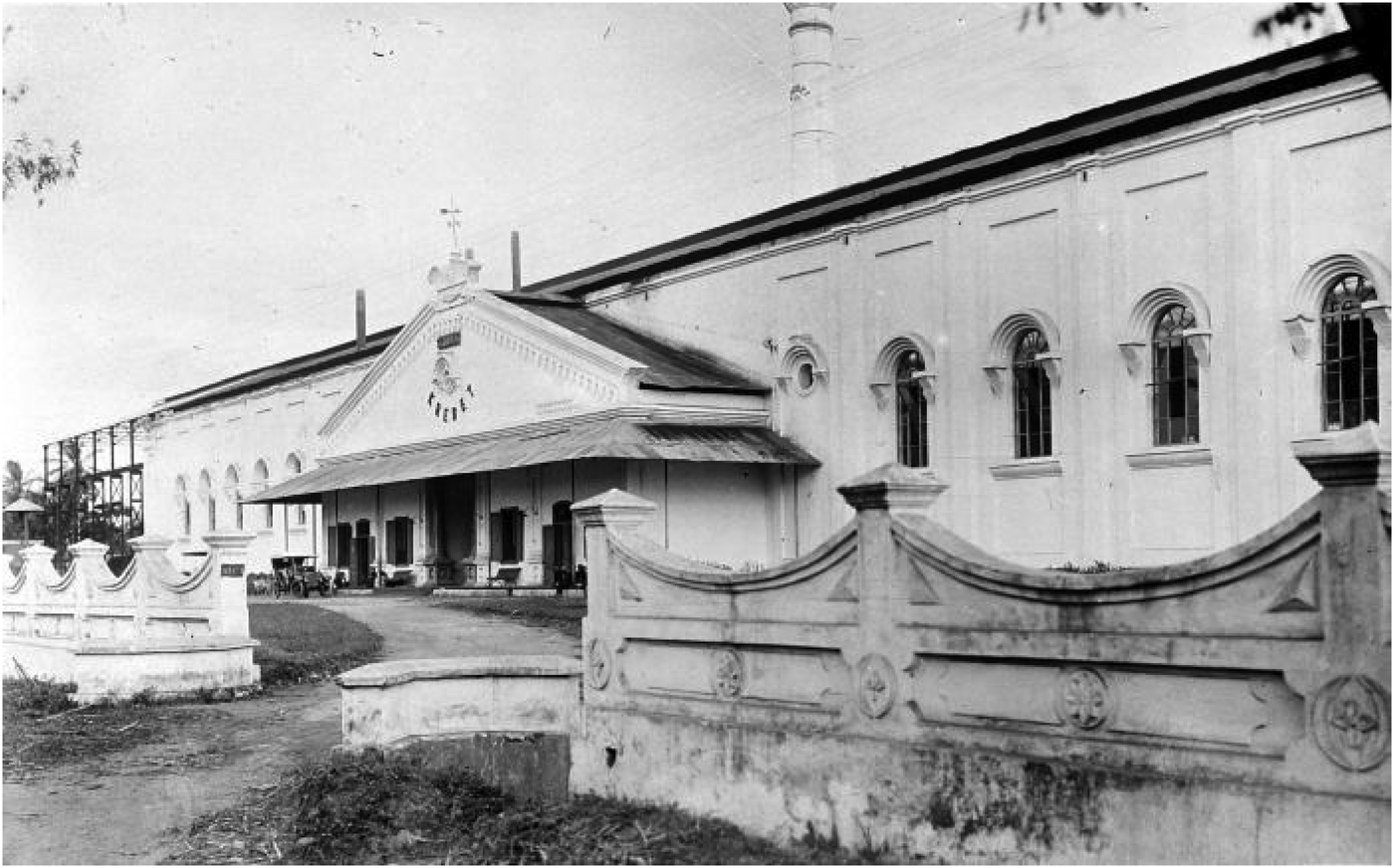
In 1894 the Krebet sugar mill was owned by H.J. Valkenhoff who faced bankruptcy in July 1897 and offered it for sale. With a guarantee by Oei Tiong Ham, the mill was bought by The Siok Lian, who continued operations, but with the old machinery, which could only process 3,000 piculs per day.Footnote 59 In 1902 Oei Tiong Ham's brother-in-law The Tik Gwan, the lieutenant Cina of Semarang, inherited Krebet from his father and with Oei Tiong Ham's financial support started to reconstruct the factory (see fig. 3). A completely new and modern factory installation was ordered which had the capacity to mill 15,000 piculs of cane per day from a planting area of 1,100 bahu.Footnote 60 Apparently The Tik Gwan could not meet his financial obligations to Oei Tiong Ham and was forced to concede the new Krebet factory to his brother-in-law. Not wasting any time Oei Tiong Ham, Ko Djie Sie and Van Heeckeren, the three main partners in the project, recruited Dutch and Eurasian senior personnel (a bookkeeper, field supervisors, garden employees, engineers and technicians), many of whom came from other sugar factories. Krebet at that time was considered the largest and most modern sugar factory in Java's East Corner (Oosthoek) and many senior employees and technicians from other sugar factories wished to be employed there. On 24 January 1908 the Krebet factory was officially incorporated with a capital of 1 million guilders divided into shares of 50,000 each and its headquarters was in Semarang. Van Heeckeren was appointed its director, Oei Tiong Ham and Ko Djie Soei its commissioners, and K. van Gelder its administrator.
The Krebet Sugar Factory in Malang. KITLV 18224, Leiden University Library, KITLV Southeast Asian & Carribean Collection, http://hdl.handle.net/1887.1/item:791603. Licensed under CC By 4.0.

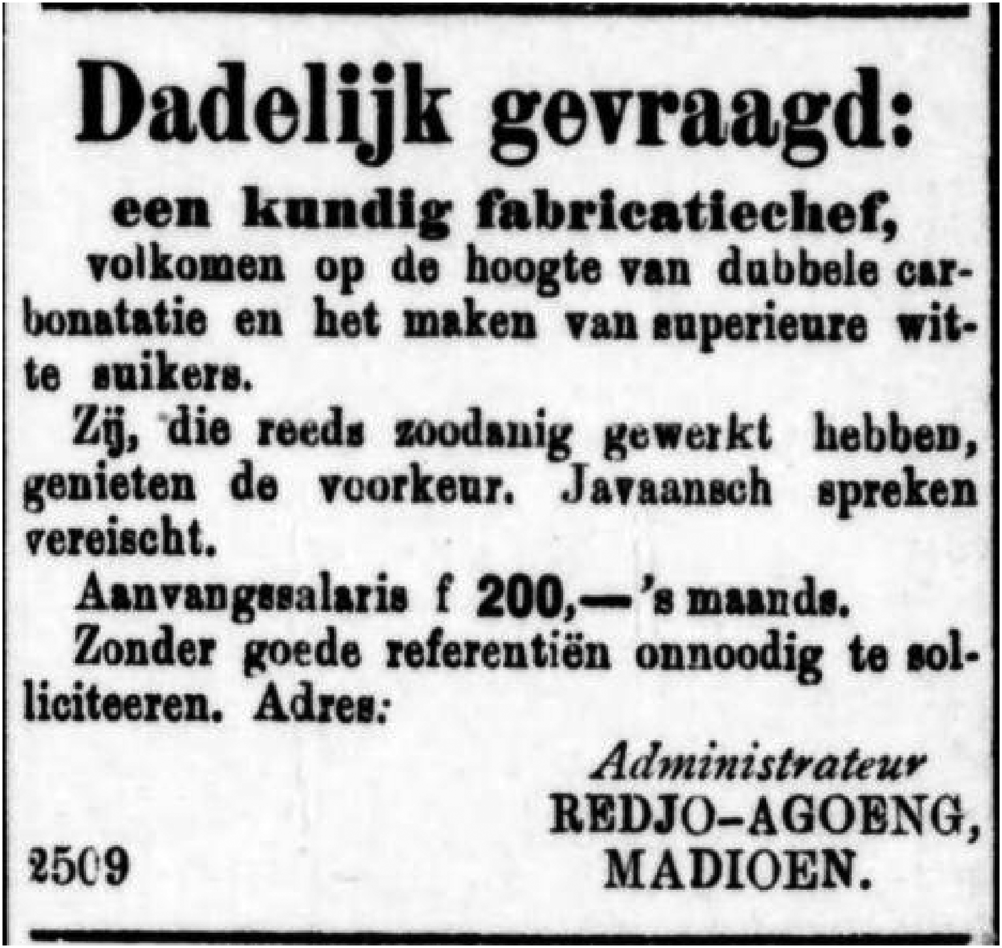
Appointing Van Heeckeren as director of his sugar factories was a strategically motivated business decision. By the late nineteenth century the market for Java sugar had started to shift from Europe and the United States to the Indian subcontinent. To protect its own refineries the United States imported mainly raw sugar, the ‘browns’, and in the latter half of the 1890s bought almost half of the Java sugar production. When, by the turn of the century, this huge market was largely lost and beet sugar had conquered the European market, sugar manufacturers in Java had to find new outlets. They started looking to Asia itself and decided that British India might be a good alternative market for the industry. To conquer the market of the Raj it was necessary, however, to produce white sugar.Footnote 61 This market shift meant that sugar factories had to be modernised and installed with expensive new production facilities and equipped with modern laboratories. Because Oei Tiong Ham's Chinese factory staff were unable to operate this technologically advanced machinery and had little knowledge about the production of superior white sugar, it was necessary to recruit European personnel. Given the anti-Chinese sentiments of the time and the prevailing racial prejudices, Oei Tiong Ham would have a difficult time attracting capable European and Indo-European staff.Footnote 62 He moreover lacked the personal connections to procure the necessary machinery in Western Europe. With the well-connected and highly respected Van Heeckeren as director he could overcome these problems. As director Van Heeckeren could legally make the highest-level management decisions, subject to specified limits and the approval of the commissioners.Footnote 63 Oei Tiong Ham himself and his closest associates, Ko Djie Soei and Tjioe Ping formed the Board of Commissioners. With the approval of the Board, Van Heeckeren soon started to replace the Chinese administrators and senior staff of the sugar factories. He brought in European administrators and ordered them to hire the best European engineers, chemists and field supervisors around. Advertisements were placed in newspapers to attract capable fabrication chiefs, well acquainted with the double carbonation process and manufacturing of superior white sugars. Redjo Agoeng was among the first sugar mills in Java to produce factory white (see fig. 4).
‘Immediately requested: A skilled manufacturing manager, fully aware of double carbonation and the making of superior white sugars. Those who have already worked as such are preferred. Speaking Javanese is required. Starting salary f200 per month.
Without good references applying is unnecessary. Address: Administrator, Redjo-Agoeng, Madioen.’ Advertisement, Soerabaijasch Handelsblad, 20 Sept. 1900

To attract European staff, the administrators were given the financial means to build housing complexes and leisure facilities according to European standards. It did not take long for European personnel from other sugar factories owned or administered by the Dutch conglomerates to seek employment with one of the Oei Tiong Ham factories. Europeans continued to dominate the management of the Oei factories until the late 1920s.
As Roger Knight has noted, by 1905 thirty-two of Java's more than hundred and seventy factories were producing white sugar, and by the mid-1920s around 60 per cent of the colony's sugar factories were designated as white-sugar manufacturers.Footnote 64 Of these thirty-two in 1905 four belonged to the Oei Tiong Ham Concern, which shows the large impact of the conglomerate on the modernisation of Java's sugar industry.
Oei Tiong Ham seems to have been the only Chinese capitalist in Java to shift production from browns to factory white. Other long-established and well-known Chinese sugar manufacturers from East Java stuck to the production of raw sugar destined for the refineries in Hong Kong and Japan.Footnote 65 These Peranakan Chinese sugar factory owners hence felt no need to employ Dutch-educated European engineers and chemists and, except for an occasional European administrator or bookkeeper, kept working with Chinese family members as factory and field staff.Footnote 66 This phenomenon has been noticed by many writers. Jamie Mackie, for example wrote that
The key factor in his (Oei Tiong Ham PP) commercial success seems to have been an awareness of the need to adopt Dutch business methods and technical skills combined with a shrewd sense of timing in his purchasing and sales. In the latter respect he was perhaps not very different from other Chinese traders of his time, but he was far ahead of them in the former (although it is puzzling that no others followed him on that score).Footnote 67
But what scholars like Mackie failed to notice is that the key factor in employing Europeans and appointing Van Heeckeren as director was the fact that Oei Tiong Ham wanted to manufacture factory white sugar in order to expand his sugar empire to British India. That other Chinese sugar manufacturers did not follow him is difficult to explain. Unlike Oei Tiong Ham, they obviously lacked the huge capital outlays necessary to build large modern factories capable of producing white sugar. But (family) tradition seems to have played a role as well. The Chinese sugar manufacturers from East Java had been in the business since the early years of the Cultivation System and apparently found it difficult to make the transition, also given the complicated intra-family shareholding of their factories and estates. Oei Tiong Ham was a newcomer in the sugar industry and was not hindered by family tradition nor by any conflicting intra-family interests.
It should be noted that the formal registration of his sugar factories as limited companies in 1902 took place after Oei Tiong Ham had received official permission to wear Western clothing (1898) and to cut his pigtail (1901).Footnote 68 These requests were submitted to the governor-general by Van Heeckeren, who was apparently able to convince the colonial authorities that Captain Oei Tiong Ham, as the most powerful Chinese in Java and owner of five sugar factories who employed Dutchmen as technicians and administrators, should be allowed this European privilege.
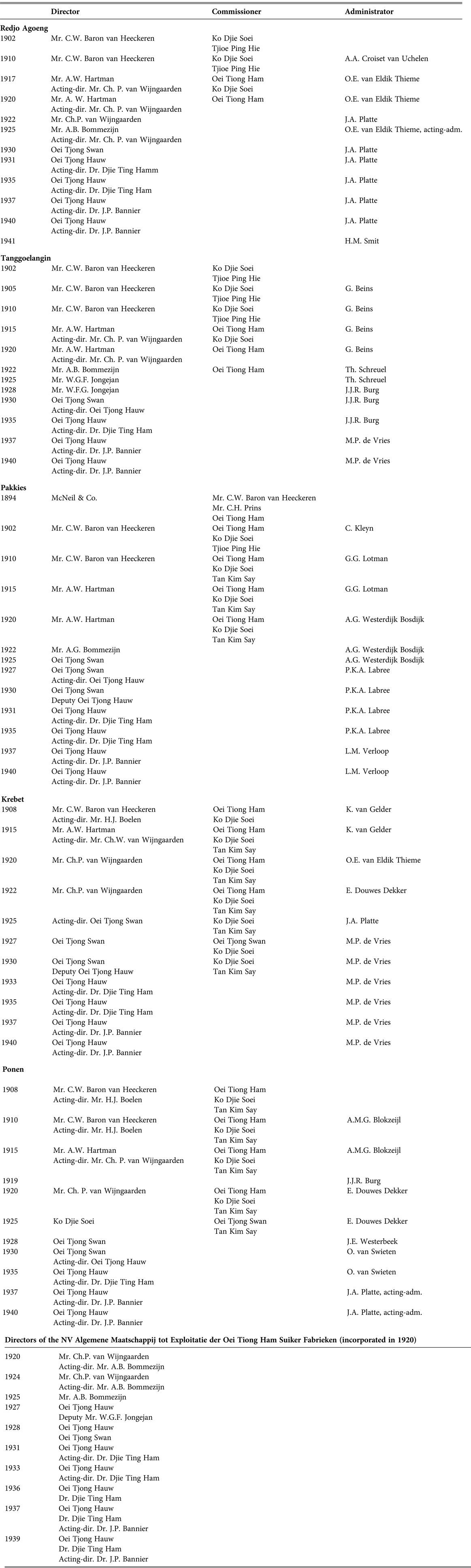
From the description above it has become clear that in laying the foundations for his sugar empire Oei Tiong Ham collaborated closely with C.W. Baron van Heeckeren. In the next years Van Heeckeren and his associates were appointed as directors and vice-directors of the various sugar factories of the OTHC (see appendix table 3). Until the mid-1920s they managed his sugar empire and dealt with the labour unrest that occasionally broke out at the different factories.
At the same time Van Heeckeren and his associates continued their work as the Oei family's legal advisors. For these services his law office probably received a monthly allowance of around 1,000 guilders.Footnote 69 This was extremely well-paid when we consider that Oei Tjong Hauw, president-director of the OTHC in the 1930s and 1940s, received a salary of 5,000 guilders a month.
Van Heeckeren's successors
In 1910 A.W. Hartman succeeded Van Heeckeren as state-attorney of Semarang. Hartman was appointed as substitute-officer at the Council of Justice of Semarang in May 1905 and in January 1906 as lawyer and prosecutor at the same Council. In January 1910 he temporarily replaced Van Heeckeren as state-attorney. At that time he was already a member of the board of the Semarang Chamber of Commerce and Director of the General Telephone Company (Algemeene Telefoon Maatschappij) in Semarang.Footnote 70 During his term in this office he succeeded Van Heeckeren as director of the Oei Tiong Ham sugar factories. The vice-director was Ch.P. van Wijngaarden, a young lawyer attached to Van Heeckeren's office, who was on the brink of his Indies political career. Hartman entertained close relations with Oei Tiong Ham and acted several times as his intermediary. For example, when in November 1911 a storm surge hit the Netherlands and a large part of the country was flooded Oei Tiong Ham personally handed 5,000 guilders to Hartman, who made sure that it reached the Dutch victims.Footnote 71 In early 1912 Hartman became vice-chairman of the organising committee for the Semarang International Colonial Exhibition of 1914, which was a major milestone in the history of Semarang.Footnote 72 Oei Tiong Ham provided the fairgrounds, financed the construction of a magnificent entrance hall, and had a large Chinese pavilion built. Hartman was also appointed as secretary of the SSP's Board of Commissioners and in 1912 became its president. During his presidency, the company took over the remaining shares of the Semarangsche Stoomvaart Maatschappij, which had been dissolved by Oei Tiong Ham, thus acquiring an additional 57 prahu and two tugboats. With the extension of its fleet of prahu the SSP was able to provide better and faster loading and unloading services to the increasing number of steamships that anchored in Semarang harbour.Footnote 73
For the lawyers in Van Heeckeren's network it was also customary to be appointed as a commissioner of the Semarang branch of the Java Bank. In October 1913 Van Wijngaarden replaced H.J. Boelen from this position.Footnote 74 Van Wijngaarden soon made his name known in Semarang, becoming a member of the city's municipality and chairman of the Vereeniging Local Belangen (Association for Local Interests). In this capacity he furiously attacked the colonial government on the implementation of the Decentralisation Law of 1903, which according to Van Wijngaarden and others hardly gave new legislative powers to the municipalities. In early 1917 Van Wijngaarden succeeded Hartman as state-attorney of Semarang and through this office became involved in Oei Tiong Ham's sugar business. In that same year he stood as a candidate for the People's Council and in 1918 chaired the Decentralisation Congress. His political views and his fight for more executive power in local affairs suited Oei Tiong Ham, This became clear during the labour strikes at Redjo Agoeng and Krebet in 1919–20, when Van Wijngaarden managed to close a deal with the Javanese labour unions without interference from the colonial government.Footnote 75 Under Van Wijngaarden's directorship the five sugar mills were in 1920 merged into one management company, the NV Algemeene Maatschappij tot Exploitatie der Oei Tiong Ham Suiker Fabrieken, which he and his associate A.B. Bommezijn directed until the mid-1920s.Footnote 76
New directions and new directors
In 1921 Oei Tiong Ham relocated to Singapore, partly to escape colonial wartime profit taxes and partly to secure under Anglo-Saxon law the legal right to nominate his heirs among his 26 children.Footnote 77 In the same year Van Heeckeren repatriated to the Netherlands and moved with his family to Cannes in the south of France. When Oei Tiong Ham died in 1924, his son Oei Tjong Swan took over as president-director of the conglomerate. Under Tjong Swan's reign the directorship of the sugar factories changed significantly. The Semarang lawyers withdrew from their positions and Oei Tjong Swan and his younger brother Oei Tjong Hauw replaced them. The individual sugar factories, however, continued to be managed by Dutch administrators, some of whom had worked for the conglomerate for more than a decade. This change in the directorship structure was mainly due to two factors.
Firstly, since the mid-1920s many young Dutch-educated elite Peranakan Chinese were returning to Java with academic degrees from Dutch universities. Oei Tjong Swan, just like his father, supported the education of young Peranakan Chinese in the Netherlands and offered them opportunities to pursue a career within the OTHC. He was subsequently able to bring the most talented Peranakan graduates into the company, many of whom came to occupy important positions within the top echelons of the conglomerate and played important social and political roles in Java society in the 1930s and 1940s. Two of the most prominent were Djie Ting Ham, who in the 1930s became the managing director of the OTHC Sugar Factories,Footnote 78 and Yap Kie Ling, who became the OTHC's technical and chemical advisor and a member of the Board of Directors in the mid-1930s.Footnote 79 This professional well-educated Peranakan Chinese cohort had not been available to Oei Tiong Ham, who had therefore depended on Dutch technicians and engineers.
Secondly, it turned out that the Dutch colonial sugar policy, which was generally in favour of Dutch capital and not in the interests of Chinese sugar manufacturers, had since the end of the First World War been devised by former Dutch directors of the OTHC concern. Three of the most important architects of this policy, J.W. Ramaer, A.W. Hartman and W.G.F. Jongejan, had as Oei Tiong Ham's legal advisors and as directors of his sugar factories for a long time been closely involved in OTHC's businesses.
Ramaer was Oei Tiong Ham's lawyer and authorised representative in Surabaya, whereas Hartman directed the five OTHC sugar factories during the First World War. In 1917, after returning to Holland, Ramaer founded BENISO (Bond van Eigenaren van Nederlandsch-Indische Suikerondernemingen), which Hartman joined as a board member. BENISO became the Dutch colonial sugar lobby in the Netherlands and devised sugar policies that were mainly in the interest of the Dutch conglomerates.Footnote 80 Hartman drew up the statutes of the Vereenigde Java Suiker Producenten (United Java Sugar Producers, VJSP), which was established in 1918 in Amsterdam and, under pressure of the Handelsvereeniging Amsterdam (HVA) and against the wishes of Governor-General van Limburg Stirum, only allowed Java sugar producers to become members. The VJSP thus excluded sugar producers cum traders such as the OTHC/Kian Gwan, Fraser & Eaton Co./ Maclaine & Co. and other Chinese sugar manufacturers/merchants.Footnote 81 During the 1920s Hartman, who also chaired the Board of the Koloniale Bank, repeatedly adhered to the demands of the HVA and the Nederlandsche Handel-Maatschappij (NHM) (two of the major Dutch sugar manufacturing companies) in designing colonial sugar policies.Footnote 82
Jongejan was the one who had advised Oei Tiong Ham to relocate to Singapore to be able to nominate his heirs under British law. His testimony about the legality of Oei Tiong Ham's will, which was crucial and favourable for Oei Tjong Swan and his brother, was accepted by the Singapore court. Shortly after his father's death Tjong Swan thereupon appointed Jongejan as director of Tanggoelangin and deputy-director of the OTHC sugar factories. However, when he returned to the Netherlands in 1928, Jongejan used his inside knowledge of OTHC's sugar business to the benefit of Dutch metropolitan capital and started to promote the interests of the HVA and NHM. In 1931 he and Hartman were involved in the founding of the NIVAS as single seller of Java sugar, which was strongly opposed by OTHC and its banker, the NIHB.
The decisive roles of Hartman and Jongejan — former OTHC directors — in the formulation of colonial sugar policies apparently led Tjong Swan and Tjong Hauw to dismiss the Semarang lawyers from the Board of Directors and rely solely on their own well-educated Peranakan Chinese (family) network. The effect of all this was that the Peranakan Chinese sugar elite started to see Dutch colonial sugar policies as typical of Western economic imperialism, which led them to establish the Peranakan Chinese political party Chung Hwa Hui (CHH) in 1928 and seek economic collaboration with the Republic of China and Japan.Footnote 83
Conclusion
This study has shown that until the mid-1920s the Dutch state-attorneys of Semarang played a central role in the development of Oei Tiong Ham's sugar empire. They also joined hands in developing Semarang's society and economy.Footnote 84 Their business partnership was quite remarkable given the prevailing anti-Chinese sentiments and policies and the non-European legal status of the Chinese in colonial Indonesia. It also contrasts with earlier interpretations of the encounters between Overseas Chinese capitalists and the Dutch colonial state. As the practices of colonial capitalism in both corporate structures and business culture began to change significantly in the late nineteenth century, Oei Tiong Ham understood — probably more so than others — that the wealth gained from the opium farms was not to last and that the whole revenue farm system would soon be a thing of the past,Footnote 85 a thing of ‘traditional’ Chinese elite wealth, power and status. By seizing the legal opportunities provided by the Dutch colonial state and aligning himself with the talented and enterprising lawyer C.W. Baron van Heeckeren, he was able to advance his business interests and build his vertically integrated sugar conglomerate.
On the other hand, it was remarkable that Van Heeckeren, as a totok Dutch, took Oei Tiong Ham as a business partner. In the racist and anti-Chinese atmosphere of late nineteenth century Indies society these were daring steps.Footnote 86 It was not only the financial benefits that brought him to collaborate with Oei Tiong Ham. Van Heeckeren, just like his lawyer colleagues, Caesar Voûte, C.Th. van Deventer and Minister of Colonies Th.B. Pleyte, obviously didn't share the anti-Chinese sentiments of wider society. They belonged to the liberal faction in Dutch colonial society that supported the emancipatory and modernist movements among both the Chinese and the Javanese. On a personal level too Van Heeckeren and Oei Tiong Ham got along quite well. The Semarang state-attorney, often accompanied by his wife and two daughters, occasionally visited the Oei family at Gergadji and made inspection tours of the sugar plantations which could last several days.Footnote 87
There were also other prominent Chinese elites during that same period who formed similar business partnerships with colonial officials and European entrepreneurs and were able to use Dutch colonial law to advance their economic interests. In the Indies newspapers one finds numerous examples of Chinese–Dutch corporate partnerships in mining (oil, bauxite, and coal), forestry, agriculture, transport (tramways and shipping), and the service sector. For example, Major Tjong A Fie in Medan, Major Be Kwat Koen in Solo, Major Tan Tjin Kie in Cirebon, or Majors The Boen Khe and The Toan Ing in Surabaya all ran enterprises in partnership with Europeans. Some of these joint undertakings developed into major establishments, others disappeared from the scene after the First World War, when Dutch metropolitan capital was increasingly ruling the roost. All these elite Chinese had one thing in common: they aimed to fuse Western modernity with traditional Chinese culture. They supported the Confucian revival movement and established local Tiong Hoa Hwee Kwan schools but, like Oei Tiong Ham, also supported Christian churches, nurseries, and orphanages, and funded the building of hospitals and outpatient clinics which admitted patients from all ethnic groups.
Van Heeckeren returned to the Netherlands in 1921. The sugar empire of Oei Tiong Ham he had helped build and the legacy of the Raja Gula he helped create, lived on in the memories of many around the world — not only in Indonesia and Singapore, and Overseas Chinese circles, but also among the (Indies) Dutch population of the Netherlands.
Appendix tables
C.W. Baron van Heeckeren: Directorships and commissionerships

Directors, commissioners and administrators of the Oei Tiong Ham sugar factories