





In the final decades of the Portuguese colonial regime, the imperial state intensified efforts to industrialise African territories, particularly Angola and Mozambique. These initiatives unfolded amid international pressure, administrative reform, and the growing need to justify the empire’s continued existence. Under the Estado Novo, imperial capitalism remained largely self-centred, only minimally open to foreign capital, and oriented towards economic integration between metropole and colonies.Footnote 1 Authors such as Ennes Ferreira and Adelino Torres interpret this trajectory as culminating in a late-colonial developmentalism that sought to modernise the empire without relinquishing its authoritarian roots.Footnote 2
Until 1960, Angola was a vital source of raw materials and primary products for the Portuguese economy. As Adelino Torres notes, between 1961 and 1970, Angola experienced a turning point in colonial policy, contrasting with the previous decade when industrial structures were nearly absent and foreign investment was heavily regulated.Footnote 3 At the end of the 1950s and the beginning of the 1960s, a major transformation occurred, characterised by increased investment in public and private infrastructure, the importation of manufactured products, especially textiles and wine, as well as beer, preserves, and chemical products, and the growth of exports such as iron, oil, coffee, and diamonds.Footnote 4 This shifting pattern of public and private capital reflected a broader strategy of reinvesting profits accumulated during the Second World War into the colonial economy.Footnote 5 Within this wider process, the articulation between industrial forestry, pulp production, and infrastructure remains a comparatively underexplored dimension of late-colonial development in Angola.
It was within this broader reorientation of late-colonial development that the Companhia de Celulose do Ultramar Português (Portuguese Overseas Pulp Company; CCUP) was established. Founded in 1955, and beginning operations in the early 1960s, this company was dedicated to processing timber, predominantly Eucalyptus saligna, into pulp, printing and writing paper, paper bags, and other products. Operating under the aegis of the Estado Novo and in close coordination with major metropolitan economic groups, it became one of the clearest expressions of the late-colonial attempt to bind industrial production, territorial planning, and imperial economic integration in Angola. Its establishment in Alto Catumbela enables us to examine, from a particularly revealing angle, how colonial development was materially organised through the articulation of forest supply, industrial processing, railway transport, and energy provision.
From 1961 onwards, however, this developmentalist vocabulary took shape under the shock of war in Angola. The conflict reshaped both the political urgency of asserting sovereign presence through development and the institutional framework of labour and governance. The formal dismantling of the “indigenous” legal status and the subsequent reorganisation of labour norms did not automatically dissolve workplace hierarchies. Rather, these hierarchies were reframed within a new juridical language, while the economic rationality of cost compression and territorial control remained central to late-colonial industrial projects.
The CCUP can be understood not simply as a factory, but as a late-colonial infrastructural formation whose viability depended on the coordination of forest supply, railway transport, and access to energy. It did not create Angola’s eucalyptus base from scratch. Rather, it sought to industrialise a material and territorial system that had already developed around the Benguela Railway and its requirements for fuel, transport, and regular timber supply. These infrastructures were not neutral means of production and circulation but instruments of government, reorganising territory, labour, and natural resources into legible and calculable flows of timber, kilowatt-hours, tonnage, and wages. In this respect, the enterprise’s competitiveness derived less from any supposed natural fertility of Angolan territory than from a form of institutional fertility grounded above all in the compression of African labour costs, complemented by politically mediated energy prices, financial support, and controlled market arrangements.
Drawing on documentation from the Arquivo Nacional da Torre do Tombo (TT), the Arquivo Histórico Ultramarino (AHU), and official reports from CCUP, the Companhia do Caminho de Ferro de Benguela (Benguela Railway Company; CCFB), and the Banco de Angola (Bank of Angola, BA), this article reconstructs the material, political, and institutional conditions that shaped the enterprise between the mid-1950s and 1974. It examines the rhetoric of modernisation, the limits of industrial expansion, and the forms of state intervention that sustained the forest-based industry in Angola’s Central Plateau.
This analysis is grounded in a theoretical approach that draws on the work of James C. Scott, Jason W. Moore, Karl Marx, Karl Polanyi, and Michel Foucault.Footnote 6 It treats the colonial economy not merely as an aggregation of enterprises and infrastructure, but as a project aimed at rendering nature and labour legible, measurable, and productive. From Scott’s perspective, the CCUP may be read as an instance of high-modernist planning in a colonial setting, aimed at transforming the forest into an object of administration and profit.Footnote 7 Foucault’s notion of gouvernementalité helps to examine how technical knowledge, institutional authority, and economic rationality intertwined within the late Portuguese empire. This framework allows the pulp industry to be approached not only as an economic venture but also as a political technology for organising territory, labour, and resources. In a broader imperial perspective, the case also speaks to work on the coercive and infrastructural foundations of colonial capitalism, including approaches that treat water and energy as material technologies of imperial power.Footnote 8
This article asks how colonial policy shaped the creation and direction of the CCUP, what role infrastructures such as the Benguela Railway played in the enterprise, and to what extent the project formed part of a broader attempt to render territory, labour, and forest resources legible and manageable within late Portuguese colonialism.
The Late Portuguese Colonial Economy: Policies, Planning, and Industrial Ambitions
The fall of the First Republic in 1926 and the ensuing Military Dictatorship led to a major reorganisation of power in Portugal, with a focus on centralisation and an authoritarian state. In the colonial sphere, the Organic Bases of Colonial Administration and the Organic Charter of Angola curtailed local autonomy and increased metropolitan oversight, laying part of the legal groundwork for the imperial order later consolidated under António de Oliveira Salazar.Footnote 9 The Colonial Act of 1930, enacted while Salazar was Minister of Colonies, asserted imperial unity and a civilising mission while emphasising the colonies’ subjugation to Portugal. Article 2 described it as “the organic essence…to possess and colonise overseas…and civilise indigenous populations,” thus reflecting Salazar’s colonial ideology—nationalism, religion, and empire as the bases of sovereignty.Footnote 10
In subsequent speeches, Salazar reinforced this view, asserting Portugal’s “historic right” to “overseas possessions through the categorical imperative of history, by its actions in discoveries and conquests, and by the harmony of the civilising efforts of the races.”Footnote 11 Such formulations were more than rhetorical. They legitimised a hierarchical political economy in which the colonies were subordinated to metropolitan priorities as sites of production, extraction, and controlled exchange. The imperial economy was thus consolidated around a protectionist, tightly regulated model of asymmetric integration, in which colonial territories supplied raw materials and served as preferential markets for metropolitan goods.
Private enterprise was heavily restricted, and in 1936 the government introduced the condicionamento industrial (industrial conditioning regime), which was extended to the overseas territories the following year. As Valentim Alexandre notes, this mechanism enabled the state to “control the establishment of new industries in the colonies.”Footnote 12 Alongside it, economic coordination agencies were created to regulate exports and the spatial distribution of productive activity, maintaining the imperial economy under a single administrative hierarchy.Footnote 13 After the Second World War, however, international criticism of forced labour, the emergence of the United Nations, and the redefinition of colonial policies by other European powers pushed Portugal to revise its imperial discourse. The 1951 constitutional revision, which replaced the term “colonies” with “overseas provinces,” and the launch of the First Development Plan (1953–58) reflected this attempt to modernise the empire without changing its political foundation.
Nevertheless, this attempt to “modernise” the empire without altering its political foundations unfolded under the shock of the Angolan conflict in 1961 and the growing international scrutiny that accompanied it. The reform package issued in September 1961 is revealing in this respect. Decree-Law no. 43893 formally revoked the legal status of the “indigenous,” seeking to dismantle the most explicit juridical basis of differentiated colonial citizenship.Footnote 14 The measure did not so much eliminate colonial hierarchy as reformulate it within a new juridical language. In the same normative sequence, Decree no. 43894 approved the Regulation on the Occupation and Concession of Land in the Overseas Provinces, reorganising the land regime and reinforcing administrative discretion over classification, demarcation, reservation, and concession.Footnote 15 By distinguishing public domain, provincial assets, and so-called “vacant” lands, and by linking access to land to obligations of economic utilisation—sometimes requiring exploitation plans and proof of technical and financial capacity—the regulation framed land not as freely appropriable property but as a resource subordinated to administrative decision and economic valorisation. In practice, these measures provided an institutional basis particularly favourable to the expansion of agricultural, forestry, and industrial concessions in the interior, including the eucalyptus-based projects that later underpinned pulp production on the Central Plateau.
This reorientation also found expression in the Planos de Fomento (Development Plans), which became central instruments of late-colonial developmentalism.Footnote 16 As Victor Pereira emphasises, “in the Estado Novo, plans multiplied: road, school, social and corporate training.”Footnote 17 The First Development Plan integrated these sectoral programmes into a comprehensive development project, although subordinate to state authority and metropolitan capital.Footnote 18 By 1974, four plans had been implemented, and a fifth was only drafted; the Fourth Plan (1974–79) was interrupted by the Carnation Revolution. Unlike Soviet Five-Year Plans, Portuguese plans did not establish strict quantitative targets but presented themselves as “guides for economic growth” compatible with the corporate principle of a mixed economy.Footnote 19 In this sense, they did not signal a retreat of state control, but rather its reformulation through selective investment, infrastructural expansion, and administratively guided development. Ferraz’s reconstruction of expenditure under the development plans helps to measure the scale of this effort. Between 1953 and 1972, roughly 53.3 million contos were spent in the overseas provinces, a figure that rises to 56.5 million if the expenditure recorded in the State General Accounts for 1973–74 is included.Footnote 20 Of this, 56.5 percent was directed to Angola, and industry absorbed just over 28 percent of total overseas investment, helping to explain why projects such as the CCUP emerged there.Footnote 21
In this context, Angola assumed a prominent role. The vastness of the territory, the abundance of natural resources, and the existence of a well-established railway network—particularly the Caminho de Ferro de Benguela (Benguela Railway; CFB)—made it the main testing ground for colonial development policies. The post-war period also coincided with a growing pressure from metropolitan economic groups for greater freedom to invest overseas.Footnote 22 Decree-Law no. 33924, dated 5 September 1944, paved the way for the creation of cotton spinning and weaving industries, which remained under tight state control. Later, in 1965, Decree-Law no. 46666 replaced the 1936 industrial conditioning framework and opened the way for the legal establishment of new industries in Angola under revised rules of state control.Footnote 23 These measures reflected a gradual shift: from a purely restrictive system to a policy of controlled development, or, more precisely, to a form of selective, administratively managed industrial expansion.
From that point onward, industrial enterprises grew rapidly, especially in the cement, metalworking, and textile sectors.Footnote 24 As Adelino Torres notes, between the 1950s and 1960s, Angola “embodied the paradigm shift” of Portuguese colonial policy, transitioning from a primary-export economy to a dependent industrialisation model.Footnote 25 The rise in exports of coffee, diamonds, iron, and oil generated surpluses of capital that fuelled investment in new production facilities and infrastructure.Footnote 26 Silva Lopes would later observe that the partial liberalisation of the 1960s represented “a choice of fundamental importance in defining the development strategy of the Portuguese economy, leading to an export-oriented model.”Footnote 27 This expansion extended beyond traditional sectors into forestry. Eucalyptus, initially planted to supply firewood for CFB locomotives, came to be regarded as a strategic industrial raw material. Land concessions, credit, energy, and logistics on the Central Plateau sustained the CCUP, which brought together development policy, forest exploitation, and the Benguela Railway infrastructure. It symbolised Portuguese colonial modernisation but also exposed its limits: dependence on the metropole, a weak internal market, and growing international pressure for decolonisation. This reorientation also depended on a technical reimagining of forest resources. In post-war Portuguese debate on overseas pulp production, and in the experiments conducted along the Benguela Railway, tropical forestry increasingly came to be treated not as a marginal activity but as a field of calculation, planning, and industrial possibility.
Founding the Companhia de Celulose do Ultramar Português: Structure and Objectives
The creation of the CCUP in 1955 marked the realisation of a series of ideas, experiences, and technical knowledge accumulated over many years. The project was one of the clearest expressions of the attempt to make the colonial territory “legible” and productive, according to the modernising and planning logic that James C. Scott would identify as typical of “high modernism” in modern states: to organise, simplify, and dominate nature and society through technique.Footnote 28 Alongside the practical experience of eucalyptus cultivation and supply associated with the Benguela Railway, a scientific and engineering discourse emerged in Portugal on the industrial use of tropical and non-tropical woods. Engineer Fernando Gaio Veloso’s 1957 intervention at the Second Portuguese Industry Congress was particularly revealing in this respect, since it framed colonial cellulose production as technically feasible, if problems of forest heterogeneity, transport, energy, and industrial adaptation were addressed together.Footnote 29
The company’s formation occurred at a pivotal moment in Portuguese colonial policy, when the restrictive framework of the condicionamento industrial increasingly coexisted with a redefinition of the overseas development strategy. The Undersecretary of Overseas Territories, Raul Jorge Rodrigues Ventura, played a crucial role by approving the preparatory studies and recommending their implementation in Angola and Portuguese Guinea.Footnote 30 According to the records, Ventura expressed “interest in initiating in Angola and extending to Portuguese Guinea,” recognising the potential of both regions.Footnote 31 Angola was ultimately chosen for its existing eucalyptus plantations on the Central Plateau and the logistical advantages of the Benguela Railway. In contrast, Portuguese Guinea, despite its tropical forests, lacked comparable infrastructure. The decision rested not only on technical criteria, but also on the aim of strengthening a development axis around the CFB.
Founded by public deed on 1 April 1955, the CCUP established its headquarters in Alto Catumbela, within the administrative district of Ganda, Angola (Figure 1).Footnote 32 Although it was a private initiative with national capital, it received political and institutional support from the Estado Novo from the outset. On 9 April 1957, following a favourable opinion from the Undersecretary of Overseas Territories, it was officially authorised to establish its pulp industry in Angolan territory.Footnote 33 The establishment of the CCUP symbolised the link between forest science and colonial engineering, reflecting the regime’s push to industrialise the empire and turn landscapes in the tropics into productive spaces. The feasibility studies rested on a demanding premise: the issue was not simply whether pulp could be produced in Angola, but whether it could be produced competitively within an already structured international market.Footnote 34
Location of the CCUP factory at Alto Catumbela, in the Ganda region, within the Benguela-Nova Lisboa corridor of central Angola.

Figure 1 Long description
A detailed map of central Angola showing various regions, roads and geographical features. The Benguela–Nova Lisboa corridor is prominently marked, with the Ganda region highlighted in a red circle. Numerous towns and routes are labeled, illustrating the connectivity within the area. The map includes topographical lines indicating elevation changes and rivers are depicted, providing a comprehensive view of the region′s landscape. The map is oriented with north at the top and a scale is present for distance measurement.
This economic need dictated the factory’s location. Under Julius Grant’s technical supervision, feasibility studies confirmed the potential of Angola’s Central Plateau and highlighted key aspects. Grant’s report identified eucalyptus as the only species capable of yielding commercially viable bleached pulp.Footnote 35 Alto Catumbela, in the Ganda region, was chosen for its abundant water, 180 hectares of available state land, direct access to the Benguela Railway via a diversion and a station, and a climate favourable to European labour settlement.Footnote 36 Forest availability alone could not make pulp production viable: the factory required the regular coordination of timber, water, energy, transport, labour, capital, and access to markets.
The existing CCFB structure reinforced the decision. Established in 1902 with predominantly British capital, the CCFB enjoyed extensive exploration rights along a 120 km segment of its 1,347 km stretch.Footnote 37 This concession made it a key agent of economic colonisation, linked to the growth of the port of Lobito, agricultural expansion, and the development of eucalyptus plantations to fuel locomotives. The CCUP benefited from this infrastructure and forest management expertise. To ensure raw material supplies, the CCUP used a two-stage approach: first, relying on existing plantations and fixed-price agreements with private landowners and the government. The CCFB, with around 100 million eucalyptus trees, became a vital supplier.Footnote 38 By 1957, the company had launched its own reforestation programme on government-provided land. Ordinance no. 9925, dated 9 October 1957, secured two plots, totalling approximately 10,000 hectares each, in the Ganda and Caála regions, with a commitment to maintain forest cover over multiple cycles.Footnote 39
The acquisition of Sanguengue plantations in October 1959 reinforced the company’s forest base, giving it access to around nine million Eucalyptus saligna trees across 17,000 hectares, both securing an immediate source of raw materials and scope for future expansion.Footnote 40 However, the transaction sparked a major legal and political conflict involving the former owner, the German citizen Kai von Ahlefeldt, and the English businessman Harold H. Brand, director of the Angola Wood Products Company (COPROMA).Footnote 41 In March 1960, at the height of the CCUP’s financial difficulties, Brand wrote a letter to Salazar, denouncing the “incompetence and mismanagement” of the company and warning of the risk of total loss of the 75 million escudos loan requested from the Banco de Fomento Nacional (National Development Bank; BFN).Footnote 42 Beyond commercial rivalry, the episode reveals the wider climate of competition and discredit surrounding the pulp sector in Angola.
The CCUP correspondence with the Presidency of the Council of Ministers refers to a 1959 statement in which the company portrayed itself as a victim of external factors, such as the recent establishment of the BFN and the withdrawal of financial support for overseas industry. In 1960, the CCUP sent another letter to Salazar, seeking to restore its image by framing the acquisition of the Sanguengue plantations as an act of order and national defence against foreign competition.Footnote 43 Through this language, the company sought to restore its standing with the government and neutralise critics such as Brand. During the ensuing administrative proceedings, the Directorate-General of the Economy initially recommended the shared exploitation of the forest resources, but the government subsequently reversed that decision.Footnote 44 The Portuguese government ultimately upheld the CCUP’s right to exploit the plantations, and the company sought to consolidate that position by filing an administrative appeal with the Supreme Administrative Court against the authorisations previously granted to Brand and COPROMA.Footnote 45 The outcome strengthened the CCUP’s control over the forest sector and effectively marginalised competing projects.Footnote 46 The dispute marked a turning point in the transformation of eucalyptus plantations into managed and centralised resources aligned with principles of technical rationalisation and “authoritarian high modernism,” in which forests became a disciplined, quantifiable resource.Footnote 47
The language used in the company’s reports and correspondence, centred on the idea of “promoting the development of our Overseas territories” and “the formation of new Portuguese Christian communities in the Overseas territories,” obscured the broader political stakes of the conflict: the assertion of a model of industrialisation overseen by the state at the expense of autonomous private initiatives.Footnote 48 The Lisbon decision reflected a structural alliance between political power and metropolitan capital, characteristic of the Estado Novo’s corporative economy. Support for the CCUP included privileges such as tax and customs exemptions, import licences, forest land concessions, technical assistance, and credit facilities.Footnote 49 The classification of the factory as a “basic industry” solidified its status as a priority enterprise within the overseas development plans.Footnote 50
The planning documentation treated labour not as a neutral background condition but as a budgeted and structured component of the project. In the “Map of Labour Allocation and Calculation,” the workforce “considered in the budget” totalled 254 Europeans and 208 African workers for the factory and internal services, with European staff expected to be recruited in the metropole and only gradually replaced by local personnel.Footnote 51 The same materials also point to an institutional dimension of the project’s cost base: provision was made for social charges calculated as a percentage of wages and salaries, alongside the remark that, in Angola, there was no compulsory contribution to provident funds—an asymmetry vis-à-vis the metropolitan framework that contributed to keeping labour-related costs structurally lower at the planning stage.
The low cost of raw materials—a consequence of the structural devaluation of African labour and the coercive exploitation of the countryside—was the main factor behind the CCUP’s competitiveness. The estimates submitted to the BFN placed the projected industrial cost of bleached eucalyptus pulp at approximately 33 percent of the corresponding costs in the United States, Canada, Sweden, and Finland. The projected cost of unbleached eucalyptus pulp was approximately 37 percent of that attributed to the Portuguese Pulp Company.Footnote 52 These figures did not demonstrate technical superiority; rather, they reflected the political economy of colonial coercion. The company claimed the new industrial complex would reduce paper imports, stimulate exports, and strengthen Angola’s trade balance, thereby aligning with the Estado Novo’s rhetoric of industrial self-sufficiency.Footnote 53
In 1957, when authorisation was granted to operate a fifty-tonne-per-day bleached pulp unit, with plans to expand to one hundred tonnes daily, a new technical requirement emerged: energy supply. To address this, the Hidroelétrica do Alto de Catumbela (Alto Catumbela Hydroelectric Power Plant; HEAC) was established in the same year. The HEAC brought together shareholders from the CCUP, the CCFB, the Agricultural Society of Cassequel, and the Angola Sugar Company, forming an integrated colonial conglomerate.Footnote 54 The original project—using the Lomaum waterfalls (Figure 2 and Figure 3) to supply the factory—evolved through the direct intervention of Raul Ventura into a “public interest” endeavour. This project also aimed to electrify Nova Lisboa (Huambo) and the area influenced by the Benguela Railway.Footnote 55
Proposed hydroelectric development at Lomaum on the Catumbela River, 10 September 1959.

Lomaum Dam, supplying the Alto Catumbela Hydroelectric Plant.

The plan, developed by Hidrotécnica Portuguesa, Lda., grew significantly: the initial investment of 50,000 contos (that is, 50 million escudos) increased to 150,000 contos, and the total cost of the distribution network reached 250,000 contos. The financial model followed the logic of colonial corporate capitalism, with approximately 31.8 percent state participation (confirmed in 1973) and loans from the BFN.Footnote 56
The Development Plans, including the 1967 Interim Plan and the 1969 Third Development Plan, confirm the allocation of resources to HEAC, reinforcing the project’s public nature. Financial entries in the Planos de Fomento support this. The Interim Development Plan Execution Report—Ultramar (1967) details hydroelectric expenditure at Lomaum, totalling 36,687 contos, including 6,450 from the Central Administration and 30,000 from credit institutions.Footnote 57 It also records a payment of 5,186,477 escudos to HEAC for the transmission line and substations linking Alto Catumbela and Nova Lisboa, as well as for the electricity distribution system between General Machado and Silva Porto.Footnote 58 Additionally, the Third Development Plan references Decree no. 48956 of 8 April 1969, which authorised Angola to subscribe 50,000 contos in HEAC, strengthening the state’s legal and financial role.Footnote 59
Completed in 1965, the infrastructure linked the Biópio and Lomaum power stations via a 150 kV network, ensuring a reliable supply for the factory and the city of Nova Lisboa. The differentiated tariffs set by the state—20 centavos/kWh for the CCUP and 50 centavos/kWh for public networks—exemplify a cross-subsidy policy characteristic of the colonial economy. By granting the company the most favourable energy tariff, the system protected industrial competitiveness while requiring public distribution and, ultimately, urban consumers to bear a larger share of the system’s financial burden.Footnote 60 Seen in this light, hydropower was not merely a technical response to industrial demand, but part of a wider colonial politics of water and energy in which developmental priorities and imperial hierarchies structured access, pricing, and distribution.Footnote 61
Industrial Materialities: Infrastructure, Production, and Labour in the Colonial Economy
After overcoming initial obstacles, the CCUP established a technical office staffed by Portuguese and foreign engineers to develop Angola’s pulp and paper industry. The project included the construction of a factory, energy infrastructure, and staff housing, as well as the procurement of raw materials. The share capital was 100,000 contos, half of the estimated total investment of 200,000 contos, in accordance with the 50 percent limit imposed by financial regulations.Footnote 62 At the time, the BFN did not yet exist (created in 1958), and the lack of long-term credit worsened financing issues.Footnote 63 Metropolitan banks showed interest but offered only limited, short-term loans. The Bank of Angola’s Development Department provided the most support with a loan after a study confirmed the industry’s viability. The company also secured deferred-payment arrangements for equipment from Sweden and England, revealing both its dependence on foreign technology and the constraints of internal financing.Footnote 64
In the technical plan, the adoption of the alkaline (soda) method—recognised for its flexibility and ability to produce high-quality pulp—involved local procurement of caustic soda, chlorine, and lime. Studies conducted in the Lobito and Benguela regions demonstrated the feasibility of producing these reagents by electrolysing salt and using regional lime in the caustification process.Footnote 65 The integration of local resources aimed to reduce import costs and strengthen productive autonomy, establishing a model of autarkic industrialisation. Laboratory experiments confirmed the feasibility of manufacturing writing, printing, packaging paper, and paperboard, all with grammages exceeding 30 g/m2, from eucalyptus pulp and small proportions of other fibres.Footnote 66
The 1967 Interim Development Plan and the Bank of Angola’s annual report point to a clear reorientation of manufacturing investment in Angola. Excluding mining and energy, capital was increasingly channelled towards strategic branches with greater technical complexity and heavier fixed-capital requirements. Paper and paper products led this movement, accounting for 42.8 percent of total manufacturing investment, followed by rubber (17.4 percent) and food (16.6 percent).Footnote 67 Taken together, these sectors represented the principal priorities of late-colonial industrial policy in Angola. In this context, the prominence of pulp and paper is particularly significant: it indicates that the sector was regarded not merely as another branch of production, but as central to economic modernisation and to the consolidation of Portuguese settlement in Angola’s interior. The pattern of this manufacturing investment is summarised in Table 1.
Manufacturing investment in Angola, 1967 (percentage of total non-mineral manufacturing capital investment)

Table 1 Long description
Angola’s 1967 non-mineral manufacturing capital investment is broken down by sector as shares of the total. Paper and paper products dominates with 42.8%, accounting for nearly half of all investment. Rubber and food follow at 17.4% and 16.6%, each well below paper but close to one another. Non-metallic mineral products receives 6.6%, while printing and publishing, wood and cork industries, and non-electrical machinery construction are each small at 2.6%, 2.5%, and 2.2%. Overall, investment is highly concentrated in paper, with the remaining sectors making up much smaller portions. Percentages reflect shares of non-mineral manufacturing investment only and do not indicate output, employment, or profitability.
Source: Banco de Angola, Relatório e contas do Banco de Angola referente ao ano de 1967 (Luanda: Banco de Angola, 1968), 90; Presidência do Conselho, Plano Intercalar de Fomento, Ultramar, 1967, 17.
In the 1967 report, the allocations assigned to the manufacturing industries, included in the Plan’s imperative programme, confirm the state’s direct involvement in the capitalisation and expansion of industrial companies.Footnote 68 The document notes an initial allocation of 30,000 contos, fully spent, for participation in the capital of finance and development companies, with credit institutions identified as the main financial agents. A later note recalls Ordinance no. 15102, of 9 August 1967, regulating industrial conditioning in Angola, and Decree no. 47646, of 19 April, which authorised the province to subscribe up to 20,000 contos in the CCUP’s capital increase.Footnote 69 These instruments attest to the company’s central role in the colonial economic planning apparatus, reflecting a model of mixed economy in which the state ensured the viability of large public-interest industrial undertakings.
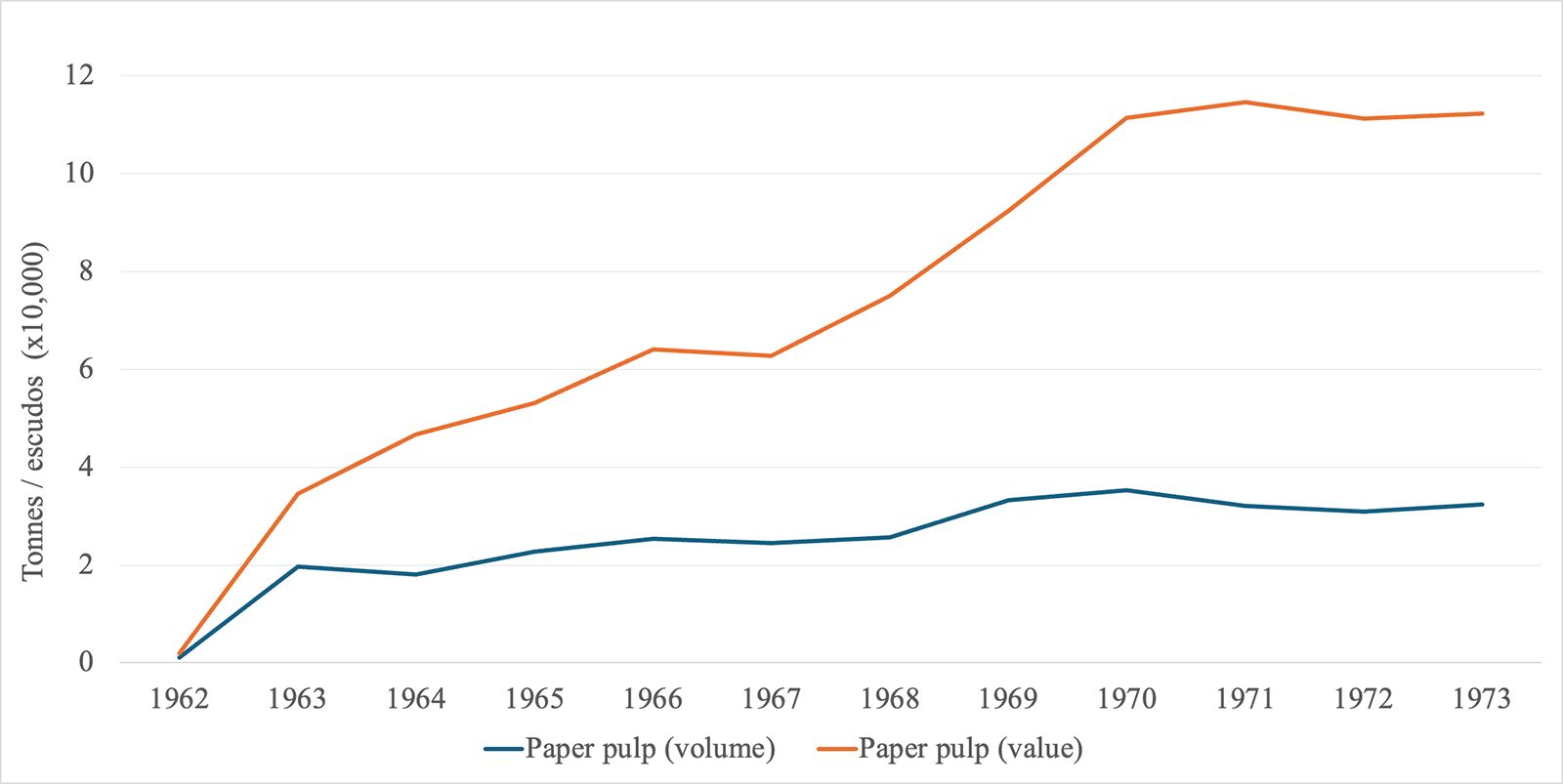
This realignment highlights CCUP’s role in the new industrial axis of central Angola. The Alto Catumbela pulp mill was a key piece of infrastructure (see Figures 4 and 5, below), connecting the exploitation of forest resources, especially eucalyptus plantations along the Benguela Railway, with import substitution and exports. The pulp sector became a symbol of the empire’s late developmentalist model, marked by public intervention, credit, and integrated production. The broader economic significance of this industrial realignment is also visible in the trajectory of pulp exports, which increased markedly in both volume and value between 1962 and 1973 (Figure 6).
Exterior of part of the Alto Catumbela mill.

Interior of the Alto Catumbela mill.

Paper pulp exports, 1962–73. Volume (tonnes) and value (escudos) are plotted on a common scale of 10,000.

The rise in exports also corresponded to the increasing centrality of paper and pulp in Angola’s late-colonial investment strategy. The 1967 Interim Development Plan highlights the paper industry and the CCUP as key to Angola’s industrial investment, accounting for nearly half of manufacturing capital. The company’s case shows how economic policy, colonial planning, and industrial territorialisation intersected, implementing the ideology of “overseas development” through large enterprises that reinforced Portuguese dominance after the Second World War. Beneath the rhetoric of progress, these projects reconfigured land and labour through roads, dams, electrical networks, housing, and social services designed to settle and discipline the workforce around Alto Catumbela.
Thus, the presence of the CCUP in Angola was structured not only as an economic enterprise but also as a device of social and territorial engineering, presented under the rhetoric of “the integration of local populations.” Investments in housing (for Europeans and Africans), water supply, churches, schools, and other infrastructure formed part of a model of occupation and discipline of the territory (see Figure 7).Footnote 70 The mobilisation and control of labour were central pillars of the company’s colonial project, operating in complementary ways in rural areas and in the industrial complex. However, this paternalistic rhetoric chiefly aimed to mobilise and secure the workforce required by the monoculture forestry regime. In these rural operations, involving afforestation and its conservation, as well as subsequent tasks such as cutting, felling, stacking, and loading timber for the factory, the company employed 56 “non-native” technicians, 36 “native” technicians, and between 7,500 and 12,000 rural workers (permanent and seasonal) (Table 2).Footnote 71
Barracks for African factory workers.

Labour force employed in afforestation and rural forestry operations

Table 2 Long description
Labour force counts for afforestation and rural forestry operations are broken down by staff category and main duties. Rural workers, including permanent and seasonal staff, number between 7,500 and 12,000 and carry out most field and timber-handling tasks such as planting, maintenance, cutting, felling, stacking, and loading for the factory. European technicians total 56 and focus on technical supervision of afforestation, conservation, and timber operations. African technicians total 36 and provide local technical support across forestry operations and rural tasks. The figures indicate a workforce dominated by rural labour, with technicians forming a small supervisory and support group. The rural worker total is given as a range, suggesting seasonal or fluctuating staffing levels rather than a single fixed headcount.
Source: CCUP, Relatório, Contas e Parecer do Conselho Fiscal, Anexo I—Ampliação fabril de 1974 (Alto Catumbela: CCUP, 1975), 15.
“Social integration,” therefore, amounted to labour control and territorialisation of production, rather than genuine development policies. By 1959, the company declared that it held around 50,000 hectares of land under a combination of full ownership, definitive concession, demarcation, transfer, and lease with promise of sale. This formulation makes visible the legal and territorial architecture on which the project depended.Footnote 72
This workforce management logic extended to the very heart of the industrial project: the factory. The labour hierarchy planned for the manufacturing unit (Table 3) reflected and bureaucratised colonial power relations. At the top of the pyramid stood a General Director earning 30,000 escudos per month, followed by a clearly differentiated chain of service directors, heads of service, heads of section, and forepersons. At the base was a much larger body of labourers and clerical staff. Here, wage and role disparities were stark: 147 European male labourers were assigned a monthly wage of 5,000 escudos, whereas 196 African male labourers received 750, and 12 African women, at the bottom of the structure, only 250. The table also makes clear that the hierarchy was not only racial but numerically organised, combining unequal remuneration with a carefully graded distribution of authority and labour.
Planned labour hierarchy in the CCUP manufacturing unit

Table 3 Long description
Planned staffing lists job categories with headcounts and monthly wages per worker in escudos, totaling 462 workers. The largest group is African male labourers with 196 workers paid 750 per month, followed by European male labourers with 147 workers paid 5,000. African female labourers number 12 and have the lowest wage at 250, while European female labourers number 10 and earn 2,500. Clerical roles are split by gender: 15 male clerks at 5,000 and 19 female clerks at 3,000. Supervisory and management positions are comparatively few but much higher paid, from 26 forepersons at 9,000 up to 1 general director at 30,000, with 3 directors of services at 25,000. Overall, the plan concentrates most workers in lower-paid labour categories, with wages varying sharply by role and also differing by gender and by European versus African labour categories.
Source: TT AOS UL-33, Caixa 829, pt. 8, “Angola. Companhias coloniais. Companhia de Celulose do Ultramar Português, SARL—pedido de financiamento,” 1959, fl. 492.
Taken together, these disparities show that “social integration,” focused on housing and services, was intertwined with labour control and the territorialisation of production, reinforcing racial and functional hierarchies in the factory. From this perspective, the discourse of industrial self-sufficiency and import substitution should be understood as an integral part of this colonial epistemology of economic rationalisation. Following James C. Scott’s formulation in Seeing Like a State, the factory, the laboratory, and the development plan functioned as instruments for rendering territory and labour legible to metropolitan power.
The economic logic of the CCUP is best understood through Karl Marx’s theory of differential rents in Book III of Capital, which develops and systematises elements already present in Ricardo.Footnote 73 For Marx, differential rents arise from the disparity between the general and the individual price of production, and therefore from the difference between the average rate of profit and the profit secured under specific conditions of production.Footnote 74 In the Angolan case, this logic is particularly clear. As noted in the previous section, the projections submitted to the BFN placed the costs of unbleached eucalyptus pulp at roughly 37 percent of the Portuguese benchmark, while the projected cost of bleached eucalyptus pulp stood at approximately 33 percent of the relevant international benchmarks. These implied reductions of around 63 percent and 67 percent, respectively.Footnote 75 These figures are not treated here as evidence of actual profitability, but as colonial planning devices that translated territory, labour, and capital into a numerical promise of super-profits, thereby legitimising public credit, political backing, and large-scale investment.
Seen in this light, the CCUP did not simply come to benefit from differential rent. It was conceived from the outset with the expectation of capturing such differential gains and was technically designed to convert colonial asymmetries into economic advantage. Investments in intensive forestry techniques created conditions analogous to those discussed by Marx under differential rent II, insofar as successive applications of capital to the same productive base were expected to increase productivity and lower the firm’s individual cost of production. In Angola, however, these technical gains were embedded in a wider colonial structure of compressed African labour costs, subsidised energy, fiscal incentives, and access to low-cost raw materials. It was precisely this combination of technical intensification and colonial cost compression that made the projected cost structure appear so exceptional. Figure 8 helps visualise the locational advantages on which the project depended, particularly the spatial relationships among the CCUP factory, the HEAC power station, the Benguela Railway, and the surrounding eucalyptus perimeters.
Spatial relationship between the CCUP factory, the HEAC power station, and the eucalyptus perimeters along the Benguela Railway Line.

Figure 8 Long description
The map illustrates the spatial relationship between the CCUP factory, marked with a red circle and the HEAC power station, marked with a blue circle, along the Benguela Railway Line. The railway line is depicted with a series of connected lines and stations, running parallel to the coastline labeled as ′Oceano Atlantico′. Eucalyptus perimeters are indicated along the railway, with various labeled locations. The map is oriented with a north arrow pointing upwards, showing the railway′s path from the coast inland. The geographic layout includes several labeled stations and towns along the railway, providing a detailed view of the infrastructure and natural features in the region.
At the same time, differential rent I remained decisive. Ricardo associated it primarily with fertility, but Marx made explicit that location must be treated as an equally important basis of rent, since proximity to transport networks, markets, and infrastructure can systematically lower costs and increase realised surplus. In the CCUP case, this positional advantage was fundamental. The proximity of the Benguela Railway, the Central Plateau’s forest zones, river systems, and the port of Lobito reduced logistical costs and reinforced the colonial state’s territorial control. These were not merely natural advantages. They were historically produced through previous investments in railway and forestry infrastructure and incorporated into the project as fixed, territorialised capital, extending the extractive model first consolidated by the CFB.
A useful way to sharpen this point is through cotton production. Countries such as Egypt and Brazil benefited from highly fertile land and therefore represent classic cases of Ricardian comparative advantage grounded in natural endowments.Footnote 76 Angola, by contrast, lacked comparable natural fertility, yet cotton production could remain competitive in certain colonial contexts. This competitiveness did not derive from environmental advantages, but from what may be termed here institutional fertility: a colonial system based on coercion, the systematic undervaluation of African labour, administrative control over land, and privileged access to credit, energy, and circulation infrastructures, all of which enabled a severe compression of production costs.Footnote 77 It was precisely this politically structured reduction of labour and land costs that sustained Angola’s capacity to approximate, and in some cases reproduce, levels of competitiveness associated with more naturally favourable environments. In this sense, what appears as a question of natural fertility is better understood as a historically produced configuration of economic conditions, which can be conceptualised through the distinction between differential rent I and differential rent II. Taken together, these elements help explain how territory, labour, and capital were assembled in ways that anticipated super-profits and sustained the Estado Novo’s broader project of economic and environmental rationalisation under late-colonial rule.
Thus, the two forms of differential rent coexisted and reinforced one another: first, differential rent I, derived from the fertility of the land and from its location, visible in the extensive plantations of a region marked by significant rainfall and, above all, in its direct articulation with the Benguela Railway, which reduced transport costs, strengthened territorial control, and sustained imperial logistical integration; differential rent II, by contrast, concerned the productivity gains expected from successive investments in the same territorial and productive base.Footnote 78 It resulted from capital investment in intensive forestry techniques, while the overexploitation of labour served as a social condition that helped lower individual production costs without constituting a form of differential rent II. In this respect, reforestation programmes, nursery construction, the presence of a Forestry Services team within the CCFB, and the technical supervision provided by the regime’s own Forestry Services contributed to the adoption of more efficient silvicultural methods and to increased productivity in particular plots. This expansion of fixed capital, often supported by the state, increased productivity and reduced individual production costs, thereby generating potential super-profits for concessionaires such as the CCFB and the CCUP.
This logic of rationalisation was not confined to the economic sphere. The anticipation of super-profits was grounded in the same colonial mechanisms that relied on cheap labour and the exploitation of cheap nature. Although documentation on environmental aspects is limited, this should not be taken to indicate an absence of impact. The establishment of extensive eucalyptus plantations under a monoculture regime—with only limited areas planted with Pinus and Cupressus—significantly transformed the Alto Catumbela ecosystem, affecting soils, hydrology, and biodiversity.Footnote 79 This dynamic aligns with what Jason Moore described as the logic of cheap nature: the incorporation of colonial natural resources into a system of global accumulation that concealed both ecological and human costs.Footnote 80 Moore’s “world-ecology” framework helps us to see how labour and nature were jointly commodified: the cheapening of African work and the cheapening of ecosystems in the tropics were two sides of the same capitalist world-process.Footnote 81
From a political-ecological perspective, the CCUP’s forest regime functioned as a colonial technology of simplification, transforming complex ecologies into uniform productive landscapes. This dynamic resonates with James C. Scott’s critique of high-modernist schemes, not because the project was merely “technical,” but because its claims to order, progress, and efficiency depended on reducing social and ecological complexity to administratively manageable forms.Footnote 82 The gap between optimistic projections and the conditions under which production and labour were organised, therefore, reveals more than a failed business forecast. It exposes the contradiction between a technocratic vision of industrial self-sufficiency and a dependent system built on labour inequality, metropolitan finance, and ecological transformation.
The CCUP thus became emblematic of a subordinated project of modernity, in which industrialisation served not only economic objectives but also political ones, including territorial fixation and colonial legitimation. Within the same space, it condensed the promises of progress and the practices of coercion, as well as technical innovation and ecological simplification, revealing how late Portuguese colonialism sought to transform nature in the tropics into raw material for the world economy.
Limits and Contradictions of the Colonial Cellulose Project
The consolidation of the CCUP in the 1960s marked the high point of a broader late-colonial ambition: to transform space in the tropics into productive territory and to turn the forest into economic infrastructure. Yet the same process that seemed to confirm the enterprise’s viability gradually made its contradictions more visible. What had been presented as a project of industrial self-sufficiency increasingly revealed the structural limits of a dependent form of industrialisation, sustained by public credit, administrative discretion, subsidised infrastructures, and deeply unequal labour relations. It also laid bare the contradictions of overseas development policy itself, whose technical rationality sought to reconcile economic modernisation with colonial domination. In this sense, the company may also be read through Foucault’s notion of gouvernementalité: development functioned not simply as an economic strategy, but as a colonial technology of government, producing new forms of control over territory, resources, and labour.Footnote 83
From the outset, the factory faced logistical, financial, and political constraints that affected production. As noted earlier, the pulp plant was approved in 1957, with an initial projected capacity of fifty tonnes of pulp and twenty-five tonnes of paper per day. Yet the project soon diverged from its original assumptions. The second phase, intended to raise pulp capacity to one hundred tonnes per day, was delayed by difficulties in equipment assembly and by the wider disruptions that followed the outbreak of the war of independence in 1961. Experimental production only began in 1961, and it was not until 1963 that the company approached roughly 80 percent of nominal pulp capacity, while paper production remained well below forecast.Footnote 84 This exposed the gap between technical planning and the material conditions of colonial implementation.
As these constraints accumulated, the state’s participation in the company became more direct. By 1973, the state held 57 percent of the company’s capital, divided equally between the BA and the BFN, making the CCUP the colonial company with the highest level of state participation in Angola.Footnote 85 This gradual expansion of indirect state ownership points to one of the defining features of late-colonial capitalism: the fusion of technical and political power. The company continued to present itself as a private and modern industrial enterprise. Yet, in practice, it operated through directed credit, public guarantees, and administrative support, placing it firmly within the apparatus of colonial planning. In this respect, the case recalls, in a specifically colonial register, what Karl Polanyi described as a “double movement”: the expansion of market-oriented production alongside political intervention designed to sustain and regulate it. Here, however, such intervention did not correct structural inequalities so much as reproduce them within the same corporate and colonial order that had generated them.Footnote 86
The project’s contradictions become clearer once labour is placed at the centre of the analysis. The salary table discussed in the previous section pertains to the pre-1961 phase and should be read as a baseline for the labour hierarchy on which the enterprise was originally designed. It cannot, by itself, serve as direct evidence for the later period. European technicians lived in company-built housing with schools and social facilities, while African workers, both permanent and seasonal, occupied separate quarters with fewer services, reinforcing the racial hierarchy the project claimed to transcend. The available documentation does not indicate any systematic promotion of African employees to supervisory roles; the racial division of labour appears to have remained largely intact throughout the company’s existence. What the post-1961 reports and accounts reveal is the increasing weight of wages, salaries, and personnel-related charges in the company’s expenditure.Footnote 87 Taken together, these developments suggest that the cost advantage initially built on the compression of African labour costs did not simply vanish after 1961 but became progressively more difficult to preserve.Footnote 88
The years after 1961 should therefore be read less as a rupture than as a phase of mounting friction. The formal dismantling of the legal status of the “indigenous,” the reorganisation of labour norms, and the broader pressures generated by war did not abolish the colonial hierarchy on which the enterprise had been built. Yet they altered the conditions under which that hierarchy operated. Labour remained central to the company’s comparative advantage, but it became a less stable and more costly basis for that advantage than the planning documents of the late 1950s had assumed. The contradiction, in other words, was not that labour suddenly ceased to matter, but that the regime on which the project had been founded could no longer guarantee the same degree of predictability at the same cost.
The company’s own documentation makes this increasingly evident. In the 1969 report, the administration already anticipated an increase in labour costs for 1970, linked to the updating of staff remuneration.Footnote 89 In 1971, the company referred to new burdens not borne in 1970, including wage updates and improvements in working conditions.Footnote 90 The comparative figures show remuneration rising from 70.8 million escudos in 1971 to 90.7 million in 1972, 103 million in 1973, and 125 million in 1974. The reports attributed this upward trend to increases in wages, salaries, and social charges, as well as broader inflationary pressures affecting labour costs.Footnote 91 These references do not mean that colonial labour inequality had been overcome. They show, rather, that the low-cost regime on which the company’s earlier projections relied was becoming more expensive, more fragile, and more difficult to sustain.
This helps explain why the search for technical and organisational solutions intensified in the late 1960s and early 1970s. Expansion was not simply the expression of confidence or developmental ambition, but also a response to pressure. The economic feasibility study initiated in 1965 and presented in 1967 proposed a substantial enlargement of productive capacity. It was followed by a second phase of reforestation, including the planting of eucalyptus across 90,000 hectares to secure a continuous supply of raw material.Footnote 92 The broader strategy linked industrial upgrading to reforestation, infrastructure, and the reorganisation of labour and settlement around Alto Catumbela. In this sense, expansion must be read both as an effort to preserve profitability and as an attempt to recover control over a model whose original advantages were proving increasingly difficult to maintain.
This territorial logic had already been anticipated in the company’s earlier labour calculations. In the late 1950s, the factory and its internal services were designed around a core staffing model of 254 Europeans and 208 African workers, with European recruitment expected to be secured in the metropole.Footnote 93 Yet actual labour requirements quickly exceeded these factory-based staffing plans, revealing the scale of labour required by an integrated forest-industrial complex. By March 1959, the company reported 122 European and 1,245 African workers in its service, while also emphasising the housing, supplies, labour discipline, and social assistance required to sustain the enterprise on a site where, as it noted, practically nothing had previously existed.Footnote 94 In the same report, the company linked the stabilisation of African labour to the concession of land near the factory, making clear that the “factory” could not be separated from a wider regime of labour mobilisation, settlement, and everyday reproduction centred on Alto Catumbela and extending into the surrounding forest zones. Technical expansion and labour control were inseparable from the beginning.
Alongside the enterprise’s financial restructuring, the company had been preparing for a new phase of expansion since 1967. This began with the second phase of reforestation and, from 1970 onwards, with studies and projects aimed at enlarging industrial capacity. The stated objectives were to increase profitability, preserve the company’s existing structure, secure the continuity of capital, and integrate forest areas and local populations around the Alto Catumbela industrial complex. In the 1973 report, expansion was justified not only as a means of increasing profitability but also as necessary to preserve the social and territorial framework that the company claimed to have established around Alto Catumbela and its forest perimeters. The report argued that the factory had already attracted and settled about 10,000 inhabitants in Alto Catumbela and that, by extending similar conditions to the forest perimeters, it would bring the total population to roughly 25,000.Footnote 95 Taken together, these figures suggest that expansion was conceived not only in productive terms, but also as an attempt to stabilise and enlarge a wider territorial order around the enterprise.
After assessing ten international companies, the CCUP selected the Finnish firm Jaakko Pöyry & Co., whose initial study forecast strong growth in European demand for short-fibre eucalyptus pulp and identified Africa and Brazil as strategic production regions.Footnote 96 In 1973, the firm completed a feasibility study. Still, the CCUP rejected the multi-package supply model, arguing that it dispersed financing and complicated technical control, and instead opted for a turnkey arrangement.Footnote 97 The issue was no longer only one of productive capacity. It had become one of coordination, finance, risk, and control. Concentrating technical responsibility in a single contractor was itself an attempt to manage the growing fragility of the project.
In January 1974, after consultations in Helsinki and with the agreement of the main shareholders—the government of Angola, the BFN, and the BA—two consortia remained under consideration. The date of 25 April 1974, at 6 p.m., was fixed for the signing of the letter of intent in Lisbon.Footnote 98 The Carnation Revolution, which broke out in the early hours of that day, interrupted the formalisation of the contract and accelerated the disintegration of the colonial economic framework.Footnote 99 Seen in retrospect, the interruption of the Helsinki-Lisbon sequence was not merely an external shock. It exposed the extent to which the late-colonial modernisation of the CCUP depended on a very particular institutional environment: administrative control over land and forest perimeters, stable political authority, and the capacity to mobilise labour and services around Alto Catumbela while preserving a compressed unit-cost structure.
The shift from a multi-package model to a turnkey contract illustrates the company’s attempt to reduce coordination risk and strengthen technical control. At the same time, it underlines how deeply the project relied on financial tutelage, foreign expertise, and state-backed guarantees. In this respect, the limits of the CCUP were not external to its developmental logic. The project’s apparent strength rested on colonial inequality, administrative power over land and labour, and dependence on metropolitan finance and external technical knowledge. These conditions made the project conceivable, but also vulnerable. As labour-related costs rose, war and reform weakened the predictability of the colonial order. As expansion demanded ever greater technical and financial coordination, the model’s contradictions became more visible.
The relative underperformance of the CCUP should therefore be read less as a simple business failure than as a symptom of the wider tensions of late Portuguese colonial developmentalism. Its ambition lay in transforming eucalyptus, transport, energy, labour, and territory into a coherent industrial system. Its contradiction was that this coherence depended on political and social conditions that could not remain indefinitely stable. In that sense, the history of the CCUP reveals not the failure of planning as such, but the limits of a colonial project that sought to produce industrial modernity without relinquishing the hierarchies and dependencies on which it had been built.
Conclusion
The case of the CCUP shows, first, that late-colonial industrialisation in Angola cannot be reduced to the history of a factory alone. The company only becomes fully intelligible when placed within the wider infrastructural formation that sustained it: eucalyptus plantations, railway transport, hydroelectric power, concessional land policy, and state-backed finance. In this sense, the CCUP was not simply an industrial enterprise in colonial Angola; it was one of the most ambitious attempts to reorganise the Central Plateau as a productive corridor in which forest, energy, transport, and labour served a single developmental project.
Secondly, the article has argued that these infrastructures were not neutral means of circulation or production. They operated as instruments of government. Through railway integration, forest demarcation, land concession, electrification, labour planning, and industrial tariffs, the colonial state and its allied economic actors transformed ecological and social complexity into administratively manageable flows of timber, kilowatt-hours, wages, and projected output. The CCUP therefore illuminates the material workings of late-colonial governmentality: not only the extraction of value but the rendering of territory, labour, and nature legible.
Thirdly, the company’s projected competitiveness did not derive primarily from natural abundance. It rested on what this article has called a form of institutional fertility: access to land through concession, inherited railway infrastructure, politically structured energy prices, selective credit and public guarantees, and, above all, the structural devaluation of African labour. The wage hierarchy, the asymmetrical social architecture of the workforce, and the integration of rural labour into the forest-industrial regime were central to the cost structure that made colonial pulp production appear exceptionally competitive.
However, the same case also reveals the limits of late Portuguese colonial developmentalism. The CCUP required constant institutional support, faced financial and logistical constraints, and repeatedly sought expansion to overcome weaknesses that were not merely conjunctural but structural. This became increasingly clear after 1961. While the pre-war salary structure reveals the labour hierarchy on which the project was originally designed, later reports show that wages, salaries, and personnel-related charges were rising steadily, making the comparative advantage built on the compression of African labour costs progressively harder to sustain. Its dependence on metropolitan capital, external technical expertise, subsidised infrastructures, and a politically unstable colonial order meant that the promise of industrial modernity remained inseparable from coercion, asymmetry, and vulnerability. The interruption of the expansion project in 1974 exposed how deeply the enterprise depended on the colonial framework that had enabled it.
Seen in retrospect, the CCUP condensed the central contradiction of late Portuguese colonialism in Angola: the attempt to produce modern industry through a regime that sought simultaneously to rationalise territory, cheapen labour, discipline nature, and preserve imperial domination. Its history is therefore not only the history of one company, but also of how development functioned as a colonial technology of power, and of how modern industry in the late empire depended on the assembly of cheap labour, cheap nature, and strategic infrastructures—including water and energy systems—whose inequalities and dependencies ultimately limited what they made possible.
Acknowledgements
FCT supported this research through doctoral scholarship UI/BD/152807/2022 and by CITCEM (UIDB/04059/2025; https://doi.org/10.54499/UIDB/04059/2025). The author thanks the editors of The Journal of African History and the anonymous reviewers; Kiran Klaus Patel, Maciel Santos, and Miguel Bandeira Jerónimo for their comments and invitations to discuss this work; staff at the Torre do Tombo National Archive and Overseas Historical Archive; and Leonardo Aboim Pires for digitising company reports missing from Porto collections.




 Open access

