Introduction
Hospice is the provider of end-of-life care to patients whose life expectancy is generally less than 6 months. The number of hospices in the United States (U.S.) has continued to increase since the introduction of the Medicare Hospice Benefit in 1982, with 4,840 Medicare-certified hospices operating in 2019 (NHPCO 2021). Among all the hospices, the majority (77%) were freestanding compared to 11% hospital-based and 11% home health-based in 2016 (MedPac 2019). Focused on caring rather than curing, most hospice care is provided in the patients’ home but can also be offered in freestanding hospice inpatient or respite units, hospitals, and nursing homes and other long-term care facilities.
As a result of the Affordable Care Act (ACA) of 2010, hospices were required to provide information regarding the Hospice Quality Reporting Program (HQRP), with a reduced reimbursement tied to hospices if they fail to submit data to the Centers for Medicare and Medicaid Services (CMS) (HHS 2013). The HQRP requires hospices to submit data on the Hospice Item Set (HIS), Medicare hospice claims, and the Consumer Assessment of Healthcare Providers & Systems (CAHPS®) Hospice Survey (CMS 2014). HIS measures the process of hospice care including pain screening and assessment, dyspnea screening and treatment, bowel regimen for patients on opioids, discussion of treatment preferences, and beliefs/values addressed. Hospice CAHPS® survey measures included communication, timely care, symptom management, emotional and spiritual support, respect, training families, overall rating, and willingness to recommend. A study that examined freestanding hospice’s participation in the HQRP found that hospices with lower quality, located in a competitive market, and for-profit (FP) hospices were less likely to participate in the HQRP (Hsu et al. Reference Hsu, Hung and Wang2019).
Prior studies in the hospice literature have focused on the relationship between hospice organizational characteristics and hospice service patterns and utilization, including ownership (Carlson et al. Reference Carlson, Gallo and Bradley2004), chain-affiliation (Aldridge et al. Reference Aldridge, Epstein and Brody2016), and size (Carlson et al. Reference Carlson, Herrin and Du2009). To date, there have been 2 studies by Anhang Price and colleagues examining the association between hospice organizational characteristics and CAHPS® and HIS measures of quality of hospice care (Anhang Price et al. Reference Anhang Price, Tolpadi and Schlang2020; Price et al. Reference Price, Parast and Elliott2023). They found that hospice characteristics of top performers were different between HIS and CAHPS®. While smaller, independent, not-for-profit (NFP) and government hospices were in the top quartile for CAHPS®, large FP chain hospices performed better on process measures assessed through chart documentation (Anhang Price et al. Reference Anhang Price, Tolpadi and Schlang2020). They also found family caregivers reported poorer experience of care in FP hospices (Price et al. Reference Price, Parast and Elliott2023). As the provider of end-of-life care, the measurement of hospice quality was different from health-care organizations in other settings like nursing homes and hospitals (CMS 2022).
There are several limitations to the 2 studies. First, they did not consider organizational factors that may affect hospice performance, such as levels of care or financial resources. Second, they did not consider community factors beyond rural location. Community factors, such as competition, per capita income, education, and percent of racial/ethnic minorities and older adults may affect the demand and supply of hospice care, and ultimately hospice performance in terms of CAHPS®. According to systematic reviews on hospice performance and hospital patient satisfaction measured by HCAHPS®, community factors were less likely to be considered when compared with organizational and patient factors (He et al. Reference He, O’Connor and Qu2020; Mazurenko et al. Reference Mazurenko, Collum and Ferdinand2017). This study makes a contribution to the literature by exploring a broad range of organizational and community factors that may be associated with quality of care, as measured by patient and family experiences of hospice care through the CAHPS® Hospice Survey.
Methods
Data
This panel data study examined the relationship between hospice patient/family experience and hospice organizational-level and community-level factors for the period 2017–2020. We used secondary data from Hospice Compare, Healthcare Cost Report Information System (HCRIS) Dataset, Rural–urban commuting area (RUCA) codes, and the American Community Survey (ACS). The Hospice Compare extracts variables from the HISs, Medicare claims data, and CAHPS® Hospice Survey, and make those measures publicly available, as required by the ACA of 2010. Hospice Compare has hospice cost, volume, quality, and patient experience measures. Hospices directly contract with a CMS approved vendor such as Press Ganey Associates and Qualtrics to administer the CAHPS® Hospice Survey on behalf of the hospice (CMS 2022). These vendors initiate the CAHPS® Hospice Survey for a sampled decedents/caregivers following the patient’s death. After quality checks, the vendors share the data with the CMS Data Warehouse. The CMS calculates the CAHPS® scores across 8 rolling quarters and publishes it on a quarterly basis (CMS 2022). The HCRIS contains extensive cost and statistical data for free-standing hospices. RUCA codes consider the measures of population density, urbanization, and daily commuting in assigning location to each area. The ACS is a demographic survey program that the U.S. Census Bureau conducts regularly to gather population social, economic, housing, and demographic information. We merged RUCA codes and ACS with hospice data using hospice main offices’ zip codes. The final analytic sample had 8,324 hospice-year observations.
Variables
Supplemental Table S1 displays each of the measures, definitions, and their data sources. The dependent variables are the CAHPS® Hospice Survey scores (CMS 2022). The variables were extracted from the CMS Hospice Compare (CMS 2022). This survey has 47 questions to assess patient and family experiences with hospice care. These questions are reduced to 6 composite measures and 2 global measures. Composite measures are Emotional and spiritual support, Treating patient with respect, Help for pain and symptoms, Communication with family, Providing timely help, and Training family to care for patient. Global measures are Rating of this hospice and Willing to recommend this hospice. For example, the last measure is assessed via the question “Would you recommend this hospice to your friends and family?” and the measure shows the percentage of caregiver respondents that give the most positive response (“yes, definitely”). All these measures range from 0 to 100 where the higher number indicates a better patient experience.
The independent variables were categorized into organizational- and community-level factors (Supplemental Table S1). The organizational-level variables include the composite process quality measure (CMS 2022), hospice size (operationalized as total annual unduplicated service days), levels of care (operationalized as percentages of patients receiving different levels of care, such as routine home care, continuous home care, inpatient respite care, and general inpatient care), ownership status (categorized into FP versus NFP), chain affiliation (categorized into chain affiliated versus not chain affiliated), organizational longevity (years of operation), financial performance (total margin, calculated as [ $\frac{{{\text{total revenue }}-{\text{ total expense}}}}{{{\text{total revenue}}}}$]), payer mix (operationalized as percentages of patients whose primary payer was Medicare, Medicaid, or other pay), and location (categorized into metropolitan, micropolitan, small town, and rural area). The composite quality measure was extracted from CMS Hospice Compare and all other organizational level factors were extracted from HCRIS.
The community-level factors were competition (Herfindahl–Hirschman index (HHI), calculated by squaring the market share of each hospice in the county based on patient days, and summing the resulting numbers), people 65 and over (percentage of population who are 65 or older), per capita income (average income in U.S. dollars, calculated as total the personal income of the residents of an area divided by the population of the area), racial/ethnic minorities (percentage of population who are non-White), and education level (percentage of population age 25–64 years with a high school diploma or higher education). Community-level factors were extracted from ACS.
Statistical approach
The univariate statistics were calculated with means and standard deviations for continuous variables, and frequencies and percentages for categorical variables (Table 1). To account for within and between hospice variability, we used multivariate random-effects generalized least squares regression in examining the relationships between the CAHPS® measures and the organizational and market factors (Table 2). As this model also allows us to estimate both fixed and random effects, we used state fixed effects to control for state-level variations and year fixed effects to account for temporal variations. There were 6 regression models, 1 for each of the CAHPS® measures. As a sensitivity analysis, we re-ran the model using pre-COVID-19 (2017–2019) sample (Supplemental Table S2). The unit of analysis in this study was the hospice-year observations. This means that each unit represented 1 year of data for a single hospice. Each hospice-year was treated as a separate unit for the purpose of analysis. This approach allowed us to capture variations within the same hospice over time, as well as between different hospices within the same year. In our models, each unique hospice identifier in each year was included as a random effect to account for unobserved, time-invariant characteristics of individual hospices. We used Stata 17 for data management and analysis. To detect statistical significance, a p-value lower than 0.05 was used.
Sample statistics (N = 8,324 hospice-year observations)

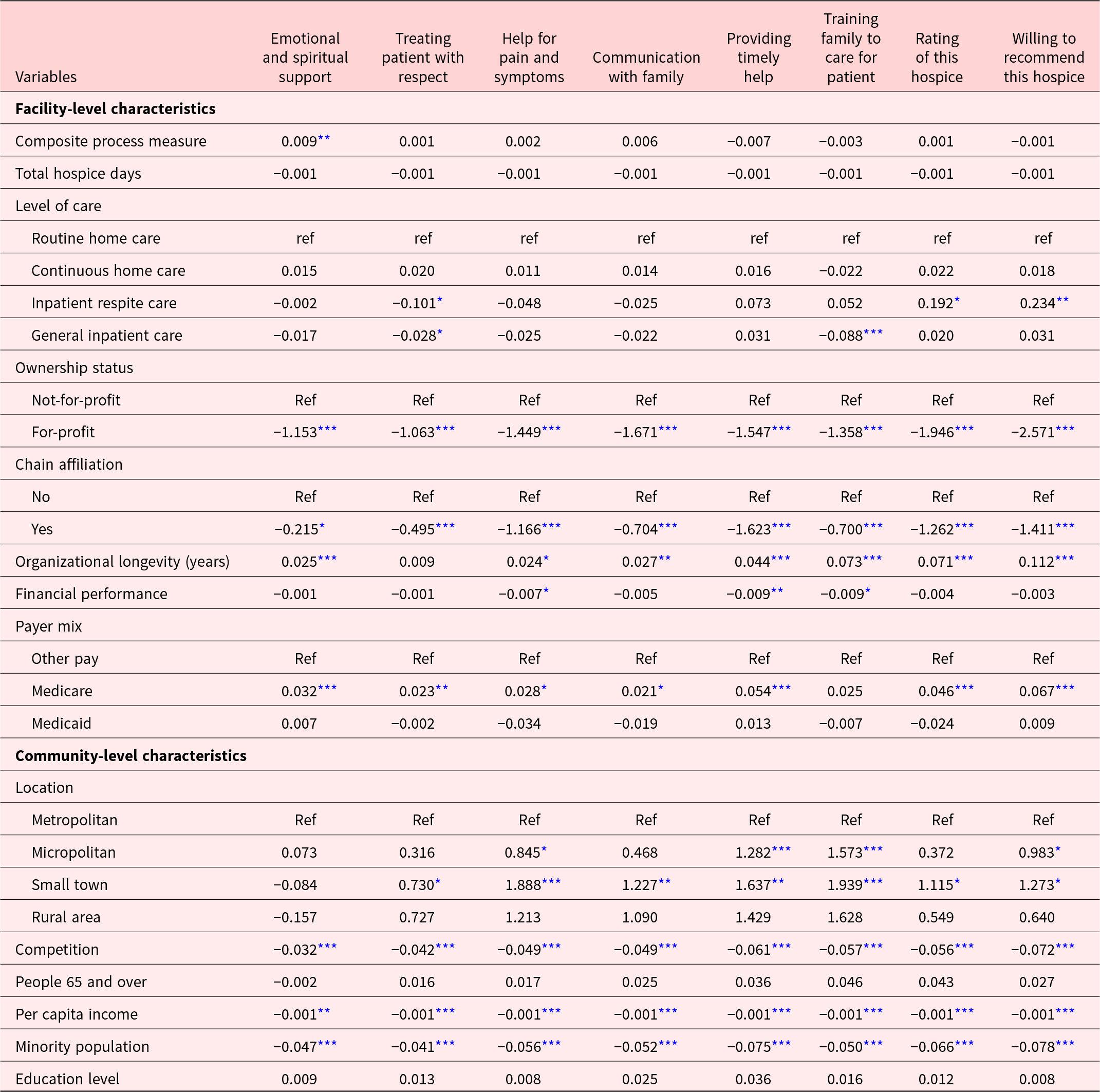
Relationship between CAHPS scores and hospice organizational- and community-level characteristics (N = 8,324 hospice-year observations)

* p < 0.05, **p < 0.01, ***p < 0.00.
Results
Table 1 shows the descriptive statistics of the sample. Patient/family experience scores ranged from 75 (Help for pain and symptoms) to 90 (Treating patients with respect). While 2 measures (Emotional/spiritual support and Communication with family) reported a small increase from 2017 to 2020, most other CAHPS® scores remained the same. Hospices performed the standard care processes on the majority of patients (86% in 2017). The vast majority of hospice patients (98%) needed routine home care where multidisciplinary care team makes routine, scheduled visits in the home. A very small percentage of hospice patients (0.22% in 2017) required continuous home care where care is provided 24 hours a day at patient’s bedside in a home setting. Furthermore, less than 2% of patients received care in an inpatient facility.
One fourth of the hospices were NFP and about half of them were chain affiliated. While the ownership status remained stable over time, there was a 9% increase in hospices that were chain affiliated (from 43% in 2017 to 52% in 2020). Hospices were able to generate positive total margin that significantly increased over time (from 7.7% in 2017 to 13.5% in 2020). For every dollar collected as revenue in 2020, hospices, on average, kept 13.5 cents as profit. Most (93%) of hospice patients had Medicare as the primary payer. Only 4% of patients had private (commercial) insurance or no insurance (out-of-pocket payment), followed by 3% patients that were covered by Medicaid. While hospices can serve people in various locations, most of their main offices were in metropolitan areas (80%), followed by 13% in micropolitan areas, and only 7% in small towns or rural areas. Hospices operated in a very competitive market (with an HHI of 90 out of 100).
Table 2 shows the multivariate random-effects regression results. Among organizational-level factors, FP and chain affiliated hospices were negatively associated with CAHPS® scores. Compared to NFP ones, FP hospices reported lower scores for all CAHPS® measures: Willingness to recommend this hospice (3 points, p < 0.001), Rating of this hospice (2 points, p < 0.001), Communication with family (2 points, p < 0.001), Providing timely help (2 points, p < 0.001), Emotional and spiritual support (1 point, p < 0.001), Treating patients with respect (1 point, p < 0.001), Help for pain and symptoms (1 point, p < 0.001), and Training family to care for patient (1 points, p < 0.001) measures. For example, on average, in a given year, FP hospices receive a positive recommendation from a percentage of patients/caregivers that is 3 percentage points lower than that received by NFP hospices. Likewise, chain affiliated hospices, in comparison with nonaffiliated ones, reported lower scores for all CAHPS® measures. However, organizational longevity and payer mix (Medicare) were positively associated with CAHPS® scores. Hospice composite process measure, a metric to assess the quality of care, was positively correlated with only one of the CAHPS® measures, Emotional and spiritual support (p < 0.01). Levels of care variables had mixed results. While inpatient respite care was positively associated with Rating of this hospice (p < 0.05), and Willingness to recommend this hospice (p < 0.01), it was negatively associated with Treating patients with respect (p < 0.05). General inpatient care was negatively associated with Treating patients with respect (p < 0.05) and Training family to care for patient (p < 0.001). Finally, better financial performance was negatively associated with 3 out of 8 CAHPS® measures: Help for pain and symptoms, Providing timely help, and Training family to care for patient, respectively. However, total hospice days, continuous home care, and Medicaid were not associated with any CAHPS® measures.
Regarding the community-level factors, competition was negatively correlated with CAHPS®, whereas hospices that operate in more competitive markets reported lower patient/family experience scores. Furthermore, higher per capita income and percentage of racial/ethnic minorities were associated with lower CAHPS® scores. Finally, hospices located in sub-urban and small towns, as compared to the ones in metropolitan areas, reported higher CAHPS® scores. Yet, rural location, population 65 and over, and education level were not found to be associated with any CAHPS® measures.
To tease out the COVID-19’s impact on patient/family experiences, we excluded data from 2020, and re-ran the model using 2017–2019 (Supplemental Table S2). The findings were similar to those in the original model (Table 2).
Discussion
Over the last decade, the hospice industry has undergone a significant transformation, with a rise in FP hospices and a decline in NFP and governmental-owned hospices (NHPCO 2021). This transformation was influenced by 2 factors: the change in hospice ownership from NFP to FP and the entry of recently founded FP hospices. The FP chain hospices saw the largest increase among all the FP hospices that entered the market (Stevenson et al. Reference Stevenson, Dalton and Grabowski2015; Thompson et al. Reference Thompson, Carlson and Bradley2012). Findings from our study showed that compared to FP hospices, NFP hospices performed better in all measurements of CAHPS® scores. Patients’ ratings of the hospice and family members’ willingness to recommend the hospice were significantly higher for NFP hospices. The finding was consistent with the literature about the relationship between hospice ownership and quality. FP hospices compared with NFP hospices offered narrower ranges of services to patients (Carlson et al. Reference Carlson, Gallo and Bradley2004), reported more limited enrollment policies (Aldridge et al. Reference Aldridge Carlson, Barry and Cherlin2012), and had higher rates of complaint allegations and deficiencies (Stevenson et al. Reference Stevenson and Sinclair2018). Based on patient level data, studies found FP hospices were more likely than NFP hospices to enroll patients with longer length of stay (Lindrooth and Weisbrod Reference Lindrooth and Weisbrod2007), to discharge patients alive (Prsic et al. Reference Prsic, Plotzke and Christian2016; Teno et al. Reference Teno, Plotzke and Gozalo2014), to have higher rates of utilization in hospital and emergency services (Aldridge Reference Aldridge2021; Aldridge et al. Reference Aldridge, Epstein and Brody2016), and to have worse care experience from caregivers (Price et al. Reference Price, Parast and Elliott2023). We also found chain-affiliated hospices had lower CAHPS® scores. Chain-affiliated hospices, particularly those belonging to national chains, may have less flexibility in implementing and customizing care protocols (Anhang Price Reference Anhang Price, Tolpadi and Schlang2020), which may result in worse patient experience.
Hospice longevity was positively associated with patients’ rating of the hospice and family members’ willingness to recommend the hospice. The finding is consistent with previous studies’ findings that new hospices offered fewer services to patients like radiation services (Aldridge et al. Reference Aldridge, Epstein and Brody2018; Lorenz et al. Reference Lorenz, Asch and Rosenfeld2004). A recent study also found that newer hospices scored lower on the HIS process of care measures (Anhang Price Reference Anhang Price, Tolpadi and Schlang2020). Our study found that hospices with greater longevity provided better emotional and spiritual support, offered more help for pain and symptoms management, communicated better with family, provided more timely help, and trained family better to care for patients. It is possible that hospices that have served longer in the market understand the needs of patients and families better, have already set up the guidelines and provide training to staff to offer better quality of services.
Hospice payer mix also played a role in the CAHPS® scores they received. We found that the percentage of Medicare patients was positively associated with patients and families’ ratings of the hospice and their willingness to recommend the hospice. A previous study found that Medicare payer mix was positively associated with total operating margin and return on assets (He et al. Reference He, O’Connor and Qu2021). In this study, we found that hospices with a higher percentage of Medicare patients provided better emotional and spiritual support and more timely help. As such, these hospices may have a better resource profile, which may result in better staffing patterns and ultimately better patient experience. However, we did not find much support in terms of the relationship between the hospices’ quality of care and their financial performance.
Hospice community factors including metropolitan location, competition, per capita income, and racial/ethnic minority population percentage were negatively associated with CAHPS® scores. In terms of hospice location, we found that compared to metropolitan hospices, hospices located in small towns and micropolitan regions performed better in several CAHPS® survey measures. In the hospital setting, 1 study had similar findings in terms of metro status being negatively associated with 7 out of the 10 patient satisfaction measures (Kazley et al. Reference Kazley, Ford and Diana2015). Hospices located in smaller geographic areas may serve fewer patients and may be closer to patients’ home, which make patients and their families feel more connected to the hospices, resulting in better experience. We also found competition had a negative impact on all aspects of CAHPS® scores. Our results were different from the hospital settings as Kazley et al. found competition was positively associated with 5 of the 10 measures for patient satisfaction. Another previous study found that hospices located in the competitive regions were less likely to use volunteers (Apenteng et al. Reference Apenteng, Linder and Opoku2016). It is possible that hospices serving in more competitive markets may have more difficulties in attracting and retaining adequate staffing, and this may result in worse patient experience. Carlson et al. found that hospices located in highly competitive markets had higher patient disenrollment rates (Carlson et al. Reference Carlson, Herrin and Du2009). The high disenrollment rates could be related to patients and their families’ low satisfaction of hospice care as measured by CAHPS® scores. With respect to per capita income, we found a negative relationship between per capita income and CAHPS® scores. This finding is consistent with the hospital setting that hospital located in markets with higher per capita income had significantly lower levels of patient satisfaction across all measures (Kazley et al. Reference Kazley, Ford and Diana2015; McFarland et al. Reference McFarland, Ornstein and Holcombe2015). Patients residing in wealthier communities may have greater expectations of care, which may result in worse patient experience compared to hospices in lower income communities. Finally, our study suggests potential racial/ethnic disparities in hospice quality of care given that communities with a higher proportion of racial/ethnic minorities were associated with worse patient experience. Our finding is consistent with a previous study that racial/ethnic disparities exist in the hospice setting, with racial/ethnic minority patients having higher disenrollment rates and greater hospital usage (Rizzuto and Aldridge Reference Rizzuto and Aldridge2018).
Our study findings have several policy implications. The growth of FP and chain-affiliated hospice may affect hospice quality of care. Because of this transformation in the hospice market, the way patients are cared for, and the services offered by hospice will differ. Therefore, policy interventions may be needed for hospices to improve their patient/family experience in hospice care. Our study also shows the importance of understanding organizational and community factors and how these factors may affect the quality of care. Findings from our study could help policymakers in shaping oversight and quality improvement efforts in the hospice industry. To understand which factors may contribute to the improvement of hospice patient experience, future studies can be conducted from the longitudinal perspective.
This study has several limitations. First, this study was limited to freestanding hospices. The results are not generalizable to institution-based hospices (e.g., hospital-based, nursing home-based hospices). However, most hospices (78%) were independent, freestanding hospices (MedPac 2019). Second, our sample is limited as hospices that serve fewer than 50 patients a year and newly opened hospices are not required to participate in the CAHPS® Hospice Survey. Lastly, the secondary data sets used for this study may be subject to inaccuracies, and the data sources were limited to 2017 to 2020. Future studies can be performed to examine the impact of COVID-19 on hospice performance.
In conclusion, we found that hospice organizational factors like FP ownership and chain-affiliation were negatively associated with CAHPS® scores. Hospice organizational longevity and Medicare payer mix were positively associated with patients and families’ ratings and willingness to recommend the hospices. Hospice community factors including competition, per capita income and the percentage of racial/ethnic minorities were negatively associated with CAHPS® scores. Understanding the factors associated with patients and families’ experience of hospice care may help us understand the variation of hospice quality of care and find ways to improve the care received by hospice patients.
Supplementary material
The supplementary material for this article can be found at https://doi.org/10.1017/S1478951524000907.
Data availability statement
The data that support the findings of this study are available on request from the corresponding author.
Funding
This research received no specific grant from any funding agency, commercial or not-for-profit sectors.
Competing interests
The authors declare that they have no known competing financial interests or personal relationships that could have appeared to influence the work reported in this paper.