Preparedness practitioners are well acquainted with the fact that promoting public readiness to emergencies is a challenge. Levels of household adjustment to emergencies reported in the literature usually range between 17%Reference Eisenman, Wold and Fielding 1 and 48%.Reference Page, Rubin and Amlôt 2 In some cases, much lower levels were indicated.Reference Kapucu 3 These levels remain insufficiently low, despite best efforts by civil defense authorities to engage the public in meaningful preparedness behavior.
Most attempts at engaging the public in preparedness behavior follow similar paths, predominantly through risk communication campaigns or education programs. The underlining assumption of this approach is that, by increasing awareness to risks and elevating threat perception sufficiently, one can generate the motivation needed for preparedness behavior. Yet, recent studies suggest that, in some cases, a more complex psychosocial framework needs to be considered, one that will make these mainstream approaches to preparedness promoting nearly null and could explain why public preparedness remains so difficult to achieve.Reference Norris 4 – Reference Roudini, Khankeh and Witruk 9
Indeed, the more dug into, the more constructs that emerge as potential psychosocial correlates of preparedness behavior. Becker et al.,Reference Becker, Paton, Johnston and Ronan 8 for example, elaborated on a sociopsychological model explaining preparedness behavior originally proposed a decade earlier by Paton in 2003.Reference Paton 5 Certainly, the newer model sheds much needed light on the complex psychosocial framework of preparedness behavior. However, this and similar models (eg, Health Belief ModelReference Becker 10 , Theory of Planned BehaviorReference Fishbein and Ajzen 11 , Protection Motivation TheoryReference Maddux and Rogers 12 , and the Person Relative to Event TheoryReference Mulilis and Duval 13 ) seem to have limited predictive capacity over preparedness behavior, in some cases. These theories assume that cognitive contents, namely beliefs, meanings, or attitudes, guide behavior and influence it directly through rational decision-making.Reference Eiser, Bostrom and Burton 14 However, when dealing with the adversities of emergencies and disasters, specifically death and injury, we should consider that rationality, realism, reasonable decision-making, and voluntary conscious control are strongly negatively affected.
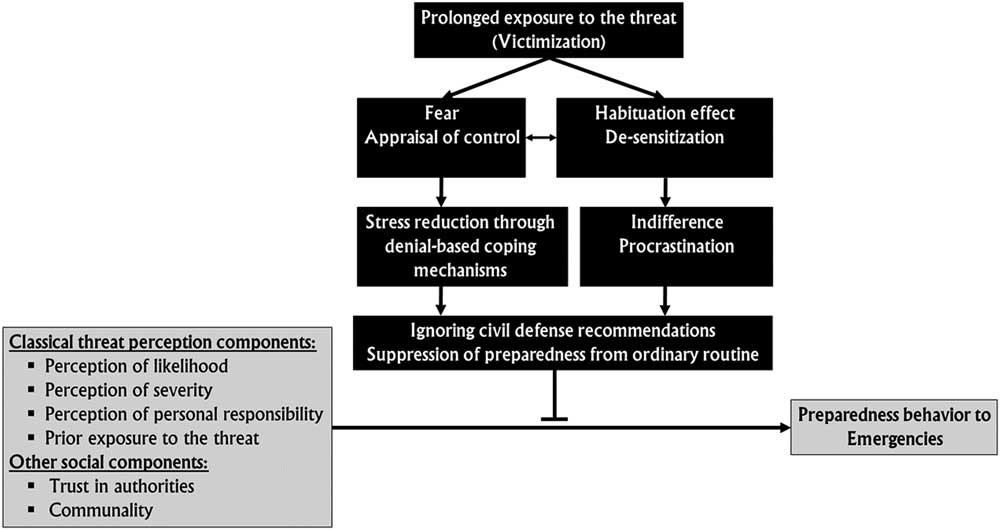
Perhaps most vividly, this notion is portrayed with the case of victimization. Proposed by researchers in the context of earthquake preparedness in Turkey, the victimization model suggests that, when frequently exposed to any given threat, a population will assume protective behavior patterns that are governed mostly by fear and appraisal of control.Reference Rüstemli and Karanci 15 In other words, under such circumstances, classic components of risk perception (eg, perception of likelihood or severity of the risk) lose their capacity to perform as accurate predictors of preparedness behavior. In a later study done in 2005, Karanci, Aksit, and Dirik reported that earthquake awareness raising workshops in Turkey led, in fact, to greater levels of risk awareness among participants; however, had a very limited effect in terms of actually promoting households' preparedness.Reference Karanci, Aksit and Dirik 16 These findings are in line with the overall claim made earlier, that, despite best intentions, educational programs are limited in generating behavioral motivation for preparedness, in some cases.
A recent study performed in Israel supports the assertions of the victimization model with regards to preparedness patterns of the Israeli population to armed conflicts.Reference Bodas, Siman-Tov, Peleg and Kreitler 17 The model suggests that, kept under constant threat, the majority of Israelis align with one of two plausible coping mechanisms (Figure 1). The first is driven by a habituation (desensitization) effect to the threat, which leads to indifference or apathy. The second is driven mostly by fear and anxiety, causing people to withdraw into denial as an adapting coping mechanism. Either way, both routes can lead to a repression of preparedness behavior and will likely nullify the positive effect that risk cues (eg, risk communication campaigns) have on preparedness behavior. It should be noted that this model remains highly speculative, at this point, yet more and more evidence suggest that it has merits. In particular, there are multiple publications indicating the limited influence of classic threat perception components on preparedness, alongside a growing body of literature suggesting greater prevalence of fear-directed preparedness behavior.Reference Terpstra 18 – Reference Wirtz, Rohrbeck and Burns 24
The Victimization Model and Its Effect on the Suppression of Public Preparedness Behavior.

So, what can be done? Acknowledging that, at least under some circumstances, it is extremely challenging to promote public readiness, perhaps we should change the mainstream dogma and pursue innovative approaches to promoting public preparedness to emergencies. We should use out-of-the-box thinking to overcome the challenges associated with the psychosocial framework of preparedness behavior.
One possible solution for advancing preparedness behavior emerges from a recent study performed in Israel (Bodas, Siman-Tov, Kreitler, and Peleg; under review). This study was able to demonstrate that victimization can be circumvented through external incentives. Alternatively put, preparedness behavior can be promoted if it is directed at a different goal other than simply “being prepared.” More specifically, when monetary incentives were offered, a substantial and significant change in reported behavior was observed. Despite the probable cynical reaction that most would have to this information, this psychological intervention was not proposed out-of-the-blue. It followed the case study of organ donations in Israel.
Becoming an organ donor in Israel requires one to opt into the registry. Just consider the cognitions associated with this behavior, that is, acknowledging your own death in what could be very traumatic circumstances (eg, car accident), and the reaping of your parts. No wonder that opt-in levels remained low for many years. 25 However, this changed in 2010, when the National Transplants Center at the Israeli Ministry of Health offered priority in organ transplant to members of the public opting into the donor registry (and their immediate kin) should they ever require it. This move was approved by a broad ethical forum at the request of the Ministry of Health and was introduced into the organ donation law. The result was an immediate increase of more than 55% in opt-ins during the subsequent year, with a sustained increase in the following 2 years. 25 But why? What changed? It is possible that, by offering this external incentive, the state was able to circumvent those negative cognitions associated with the behavior and turn them into a cost-benefit analysis. This, in turn, led to a decision-making process that follows rational thinking, which supported the behavior of opting into the registry. New signees joined the registry not only for altruistic reasons, but also for the potential benefits to be had by doing so.
If so, this demonstrates how shifting behavior-related cognitions from inhibiting to promoting ones can stimulate behavioral change without altering anything concerning the perception of the threat or the behavior itself. In the case of emergency preparedness, it is possible that, by offering external incentives, people can be engaged in preparedness behavior while allowed to retain their denial as an adaptive coping mechanism. With an external incentive, people are offered a bypass route to performing the behavior without experiencing the anxiety associated with it. Alternatively, if a person is not getting prepared simply because of indifference, then the bypass route can serve as an incentive that will put an end to their procrastination and motivate them into action. Either way, it seems that external incentives can serve to overcome both routes blocking preparedness behavior according to the victimization model.
A possible policy change in light of the aforementioned could be offering tax reliefs to households that engage in meaningful household adjustment behavior. For instance, one can consider a model in which acquiring a pre-made preparedness kit with necessities for time of emergency, such as a flash light, battery-operated radio, canned food and water, etc., would make that household eligible for a tax reduction. Of course, such policy should be based on a thorough analysis of the costs of this move in comparison to estimated lives saved, injuries prevented, and other losses that will likely be avoided through the increased levels of public preparedness.
Without a doubt, this is not a “magic pill.” The implications of this tactic are plentiful and must be carefully considered before policies might change or adapt. Offering people incentives for doing something that they are responsible to do anyway could have negative side effects. For example, if people perform a certain behavior solely to achieve an external and unrelated reward, how will that affect the way they perceive the importance of said behavior on its own? Moreover, will this lead to an ever-growing demand for increased incentives to maintain the same levels of behavior?
Although there might be drawbacks to the reduction of preparedness behavior into a cost-benefit discourse, this can still be considered as an innovative approach to promoting public readiness. This is a possible opportunity to engage more households in preparedness action, minimize injuries, and ultimately save more human lives.