INTRODUCTION
Children from migrant backgrounds typically speak a minority heritage language alongside the majority language of the host country. These dual language children might be dominant in the heritage language until entry in a preschool or school, when they become exposed to the pressures of becoming proficient in the majority language (Montrul, Reference Montrul2016; Murphy, Reference Murphy, Miller, Bayram, Rothman and Serratrice2018). These children have to acquire adequate second language (L2) abilities to properly access the curriculum, succeed academically, be competitive in the job market, and achieve social integration more broadly (National Academies of Sciences, Engineering, and Medicine [NASEM], 2017; Picot & Sweetman, Reference Picot and Sweetman2012; Strand & Demie, Reference Strand and Demie2005). Despite the importance of dual language children’s long-term attainment in their L2, there is limited research detailing their oral L2 skills beyond elementary school and, in particular, how they compare to their monolingual peers.
Children learning English as a L2 in Canada, the United States, or the United Kingdom can be referred to as English Language Learners (ELLs), Dual Language Learners (DLLs), or English as an Additional Language Learners (EALs), and a consensus does not exist regarding terminology, the population to which it refers, or its implications for education (e.g., see discussion in NASEM, 2017). For example, the term “ELL” can refer to a student who is in a certain program or stream at school. By contrast, in this study we use a more neutral term, “DLL,” to denote children and youth from first- or second-generation migrant backgrounds, who have exposure to a minority language at home, in addition to English as the majority language of school and the community. This definition applies regardless of what program or stream the student is in at school.
Regarding how long it takes for DLLs to acquire L2 skills commensurate with those of monolingual peers, Cummins’s BICS/CALP model has been influential in the conceptualization of timelines. In this model, a distinction is made between conversational fluency (Basic Interpersonal Communicative Skills; BICS), which DLLs can develop relatively rapidly, and the more challenging oral and written academic language proficiency (Cognitive Academic Language Proficiency; CALP) (see Cummins, Reference Cummins2000, Reference Cummins2008 and relevant references therein). The BICS/CALP distinction was initially proposed to raise awareness regarding the risk of educators’ overestimating DLLs’ linguistic abilities based on their rapidly attained high level of BICS. Overestimation could result in DLLs’ premature reclassification from “English learners” to “English proficient” in school systems, thus creating academic difficulties for these learners (Cummins, Reference Cummins2008). Indeed, several studies indicate that it takes about 5–7 years to attain monolingual peer-appropriate levels of CALP (Collier, Reference Collier1987; Collier & Thomas, Reference Collier and Thomas1989; Cummins, Reference Cummins1981, Reference Cummins2000; Hakuta et al., Reference Hakuta, Butler and Witt2000; Saunders & O’Brien, Reference Saunders, O’Brien and Genesee2006; see discussion and references in Cummins, Reference Cummins2008). This 7-year timeline coincides roughly with the end of elementary school in a K–6 system, when children’s growth in L2 oral skills starts slowing down (Farnia & Geva, Reference Farnia and Geva2011; Hakuta et al., Reference Hakuta, Butler and Witt2000; Klesmer, Reference Klesmer1993; Saunders & O’Brien, Reference Saunders, O’Brien and Genesee2006).
Notwithstanding empirical support for this 7-year timeline for CALP, an academic achievement gap between youth with a migrant background and those without is often observed in middle school (Borgna & Contini, Reference Borgna and Contini2014; Demie & Strand, Reference Demie and Strand2006; Kohler & Lazarín, Reference Kohler and Lazarín2007; NASEM, 2017; OECD, 2010; Schnepf, Reference Schnepf2007), although this gap has been found to be smaller (even nonexistent) in Canada or Australia as compared to other countries such as the United States or Finland (NASEM, 2017; OECD, 2010). This contrast suggests that limited L2 skills, rather than DLL status per se, may be one of causes of DLL underachievement in some social contexts. Studies examining timelines for DLLs to be reclassified in American school systems have also noted that some students remain in the EL category through middle school (NASEM, 2017); however, these studies do not examine oral English skills directly and tests used for reclassification often vary across districts. Therefore, further examination of DLLs’ long-term development of oral L2 skills is warranted.
Additional limitations in existing research on DLLs’ long-term L2 outcomes also motivate further research, which we discuss in detail in the following text but enumerate here briefly. First, the vast majority of studies have investigated DLLs in elementary school only, which means little is known about whether after catching up, DLLs are able to sustain parity with their monolingual peers, who are also developing and fine-tuning their language skills, into middle school. Second, this research has mainly been conducted with early arrivals who have had all their schooling in the host country and so information on the L2 acquisition of late arrivals (DLLs who arrive in the host country after age 8 through their teens) still remains unknown, and it is questionable whether developmental timelines for early arrivals are generalizable to late-arrival DLLs (Lightbown & Spada, Reference Lightbown and Spada2006; Thomas & Collier, Reference Thomas and Collier1997). Third, the empirical research on oral language development in DLLs in senior elementary and middle school is limited (Hakuta et al., Reference Hakuta, Butler and Witt2000; Saunders & O’Brien, Reference Saunders, O’Brien and Genesee2006). Existing studies focus on vocabulary size, reading, and other academic skills or global measures of proficiency, and individual oral linguistic domains (such as morphosyntax) are often neglected, despite the importance of oral language skills for reading (Murphy, Reference Murphy2014). Finally, while sources of individual differences among DLLs in early elementary school have been intensively researched (Chondrogianni, Reference Chondrogianni, Miller, Bayram, Rothman and Serratrice2018), to date, sources of individual variation in DLLs’ L2 performance in middle school is largely unknown. A comprehensive understanding of DLLs’ L2 acquisition outcomes and convergence with monolingual peers requires addressing these gaps.
Accordingly, the present study compared the English skills of DLL youth, who varied in age of arrival, and their monolingual classmates in middle schools in Western Canada (grades 7–9; ages 12–15). The objectives of this study were twofold: (a) to examine whether the 7-year timeline is valid for DLL youth in middle school, both as a group and for individuals, and across linguistic subdomains, and (b) to determine the factors that account for individual variation in English skills among DLLs at this age.
L2 ACQUISITION OF ENGLISH ORAL LANGUAGE SKILLS IN ELEMENTARY AND MIDDLE SCHOOL
Oral language can be divided into subdomains such as vocabulary, morphosyntax, semantics, and pragmatics of the language. This section reviews research on the development of two subdomains, vocabulary and morphosyntax, by DLLs. We restrict our review to these two domains as they are the focus of the present study. Henceforth, oral language skills in the present study refers to vocabulary and morphosyntax.
VOCABULARY
Vocabulary size is likely the most studied L2 oral language skill. Studies from Canada, the United States, and the United Kingdom have consistently found DLLs to be outperformed by monolinguals in receptive vocabulary size in senior elementary school (age 8 and up) (Bialystok et al., Reference Bialystok, Luk, Peets and Yang2010; Chen et al., Reference Chen, Ramirez, Luo, Geva and Ku2012; Chondrogianni & Marinis, Reference Chondrogianni and Marinis2011; Cobo-Lewis, et al., Reference Cobo-Lewis, Pearson, Eilers, Umbel, Oller and Eilers2002; Farnia & Geva, Reference Farnia and Geva2011; Mahon & Crutchley, Reference Mahon and Crutchley2006; Marinis & Chondrogianni, Reference Marinis and Chondrogianni2010). The gap between DLLs’ and monolinguals’ receptive and expressive vocabularies appears to become narrower as age increases, although it may not close entirely by the end of elementary school (Cameron, Reference Cameron2002; Cobo-Lewis et al., Reference Cobo-Lewis, Pearson, Eilers, Umbel, Oller and Eilers2002; Farnia & Geva, Reference Farnia and Geva2011; Mahon & Crutchley, Reference Mahon and Crutchley2006). In contrast, Paradis and Jia (Reference Paradis and Jia2017) found that Chinese first language (L1) DLL children residing in Canada, aged 8.5 to 10.5, had met age-expected performance on standardized tests of receptive vocabulary breadth and depth after 6.5 years of exposure to English. However, this study included a smaller sample than some other studies and the DLLs were mostly from higher socioeconomic status (SES) backgrounds, unlike other studies where children had a broader range of backgrounds.
The research on the vocabulary development of DLLs in middle and secondary school is notably sparser. One of the few studies to investigate it is Cummins’s (Reference Cummins1981) reanalysis of Ramsey and Wright’s (Reference Ramsey and Wright1974) data on the receptive vocabulary of 1200 DLLs in Toronto, Canada (ages 10, 12, and 14) whose length of exposure to English was between 1 and 11 years. Their performance was compared to the norm for students in the Toronto school system. After only five years of English exposure, DLLs performed at –0.5 SDs below grade norms, although it took them between 9 to 11 years to perform at the normative level, suggesting a protracted time to convergence. Carhill et al. (Reference Carhill, Suárez-Orozco and Páez2008) reported data on 274 DLLs, ages 14–19, assessed using a comprehensive test battery focused on vocabulary and lexical relations. Despite having resided in the United States for nearly seven years at the time of testing, only 7.4% of the participants in this study scored at or above the normed mean for English speakers. Importantly, these DLLs had a low SES and attended schools characterized by a high poverty rate. Finally, Cameron (Reference Cameron2002) examined vocabulary knowledge of 63 DLLs in the United Kingdom aged 14–16 and found that, after 10 years of English schooling, these DLLs still showed significant gaps when compared to the monolingual group, even with respect to high-frequency words.
Taken together, these studies, especially those that accounted for length of exposure to English (Cameron, Reference Cameron2002; Carhill et al., Reference Carhill, Suárez-Orozco and Páez2008; Cobo-Lewis et al., Reference Cobo-Lewis, Pearson, Eilers, Umbel, Oller and Eilers2002; Farnia & Geva, Reference Farnia and Geva2011), cast doubt on the validity of the 7-year timeline for DLLs to attain monolingual levels of English vocabulary skills. Of special concern is the sparsity in research on DLLs in middle school, and the fact that only one study (Cummins, Reference Cummins1981) included DLLs who were late arrivals.
MORPHOSYNTAX
Studies examining morphosyntax in the early stages of English L2 acquisition have found that DLLs have difficulty with articles, plural -s, and especially tense-agreement morphemes such as BE, DO, third-person singular -s, and past tense (e.g., Dulay & Burt, Reference Dulay and Burt1973, Reference Dulay and Burt1974; Paradis et al., Reference Paradis, Rice, Crago and Marquis2008; Zdorenko & Paradis, Reference Zdorenko and Paradis2008). Studies investigating DLLs’ morphosyntactic skills in senior elementary school have not found them to converge with monolinguals’ morphosyntactic skills (Marinis & Chondrogianni, Reference Marinis and Chondrogianni2010; Paradis et al., Reference Paradis2016). For example, Marinis and Chondrogianni (Reference Marinis and Chondrogianni2010) investigated the production of third-person -s and past tense by 38 Turkish L1 DLLs, ages 6–10. The authors found that after six years of exposure, 33% of the DLLs still failed to meet monolingual age norms for at least one of the two morphemes. Similarly, Paradis et al. (Reference Paradis, Tulpar and Arppe2016) investigated the production and grammaticality judgments of third-person -s, past tense, BE, and DO by 18 Chinese L1 DLLs, aged 7.5 to 9.5 at the outset. These DLLs were followed from four to six years of exposure to English in school, after which only 39% of the DLLs had reached monolingual levels of accuracy with these morphemes. Importantly, growth curves suggested that divergence from monolingual norms in the other 61% was likely to persist. Finally, Jia (Reference Jia2003) and Jia and Fuse (Reference Jia and Fuse2007) reported on the production of seven English grammatical morphemes (plural -s, regular and irregular past, third-person -s, BE, DO, and progressive -ing) in spontaneous language samples of 10 Mandarin L1 DLLs who arrived in the United States between the ages of 5 and 16 using a longitudinal design that spanned five years. After five years of exposure, no participants mastered (defined as 80% accuracy in this study) all the morphemes and they showed very different levels of accuracy with respect to the different morphemes. In general, late arrivals (i.e., the DLLs who arrived to the United States at age 12 or older) performed similarly to early arrivals. However, toward the end of the study, age-related differences started to emerge: early arrivals outperformed late arrivals with respect to third-person -s. Nevertheless, the heterogenous ages and small sample make generalization of the studies by Jia and colleagues uncertain. Overall, the studies reviewed here indicate protracted timelines for the acquisition of English morphosyntax. We are not aware of any studies examining morphosyntactic skills of DLLs who are all in middle school.
SOURCES OF INDIVIDUAL DIFFERENCES IN DLLS: INPUT AND COGNITIVE FACTORS
Much research has investigated what cognitive and input factors affect the wide individual variation in the early stages of L2 English acquisition (e.g., Bohman et al., Reference Bohman, Bedore, Peña, Mendez-Perez and Gillam2010; see Chondrogianni, Reference Chondrogianni, Miller, Bayram, Rothman and Serratrice2018 for a review). Fewer studies have looked into the effects of these factors on individual differences specifically in DLLs aged 8 and older with longer exposure; nevertheless, we focus our review of the literature mainly on these studies.
INPUT FACTORS
Both quantitative and qualitative aspects of the input influence L2 development. The most prominent quantitative input factor is cumulative or length of exposure to the L2. Unsurprisingly, length of L2 exposure in school is associated with gains in vocabulary, and morphosyntax in DLLs regardless of their age (Carhill et al., Reference Carhill, Suárez-Orozco and Páez2008; Chen et al., Reference Chen, Ramirez, Luo, Geva and Ku2012; Chondrogianni & Marinis, Reference Chondrogianni and Marinis2011; Cobo-Lewis et al., Reference Cobo-Lewis, Pearson, Eilers, Umbel, Oller and Eilers2002; Collier, Reference Collier1987; Cummins, Reference Cummins1981; Jia & Fuse, Reference Jia and Fuse2007; Klesmer, Reference Klesmer1993; Marinis & Chondrogianni, Reference Marinis and Chondrogianni2010; Paradis & Jia, Reference Paradis and Jia2017). Research has also examined the impact of concurrent use of the L2 at home, another quantitative input factor. Some studies note a positive effect of L2 use at home for the acquisition of vocabulary and morphosyntax in DLLs in senior elementary school (Chondrogianni & Marinis, Reference Chondrogianni and Marinis2011; Cobo-Lewis et al., Reference Cobo-Lewis, Pearson, Eilers, Umbel, Oller and Eilers2002; Jia & Fuse, Reference Jia and Fuse2007; Paradis et al., Reference Paradis, Tulpar and Arppe2016; Paradis & Jia, Reference Paradis and Jia2017).
Qualitative properties of the input, such as richness of the L2 environment outside school, have been shown to predict vocabulary and morphological skills in older DLLs (Jia & Fuse, Reference Jia and Fuse2007; Paradis et al., Reference Paradis, Tulpar and Arppe2016; Paradis & Jia, Reference Paradis and Jia2017). Richness of the L2 environment is assessed through engagement with language-enhancing activities outside school, such as reading English books, watching/listening to English media, and socializing with friends in English. Broader environmental characteristics that may influence input quality, such as parental L2 fluency and SES or parental education level, have also been shown to have an effect on L2 vocabulary and morphosyntactic skills (Cobo-Lewis et al., Reference Cobo-Lewis, Pearson, Eilers, Umbel, Oller and Eilers2002; Golberg et al., Reference Golberg, Paradis and Crago2008; Hakuta et al., Reference Hakuta, Butler and Witt2000; Klesmer, Reference Klesmer1993; Paradis & Jia, Reference Paradis and Jia2017). Finally, educational conditions, which also index broader environmental factors, may also have an effect on language development. For example, school quality (i.e., school resources, levels of poverty in the school) has been shown to correlate with the vocabulary size of DLLs in secondary school (Carhill et al., Reference Carhill, Suárez-Orozco and Páez2008).
COGNITIVE FACTORS
Language aptitude consists of a variety of cognitive mechanisms related to language learning. Two of these cognitive mechanisms, verbal memory and nonverbal analytical reasoning, have received special attention in research investigating English development by DLLs in early and late elementary school. Superior verbal memory and nonverbal analytical reasoning have been found to be associated with faster rates of vocabulary and morphosyntactic development (Farnia & Geva, Reference Farnia and Geva2011; Paradis, Reference Paradis2011; Paradis et al., Reference Paradis, Tulpar and Arppe2016; Paradis et al., Reference Paradis2017). For example, Paradis et al. (Reference Paradis, Tulpar and Arppe2016) found that verbal short-term memory abilities strongly predicted individual differences in DLL children’s accuracy with grammatical morphemes in senior elementary school. Cognitive abilities are thought to influence language learning by facilitating the learner’s storage and uptake of the input they are exposed to (Farnia & Geva, Reference Farnia and Geva2011; Paradis, Reference Paradis2019). To the best of our knowledge, no study has explored the impact of individual cognitive capacities on the vocabulary and morphosyntactic skills of adolescent DLLs.
THE PRESENT STUDY
The first goal of this study was to evaluate the validity of the 7-year timeline for DLLs to achieve oral English skills commensurate with those of monolingual peers. This goal is motivated by the conflicting findings around timelines for convergence and general dearth of research on oral language skills in DLLs in this age range. Toward this end, we investigated the oral L2 skills of DLLs in middle school (ages 12–15, grades 7–9) and compared them to monolinguals the same age. We assessed their vocabulary breadth and depth and knowledge of morphosyntax, the latter being understudied in this population. The BICS/CALP conceptual distinction outlined in the preceding text is based on the functional uses and context embeddedness of language, and thus does not map directly onto linguistic subdomains like vocabulary and morphosyntax. Nevertheless, the L2 oral skills in the present study fall more into the CALP category because they measure advanced vocabulary knowledge and precision in judging grammatical well-formedness. In addition, the tests employed in this study (see information regarding measures in section “Procedures”) measure language knowledge in a highly decontextualized, cognitively challenging manner (cf. Cummins, Reference Cummins2000). For these reasons, we developed research questions using the 7-year timeline as an estimate for convergence between DLLs and their monolingual classmates. The second goal of this study was to examine sources of individual differences in the oral language skills of the DLLs, which is also relevant to the issue of convergence between DLLs and monolinguals at this age. Our specific research questions were:
(1) Do adolescent DLLs show similar skill levels with vocabulary and morphosyntax as monolinguals? What is the role of length of schooling in the L2 in determining their outcomes and similarities with monolinguals? Are there differences in timelines for vocabulary and morphosyntax?
To test the role of L2 exposure, we used two approaches: (a) assessing the relationship between length of English schooling in years as a continuous variable for the entire DLL group, and (b) assessing this relationship by converting the length of English schooling into a categorical variable, thus dividing the DLLs into two groups: early arrivals who had seven or more years of English schooling in Canada (EA-DLL) and late arrivals who had less than seven years of English schooling in Canada (LA-DLL). Approach (a) permits to view the shape and nature of the relationship between increments in cumulative exposure and outcomes for DLLs. Approach (b) permits a closer examination of whether a seven-year timeline marks a clear shift in how DLLs compare to monolinguals in their L2 skills.
(2) What is the role of (quantitative and qualitative) input and cognitive factors in predicting individual differences in the oral English skills of adolescent DLLs?
Following previous research with younger DLLs, input quantity outside of school was indexed through relative use of English and the L1 between DLLs and their parents, siblings, and friends. Input quality was indexed through assessing the richness of L2 activities outside school and parental education levels. The cognitive factors we investigated were verbal memory and nonverbal analytical skills.
METHODS
PARTICIPANTS
Participants were recruited in Edmonton and Vancouver (cities in Western Canada) through school boards and one charter school. Our research proposal and university ethics approval were reviewed by the school boards and charter school council and, once accepted, we were referred to the school principals who expressed interest in cooperating with this research. We excluded students (N = 6) who had attended a French immersion program in Canada and, thus, only included students who had English-only schooling once arrived in Canada. A total of 184 DLL and 43 monolingual participants from 10 schools were included in this study. Both Edmonton and Vancouver are English-majority language cities with substantial linguistic diversity: roughly 34% of people residing in Edmonton and 47% in Vancouver have an L1 other than English (Statistics Canada, 2016). The DLLs’ L1 backgrounds were diverse (39 different home languages were represented in our sample): Arabic, Cantonese, Cebuano, Farsi, Fijian, French, Gujarati, Hebrew, Hindi, Ilocano, Japanese, Konkani, Korean, Kurdish, Lugandan, Malayalam, Mandarin, Marathi, Oromo, Punjabi, Rajasthani, Romanian, Russian, Sierra Leonian Creole, Spanish, Swahili, Tagalog, Taiwanese, Tamil, Telugu, Thai, Tigrinia, Turkish, Twi, Urdu, Uzbek, Vietnamese, and Yoruba. All languages were spoken as an L1 by between 1 and 10 participants except for Cantonese (n = 24), Mandarin (n = 59), and Punjabi (n = 25). These DLL participants were subdivided, following the 7-year exposure to the L2 in school cutoff, into early arrivals, EA-DLLs (N = 128), and late arrivals, LA-DLLs (N = 56). To neutralize possible effects of school quality (Carhill et al., Reference Carhill, Suárez-Orozco and Páez2008), the monolingual control group attended the same schools as the DLLs.
Participants’ characteristics are presented in Table 1. Background details on some characteristics are given in the “Procedures” section. All three groups were similar in age and the mean age for all participants was 13.77 (SD = 0.81). All groups were skewed toward higher SES, as indexed by the fact that most participants had parents with some university education. In this respect, the parents of this participant sample are representative of the immigrant population in Canada, which is generally highly educated (Statistics Canada, 2017). All groups showed nonverbal analytic reasoning and phonological short-term memory skills at the normative mean, on average. Monolingual and EA-DLLs had comparable lengths of schooling in English in Canada, around 9 years (M = 9.49, SD = 1.17 and M = 9.69, SD = 1.31, respectively). As expected, the length of schooling in the L2 of the LA-DLL group was shorter (M = 2.98, SD = 1.90). Length of schooling included full-time childcare/preschool, in addition to kindergarten and upper grades in Canada, as this represents sustained and consistent exposure to English outside the home. Twenty-four (43%) LA-DLLs declared having had some exposure to English in their home country before their arrival to Canada. Because it was difficult to obtain reliable information on the quantity and quality of this English exposure, we could not incorporate this as a continuous variable into our analyses. Therefore, to check whether such exposure made any important differences, we divided LA-DLLs into two subgroups: those who declared English exposure prior to immigration and those who did not. This resulted into two groups with similarly diverse L1 backgrounds, similar ages of onset of schooling in Canada (M prior English = 11.23, SD = 2.20; M no prior English = 11.18, SD = 1.96) and similar length of schooling in Canada (M prior English = 2.67, SD = 2.28; M no prior English = 3.17, SD = 1.67). Importantly, no significant differences emerged when the two LA-DLL subgroups were compared with regard to the outcome variables reviewed in the following text. Thus, all LA-DLLs are considered together according to their length of English schooling in Canada in the present study.
Participants’ characteristics

Note. Figures presented as Mean(SD). EA-DLLs and LA-DLLs are subgroups of the DLL group, according to their length of schooling in English in Canada.
a Variables presented as years.
b Length of schooling includes full-time childcare/preschool in addition to K and up.
c Relative measures of English/L1 use on a 1–5 scale: 1 = English never and L1 always (90%+), 2 = English seldom and L1 usually (30%/70%), 3 = English 50% and L1 50%, 4 = English usually L1 seldom (70%/30%), 5 = English almost always and L1 almost never (90%+).
In terms of relative English use at home, EA-DLLs appeared to use more English than LA-DLLs overall. The monolingual and EA-DLL groups reported comparable hours of English-rich activities in an average week (M = 58.77, SD = 40.81 and M = 56.40, SD = 36.12, respectively); whereas the LA-DLL group reported fewer hours (M = 49.12, SD = 30.32). In keeping with best practices in nuisance-variable control (Sassenhagen & Alday, Reference Sassenhagen and Alday2016), we refrained from using inferential tests to demonstrate groupwise equivalencies or differences for these variables. All the preceding variables were, instead, included as covariates (i.e., fixed effects) in the regression analyses or controlled for by using age-equivalent standard scores.
In addition to the three aforementioned groups, a group of monolingual English L1 adults (N = 45) was included for interpretation of the grammaticality judgment task scores because this was not a standardized measure. The mean age of this group was 20.57(SD = 2.25). All participants in this group were undergraduate university students living in Edmonton.
PROCEDURES
All youth participants were tested at their schools by student assistants. Parents responded to a brief questionnaire distributed with the consent form for their child’s participation in the study. Youth participants gave oral assent to participation in the study as well. Adult monolingual participants were tested at the University of Alberta by student assistants and signed their own consent forms.
Alberta Language Environment Questionnaire-3 (ALEQ-3; adapted from Paradis, Reference Paradis2011). We collected language background information for all participants with two complementary questionnaires, which appear in the Supplementary Materials: the ALEQ-3 answered by participants and a brief set of questions answered by their parents. The ALEQ-3 gathered demographic information (age, length of residence in Canada, and length of schooling in English in Canada) together with current patterns of English/L1 use with parents, siblings, and friends, and the frequency of English oral language and literacy activities. Note that we separate length of English schooling from general cumulative exposure through home and school following findings that exposure in school is a stronger predictor of L2 oral language than language use at home (e.g., Paradis, Reference Paradis, Tulpar and Arppe2016). The variables of English/L1 use with parents, siblings, and friends were reported as relative measures on a 1–5 scale (1 = English never and L1 always [90%+], 2 = English seldom and L1 usually [30%/70%], 3 = English 50% and L1 50%, 4 = English usually L1 seldom [70%/30%], 5 = English almost always and L1 almost never [90%+]). To estimate the frequency of English oral language and literacy activities, participants were asked to indicate how many hours per week they spent (a) reading (books, short stories, poems, textbooks, articles, and magazines); (b) listening to music and watching TV and movies; (c) playing videogames; (d) browsing social media; and (e) doing extracurricular activities. These hours were combined to form the compound variable Weekly hours of English activities in Table 1, which is a measure of richness of the L2 environment.
Questions for parents were delivered in written form. The parent questionnaire allowed us to confirm the demographic information provided by participants and allowed the collection of information on parental level of education. Due to constraints imposed by the school boards, we could not ask for maternal and paternal level of education, but instead had to ask for educational levels of “caregiver 1” and “caregiver 2.” The variable Parental years of education in Table 1 refers to the years of education of “caregiver 1,” under the assumption that it is most frequently mothers who respond to questionnaires. Furthermore, levels of education between caregivers were moderately correlated (r s = .448, p < 001). Patterns of results did not differ by considering this variable differently.
Parent and self-reports on language input and use are widely used and are considered to be reliable in bilingual acquisition research (Paradis, Reference Paradis and Jia2017).
Kaufman Brief Intelligence Test, 2nd Edition—Matrices (KBIT-2; Kaufman & Kaufman, Reference Kaufman and Kaufman2004). The full test measures nonverbal and verbal intelligence, but we included a subtest that indexes nonverbal analytic reasoning. Participants are asked to select one picture from an array of five or six that best completes a relationship or matrix. Age-referenced standard scores were calculated. The standard mean(SD) for this test is 100(15). The internal consistency reliability for this test for the ages tested is .86–.91.
Comprehensive Test of Phonological Processing—Nonword repetition subtest (CTOPP; Wagner et al., Reference Wagner, Torgesen and Rashotte1999). This test measures verbal short-term memory abilities by having participants repeat nonsense words based on English phonotactics that progressively increase in syllable length and complexity. Age-referenced standard scores were calculated. The standard mean(SD) for this test is 10(3). The Cronbach’s alpha of this test for the age range tested is .73–.78.
The English standardized tests that comprised the outcome variables were the following:
Peabody Picture Vocabulary Test (PPVT-4; Dunn & Dunn, Reference Dunn and Dunn2007). This test measures receptive vocabulary breadth. Participants point at the picture, of an array of four, that best matches a spoken word provided by the experimenter. Age-referenced standard scores were calculated. The standard mean(SD) for this test is 100(15). The internal consistency reliability for PPVT for the ages tested using the split-half method is .93–.96.
Clinical Evaluation of Language Fundamentals 4th Edition Word Classes—Receptive subtest (CELF-WCR; Semel et al., Reference Semel, Wiig and Secord2003). This task measures participants’ vocabulary depth by assessing their knowledge of lexical semantics. Participants are asked to choose two words from a list of four that share a semantic relationship. Standard scores were calculated. The standard mean(SD) for this test is 10(3). The Cronbach’s alpha of reliability for this test for the age range tested is .83–.85.
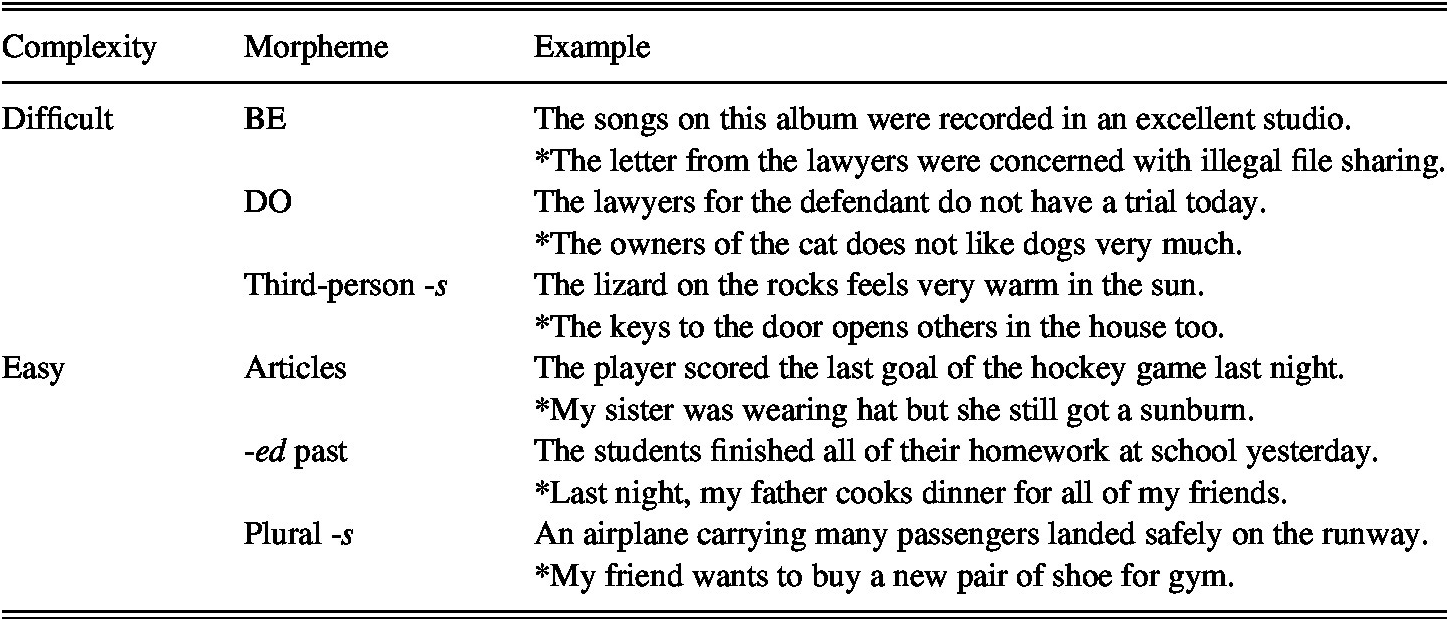
Grammaticality Judgment Task. Participants completed an experimental (nonstandardized), timed auditory grammaticality judgment task (GJT). Participants were presented aurally with 54 stimuli for which they had to produce a binary judgment (i.e., whether the sentence sounded “good” or “bad”) as quickly as possible. Target grammatical sentences included one of six morphemes: BE, DO, third-person -s, past -ed, articles, and plural -s, and their ungrammatical counterparts had the morpheme omitted. There were six stimuli of between 10 and 12 words for each morpheme. Additionally, this task contained 6 distractors and 12 fillers. Half of the target and distractor stimuli were grammatical and half were not. All fillers were grammatical.
The stimuli sentences fell into two categories based on the level of difficulty for participants in detecting grammaticality: morphemes in nonadjacent tense-agreement dependencies (difficult) versus other morphemes (easy). The stimuli for BE, DO, and third-person -s appeared in difficult stimuli, that is, sentences that contained nonadjacent tense-agreement dependencies, which, in the ungrammatical conditions, were violated. The nonadjacency of the head noun and the inflected verb was triggered by presenting a heavy noun phrase, which included a postmodifier prepositional phrase. For the other three morphemes, an obligatory article, past -ed, or plural -s inflection either appeared (grammatical) or was omitted (ungrammatical). Grammatical and ungrammatical example sentences are shown in Table 2. We analyzed global scores and scores comparing easy versus difficult stimuli in this study. Accuracy with respect to the individual morphemes is under investigation with a different participant sample and research goals (Rusk et al., in preparation).
Grammatical and ungrammatical GJT example stimuli classified according to difficulty and morpheme

This GJT was created and presented using E-Prime 2.0 (Psychology Software Tools, 2012). The sentences were recorded by a male, native speaker of Canadian English. Participants completed the task in a quiet room with headphones and were instructed to respond to each sentence using a keyboard button as soon as they decided regarding the (un)grammaticality of the sentence. Two different counterbalanced lists for the presentation of the GJT stimuli were randomized using E-Prime and DLL and monolingual participants were balanced across each list, ensuring that both groups were equally likely to receive either list. The Cronbach’s alpha for this test was .70, which indicates acceptable reliability for an experimental GJT (Spinner & Gass, Reference Spinner and Gass2019, p. 116).
RESULTS
COMPARING MONOLINGUAL AND DLL PERFORMANCE ON LANGUAGE TASKS
PPVT-4
Descriptive statistics are in Table 3. The DLL group almost reached the standard mean for this test (M = 99.67, SD = 23.24). However, this group had a significantly lower score than the monolingual group (t(102.7) = 5.0935, p < .001; Cohen’s d = .649, medium effect size). DLLs were then considered separately (EA-DLLs and LA-DLLs) depending on their length of schooling in English in Canada to directly assess the 7-year timeline (RQ 1, approach b). A one-way nonparametric ANOVA (for samples with heterogeneous variances) comparing the scores of monolinguals, EA-DLLs and LA-DLLs also found a main effect for group: F(2,91.142) = 38.668, p < .001. Post-hoc pairwise comparisons using the Bonferroni correction found that LA-DLLs differed significantly from both EA-DLLs and monolinguals (both p < .001), but EA-DLLs were not found to perform differently from monolinguals (p = .37). Focusing on EA-DLLs, the main group of interest, only 4.8% of EA-DLLs performed –1SD below the standard normative mean for PPVT-4. However, if we consider their target to be their monolingual peers, 25.8% of EA-DLLs were found to perform –1SD below the monolingual mean.
Monolingual and DLL standard scores in PPVT-4 and CELF-WCR tests

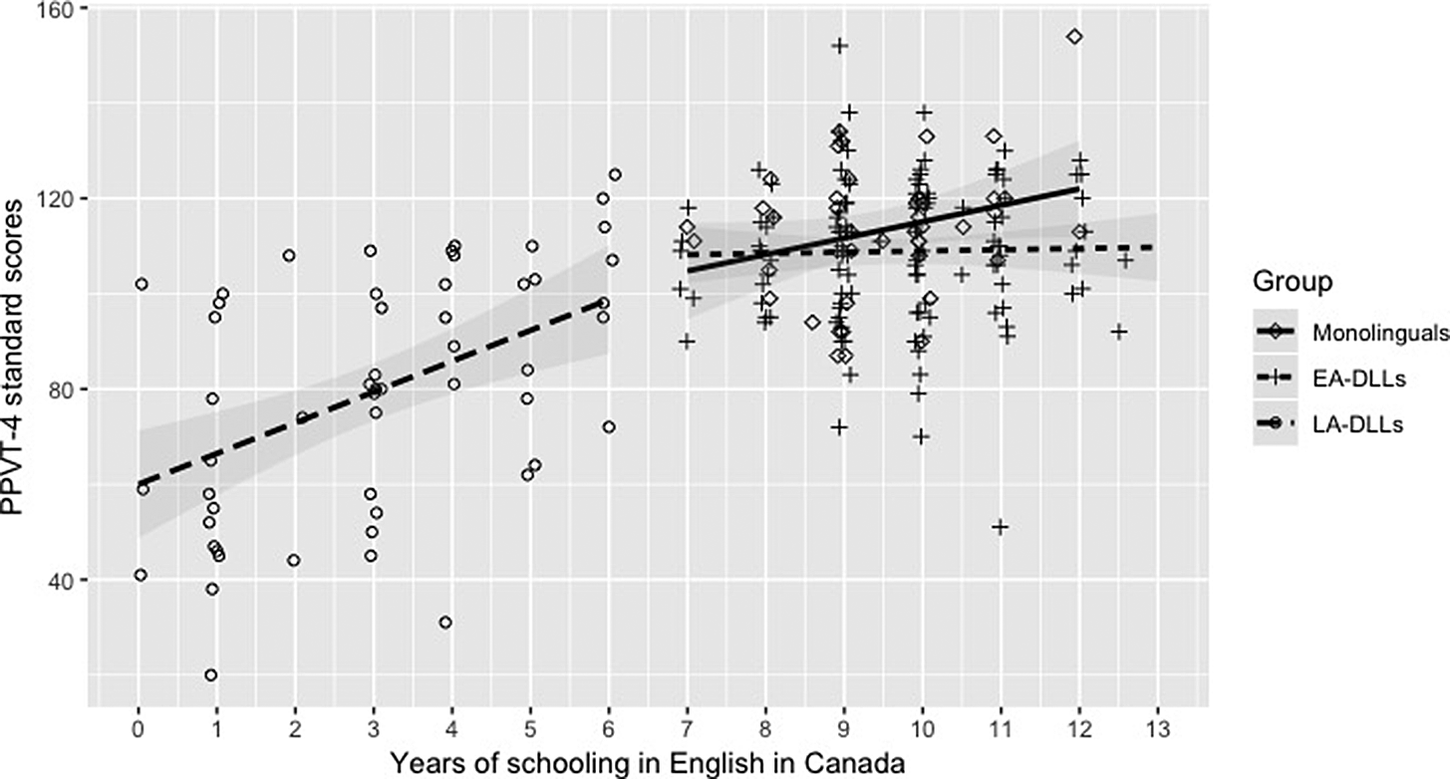
Our first research question also asked how DLLs’ performance varied as a function of years of schooling in English in Canada, which we approached in two ways (RQ 1, approaches a and b). Figure 1 is a scatterplot of scores for monolinguals, EA-DLLs, and LA-DLLs as a function of years of schooling in Canada. A Pearson correlation found a moderate positive correlation between years of schooling and PPVT-4 scores in the DLL group as a whole (r = .62, p < .001), indicating that DLLs’ vocabularies grow with length of L2 exposure. When the two groups of DLLs were considered separately, the correlation remained, albeit more moderate, for LA-DLLs (r = .48, p < .001). However, no correlation was found between the two variables for EA-DLLs (r = .02, p = .40). This second analysis shows that, up to seven years of schooling, DLLs make gains in their receptive vocabulary. However, after seven years, DLLs seem to plateau because no further improvements are seen as a function of more years of English schooling.
EA-DLLs, LA-DLLs, and monolinguals’ PPVT-4 standard scores as a function of years of schooling in English in Canada. Points are jittered to avoid overplotting due to discreteness. A regression line with 95% confidence interval showing how years of schooling predict PPVT scores, fit with a linear model for each group, appears superimposed.

CELF-WCR
Descriptive statistics are shown in Table 3. DLLs performed above the standard mean of this task (M = 10.27, SD = 3.67). However, the monolingual group had a significantly higher score than the DLL group (t(61.268) = 5.2455, p < .001; Cohen’s d = .778; medium effect size). To compare the two DLL groups to monolinguals, a K-Sample Fisher-Pitman Permutation Test from the package coin in R (Hothorn et al., Reference Hothorn, Hornik, Van De Wiel and Zeileis2008; R Core Team, 2018) was used because both the normality and homogenous variance assumptions were violated. This test found a significant between-groups difference (χ2 = 53.318, p < .001). Using pairwise comparisons with a Bonferroni correction, three-way group differences obtained: the monolingual group differed significantly from both the EA-DLLs (p = .03) and LA-DLLs (p < .001) and the EA-DLL group also differed from the LA-DLL group (p < .001). Looking at individual results, only 5.8% EA-DLLs performed –1SD below the normative mean for the CELF-WCR test, whereas 37.5% performed –1SD below their monolingual peers’ mean.
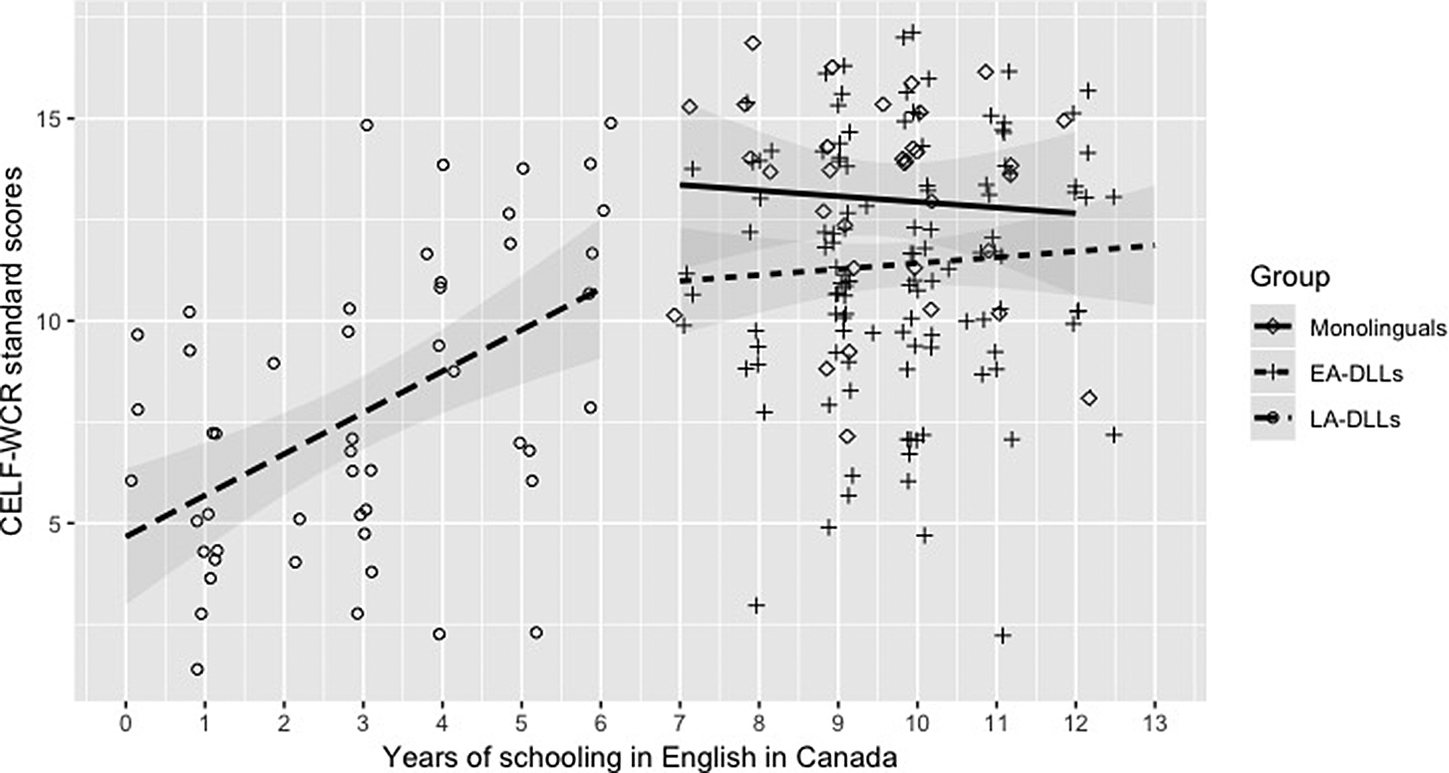
In terms of the relationship between CELF-WCR scores and years of schooling in Canada (Figure 2), the same pattern observed for PPVT-4 applied. When all DLLs were considered together, a moderate positive relationship emerged between the two variables (r = .52, p < .001). When only LA-DLLs were considered, the same correlation was found (r = .52, p < .001). No significant correlation was found between CELF-WCR scores and years of schooling for the EA-DLL group (r = .06, p = .25). These results show, again, progress in the DLL group until seven years of schooling in English but a plateau afterward.
EA-DLLs, LA-DLLs, and monolinguals’ CELF-WCR standard scores as a function of years of schooling in English in Canada. Points are jittered to avoid overplotting. A regression line with 95% confidence interval showing how years of schooling predict CELF-WCR scores, fit with a linear model for each group, appears superimposed.

Grammaticality Judgment Task
The global accuracy scores for the GJT are reported in Table 4, together with the scores for difficult and easy stimuli (see “Procedures”). For each stimulus, participants received a score of 1 if they correctly accepted a grammatical sentence or rejected an ungrammatical one and received a score of 0 if they rejected a grammatical sentence or accepted an ungrammatical one. Scores were calculated by averaging accuracy over all the stimuli for each participant (global scores); or only difficult (difficult) or easy stimuli (easy). Therefore, the closer the value is to 1, the more accurate the participant/group was in judging the grammaticality of the stimuli sentences. By way of providing a performance benchmark, the scores from an English monolingual adult control group (N = 45) are presented (see “Participants”).
GJT accuracy proportion scores in GJT by group: global scores and scores for difficult and easy stimuli

In terms of overall accuracy on the GJT, the monolingual adolescent group was found to differ significantly from the adolescent DLL group (t(64.126) = 4.3425, p < .001; Cohen’s d = .7; medium effect size). When the four groups were considered independently (i.e., adult monolinguals, adolescent monolinguals, EA-DLLs, and LA-DLLs), a Kruskal-Wallis rank sum test, which accounts for nonnormal distributions, found a significant between-groups difference (χ2 = 58.915, p < .001). A Tukey post-hoc test found all groups to be significantly different from one another (for the monolingual adolescent–EA-DLL contrast: p = .048; all other contrasts: p < .001). Considering individual performance in the EA-DLL group, 29.8% of the participants in this group scored –1SD below the monolingual adolescent mean whereas 71% scored –1SD below the monolingual adult mean.
With respect to the difficult and easy stimuli, the adolescent monolingual group outperformed the adolescent DLL group in both difficult (t(53.612) = 2.4693, p = .017, Cohen’s d = .46; small), and easy stimuli (t(89.266) = 4.9872, p < .001, Cohen’s d = .67; medium). For the difficult stimuli, a Kruskal-Wallis rank sum test found a significant between-group (monolingual adults, monolingual adolescents, EA-DLLs, and LA-DLLs) difference (χ2 = 53.956, p < .001). Tukey post-hoc tests showed significant differences between all groups except for the EA-DLL and LA-DLL contrast. All the other contrasts were p < .01 except for the adolescent monolingual and EA-DLL one (p = .046). For easy stimuli, a significant between-group difference was also found (χ2 = 89.619, p < .001). Tukey post-hoc tests found no differences between adult and adolescent monolinguals, but all other contrasts were p < .001, except for the adolescent monolingual and EA-DLLs contrast (p = .031). These contrasts showed that differences between EA-DLLs and adolescent monolinguals were observed regardless of the complexity of the stimuli.
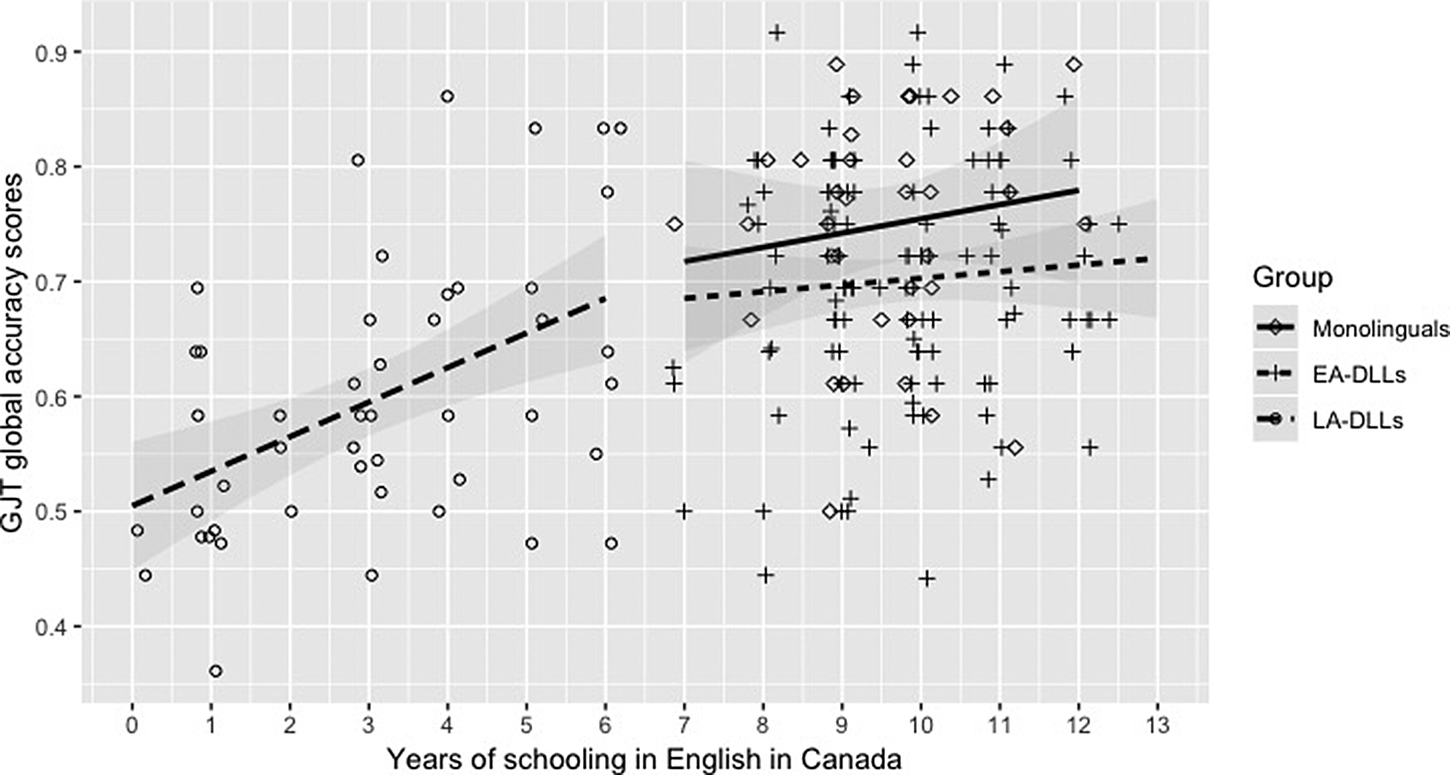
In terms of the relationship between global accuracy on the GJT and years of schooling in English in Canada (Figure 3), a moderate correlation was found for the DLL group as a whole (r = .34, p < .001). When only LA-DLLs were considered, a similar correlation was found (r = .52, p = .015). However, in the EA-DLL group, no such correlation obtained (r = .13, p = .32), echoing the findings for the other tests.
EA-DLLs, LA-DLLs, and monolinguals’ GJT global accuracy scores as a function of years of schooling in English in Canada. Points are jittered to avoid overplotting. A regression line with 95% confidence interval showing how years of schooling predict GJT global accuracy scores, fit with a linear model for each group, appears superimposed.

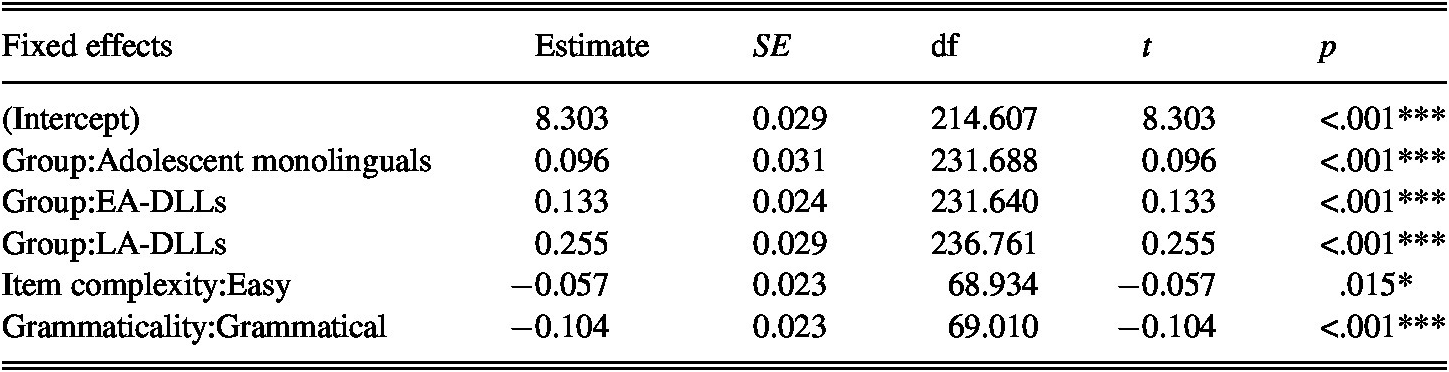
Reaction times (RTs) on the GJT stimuli that had been judged correctly were analyzed next. Because RTs violated the normality assumption, as it is often the case for this type of data (Baayen & Milin, Reference Baayen and Milin2010), they were logarithmically transformed. Outlier RTs within participants were trimmed (Baayen & Milin, Reference Baayen and Milin2010), which resulted in eliminating 2.07% of the data. A linear mixed-effect model using the lme4 package (Bates et al., Reference Bates, Maechler, Bolker and Walker2015) was fitted to the trimmed dataset. In this model, the outcome variable was the logarithmically transformed RT in milliseconds that participants took to decide about the grammaticality of a stimulus. The fixed effects were group, complexity, and grammaticality of the stimulus. The random effects were item and participant. The results of this model are shown in Table 5. Complexity and grammaticality contributed to the model significantly: easy stimuli and grammatical stimuli were responded to significantly faster than difficult and ungrammatical stimuli. To further unpack the effect of group shown in Table 5, we ran post-hoc contrasts with a Tukey adjustment using the package emmeans for R (Lenth, Reference Lenth2019). EA-DLLs and monolingual adolescents were found to have responded at a similar speed. However, monolingual adults were significantly faster than the other three groups and LA-DLLs were significantly slower than the other three groups (for the adult monolingual-adolescent monolingual contrast, p = .009; all other significant contrasts: p < .001).
Coefficient table for linear mixed-effects regression for GJT RTs. Logarithmically transformed RTs in milliseconds are the outcome variable

Note. The reference level for the three variables are: Group = Adult monolinguals; Item complexity = Difficult; Grammaticality = Ungrammatical. *** = p < .001; ** = p < .01; * = p < .05
MODELING INDIVIDUAL DIFFERENCES IN DLLS’ PERFORMANCE
Our second research question asked about the role of cognitive and input factors as predictors of individual differences in the DLLs’ English vocabulary and morphological skills. To investigate this, we built one regression model for each language test with the descriptive characteristics in Table 1 as predictors (fixed effects). Because length of schooling was included as a fixed effect, the DLLs were not divided into groups.
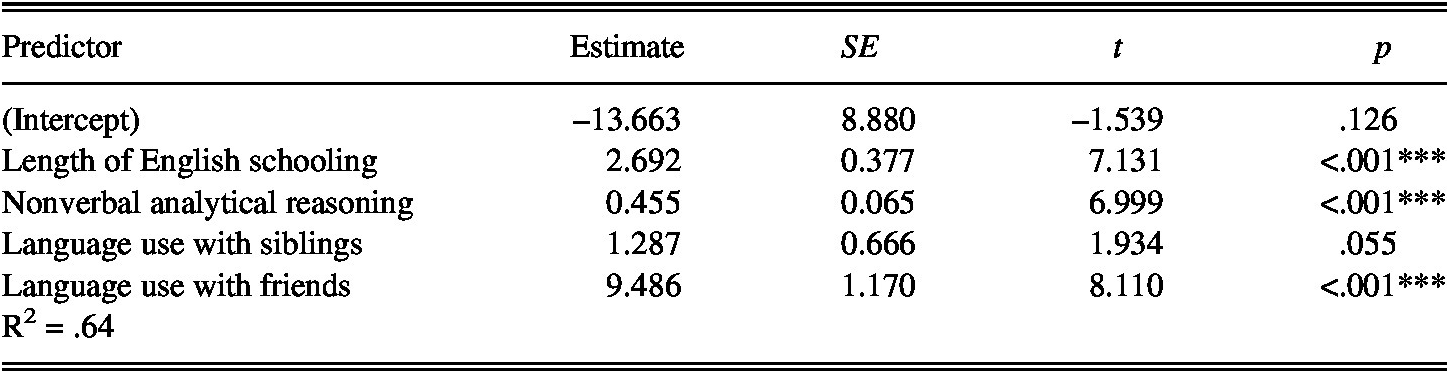
We fit one linear model for DLLs’ PPVT-4 scores as a function of: (a) length of schooling in English in Canada, (b) parental years of education, (c) nonverbal analytical skills, (d) phonological short-term memory, (e) English use with parents, (f) English use with siblings, (g) English use with friends, and (h) weekly hours of English activities. Due to the results reported in the preceding text, it was anticipated that length of schooling would be a significant predictor in these models, but including this variable as a fixed effect allowed us to control for the length of schooling while modeling the influence of other variables. The analysis started with a full model with all predictors and using backward selection, the nonsignificant factors were removed one at a time to arrive at the optimal model. At each step, the reduced model was compared to the fuller model using a log-likelihood ratio test to ensure that the removal of the given predictor did not result in a significantly less explanatory model.
The optimal model for PPVT-4 is shown in Table 6. In addition to length of schooling, two other measures of input quantity, language use with siblings and language use with friends, contributed positively to increasing vocabulary scores, although language use with friends accounted for much more variation. Finally, nonverbal analytical reasoning was also a significant and positive predictor for DLLs’ performance on this test.
Optimal model for DLLs’ PPVT-4 scores

Note. *** = p < .001; ** = p < .01; * = p < .05
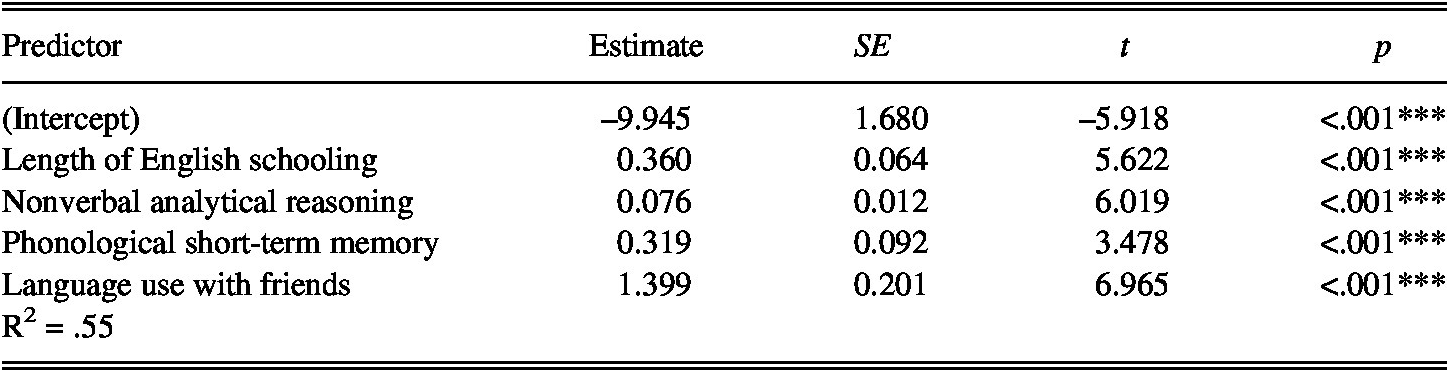
For the CELF-WCR test, we carried out the same modeling procedure, starting with the same full model as for PPVT-4. The optimal model appears in Table 7. Length of schooling in English again emerged as a significant positive predictor. In addition to length of schooling, two cognitive factors, nonverbal analytical reasoning and phonological short-term memory, predicted higher CELF-WCR scores. Language use with friends was also associated with higher scores.
Optimal model for DLLs’ for CELF-WCR scores

Note. *** = p < .001; ** = p < .01; * = p < .05
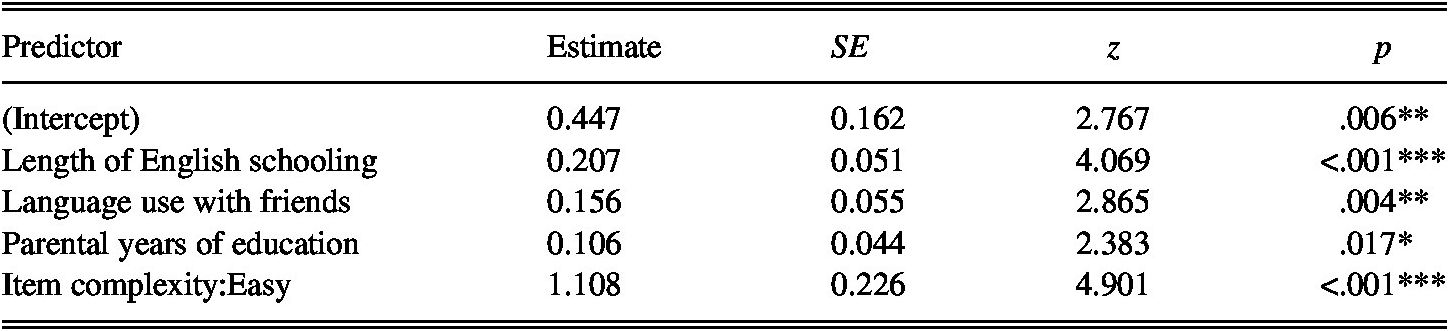
For the GJT, we fit one binomial generalized mixed-effects model using the lme4 package (Bates et al., Reference Bates, Maechler, Bolker and Walker2015). The response variable was either 1 (correct) or 0 (incorrect) for each individual stimulus of the GJT. The fixed effects were the same as for the preceding models, together with sentence complexity (either difficult or easy). Unlike the other fixed effects, sentence complexity is not an individual factor but an item-level factor. However, it was included as a fixed effect to estimate and control for the variance associated with this variable. The random effects in these models were item and participant. As before, the initial model included all predictors and we followed backward selection to obtain the optimal model.
The optimal model for accuracy in the GJT appears in Table 8. Length of schooling again predicted variance in performance positively. Item complexity also contributed significantly to the model, as participants were significantly more accurate in judging easy sentences. In addition, language use with friends and parental years of education contributed significantly to the model, indicating that using more English with friends and having parents with more years of education was associated with higher GJT scores. The C index of concordance for this model was .80. A C index of .80 is generally assumed to indicate that the model had good discrimination (Hosmer et al., Reference Hosmer, Lemeshow and Sturdivant2013).
Optimal model for DLLs’ GJT accuracy scores

Note. *** = p < .001; ** = p < .01; * = p < .05
DISCUSSION
The motivation behind the present study was twofold: (a) to evaluate the validity of a 7-year timeline for DLLs to converge with monolinguals with respect to English skills, and (b) to investigate what input and cognitive factors may account for individual variation in DLLs at this age. To this end, DLLs in middle school (N = 184), an underresearched age range in L2 acquisition research, were compared to a control group of monolingual peers (N = 43) attending the same schools with regard to their performance on three tests: PPVT-4 (vocabulary breadth), CELF-WCR (vocabulary depth), and an experimental GJT (morphosyntax). DLLs were further subdivided into EA-DLLs (early arrivals; N = 128) and LA-DLLs (late arrivals; N = 56) according to their length of schooling in Canada (seven or more years and less than seven years, respectively) to allow for the direct assessment of the role of length of schooling in English on the development of English oral language skills around a 7-year cutoff.
DLLS COMPARED TO MONOLINGUALS: SEVEN YEARS TO CONVERGENCE?
Our first research question concerned how long it takes for DLLs to approach monolingual levels of oral L2 skills in terms of vocabulary and morphosyntax. When DLLs were considered as one group, they performed at or just below the standard mean for both PPVT-4 and CELF-WCR (note that the GJT did not have a standard mean because it was an experimental task). However, when they were compared to their monolingual classmates, DLLs had lower scores for all three tests. This contrast shows that monolingual peers provided a more difficult target for DLLs to reach than standard means. As a result, research focused on assessing DLLs’ L2 abilities in relation to those of monolinguals should consider including a monolingual peer group from the same schools, as this might yield separate information from standard norms.
When EA-DLLs and LA-DLLs were considered independently, task effects emerged for the early arrival group. EA-DLLs were found to perform on par with their monolingual peers with respect to PPVT-4 only, but significant differences between the two groups were found both on the CELF-WCR test and on accuracy (though not reaction times) on both the easy and difficult stimuli of the GJT. PPVT-4 assesses vocabulary breadth by having participants point at the picture that best matches a spoken stimulus. Therefore, this test only requires a minimum, surface-level knowledge of the meaning of the word (Nation, Reference Nation2001; Read, Reference Read, Bogaards and Laufer2004). While PPVT-4 and CELF-WCR measure clearly interconnected constructs (Qian, Reference Qian1999), the latter assesses knowledge of lexical semantics and requires participants to recruit deeper knowledge of the meaning of words and their relationship with other words. Finally, GJT demands fast access to metalinguistic knowledge to judge aurally presented sentences as (un)grammatical in a timely manner. Therefore, EA-DLLs appeared to have caught up with their monolingual peers with respect to language measured by a less demanding task, but not with respect to more demanding tasks tapping into abilities with lexical semantics (CELF-WCR) and grammatical well-formedness (GJT).
Taken together, the results of this study do not fully support a 7-year-to-convergence timeline for all DLLs. There are two potential reasons to explain these conflicting results. First, previous studies have largely focused on more general academic English skills (i.e., CALP; Collier, Reference Collier1987; Collier & Thomas, Reference Collier and Thomas1989; Cummins, Reference Cummins1981, Reference Cummins2000) rather than on separate and specific oral language skills as we did in the present study. Second, unlike previous research with adolescents (Carhill et al., Reference Carhill, Suárez-Orozco and Páez2008; Cummins, Reference Cummins1981), this study did not use grade or standard norms as a reference, but monolingual peers attending the same schools. As observed in the preceding text, the monolingual peers in our study provided a more challenging target. While we did not find EA-DLLs to converge with monolinguals with respect to performance on all tests after seven years of schooling in English, the 7-year cutoff was found to be a relevant timeline for DLLs in another respect. This timeline played an important role in terms of gains in performance: moderate correlations were observed for the LA-DLL group between length of schooling and performance on all tests. However, no such correlations emerged for the EA-DLL group. Visual inspection of the trend lines in Figures 1–3 are consistent with the correlations. This finding implies that while initial significant gains are expected as a function of schooling in the L2 during the first few years, DLLs’ performance possibly reaches asymptote after seven years of schooling. These results suggest that additional years of schooling in English may not result in further gains and that differences between monolinguals and DLLs (as a group) are likely to persist.
Our findings provide some support for studies that propose that limited language skills may be one of the causes for the DLL-monolingual achievement gap in middle and secondary school (e.g., Demie & Strand, Reference Demie and Strand2006; Kohler & Lazarín, Reference Kohler and Lazarín2007). That is, some—but not all—DLLs may be at risk for academic underachievement, not by virtue of being bilingual, but due to lower English oral language skills that may limit their access to the curriculum (Demie & Strand, Reference Demie and Strand2006; Murphy, Reference Murphy, Miller, Bayram, Rothman and Serratrice2018). This finding has policy implications for second language support for DLLs in schools. When “ELL” (or other terminology) is used as a label for a student in the school system, it often comes with certain conditions, such as English-as-a-second-language support, specialized services, and teacher expectations. When an ELL student is formally reclassified as “English-proficient,” much-needed services may be withdrawn. In the United States, reclassification often occurs between three to seven years of schooling (NASEM, Reference Kohler and Lazarín2007). We hope that the empirical evidence presented in this study, together with the body of research that also find that seven years of schooling are insufficient for all DLLs to perform on par with monolinguals (e.g., Cameron, Reference Cameron2002; Carhill et al., Reference Carhill, Suárez-Orozco and Páez2008), informs debates about reclassification policies and practices, and about what are fair expectations for DLLs. These results indicate that many DLLs would benefit from L2 support that extends beyond the early years of schooling in the host country (as argued by Cummins, Reference Cummins2000, among others). This support would be critical for late arrivals, who experience the pressures of learning curriculum content at the same time as they catch up to monolinguals with respect to their linguistic skills.
Up to now, we have considered DLLs as one group, but this study also showed that DLLs are a highly heterogeneous group with wide individual variation, even beyond seven years of schooling. Visual inspection of Figures 1–3 and SDs in Tables 3 and 4 are consistent with this finding. In fact, despite the significant differences in performance between the EA-DLL and monolingual groups, the majority of EA-DLLs performed within 1SD of their monolingual peers and many DLLs (including some LA-DLLs) outperformed their monolingual peers. This suggests that convergence with monolinguals should not be an “all or nothing” construct and that sources of individual differences need to be examined closely.
SOURCE OF INDIVIDUAL DIFFERENCES IN DLLS
Apart from the expected effect of length of schooling, both concurrent input and cognitive factors predicted variance in the DLL group on the three tests. Specifically, English use with friends contributed significantly, in a positive manner, to both lexical and morphosyntactic outcomes. That is, DLLs who use more English with their peers performed better overall. A smaller positive effect for English use with siblings was obtained for PPVT-4 scores only. Despite the positive effect of overall English use in the home on oral English skills in DLLs in senior elementary school (Chondrogianni & Marinis, Reference Chondrogianni and Marinis2011; Cobo-Lewis et al., Reference Cobo-Lewis, Pearson, Eilers, Umbel, Oller and Eilers2002; Jia & Fuse, Reference Jia and Fuse2007; Paradis & Jia, Reference Paradis and Jia2017), we found no evidence of an association between English use with parents and gains in performance on any of the three tests. The finding that, for adolescent DLLs, it is language use with peers, rather than language use with siblings or parents, that predicts most of the variance in performance highlights the uniqueness of this adolescent population. In this age range, DLLs may spend more time interacting with members of the community outside the household and language choice with these interlocutors may therefore have a more direct impact on language development. Importantly, in this study, language use was measured using a scale with English at one end and L1 at the other. In the future, studies that look into specific patterns of socialization among adolescent DLLs (e.g., absolute number of hours spent conversing in English/L1 with friends) could contribute important insights in this respect.
In terms of qualitative properties of the input, more parental years of education were associated with higher accuracy on the GJT by DLLs. This finding is in line with those from studies with younger children, which have found that DLLs with more educated parents were more likely to reach age-appropriate levels of grammar (see Chondrogianni, Reference Chondrogianni, Miller, Bayram, Rothman and Serratrice2018 for a review). However, richness of the English language and literacy activities was not a significant predictor in the present study. This is surprising considering the well-documented effect of this factor in younger DLLs (Jia & Fuse, Reference Jia and Fuse2007; Paradis, Reference Paradis2011; Paradis et al., Reference Paradis, Tulpar and Arppe2016; Paradis & Jia, Reference Paradis and Jia2017). It is possible that richness of the L2 environment predicts less individual variation in learners with more than seven years of exposure to the L2 than in those who are in their initial stages of L2 development. Thus, the nonsignificant effect of this variable could be because EA-DLLs were the majority in our DLL sample, and were therefore at a stage in their development where richness may not have contributed to their individual L2 outcomes.
In addition to input factors, nonverbal analytical reasoning, a nonlinguistic cognitive measure, featured in the optimal models for DLLs for PPVT and CELF-WCR, indicating that DLLs with higher analytical abilities fared better in the vocabulary measures. Phonological short-term memory also predicted higher CELF-WCR scores in this group. These findings indicate that general learning mechanisms shape the language abilities of DLLs beyond the elementary-school ages and that the contribution of cognitive factors might not be constrained by age of acquisition or length of exposure.
STUDY LIMITATIONS
This study has several limitations that we hope are addressed in future research. First, we only collected information on parental level of education, but not L2 fluency. Parental L2 skills may modulate the contribution of home language, although our results suggest that DLLs in middle school are more influenced by peers and siblings than by parents. Some aspects of DLLs’ backgrounds should be addressed specifically, such as the effect of L1 typology and LA-DLLs’ exposure to English prior to immigration to an English-majority country. In terms of the former, recruiting a sample of DLLs with fewer L1 backgrounds would permit comparisons such as whether DLLs with Chinese L1s show weaker performance on our morphosyntactic task compared DLLs with Spanish L1s, due to the lack of tense/agreement morphology in their L1 (e.g., Paradis, Reference Paradis2011). In addition, we did not have access to any indicators of academic performance for our sample and, therefore, all inferences in terms of the link between oral language skills and academic achievement have been based on prior research (e.g., Murphy, Reference Murphy, Miller, Bayram, Rothman and Serratrice2018). Finally, our DLL sample was skewed-high in terms of SES because most parents had some university education. While this is representative of DLLs in Canada, it could be a limitation in terms of generalizability of these results to other DLL samples.
CONCLUSIONS
This was the first study to investigate English oral language skills in DLLs in middle school, including late arrivals, with respect to time to convergence with monolinguals and the role of concurrent input and cognitive factors in explaining individual differences. Two main findings of the present study are of special note. First, it was found that seven years of English schooling did not index convergence for oral L2 skills for all DLLs, but it did index a shift in the growth of these skills. For DLL students who had not achieved convergence within this timeline, the observed slowdown in growth may impact their ultimate L2 attainment. Second, DLLs in this study were characterized by heterogeneity in terms of individual performance. This pervasive individual variation raises questions about the usefulness of a single term (such as “DLL”) to encapsulate this highly diverse group and its timeline for convergence. Nevertheless, several DLLs in our study performed well below monolinguals on the three outcome measures despite long-term exposure to English. As we have argued, academic attainment may hinge on these, sometimes limited, oral language skills. In this regard, studies—such as this one—that examine the causes of individual variation have the potential of contributing important insights into how to best support students with a minority L1.
Supplementary Materials
To view supplementary material for this article, please visit http://dx.doi.org/10.1017/S0272263119000767.