Dust may be settling on the argument of whether an economic vote exists. (See the reviews of Duch, Reference Duch2007; Lewis-Beck and Stegmaier, Reference Lewis-Beck and Stegmaier2013.) But, the argument over its changeability remains unsettled. A debate has persisted about the stability of the economic vote in Western democracies. In an early pivotal review, Lewis-Beck and Paldam (Reference Lewis-Beck and Paldam2000, 119) posed ‘[t]he crucial question: is the instability… apparent or inherent?’ More recently, the influential review of Anderson (Reference Anderson2007, 286) contended ‘the economic voting effect… is intermittent, highly contingent’. If the economic vote is changeable, that could arise from different sources. Perhaps it comes from random fluctuations due to measurement, or perceptual, error (Kramer, Reference Kramer1983). Or perhaps the observed change results from institutional differences, and is thus conditional. Then, the change would be neither random nor inherent, but rather explainable once the conditions are specified (Duch and Stevenson, Reference Duch and Stevenson2008).
A third kind of change, neither random nor conditional, serves as our chief concern here: a systematic change in the economic vote over time, resulting from the changing strength of long-term social and partisan forces. In terms of the general theory of political behavior, as initially defined by Campbell et al. (Reference Campbell, Converse, Miller and Stokes1960) in the funnel of causality, long- and short-term forces are competing for the vote (see also Lewis-Beck et al., Reference Lewis-Beck, Nadeau and Elias2008). If these long-term forces wane, it might allow the short-term forces to gain a firmer hold. Of particular interest are recent claims that, in Western Europe, the long-term forces of social class and of party identification are in decline, so facilitating the strengthening of the economic vote as a short-term force.
Below, we review the literature on trends in social structure and partisanship, and their link to the vote. We then consider how the economic vote might be affected by these patterns. A dominant hypothesis is that these changing long-term forces have allowed an increase in this leading short-term force. However, the alternative hypotheses – that these changing long-term forces have been accompanied by a decrease in the economic vote, or simply no change at all – must also be considered. To test these rival hypotheses, we examine cross-sectional time series of national election surveys from seven Western European democracies. Utilizing these data separately, and in a pool, we estimate carefully specified voting behavior equations, with retrospective evaluations of the economy featured over a long period, from 1970s to now. Further, we complement these individual-level analyses with an aggregate-level examination of the economy’s impact on incumbent vote shares.
Changing long-term forces: social structure and partisanship
The work of Lipset and Rokkan (Reference Lipset and Rokkan1967) has been highly influential for understanding voting behavior in Western Europe. Their assertion that cleavage structures dominated the vote initially seemed self-evident, given the ‘frozenness’ of European party systems. But this prominent theory was soon contested. On the one hand, voter instability, coupled with rising volatility, challenged this contention of immutability (Crewe and Denver, Reference Crewe and Denver1985; Dalton and Wattenberg, Reference Dalton and Wattenberg2002). On the other hand, there emerged a discussion over whether class cleavages were becoming less important electoral predictors.
Clark and Lipset’s (Reference Clark and Lipset1991) contention that social class was ‘dying’ as a vote determinant sparked serious controversy (Franklin et al., Reference Franklin, Mackie and Valen2009; Jansen, et al., Reference Jansen, De Graaf and Need2011; Evans and Tilley, Reference Evans and Tilley2012). At the same time, the argument for the continued relevance of class voting did not go away (van der Waal et al., Reference van der Waal, Achterberg and Houtman2007). A similar conversation has unfolded regarding the alleged decline of religious voting (van der Brug et al., Reference van der Brug, Hobolt and De Vreese2009). This discussion on the waning impact of these social forces has also taken a methodological turn (van der Waal et al., Reference van der Waal, Achterberg and Houtman2007; Jansen et al., Reference Jansen, Evans and De Graaf2013). Overall, the current consensus points to the view that the impact of cleavages on voting is eroding (Evans and Tilley, Reference Evans and Tilley2012).
Alongside these social structure changes, partisanship changes have surfaced. A main causal mechanism offered refers to the ‘dealignment’ process, implying weakening bonds between parties and voters (Crewe and Denver, Reference Crewe and Denver1985; Dalton and Wattenberg, Reference Dalton and Wattenberg2002). The term suggests voters are now ‘freed’ from the distractions, or distortions, of social cleavages and have begun to choose more objectively (Rose and McAllister, Reference Rose and McAllister1986). Such changes challenge fundamental theories of voting behavior. In response, different scholars have argued for a shift, with long-term partisan forces becoming less important, and short-term forces becoming more (Thomassen, Reference Thomassen2005; Costa Lobo, Reference Costa Lobo2006; Walczak et al., Reference Walczak, van der Brug and De Vries2012). Indeed, party identification itself appears to have decreased over time (Dalton and Wattenberg, Reference Dalton and Wattenberg2002). Moreover, a related measure of partisanship, left–right ideology, may be eroding as well (van der Brug, Reference van der Brug2010; Walczak et al., Reference Walczak, van der Brug and De Vries2012).
In summary, a growing body of research indicates that social structure and partisanship exercise a diminishing impact on the vote. This prompts the question: What has replaced their impact? Some scholars have suggested that short-term factors – issue positions, leaders, performance evaluations, the economy – deserve a closer look (Thomassen, Reference Thomassen2005; Costa Lobo, Reference Costa Lobo2006; Walczak et al., Reference Walczak, van der Brug and De Vries2012). This question holds interest on theoretical and normative grounds, as well as empirical ones. If sociological predispositions now have a weaker claim, that could lead to stronger mechanisms of democratic accountability, with voters responding more to issues and outcomes. Further, if the grip of partisanship has lessened, voters could more independently assess incumbents and parties. In that case, the dealignment might even be ‘producing a deliberative public that more closely approximates the classic democratic ideal’ (Dalton and Wattenberg, Reference Dalton and Wattenberg2002: 60).
Changing short-term forces: the rise of economic voting?
Research on economic conditions and voting behavior continues to mount (Lewis-Beck and Stegmaier, Reference Lewis-Beck and Stegmaier2013). Its classic assumption – commonly traced back to Key (Reference Key1966) – argues that voters hold incumbents accountable for past economic performance and punish or reward them at the ballot box. While the economic voting paradigm was originally formulated within the American context, it was soon exported to Western Europe (Lewis-Beck, Reference Lewis-Beck1988; Lewis-Beck and Stegmaier, Reference Lewis-Beck and Stegmaier2013). At an individual level, the recent move beyond single-country studies, and to pooled survey data, shows that the economic vote survives across a host of democracies (Lewis-Beck and Whitten, Reference Lewis-Beck and Whitten2013). This extensive literature has not remained unchallenged, however, and some authors argue that economic evaluations as well as vote choices are caused by the same factors, such as partisan attachments (Evans and Pickup, Reference Evans and Pickup2010). Others have responded to this challenge of endogeneity driving results by investigating ways to address this issue statistically, including by means of panel designs (Lewis-Beck et al. Reference Lewis-Beck, Nadeau and Elias2008). The debate on the extent to which perceptions of economic evaluations are exogenous continues (van der Eijk et al. Reference van der Eijk, Franklin, Demant and van der Brug2007). However, it seems clear that perceptions of economic conditions are not fully endogenous, and that they – while imperfectly – ‘correlate with changes in objective economic conditions and influence political support’ (Stevenson and Duch, Reference Stevenson and Duch2013: 318). Furthermore, the economic voting proposition sustains itself for the macro level as well (Duch and Stevenson, Reference Duch and Stevenson2006; Nadeau et al., Reference Nadeau, Lewis-Beck and Bélanger2013; Dassonneville and Lewis-Beck, Reference Dassonneville and Lewis-Beck2014a). The economy now stands as an important vote determinant in many countries, across decades of elections conducted under different democratic rules.Footnote 1 From this rich political science literature, ‘a near-consensus has emerged that the effect of economic voting is real and substantial’ (Achen and Bartels, Reference Achen and Bartels2016: 146).
So the economic vote exists. However, we know little about its empirical time trajectory. A leading hypothesis, H1, holds that the economic vote has increased. The core notion here argues that as voters become less bound by party and society, they see choices clearly, and make them unfettered by personal or political biases. Because they are more educated, they are better able to observe the state of the economy and, freed of partisan prejudices, can reward or punish rulers for their performance. Kayser and Wlezien (Reference Kayser and Wlezien2011) offer evidence for such a pattern. For example, they show that the economic vote has more strength in countries where low-partisan attachment prevails. Furthermore, they offer an indication of the individual-level mechanism at play, as they show partisans to be more economically responsive. Similarly, Kosmidis and Xezonakis (Reference Kosmidis and Xezonakis2010) demonstrate that economic evaluations weigh more heavily on the vote choices of late deciders in a campaign. Such findings lead Kayser and Wlezien (Reference Kayser and Wlezien2011: 365) to assert the existence of ‘a growing effect for the objective economy on the vote in Europe’.
The idea that dealignment favors the economic vote may seem intuitive and it does suggest that the economic vote in European publics could be growing. But, first, it depends on the extent to which European electorates are more dealigned overall. Second, other processes are occurring, and they might act to counterbalance dealignment. In particular, consider the trend to economic globalization, rendering the national economy more open. When responsibility for economic performance becomes less tied to domestically elected politicians, the national economic vote could decline. Citizens do seem aware of global economic conditions, and their divergence from the national economy (Duch and Stevenson, Reference Duch and Stevenson2010; Hellwig, Reference Hellwig2014).
Different studies demonstrate that, under more open economies, voters indeed hold the government less accountable (Fernández-Albertos, Reference Fernández-Albertos2006; Hellwig, Reference Hellwig2014). Such findings suggest individual voters are acting rationally, not blaming national incumbents for what is out of their control. Such individual-level observations help explain why, at the aggregate level, the economic vote lessens in more open economies (Hellwig and Samuels, Reference Hellwig and Samuels2007; Kayser, Reference Kayser2007; Duch and Stevenson, Reference Duch and Stevenson2010). In the context of Western Europe, the political and economic integration into the European Union further diminishes national government responsibility, reducing the economic vote still more (Costa Lobo and Lewis-Beck, Reference Costa Lobo and Lewis-Beck2012). In sum, it may be that an alternative hypothesis – H2 – is more sustainable, namely, the economic vote has decreased.
Thus, we see that strong theoretical arguments can be mustered for these two rival hypotheses, H1 and H2. What does available evidence suggest about the trajectory of the economic vote? Is it stronger or weaker? For firm conclusions, analyses of over-time changes are warranted. But these studies are rare. Moreover, they do not point in the same direction. Early on, Anderson (Reference Anderson1995) claimed that voters have become more sensitive to the economy. In contrast, Listhaug’s (Reference Listhaug2005) analysis of economic retrospective voting in Europe since the 1970s shows no heightened pattern. Carrying out comprehensive cross-sectional analyses of advanced democracies, Duch and Stevenson (Reference Duch and Stevenson2008) conclude that the economic vote may be declining. But Bellucci and Lewis-Beck (Reference Bellucci and Lewis-Beck2011), in an extended investigation of a popularity function estimated across six major Western democracies, decide that the economic coefficient exhibits great stability over time. That result would suggest a third hypothesis, H3, effectively the null, stating that the economic vote has remained the same.
Thus, each of these three hypotheses – increase, decrease, no change – has received empirical support in the literature. But that folio has few entries.Footnote 2 We thus address an important research gap, investigating the economic vote across a 40-year period of European national elections and carrying out our analyses at micro- and macro levels.
Data and measures
Micro-data
To investigate the economic vote at the individual level, we only deploy data from long-standing European national election surveys. Further, unlike some other investigations, we eschew surveys that measure vote intention (see, e.g., Duch and Stevenson (Reference Duch and Stevenson2006) or Kayser and Wlezien (Reference Kayser and Wlezien2011)). Hopefully, relying on reported vote in real elections, rather than on the more indirect measures of vote intention, will yield more valid estimates. In this spirit, we exclude surveys organized in the context of European Parliament elections. We start with data from The European Voter Project (ICORE, 2005), and its files on Denmark, Germany, Great Britain, The Netherlands, Norway, and Sweden, to the late 1990s, supplementing with surveys covering the most recent elections. We add ITANES-data on Italy to include a country in Southern Europe as well (for details, see Appendix 1). Economic measures are available from the mid-1970s onwards.Footnote 3 Combining all these data sources, we can examine the impact of economic evaluations in these leading democracies, at an individual level, from the mid-1970s to the present.
Clearly, we are examining choices in a variety of electoral systems, multiparty and proportional. The nominal nature of party choice variables has pressed some scholars to use multinomial logit models or to investigate each party vote separately (Duch and Stevenson, Reference Duch and Stevenson2006, Reference Duch and Stevenson2008). To test the economic voting theory in its purest form, we prefer a dependent variable that captures vote for an incumbent party in binary form. Importantly, doing so allows comparability across the different national surveys.Footnote 4 We accept Duch and Stevenson’s (Reference Duch and Stevenson2008, 50) fundamental argument for resting the enterprise on a dichotomous dependent variable of incumbent vs. opposition: ‘These models demand that we define the choice set similarly across the studies to be pooled (i.e., we can estimate a pooled model in which the dependent variable is a vote for or against an incumbent but not when it is for or against each of the available parties – which differ from survey to survey)’. Having made these claims, we do explore the use of the dependent variable of Prime Minister party vote for estimating binary logit models (see our Challenges section).Footnote 5
Given the focus on over-time variation, a crucial point concerns measurement of the economic evaluations. We wish to rely on indicators that are measured consistently. When combining different election survey data, however, some variation in question wording will occur. As a guiding principle, we include survey data regarded as standard – the sociotropic, retrospective measures first applied in a comparative European context by Lewis-Beck (Reference Lewis-Beck1988).Footnote 6 Respondents are asked to evaluate whether the national economy over the past year has gotten ‘better’, ‘worse’, or ‘stayed the same’.Footnote 7 For comparability, we have standardized all economic evaluation measures from 0 (most negative evaluation) to 1 (most positive evaluation).
The individual-level analyses may be limited, in that they base themselves on the respondent’s subjective perception of the economy, rather than on an objective economic measure (Kramer, Reference Kramer1983). It is relevant to note that merging the GDP data with the individual-level dataset allows verifying whether (mean) perceptions of the state of the economy are indeed correlated to real economic conditions. Doing so, we find a correlation of 0.381 (P<0.000). That being said, within the literature on economic voting, there remains some discussion on the meaning of subjective economic perceptions and their value for studying economic voting (van der Eijk et al., Reference van der Eijk, Franklin, Demant and van der Brug2007; Pickup and Evans, Reference Pickup and Evans2013; Stevenson and Duch, Reference Stevenson and Duch2013; De Vries, Hobolt and Tilley, Reference De Vries, Hobolt and Tilley2018). First, there are endogeneity concerns, arising from the fact that voters’ partisan attachments influence both their perceptions of economic conditions and their likelihood to vote for the incumbent. Reviewing the literature on this issue, Stevenson and Duch (Reference Stevenson and Duch2013: 306) conclude that ‘the potential endogeneity problem on its own should not lead scholars to prefer aggregate objective measures’.
Second, it has been argued that all individual-level variation in perceptions of economic conditions reflects noise in survey-based measures of economic voting because ‘the national economy is the same for all respondents in a national survey’ (van der Brug et al. Reference van der Brug, van der Eijk and Franklin2007: 22). Stevenson and Duch (Reference Stevenson and Duch2013: 307) disagree with this assessment of survey-based indicators of the state of the economy, and argue that ‘variation in opinions about the economy represent real or ‘natural’ variation in the distribution of messages that make up the observable economy’ and they continue that ‘it is exactly this kind of variation we should use to build theoretically driven estimates of economic voting’.
It is beyond the scope of this paper to settle such debates, but we acknowledge the limitations of an analysis of economic voting that exclusively relies on survey-based measures of the state of the economy. Therefore, we supplement our individual-level analyses with a macro-analysis of economic voting, looking directly at how the national incumbent vote responds to the objective economic indicator of GDP growth.
We study the electoral impact of economic evaluations while controlling for relevant covariates. First, we control for socio-demographic variables. Besides gender and age, we control for education, religion,Footnote 8 social class or income, and urbanization. These particular covariates are included in each estimation, to the extent of their availability. With the exception of age and gender, all these socio-demographic measures are standardized (0–1). Second, we include a partisan ‘anchoring’ variable, to account for long-term social-psychological forces. This ‘anchor variable’ means ideological identification (left–right self-placement, standardized 0–1) or, in the case of Britain, party identification.Footnote 9
Macro-data
To investigate the evolution of the economic vote at the aggregate level, we examine the link between the objective economy and incumbent performance in Western European countries, since 1950.Footnote 10 By focusing on the macro-link between economic indicators and incumbent vote shares, instead of for example, studying the effect of objective economic indicators on individuals’ reported vote choice, we address the problem of a ‘micrological fallacy’, which refers to the fact that ‘while individual voters may appear to be economic voters, all voters taken together may not reflect the changing state of the economy’ (Dassonneville and Lewis-Beck, Reference Dassonneville and Lewis-Beck2014a: 373). In addition, when relying on individual-level survey data, it should be kept in mind that survey respondents are not necessarily representative of all voters.
Our data-set covers 14 countries and 271 elections, from 1950 to 2018 (see Appendix 2 for details). To construct the dependent variable of incumbent vote share we utilized electoral results documented by Mackie and Rose (Reference Mackie and Rose1991), supplemented with election reports in Electoral Studies, the European Journal of Political Research, and online sources for the most recent elections (Nordsieck, Reference Nordsieck2018). Information on the incumbency status of parties comes from the ‘Parliament and Government Composition Database’ (Döring and Manow, Reference Döring and Manow2012). Incumbent vote shares were calculated by summing the vote shares of all parties belonging to the coalition governing before the election.
To examine the economy, we rely on the objective indicator of GDP growth, which Kayser and Wlezien (Reference Kayser and Wlezien2011: 379) have labeled ‘the most general objective measure of economic welfare’. Other research, as well, has established a strong connection between GDP growth and incumbent vote share in Europe (Dassonneville and Lewis-Beck, Reference Dassonneville and Lewis-Beck2014a). As is customary in economic voting research, we lag our GDP measure 1 year (Lewis-Beck and Stegmaier, Reference Lewis-Beck and Stegmaier2013). This 1-year time lag not only enhances causal claims, it also follows from retrospective theory, suggesting voters evaluate the past economy. In addition, using a 1-year lag also implies the time lag for the aggregate-level analysis coincides with the time-frame referenced in most of the retrospective economic evaluation measures used in the individual-level surveys. We employ annual GDP growth rates, since adequate quarterly time series are not available (The Conference Board, 2014).
To account for the timing of particular elections, the data were weighted according to the election month, as suggested by Bélanger and Gélineau (Reference Bélanger and Gélineau2010: 98).Footnote 11 Time itself is operationalized as years since 1950. Furthermore, we control for two aspects of clarity of responsibility. Last, we control for the incumbent vote share at the previous election. This t−1 variable acts as a general control on independent variables that were, of necessity, omitted.
Methods
The micro level
In our individual-level analyses, we estimate models for the incumbent vote, over a series of binary logistic regression models. We focus on how economic evaluations affect the probability of an incumbent vote (after controlling for socio-demographics and partisanship). Thus, the models take the following general form:
 $${\rm ln}\,\left( {{\rm Incumbent}\,{\rm Vote}} \right){\equals}\alpha {\plus}\beta _{1} {\rm Economy}{\plus}\beta _{2} {\rm controls}{\plus}{\varepsilon}$$
with Incumbent Vote=1 for an incumbent party vote, 0 otherwise; Economy=the voter’s retrospective sociotropic evaluation of the national economy (scored 0 to 1, from ‘worse’ to ‘better’).
Such a model is estimated for each national election study. To assess the economic vote impact, as well as its evolution, we then estimate the average marginal effect of economic evaluations on voting for the incumbent.
Besides this country-by-country analysis, we pool all the election surveys. However, because the control variables in the models can differ country-to-country, and election-to-election, we first estimate two separate incumbent vote models, one with socio-demographic variables, and one with the variable of partisanship (left–right self-placement or party identification). The linear predictions (the y-hats) of these models are then saved and included in a pooled data-set. They serve as standardized measures, or proxies, to control for the impact of socio-demographics and partisanship. Other independent variables included in the pooled model are, of course, respondent economic evaluation (again standardized 0–1), a measure of time since 1970 and country-dummies (standard errors are robust to country-clusters). To examine the impact of economic evaluations, and whether it has changed over time, we estimate a binary logit model of the following form on the pool:
 $$\eqalignno{ {\rm ln}\,\left( {{\rm Incumbent}\,{\rm Vote}} \right){\equals} & \alpha {\plus}\beta _{1} {\rm Economy}{\plus}\beta _{2} {\rm Time}{\plus}\beta _{3} {\rm Economy}{\times}{\rm Time} \cr {\plus} & \beta _{4} {\rm Socio}{\hbox\-}{\rm Demographic}\,{\rm y{\hbox\-}hat}{\plus}\beta _{5} {\rm Anchor}\,{\rm y{\hbox\-}hat} \cr {\plus} & {\rm country}\,{\rm dummies}{\plus}{\varepsilon} $$
where Incumbent Vote and Economy=measures as in Equation (1), Time=years since 1970, Socio-Demographic y-hat=a proxy (linear prediction of the incumbent vote with only socio-demographic predictors), Anchor y-hat=a proxy (linear prediction of the incumbent vote with only partisanship or only left–right as the predictor).
The macro level
Our macro-dataset defines itself as a time-series-cross-section, and this structure has to be considered. Given an unbalanced panel, with more elections included for some countries, we had to first confirm the stationary nature of the data.Footnote 12 For estimation, we follow the recommendation of Beck and Katz, who employ OLS regression with panel corrected standard errors (PCSE) specified (Beck and Katz, Reference Beck and Katz1995). The model takes the following form:
 $$\eqalignno{ {\rm Incumbent}\,{\rm Vote}\,{\rm Share}{\equals} & \alpha {\plus}\beta _{1} {\rm GDP}{\plus}\beta _{2} {\rm Time}{\plus}\beta _{3} {\rm GDP}\,\times\,{\rm Time} \cr {\plus} & \beta _{4} {\rm controls}{\plus}{\rm country}{\hbox\-}{\rm dummies}{\plus}{\varepsilon} $$
with GDP=the weighted GDP growth rate, 1 year before the election, Time=the years since 1950.
As evident from Equation (3), this model includes an interaction between GDP and Time, so allowing a check on whether the economic impact on incumbent vote has changed significantly over time. While the model presented in Equation (3) forms our basic specification, we also want to check whether these results are robust. We account for serial correlation by inclusion of a lagged dependent variable (LDV) on the right-hand side.Footnote 13 The inclusion of this lagged dependent variable serves to control for potential omitted variable bias.Footnote 14
Results
Micro level: country-by-country
Let us begin with an examination of the economic vote at the individual level. We first estimate the logistic regression Equation (1) above, on the election studies in our seven European nations (full results are in Appendix 3). Reading through these 56 election-specific regressions, one observes considerable variation. The model fit statistics fluctuate a great deal. With respect to the socio-demographic variables, there exists strong variation in the extent to which particular variables predict the vote. For these variables, no clear time trend in the magnitude of their coefficients emerges. However, some are consistently strong predictors, such as religion in the Netherlands or social class in Sweden. Finally, the partisan anchoring variables are consistently strong predictors.
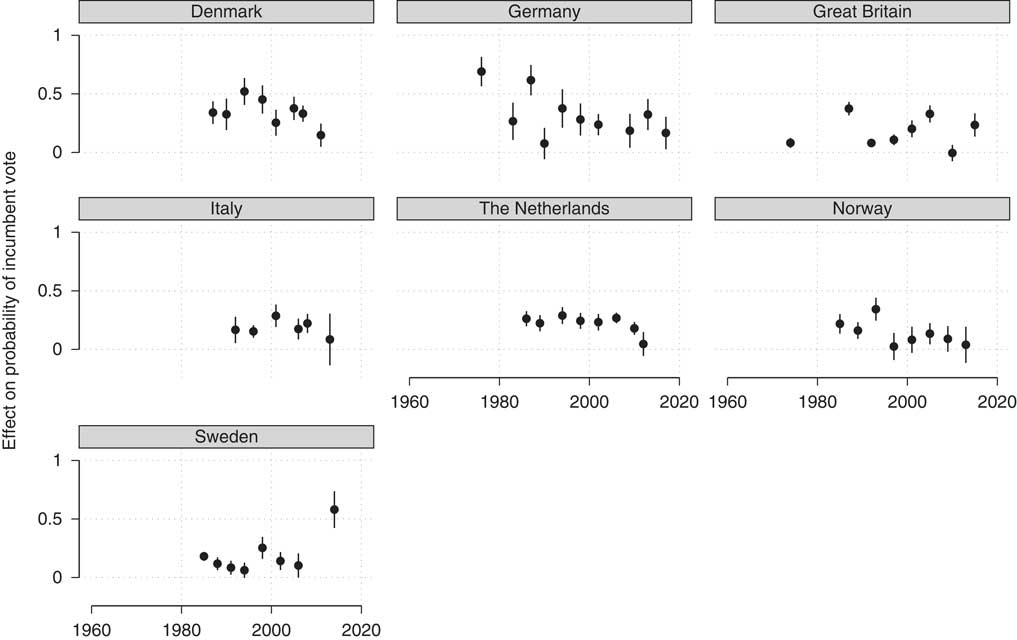
Consider now the effects from the economic evaluation variable. The economic voting coefficients appear to vary. To give the results more clarity, we present average effects based on these estimations (Figure 1). If dealignment causes changes in the impact of economic evaluations on the vote choice, we would not expect this change to occur at the same time in different countries in our sample (Franklin et al., Reference Franklin, Mackie and Valen2009). The results of the elections-specific analyses that are plotted in Figure 1 are particularly useful for capturing such country-specific trends.
Effect of the economy on the incumbent vote. Average effect (and 95% confidence intervals) on probability of voting for the incumbent as economic evaluation moves from least to most positive. Based on estimates of 56 election-specific models, reported in Appendix 3.

We plot, for each election, the change in probability of an incumbent vote, as the voter moves from the most negative to the most positive economic evaluation. Eyeballing the graphs, our country-specific analyses do not show a clear trend in the economic vote over time. In some countries, the economic vote tends to weaken somewhat; see, for example, the trends in the Netherlands and Norway. In other countries, there is somewhat of a surge, like in Sweden. Overall, then, the graphs show fluctuation in the economic vote, but no trend. Indeed, estimating the Pearson correlation between these estimates and time, none of them is significant (P-values vary between 0.083 in Sweden and 0.893 in Great Britain). However, these graphs offer only preliminary assessments, which await the necessary statistical testing below.
Micro-analysis: the pool
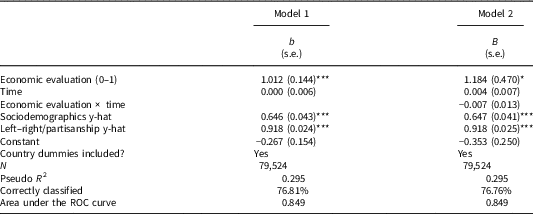
The country-by-country analyses do not signal an increasing economic vote over time. To fortify this observation, we now pool the 56 election surveys. As a preliminary sounding, we correlate economic evaluation with real incumbent vote share, across all elections. We find that r=0.204, suggesting an economic vote worth pursuing. Our multivariate results, in Table 1, further support the presence of economic voting in these seven nations. Start with Model 1, where economic evaluation carries a coefficient of 1.012, easily reaching statistical significance (P<0.001). Interestingly, this coefficient comes close to the estimate (of 1.1) that Nadeau et al. (Reference Nadeau, Lewis-Beck and Bélanger2013) obtain in a different European sample. Our results not only show economic evaluations significantly affect incumbent voting; they also show a substantial effect. As evaluations move from the most negative to the most positive, the voter probability of choosing an incumbent party more than doubles (the odds ratio, not reported in the table, is 2.752).
Explaining the incumbent vote – individual-level binomial logit estimations (since 1974)

Standard errors in Model 1 and Model 2 are robust for seven country-clusters. Significance levels: *P<0.05; ** P<0.01; *** P<0.001.
ROC= receiver operating characteristic.
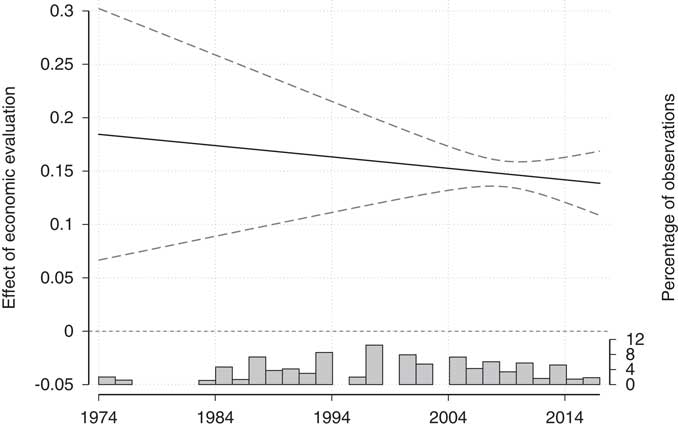
Having confirmed that these European voters are economic voters, we turn to whether the strength of economic evaluations has changed over time. We begin with Model 2, adding an interaction term between economic evaluation and time (years since 1970). The results do not reveal signs of an over-time change in economic evaluation impact. A negative interaction effect between time and GDP growth rates is hinted at, but this interaction term does not come close to significance.Footnote 15 This general finding of no significant interaction is evident from Figure 2, where we plot the average effect of economic evaluations on the probability of voting for the incumbent over time (as estimated in Model 2). While confidence intervals are somewhat wider at the start of the time series, the plot quite clearly conveys the stability of the economic voting coefficient over time.
Impact of economic evaluations on voting for the incumbent. Average effect (and 95% confidence intervals) on probability of voting for the incumbent as economic evaluation moves from least to most positive. Based on estimates of Model 2 in Table 1.

We probed the robustness of these results when controlling for the effective number of parties in an election (see Appendix 4). This is an important test in the context of our analysis on temporal change, because party systems in Western Europe have become more fragmented over time (Mair, Reference Mair2006). Regardless of the model, the results do not yield a significant over time change in the weight of the economic voting coefficient. In none of the models does the interaction coefficient even approach a conventional significance level, despite the large sample size.
Thus, our individual-level analyses confirm the importance of economic evaluations on the vote choice in these European nations. With few exceptions, in the country-by-country analyses economic evaluations are significant predictors of the incumbent vote. The pooled analysis further confirms the electoral importance of these economic evaluations. With respect to the temporal dimension of the economic vote, we find no significant trend. The strength of the economic vote remains unchanged, for these elections across this expanse of time.
The macro level
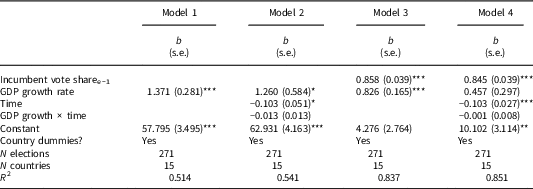
Even though our micro-level findings stand up to various operationalizations, they are not free of criticism. After all, they base themselves on the respondent’s subjective perception of the economy, rather than on an objective economic measure (Kramer, Reference Kramer1983). In response, we directly investigate how the national incumbent vote responds to the objective economic indicator of GDP growth, in this way again addressing a potential ‘micrological fallacy’ in the individual-level research (Dassonneville and Lewis-Beck, Reference Dassonneville and Lewis-Beck2014a). First, we establish whether a baseline economic vote exists at the macro level. The straightforward model estimated in Model 1 (Table 2) shows that GDP growth rates are significantly related to the vote share of incumbents. Its slope registers statistical significance and carries a substantive value of about 1.4. That is, a one percentage point increase in GDP growth generates more than a one percentage point in increase in incumbent support. The magnitude does show some reduction, as expected, once a lagged dependent variable serves as a control, but it remains highly significant at 0.001 (Model 3, Table 2). Moreover, this estimated impact of GDP growth rates remains larger than that found earlier by Dassonneville and Lewis-Beck (Reference Dassonneville and Lewis-Beck2014a). For these Western European democracies, we can safely conclude that the state of the national economy – as reflected in GDP growth rates – generally affects how incumbents fare on election day.
Explaining the incumbent vote share in Western Europe (since 1950)

Ordinary least squares (OLS) regression with panel corrected standard errors (PCSE), estimated through xtpcse in Stata. Significance levels: *P<0.05; **P<0.01; ***P<0.001. e−1 refers to the previous election.
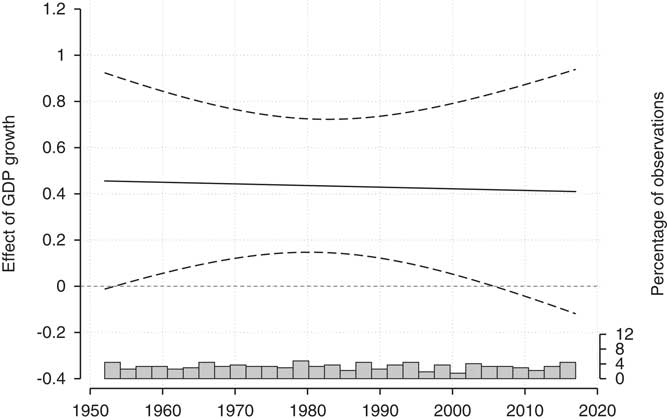
Granting the presence of a macro-level economic vote, we can now explore its change. Has it strengthened over time, as our leading hypothesis suggests, or has it weakened? To answer, we estimate Equation (3), with its interaction term between GDP growth rates and time. If our H1 is right, we should find a positive and significant interaction term, implying an increase in the electoral impact of GDP growth. However, as evident from Model 2 in Table 2, the interaction coefficient is negative and far from a conventional significance level. The same holds when including a lagged dependent variable; the interaction coefficient becomes positive, but still falls well-short of statistical significance (Model 4). These results again suggest that, while economic voting exists in Western Europe, it has not grown stronger or weaker over time. This stability of the impact of GDP growth rates on the incumbent vote share is evident from Figure 3, where we plot the average marginal effect of a one-unit increase in GDP on the incumbent vote share. Over the extended time period covered by our macro-analyses, there are no indications of a significant shift – either upwards or downwards – in the economic vote.
Impact of GDP growth on incumbent vote share. Average effect (and 90% confidence intervals) of a one unit increase in GDP growth on incumbent vote share. Based on estimates of Model 4 in Table 2.

The macro-analyses presented here cover a longer period of time and a larger number of democracies compared to our individual-level analyses. Therefore, as an additional test, we limited the aggregate-level analyses to elections since 1974, the actual time frame of our micro-analyses (see Appendix 5). The effect of GDP growth on incumbent vote share still travels in the expected direction. More importantly, our main conclusion holds: the economic vote coefficient does not change significantly over time.
Further challenges
Our aggregate-level analyses match our individual-level ones, showing the absence of a changing temporal dimension in economic voting. This inference appears quite solid, standing up to multiple tests and alternative specifications. But other challenges could, and should, be raised. First, the clarity of responsibility hypothesis must be more directly considered. For the economic vote to be operative, attribution theory dictates that the voter must assign praise (or blame) to the government for the state of the economy (Marsh and Tilley, Reference Marsh and Tilley2010). Given that necessary condition, it could be that a shifting clarity of responsibility pattern over time has confounded the observed economic voting pattern. For example, perhaps the apparent lack of change in the economic vote has occurred because of parallel, off-setting, changes in the composition of incumbent coalitions. In the face of that possibility, statistical control on clarity of responsibility is called for.
Therefore, we have verified whether our conclusions hold when controlling for variables that directly capture two established measures of clarity of responsibility for the economy (Powell and Whitten, Reference Powell and Whitten1993; Anderson, Reference Anderson2000; Dassonneville and Lewis-Beck, Reference Dassonneville and Lewis-Beck2017). We replicated the models presented in Table 2, with the addition of a measure of the effective number of parties, plus indicators of whether the government is a coalition, whether it is a minority government, and the number of parties in government. We also account for different degrees of federalism in the countries in our sample by means of the Regional Authority Index. Furthermore, because the clarity of responsibility thesis implies interaction effects, we examine the impact of these variables when they form product terms with GDP (see Appendix 6 for these results). These results do not give indications of a strong moderating impact of indicators of clarity of responsibility, confirming the current findings of Dassonneville and Lewis-Beck (Reference Dassonneville and Lewis-Beck2017). More importantly, the earlier results stand, for there is still no sign the economic voting coefficient has changed significantly since 1950.
Third, some might challenge our estimates because the dependent variable is the incumbent (coalition) vote. Some argue economic voting in multiparty systems is directed mainly at the lead party, with junior coalition parties not being blamed or rewarded for economic conditions (Debus et al., Reference Debus, Stegmaier and Tosun2014; Larsen, Reference Larsen2016). We thus further probed the robustness of our findings by re-estimating the individual- and aggregate-level models with the dependent variable as vote for the lead party only. These results, reported in Appendix 7, yield essentially the same conclusions. That is, we find no indications of a significant change in the economic vote, over time. In addition, we have estimated multinomial logit models on the individual-level data as well, to take into account the fact that most elections included in our dataset are in multiparty democracies (Alvarez and Nagler, Reference Alvarez and Nagler1998). Again, conclusions were essentially the same (see Appendix 8).
A next challenge relates to our model specification, in which we assume time to have a linear effect on the economic voting coefficient. This modeling choice is based on theoretical expectations, as the changes in voting behavior observed in Western Europe tend to proceed gradually and are conceived of as driven by a process of generational replacement (see, e.g., Walczak et al., 2012). However, to allow for the possibility of non-linear effects in the strength of the economic vote, we also estimated the impact of time by including decade dummies in the analyses. The expectation, then, would be that only in the more recent decades, can we observe a significant shift in the strength of the economic vote. This expectation is not substantiated by the results of these analyses, which are reported in Appendix 9.
Finally, we have verified whether there are indications of a decline in the economic vote when we model the impact of objective economic conditions (GDP growth) on individuals’ likelihood of voting for the incumbent – merging a macro-indicator with our individual-level data. As evident from the results in Appendix 10, these analyses do not suggest a significant over-time trend in the impact of the economy on the vote either.
In sum, we have challenged our results in different ways, adding more controls, changing specifications, and as well the operationalization of the dependent and key independent variables. Across all these additional tests, however, the same essential finding persists: the economic vote holds steady over time.Footnote 16
Discussion
Certain electoral scholars have claimed that long-term social and political forces are loosening their hold on the European voter. In particular, the election ties of socio-demography and partisanship seem diminished. Given this situation, more space emerges for the play of short-term forces, such as issues, or party leaders. With respect to the issue of the economy in particular, it has been hypothesized that the economic vote has gained strength. Voters, so the argument goes, are now liberated from their long-standing social and political bonds, and can act independently and with clarity, to reward or punish incumbents. While this argument has considerable appeal, so does the counter-argument that the economic vote has declined, because of globalization in general and European integration in particular. Going against both these rival hypotheses is the time-honored contention that, underneath it all, the economic vote endures as a stable force, operating on the voter in essentially the same way.
To test these competing hypotheses, we have investigated the vote at two levels, the individual and the aggregate. At the individual level, we have utilized national election studies, reasoning that they serve as a ‘gold standard’ for measuring voting behavior. Relatedly, we have focused on national election studies that are consistent over a long-time series. Working within these guidelines, we managed to assemble respectable time series on national elections in seven nations.
Our basic analytic strategy has been to estimate the economic vote, while imposing strong statistical controls on the long-term forces of social structure and partisanship. A consistent finding emerges, in the face of rigorous and diverse testing procedures: there exists here no temporal trend in the economic vote. Instead, the economic vote acts as a stable force in the electorate, a force that, though short-term, continues to be statistically and substantively significant.
Thus, our analyses suggest that the economic vote is stable. Can we also explain why the strength of the economic vote has remained stable? Setting aside the difficulty of explaining what would effectively be a constant, we can offer a few promising ideas. Some studies expect the economic vote to increase over time, because of the presence of electoral dealignment. The erosion of close connections between citizens and parties allows voters to move around more freely, and to hold incumbents accountable. The opposite hypothesis, of economic voting weakening over time, finds its origins in the expectation that in an increasingly globalized world citizens realize their national incumbents are not responsible for economic conditions, diluting the strength of the national economic vote. Two scenarios can explain why, despite these theoretical expectations, we find the economic vote to be stable over time. First, it may be that neither of the two mechanisms – dealignment or globalization – is working as hypothesized. Second, it may be that both are at work but with their opposite effects counterbalancing, so yielding an overall stability of the economic vote.
A number of additional analyses, reported in detail in Appendix 11, favor the former scenario, that the two mechanisms are not working in the hypothesized way. Our data confirm that strong anchoring to a party weakens the economic vote; that is, we find a statistically significant and negative voting effect when interacting the left–right or partisanship y-hats with economic evaluations. However, we find no indications that the importance of these anchorage variables is weakening over time. Hence, there is no need for their impact to be compensated by other, short-term, factors such as evaluations of the state of the economy. The story is somewhat different for socio-demographics. Our estimates confirm that the impact of socio-demographic factors is in decline, but these factors do not appear to inhibit the economic vote. As a result, the decline of their effect will not translate into a stronger economic vote. Second, we do not find strong evidence for the second – alternative – mechanism, according to which increasingly open economies weaken the economic vote. Even though we effectively observe that economies in our set of seven countries are becoming more open, the data offer no indications of economic globalization significantly weakening the economic vote longitudinally. While both theoretically plausible, neither of the mechanisms appears to effectively generate a change in the economic vote, thereby resulting in its reported over-time stability. (Of course, this conclusion still permits the mechanisms to be operating cross-sectionally, as reported in the literature.)
What does that stability mean exactly, in terms of statistics and substance? First, with respect to the statistical process, the economic vote coefficient represents a population parameter that, when estimated, has naturally occurring variance around it. To clarify, consider the distribution of the 56 separate economic voting effects (the probability change in incumbent vote) estimated in our defining micro-level model (see Model 1, Table 1 and Figure 1). More specifically, the underlying logit coefficient, with its intrinsic nonlinearity, implies a log-normal distribution (Kmenta, Reference Kmenta1997, 449–451, 512–514). This argument receives support from the Shapiro–Wilk test for normality applied to the logit coefficient (logged); W =0.96, V=1.98, z=1.46, P=.07; thus we cannot reject the null hypothesis of normality. Across different surveys, we would expect a roughly normal fluctuation in this value. However, this fluctuation would largely arise out of the error that inevitably occurs from measuring and sampling. Such errors make the economic voting coefficient appear to move, to be unstable. But, this instability is only apparent, not inherent.
Speaking substantively, what does this economic voting effect mean? In translating the logistic coefficient, we can expect the probability of an incumbent vote to increase by about 23 percentage points, when the citizen’s economic evaluation changes from the extremes of ‘worse’ to ‘better’. How is it, one might ask, that this value seems ‘so fixed’ across space and time? An analogy might be enlightening here. Suppose a health researcher, Dr Sally Smith wants to account for body weight differences in a sample of Western European adults. Her main concern involves the impact of calorie intake (X variable) on body weight (Y variable). But she knows she cannot get an accurate assessment without including other controls, such as exercise, age, etc. (Z variables). By careful specification, sampling, and measurement, she can arrive at a slope estimate of the population parameter, β, for X. [See the extremely valuable example of a well-specified model to estimate human weight in Berry (Reference Berry1993, pp. 13–18).] We would not expect the estimates of β (i.e., the b estimates from different samples) to be unchanging across countries and years. However, we would expect there to be a ‘real’, fundamentally unchanging number, at the center of this distribution of sample values. This population parameter estimate serves as a helpful piece of information for health professionals. In similar fashion, it could be helpful for policy makers, politicians, and citizens to know what tends to happen to government support, when voters increase their economic negativity. The estimated economic effect in the study at hand tells us that.
Conclusion
Our essay began with the question, what has happened to the economic vote over time? Has its magnitude increased, decreased, or stayed the same? Current scholarly opinion perhaps gives the nod to the first idea – that the economic vote has increased its impact. The appeal of that hypothesis comes from the view that long-term forces acting on the electorate have weakened their hold. Given the loosening of these heavy social-psychological bonds, voters would be freed, almost in a Rousseauian sense, to express themselves as independent political agents. They would be, if you will, tabula rasa, able to absorb the arguments and facts of debate without bias, able to weigh them and choose fairly their preferred parties and candidates. As they evaluate the politics of the moment – issues of the short-term, such as corruption, crime, the economy, it is the last that looms largest. The economy usually occupies most attention because a good economy provides the fundamental material well-being of a society; but also because economic conditions swing from boom to bust, so providing the considerable variance necessary to make or break governments.
These economic truths seem painfully obvious, of course, in times of crisis. But a confusion lies at the bottom of this truth, a confusion clarified here. During a crisis period, the economic vote remains strong. But, paradoxically, it is no stronger, at the level of individual voter mechanics, than before the crisis. Consider that, on the basis of our estimates, the probability of an incumbent party vote drops about 23 percent, when the voter’s economic perception shifts from clearly positive to clearly negative. That number – about 23 percent – stays stable over the period. Still it means that, as the national economy worsens, more voters select the ‘worse’ category when asked to evaluate performance. This explains why, in a crisis, the government loses more votes and may even be toppled. It also explains why, in an economic crisis, the economic vote appears stronger. But that is illusory; it is not stronger, it is just steady. With more and more seeing the economic collapse, negative evaluation comes to be, overwhelmingly, the dominant category, pushing more citizens to vote against the government. These micro-actions, based on a simple rule of economic voting behavior, can lead to massive macro-shifts when they are plentiful, as we have seen in the political economies of post-2008 Europe.
Our results offer no indications of over-time change in the economic vote. In addition, and perhaps even more surprisingly, our analyses do not offer strong indications that the mechanisms that are supposedly altering the effect of the economic vote over time are at work at all. We do not find indications that processes of globalization weaken the economic vote, nor that cleavage attachments inhibit economic voting. These are highly important findings, for these null results highlight the need for more research on change and stability in electoral behavior. A large number of studies have documented important trends of changes in voters’ behavior, as evident from declining levels of participation, higher levels of undecidedness, more volatility, and an erosion of partisanship. Despite these changes, the economic vote appears stable. This raises the question whether the economic vote is exceptionally stable, compared to other short-term forces such as leaders, or issues. We will pursue this topic in future work.
Acknowledgments
Previous versions of this paper were presented at the 2014 Belgian-Dutch political science conference in Maastricht, at the ‘Accountability without parties ?’ workshop at the 2015 ECPR Joint Sessions in Warsaw, at a symposium on Electoral Behaviour organized by the Vereniging voor Politieke Wetenschappen (VPW) and the Association Belge de Science Politique (ABSP) in Brussels and at the 2016 General Conference of EPSA in Brussels. We thank participants at all these events for their suggestions and are particularly grateful to Tim Hellwig, Dani Marinova and Martin Rosema for commenting on previous drafts of this paper.
Supplementary material
To view supplementary material for this article, please visit https://doi.org/10.1017/S1755773918000231