Introduction
Many pycnogonids are ectoparasites of benthic invertebrates. Even gastropods are on their menu (reviewed in Dietz et al. Reference Dietz, Dömel, Leese, Lehmann and Melzer2018). It is somewhat ironic that a marine gastropod, Dickdellia labioflecta (Dell, 1990), might have reversed this principle. Hedgpeth (Reference Hedgpeth1964), Sirenko (Reference Sirenko2000) and Schiaparelli et al. (Reference Schiaparelli, Olivero, Taviani, Griffiths, Lörz and Albertelli2008) observed clutches of eggs and young Dickdellia snails on pycnogonids. Sirenko (Reference Sirenko2000) suggested that this might be a case of ectoparasitism and not just phoresy.
Lehmann et al. (Reference Lehmann, Gailer, Melzer and Schwabe2007) studied Dickdellia eggs and juveniles attached to a male Colossendeis megalonyx Hoek, 1881 and found sections of the sea spider's cuticle under larger Dickdellia individuals in which the distal cuticle layers were absent. These sections seemed to open up the interior of the pycnogonid, and thus were a potential channel of nutrition for the snails. These sections were absent under small embryos, indicating that they had been rasped by the developing snails. Lehmann et al. (Reference Lehmann, Gailer, Melzer and Schwabe2007) concluded that the snails might indeed be ectoparasites.
However, the ectoparasitism hypothesis needs more evidence to become a theory. We have therefore reanalysed the specimens and measured stable isotope contents of both snails and ‘host’ pycnogonids. Stable isotopes have been used to infer trophic levels for various marine invertebrates (Post Reference Post2002). We thus hypothesized that a parasitic relationship between Dickdellia and Colossendeis would leave different isotopic fingerprints from, for example, phoresy.
Materials and methods
We removed tissue samples from embryos and small and large juveniles of Dickdellia attached to the male C. megalonyx from Lehmann et al. (Reference Lehmann, Gailer, Melzer and Schwabe2007) (collection number ZSM Mol 20021231) and from an adult Dickdellia from the same sample event (collection number ZSM Mol 20020906). Moreover, we took samples from C. megalonyx cuticles and leg contents, again from the same specimen that had been the ‘host’ of the Dickdellia individuals. Results are given in δ notation relative to international standards (δ15N: AIR, δ13C: VPDB), where δ = (Rsample - Rstandard)/Rstandard given in ‰. Isotope ratios (R) were determined with an isotope ratio mass spectrometer (Delta Plus, Thermo Finnigan) coupled with an elemental analyser (NC 2500, Carlo Erba) and calibrated with a laboratory standard (peptone) of known composition (δ15N = 4.93‰, δ13C = -23.80‰). Carbon and nitrogen contents were calculated from ratios of peak areas vs sample weights using standards (atropine, cyclohexanone 2,4-dinitrophenylhydrazone). A low-weight sample outside of the linearity range (two pooled embryos) was corrected with standards of similar weight. The precision (1 SD) of the isotope analyses was better than 0.2‰, except for the low-weight samples, for which 0.4‰ is a typical error.
Results and discussion
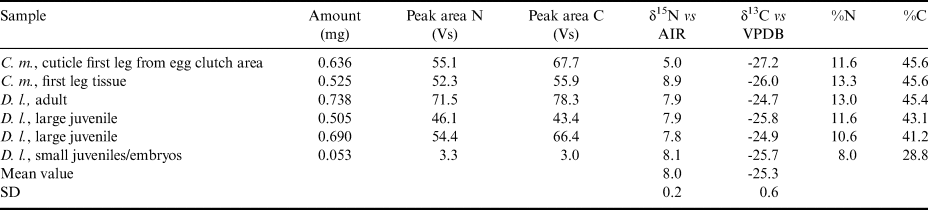
All results are given in Table I. We found almost the same δ15N values for large juveniles and adult Dickdellia individuals (7.8–7.9‰), while the embryos had a slightly higher δ15N value (8.1‰). Compared to this, the Colossendeis sample δ15N values were 5.0‰ for the cuticle and 8.9‰ for the leg muscle, thus differing by almost 4‰. The δ15N values of Dickdellia, at first sight, do not fit with the assumption of Dickdellia feeding on Colossendeis, given the frequently used trophic 15N enrichment of ~3‰ of an animal relative to its food (Peterson & Fry Reference Peterson and Fry1987). However, the values make more sense if the life history of Dickdellia is considered. Lehmann et al. (Reference Lehmann, Gailer, Melzer and Schwabe2007) suggested that Dickdellia individuals might feed on the pycnogonids by rasping their cuticles and sucking out their body contents. Hence, their food would be a mix of both sources, and the expected δ15N values of the hosts would be approximately the average of both tissues (i.e. ~7‰). For molluscs, Vanderklift & Ponsard (Reference Vanderklift and Ponsard2003) have inferred a 15N enrichment of only ~1‰ in the consumer relative to its food. This would mean that Dickdellia individuals feeding on both tissue types of Colossendeis would exhibit δ15N values pf ~8‰, which corresponds to the values we found for large juveniles and the adult. These stages were taken from rasped cuticle areas, and the adult is supposed to show the same δ15N value, as it should have had the same feeding type as the large juveniles. Conversely, the small juveniles or embryos have been taken from an unrasped cuticle section; in other words, they were not yet consuming a pycnogonid diet. Instead, they should have had a lecithotrophic past within the eggshell, and their δ15N value should be that of a Dickdellia consumer (i.e. ~8.8‰), which fits within analytical error (2 s = 0.8‰, low-weight sample). Various isotope ratios of host tissue and blood have been recorded for other ectoparasite–host associations as well (Demopoulos & Sikkel Reference Demopoulos and Sikkel2015).
δ15N and δ13C values of Dickdellia and Colossendeis samples.

C. m. = Colossendeis megalonyx, D. l. = Dickdellia labioflecta.
The δ13C values were more variable among individuals of Dickdellia and ranged between -24.7‰ and -25.8‰. The reason for this is unclear, but it might be related to traces of carbonate (shell fragments, radula). Carbonate δ13C values of an organism's shell are typically much higher than those of its tissue. This could explain why the snail δ13C values were slightly higher than the values of the potential host (-26.0‰ and -27.2‰), which could also be explained by a small trophic carbon isotope enrichment (Peterson & Fry Reference Peterson and Fry1987).
The measured δ15N values thus fit with a life history of Dickdellia as a Colossendeis parasite and not with a life history of a phoretic snail. However, our preliminary data are no more than a hint, because we used only a single Dickdellia egg cluster on a single Colossendeis, and this per se cannot lead to highly significant results. On the other hand, it is noteworthy that all of these data come from only one Dickdellia–Colossendeis sample and thus depict a real example of such an association.
Our results point to the necessity of checking for differences in the isotopic signatures of tissues potentially consumed by ectoparasites and of determining trophic fractionation values for individual taxonomic groups in future studies.
Acknowledgements
We thank the sorting teams, the crew of Research Vessel (RV) Polarstern during the ANDEEP cruises and two anonymous reviewers.
Author contributions
RRM, TL and CM designed and directed the project. CM performed the laboratory work. RRM, TL and CM analysed the data and wrote the text.