Implications
Milk yield and fertility are important dairy industry traits. Male reproduction performance (as semen quality) affects the conception rates in dairy cattle and is thus economically important, but the genetic relationships between semen production traits and yield or fertility traits in cows have not been investigated thoroughly. A bivariate animal model was used to examine the genetic correlations between cow milk yield or fertility and bull semen production traits. Moderate genetic correlations were notified between female fertility and progressive bull sperm motility (–0.42; or –0.43 after freeze-thawing). Selection focused on progressive sperm motility of bulls may improve female fertility.
Introduction
Selection to increase milk yield has increased the farm profits successfully but it has had negative effects on reproduction (Pritchard et al., Reference Pritchard, Coffey, Mrode and Wall2013). Because of its importance, female fertility is now included in breeding selection programmes in many countries (Miglior et al., Reference Miglior, Muir and Van Doormaal2005; Phillipsson, Reference Phillipsson2011). Male reproductive performance represented by semen quality traits affects also the conception rate and is thus economically important. The need to improve reproductive efficiency has therefore increased interest in both male and female fertility traits (Atagi et al., Reference Atagi, Onogi, Kinukawa, Ogino, Kurogi, Uchiyama, Yasumori, Adachi, Togashi and Iwata2017). Semen production traits have been reported to have higher heritabilities than female fertility traits (Ducrocq and Humblot, Reference Ducrocq and Humblot1995; Mathevon et al., Reference Mathevon, Buhr and Dekkers1998a and Reference Mathevon, Dekkers and Buhr1998b; Druet et al., Reference Druet, Fritz, Sellem, Basso, Gerard, Salas-Cortes, Humblot, Druart and Eggen2009; Karoui et al., Reference Karoui, Diaz, Serrano, Cue, Celorrio and Carabano2011; Suchocki and Szyda, Reference Suchocki and Szyda2015). Therefore, semen production traits can be improved by appropriate selection of bulls.
In Japan, records of semen production performance in bulls are routinely collected by artificial insemination (AI) companies, and include data on volume per ejaculate, sperm concentration, number of sperm per ejaculate, and progressive motility of sperm. These traits are affected by some environmental factors, such as age of the bull, season of semen collection and collection interval (Karoui et al. Reference Karoui, Diaz, Serrano, Cue, Celorrio and Carabano2011). Kawakami et al. (Reference Kawakami, Hanamure, Hagiya, Hayakawa, Baba and Suzuki2016) and Atagi et al. (Reference Atagi, Onogi, Kinukawa, Ogino, Kurogi, Uchiyama, Yasumori, Adachi, Togashi and Iwata2017) reported heritabilities and repeatabilities of semen production traits of Holstein bulls in Japan. Also, the genetic correlations between semen production traits have been investigated, and moderate or high genetic correlations have been reported between volume or sperm concentration and number of sperm per ejaculate (Druet et al., Reference Druet, Fritz, Sellem, Basso, Gerard, Salas-Cortes, Humblot, Druart and Eggen2009; Suchocki and Szyda, Reference Suchocki and Szyda2015). Selection to improve semen production traits and examining their effects on economically important traits measured in cows such as milk yield and fertility, are important. Female fertility traits are influenced by hormones such as gonadotropin-releasing hormone. Increased levels of these hormones in bulls are associated with increased sperm motility and sperm volume (Mishra et al., Reference Mishra, Palai, Sarangi, Prusty and Maharana2013). However, the genetic relationships between semen production traits and yield or fertility traits in cows have not yet been thoroughly investigated.
Here, the main aim of the present study is to elucidate the genetic correlations between in cow’s milk yield or fertility and bull’s semen production traits using a bivariate animal model.
Material and methods
Data
A pedigree file containing records of 885 345 animals (including the five generations preceding the cows in this study) was obtained from the Holstein Cattle Association of Japan, Hokkaido Branch (Hokkaido, Japan).
First lactation records of 305-day milk, fat, and protein yields and days open (DO) of Holstein were provided cows between 2008 and 2014 from the Hokkaido Dairy Milk Recording and Testing Association (Sapporo, Japan). The calving age of the first lactation was 18 to 35 months and the total number of records was 386 809 for yield traits and 379 889 for DO.
The semen production records were also provided by Genetics Hokkaido (Sapporo, Japan) during the period from 2005 to 2014 and the data collected were: semen production volume per ejaculate (VOL, ml), sperm concentration (CON, ×108/ml), number of sperm per ejaculate (NUM, ×108), progressive motility index of sperm (MOT), and MOT after freeze-thawing (A-MOT). Number of sperm per ejaculate was log-transformed into an NUM score (NUMS) by using a formula similar to that of Ali and Shook (Reference Ali and Shook1980) to obtain the somatic cell score, that is NUMS=log2(NUM+0.5)/108)+3. MOT and A-MOT were microscopically evaluated visually by trained technicians. The ejaculate was usually collected from the bulls once or twice a week, and the collection was attempted up to three times on each collection day. The bull age varied from 10 to 123 months and the total number of semen production trait records was 30 373 from 1196 bulls. Of these bulls, 558 had daughters with yield records (ranging from 1 to 11 663; average 285). Data of sexed semen had been removed.
Model of analysis
Genetic correlations were estimated from the combined analysis of a bivariate animal model. The first model was applied to the female records (yield or DO) and the second model was applied to the male traits. The animal model for cow’s milk yield or DO was as follows:
 $$y_{{ijk(l)m}} \,{\equals}\,{\rm HY}_{i} {\plus}M_{j} {\plus}A_{k} {\plus}\left( {s_{l} } \right){\plus}u_{m} {\plus}e_{{ijk(l)m}} $$
where y ijk(l)m is the observation for yield traits or DO; HY i the fixed effect of herd-year i of calving (28 596 subclasses with an average of 13.5 records and at least two records in each subclass); M j the fixed effect of month j at calving (12 calendar months); A k the fixed effect of age k of cow (18 subclasses); s l the fixed effect of service bull l at first insemination on DO (2238 subclasses); u m the random additive genetic effects of cow m; and e ijk(l)m the random residual effects.
Nishimura et al. (Reference Nishimura, Honda and Oyama2010) and Kawakami et al. (Reference Kawakami, Hanamure, Hagiya, Hayakawa, Baba and Suzuki2016) used fixed linear and quadratic covariates for bull age at the time of sample collection to estimate genetic parameters for semen production traits in Japan. Therefore, we applied the following animal model to semen production traits:
 $$\eqalignno{ y_{{ijklmnopq}} \,&{\equals}\,S_{i} {\plus}Y_{j} {\plus}\mathop \sum\nolimits_{t{\equals}1}^2 f_{{ks}} \left( {A_{k} } \right)^{s} {\plus}M_{l} {\plus}N_{n} {\plus}C_{o} {\plus}t_{p} \cr &\ \ {\plus}pe_{m} {\plus}u_{m} {\plus}e_{{ijklmnopq}} $$
where y ijklmnopq is the observed semen production traits; S i the fixed effect of the insemination station i of bull (two subclasses); Y j the fixed effect of year j of insemination (10 subclasses); A k the age k of bull in months; f ks the fixed regression coefficients of order s using a second-order polynomial; M l the fixed effect of collection month l (12 calendar months); N n the ejaculation attempt n on each day (three subclasses); C o the semen collection method o (two classes: use of either a breeding mount or an animal as a teaser); t p the random effect of technician p on semen collection (27 subclasses); pe m the random effect of permanent environment of animal m; u m the random additive genetic effect of animal m and e ijklmnopq the random residual effects. For cows (bulls), all bull’s (cow’s) traits were missing phenotypic values. The covariance structure of random effects was defined as:
 $${\rm var}\left[ {\matrix{ {\matrix{ b \cr t \cr p \cr } } \cr {\matrix{ u \cr e \cr } } \cr } } \right]\!{\equals}\! \left[ {\matrix{ {SB\,\otimes\,{\rm I}} & 0 & 0 & 0 & 0 \cr 0 & {T\,\otimes\,{\rm I}} & 0 & 0 & 0 \cr 0 & 0 & {P\,\otimes\,{\rm I}} & 0 & 0 \cr 0 & 0 & 0 & {G\,\otimes\,A} & 0 \cr 0 & 0 & 0 & 0 & {R\,\otimes\,{\rm I}} \cr } } \right],$$
 $$SB{\equals}\left[ {\matrix{ 0 & 0 \cr 0 & {\sigma _{{SBm}}^{2} } \cr } } \right],\,T{\equals}\left[ {\matrix{ 0 & 0 \cr 0 & {\sigma _{{tm}}^{2} } \cr } } \right],\,P{\equals}\,\left[ {\matrix{ 0 & 0 \cr 0 & {\sigma _{{pem}}^{2} } \cr } } \right]$$
 $$G{\equals}\left[ {\matrix{ {\sigma _{{af}}^{2} } & {\sigma _{{af,am}} } \cr {\sigma _{{af,am}} } & {\sigma _{{am}}^{2} } \cr } } \right],\,R{\equals}\left[ {\matrix{ {\sigma _{{ef}}^{2} } & 0 \cr 0 & {\sigma _{{em}}^{2} } \cr } } \right]$$
where SB, T, P and G are (co)variance matrices for service bull effect, technician effect, permanent environmental effect and additive genetic effect, respectively; R is a 2×2 residual variance matrix; A is the matrix of additive relationships among animals; I is an identity matrix;
 $\sigma _{{SB}}^{2} $
,
 $\sigma _{t}^{2} $
,
 $\sigma _{{pe}}^{2} $
,
 $\sigma _{a}^{2} $
and
 $\sigma _{e}^{2} $
are (co)variances of service bull effect, technician effect, permanent environmental effect, additive genetic effect, and the residual, respectively; subscripts f and m are cow’s traits and bull’s traits, respectively; and ⊗ is the Kronecker product.
The GIBBS2F90 program (Misztal et al., Reference Misztal, Tsuruta, Strabel, Auvray, Druet and Lee2002) was used for Gibbs sampling for the linear models. A flat prior was used for fixed effects, and an inverted Wishart distribution was used as the prior on the random effects. For each analysis, 100 000 samples (saving every 10th sample after a burn-in of 50 000 iterations) were used to calculate the posterior means and standard deviations of the (co)variance components. Convergence was determined from a visual inspection of the plotting of Gibbs samples.
Results and discussion
Summary statistics
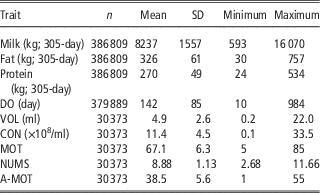
Means of milk, fat, protein, DO and semen production traits are shown in Table 1. Milk yield (8237 kg) and DO (142 days) were in agreement with those recently reported (ranging from 8080 to 8608 kg for milk yield and 144 days for DO) in Holstein cows in Japan (Yamazaki et al., Reference Yamazaki, Hagiya, Takeda, Yamaguchi, Osawa and Nagamine2014; Hagiya et al., Reference Hagiya, Hayasaka, Yamasaki, Shirai, Osawa, Terawaki, Nagamine, Masuda and Suzuki2017). Number of sperm per ejaculate was 58.6×10⁸ (giving a NUM of 8.88 after the application of an exponential calculation). The semen production traits VOL (4.9 ml), CON (11.4×10⁸/ml), and NUM were within the ranges of 4.1 to 5.5 ml for VOL, 10.8 to 14.7×10⁸/ml for CON and 43.8 to 69.0×10⁸ for NUM as reported in the literature (Ducrocq and Humblot, Reference Ducrocq and Humblot1995; Druet et al., Reference Druet, Fritz, Sellem, Basso, Gerard, Salas-Cortes, Humblot, Druart and Eggen2009; Karoui et al., Reference Karoui, Diaz, Serrano, Cue, Celorrio and Carabano2011; Suchocki and Szyda, Reference Suchocki and Szyda2015).
Means, standard deviations (SD), and minimum and maximum values for milk, fat, protein, days open (DO), volume per ejaculate (VOL), sperm concentration (CON), progressive motility index (MOT), log-transformed number of sperm per ejaculate (×108) (NUMS), progressive motility index after freeze-thawing (A-MOT)

Heritability estimates
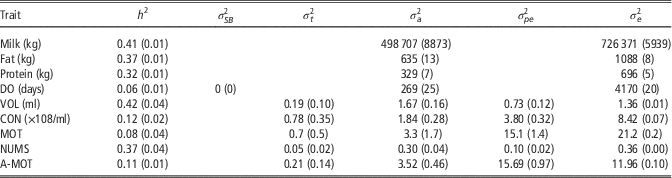
The heritability estimates for milk, fat, protein, DO and semen production traits are shown in Table 2. The heritability estimates for yield traits (0.41 for milk, 0.37 for fat and 0.32 for protein) and DO (0.05) were nearly similar to those in recent reports (ranging from 0.31 to 0.46 for milk yield, 0.29 for fat yield, 0.25 for protein yield and 0.07 for DO) for Holstein cows in Japan (Yamazaki et al., Reference Yamazaki, Hagiya, Takeda, Yamaguchi, Osawa and Nagamine2014; Hagiya et al., Reference Hagiya, Hayasaka, Yamasaki, Shirai, Osawa, Terawaki, Nagamine, Masuda and Suzuki2017; Uemoto et al., Reference Uemoto, Osawa and Saburi2017).
Posterior means (with posterior standard deviations in parentheses) of heritability (h
2) and variances of service bull (
 $\sigma _{{SB}}^{2} $
), technician (
 $\sigma _{t}^{2} $
), additive genetic (
 $\sigma _{a}^{2} $
), permanent environmental (
 $\sigma _{{pe}}^{2} $
), and residual (
 $\sigma _{e}^{2} $
) for milk, fat, protein, days open (DO), volume per ejaculate (VOL), sperm concentration (CON), progressive motility index (MOT), log-transformed number of sperm per ejaculate (×108) (NUMS), progressive motility index after freeze-thawing (A-MOT)

For the semen production traits, posterior means of heritability were estimated for CON (0.12), MOT (0.08) and A-MOT (0.11). Karoui et al. (Reference Karoui, Diaz, Serrano, Cue, Celorrio and Carabano2011) reported similar estimates in Holstein bulls in Spain, with a CON of 0.19 and MOT ranging from 0.09 to 0.16. Ducrocq and Humblot (Reference Ducrocq and Humblot1995) estimated heritabilities in Normande bulls ranging from 0.37 to 0.39 for CON, from 0.23 to 0.35 for MOT, and from 0.24 to 0.30 for A-MOT. Kawakami et al. (Reference Kawakami, Hanamure, Hagiya, Hayakawa, Baba and Suzuki2016) reported heritabilities in Japanese Holstein bulls of 0.13 for CON, 0.11 for MOT and 0.20 for A-MOT. Atagi et al. (Reference Atagi, Onogi, Kinukawa, Ogino, Kurogi, Uchiyama, Yasumori, Adachi, Togashi and Iwata2017) also reported heritability estimates in Japanese Holstein bulls, but they used records of a different AI center from ours and obtained values of 0.09 for MOT and 0.15 for A-MOT; in Japanese Black bulls, their values were 0.08 for MOT and 0.12 for A-MOT. Nishimura et al. (Reference Nishimura, Honda and Oyama2010) obtained heritability estimates in Japanese Black of 0.05 for CON and 0.15 for MOT. The heritability estimates of the present study for CON, MOT and A-MOT were thus close to those obtained under the Japanese conditions by Nishimura et al. (Reference Nishimura, Honda and Oyama2010), Kawakami et al. (Reference Kawakami, Hanamure, Hagiya, Hayakawa, Baba and Suzuki2016), and Atagi et al. (Reference Atagi, Onogi, Kinukawa, Ogino, Kurogi, Uchiyama, Yasumori, Adachi, Togashi and Iwata2017). Al-Kanaan et al. (Reference Al-Kanaan, Konig and Brugemann2015) suggested that the additive genetic variances for semen production traits varied under different heat-stress conditions; thier highest heritabilities were estimated under extreme heat conditions. Heritability estimates for CON, MOT and A-MOT traits likely be influenced by environmental stress.
Moderate heritabilities were obtained as shown in the posterior means for VOL (0.42) and NUMS (0.37) (Table 2). In Holstein bulls, Mathevon et al. (Reference Mathevon, Buhr and Dekkers1998a) reported also moderate estimates for VOL (0.24 in young bulls and 0.44 in mature bulls) and NUM (0.38 in young bulls and 0.54 in mature bulls). Lower heritabilities were reported for VOL (0.22) and NUM (0.09) by Druet et al. (Reference Druet, Fritz, Sellem, Basso, Gerard, Salas-Cortes, Humblot, Druart and Eggen2009) and for VOL (0.22) and NUM (0.18) by Karoui et al. (Reference Karoui, Diaz, Serrano, Cue, Celorrio and Carabano2011). Suchocki and Szyda (Reference Suchocki and Szyda2015) reported an estimate of 0.26 for VOL and 0.27 for NUM. Atagi et al. (Reference Atagi, Onogi, Kinukawa, Ogino, Kurogi, Uchiyama, Yasumori, Adachi, Togashi and Iwata2017) obtained heritability estimates in Holstein bulls of 0.16 for VOL and 0.14 for NUM, and in Japanese Black bulls of 0.18 for VOL and 0.18 for NUM. Nishimura et al. (Reference Nishimura, Honda and Oyama2010) found that the heritability estimates in Japanese Black bulls were low for VOL (0.11) and for NUM (0.09). Relatively low estimates of 0.09 were reported in Hereford for VOL by Kealey et al. (Reference Kealey, MacNeil, Tess, Geary and Bellows2006). Mathevon et al. (Reference Mathevon, Dekkers and Buhr1998b) reported heritability estimates ranging from 0.08 to 0.49 for VOL and ranging from 0.12 to 0.15 for NUM in Montbeliard bulls. In Simmental bulls, Gredler et al. (Reference Gredler, Fuerst, Fuerst-Waltl, Schwarzenbacher and Solkner2007) reported an estimate of 0.18 for VOL and 0.22 for NUM. Ducrocq and Humblot (Reference Ducrocq and Humblot1995) reported higher estimates for VOL (0.65) in Normande bulls. Kawakami et al. (Reference Kawakami, Hanamure, Hagiya, Hayakawa, Baba and Suzuki2016) estimated lower heritability in Japanese Holstein bulls of 0.06 for NUM. Although they used records form the same AI center as ours, their heritability estimates were lower than ours for VOL and NUMS. In present study, data from sexed semen were deleted and pre-adjustment of variance was applied to NUM; this may explain the differences in the results.
Results in this study suggested that the estimated heritabilities for semen production traits were comparable with those of economically important traits such as milk yields or female fertility. Therefore, selection of semen production traits should be effective as described by Karoui et al. (Reference Karoui, Diaz, Serrano, Cue, Celorrio and Carabano2011) and Atagi et al. (Reference Atagi, Onogi, Kinukawa, Ogino, Kurogi, Uchiyama, Yasumori, Adachi, Togashi and Iwata2017).
Repeatability and ratio of technician variance to phenotypic variance
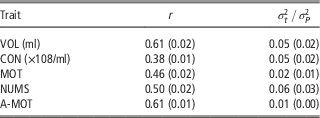
The posterior means of repeatability and the ratio of technician variance to phenotypic variance for semen production traits are shown in Table 3. The repeatability estimates ranged from moderate for CON (0.38) and MOT (0.46) to high for VOL (0.61), NUMS (0.50), and A-MOT (0.61). Mathevon et al. (Reference Mathevon, Buhr and Dekkers1998a) reported similar estimates ranging from 0.41 for NUM in young bulls to 0.64 for MOT in mature bulls in Canadian Holsteins. Kawakami et al. (Reference Kawakami, Hanamure, Hagiya, Hayakawa, Baba and Suzuki2016) reported posterior means of repeatability in Japanese Holstein bulls of 0.25 for VOL, 0.39 for CON, 0.61 for MOT, 0.16 for NUM and 0.72 for A-MOT. Atagi et al. (Reference Atagi, Onogi, Kinukawa, Ogino, Kurogi, Uchiyama, Yasumori, Adachi, Togashi and Iwata2017) likewise reported repeatability estimates in Japanese Holstein bulls (0.355 for VOL, 0.565 for MOT, 0.304 for NUM and 0.498 for A-MOT) and Japanese Black bulls (0.467 for VOL, 0.265 for MOT, 0.425 for NUM and 0.345 for A-MOT). Nishimura et al. (Reference Nishimura, Honda and Oyama2010) obtained moderate repeatability estimates in Japanese Black cattle (0.21 for VOL, 0.20 for CON, 0.29 for MOT and 0.18 for NUM). Our estimates for VOL and NUMS are somewhat higher than those recent reports in Japanese conditions because of relatively higher genetic variances estimated in the present study.
Posterior means (with posterior standard deviations in parentheses) of repeatability (r) and the ratio of technician variance to phenotypic variance (
 $\sigma _{t}^{2} \,/\,\sigma _{P}^{2} $
) for volume per ejaculate (VOL), sperm concentration (CON), progressive motility index (MOT), log-transformed number of sperm per ejaculate (×108) (NUMS), progressive motility index after freeze-thawing (A-MOT)

Our estimates for the ratios of technician variance to phenotypic variance were low (ranging from 0.01 for A-MOT to 0.06 for NUMS). Mathevon et al. (Reference Mathevon, Buhr and Dekkers1998a) reported similar the ratio of variance for collection team to phenotypic variance, ranging from 0.00 for MOT and NUM to 0.06 for VOL.
Genetic correlations
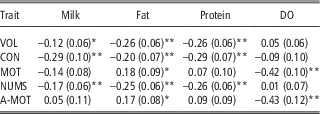
The posterior means and their standard deviations for the genetic correlation estimates between yield traits or DO in cows and bull’s semen production traits are shown in Table 4. The genetic correlations between yield traits in cows and VOL, CON or NUMS in bulls were weakly negative and ranging from –0.12 to –0.26 for VOL, from –0.20 to –0.29 for CON, and from –0.17 to –0.26 for NUMS. These weak and negative estimates of genetic correlations indicate that selection for increasing milk yield may gradually associated with decreasing in semen production ability of bulls.
Posterior means (with posterior standard deviations in parentheses) of genetic correlations of semen production traits with milk, fat, and protein yields and days open (DO)

*Correlation coefficient differs from zero (P<0.05).
**Correlation coefficient differs from zero (P<0.01).
Moderate negative genetic correlations were obtained between DO and MOT (–0.42) and between DO and A-MOT (–0.43). These negative genetic correlations between DO and MOT or A-MOT imply that selection for increasing MOT and A-MOT in bulls would decrease DO. Johnston et al. (Reference Johnston, Corbet, Barwick, Wolcott and Holroyd2014) reported that semen quality and the levels of some hormones in bulls were correlated with female reproductive ability under tropical conditions. However, the moderate negative genetic correlations between DO and MOT or A-MOT are likely due to the effects of gonadotropin secretion on female fertility and sperm production ability, suggesting that we should more aggressive selection for DO or MOT (A-MOT) could improve fertility traits in both bulls and cows.
Conclusions
The estimated heritabilities for semen production traits were low to moderate (ranging from 0.08 for MOT to 0.42 for VOL). The repeatability estimates obtained were moderate to high (ranging from 0.38 for CON to 0.61 for VOL and A-MOT). Estimated ratios of technician variance to phenotypic variance were low (ranging from 0.01 for A-MOT to 0.06 for NUMS). Weak negative genetic correlations between yield traits in cows and VOL, CON and NUMS in bulls were estimated. Moderate negative genetic correlations were obtained between DO and MOT or A-MOT (–0.42 or –0.43). Selection focused on MOT or A-MOT in bulls may therefore improve DO in cows.
Acknowledgements
The authors are grateful to Yamato Atagi for providing suggestions to improve the manuscript. They are also grateful to the two referees for their helpful comments and suggestions.