



I thank the editors for allowing me to respond briefly to Gussenhoven & Peters (Reference Gussenhoven and Peters2019). Gussenhoven & Peters’ long-term contribution to our understanding of Franconian tonal accent can hardly be overstated; in particular, their detail-oriented method of data collection has set new standards for the documentation of tone-accent systems. However, I do not think that the arguments they present in their reply make a convincing case against the analysis presented in Köhnlein (Reference Köhnlein2016), or more generally against the metrical approach to Franconian and related accentual systems (e.g. Hermans Reference Hermans, Botma and Noske2012, Kehrein Reference Kehrein2018, van Oostendorp Reference Oostendorp2018 for Franconian; Morén-Duolljá Reference Morén-Duolljá2013, Iosad Reference Iosad, Hilpert, Östman, Mertzlufft, Rießler and Duke2015, Reference Iosad2016a for North Germanic; Iosad Reference Iosad, Giles, Chapot, Cooijmans, Foster and Tesio2016b, Morrison Reference Morrison2019 for Scottish Gaelic).
1 General considerations
The metrical foot-based approach focuses not only on an explicit analysis of the tonal contours in Franconian dialects, but also aims to account formally for morphological alternations and other predictable correlates, viz. interactions of tonal accent with duration, vowel and consonant quality. The existence of such additional correlates is perfectly in line with a foot-based analysis, since it mirrors correlates of stress and foot structure found in Germanic languages and elsewhere. The general strategy in existing tonal analyses, on the other hand, appears to be to formalise some tonal associations and infer others from phonetic implementation rules. Predictable segmental and durational correlates are typically referred to as phonetic enhancement of the tonal contrast, possibly followed by phonologisation (e.g. Gussenhoven & Peters Reference Gussenhoven and Peters2019: 507). While this reasoning might be applicable from a functional or diachronic perspective, there is no attempt in the tonal approach to explicitly formalise how the synchronic grammar treats phonologically predictable interactions of tonal accent and segmental structure.
With regard to morphology, it is well established that in Franconian tonal minimal pairs which carry morphological information (e.g. number, case, adjectival morphology), Accent 1 corresponds to the more marked category (e.g. van Oostendorp Reference Oostendorp2005); I know of no counterexamples to this generalisation. While my metrical analysis explicitly formalises such alternations, morphological evidence has always been disregarded in the synchronic tonal approach. In their reply, Gussenhoven & Peters (Reference Gussenhoven and Peters2019: §3.1) dismiss singular–plural minimal pairs as ‘exceptional’. In this context, it is notable that morphology, particularly the number distinction, is the most central ingredient of Gussenhoven's own diachronic approach to the genesis of tonal accent – it is so crucial that Gussenhoven (Reference Gussenhoven, Kubozono and Giriko2018) refers to this as the ‘morphological origin’ of tonal accent. His work on diachrony places a rather small subset of singular–plural pairs at the heart of the tonal opposition, from where the contrast allegedly spread across the whole lexicon, partially as ‘a marker of the number contrast’ (Gussenhoven Reference Gussenhoven, Kubozono and Giriko2018: 354). The types of word pairs under discussion are exactly those that Gussenhoven & Peters call irregular in their reply, yet there is no evidence to suggest that the relevance of tonal accent for number marking may have decreased over time.
2 Empirical issues
At various points in their reply, Gussenhoven & Peters call into question the adequacy of the tonal associations I adopt in my work (particularly in Köhnlein Reference Köhnlein2011, where I analyse the tonal mapping in four representative dialects in detail), and claim that their analyses are to be preferred. Space permits brief discussion of only two relevant cases.
First, Gussenhoven & Peters argue against my analysis of the Roermond dialect, because of the use of an IP-final low boundary tone and an utterance-final high boundary tone to formalise the falling-rising contour for Accent 2. They state that my analysis thus wrongly predicts that phrase-final Accent 2 is realised without a final rise in continuation, because there can be no utterance-final H in continuative intonation, noting that ‘the continuation intonation is identical to the interrogative intonation’ (Reference Gussenhoven and Peters2019: 513). However, I do not believe that this is a serious problem. My analysis was informed by a footnote in Gussenhoven's (Reference Gussenhoven and Horne2000) paper on Roermond, which, I have since learned, contained a number of errors affecting the content. Furthermore, the resulting empirical concerns can be easily overcome. One straightforward strategy would be to reanalyse the Roermond boundary tones as IP-final LH throughout the grammar, rather than decomposing them into an IP-final L and an utterance-final H; this would resolve the continuative intonation problem.
The second case I will consider is Gussenhoven's (Reference Gussenhoven, Asu and Lippus2013, Reference Gussenhoven, Abrahamsen, Koreman and van Dommelen2017) tonal analysis of my fieldwork data from Arzbach, which Gussenhoven & Peters (Reference Gussenhoven and Peters2019) discuss in some detail. Several aspects of this analysis merit discussion, but I concentrate only on a specific tonal pattern that Gussenhoven (Reference Gussenhoven, Abrahamsen, Koreman and van Dommelen2017) addresses in a corrigendum to Gussenhoven (Reference Gussenhoven, Asu and Lippus2013), viz. the tonal contours in phrase-final, postnuclear interrogatives. (1) shows the tonal contours from Gussenhoven (Reference Gussenhoven, Abrahamsen, Koreman and van Dommelen2017). Note that these contours are ‘partly inferred’ (Gussenhoven Reference Gussenhoven, Abrahamsen, Koreman and van Dommelen2017: 191; see also Gussenhoven & Peters Reference Gussenhoven and Peters2019: n. 12) and thus differ from the data presented in Köhnlein (Reference Köhnlein2011); furthermore, the segmental content of these examples is taken neither from my work nor from the Arzbach dialect, but from the Roermond dialect. In (1), Accent 2 is represented as a fully pronounced rise-fall with a Lfifl contour (where the initial L is the lexical tone), whereas Accent 1 without the lexical L has fifl, realised as fall-to-mid.
According to Gussenhoven (Reference Gussenhoven, Abrahamsen, Koreman and van Dommelen2017: 191), the fall-to-mid in the bitonal contour for Accent 1 ‘generally applies to phrase-final syllables without the lexical tone’. This seemingly trivial statement in fact involves the necessity for some heavy machinery. The author proposes a pattern of phonetic simplification (‘truncation’) for a bitonal sequence, which applies to Accent 1 in (1a), but is apparently overridden for Accent 2 in (1b) because of the preceding lexical tone. Accordingly, the proposed more complex tritonal Accent-2 contour in (1b) is assumed to be fully realised (‘compressed’), rather than truncated.
(1)

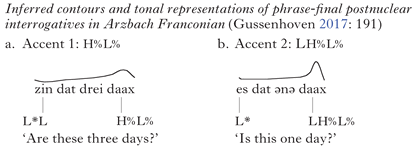
From the perspective of articulatory economy, a prosodic system that truncates a bitonal contour and compresses a tritonal contour is the exact opposite of what one might expect. Furthermore, it is unclear why and how a preceding lexical tone would block a phonetic implementation rule on a tonal sequence. Lastly, even if the two relevant contours were assumed to have the same representational complexity, it would still be typologically unexpected to find truncation for Accent 1 and compression for Accent 2. As Gussenhoven (Reference Gussenhoven2004: 138) notes, ‘languages or language varieties may differ in that one is compressing and another truncating’. By the logic of this statement, differences by accent class in the same prosodic context of the same prosodic system should not exist. Gussenhoven (Reference Gussenhoven, Abrahamsen, Koreman and van Dommelen2017: 191) and Gussenhoven & Peters (Reference Gussenhoven and Peters2019) present this as a trivial aspect of their tonal analysis of the Arzbach data: ‘nothing in the present paper hinges on this issue’ (Gussenhoven & Peters Reference Gussenhoven and Peters2019: n. 12); however, it seems to me that this is an illustrative example of the unlimited power of phonetic implementation in the tonal approach.
3 Conclusion
Although there are disagreements over theoretical concepts and empirical concerns, I welcome Gussenhoven & Peters’ call for work on the issue from an experimental perspective, in the hope that it will indeed be possible to design experiments that help to distinguish between the two approaches. In closing, I emphasise that I do not wish to suggest that the metrical approach, or my specific metrical analysis, is necessarily better than any approach involving lexical tone. However, I do consider the metrical approach to be generally well equipped for the analysis of tonal accent in ways that tonal analyses that have been proposed are not, for the conceptual reasons outlined in my work and in other metrical analyses of European tonal accent systems cited above. Although I have addressed only a subset of my concerns, I hope to have indicated why Gussenhoven & Peters’ reply does not challenge my view that metrical approaches to tonal accent are worth pursuing.


