The Cold War motivated the design of U.S.-sponsored re-distributive policies in Latin America to fight communism, diminish the influence of the Soviet Union, and avoid the appearance of a “second Cuba” (Taffet Reference Taffet2007).Footnote 1 Among these efforts, agrarian reform programs were one of the most important. More than 40 million hectares were expropriated in Brazil, Bolivia, Chile, Colombia, Ecuador, Guatemala, Mexico, Peru, and Venezuela (Albertus Reference Albertus2015). Despite their relevance, there has been little empirical attention to how these policies were implemented on the ground. Studying how expropriations took place is not only important to understand the economic impact of land reform programs across the American continent; it also reveals the potential effectiveness of these international policies as tools of political influence during the Cold War.
This article shows that organized groups of workers affected the intensity of one of the largest policies of the time: Salvador Allende’s land reform in Chile (1970–1973). After being elected president in a contentious election, Allende attempted to create a “democratic road to socialism” and used the existing land reform program to expropriate more than six million hectares with the goal of empowering agricultural workers. In this context, groups of workers exerted pressure to radicalize policies and accelerate the transition to socialism. We show that the collective actions of workers influenced the government to expropriate plots in certain localities, and we interpret this response as an attempt to avoid an uprising (Acemoglu and Robinson Reference Acemoglu and Robinson2006).
Chile is an interesting case study for several reasons. Historically, the pressure from radical groups has been suggested as one of the causes behind the economic collapse of Allende’s government and the 1973 coup that followed (Boorstein Reference Boorstein1977; Sigmund Reference Sigmund1977). We provide novel evidence of the policy agenda responding to collective actions partly organized by the radical left. Institutionally, the entity in charge of the land reform program kept records of all expropriated plots, allowing us to observe the location and date of expropriations. The collective actions of workers, as measured by land invasions, are also well documented in police reports with their exact locations and dates. These invasions reveal that the pressure from workers to radicalize policies began to appear at different points in time across the country. We combine all these data to construct a panel dataset of counties observed monthly during the government of Salvador Allende.
The empirical strategy uses month-by-month invasions of plots and the number of expropriations across hundreds of agricultural counties in an event study research design. This strategy exploits the staggered appearance of collective actions after Salvador Allende rose to power in November 1970. Differences in the dates and locations of these actions allow us to control for unobserved heterogeneity by county and month using fixed effects. We estimate that the initial invasion triggered an additional 6–7 invasions in the following 12 months, and together these collective actions induced an additional 2–3 expropriations during the same period, an increase of almost 40 percent. This increase cannot be explained by the displacement of expropriations from the future. Moreover, invasions seem to have increased the intensity of the program as the total number of hectares expropriated increased by 20 percent. These results are robust to the removal of counties without invasions and counties with the first invasion within three months of Allende’s rule. We also obtain similar results if we allow for a demanding specification with time shocks across clusters of nearby counties and if we control for the availability of large plots.
Why was the government responding to the collective actions of workers? The answer is far from obvious. One explanation is that Allende’s government colluded with groups of workers to organize invasions and thus create a legal justification to expropriate these plots.Footnote 2 Although invasions were not a legal reason to expropriate, these actions could have exerted pressure for the landowner to offer the plot. An alternative interpretation of results is that radical groups were threatening with a revolt, and expropriations were implemented in an attempt to prevent uprisings. Historical and empirical evidence suggests the latter interpretation is relatively more important in the context of Salvador Allende’s government. Radical political groups to the left of the coalition in power encouraged and assisted workers to invade plots, creating a “threat to the government’s commitment to legality and controlled change” (Winn and Kay 1974, p. 141).
We end our empirical analysis by exploring whether the displacement of expropriations can explain our findings. Event study estimates reflect within-country comparisons, and thus the aggregate effect is confounded by a potential displacement of expropriations across locations. We assume that displacement occurs across nearby counties and estimate a conservative displacement rate of 38 percent. Using this number, we calculate that 6–10 percent of Salvador Allende’s expropriations would not have taken place in the absence of the collective actions of workers.
Our primary contribution is to the empirical literature that documents the causes and consequences of social conflict and collective actions more generally (e.g., Acemoglu and Robinson Reference Acemoglu and Robinson2006; Blattman and Miguel 2010). Previous research has shown how protests and riots can affect the formation of political movements, political preferences, and the work of incumbent politicians (Madestam et al. Reference Madestam, Shoag, Veuger and Yanagizawa-Drott2013; Aidt and Franck 2015; Larreboure and González 2021). Other research provides insights into why individuals participate in collective actions when there are private costs and the benefits are common to the group (e.g., Cantoni et al. Reference Cantoni, Yang, Yuchtman and Jane Zhang2019; Manacorda and Tesei 2020; Enikolopov, Makarin, and Petrova Reference Enikolopov, Makarin and Petrova2020; González Reference González2020).Footnote 3 In contrast to these studies, we focus on the role of land invasions in shaping the policy agenda of a left-wing government during the Cold War. As emphasized by Downs (Reference Downs1972), public attention can be affected by the collective actions of pressure groups and shape the policy-making process, but empirical evidence is scarce. We contribute to this literature by showing empirically how organized groups of workers affected the redistribution of assets in the context of a large land reform program in Latin America.
The re-distributive nature of land reform makes this article also related to the literature studying the extension of voting rights under the threat of revolution (e.g., Acemoglu and Robinson Reference Acemoglu and Robinson2000, Reference Acemoglu and Robinson2006; Aidt and Franck 2015). A collection of results suggest that elites can choose to extend voting rights strategically to prevent an uprising, a process of enfranchisement that can also be interpreted as an increase in re-distributive policies (Meltzer and Richard 1981). In contrast to previous research, we exploit the month-to-month frequency of expropriations to emphasize that collective actions can also serve as revolutionary threats and affect the intensity of a policy.
Land reform programs across the world have also received a significant amount of attention from scholars. Previous research has suggested that collective actions affected the redistribution of plots in Mexico, Colombia, and Italy (Dell Reference Dell2012; López-Uribe Reference López-Uribe2019; Percoco Reference Percoco2019). However, that research uses mostly cross-sectional analyses, and it does not differentiate between expropriation and redistribution of plots. As a consequence, the effect of collective action on the intensity of this policy has been difficult to establish. In contrast, we exploit the timing in which collective actions appear using relatively high-frequency data and emphasize the interactions between the policymaker and potential beneficiaries in a highly politicized context.Footnote 4 Finally, the study of land invasions is relatively more scarce and emphasizes the role of economic conditions in driving these actions, particularly in contexts of high inequality (Hidalgo et al. Reference Hidalgo2010; Albertus, Brambor, and Ceneviva Reference Albertus, Brambor and Ceneviva2016).
HISTORICAL BACKGROUND
Land Reform and Salvador Allende
Chile’s land reform program began in 1962 shortly after the creation of the Alliance for Progress, an economic program between the United States and Latin American countries to prevent a “second Cuba” in the region (Wright Reference Wright2000; Taffet Reference Taffet2007). An institution named Corporation of Agrarian Reform (Corporación de Reforma Agraria, CORA) was in charge of the process. The original program contained a limited number of legal causes to expropriate a plot, and thus only a few plots were expropriated during Alessandri’s right-wing government (1958–1964). After a second land reform law was enacted in 1967, which allowed CORA to expropriate “large” or “inefficient” plots, president Eduardo Frei (1964–1970) was able to increase expropriations (Loveman Reference Loveman1976). The land reform process of a plot began with the expropriation, continued with “asentamientos” (settlements), and ended with the redistribution of the plot. An asentamiento was transitory collective exploitation of the land under the advice of the state, which acted as the partner, and their goal was to give workers enough time to learn and organize the production process.Footnote 5 In the last step of the process, the land would be assigned to individuals or communitarian properties.
The expropriation of plots increased significantly under Salvador Allende (November 1970–September 1973). Allende rose to power after a contentious election in which he got 36.6 percent of the vote running under the umbrella of a left-wing coalition known as Popular Unity (U.P. in Spanish).Footnote 6 The land reform program was a crucial part of Allende’s policy platform during the 1970 presidential election. The program of the U.P. reveals the pillars of his plan: to nationalize all strategic and large companies, regulate prices, increase the wages of workers, and increase the intensity of expropriations in the context of the existing land reform program (Popular Unity 1969). These policies had the goal to create a “democratic road to socialism.” The land reform process remained largely unchanged, with small changes such as the replacement of asentamientos by Agrarian Reform Centers (Centros de Reforma Agraria, CERA) from mid-1971 onwards (Loveman Reference Loveman1974, p. 152). All in all, the first half of Allende’s government was relatively successful, but the second half was characterized by an economic collapse and social unrest (Boorstein Reference Boorstein1977, p. 111).
Chile’s experiment with socialism ended with a U.S.-backed coup in September 1973, followed by a 17-year dictatorship that returned some previously expropriated plots (Qureshi Reference Qureshi2009). The relative contribution of internal versus external forces behind the fall of Salvador Allende remains debated. For example, Fidel Castro famously stated that “the Chilean experiment was failing because of Allende’s reluctance to become ‘more radical’” (Davis Reference Davis1985, p. 44). Internal forces came from left-wing groups and included strikes, occupations, and land invasions (Haslam Reference Haslam2005, p. 97). External causes included the United States’ “invisible economic blockade” propelled by president Richard Nixon to “make the [Chilean] economy scream” (Kornbluh Reference Kornbluh2003, p. 83).
Land Invasions as Collective Actions
Land invasions were a key characteristic of the countryside during Allende’s rule. A number of historians have documented these invasions using case studies from different regions of Chile (e.g., Sánchez Reference Sánchez2012; Redondo Reference Redondo2015; Robles-Ortiz Reference Robles-Ortiz2018). The most common interpretation of these collective actions is that they generated pressure from the countryside to increase the intensity or “radicalize” the land reform program (Kay Reference Kay1977; Robles-Ortiz Reference Robles-Ortiz2018; Navarrete Reference Navarrete2018). Scholars also emphasize the importance of Allende’s victory to increase the overall intensity of invasions and the acquisition of land rights as invaders’ main objective (Bravo Reference Bravo2012; Redondo Reference Redondo2015).
Why did peasants use land invasions as a strategy to improve their economic conditions? Peasants began to invade plots because landowners learned to simply replace workers during traditional strikes, and invasions prevented them from doing so (Bengoa Reference Bengoa1972). In addition, a change in workers’ demands was key, which moved from demanding better labor conditions to demanding ownership in the context of the agrarian reform (Redondo Reference Redondo2015, p. 159). The increasing demand for land ownership was at least partially explained by the importance of land reform as a policy during political campaigns on the eve of the 1970 presidential election (Petras Reference Petras1971). Moreover, scattered information about specific invasions suggests that invaders were workers from the same plot (Kay Reference Kay1977, p. 868), who in the case of expropriation were likely to have been a part of the later asentamiento and thus the beneficiaries of the land reform program.
Invasions were usually non-violent acts in which workers took control of a property’s entrance, typically setting up a camp at the main gate (Robles-Ortiz Reference Robles-Ortiz2018). An example comes from the chronicles of American journalist Norman Gall:
“[the invasion] of the Tres Hijuelas farm came just a few weeks after the inauguration of the Marxist Unidad Popular regime of President Salvador Allende, and was the visible beginning of the present wave of peasant insurrection (…) families from the neighboring Reducción Alhueco quietly threaded their way across the wheat fields of Cautín Province in southern Chile to pitch crude tents of wheat sacks and old blankets under a hillside cluster of eucalyptus trees on the farm (…) posting guards at the deserted clapboard farmhouse of the Fundo Tres Hijuelas - the Owner, Carlos Taladriz, lived in the neighboring town of Lautaro and was away in Santiago at the time - as well as at the machine shed, at the roadside entrance to the farm and at the bridge of planks that crossed over a small stream to the house. The only persons living on the 1,250-acre farm at the time were a shepherd and a tractor driver.”
An important question to understand the timing and intensity of land invasions is how agricultural workers were able to solve the collective action problem. This is a hard question to answer, but we hypothesize that the 1967 unionization law was an important factor. This law effectively allowed workers in rural areas to collectively bargain to improve their labor conditions and therefore increased the benefits of collective action. Accordingly, unionization numbers began to rise after the enactment of this law. When Allende took office, 140,000 rural workers were unionized, and another 100,000 organized in cooperatives. Moreover, union membership grew by 50 percent during Salvador Allende’s first year in office (Gómez and Klein Reference Klein1972).
Historical accounts support the idea that unions were instrumental in invasions. The majority of workers who participated in unions lived in rural estates and were, therefore, better off than seasonal workers. Politically, unions supported the Christian democrats, but they became more radicalized after Allende’s victory (Winn and Kay 1974). The work of Robles-Ortiz (Reference Robles-Ortiz2018, p. 9) provides a clear example of how unions were linked to land invasions:
“the local miristas [left-wing radicals] decided to take over the Neltume estate […] thus challenging the Popular Unity. The clash took place in the labour union assembly, which voted in favour of taking control of Neltume. The toma took place on December 9, 1970. It was carried out by some 390 workers ‘with the support of two extremists’ who were ‘university students and members of the MIR [left-wing radical movement]’.”
Another example comes from a plot in the city of Melipilla where the local union organized an invasion with workers from nearby plots (Kay Reference Kay1977, p. 868). According to these investigations, workers and members of the radical left routinely engaged with unions and together led invasions, even though beneficiaries were likely to have been previous workers of the plot.
DATA AND DESCRIPTIVE EVIDENCE
This section describes the data sources we use to measure these historical processes.Footnote 7 We then explain how we constructed the panel data used in the empirical strategy and offer a comparison of counties with and without invasions.
Land Reform Files and Invasions
To measure the intensity of the land reform program, we use historical files documenting the universe of expropriations. The Corporation of Agrarian Reform was in charge of expropriations and kept administrative records of the entire process. The original data consists of 5,800 files, each one describing an expropriation on a two-sided sheet. The description includes the exact date of expropriation (month and year), the county in which the expropriated plot was located (there were 280 counties), the size of the plot in hectares, and the legal cause used to justify the expropriation.
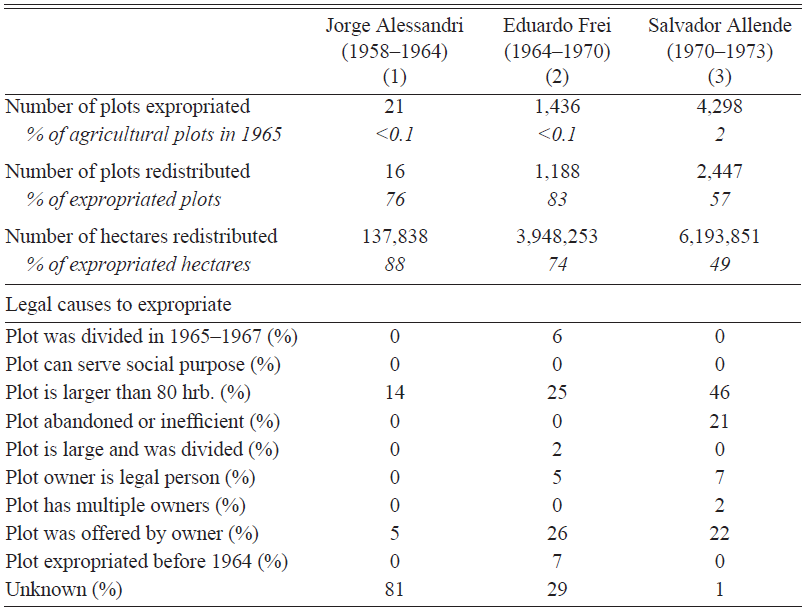
Table 1 presents descriptive statistics that confirm the overall intensity of the program and the legal causes used across the three governments of the time. This table makes it clear that expropriations were very intense during the Allende years. Using the 1965 agricultural census as a benchmark, we calculate that 2 percent of the total number of plots was expropriated during this period (4,298 plots), which constituted 20 percent of all agricultural hectares in the country (6.2 million hectares). Half of these plots and agricultural land were redistributed. Empirically, the three most important legal causes used by the corporation to expropriate plots were: (1) the plot was larger than 80 hectares, (2) the plot was abandoned or inefficient, and (3) the plot was offered by the owner. Under Allende’s government, these causes explain more than 90 percent of expropriations.
THE LAND REFORM PROGRAM UNDER DIFFERENT GOVERNMENTS

Notes: This table presents descriptive statistics of land expropriations under different governments. The upper panel describes the total number of plots and hectares expropriated, together with the number of land invasions. The lower panel present the legal causes used to expropriate plots.
Source: Land reform data files.
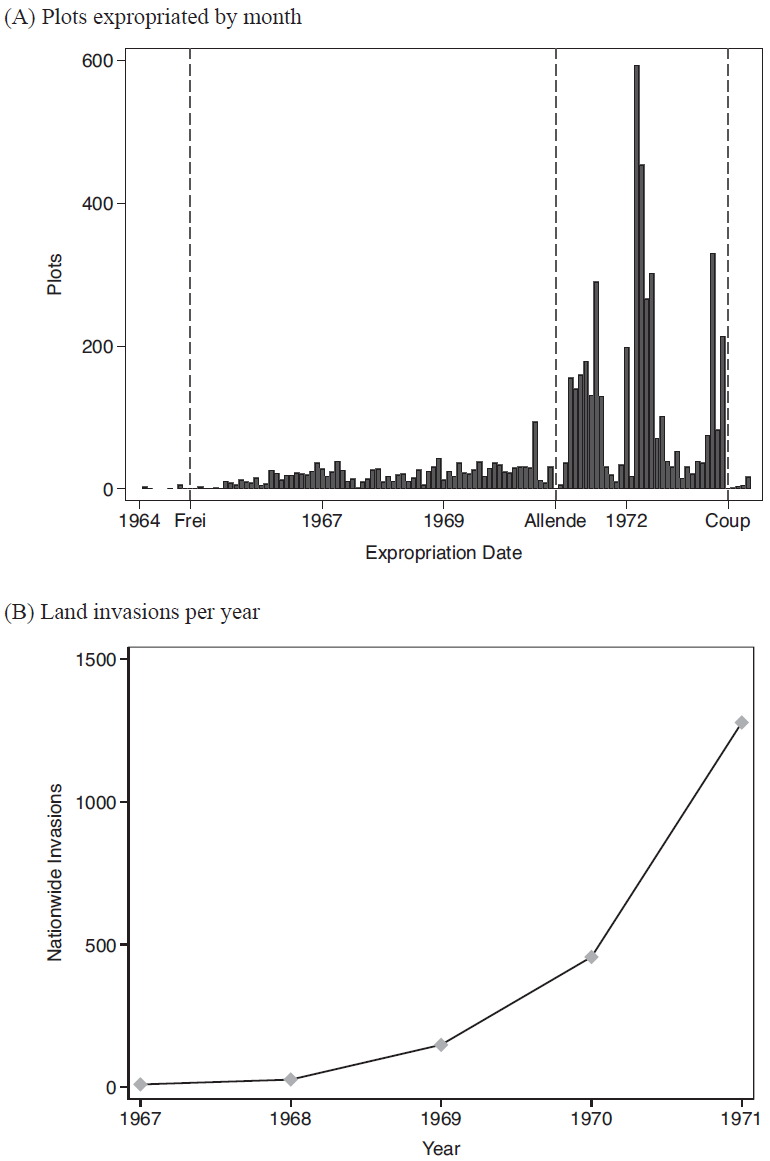
Our work uses countrywide data during the Allende years, combined with the exact dates of expropriations, to study the intensity of this policy. Previous research has studied the land reform program regionally (Robles-Ortiz Reference Robles-Ortiz2018), the long-run effects of redistribution (Cuesta et al. Reference Cuesta, Díaz, Francisco, Felipe and Guillermo2017; Lillo Reference Lillo2018), and the political impacts of Eduardo Frei’s policy (González Reference González2013). The study of the intensity of this policy at the micro-level can lead us to reinterpret the long-run impacts and to put regional studies into a more general historical perspective. Figure 1 Panel (A) presents the number of expropriations by month, revealing the stark differences between the two halves of Allende’s government. Similarly, this is the first effort to combine the land reform files with land invasions data and unions in a countrywide dataset of counties observed monthly.
CHILE’S AGRARIAN REFORM AND LAND INVASIONS
Notes: Panel (A) presents the number of plots expropriated by month between January 1964 and December 1973. Panel (B) presents the number of land invasions per year between 1967 and 1971.
Sources: Land reform data files and police reports of land invasions.

We also digitized the universe of recorded land invasions during the Allende years, which reveals new historical patterns. We measure the exact location and time of land invasions using data from police reports that were published by the Chilean Congress in May 1972 as part of Ordinary Session V, in which the state of the countryside was discussed. The origins of the data can be found in allegations of a congressman who accused the government of orchestrating these invasions to intensify the land reform program (National Congress of Chile 1972, pp. 270–90). After several rounds of discussions with the Ministry of Agriculture, the congressman mandated the Ministry of the Interior to construct a registry with all the invasions. The police wrote this report, which they sent to the congress, generating a discussion about invasions, expropriations, and the role of the government. We account for the inherent reporting bias in these reports by using county-level fixed effects.
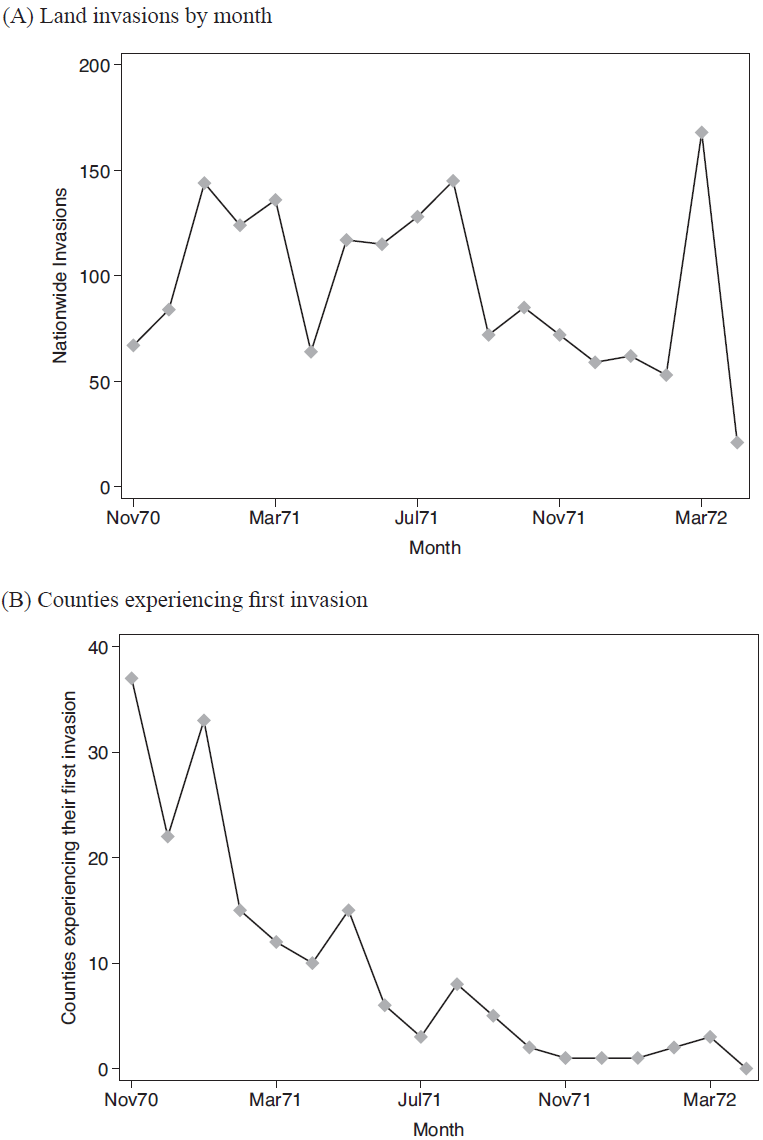
Although previous research has used qualitative information from the reports as part of regional studies (Sánchez Reference Sánchez2012; Redondo Reference Redondo2015), the universe of the data in this report has never been used before to construct a national study. Moreover, a quantitative analysis of these invasions and their relation to expropriations has been notably absent. The report includes 1,747 land invasions happening between November 1970 and April 1972 with the county in which each one took place. We complement these data with the number of invasions by province before Allende reported in Klein (Reference Klein1972). Provinces are larger administrative units than counties, so we employ counties throughout the analysis but complement it with province data when needed. Figure 1 Panel (B) presents the number of land invasions per year. Taken together, all of these sources confirm that most invasions took place under Allende’s government (1,700 of 2,200), although the increase in invasions began before his government, a pattern that has not been recognized before and that we hypothesize is related to the 1967 unionization law. Figure 2 Panel (A) presents the number of invasions per month, revealing a significant amount of persistence and variation in their intensity throughout this period.
LAND INVASIONS DURING SALVADOR ALLENDE’S GOVERNMENT
Notes: Panel (A) presents the number of land invasions per month from the first month in which Salvador Allende held office until the last month with data on invasions. Panel (B) presents the number of counties experiencing their first land invasion.
Source: Police reports of land invasions.

The Importance of Unions
We hypothesize that the historical origins of invasions can be found in the 1967 unionization law previously described. As a consequence of this law, the number of unions spreads rapidly throughout the country. We digitized data on the number of sindicatos (unions) by county from a registry originally constructed by Gómez and Klein (Reference Klein1972) to understand the state of local organizations. The authors define their work as a census derived from their collaboration with the Institute for Agricultural Development, an entity created by the agrarian reform law, which operated under the umbrella of the Ministry of Agriculture. The goal was to “develop a global quantitative report of public use that serves as a guide for workers in the agricultural sector” (p. 1, own translation). This census was implemented between the last week of January and the first week of February of 1972. Most of these unions met weekly or monthly.
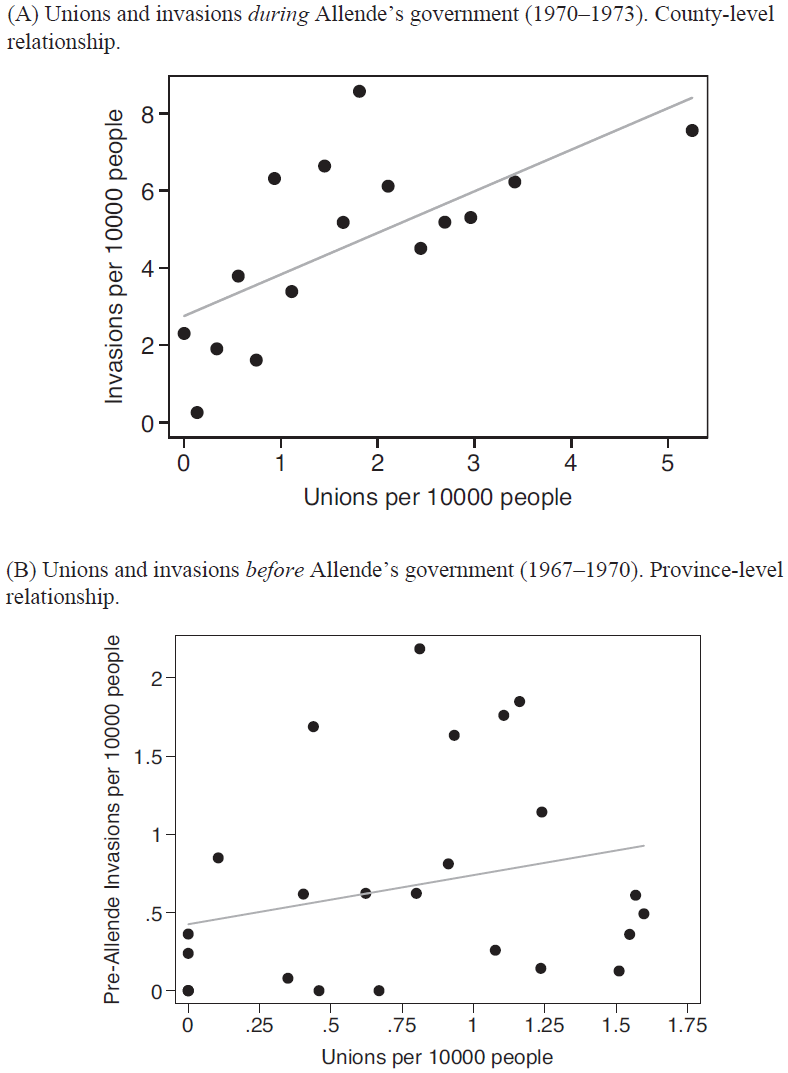
These data support the existence of a link between unions and invasions. Figure 3 Panel (A) shows that there is a positive partial correlation between unionization per county and invasions. Moreover, Figure 3 Panel (B) shows a similar province-level relationship between these variables in the period 1967–1970. That is, unions seem to have helped to coordinate invasions, and this suggestive evidence appears both during Allende but also before. This evidence is revealing as most previous studies argue that it was the election of Allende that triggered invasions. This and previous patterns suggest that his election could have accelerated this process, but invasions and their foundations were there before his arrival. Online Appendix Figure A.1 and Table A.1 add control variables to this analysis to show that this is a robust correlation. Overall, we interpret these patterns together with historical accounts as suggestive evidence consistent with our hypothesis regarding the importance of this law.
LAND INVASIONS AND THE 1967 UNIONIZATION LAW
Notes: Panel (A) presents a bin scatter plot and linear fit between the number of land invasions per 10,000 inhabitants in the period 1970–1972 (y-axis) and the number of unions per 10,000 inhabitants (x-axis) at the county level. Panel (B) presents a scatter plot and linear fit between the number of land invasions per 10,000 inhabitants in the period 1967–1970 (y-axis) and the number of unions per 10,000 inhabitants (x-axis) at the province level. Data on invasions before 1970 is only available at the province level.
Sources: Police reports of land invasions and data from Gómez and Klein (Reference Klein1972).

Descriptive Statistics
We constructed a panel of 221 counties observed between November 1969 and December 1973 for a total of 11,050 county-month observations.Footnote 8 A county enters our final sample if it experiences at least one occupation or one expropriation during this period. There are 176 (80 percent) counties with at least one invasion and 45 counties (20 percent) with zero invasions but at least one expropriation. Counties without expropriations and invasions host mostly urban centers or very small towns. Online Appendix Figure A.2 presents a map of the country with expropriations, invasions, and the final sample of counties. The average county in the final sample experienced eight land invasions between November 1970 and April 1972, that is, 0.43 invasions per month or 2.6 invasions every six months. A total of 12 plots were expropriated in the average county, that is, one every two months.
We also use data from the 1955 and 1965 agricultural censuses originally digitized by Cuesta, Gallego, and González (2015). From this data, we obtain measures of agricultural production at the county level, a land inequality measure (Gini), the number of agricultural workers, agricultural equipment, and plot sizes. Although we cannot combine the agricultural censuses with expropriations data at the plot level, we can do this at the county level. The census data provides us with a baseline measure of the state of the agrarian economy at the local level before the land reform process and invasions began. We also digitized electoral outcomes from the 1970 presidential election.
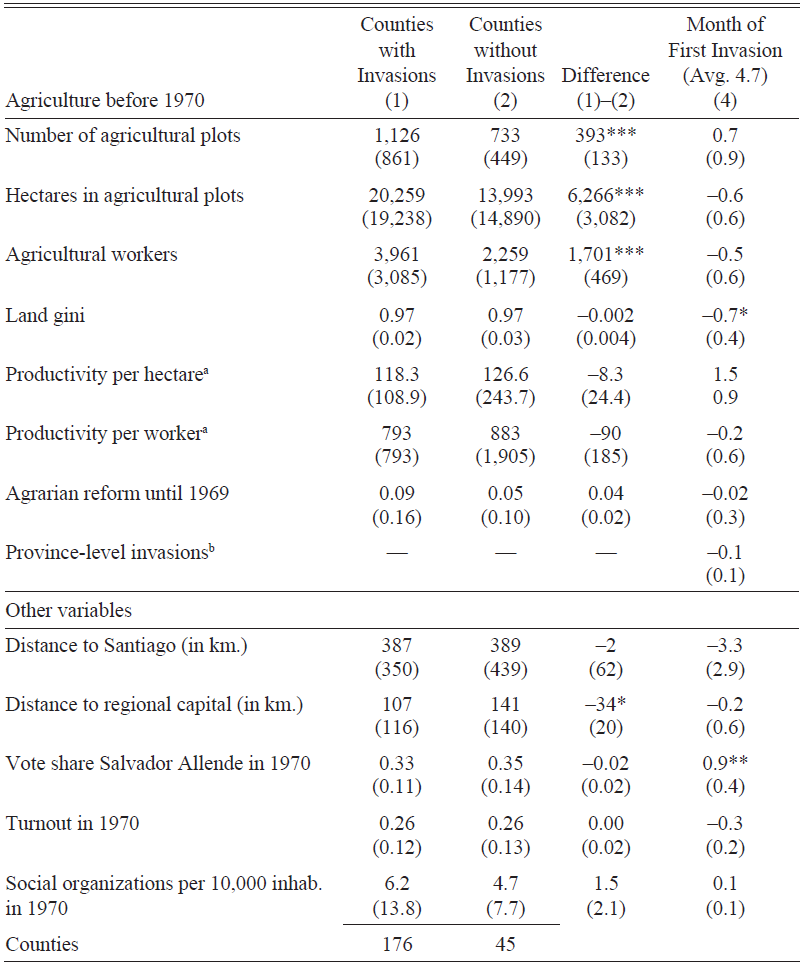
Table 2 offers a comparison of these variables across counties with and without invasions. Columns (1) and (2) present the average and standard deviation. Column (3) presents the difference between averages in previous columns and their statistical significance. Counties that experienced invasions have on average more plots and more agricultural workers. Although at the time Chile exhibited high inequality and volatile economic conditions, counties with and without land invasions had similar economic characteristics, as measured by inequality in land property rights and productivity per hectare or worker. Both types of counties had experienced the agrarian reform similarly until 1969 and were located at the same distance of the capital.
DESCRIPTION OF COUNTIES BEFORE ALLENDE’S GOVERNMENT (1970–1973)

Notes: Descriptive statistics for rural counties in Chile. Column (1) describes counties with at least one invasion during Allende’s government, Column (2) describes counties without invasions, and Column (3) presents the difference between Columns (1) and (2). Column (4) presents coefficients from a cross-sectional regression using the month of first invasion as dependent variable (month 1 is November 1970, month 18 is April 1972) and (standardized) variables and region fixed effects as predictors. The average of the month of first invasion is 4.7 and its standard deviation is 3.8. Standard deviations in parentheses in Columns (1)–(2) and standard errors in Columns (3)–(4).
a Measured in thousands of Chilean pesos.
b Comes from a separate regression using province-level invasions before 1970 and provinces as units of observation. Statistical significance: *p<0.10, **p<0.05, ***p<0.01.
Sources: Land reform data files, 1965 Agricultural Census, police reports of land invasions, Electoral Service, and Civil Registry.
In terms of political affiliation and organizational characteristics, the two groups of counties exhibited similar political support for Allende in the 1970 presidential elections and similar political participation as measured by total votes over population in 1970. Finally, the number of social organizations per 10,000 inhabitants formed before Allende’s government is slightly higher in counties with invasions, but the difference is not statistically significant at conventional levels.Footnote 9 All in all, we conclude that the two sets of counties were somewhat different, reinforcing the importance of using county-level fixed effects to account for these differences.
EMPIRICAL STRATEGY
To estimate the effect of the collective actions of workers on expropriations of agricultural plots, we use an event study research design. This method is a generalization of a difference-in-difference model in which the “treatment” occurs at different points in time and was popularized by financial economists (Campbell Reference Campbell1997). Crucial in this methodology is the definition of the “event” (i.e., the treatment) to be studied. We define the event as the first invasion of a plot after November 1970, when Allende rose to power. Although we could use any invasion as an event, first invasions were relatively more unexpected while subsequent invasions were not, and thus by focusing on the former, we can minimize potential anticipation effects. An example of this comes from an important agricultural region in the south of the country, where the first wave of invasions “took Panguipulli by storm in the summer of 1971” (Robles-Ortiz Reference Robles-Ortiz2018, p. 13). Importantly, invasions could have been part of a “package” of political actions unobserved to us, and therefore, we interpret invasions as a proxy for the collective actions of workers. Figure 2 Panel (B) plots the number of first invasions by month.
Motivated by the previous observations, we centered the data around first invasions and focus on the months before and after these events, which allows us to control for the county- and month-level unobservable variables by using fixed effects. The strategy effectively exploits the timing in which invasions began to appear in different parts of the country. We begin by using a semi-parametric version of this strategy and estimate the following regression equation by ordinary least squares:
 $${\rm{Expropriation}}{{\rm{s}}_{{\rm{ct}}}} = {\sum _{{\rm{k}} = - 12}}^{12}{{\rm{b}}_{\rm{k}}}{{\rm{D}}_{{\rm{ct}}}}^{\rm{k}} + {{\rm{g}}_{\rm{c}}} + {{\rm{V}}_{\rm{t}}} + {{\rm{e}}_{{\rm{ct}}}},$$
where Dctk is a set of indicators for the months before and after the first invasion in a county, for example, Dct1 is equal to one in county c in month t only if the first land invasion took place in the previous month. In addition, gc and vt are a full set of county and month fixed effects, which control for unobserved time-invariant differences across counties and temporal factors affecting all counties. The former accounts for the fact that some counties are simply more exposed to land reform because, for example, of their economic structure, and the latter for reasons such as the arrival of a socialist government increasing the probability of expropriations. The error term ect has a mean of zero, and we allow it to be correlated within counties over time.
The coefficients of interest are b–12, b–11,…, b12, and measure the change in expropriations in the 12 months before and after the first invasion of a plot under Allende’s government.Footnote 10 Operationally, the indicator  $${\rm{D}}_{{\rm{ct}}}^{0}$$ takes the value of one in the month of the first invasion, and we omit the indicator
 $${\rm{D}}_{{\rm{ct}}}^{ - 1}$$ from Equation (1). Therefore, the coefficients of all remaining indicators need to be interpreted relative to the month before the event. For example, if b1 > 0, then there was an increase in the number of expropriations in the following month after the first invasion, relative to the month before the event. In this sense, the coefficients bk with kϵ[–12,–1] serve as a measure of the trend in expropriations in a county before it experienced the first invasion.
Equation (1) can be considered a fairly non-parametric estimate of how the land invasions affected expropriations. As a complement, we also estimate the following parametric version:
 $${\rm{Expropriation}}{{\rm{s}}_{{\rm{ct}}}} = {\rm{b}}{{\rm{D}}_{{\rm{ct}}}} + {{\rm{g}}_{\rm{c}}} + {{\rm{V}}_{\rm{t}}} + {{\rm{e}}_{{\rm{ct}}}},$$
where Dct takes the value of one for the 12-month period after the first invasion and zero otherwise. Note that in this equation, b captures the average change in expropriations in the months after the event, and we are also imposing that the coefficients before the event are zero. In this sense, this equation contains less information and more restrictions, but it is nevertheless useful because it is a simpler model, and it allows us to improve efficiency by estimating fewer parameters. All remaining variables in Equation (2) are defined as in Equation (1).
Column (4) in Table 2 presents suggestive evidence for the validity of our design. Our concern is omitted variables changing over time that affected the appearance of first invasions and expropriations. To check for this, we estimate a cross-sectional regression using the month of the first invasion across counties as a dependent variable and a large set of pre-determined variables as predictors.Footnote 11 Column (4) presents estimates and their standard errors using standardized predictors to facilitate their interpretation. In almost all cases a one standard deviation increase in a predictor has a small and statistically insignificant effect in the month of the first invasion. Moreover, province-level invasions before Allende have little predictive power of the average month of the first invasion in a province. All in all, the timing of first invasions appears unlikely to be driven by variables that affected expropriations.
Finally, we emphasize that there are modeling decisions when estimating Equations (1) and (2). These decisions are important for both interpreting results and checking for their robustness. In the first place, we measure expropriations in different ways, including the total number of plots expropriated, the total number of hectares expropriated, and the percentage of hectares in the county that were expropriated, among others. In addition, when estimating Equation (1), we can only consider first invasions during Allende’s government because invasions by month are unavailable for other periods. As expected, many of the first invasions in the data occurred at the beginning of the new government. Thus in the following section, we check if the dispersion of events has some effect on results. And third, given the observed differences between counties with and without invasions, we estimate both equations using (1) all counties and (2) counties with at least one invasion.
MAIN RESULTS
Using the previously described event study research design, this section shows that the collective actions of workers affected the intensity and location of expropriations. We then present and discuss a battery of empirical exercises that suggest these results represent robust findings.
Invasions and Local Political Actions
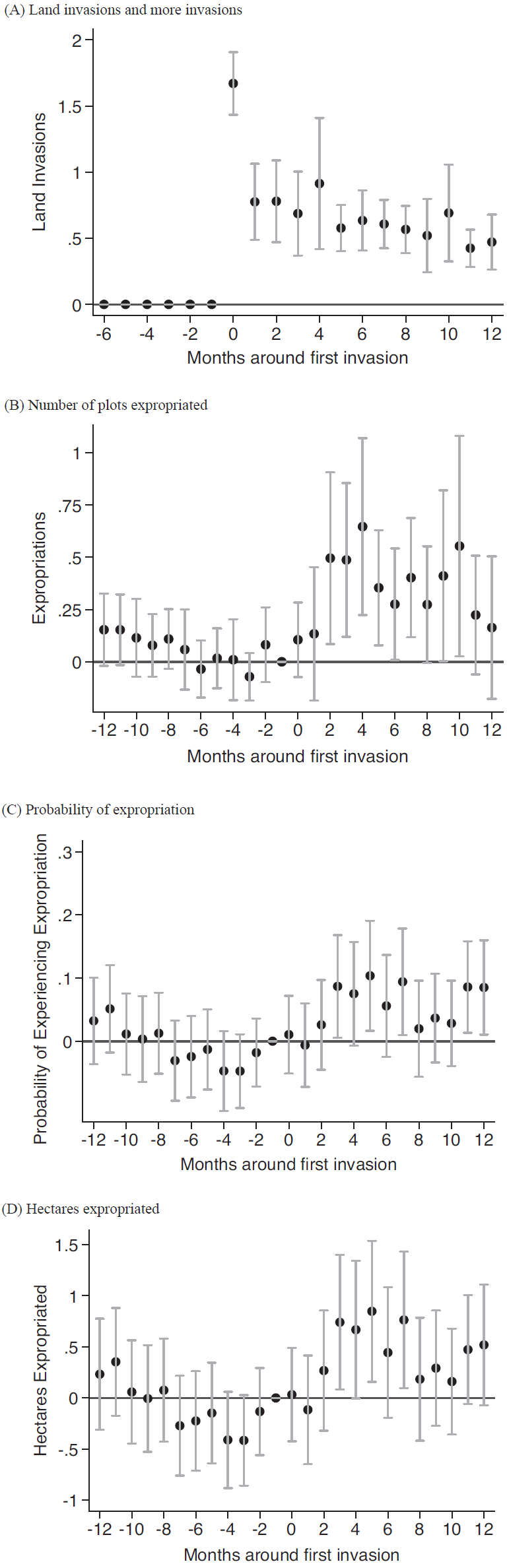
Figure 4 Panel (A) presents estimates of bk in Equation (1), with their corresponding 95 percent confidence intervals, using land invasions as the dependent variable. The motivation to begin with this specification is that after the first plot was invaded by agricultural workers, there might be more invasions and political actions afterward. Testing for the dynamics of these collective actions is important to understand the event in our research design. The x-axis in this figure denotes the months relative to the first land invasion (t = 0), and the y-axis measures the change in the number of invasions. The coefficients to the left of the event represent invasions before the first invasion and are by definition equal to zero. The coefficients to the right measure the change in land invasions after the first one.
LAND INVASIONS AND EXPROPRIATIONS
Notes: These figures present estimates of Equation (1) with their corresponding 95 percent confidence interval. Each panel uses one of four different dependent variables.
Sources: Land reform data files and police reports of land invasions.

The estimated coefficients reveal that in the months following the first invasion in a county, there are significantly more invasions within the same location. In particular, in the month of the first invasion, there were on average 1.6 invasions. This is, it was usual that the first invasion came together with another invasion. This result is consistent with the notion that invasions were part of a package of political actions. Moreover, in the following six months, we observe approximately four more invasions, an increase of approximately 150 percent over the sample average. The number of invasions within months 6 and 12 of the first invasion also increases, but in a smaller magnitude than in the first six months. Estimates of Equation (2), the parametric version of the event study, show similar magnitudes and can be found in Table 3 Column (1).
LAND INVASIONS AND EXPROPRIATIONS USING AN EVENT STUDY ANALYSIS

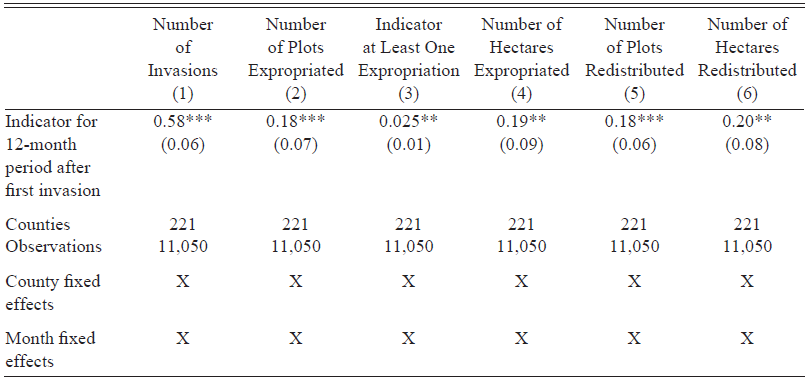
Notes: Each column presents estimates of Equation (2)—the parametric version of the event study methodology—using a different dependent variable. Each observation corresponds to a county-month pair in the period between 01/1970 and 04/1972. The number of hectares expropriated and distributed use the hyperbolic sine transformation proposed by Burdbidge et al. (1988). Standard errors are clustered by county. Statistical significance: *p<0.10, **p<0.05, ***p<0.01.
Sources: Land reform data files and police reports of land invasions.
The dynamic pattern of land invasions across the country is important because it means that the majority of invasions were not randomly allocated across space and time. Indeed, invasions were significantly more likely to occur after the first one took place. There are multiple potential explanations for this pattern, including the diffusion of information, social effects, and packages of political actions. Regardless of the explanation, this result implies that when we study expropriations in the months after the event, the estimated coefficients represent the effect of multiple political actions, which were triggered by the first one.
Expropriations
Figure 4 Panel (B) presents estimates of Equation (1). The omitted category is the month before the first invasion. These estimates show that the total number of plots expropriated in a county increased significantly after the first plot was invaded. All coefficients after the event are positive and most are statistically significant (p-values < 0.05, except for the first and last two). By integrating coefficients, we calculate that there were on average 2–3 more plots expropriated within six months of the event. Given that all coefficients after the event are positive, the displacement of expropriations from months in the future to the present is unlikely to be an explanation behind our results. The number of monthly expropriations increased by approximately 20 percent (Online Appendix Figure A.4-A). Similarly, the intensity of expropriations also increased between months 6 and 12 but in a relatively smaller magnitude. The effect of invasions appeared two months after the first invasion and peaked for about three months before slowly fading out.
Importantly, the number of expropriations did not exhibit a trend before the event. All coefficients before the first invasion hover around zero, are statistically insignificant at conventional levels, and the point estimates are of remarkably small economic magnitude. Our identification assumption is that in the absence of a first invasion the number of expropriations would have been similar, a counterfactual that in this case corresponds to other counties without (yet) a first invasion. Although essentially untestable, the absence of pre-trends before the study and the high-frequency of the data suggest this assumption is likely to hold.
Similar to the increase in the number of plots expropriated, Figure 4 Panels (C) and (D) show that the probability of a county experiencing at least one expropriation and the number of hectares expropriated also increased. In the former case, we estimated our main equation using an indicator that takes the value of one if the county experienced at least one expropriation and zero otherwise. In the latter, we use the logarithm of hectares expropriated.Footnote 12 In the months following the first invasion, the probability of a county experiencing an expropriation in a month increased by an average of 2–3 percentage points, with a peak of 8–10 percentage points within months 3–5, from a base of 17 percent in the sample average. The number of hectares expropriated increased by 21 percent in the average county with a peak of 70–80 percent again within months 3 to 5. In both cases, the absence of statistically significant trends before and the fading out of expropriations after the sixth month remains as a characteristic of the estimates. As a consequence of these patterns, the average size of an expropriated plot increased (Online Appendix Figure 4-B).
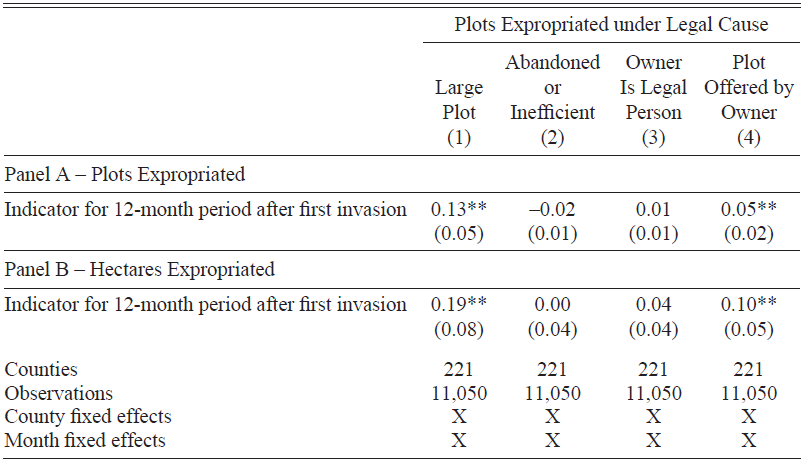
Table 3 presents estimates of Equation (2) using the same four previous outcomes. This specification is a relatively more parametric version of Equation (1), in which we constrain coefficients before the event to be equal to zero and estimate a single indicator variable for the period after the event. Then, the coefficient associated with the latter indicator captures the average increase in a single month. Column (1) shows that the first invasion was followed by 0.6 invasions each month. In Column (2), we observe that there were an additional 2.2 plots expropriated within one year of the event (0.18 × 12 months), an increase of 27 percent over the annual average. Finally, Column (3) shows the probability of experiencing at least one expropriation increases by 2.5 percentage points in a given month and the number of hectares expropriated increased by 19 percent 12 months after the first plot was invaded. Table 4 shows that two-thirds of these expropriations used the legal cause of large plots, while one-third was a plot offered by the owner to the corporation. The remaining causes were barely used after an invasion took place.
LEGAL CAUSES USED TO EXPROPRIATE PLOTS AFTER INVASIONS

Notes: Each estimate and its standard error come from an estimation of Equation (2). Panel A uses the total number of expropriations as dependent variable and Panel B the hyperbolic sine transformation of the total number of hectares expropriated. Different columns use expropriations under different legal causes. Each observation corresponds to a county-month pair in the period between 01/1970 and 04/1972. Standard errors are clustered by county. Statistical significance: *p<0.10, **p<0.05, ***p<0.01.
Sources: Land reform data files and police reports of land invasions.
Robustness of Results
This section provides statistical exercises that check for the robustness of previous estimates. We begin by addressing the fact that most events took place at the beginning of Allende’s rule. Then we show that results are unaffected by our specification decisions. We end the section by presenting and discussing more flexible specifications that account for unobserved heterogeneity over time across groups of nearby counties.
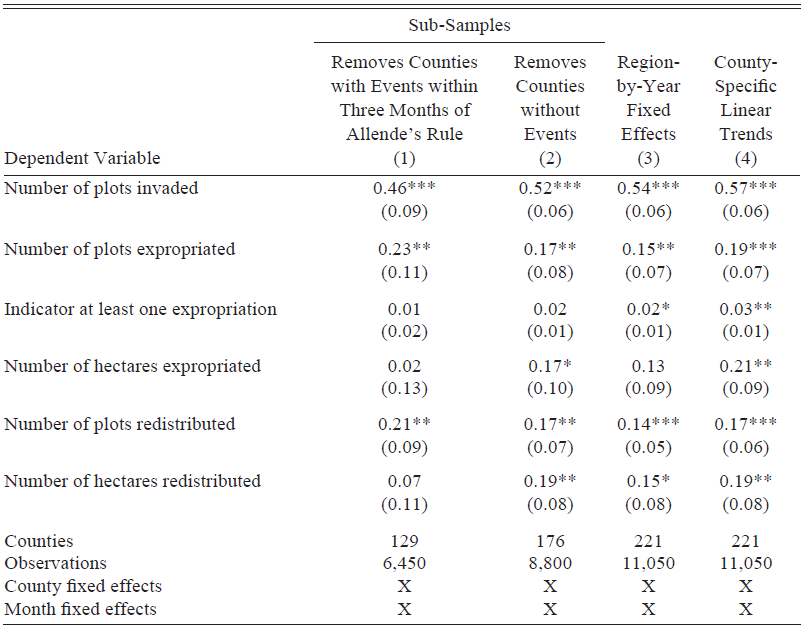
Half of the counties in our sample experienced a first invasion within three months of Allende’s government. This dispersion of events could constitute a threat to the validity of our research design if unobserved time shocks at the beginning of the new government coincide with the location of counties experiencing the first invasion. An example of this is local elections held in April 1971, which could be driving the timing of expropriations. To test for this concern, we remove from the estimation all counties with the first invasion within three months of Allende’s rule. This restriction ensures that the events are relatively spread throughout the period of study, minimizing concerns about unobserved time shocks. Column (1) in Table 5 presents the results. The estimated coefficient is still positive, statistically significant, and of similar magnitude than when using the full sample. If anything, the point estimate is actually larger than before (0.23 versus 0.21). We conclude that the dispersion of events is unlikely to be driving results.
ROBUSTNESS OF PARAMETRIC EVENT STUDY RESULTS

Notes: Each estimate and its standard error come from an estimation of Equation (2) using a different dependent variable. Rows represent different outcomes and columns denote the robustness exercise implemented. Each observation corresponds to a county-month pair in the period between 01/1970 and 04/1972, except otherwise noted. The number of hectares expropriated and redistributed use the hyperbolic sine transformation proposed by Burbidge, Magee, and Robb (1988). Standard errors are clustered by county. Statistical significance: *p<0.10, **p<0.05, ***p<0.01.
Sources: Land reform data files and police reports of land invasions.
Approximately 20 percent of our sample of agricultural counties never experienced an invasion. In terms of observable variables, Table 2 shows that these counties were somewhat different from other counties. Hence, never-invaded counties might constitute a poor counterfactual and could produce bias in our estimation in the presence of unobserved time factors interacting with some fixed county characteristic. To check for this potential threat, we estimate Equation (2) using only the sample of 176 counties with at least one invasion in the period of study. When imposing this restriction, identification arises only from the timing in which first invasions began to appear across counties. Results are presented in Table 5 Column (2). Estimates remain of similar magnitude and statistical significance, and hence this is unlikely to be a concern. Similarly, results are also robust to different measures of the dependent variables (Online Appendix Table A.2).
Yet another potential threat is the presence of correlated unobserved time shocks. A leading concern is the availability of large (expropriable) plots, which made the county subject to expropriations and invasions right from the beginning of Allende’s government, perhaps creating a spurious correlation between these variables. Reassuringly, results are similar when we control for the county-level availability of large plots—as measured by the 1965 agricultural census—interacted with time (calendar) fixed effects (Online Appendix Figure A.5). More generally, any time-variant policy that affects counties in the south or the north of the country differentially constitutes a potential threat. To address these concerns, we estimate Equation (2) using region-by-year fixed effects. Chile was divided into 13 regions, administrative units composed of clusters of counties. This specification allows for non-parametric regional trends in both invasions and expropriations. Column (3) in Table 5 presents estimation results for the four expropriation outcomes, and estimates remain virtually unchanged. In addition, Column (4) shows that all results are robust to the inclusion of county-specific linear trends. Finally, our inference remains unchanged when using two-way clustering to allow correlation of outcomes within event dates (Brown and Warner 1985), and it is also similar when we allow for spatial correlation across counties during each time period (Conley Reference Conley1999).Footnote 13
MECHANISMS AND INTERPRETATION
This section evaluates three interpretations of previous results. First, we analyze if the actions of workers can be considered a threat to revolt. Second, we evaluate the possibility that collective actions were orchestrated by the government to facilitate expropriations. And third, we consider whether invasions shaped the policy agenda by changing local public opinions. We end by offering back-of-the-envelope calculations of the role of displacement in explaining our findings.
The Threat of a Revolution and Collusion
Historians have emphasized that organized groups invaded plots to try to exert pressure on the government to radicalize policies and increase redistribution in the short run (e.g., Robles-Ortiz Reference Robles-Ortiz2018).Footnote 14 This is also a classical theoretical argument formalized by Acemoglu and Robinson (Reference Acemoglu and Robinson2006). Under this framework, the government observes invasions and chooses to either repress collective actions or expropriate the plot. If repression is chosen, there is a probability of a revolution, and the government could be overthrown or impeded to follow its economic and political plans. Then, if we observe the government expropriating after an invasion, we say that existing conditions made the latter option more attractive because of the “threat of a revolution.”
Another interpretation of our results is that the government was orchestrating invasions to facilitate expropriations. Although no legal cause can appeal to invaders as a reason to expropriate, the government could have incentivized workers to invade plots with the goal of exerting pressure on the landowner to offer it to the corporation. This legal cause accounted for 22 percent of expropriations in the Allende years (see Column (3) in Table 1), therefore at first sight this interpretation might be important. However, the work by Winn and Kay (1974) and Robles-Ortiz (Reference Robles-Ortiz2018) suggests that Allende did not orchestrate invasions at the beginning of his government. In contrast, radical left-wing groups outside of the government seem to have triggered most of the early invasions, which lends credibility to our econometric focus on early invasions and the “threat of a revolution” interpretation. Moreover, a battery of empirical exercises suggests that potential collusion between Allende and invaders is unlikely to explain the empirical relationship between invasions and expropriations we have documented.
The role of left-wing radical groups in triggering early invasions has been previously documented by historians, and the majority claim that the goal was to exert pressure to radicalize the land reform program and “speed up” the revolution. The most well-known groups exerting this pressure were the Revolutionary Left-wing Movement (MIR) and the Peasant Revolutionary Movement (MCR). An example of the role of the former comes from Winn and Kay (1974, p. 141), who emphasize its role early on: “With the encouragement and assistance of MIR, the revolutionary movement to the left of the Unidad Popular, these tomas [invasions] had assumed powerful proportions by the first months of 1971. To the Allende government, this pressure from below represented both an opportunity for speeding up the rural revolution and a threat to the government’s commitment to legality and controlled change.”Footnote 15 Similarly, Robles-Ortiz (Reference Robles-Ortiz2018, p. 142) emphasize the role of the MCR in triggering some of these early invasions: “Confronting the workers, Governor Hodges argued that the toma [invasion] was illegal, and it would only be prejudicial to President Allende, because the opposition would use it to blame the government for the ‘state of chaos’ in the countryside. Hodges did not persuade the MCR workers; an MCR ‘emissary’ went to his office to inform him that they would take over all the cordillera latifundia.”
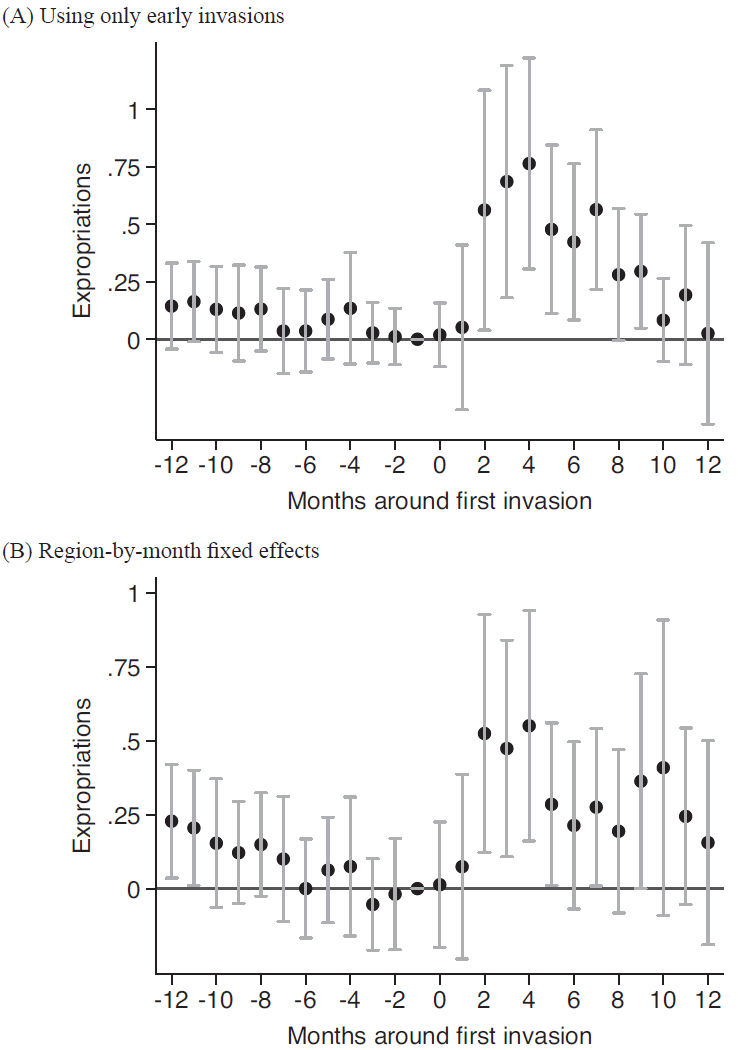
To empirically assess the potential role of the government in driving our results, we performed three empirical exercises. First, we have re-estimated our main specification exploiting only the first invasions that occurred within six months of Allende’s government. We do this to be conservative and assume that invasions towards the end of 1971 and 1972 could have been orchestrated by the government. Reassuringly, Panel (A) of Figure 5 shows that results are similar, suggesting that estimates are unlikely to be driven by government actions. Second, Winn and Kay (1974) argue that some invasions were planned by the government at the regional level. At the time, Chile was divided into 13 regions. These plans could constitute a threat if we are omitting regional factors driving invasions and expropriations. However, results in Panel (B) of Figure 5 are again similar when we include region-by-month fixed effects, suggesting unobservables at the regional level are unlikely to be an econometric threat. And third, if the government planned invasions, we might expect this to occur in places where they had more political support. However, Online Appendix Figure A.8 shows that invasions were, if anything, more likely to have taken place in locations where Allende obtained fewer votes in the 1970 presidential election. In sum, the evidence is inconsistent with the role of the government in driving the empirical relationship between invasions and expropriations.
COLLUSION BETWEEN WORKERS AND THE GOVERNMENT
Notes: Panel (A) presents estimates of Equation (1) with their corresponding 95 percent confidence interval using only invasions within six months of Salvador Allende’s government (November 1970–May 1971). According to historical accounts these early invasions are unlikely to be orchestrated by the government. Panel (B) presents estimates using our main specification but augmented with region-by-month fixed effects, administrative unit in which the government appears to have organized some invasions. Both panels constitute evidence against the collusion mechanism.
Sources: Land reform data files and police reports of land invasions.

Local Public Opinion
An additional mechanism through which invasions could have increased the intensity of expropriations is by shaping public opinion regarding land inequality and the plight of the poor. Although intuitive, Robles-Ortiz (Reference Robles-Ortiz2018) claims that invasions fostered mixed local opinions and received negative coverage from the opposition-controlled press. Newspapers highlighted the presence of MIR (radical left) collaborators, referring to them as “extremist elements” (El Correo, 1 December 1970). A key contributor to the negative press that invasions received was the Christian Democrat Party (PDC), a large party with strong support in the countryside, which was publicly against land invasions. Robles-Ortiz (Reference Robles-Ortiz2018, p. 11) argues that:
“The PDC’s discourse was politically influential. It grossly exaggerated the ‘guerrilla threat,’ and was systematically disseminated by the opposition’s newspapers. In early February of 1971, providing no source, El Correo reported that ‘all the cordillera next to Panguipulli is under Comandante Pepe’s control, and he is now in the position of mobilizing a mob of no less than five thousand campesinos.’ PDC national leaders used the newspapers’ vague notes to support their interventions in Congress.”
Surveys conducted during the first two years of Allende’s government also support the idea that invasions were far from popular among the public. These surveys, conducted by sociologist Eduardo Hamuy, reveal that 47 percent of 1,800 respondents thought violence had increased when compared to previous governments.Footnote 16 Moreover, 60 percent responded that the left-wing was causing this violence, and only 16 percent perceived it was caused by right-wing groups. Finally, consistent with previous anecdotal evidence and responses in the Hamuy surveys, Online Appendix Table A.3 presents cross-sectional regression estimates, which reveal that the number of invasions before the 1971 local election was unrelated to the local political support obtained by the candidates from the left-wing coalition in power (UP). In sum, anecdotal and empirical evidence suggests that public opinion was unlikely to be a mechanism connecting invasions and the policy agenda.
The Role of Displacement
Our estimates represent the impact of the first invasions after Allende rose to power using other counties as counterfactuals over time. Without further assumptions, these within-country comparisons prevent us from knowing whether invasions increased the intensity of expropriations or if these would have taken place anyways in a different location or time. This could be the case, for example, if the government had limited capacity and invasions were diverting expropriations from one place to another. Although the potential displacement does not invalidate our analysis, it affects its interpretation. This section explores the importance of displacement in explaining our findings using an estimate of the structure and strength of displacement.
Spatial diversion of expropriations is likely to be the most relevant displacement.Footnote 17 Unfortunately, we lack a counterfactual for the country, so the best we can do is to explore the importance of displacement using two simple assumptions. First, we use our estimates from previous sections and assume the absence of displacement: 176 first invasions were causing an increase in hectares expropriated per month over 12 months, for a total of 0.6 million hectares expropriated due to invasions, or 10 percent of Allende’s expropriations. Second, we assume that displacement occurred only across adjacent counties. In practice, we estimate Equation (2) using the sum of hectares expropriated in the three nearest counties as the dependent variable. A negative estimate would indicate the presence of displacement. However, after a first invasion, we estimate that expropriations increased by 300 hectares in nearby counties.Footnote 18 We can conservatively use the 95 percent confidence interval [–110, 700] and reject a displacement rate larger than 38 percent (–100/261 = 0.38).Footnote 19 Using this rate, we calculate that invasions increased the number of hectares expropriated during the Allende years by 0.4 million hectares or 6 percent of expropriations in this period.
All in all, these calculations suggest that land invasions generated 0.4–0.6 million hectares of additional expropriations, equivalent to 6–10 percent of all area expropriated by Salvador Allende between 1970 and 1973, approximately 0.7 percent of the Chilean territory or the size of Trinidad and Tobago. Thus the presence of displacement is unlikely to fully explain our findings.
CONCLUSION
The role of collective action as a factor that can affect the intensity of a policy has been relatively overlooked empirically. In this article, we have studied Chile’s peasant social movement at the beginning of the 1970s and Salvador Allende’s land reform program to show how organized groups of agricultural workers affected the location and intensity of expropriations. We find that in the months following the invasion of a plot, the number of plots expropriated in the same area increased significantly. After exploring a variety of mechanisms, we conclude that the government is likely to be expropriating plots after invasions to avoid an uprising.
The impact of land invasions on the policy agenda can deliver important lessons for the future. Recent waves of protests around the world have sparked a renewed interest in understanding the role of group actions in shaping the policy-making process. Moreover, the increased availability of information technologies has decreased the cost of coordination, and hence collective actions are likely to become more common, not only in developed countries but in low-income countries as well (Enikolopov, Makarin, and Petrova Reference Enikolopov, Makarin and Petrova2020; Manacorda and Tesei 2020). In our context, the unionization law of 1967 acted as a decrease in the cost of coordination, and hence land invasions and other collective actions spread throughout the country. We believe this historical context provides a useful case study to understand the interplay between organized groups and the policymaker. Our results highlight the potential radicalization of the policy agenda of an incumbent government in the presence of organized groups that can exert pressure to pursue their goals.