INTRODUCTION
Estuaries and coastal lagoons represent highly important environments for marine biodiversity and productivity, due to their potential value as nurseries for several marine species including commercially important fish and invertebrates (Boesch & Turner, Reference Boesch and Turner1984; Beck et al., Reference Beck, Heck, Able, Childers, Eggleston, Gillanders, Halpern, Hays, Hoshino, Minello, Orth, Sheridan and Weinstein2001). Among these, shrimp species of the family Penaeidae represent one of the most important fishery resources inhabiting tropical and subtropical estuarine ecosystems during part of their life cycle (Garcia & Le Reste, Reference Garcia and Le Reste1981). Spawning and larval development of penaeid shrimps take place in the sea, then they settle as postlarvae in estuaries and coastal lagoons where they spend their juvenile stage, and later as subadults migrate offshore and join the adult population (Dall et al., Reference Dall, Hill, Rothlisberg, Sharples, Blaxter and Southward1990).
Submerged aquatic vegetation (SAV) in estuarine ecosystems is composed of different types of primary producers, including seagrasses and macroalgae, which cover the substrate in shallow areas forming extensive subtidal vegetated habitats (Little, Reference Little2006). Seagrass and algal meadows have a positive influence on the abundance of juvenile fish and macrofaunal invertebrates (Jackson et al., Reference Jackson, Rowden, Attrill, Bossey and Jones2001; Bolam & Fernandes, Reference Bolam and Fernandes2002; Salovius & Kraufvelin, Reference Salovius and Kraufvelin2004; Unsworth et al., Reference Unsworth, De Grave, Jompa, Smith and Bell2007; Casares & Creed, Reference Casares and Creed2008). In fact, physical and biological aspects of SAV (presence/absence, cover, density, biomass and species composition) can affect the distribution and abundance of juvenile shrimp in tropical estuaries and coastal lagoons (Haywood et al., Reference Haywood, Vance and Loneragan1995; Loneragan et al., Reference Loneragan, Kenyon, Staples, Poiner and Conacher1998; Pérez-Castañeda & Defeo, Reference Pérez-Castañeda and Defeo2004). Furthermore, it has been recognized that the density and biomass of seagrass enhance growth and survival of juvenile penaeids (Loneragan et al., Reference Loneragan, Haywood, Heales, Kenyon, Pendrey and Vance2001; Pérez-Castañeda & Defeo, Reference Pérez-Castañeda and Defeo2005), demonstrating the importance of SAV habitats as nursery areas for penaeids in the tropical region.
Although intertidal salt marsh vegetation is surmised to be the main estuarine habitat used by juvenile penaeids in subtropical latitudes (Boesch & Turner, Reference Boesch and Turner1984; Zimmerman et al., Reference Zimmerman, Minello, Rozas, Weinstein and Kreeger2000; Web & Kneib, Reference Web and Kneib2002), some studies have also pointed out the value of SAV beds for the abundance of shrimp species in the subtropical regions of the western Atlantic (Sheridan, Reference Sheridan1992; Murphey & Fonseca, Reference Murphey and Fonseca1995; Rozas & Minello, Reference Rozas and Minello1998; Clark et al., Reference Clark, Christensen, Monaco, Caldwell, Matthews and Minello2004). However, the distribution of penaeid shrimps in relation to SAV habitats and abiotic environmental factors has not been examined in a microtidal hypersaline system where intertidal saltmarsh habitats are absent. This is of particular relevance because biotic, abiotic or landscape factors may affect the relative value of SAV beds as nurseries for penaeids (Beck et al., Reference Beck, Heck, Able, Childers, Eggleston, Gillanders, Halpern, Hays, Hoshino, Minello, Orth, Sheridan and Weinstein2001).
Abiotic environmental factors (e.g. salinity and temperature) also influence the distribution of juvenile shrimp within estuarine ecosystems (Lüchmann et al., Reference Lüchmann, Freire, Ferreira, Daura-Jorge and Marques2008). Juvenile Farfantepenaeus aztecus Ives, 1891 and F. duorarum Burkenroad, 1939 have been found in salinity regimes ranging from oligohaline to mixoeuhaline (2 to 37), and temperatures from 5 to 30°C; however, the preference for a particular range of salinity and temperature differs among estuaries (Murphey & Fonseca, Reference Murphey and Fonseca1995; Howe et al., Reference Howe, Wallace and Rikard1999; Pérez-Castañeda & Defeo, Reference Pérez-Castañeda and Defeo2004) indicating that, irrespective of the abiotic conditions, other factors are also important in determining the distribution and abundance of penaeids.
The Laguna Madre of Tamaulipas is the biggest subtropical coastal lagoon in Mexico, extending 200 km along the Gulf of Mexico. It is a microtidal hypersaline ecosystem with extensive subtidal SAV beds, where three penaeid shrimp species, Farfantepenaeus aztecus, F. duorarum and Litopenaeus setiferus Linnaeus, 1767, co-occur (Britton & Morton, Reference Britton and Morton1989; Barba, Reference Barba1999). Unfortunately, information about the distribution of penaeids on SAV beds along this important coastal lagoon is not available elsewhere. In this study, we examine the abundance and distribution of Farfantepenaeus species on SAV habitats in the Laguna Madre of Tamaulipas in order to assess the utilization of SAV beds by penaeids along a subtropical hypersaline ecosystem, and to evaluate the relative influence of biotic and abiotic factors on shrimp abundance.
MATERIALS AND METHODS
Study area
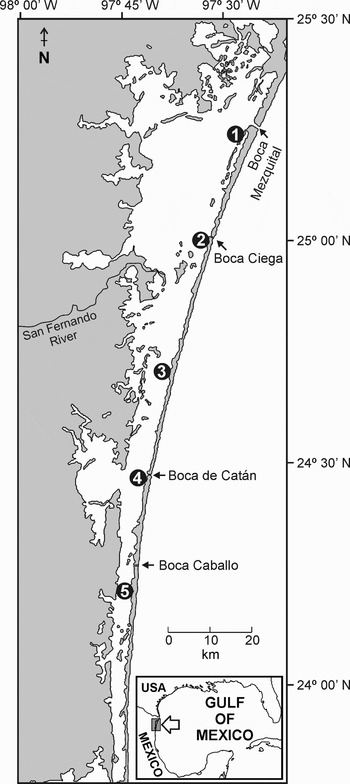
The Laguna Madre of Tamaulipas (north-eastern Mexico) is a 200 km-long subtropical coastal lagoon with a diurnal microtidal regime located on the Gulf of Mexico (latitude 23°50′−25°30′N and longitude 97°15′−97°45′W). It has an area of about 2000 km2 and a maximum depth of a little more than 3 m. The northern part of the lagoon has a width of ~20 km, decreasing southward to <3 km (Britton & Morton, Reference Britton and Morton1989). The lagoon is for the most part cut off from the sea by long and narrow sandy barrier islands. However, four small (200–400 m width) permanent tidal inlets (Boca Mezquital, Boca Ciega, Boca de Catán and Boca Caballo) breach the barrier islands (Figure 1), providing a little water exchange between the lagoon and the Gulf of Mexico. This situation combined with the lack of significant river discharges and the semi-arid climate, has made the Laguna Madre of Tamaulipas a hypersaline lagoon, where salinities are often over 33 (Barba, Reference Barba1999) and sometimes in excess of 130 (Britton & Morton, Reference Britton and Morton1989). In fact, the Laguna Madre of Tamaulipas is the largest hypersaline coastal lagoon in Mexico, and together with the Laguna Madre of Texas (USA) they comprise the greatest hypersaline lagoon system on the North American continent (Tunnel & Judd, Reference Tunnel and Judd2002).
Location of sampling sites (•) along the Laguna Madre of Tamaulipas (Mexico). Name and location of permanent tidal inlets are indicated by black arrows.

Peak recruitment of F. aztecus postlarvae into estuaries and coastal lagoons of the northern Gulf of Mexico occurs in spring (March–April) and autumn (August–October) (Matthews, Reference Matthews2008), whereas high densities of immigrating F. duorarum postlarvae have been found mainly from July to September (Criales et al., Reference Criales, Wang, Browder, Robblee, Jackson and Hittle2006). Although both species occur throughout the Gulf of Mexico, F. aztecus is concentrated along the coast of Texas, Louisiana and eastern Mexico, whereas F. duorarum has centres of abundance in south-western Florida and south-eastern Mexico (Renfro & Brusher, Reference Renfro and Brusher1982). However, locations of the main spawning areas of F. aztecus and F. duorarum are unknown for the Mexican coasts in this region.
Sampling and laboratory procedures
Five sites along the Laguna Madre of Tamaulipas were sampled during two winter months (January and February 2005), covering a distance of approximately 120 km along the inner margin of the island barriers (Figure 1). Shrimp were collected at night on flood tide by taking three replicate samples (tows) at each sampling site, using a beam trawl (2.0 × 0.6 m mouth; 2.5 m long; mesh size 1.3 cm). The beam trawl was hand-hauled 50 m along the bottom (1.0 m depth approximately) parallel to the water's edge, resulting in a sampling area of 100 m2 per tow. A total of 30 beam-trawl samples were obtained for this study.
For each replicate sample, water temperature (°C) and dissolved oxygen (mg l−1) were measured with a hand-held field instrument (YSI model 550A), and salinity with an optical refractometer. Additionally, submerged aquatic vegetation (SAV) was collected by taking two replicate samples (using a 1 m2 quadrat) along a transect parallel to each 50 m trawl. SAV was bagged and transported to the laboratory for biomass determination (wet weight, g m−2) discriminating by type of SAV: algae and seagrass (excluding rhizomes). The algal community was composed of unattached forms drifting on the bottom of the lagoon (drift algae) and attached algae, which were analysed separately.
Shrimp were preserved in 70% ethyl alcohol. Each individual shrimp was measured (carapace length (CL)) to the nearest 0.1 mm and separated by species, according to morphological characteristics, under a dissecting microscope (Pérez-Farfante, Reference Pérez-Farfante1970). All specimens smaller than 8.0 mm CL, were only identified to the genus level, because of the lack of distinctive characteristics in Farfantepenaeus spp. below this size. Shrimp were categorized into 3 population components: recruits (CL < 8.0 mm), juveniles (CL ≥ 8.0 and <15.0 mm) and subadults (CL ≥ 15.0 mm).
Data analyses
Data from both sampling dates were pooled to evaluate spatial variations in environmental factors and shrimp abundance. One-way ANOVAs were used to test for differences among sites in salinity, temperature, dissolved oxygen, algal (drift and attached) and seagrass biomass (g m−2), as well as to evaluate spatial differences in shrimp abundance (ind 100 m−2) discriminated by species, and population component. When necessary, data were transformed using log (x+0.5) or fourth-root to fulfil ANOVA assumptions. At each site, length–frequency distributions were constructed for each species and compared with Kolmogorov–Smirnov tests (Zar, Reference Zar1999).
Forward stepwise multiple regression analysis was used to assess the relative effect of salinity, temperature, dissolved oxygen and SAV biomass (discriminated by algae and seagrass) on shrimp abundance. This analysis was undertaken using F values of 1 and 0, chosen a priori for variable entry and removal, respectively, until the best regression model was obtained. Partial correlations and redundancy of independent variables were also analysed. Additionally, linear functions were fitted to evaluate the influence of seagrass biomass on shrimp abundance.
RESULTS
Environmental variables
Salinity ranged from 34 (site 1) to 45 (site 3) and showed significant differences between sites along the coastal lagoon (P < 0.01, ANOVA). Salinity (mean±SE) was significantly higher at site 3 (44.2±0.4), whereas lower salinities were registered near the tidal inlets (Figure 1; Table 1), particularly at sites 1 (35.2±0.4) and 5 (36.3±1.3) which were not significantly different from each other. Water temperature tended to be slightly higher at site 5 (21.6±0.3°C) and lower at site 1 (20.2±0.7°C) (Table 1); however such differences were not significant (P > 0.05, ANOVA). Mean dissolved oxygen concentration varied from 5.5 to 7.1 mg l−1 among sites (Table 1); however, no significant differences were found (P > 0.05, ANOVA).
Spatial variation (mean±SE) in salinity, temperature, dissolved oxygen, algae and seagrass biomass at five sampling sites along the Laguna Madre (Mexico).

The dominant drift alga was Digenia simplex (Wulfen) Agardh, 1822, whereas Penicillus capitatus Lamark, 1813 and Udotea occidentalis Gepp & Gepp, 1911 comprised most of the biomass of attached algae. On the other hand seagrass meadows were dominated by Halodule wrightii Ascherson, 1868 (shoal grass) with 90.6% of total seagrass biomass, while the remaining 9.4% corresponded to Syringodium filiforme Kützing, 1860 (manatee grass). Biomass of drift and attached algae was significantly different among sites along the lagoon (P < 0.05, ANOVA). The highest biomass of drift algae was observed at site 1 (751.4±333.7 g m−2), whereas the lowest occurred at site 3 (15.1±7.1 g m−2) (Table 1). Attached algae had the lower biomass at site 3 (6.4±3.5 g m−2) and higher at site 2 (137.0±40.5 g m−2). Significant differences in seagrass biomass were also detected among the different sites (P < 0.05, ANOVA), being highest at site 4 (99.8± 39.4 g m−2) and lowest at site 1 (1.1±1.0 g m−2) (Table 1).
Farfantepenaeus shrimp
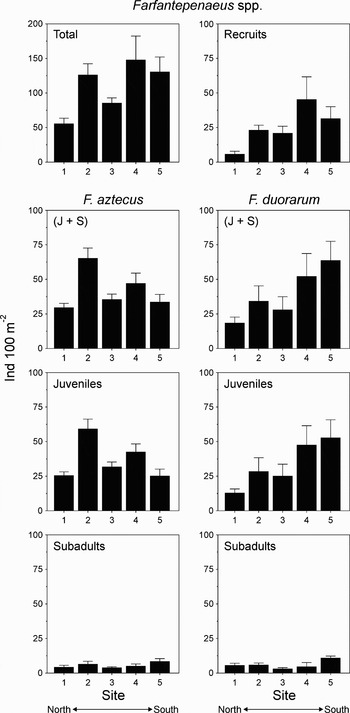
A total of 3268 shrimp belonging to two Farfantepenaeus species were collected in the Laguna Madre. Farfantepenaeus aztecus represented 39.5% of the total abundance, followed by F. duorarum with 36.8%. The remaining 23.7% corresponded to recruits (CL < 8.0 mm). With the exception of F. duorarum and subadults, shrimp abundance exhibited significant differences (ANOVAs, P < 0.05) among sites along the lagoon. Abundance of recruits and total shrimp was significantly lower at site 1 (ANOVAs, P < 0.05; Figure 2) and higher at sites 2 to 5, which did not reveal significant differences among them. On the other hand, F. aztecus was significantly more abundant at site 2 (ANOVA, P < 0.05), whereas the remaining sites were not significantly different from each other (Figure 2). Although the mean number of F. duorarum individuals tended to increase at site 5 (Figure 2) such differences were not significant (ANOVA, P > 0.05).
Spatial variation of Farfantepenaeus shrimp abundance (mean+SE) by species and population component. J+S, juveniles+subadults.

Length–frequency distributions by site showed a clear dominance of juveniles, constituting ≥70% of collected individuals (Figure 3). In spite of the fact that the proportion of subadults (bigger individuals) was slightly higher at sites 5 and 1 for F. aztecus and F. duorarum respectively (Figure 3), there were no significant differences in length–frequency distributions among sites (Kolmogorov–Smirnov, P > 0.05).
Spatial variations in length–frequency distributions of shrimp species. Percentages of juveniles (J) and subadults (S) are indicated.

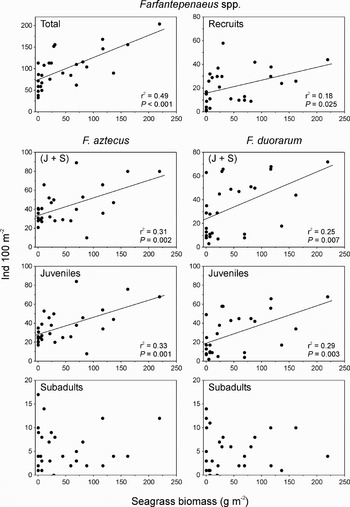
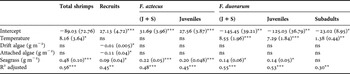
Multiple regression models accounted for 30 to 56% of the variance of shrimp abundance. The densities of total shrimp and F. duorarum (juveniles+subadults and only juveniles) were positively related to seagrass biomass and water temperature, whereas subadults of this species were positively related to temperature. Abundance of F. aztecus (juveniles+subadults and only juveniles) was significantly explained by the seagrass biomass, whereas the abundance of recruits was inversely related to drift and attached algae, and positively with seagrass biomass (Table 2). In all of the above cases, with the exception of subadults, a significant positive linear relationship between seagrass and shrimp abundance was fitted, indicating an increase in numbers of individuals with increasing seagrass biomass (Figure 4).
Relationships between seagrass biomass and Farfantepenaeus shrimp abundance. A linear model of the form Y = a+bX was fitted in all cases, excluding subadults. J+S, juveniles+subadults.

Farfantepenaeus spp. Regression coefficients (±SE) for predictor variables in forward stepwise multiple-regression analyses of shrimp abundance (species and population components). Only predictors with at least one significant relationship are shown. Results of F. aztecus subadults are not shown because environmental variables were not significant predictors. J + S, juveniles + subadults; ns, not significant; *P < 0.05; **P < 0.01; ***P < 0.001.

DISCUSSION
Submerged aquatic vegetation
Spatial patterns in biomass were relatively different for each component of SAV. The peak biomass of drift and attached algae occurred at the northern part of the lagoon (sites 1 and 2, respectively). Conversely, seagrass was scarce at site 1, but it reached a peak biomass at site 4 (Table 1). Biomass of drifting algae was clearly higher than seagrass at sites 1 and 5, whereas the biomass of attached algae was markedly higher than seagrass at sites 1 and 2 (Table 1). In some temperate estuarine ecosystems, loss of seagrass often coincides with increased macroalgal accumulations, because of light reduction for the newly recruiting seagrass shoots induced by the macroalgal canopy (Hauxwell et al., Reference Hauxwell, Cebrian, Furlong and Valiela2001). This fact could explain the lower seagrass biomass in some areas along the Laguna Madre.
Distribution of shrimp along the lagoon
The presence of Farfantepenaeus aztecus and F. duorarum in the Laguna Madre is related to their natural distribution range, including the Gulf of Mexico coast (Pérez-Farfante, Reference Pérez-Farfante1988). Litopenaeus setiferus is another penaeid shrimp species inhabiting this ecosystem (Barba, Reference Barba1999), and it is indeed captured by artisanal fishers in the lagoon; however, this species was not present in any of our samples. The fact that the recruitment of L. setiferus postlarvae does not occur until May, as documented in Galveston Bay, Texas (Baxter & Renfro, Reference Baxter and Renfro1966) may explain the absence of L. setiferus during our study.
The abundance proportions of F. aztecus and F. duorarum were roughly in agreement with the results obtained by Barba (Reference Barba1999) at the central part of the lagoon. On the other hand, this result differs from the abundance reported by commercial landings from the Tamaulipas coast, where F. aztecus constitutes >87% of the total shrimp catch (SAGARPA, 2005). Similarly, Howe et al. (Reference Howe, Wallace and Rikard1999) found an apparent anomaly between shrimp densities in a coastal lagoon of Alabama (USA) and commercial landings. They argued that F. aztecus and F. duorarum are not consistently distinguished from one another when harvested along the Alabama coastline, which may in part explain these differences.
Both shrimp species were approximately equally abundant in the lagoon; however, their spatial distribution patterns were quite different. Farfantepenaeus aztecus exhibited higher abundance at site 2, whereas no significant differences were detected for F. duorarum. The spatial patterns of abundance and shrimp size along the lagoon can be related to different biotic and abiotic factors influencing settlement, survival and growth of F. aztecus and F. duorarum. Indeed, local population densities of marine species are the result of both pre- and post-settlement processes operating together (Caley et al., Reference Caley, Carr, Hixon, Hughes, Jones and Menge1996). It is probable that the tidal inlets in the Laguna Madre have a differential postlarval influx, caused by their relative location to the spawning centre and by spatial variations in coastal currents, as has been reported for the supply of F. duorarum postlarvae to nursery grounds in Florida Bay (Criales et al., Reference Criales, Wang, Browder, Robblee, Jackson and Hittle2006). However, although the abundance of juvenile shrimp is affected by the supply of postlarvae from offshore (Vance et al., Reference Vance, Haywood, Heales, Kenyon and Loneragan1998), environmental conditions and SAV communities are key factors in explaining the spatial distribution of penaeids within estuaries and coastal lagoons (Haywood et al., Reference Haywood, Vance and Loneragan1995; Loneragan et al., Reference Loneragan, Kenyon, Staples, Poiner and Conacher1998; Pérez-Castañeda & Defeo, Reference Pérez-Castañeda and Defeo2004).
Laguna Madre exhibited extensive SAV beds composed of a mixture of drift algae (mainly Digenia simplex), attached algae (mainly Penicillus capitatus and Udotea occidentalis) and seagrasses (mainly Halodule wrightii). Drifting and attached algae can provide suitable habitats for macrofauna (Salovius & Kraufvelin, Reference Salovius and Kraufvelin2004), including some penaeid shrimp species in estuaries (Haywood et al., Reference Haywood, Vance and Loneragan1995). However, according to our results, algae biomass (drift and attached) did not have a positive influence on shrimp abundance in Laguna Madre, indicating that penaeids do not show a preference for drift or attached algae.
Spatial distribution of recruits suggests lower recruitment and/or higher mortality of smaller individuals at site 1, where the substratum was dominated by drifting algae. In some estuaries, it has been reported that algal beds can support densities of postlarval and juvenile shrimp (Penaeus semisulcatus) equal to those found in seagrass beds (Haywood et al., Reference Haywood, Vance and Loneragan1995). However, in the present study algal material appear not to provide an important habitat for the settlement and survival of shrimp postlarvae. The negative influence of algae biomass on the abundance of recruits (Table 2) also gives support to this idea. On the other hand, seagrass biomass was a consistent linear predictor of abundance for Farfantepenaeus species and their population components, with the exception of subadults, suggesting a preference for seagrasses (i.e. Halodule wrightii). The lack of significant relationships between the abundance of subadults and seagrass biomass could be associated to shifts in habitat use among population components (Loneragan et al., Reference Loneragan, Kenyon, Staples, Poiner and Conacher1998). Previous studies have indicated that some penaeids have differential preferences for vegetated structures according to shrimp size and time of day (Kenyon et al., Reference Kenyon, Loneragan and Hughes1995; Liu & Loneragan, Reference Liu and Loneragan1997). Thus, the dependence of the population components of F. aztecus and F. duorarum on seagrass meadows could differ between day and night periods. This issue should be evaluated in the near future.
Even though seagrasses dominated the substrata at site 3, exhibiting higher seagrass biomass than site 5 (Table 1), site 3 was far away from the tidal inlets, and thus from the source of postlarvae, which may partially explain the lower abundance observed at this site in comparison with sites 2, 4 and 5, close to the tidal inlets Boca Ciega, Boca de Catán, and Boca Caballo, respectively (Figure 1). This result agrees with previous studies showing that the value of seagrass habitats for aquatic fauna is influenced by their location within the estuary (Hannan & Williams, Reference Hannan and Williams1998; Pérez-Castañeda & Defeo, Reference Pérez-Castañeda and Defeo2004). Additionally, higher salinity levels at site 3 (44.2; Table 1) might also influence the use of seagrass habitats by penaeids. High salinity in combination with low temperature (i.e. 21.1°C) has negative effects on shrimp growth (Browder et al., Reference Browder, Zein-Eldin, Criales, Robblee, Wong, Jackson and Johnson2002), and thus, a lower affinity of penaeids for these areas may be expected. On the other hand, SAV beds at site 1 (neighbouring the tidal inlet Boca Mezquital) were clearly dominated by algae, which did not provide an equivalent habitat to seagrass for penaeids resulting usually in lower abundance of shrimp at this site. Shrimp inhabit seagrass beds because they provide food and protection against predators (Minello, Reference Minello1993; Corona et al., Reference Corona, Soto and Sánchez2000). Indeed, a significantly higher abundance of shrimp was observed when seagrass biomass increased (Figure 4).
Temperature is directly related to movement, feeding, growth and survival of penaeids (Dall et al., Reference Dall, Hill, Rothlisberg, Sharples, Blaxter and Southward1990), which could explain the positive influence of water temperature on the total abundance of shrimp and F. duorarum. This result is consistent with previous studies of penaeids where temperature influenced the spatial and temporal patterns of F. brasiliensis in a subtropical coastal lagoon from South America (Lüchmann et al., Reference Lüchmann, Freire, Ferreira, Daura-Jorge and Marques2008). In contrast, the lack of effect of salinity on shrimp density was the opposite of that observed in other tropical (Celestun) and subtropical (Conceição) lagoons, where shrimp density was positively related to salinity (Pérez-Castañeda & Defeo, Reference Pérez-Castañeda and Defeo2001; Lüchmann et al., Reference Lüchmann, Freire, Ferreira, Daura-Jorge and Marques2008). However, Laguna Madre has higher salinity levels (34 to 45) than Celestun (22 to 32) and Conceição (23 to 27) which could account for these differences.
In summary, our results indicate that shrimp abundance was positively related to seagrass biomass and/or to water temperature, whereas there was a negligible or negative relationship with algal biomass, suggesting that seagrass is the most important component of SAV beds influencing the abundance of F. aztecus and F. duorarum. In this sense, the protection of seagrass beds from human impact may be critical for the conservation and management of these shrimp species of commercial value in the Gulf of Mexico.
ACKNOWLEDGEMENT
We thank PROMEP Mexico (grants 103.5/04/1405 and 103.5/05/3156) for its financial support.