Orthostatic intolerance is a constellation of signs and symptoms that are elicited by standing upright and relieved by recumbency.Reference Low, Sandroni, Joyner and Shen 1 Postural tachycardia syndrome and vasovagal syncope are main entities of orthostatic intolerance in children. Postural tachycardia syndrome is defined by symptoms of orthostatic intolerance in association with excessive tachycardia.Reference Jarjour 2 Its symptoms include palpitations, light headedness, chest discomfort, shortness of breath, blurred vision, and exercise intolerance.Reference Jarjour 2 , Reference Stewart 3 Postural tachycardia syndrome is more frequent in female patients and most cases occur from the age 15 to 25 years old. Chronic fatigue, chronic headache, fibromyalgia, and sleep disturbances have been frequently associated with postural tachycardia syndrome. Physical deconditioning and psychological factors play an important role in these patients. Some individuals with serious symptoms were unable to participate in the school studies or the social activities. One-third of medical students report at least one syncopal episode in their life-time.Reference Kenny, Bhangu and King-Kallimanis 4
Treatment status of postural tachycardia syndrome and vasovagal syncope
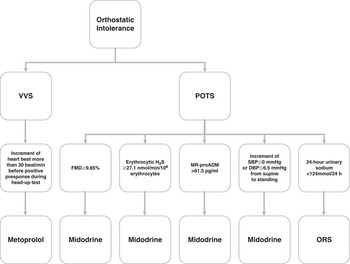
The mechanisms for those diseases have been unclear yet. Absolute hypovolemia, hyper-adrenergic responses, imbalance in the autonomic nervous system, and impaired regulation of peripheral vascular resistance were thought to be involved in the pathogenesis.Reference Medow and Stewart 5 Therefore, the supplementation with water, or salt, or midodrine, or β-blockers was applied to children with postural tachycardia syndrome or vasovagal syncope; even the pyridostigmine or octreotide was sometimes used partly for postural tachycardia syndrome patients (Fig 1).
Schematic graph: Individualised therapy for orthostatic intolerance; DBP=diastolic blood pressure; FMD=flow-mediated dilation; H2S=hydrogen sulfide; MR-proAD=midregianl-proadenomedullin; ORS=oral rehydration saline; POTS=postural tachycardia syndrome; SBP=systolic blood pressure; VVS=vasovagal syncope.

For postural tachycardia syndrome, regardless of the basic pathophysiological mechanism, most patients require volume expansion with adequate daily water (1.5–2 L) and sodium intake.Reference Benarroch 6 β-blockers, such as metoprolol (25 mg/day), was used to control the excessive sinus tachycardiaReference Kanjwal, Karabin and Sheikh 7 and α1-adrenergic agonist midodrine (2.5 mg, twice a day) to elicit peripheral vasoconstriction and reduce venous pooling.Reference Chen, Wang and Sun 8 The efficacy of the medicine, however, varied. Zhang et al showed that oral rehydration salts plus midodrine hydrochloride or plus metoprolol improved the efficacy of drugs in children with postural tachycardia syndrome, and the efficacy of midodrine hydrochloride was superior to that of metoprolol.Reference Zhang, Liao, Li, Chen, Jin and DU 9 Another study revealed that midodrine hydrochloride was effective in the treatment of children with postural tachycardia syndrome, with the cure rate of 68.2%.Reference Chen, Wang and Sun 8 However, Lai et al said that adolescents taking β-blockers and midodrine both improved the conditions (63.6% versus 36.4%).Reference Lai, Fischer and Brands 10 Fu et al considered that for patients with postural tachycardia syndrome, exercise training is superior to propranolol at restoring upright haemodynamics, normalising renal–adrenal responsiveness, and improving the quality of life.Reference Fu, Vangundy, Shibata, Auchus, Williams and Levine 11 In contrast, a study by Arnold found that a single low dose of propranolol (20 mg) as compared with placebo was useful in increasing maximum exercise capacity measured 1 hour after medication.Reference Arnold, Okamoto and Diedrich 12
On the basis of cases of 20 children, Ross AJ et al conducted a double-blind placebo-controlled cross-over study. Postural tachycardia syndrome subjects received 2 weeks of treatment with midodrine or placebo. In neuropathic postural tachycardia syndrome, midodrine decreased supine heart rate, calf blood flow, and calf venous capacitance, while increasing mean arterial pressure and calf vascular resistance compared with placebo. In hyperadrenergic postural tachycardia syndrome, both placebo and midodrine decreased upright heart rate and increased supine calf vascular resistance. This suggests that midodrine is probably an effective treatment for neuropathic postural tachycardia syndrome, but not for hyperadrenergic postural tachycardia syndrome.Reference Ross, Ocon, Medow and Stewart 13 Arnold AC et alReference Arnold, Okamoto and Diedrich 14 provided Class II evidence that a single low dose of propranolol (20 mg daily) as compared with placebo was useful in increasing maximum exercise capacity measured 1 hour after medication. For patients with postural tachycardia syndrome, exercise training is superior to propranolol at restoring upright haemodynamics, normalising renal–adrenal responsiveness, and improving the quality of life.Reference Fu, Vangundy, Shibata, Auchus, Williams and Levine 15
As for the vasovagal syncope, a meta analysis showed that α-adrenergic agonists were found effective in preventing vasovagal syncopal recurrence. β-blockers were not found to be effective when only randomised studies comparing β-blockers with non-pharmacologic agents were assessed.Reference Vyas, Swaminathan, Zimmerman and Olshansky 16 A study by Chen et al showed that the cure rate of children who suffered from vasovagal syncope by taking oral metoprolol was 60.61%.Reference Chen, DU and Zhang 17 However, a study by Russia revealed that overall efficacy of atenolol and midodrine was 44% and 70%, respectively.Reference Kuchinskaia, Pevzner and Vershuta 18
Considering the different mechanisms of the diseases and currently unfavourable results of the treatment, great improvement was achieved in terms of an individualised therapy, and before the application of any treatment biological markers or predictors could provide useful information for doctors to choose the specific treatment regimen.Reference Liao, Yang and Zhang 19 – Reference Zhang, Li and Ochs 21
Predictors for oral rehydration salt therapy for postural tachycardia syndrome in children
The mechanisms for postural tachycardia syndrome have not been fully determined. Previous studies showed that it might be associated with relative hypovolemia.Reference Jacob, Robertson, Mosqueda-Garcia, Ertl, Robertson and Biaggioni 22 Increasing blood volume by increasing fluid and salt intake was proven to be partially beneficial for some children and adolescents.Reference Lu, Diedrich and Tung 23 , Reference Mathias and Young 24 Salt supplementation is sometimes effective in certain patients with postural tachycardia syndrome, but how to recognise those who will respond to this treatment is an issue worthy of investigation. El-Sayed and HainsworthReference El-Sayed and Hainsworth 25 validated 24-hour urinary sodium excretion as a marker for hypovolemic status. This marker, 24-hour urinary sodium excretion, correlated with plasma volume. A study by Zhang et al showed that lower 24-hour urinary sodium excretion was associated with more serious symptoms in children and adolescents with postural tachycardia syndrome, and 24-hour sodium excretion of <124 mmol/24 hours was an indicator of the effectiveness of salt supplementation in children and adolescents with postural tachycardia syndrome.Reference Zhang, Liao, Tang, Du and Jin 26
Predictors for therapeutic response to midodrine hydrochloride in children with postural tachycardia syndrome
Flow-mediated vasodilation
Symptom scores and changes in heart rate during head-up tilt test are usually used as markers for evaluating the therapeutic effects against postural tachycardia syndrome. As an α-adrenoceptor agonist, midodrine can treat the inappropriate control of peripheral vascular resistance that is supposed to be a cause of postural tachycardia syndrome.Reference Carew, Connor and Cooke 27 , Reference Grubb 28 Midodrine has been reported to improve symptoms and decrease standing heart rate for some postural tachycardia syndrome patients.Reference Paling, Vilches-Moraga, Akram, Atkinson, Staniland and Paredes-Galán 29 , Reference Chen, Du and Jin 30 To increase the effective rate, finding predictors for the therapeutic response of midodrine in cases of postural tachycardia syndrome is needed. Flow-mediated vasodilation by colour Doppler vascular ultrasound is a non-invasive method of evaluating endothelial function.Reference Liao, Yang and Zhang 19 Previous study revealed that children with postural tachycardia syndrome had greater flow-mediated vasodilation than healthy children and suggested that augmented flow-mediated vasodilation and abnormal endothelial function might play important roles in the development of adolescent postural tachycardia syndrome.Reference Liao, Chen and Liu 31 A study by Liao et al showed that flow-mediated vasodilation of 9.85% yielded a high sensitivity and specificity. Results demonstrated that flow-mediated vasodilation could be a predictor of the efficacy of midodrine for treating children with postural tachycardia syndrome.Reference Liao, Yang and Zhang 19
Erythrocytic hydrogen sulfide
Hydrogen sulfide (H2S) is a new vasodilating gasotransmitter.Reference Zhang, Li and Stella 32 , Reference Tang, Li and Du 33 Excessive vasodilation was thought to be involved in the mechanisms for postural tachycardia syndrome. Therefore, a possible link between H2S and postural tachycardia syndrome might exist. Zhang et al reported that the plasma content of H2S was increased in children with postural tachycardia syndrome.Reference Zhang, Li and Stella 32 Geng et al reported that endogenous H2S was primarily released from erythrocytes and that erythrocytic H2S production and serum H2S contents were positively correlated in hypotensive patients.Reference Geng, Yan and Zhong 34 A study by Jinyan et al indicated that H2S production from erythrocytes was significantly higher in the postural tachycardia syndrome patients than in the controls.Reference Yang, Zhao and Du 20 H2S production was also significantly higher in responders to midodrine hydrochloride than in non-responders. A cut-off value of erythrocytic H2S production of 27.1 nmol/minute/108 erythrocytes yielded the sensitivity of 78.9%, and the specificity 77.8% for predicting the effect of midodrine hydrochloride on children with postural tachycardia syndrome.Reference Yang, Zhao and Du 20
Midregional pro-adrenomedullin
Adrenomedullin is a circulating 52-amino-acid vasopeptide that has immune-modulating, metabolic, and vascular actions.Reference Nishida, Horio and Suzuki 35 It is a potent vasodilator with antimitogenic, natriuretic, and diuretic effects. Compared with its short half-life, pro-adrenomedullin was a much stable fragment. Pro-adrenomedullin is produced in equimolar amounts to adrenomedullin and reflects the level of adrenomedullin.Reference Al-Omari, Khaleghi and Mosley 36 , Reference Struck, Tao, Morgenthaler and Bergmann 37 A study by Zhang et al showed that plasma levels of pro-adrenomedullin were significantly higher in children with postural tachycardia syndrome than controls. In addition, plasma levels of pro-adrenomedullin in responders to midodrine hydrochloride were significantly higher than those of non-responders. Using a cut-off value for pro-adrenomedullin of 61.5 pg/ml produced both high sensitivity (100%) and specificity (71.6%) in predicting the efficacy of midodrine hydrochloride therapy for treating postural tachycardia syndrome.Reference Zhang, Li and Ochs 21
Upright blood pressure change during the standing
Owing to the fact that an α1-adrenoreceptor agonist increased vasculartension, it was used to successfully treat some postural tachycardia syndrome patients who had reduced contractility of peripheral blood vessels and low peripheral vascular resistance. Therefore, in clinical practice, it is important to recognise postural tachycardia syndrome children with a low vascular contractility and resistance, who might get a favourable response to midodrine hydrochloride. In 2013, Deng et al found that midodrine hydrochloride for children with postural tachycardia syndrome would be predicted to be effective when the pre-treatment increase in systolic blood pressure was ⩽0 mmHg, or when the pre-treatment increase in diastolic blood pressure was ⩽6.5 mmHg – from the supine position to standing – yielding a sensitivity of 72% and specificity of 88%.Reference Deng, Liu and Liu 38
Haemodynamic change during head-up tilt test as a predictor for the therapeutic response to β-adrenoceptor blocker in children with vasovagal syncope
In syncopal patients without cardiac pathological lesion, syncope is most commonly vasovagal syncope, and is due to an inappropriate reflex vasodilation and/or bradycardia that can often be elicited with head-up tilt testing.Reference Zhang, Du, Zhen, Li and Wang 39 The value of haemodynamic change during head-up tilt test is usually used as standards for evaluating the therapeutic effects against vasovagal syncope. A study by Zhang et al found that a marked increase in heart rate in head-up tilt test was a better predictor of metoprolol efficacy in the treatment of children with vasovagal syncope. If an increase of 30 beats/minute was taken as a borderline in heart rate during positive response in head-up tilt test compared with that of baseline value, with respect to predicting the metoprolol efficacy in the treatment of vasovagal syncope, the sensitivity was 81%, the specificity was 80%, and the diagnostic value was 81%.Reference Zhang, Du, Zhen, Li and Wang 39
Conclusion and prospect
The 24-hour urinary sodium excretion was a useful indicator for postural tachycardia syndrome patients. It can identify individuals with salt deficiency and also predict those who will benefit most from the increased salt intake. The flow-mediated vasodilation is inexpensive, non-invasive, and easy to carry out. As a biological marker, erythrocytic H2S and plasma pro-adrenomedullin are relatively stable and is simple and inexpensive. Hence, before the application of the different treatment, evaluating the possible biomarkers or predictors could increase the cure rate, and importantly would avoid unnecessary drugs and treatments. However, for the best treatment, we still need large-sized, randomised, double-blind, and controlled studies in the future.
Acknowledgements
Jing Lin and Hongfang Jin wrote the review and modified it. Junbao Du designed the review and revised it.
Financial Support
The work was supported by grants from the National Twelfth Five-Year Plan for Science & Technology Support [2012BAI03B03].
Conflicts of Interest
None.