INTRODUCTION
Surface drifting longline is used worldwide by fisheries targeting large pelagic fish, mainly swordfish Xiphias gladius Linnaeus, 1758. The Fisheries Global Information System from the FAO defines the drifting longline as ‘a mainline kept near the surface or at a certain depth by means of regularly spaced floats and with relatively long snoods with baited hooks, evenly spaced on the mainline’ (available from: http://www.fao.org), which is known to have a negative impact on marine mammals, sea turtles, seabirds and sharks (Crowder & Murawski, Reference Crowder and Murawski1998; Lewison et al., Reference Lewison, Crowder, Read and Freeman2004).
The Alboran Sea is an important area for megafauna in the North Atlantic–Mediterranean region, connecting the western Mediterranean Sea with the Atlantic Ocean and providing an important corridor for migratory marine species (Cañadas et al., Reference Cañadas, Sagarminaga, de Stephanis, Urquiola and Hammond2005; Tudela et al., Reference Tudela, Kai Kai, Maynou, Andalossi and Guglielmi2005). The largest Spanish fishing boats do not operate in this area because of the frequency of maritime traffic. The Alboran fishery is carried out by a number of artisanal boats fishing near the coast. The artisanal boats normally used the ‘traditional longline’ and monofilament mainline and branchlines stored in bins versus the hydraulically-operated monofilament longline reel (commonly known as the ‘American roller’) used mainly in the Balearic Sea.
In the Alboran Sea, this surface longline fishery targets swordfish Xiphias gladius, mainly during summer, and bluefin tuna Thunnus thynnus and albacore Thunnus alalunga during spring; in other seasons they fish beyond the Alboran Sea.
In this paper, we analysed variations in swordfish capture and the species diversity of the catch, under different oceanographic and technical conditions, in the logline fishery operating in the Alboran Sea during the summer season.
MATERIALS AND METHODS
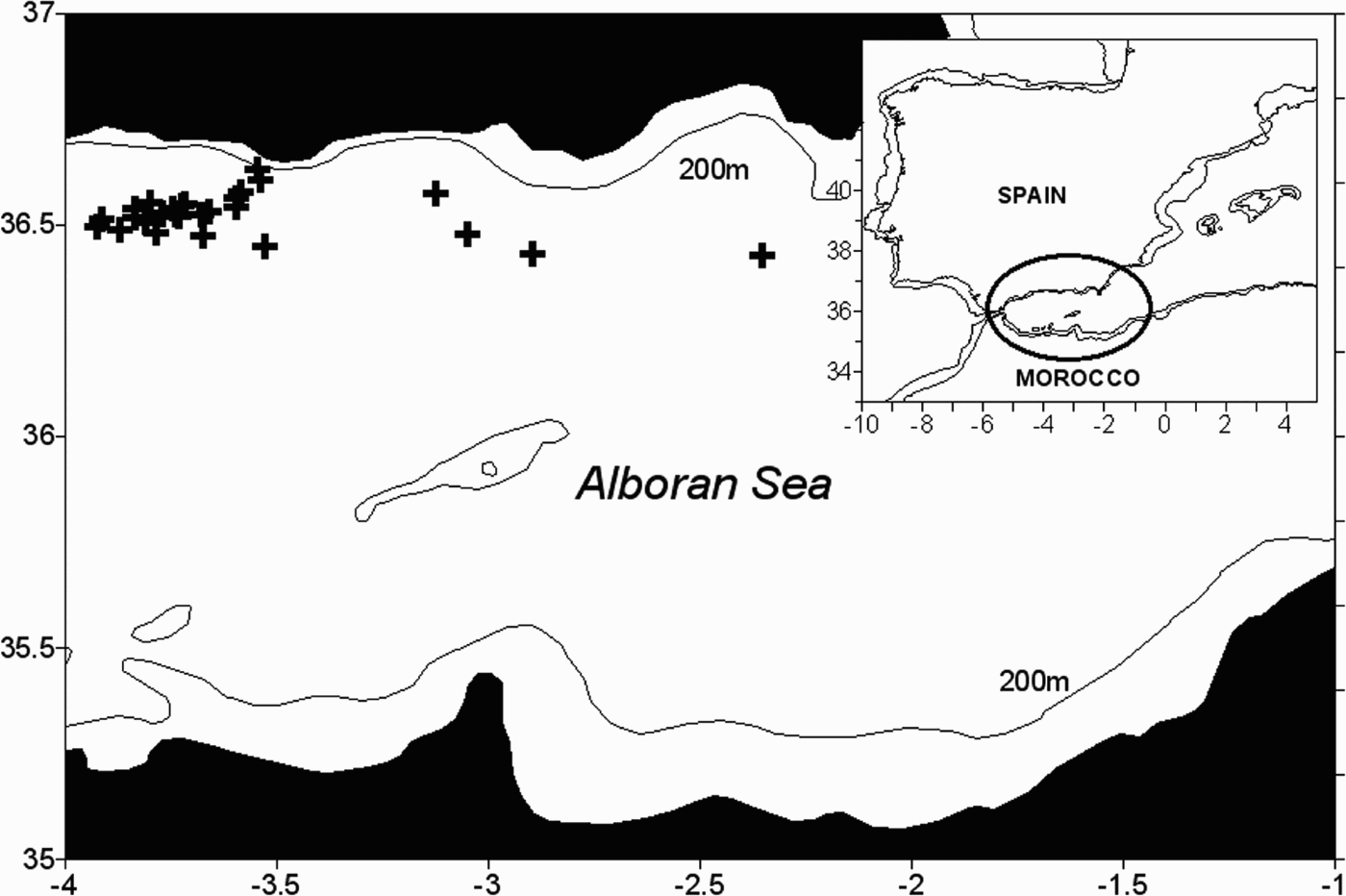
The Alboran Sea extends from the Strait of Gibraltar to an adopted line running from Cabo de Gata (Almeria, Spain) to the Cape of Oran (Algeria). Our study region lies between 36°–37°N and 2°–4°W, which includes Spanish economic waters only (see Figure 1).
Alboran Sea study area, and locations of the observed fishing operations; 200 m depth contour is indicated.

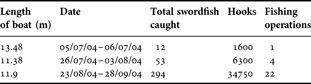
The vessels that operate in the study area have an average length of 12.25 m, a mean gross tonnage of 11.65 (GT), and a mean gross register tonnage of 11.15 (GRT). Table 1 shows the observation period, the number of fishing operations observed, the total number of hooks controlled and the total swordfish caught per boat. For more details on the fishing vessels and fishing gear see Báez et al. (Reference Báez, Camiñas, Sagarminaga, Torreblanca and Real2007a,Reference Báez, Real and Camiñasb,Reference Báez, Real, García-Soto, de la Serna, Macias and Camiñasc) and references therein.
Length of observed boats, and number of observed fishing operations, hooks, and total swordfish caught per boat.

Multiple linear stepwise regression and second-degree polynomial regressions were applied to the number of species per unit effort (SPUE = species number/1000 hooks) using technical and oceanographic variables as predictors. The number of species caught was used as a simple measure of the species diversity of the catch. We also analysed the variation in capture per unit effort (SwCPUE) of the target species, (catch number/1000 hooks). As the catch of swordfish shorter than 120 cm is frequent in these fisheries, we analysed the CPUE of small swordfish (SSwCPUE) separately. We selected the following as predictor variables: (i) time that the hooks remain in the water (soak time, ST; hours); (ii) mean value between the depth of sea bottom at initial operation point and final operation point (fishing ground depth, FG; minutes); (iii) phytoplankton concentration (SeaWiFS; mg Chlor m−3); (iv) sea surface velocity absolute component (SSV; m s−1); (v) sea surface velocity meridional component (V; m s−1); (vi) sea surface velocity zonal component (U; m s−1); and (vii) moon index as a function of its luminescence (new moon = 0; waxing moon = 0.33; waning moon = 0.66; full moon = 0.99). The lower number of available satellite sea surface temperature values (AVHRR) during the study made this satellite parameter to be automatically excluded by the statistical analysis. Meridional component and zonal component are terms commonly used in oceanography, but they can be easily replaced by the north–south component and east–west component of the sea surface velocity (that is a vector). The satellite sea surface velocity (geostrophic current) was calculated by the National Oceanic and Atmospheric Administration (NOAA) using the satellite-derived sea level anomaly and a mean climatological dynamic height field.
When analysing variations in SwCPUE and SSwCPUE, we also used the predictor variable (viii) total number of species caught per set (SP). Data for variables (iii) to (vi) were obtained from satellite measurements. Phytoplankton concentrations (mg Chlor m−3) were estimated from the colour sensor Sea-viewing Wide Field-of-view Sensor (SeaWiFS) and sea surface velocity (geostrophic velocity; m s−1) from several altimetric sensors. The data were extracted from the databases of the National Aeronautic and Space Administration (NASA) PO-DAAC, NASA Ocean-Colour and NOAA. The temporal resolution of the AVHRR sea surface temperature data was once per day. The phytoplankton concentration data were averages of 8 days. Sea surface velocity was available as daily values with each daily observation averaging the 10 previous days. The spatial resolution of the data was respectively 4 km (AVHRR), 9 km (SeaWiFS) and 18 km (altimetric observations). The satellite observations were extracted for the coordinates of the ship at the end of the fishing operations. In this study, the data used were limited to July and August, when sea water temperature does not change significantly, and, thus, the effects of seawater temperature can be ignored.
RESULTS
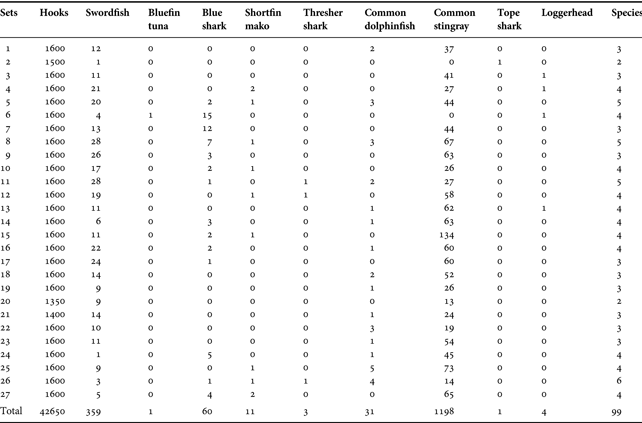
A total of 42,650 hooks were deployed during the observed fishing operations, which represents 6% of the hooks estimated for this area and period (see Báez et al., Reference Báez, Camiñas, Sagarminaga, Torreblanca and Real2007a). Nine different species were caught during the observation period: (i) blue shark Prionace glauca, (ii) bluefin tuna Thunnus thynnus, (iii) common dolphinfish Coryphaena hippurus, (iv) common stingray Dasyatis pastinaca, (v) loggerhead Caretta caretta, (vi) shortfin mako Isurus oxyrinchus, (vii) swordfish Xiphias glaudius, (vii) thresher shark Alopias vulpinus; and (ix) tope shark Galeorhinus galeus. In line with Báez et al. (Reference Báez, Camiñas, Sagarminaga, Torreblanca and Real2007a), we observed that the bycatch (or incidental capture) per unit effort (BPUE) values in open Mediterranean waters of Andalusia and Murcia are low in comparison to other Mediterranean areas. Table 2 shows the catch values per species.
Catch values per species.

We obtained 3 significant models that associated the number of species, the number of swordfish catches and the number of small swordfish caught per unit effort, respectively, with different technical and oceanographic variables.
The number of species per unit effort (SPUE) showed a linear relationship with soak time and the absolute component of surface velocity (adjusted R2 = 0.316; F = 6.783; P = 0.005). The model suggested a positive effect of the two variables on the SPUE and, consequently, a negative effect on the specificity of the fishing operation. The model is expressed as:

(ST β-value = 0.484; SSV β-value = 0.459)
The number of swordfish catches per unit effort (SwCPUE) was significantly related to the absolute component of surface velocity and moon luminescence (adjusted R2 = 0.380; F = 8.674; P = 0.002), according to the function:

(SSV β-value = −0.757; monn index β-value = 0.423)
Surface velocity had a negative influence on the number of target species caught, whereas moon luminescence had a positive effect on numbers.
A significant multiple linear relationship was found between the number of small swordfish catches per unit effort (SSwCPUE) and the absolute component of surface velocity, the number of species in the catch, the fishing ground depth, and moon index (adjusted R2 = 0.632; F = 11.725; P < 0.001), expressed as:

(SSV β-value = −0.981; SP β-value = 0.5; moon index β-value = 0.423; FG β-value = −0.328).
DISCUSSION
The oceanographic variable SSV was the variable with the greatest explanatory power, in two of the three models. The increase in the absolute component of sea surface velocity increases the number of non-target species captured, which could be due to the increase in the mobility of opportunist species that it produces, or because sea surface velocity favours the release of attractive particles from the bait of the surface gear. We have not found any references that support this view. However, the fishermen were consulted, and they suggested that opportunistic species, like the common stingray Dasyatis pastinaca and sea turtles are slow and clumsy. For this reason, an increased SSV could augment their mobility and catchability.
However, sea surface velocity has an opposite effect on the number of swordfish catches. It is possible that the increase in the number of other species near the longline gear, favoured when SSV increases, could reduce its effectiveness due to bait loss and hook occupation.
The number of species per unit effort is also related to soak time, but not the number of target species caught, which suggests that soak time could increase the probability of catching different species more than the probability of catching a higher number of the target species.
The increase in moon illumination could increase SwCPUE by helping the swordfish in locating bait. This model is in agreement with other results regarding this fishery (see, for example, Damalas et al., Reference Damalas, Megalofonou and Apostolopoulou2007 and references therein), and those targeting other billfish (Ortega-García et al., Reference Ortega-García, Ponce-Díez, O'Hara and Merila2008).
Low SSV and a high moon index also increase the capture of small swordfish. However, the number of small swordfish catches increases in shallower fishing grounds, which are usually closer to the coast. For this reason, we concluded that the swordfish could be spatially distributed as a function of their length, and in relation to distance to the coast. This point of view could be especially relevant for the fisheries management. Thus, in a recent study on sea turtle by-catch during surface longline fishing targeting swordfish in the western Mediterranean Sea, Báez et al. (Reference Báez, Real, García-Soto, de la Serna, Macias and Camiñas2007c) showed that sea turtle by-catch is independent of fishing effort and other technological factors; moreover, when distance to the coast increases, there is a higher probability of catching a loggerhead turtle. Báez et al. (Reference Báez, Real, García-Soto, de la Serna, Macias and Camiñas2007c) proposed the avoidance of longline fisheries at more than 35 nautical miles (approximately 65 km) from the coast. However, our present results indicate that the proposed 35 nautical miles limit could have undesirable results. For this reason, and in order that these results are implemented in fisheries management, we suggest that there is a strong need for further controlled studies.
ACKNOWLEDGEMENTS
We thank Miguel A. Puerto for his work as on-board scientific observer. This study was supported by the PALANDALIFE project (an Instituto Español de Oceaonografía—IEO- subproject of LIFE/E/Nat/8610), the Innovación, Ciencia y Empresa of the Andalusian Government (Grant number P05-RNM-00935), and the Spanish Ministry of Science and Education and FEDER funds (Grant number CGL2006-09567/BOS).