Among the numerous effects of the COVID-19 pandemic on healthcare facilities was the exhaustion of healthcare workers (HCWs) due to the high surge in workload and their “frontline” position against this disease. Reference Ge, Wang and Yuan1–Reference Colomb-cotinat, Poujol and Monluc5 Together with the need to care for the safety of HCWs, this condition necessitated preventive measures that would also avoid an exaggerated quarantine policy that would exacerbate the workload burden and burnout caused by the pandemic. Reference Jones, Mantey and Washer6–Reference Chou, Dana, Jungbauer, Weeks and McDonagh8
Distinct waves of the pandemic in Israel were defined by the resurgence of positive cases. The first wave (February–May 2020), second wave (May–November 2020), and third wave (November 2020–April 2021) were followed by national vaccination campaigns. These waves were mainly caused by the α variant. The fourth wave (June–November 2021) was dominated by the δ (delta) variant, and the fifth wave (December 2021–April 2022) was primarily caused by the Ο (omicron) variant. 9
Commensurate with the transmission mode of the virus, Reference Rosser, Tayyar and Giardina10–Reference Zhang and Duchaine12 the main preventive measures included the use of personal protective equipment (PPE) such as universal masking, strict hand hygiene, social distancing, and vaccination. For aerosol-producing procedures, N95 masks and eye protection were used in addition. Strategies tried in hospitals worldwide included routine testing and surveillance, with limited success. Reference Leeds, Raviprakash, Jacques, Scanlon, Cundall and Leeds13–Reference Davies, Kucharski and Eggo18
In March 2020, the Israeli Ministry of Health (MOH) issued guidelines concerning the approach in healthcare facilities toward epidemiological investigation of HCWs. These guidelines included specific criteria that needed to be met to quarantine an HCW. The guidelines instructed a differential approach to the decision to quarantine HCWs, with strict consideration of various aspects of exposure. 19
Given the unprecedented method of investigations and decision making during the pandemic as a preventive measure, we assessed their appropriateness in the management of HCWs home quarantine during the COVID-19 pandemic. Other specific aims were to depict the association between the decision of sending a HCW to quarantine, to determine the probability of becoming SARS-CoV-2 positive, and to assess the associations between HCWs characteristics within the hospital and their probability of becoming infected or infecting others.
We hypothesized that decisions based on the MOH guidelines were appropriate, decreasing the number of HCWs sent to quarantine during the COVID-19 pandemic without increasing the risk of nonquarantined HCWs infecting their coworkers and/or patients or visitors. We also hypothesized that the chances of becoming SARS-CoV-2 positive was at least 3.5% in quarantined HCWs, compared with 0.5% in nonquarantined HCWs. Because the sample size was dictated by our data file, we calculated the power to prove this hypothesis using the given sample size. The power calculated was >99%. The calculation was done using the “sampsi” command in Stata version 12 software (Stata Corp, College Station, TX).
Methods
Design and population
This retrospective cohort study was conducted at Soroka University Medical Center in Beer-Sheva, Israel, a tertiary-care center with >1,100 beds. All universal precautions previously described were in effect during the pandemic. We reviewed and analyzed data from computerized medical records of HCWs exposed to a coworker infected with SARS-CoV-2 between March 2020 and February 2021. All HCWs potentially exposed to a coworker with documented SARS-Co-V-2 infection (positive by polymerase chain reaction assay or PCR) were included. HCWs lost to follow-up <1 month after exposure were excluded.
Overall, the study included the 419 HCWs who met the inclusion criteria, and their 2,595 potential HCW contacts. Among these contacts, 752 HCWs were quarantined and 1,843 were not.
Data collecting methods
All data regarding the study population were extracted from records of the infection prevention and control unit at Soroka University Medical Center and the human resources department. The data provide information regarding demographics (age and sex), vocational history (profession and department), and time of diagnosis. We also extracted data regarding potential symptoms of SARS-CoV-2 and PCR results, the character of the exposure (in terms of distance, duration, and use of PPE), and type of exposure (social vs professional) and vaccination status (as of January 2021). Fully deidentified information was coded onto a data sheet, and HCWs and their respective departments were number coded so their identifying information could not be reconstructed from the data.
Definitions
An index case was defined as a SARS-CoV-2–positive HCW whose infection led to the epidemiological investigation. In accordance with MOH guidelines, significant exposure was defined as any HCW exposed to a SARS-CoV-2–positive coworker who stayed in the same room (within 2 m) for 15 minutes or more without using masks. A nonsignificant (ie, random) exposure was defined as an exposure that did not meet these criteria for a significant exposure (Fig. 1). Contacts were investigated if they had a significant exposure to the index case starting up to 1 week before the index case was SARS-CoV-2 positive, when the index coworker was asymptomatic. For symptomatic index cases, up to 4 days before the onset of symptoms were considered. Symptoms considered in the investigation included fever, fatigue, cough, loss of appetite, malaise, dyspnea, headache, sore throat, a runny nose, loss of smell or taste senses, nausea, vomiting, and diarrhea. With the introduction of COVID-19 vaccines in December 2020, vaccination status started to count as another factor for the decision of quarantine; fully vaccinated HCWs only had to get tested, whereas partially vaccinated and nonvaccinated HCWs were fully quarantined. HCWs who were previously ill were considered vaccinated. The length of presumed quarantine changed with government policy from 14 days in the first pandemic wave to 7 days in the third wave.
Decision to quarantine based on exposure characteristics.

Exposure types were defined as professional (ie, exposure to an index HCW while taking care of patients) or social (ie, exposure to an index HCW in activities outside patient care or hospital work, for example during shared meals, transportation, social events, etc).
Allied health professions included pharmacy, physical therapists, social workers, laboratory technicians, radiology technicians, and any clinical staff other than physicians and nurses.
Study variables
The dependent variable was whether an exposed HCW developed COVID-19. The main independent variable was the decision to quarantine the exposed HCW. We considered the following confounders: type of exposure, use of PPE, type of interaction at exposure, exposure site (hospital ward), demographics, and symptoms of the contact HCW. A tracing process, in which SARS-CoV-2–positive workers were asked to identify their close contacts, initiated a thorough inquiry among HCWs working in the same department.
We examined only exposure to coworkers with COVID-19. All index cases tested positive for SARS-CoV-2, regardless of whether exposed in the community or the hospital. The clinical outcome of interest was the PCR result (positive or negative) regardless of symptoms.
Despite an incubation period of 14 days, a follow-up period of up to 1 month was selected because the quarantine lasted up to 14 days and the turnaround time for the PCR result was ≤72 hours. Therefore, any positive contact up to 1 month since exposure was considered due to the index case, regardless of quarantine status.
In addition to deciding whether quarantine was indicated, additional instructions included an emphasis on PPE, social distancing, and hand hygiene, identical to recommendations for HCWs in general, regardless of exposure. HCWs were advised to be tested promptly for SARS-CoV-2 if they became symptomatic.
Data analysis
Data were analyzed using SPSS version 26 software for Windows (IBM, Armonk, NY). Descriptive statistics were used on all study variables. Differences between quarantined and nonquarantined HCWs were identified using 2-sample Student t tests, the Mann-Whitney test, the χ2 test, or the Fisher exact test, depending on the variable type and whether the data were normally distributed and the expected count in each category. The relative risk for becoming SARS-CoV-2 positive was calculated using bivariate Poisson regression for quarantined HCWs compared with nonquarantined HCWs. The 95% confidence intervals were calculated for the relative risk. Data were stratified for various cofactors such as age, sex, profession, etc. A multivariable analysis examined the risk of becoming SARS-CoV-2 positive for quarantined HCWs compared with nonquarantined HCWs. We controlled for confounders using Poisson multivariable analysis.
The study was approved by the Institutional Review Board of Soroka Medical Center (study no. 0332-20-SOR). This study was conducted as part of the requirements for a doctoral degree (MD) from the Goldman Medical School at the Faculty of Health Sciences, Ben-Gurion University of the Negev.
Results
Demographic and occupational characteristics
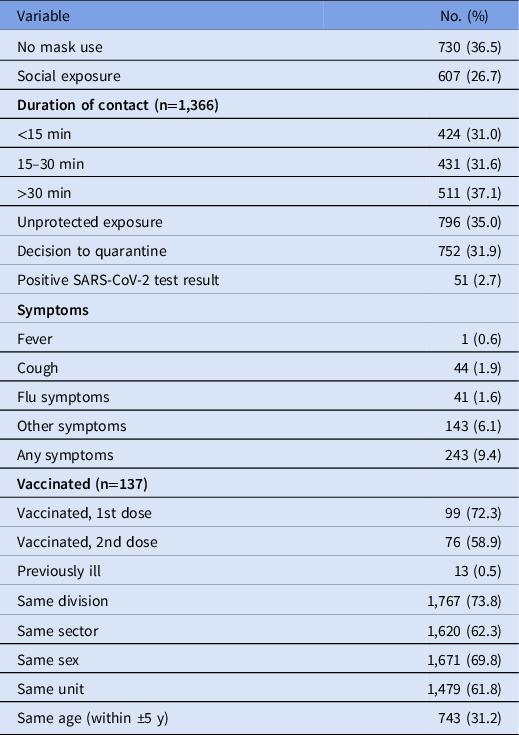
The study included 419 workers with PCR-confirmed COVID-19 and 2,397 contacts, for a mean of 6.2 ±12.2 contacts per index patient. The characteristics of contacts included in the epidemiological investigations are shown in Table 1. Of 1,911 HCWs exposed to an infected HCW, 725 were quarantined. Of those quarantined, only 36 were SARS-CoV-2 positive (5.0% of all isolated cases, 73.5% of all positive HCWs and 1.9% of all contacts), which could be considered the positive predictive value of the decision to quarantine. Among quarantined HCWs, 689 were negative for SARS-CoV-2, which could be considered as false-positive (95.0% of isolated cases, 37.0% of all negative HCWs, and 36.1% of all contacts tested). Among the 1,911 HCWs exposed, 1,186 were not quarantined. Of these, 1,173 were negative for SARS-CoV-2, which could be defined as the negative predictive value (ie, 98.9% of nonquarantined HCWs, 63.0% of all negative HCWs, and 61.4% of the HCWs tested). Also, 13 nonquarantined contacts were SARS-CoV-2 positive, which could be defined as false negatives (ie, 1.1% of nonquarantined contacts of all positive HCWs and 0.7% of all contacts). Therefore, the decision to quarantine a contact had a sensitivity of 73.5% and a specificity of 98.9%. Of the 13 nonquarantined contacts who became SARS-CoV-2 positive, only 2 were index cases, with 21 of their contacts quarantined. Among those quarantined, 5 became SARS-CoV-2 positive. Notably, 444 contacts (19.0%) failed to complete a PCR test: 438 asymptomatic contacts (20.4%) and 6 symptomatic contacts (3.1%) (P < .001).
Characteristics of Exposure Among Contactsa

a Vaccination and previous COVID-19 infection were considered only for the third wave.
Factors associated with the decision to quarantine
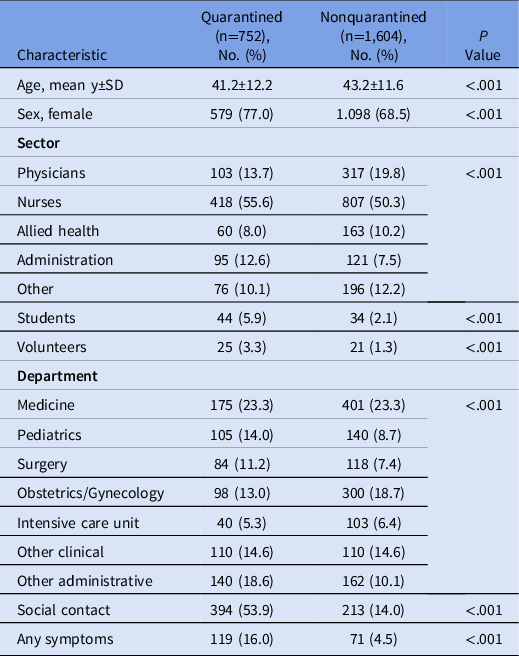
Factors associated with the decision to quarantine an HCW are shown in Table 2. Quarantined workers were younger, more likely to be female, and more likely to be nurses or administrative staff, students, or volunteers. The presence of symptoms was also a significant factor in the decision to quarantine.
Quarantined Versus Nonquarantined Healthcare Workers Exposed to a Coworker With COVID-19

Note. SD, standard deviation.
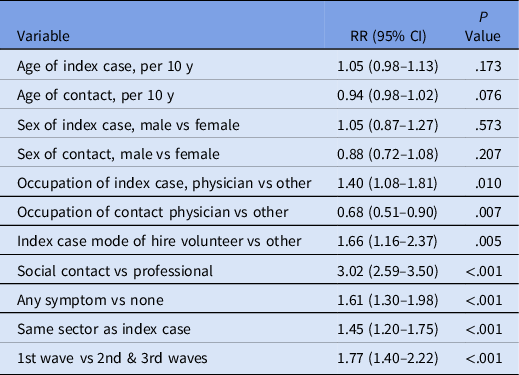
Table 3 shows the results of a Poisson regression used to analyze the relative risk associated with various factors for being quarantined. Factors positively associated with the decision to quarantine a contact in the multivariable analysis were the index-case profession (greater probability of quarantine when the index case was a physician or a volunteer), social contacts (compared with a professional contact), the presence of symptoms, and whether the index and contact were from the same sector. During the first wave of the pandemic, the probability of quarantine was also higher. Physician contacts were less likely to be quarantined.
Factors Associated With the Decision to Quarantine by Multivariable Analysis Using Poisson Regression

Note. RR, relative risk; CI, confidence interval.
Factors associated with a positive COVID-19 test
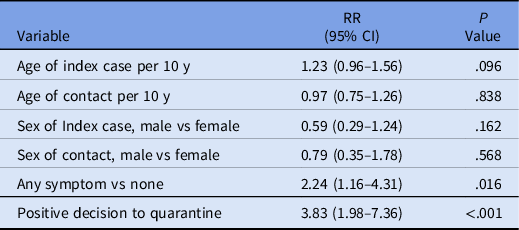
Table 4 shows the results of a Poisson regression used to analyze the relative risk associated with various factors for being SARS-CoV-2 positive. The significant risk factor for a positive SARS-CoV-2 test result were the presence of symptoms and whether the HCW had been quarantined.
Factors Associated With a Positive SARS-CoV-2 Test by Multivariable Analysis Using Poisson Regression

Note. RR, relative risk; CI, confidence interval.
Discussion
The goal of the present study was to test the appropriateness of the differential quarantine measures taken in a tertiary-care hospital throughout the COVID-19 pandemic. The decision-making algorithm had a sensitivity of 73% and a specificity of 72%. The positive predictive value was 5% and the negative predictive value was 99%. Therefore, if these steps had not been taken, 1,173 healthy HCWs would have been quarantined. The length of quarantine was, on average, 10 days long. Therefore, an estimate of 11,700 working days would have been lost if a nonselective policy was used, which equates to 902 working days per positive case.
These findings emphasize the effectiveness of the MOH guidelines and the meticulous investigations applied to implement them. These methods could be used again during pandemics (ie, COVID-19 and other diseases). Considering the overload experienced by the public healthcare system, which was highly affected by the disease, 19,Reference Ibiebele, Silkaitis, Dolgin, Bolon and Zembower20 this differential method facilitated coping with the pandemic and helped mitigate concerns raised by non–COVID-19 patients who had abstained from receiving healthcare services in fear of being infected by healthcare providers. Reference Blumenthal, Fowler, Abrams and Collins21,Reference Campbell, Galvani, Friedman and Fitzpatrick22
The finding that the medicine division and the ICU departments had lower percentages of HCWs sent to quarantine was unexpected. This finding can be explained by the high prevention awareness of HCWs in these departments, which led to higher adherence.
The findings of our study correlate with the findings of studies that measured the risk in HCWs in comparison to the general population. Reference Neves, Lawrence-Jones and Naar23 Other studies that correlate with our study emphasized measures required to contain and minimize infection with SARS-CoV-2, such as early detection of cases, surveillance measures and others, all to minimize infection rates. These measures have been successful to some extent; these studies were meant to enhance safety guidelines in the hospital environment.
Similar studies have been conducted to investigate patterns of HCW safety and modes of transmission in a hospital during a pandemic. Similar to the present study, these studies evaluated sources of exposure, finding that most SARS-CoV-2–positive cases among HCWs occurred due to exposure to other HCWs, rather than patients. Reference Peoples, Oswald and Ose24 Similar to the present study, Gordon et al Reference Gordon, Trubiano and Holmes25 also found that the main driver of infection between HCWs was contact with other HCWs. Schneider et al Reference Schneider, Piening and Assina26 reported that the main outbreaks among HCWs at a university hospital were associated with decreased adherence of HCWs with universal precautions. Decreased use of safety measures by HCWs has led to significant increases in the workload burden during the COVID-19 epidemic; poor adherence to guidelines has been correlated with COVID-19 outbreaks among HCWs.
Our study has taken a step beyond these observations to measure the appropriateness of an isolation system based on tight regulation and contact investigations. We emphasized the appropriateness of differential isolation guidelines, and our conclusions are based on real-life experiences from a large, tertiary-care, medical center during a pandemic.
Our study had several limitations. First, data could have been influenced by information bias. Some HCWs may have wanted to evade reporting low adherence to safety measures. Although covariates such as time, distance, and use of PPE may be missing or may have been misclassified, the main variables of the decision to isolate and the SARS-CoV-2 PCR results were available for all study participants. This limitation is also an inherent part of the real-life scenario of the study and likely contributed to a conservative estimate of the result. Second, many HCWs failed to complete a PCR test. Most cases of HCWs who were quarantined and did not take a PCR test occurred in the beginning of the pandemic when awareness was not high and adherence to preventive instructions was low. These findings affirm the necessity of HCW adherence to preventive policies. Notably, symptomatic contacts completed the PCR test in 97% of cases. Finally, this study applies to the α (alpha) variant of the SARS-CoV-2 virus, and different results may be produced in similar studies of the δ (delta) and the (omicron) variants. Finally, this study was performed at a single center, based on the assumption that transmission of SARS-CoV-2 in the Soroka Medical Center is unlikely to be different than at other hospitals.
In conclusion, our findings show that an efficient and closely monitored system of HCW contact investigations is important and worthwhile. The study was based on HCW reports and reported adherence to safety regulations, and these findings are relevant to the massive waves of the SARS-COV-2 α variant. However, they demonstrate an effective way of handling risk without causing damage due to arbitrary risk control measures. In the future, further consideration should be given to increasing the adherence of HCWs to contact precautions, and solutions should be sought to avoid the exclusion of high-risk populations, such as elderly volunteers, in times of stress such as pandemics.
Acknowledgments
Financial support
No financial support was provided relevant to this article.
Conflicts of interest
All authors report no conflicts of interest relevant to this article.