Robust infection prevention programs are crucial for ensuring safe patient care and should be continually promoted as a core component of hospital infrastructure. In critical times when hospital systems become over-burdened—such as the present coronavirus disease 2019 (COVID-19) pandemic—having well established and supported infection control policies and procedures is necessary for hospital preparedness and to ensure the safety of patients and healthcare workers. A key focus of infection control programs is the prevention of healthcare-associated infection (HAI). HAI is associated with increased morbidity, mortality, length of stay, and healthcare costs.Reference Magill, Edwards and Bamberg1,Reference Magill, O’Leary and Janelle2 HAI prevalence among hospitalized acute-care patients has been estimated at 3.2% in the United States,Reference Magill, O’Leary and Janelle2 6.5% in the European Union,Reference Suetens, Latour and Karki3 5.4%–5.9% in Switzerland,Reference Metsini, Vazquez and Sommerstein4,Reference Zingg, Metsini and Balmelli5 and 7.7%–10.1% in Japan.Reference Morioka, Hirabayashi and Iguchi6,Reference Morioka, Nagao and Yoshihara7 HAI prevention remains an important challenge worldwide, even in developed countries. Regional, national, international, and global collaboratives and initiatives are jointly focused on HAI prevention.Reference Avortri and Nabyonga-Orem8–13
Although HAI prevention initiatives vary worldwide, most focus on a core set of recommended prevention practices established by numerous agencies and professional organizations.Reference Barbut, Jones and Eckert14–Reference Tschudin-Sutter, Kuijper and Durovic24 Despite these recommendations, adoption and regular use of infection prevention practices vary. Several studies have highlighted international differences and gaps in infection prevention and control program organization, resources, training, and support.Reference Rosenthal, Al-Abdely and El-Kholy10,Reference Alp, Cookson, Erdem and Rello25–Reference Weinshel, Dramowski and Hajdu28 Although numerous studies have focused on international comparisons of infection prevention and control infrastructure and HAI rates, fewer comparative data are available across countries regarding specific HAI prevention practice use. Only a few studies, using data from several years ago, have examined differences in the use of specific prevention practices across multiple countries.Reference Weinshel, Dramowski and Hajdu28,Reference Krein, Greene and Apisarnthanarak29 Building on this work, we compared the adoption and regular use of practices to prevent common HAI across acute-care hospitals, including catheter-associated urinary tract infection (CAUTI), central-line associated bloodstream infection (CLABSI), ventilator-associated pneumonia (VAP) and Clostridioides difficile infection (CDI). We used more current data from the United States, Japan, the Netherlands, and Switzerland.
Methods
Study design, survey instrument, and data collection
The survey instrument, originally developed by Krein et al,Reference Krein, Hofer and Kowalski30–Reference Saint, Olmsted and Fakih33 has undergone several revisions to accommodate changes in evidence and emerging areas of interest.Reference Krein, Fowler, Ratz, Meddings and Saint34–Reference Saint, Greene and Fowler36 The primary focus has been practices to prevent device-associated infections, specifically CAUTI, CLABSI, and VAP. Questions pertaining to CDI prevention were included in the present US, Dutch, and Swiss surveys. Apart from subtle revisions to the Dutch, Swiss, and Japanese surveys to accommodate translation issues and to adapt to the respective local environments, the same survey instrument was used in all 4 countries.
In the United States, cross-sectional surveys have been conducted every 4 years since 2005. In these surveys, infection preventionists have been asked what practices their hospitals are using to prevent common HAIs. For the 2017 survey,Reference Saint, Greene and Fowler36 900 nonfederal, general medical, and surgical hospitals with an intensive care unit based on data from the American Hospital Association fiscal year 2013 database were randomly sampled. Later, 3 facilities were excluded because they had either closed or were no longer an acute-care facility, resulting in a sample of 897 hospitals. Surveys were mailed to the hospital infection preventionist in May 2017. The survey process followed a modified Dillman approach,Reference Dillman37 which included an initial mailed invitational letter and survey, a reminder postcard after ~2 weeks, and additional survey mailings at 1 month, 2 months, and 5 months to those who had not yet responded. The final reminders to nonrespondents were sent in October 2017. The US survey received the approval of the institutional review boards of The University of Michigan and the Veterans Affairs Ann Arbor Healthcare System.
In the Netherlands, between July 18, 2017, and October 31, 2017, 72 infection prevention teams, representing all acute-care hospitals in the Netherlands, were approached to participate in the survey.Reference Huis, Schouten and Lescure38 Infection prevention teams were initially contacted by telephone to explore their willingness to participate. An e-mail invitation with log-in details was then sent to the infection prevention representative of the teams that agreed to participate. Reminder e-mails were sent after 2 weeks to nonresponders. After 4 weeks, those who had not yet responded were contacted by telephone. The survey instrument was forward–backward translated into Dutch by the research team with support of a bilingual translator and was digitalized afterward with LimeSurvey. All data were collected in accordance with the General Data Protection Regulation, which standardizes data protection law across all European Union countries.
In Switzerland, between October 2015 and March 2017, 77 Swiss acute-care general and children’s hospitals with ≥3,000 annual discharges were invited to participate.Reference Sax, Schreiber and Clack39 Nonresponders received phone and e-mail reminders repetitively. The survey was translated to German, French, and Italian, and it was pretested by infection prevention specialists for the final online version (Survey Monkey, San Mateo, CA). According to the Swiss law on research on humans, ethics approval was waived.
In Japan, between July 2016 and January 2017, a survey instrument was sent to 1,456 hospitals that had at least 1 nurse certified for infection control by the Japanese Nursing Association.Reference Sakamoto, Asano and Sakihama40 The surveys were mailed to each hospital and were addressed to the lead infection preventionist. The survey questionnaire was translated into Japanese by a panel of bilingual infection prevention professionals. The Japanese survey received the approval of the institutional review board of St Luke’s International Hospital.
Study measures
The main outcomes in all countries were binary variables (0 or 1) indicating regular use of practices to prevent CAUTI, CLABSI, VAP, and CDI. The assessed practices were included in the surveys in all 4 countries (with the exception of CDI in Japan). In all countries, we asked about practices that are generally recommended, some that are considered special approaches when infection rates are not controlled, and some that are not recommended for routine use, based on US-derived infection prevention guidelines.Reference Gould, Umscheid, Agarwal, Kuntz and Pegues17,Reference Lo, Nicolle and Coffin19–Reference O’Grady, Alexander and Burns21,Reference Klompas, Branson and Eichenwald41,Reference McDonald, Gerding and Johnson42 Prior to survey distribution, local guidelines in the Netherlands, Switzerland, and Japan were compared to the US-based guidelines and were found to correspond well. Respondents were asked to rate the frequency of practice use on a scale from 1 to 5 (1 = never use and 5 = always use). Regular use was defined as a rating of 4 (almost always) or 5 (always). In addition to questions about the use of specific infection prevention practices, the instrument also elicited information about general hospital characteristics and the infection control program at each responding hospital. The presence of antimicrobial stewardship programs and established surveillance systems for urinary tract infection (UTI), CLABSI, VAP, and CDI was also assessed.
Statistical analysis
Descriptive statistics, number (%) for categorical variables, and mean (±SD) for continuous variables were calculated for hospital characteristics and specific CAUTI, CLABSI, VAP, and CDI prevention practices using SAS version 9.4 software (SAS Institute, Cary, NC) and Stata/SE version 14.2 software for Mac (StataCorp, College Station, TX).
Results
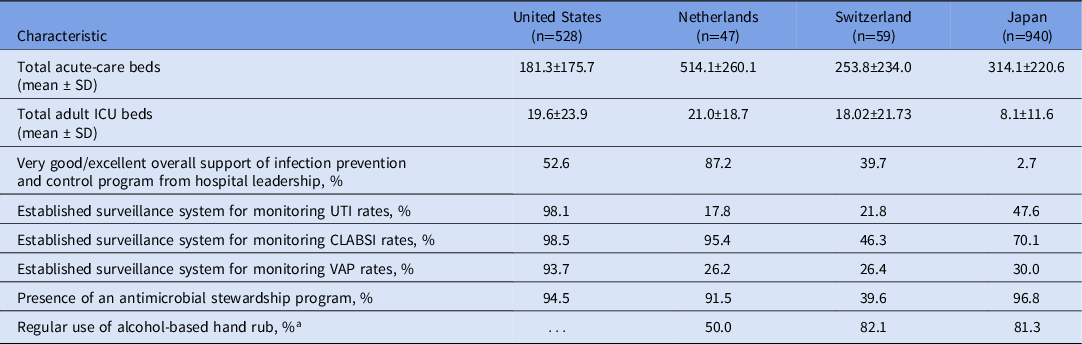
Survey response rates were 59% (528 of 897) in the United States, 65% (47 of 72) in the Netherlands, 77% (59 of 77) in Switzerland, and 65% (940 of 1,456) in Japan. General hospital characteristics and the presence of established surveillance systems by country are displayed in Table 1.
Hospital Characteristics

Note. SD, standard deviation; ICU, intensive care unit; UTI, urinary tract infection; CLABSI, central-line–associated bloodstream infection.
a Regular use of alcohol-based hand rub was not assessed in the US survey.
Overall, hospitals in the Netherlands had the largest mean number of total acute-care beds. The Netherlands also had the highest percentage of hospitals reporting very good or excellent support of the infection prevention and control program by hospital leadership. Hospitals in Switzerland had the highest percentage of hospitals reporting having a hospital epidemiologist on staff, participation in HAI collaborative efforts, and certification in infection prevention among lead infection preventionists. Relative to hospitals in Switzerland, the Netherlands and Japan, hospitals in the United States had the highest percentages of hospitals with established surveillance systems for monitoring UTI, CLABSI, and VAP. Fewer than half of hospitals in the Netherlands, Switzerland, and Japan had established surveillance programs to monitor UTI and VAP rates. Nearly all hospitals in the United States, the Netherlands, and Japan had an antimicrobial stewardship program, whereas fewer than half of Swiss hospitals did. Approximately 82% of hospitals in both Switzerland and Japan and half of Dutch hospitals regularly used alcohol-based hand rub as a general infection prevention practice. Use of alcohol-based hand rub was not assessed in the United States in 2017 because previous US surveys indicated that use was nearly universal.Reference Mody, Saint, Kaufman, Kowalski and Krein43
Practices to prevent CAUTI
Regular use of practices to prevent CAUTI varied the most across the 4 countries (Fig. 1). With the exception of aseptic technique during catheter insertion and maintenance—used by a majority of hospitals (>85%) in all 4 countries—regular use of most CAUTI prevention practices was suboptimal. The percentage of hospitals reporting regular use of portable bladder ultrasound scanners (86%), intermittent catheterization (66%), and condom catheters (49%) was highest in the Netherlands. The percentage of hospitals reporting regular use of urinary catheter reminders (61%) and nurse-initiated catheter discontinuation (59%) was highest in the United States. CAUTI prevention practices were infrequently used in Switzerland and Japan. Although no longer recommended in evidence-based guidelines, some hospitals in Japan (42%) and the United States (27%) reported regularly using silver-alloy Foley catheters.
Percentage of hospitals that regularly use practice to prevent catheter-associated urinary tract infection (CAUTI).

Practices to prevent CLABSI
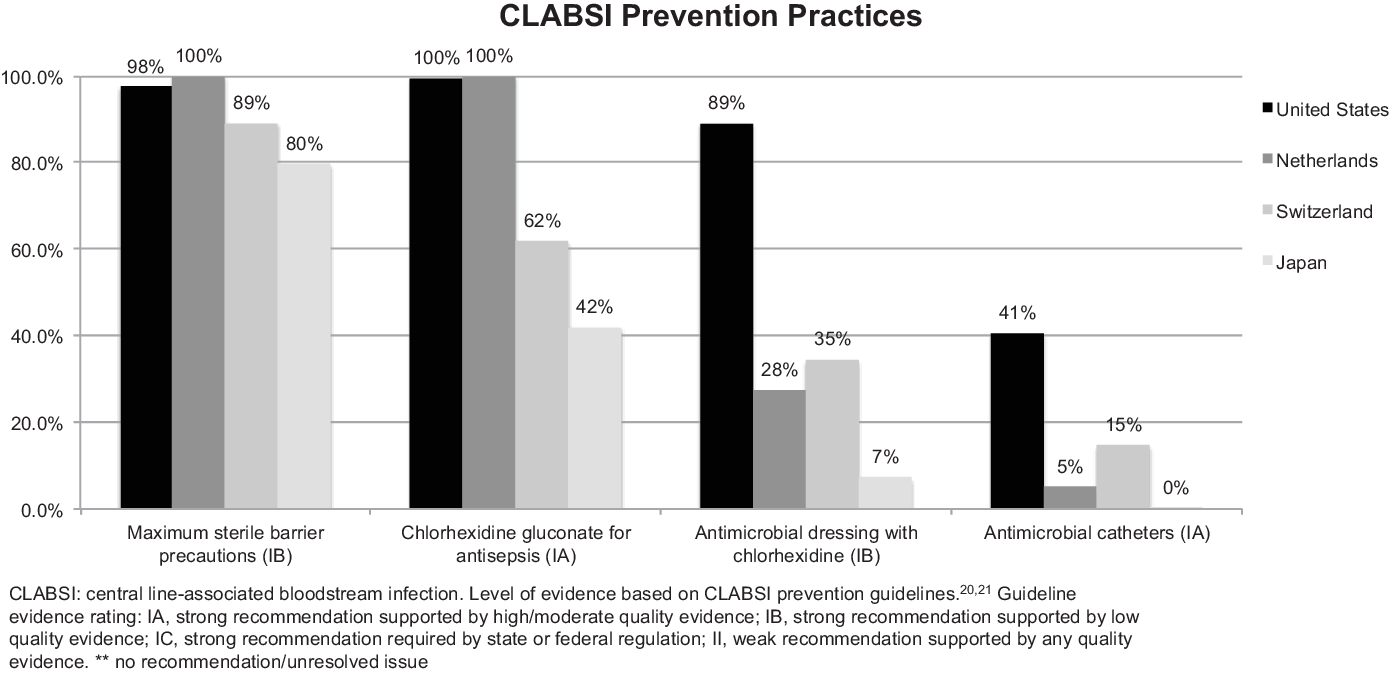
In general, the United States had the highest percentage of hospitals using practices to prevent CLABSI across all categories (Fig. 2). Maximum sterile barrier precautions to prevent CLABSI were regularly used by at least 80% of hospitals in all 4 countries. Chlorhexidine gluconate for insertion site antisepsis was used by all hospitals in the United States and the Netherlands and in most Swiss hospitals (62%). Regular use of antimicrobial dressings with chlorhexidine was used by most US hospitals (89%) but fewer than one-third of Dutch, Swiss, and Japanese hospitals. Antimicrobial catheters were used infrequently in all countries.
Percentage of hospitals that regularly use practice to prevent central-line–associated bloodstream infection (CLABSI).

Practices to prevent VAP
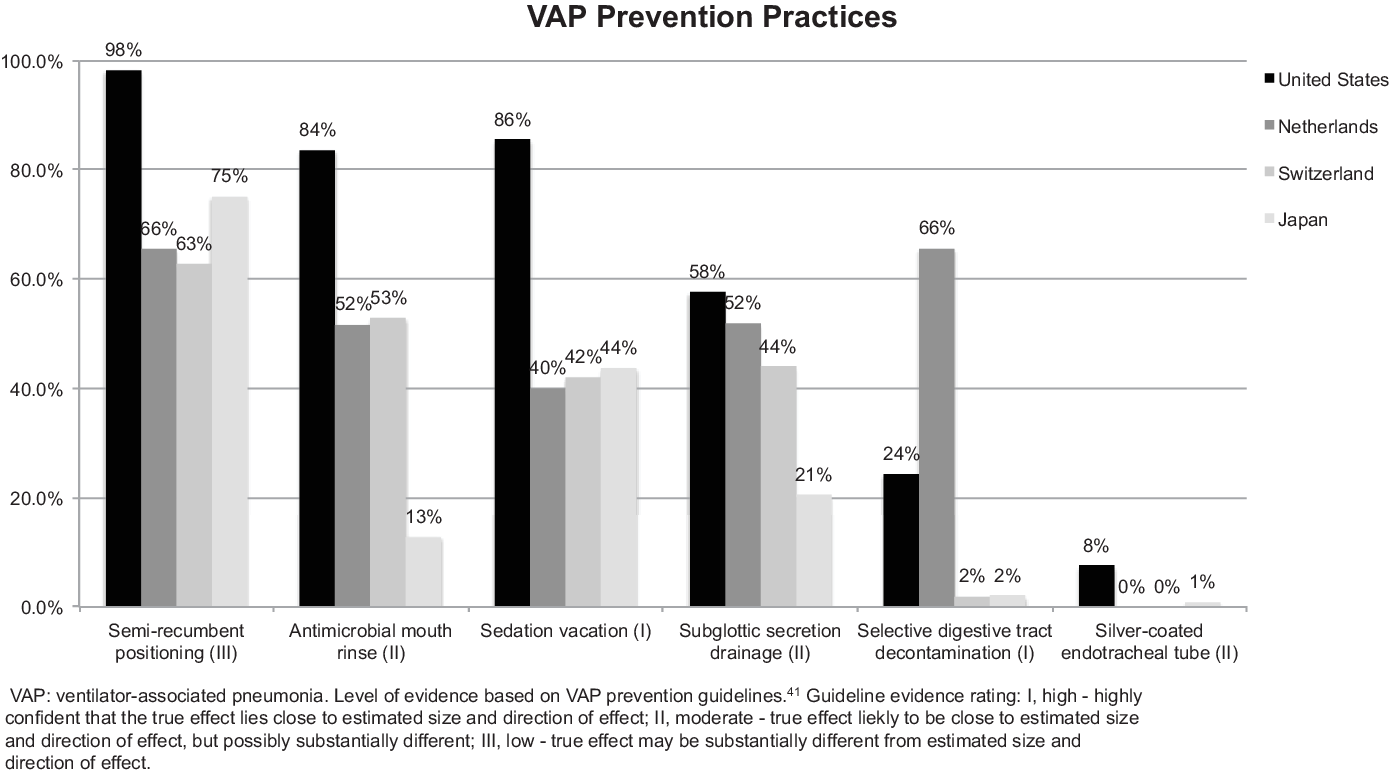
With the exception of selective digestive tract decontamination, which was used by two-thirds of hospitals in the Netherlands, a higher percentage of US hospitals reported regular use of recommended VAP prevention practices (Fig. 3). Semirecumbent positioning of the patient (98%), antimicrobial mouth rinse (84%), and sedation vacation (86%) were all used by most US hospitals. The percentage of hospitals regularly using semirecumbent positioning and sedation vacation were similar across hospitals in the Netherlands, Switzerland, and Japan (ranging from 63% to 75% for semirecumbent positioning and from 40% to 44% for sedation vacation). Selective digestive tract decontamination was essentially not used in Switzerland and Japan (2% in each country). Few, if any, hospitals used silver-coated endotracheal tubes in all countries.
Percentage of hospitals that regularly use practice to prevent ventilator-associated pneumonia (VAP).

Practices to prevent CDI
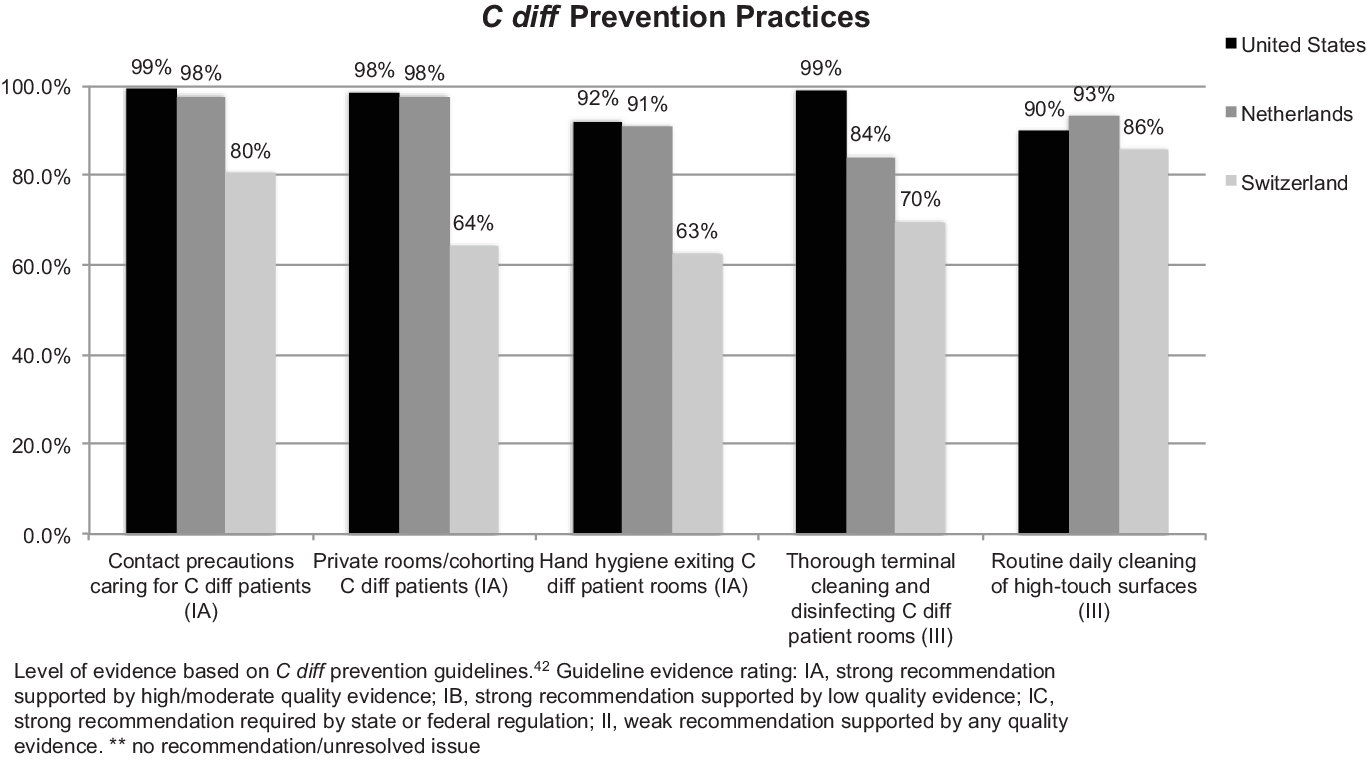
The regular use of practices to prevent CDI was not assessed in Japan. All of the CDI prevention practices were used by at least 80% of hospitals in the United States and the Netherlands, with most practices used nearly universally (Fig. 4). Although the regular use of contact precautions while caring for patients with CDI and routine daily cleaning of high-touch surfaces were regularly used in at least 80% of Swiss hospitals, only approximately two-thirds of these hospitals regularly used private rooms and/or cohorting of patients with CDI, hand hygiene when exiting the rooms of patients with CDI, and thorough terminal cleaning and disinfecting rooms of those with CDI.
Percentage of hospitals that regularly use practice to prevent Clostridoides difficile infection (C Diff, * not assessed in the Japanese survey).

Discussion
Using relatively contemporaneous data, collected via a similar survey instrument, we compared infection prevention practices across acute-care hospitals in the United States, the Netherlands, Japan, and Switzerland. We offer 3 main findings: (1) Although several practices are used by a majority of hospitals in all four countries, there is considerable variation in the use of many infection prevention practices both within and across countries. (2) The percentage of hospitals reporting regular use of most infection prevention practices was generally the highest among US and Dutch hospitals compared with those in Switzerland and Japan. (3) Although established surveillance systems for monitoring UTI, CLABSI, and VAP rates were nearly ubiquitous among US hospitals, the percentage of hospitals conducting surveillance for UTI and VAP in particular was much lower among Dutch, Swiss, and Japanese hospitals.
Several previous studies examining cross-sectional international data have identified differences and deficiencies in various components of infection prevention and control programs. A cross-sectional assessment across 194 countries found that low-income countries had lower levels of access to infection prevention and control equipment and training.Reference Desai, Ramatowski, Lassmann, Holmes, Mehtar and Bearman26 Other studies have noted similar income-based gaps in infection prevention and control and have encouraged the development of infection prevention and control infrastructure and adequate training.Reference Alp, Cookson, Erdem and Rello25,Reference Alp, Altun, Cevahir, Ersoy, Cakir and McLaws44,Reference Alp and Damani45 A cross-sectional study of 38 European countries revealed that guidance on how best to implement infection control and prevention programs, infection prevention and control staffing standards, and infection prevention and control specialization was heterogeneous and lacking across Europe.Reference Maraolo, Ong and Cimen27 Other international studies have also demonstrated heterogeneity and room for improvement in the adoption and implementation of infection prevention and control infrastructure and practices.Reference Weinshel, Dramowski and Hajdu28,Reference Krein, Greene and Apisarnthanarak29
In the present study, several prevention practices across infection domains were used by that least 80% of hospitals in the United States, the Netherlands, Switzerland, and Japan: aseptic urinary catheter insertion and maintenance (to prevent CAUTI), maximum sterile barrier precautions (to prevent CLABSI), semirecumbent positioning (to prevent VAP), and contact precautions and routine daily cleaning of high-touch surfaces (to prevent CDI). These particular practices generally are supported by moderate to strong evidence, and they are classified as recommended practices.Reference Dubberke, Carling and Carrico16–Reference Tenke, Kovacs, Bjerklund Johansen, Matsumoto, Tambyah and Naber23,Reference Balsells, Filipescu, Kyaw, Wiuff, Campbell and Nair46,Reference Martin, Zingg, Knoll, Wilson and Dettenkofer47 Despite these similarities, the adoption of other prevention practices by hospitals varied (in some cases minimally) across countries for each of the infection domains investigated.
Most CAUTI prevention practices were highly variable across countries. Low-to-moderate adoption of bladder scanners, intermittent catheterization, and condom catheters in men by hospitals in all countries may stem from lower levels of evidence and the fact that the promotion of these practices is somewhat dependent on patient factors.Reference Gould, Umscheid, Agarwal, Kuntz and Pegues17 Outside the United States, few hospitals reported regularly using catheter reminder or stop-order systems and nurse-initiated catheter removal. Quality improvement programs or strategies to enhance the use of indwelling urinary catheters are strongly recommended, albeit with low quality of evidence supporting the recommendation. Additionally, catheter reminder or stop-order systems and nurse-initiated catheter removal are examples of quality improvement strategies and are not explicitly assigned a recommendation in the authoritative guidelines.Reference Gould, Umscheid, Agarwal, Kuntz and Pegues17 Quality improvement programs containing reminder or stop-order systems and nurse-initiated catheter removal have been shown to improve appropriate catheter use and reduce CAUTI.Reference Gould, Umscheid, Agarwal, Kuntz and Pegues17,Reference Saint, Greene, Kowalski, Watson, Hofer and Krein48 Greater adoption of these CAUTI prevention practices by US hospitals may have stemmed from the implementation of large-scale national quality improvement efforts focused on CAUTI.Reference Saint, Greene and Krein49 Many practices were used by fewer than half of respondent hospitals in all countries, highlighting opportunities for reducing CAUTI regardless of level of evidence.
For CLABSI prevention, nearly 90% of US hospitals regularly used antimicrobial dressings and 40% antimicrobial catheters, whereas these products were used by only a small fraction of hospitals in the other 3 countries. Although antimicrobial dressings and catheters are both supported by strong evidence, guidelines recommend that they should be implemented if CLABSI rates are not decreasing despite adherence to other recommended CLABSI prevention measures.Reference O’Grady, Alexander and Burns21 The gap between US hospitals and other countries in the use of these 2 prevention practices may be due in part to other countries focusing more on other CLABSI bundle prevention measures (eg, maximum sterile barrier precautions).
A much higher percentage of hospitals in the United States reported regularly using antimicrobial mouth rinse compared to the other countries. Oral care with antiseptics has a moderate level of evidence in guidelines.Reference Tablan, Anderson, Besser, Bridges and Hajjeh22,Reference Klompas, Branson and Eichenwald41 However, a review published in 2016 found that chlorhexidine mouth rinse was effective at reducing VAP,Reference Hua, Xie, Worthington, Furness, Zhang and Li50 potentially explaining the increase in US hospitals adopting antimicrobial mouth rinse compared with previous reports.Reference Saint, Greene and Fowler36 Daily interruption of sedation has a high level of evidenceReference Tablan, Anderson, Besser, Bridges and Hajjeh22,Reference Klompas, Branson and Eichenwald41 and is reportedly used regularly by >80% of US hospitals. Numerous studies have demonstrated (1) a lack of shared understanding of why daily interruption of sedation is warranted,Reference Miller, Bosk, Iwashyna and Krein51 (2) that sedation protocols and scoring systems are often not systematically implemented,Reference Burns52–Reference Egerod, Christensen and Johansen54 (3) a lack of nursing acceptance to implement, and (4) concerns about patient safety and comfort.Reference Guttormson, Chlan, Weinert and Savik55–Reference Tanios, de Wit, Epstein and Devlin57 These factors may partially explain the lack of adoption and use of sedation interruption in the Netherlands, Switzerland, and Japan. Selective oral or digestive decontamination is a special VAP prevention approach with a high level of evidence.Reference Klompas, Branson and Eichenwald41 Nonetheless, its use was reported by a majority of hospitals only in the Netherlands. This is likely motivated by Dutch studies demonstrating reductions in mortality and gram-negative bacteremia, without increases in antibiotic resistanceReference Oostdijk, Kesecioglu and Schultz58 and guidelines promoting this practice in Dutch hospitals.Reference Oostdijk59
CDI prevention practices were used by most US, Dutch, and Swiss hospitals, but these were not assessed in Japan. Still, fewer than two-thirds of Swiss hospitals used private rooms and/or cohorting of CDI patients or appropriate hand hygiene when exiting CDI patient rooms. The evidence for single-patient rooms for CDI patients is moderate and opinion based,Reference Dubberke, Carling and Carrico16 potentially explaining substantially fewer Swiss hospitals reporting the use of this practice. Guidelines indicate that the combination of contact precautions (strongest level of evidence) and rigorous hand hygiene is most effective in CDI prevention.Reference Dubberke, Carling and Carrico16 Opportunities for improvement in these 2 practices exist among Swiss hospitals.
Overall, relative to US and Dutch hospitals, Swiss and Japanese hospitals are substantially lagging in the adoption and use of most infection prevention practices.
All countries we examined are developed, and differences in infection prevention are not likely to be primarily driven by differences in resources, so what might be driving lower use of many infection prevention practices in Switzerland and Japan? First, as mentioned, the level of evidence for several recommended practices is moderate or low, and interpretations of evidence supporting certain practices may vary by country. As such, it is possible that some of the gaps in prevention practice use are related to prioritizing practices graded with higher evidence in support of use. Second, case mix and specific types of HAI incidence differences by countryReference Magill, O’Leary and Janelle2-Reference Morioka, Nagao and Yoshihara7 may influence the need to adopt and regularly implement specific practices. Third, cultural differences and social desirability biases may have potentially contributed to variability in responses across countries. Fourth, it has been previously demonstrated that having strong leadership support for infection control programs is associated with increased use of certain infection prevention practices.Reference Saint, Greene and Fowler36 In the present study, fewer than half of Swiss hospitals and virtually none of the Japanese hospitals reported strong support from leadership for infection control programs. Prior work in Japan has concluded that administrative guidance and support is needed to enhance the adoption of evidence-based prevention practices.Reference Sakamoto, Asano and Sakihama40
Several notable differences in the general infection prevention practices of surveillance, antimicrobial stewardship, and use of alcohol-based hand rub were observed across countries. CLABSI surveillance was used by the majority of hospitals in all countries, with the exception of Switzerland, where fewer than half had established CLABSI surveillance. UTI and VAP surveillance is nearly universally used by US hospitals, but they were used by the minority of hospitals in other countries. HAI surveillance methods have been shown to vary across Europe.Reference Hansen, Sohr and Geffers60 Also, reporting mandates may have driven more frequent use of established surveillance among US hospitals. Regardless, promoting increased HAI surveillance is important; it has long been known that intensive surveillance is associated with reductions in HAI.Reference Haley, Culver and White61 Antimicrobial stewardship programs were lacking in Swiss hospitals. Other survey work among Swiss hospitals has confirmed this finding and has suggested that developing a formal antimicrobial stewardship standard may promote antimicrobial stewardship strategies and programs in Swiss hospitals.Reference Osthoff, Bielicki, Widmer and For62 The majority of Swiss and Japanese hospitals report regular use of alcohol-based hand rub, while only half of Dutch hospitals did. A prior survey demonstrated that 84% of US hospitals have adopted alcohol-based hand rub for hand hygiene.Reference Mody, Saint, Kaufman, Kowalski and Krein43
Our study has several limitations. First, although response rates for all surveys were quite high, the findings could still be affected by nonresponse bias, although we feel that the degree of this potential source of bias is low. Although we found that nonrespondent hospitals in the United States had slightly higher average bed size and were more likely to be located in urban locations compared to respondent hospitals in the United States, we do not feel that these differences likely influenced response. Moreover, we are confident that the moderate to excellent response rates observed in all countries yielded representative samples of acute care hospitals in each country. Second, we relied entirely on self-report from the lead infection preventionist at each hospital to determine the practices used to prevent HAIs. It is therefore possible that he or she may have understated or overstated the use of various practices. Although this too could lead to bias, we have no reason to suspect there was any sort of systematic misreporting. Third, even though data were collected using the same survey instrument, some differences in responses could result due to translation issues or cross-cultural interpretation. Fourth, we do not have information about patient characteristics or infection rates at responding hospitals, which could influence the reported use of certain prevention practices at our sample of hospitals. Fifth, although our data are contemporaneous and nationally representative of the countries included, they were collected 3–5 years ago. As such, the regular use of certain prevention practices across countries may have changed (in either direction) given ongoing efforts or shifting priorities within infection prevention and control programs. Finally, developing a comprehensive understanding of the potential reasons underlying the observed differences in infection prevention practices between countries was beyond the scope of our cross-sectional, descriptive study. We feel that supplemental qualitative studies would have been necessary to derive a sense of the organizational and cultural factors influencing the adoption, use, and maintenance of HAI prevention activities. Without specific details that focus groups, interviews, or site visits would provide, we feel that determining true underlying causes for the differences based on our cross-sectional surveys would amount to conjecture.
Limitations notwithstanding, our findings show that hospitals in the United States, the Netherlands, Switzerland, and Japan are using a number of recommended practices to prevent common HAIs. Still, we detected several opportunities for improvement across infection domains in all countries examined. Hospital adoption of many CAUTI prevention practices, especially system-level elements such as reminders and nurse-initiated stop orders and use of alternative catheterization, can be increased in all countries. Greater compliance with several infection prevention practices with strong recommendations and high quality of evidence could reduce some of the intercountry gaps observed. First, Dutch and Swiss hospitals may further prevent CLABSI by encouraging more hospitals to use antimicrobial dressings and catheters under certain conditions. Notably, national regulations in Japan dictate that 2% chlorhexidine gluconate cannot be used for central-line insertions in Japan. Second, Dutch, Swiss and Japanese hospitals may benefit from adopting and more regularly using sedation vacation because this practice may reduce the risk of VAP and has been shown to reduce the duration of mechanical ventilation.Reference Hosokawa, Egi and Nishimura63 Third, US, Swiss, and Japanese hospitals may wish to follow the Dutch lead on using digestive tract decontamination practices to further reduce VAP risk. Finally, surveillance, antimicrobial stewardship and hand hygiene are key components of infection control. Optimizing the regular use of these practices in all countries is a crucial step in ensuring patient and healthcare worker safety. As the COVID19 pandemic has shown, investing in infection prevention infrastructure and best practices will be important to maintain the high level of quality that patients expect and deserve when they come into hospitals regardless of country.
Acknowledgments
The views expressed in this article are those of the authors and do not necessarily reflect the position or policy of the Department of Veterans Affairs or the US Government or the Swiss Federal Office of Public Health.
Financial support
This work was supported by the Blue Cross Blue Shield of Michigan Foundation (grant no. 1907.II), the US Department of Veterans Affairs (VA) Health Services Research Service and National Center for Patient Safety, and Dr Krein’s VA Career Development Award (RCS 11-222). Other international support included funding by the Swiss Federal Office of Public Health and St Luke’s Life Science Institute, Tokyo, Japan. The study sponsors had no role in the design or conduct of the study; the collection, management, analysis, and interpretation of the data; nor the preparation, review, or approval of the manuscript.
Conflicts of interest
S.S. reports personal fees from Doximity and Jvion, outside the submitted work. All other authors report no conflicts of interest relevant to this article.