Introduction
As inhabitants of the sediment–water interface, periphytic ciliates play an important role in mediating carbon flux from planktonic to benthic food chains, both in freshwater and marine biotopes (Kathol et al., Reference Kathol, Norf, Arndt and Weitere2009; Norf et al., Reference Norf, Arndt and Weitere2009a, Reference Norf, Arndt and Weitere2009b; Zhang et al., Reference Zhang, Xu, Jiang, Zhu and Al-Resheid2012, Reference Zhang, Xu, Jiang, Zhu and Al-Rashied2013; Xu et al., Reference Xu, Zhang and Jiang2014; Abdullah Al et al., Reference Abdullah Al, Gao, Xu, Wang and Xu2017). Furthermore, community-based parameters based on these microbiota (e.g. ‘taxon-free’ traits, body-size spectrum, trophic-functional features and functional diversity) have been widely used as bioindicators for bioassessment of environmental/ecological quality status, because of their rapid responses to natural and anthropogenic impacts on the environment (Cairns & Henebry, Reference Cairns, Henebry and Cairns1982; Peters, Reference Peters1983; Norf et al., Reference Norf, Arndt and Weitere2007; Xu et al., Reference Xu, Zhang, Jiang, Zhu, Al-Rasheid, Warren and Song2011, Reference Xu, Zhang and Jiang2014; Zhang et al., Reference Zhang, Xu, Jiang, Zhu and Al-Rashied2013; Abdullah Al et al., Reference Abdullah Al, Gao, Xu, Wang and Xu2017, Reference Abdullah Al, Gao, Xu, Wang, Warren and Xu2018).
Periphytic ciliates feed on a variety of microbial food (e.g. bacteria, algae, detritus), the sources of which are commonly either of planktonic origin or suspended in the water column (Weitere et al., Reference Weitere, Schmidt-Denter and Arndt2003; Parry, Reference Parry2004; Scherwass et al., Reference Scherwass, Fischer and Arndt2005; Wang & Xu, Reference Wang and Xu2015; Wang et al., Reference Wang, Xu, Zhao, Gao, Abdullah Al and Xu2017). Therefore, the colonization dynamics of periphytic ciliates can be shaped by their food supply in response to changes in water conditions at different water depths in the water column (e.g. sunlight, microalgae and nutrients) (Xu et al., Reference Xu, Min, Choi, Jung and Park2009a, Reference Xu, Min, Choi, Kim, Jung and Lim2009b; Zhang et al., Reference Zhang, Xu, Jiang, Zhu and Al-Rashied2013; Abdullah Al et al., Reference Abdullah Al, Gao, Xu, Wang and Xu2017). So far, although several investigations on colonization dynamics of periphytic ciliates have been reported in marine ecosystems, as regards the vertical variation in colonization dynamics of periphytic ciliates, little information is known. Previous investigations have reported that periphytic ciliate communities show clear spatial and temporal succession during colony formation on artificial substrates in relation to environmental conditions such as food supply, light intensity and nutrients (Li et al., Reference Li, Xu, Lin and Song2009; Xu et al., Reference Xu, Min, Choi, Jung and Park2009a, Reference Xu, Min, Choi, Kim, Jung and Lim2009b, Reference Xu, Zhang, Jiang, Zhu, Al-Rasheid, Warren and Song2011, Reference Xu, Zhang and Jiang2014; Abdullah Al et al., Reference Abdullah Al, Gao, Xu, Wang and Xu2017). However, these studies were limited to up to 1 m depth from the surface and were mainly on a spatial rather than a vertical scale. In order to use colonization dynamics of periphtyic ciliates as pollution bioindicators, it is necessary to conduct research on the vertical scale to confirm the optimal water depth for community and ecological research.
In this study, a 1-month baseline survey was conducted using the glass slide method at four water depths in the coastal waters of the Yellow Sea, northern China. The aims of the study were (1) to demonstrate the colonization process of periphytic ciliates at different water depths; (2) to distinguish any vertical variation in colonization dynamics of the ciliates; and (3) to determine an optimal sampling water depth for bioassessment in marine ecosystems using ciliates.
Materials and methods
Study site and sampling period
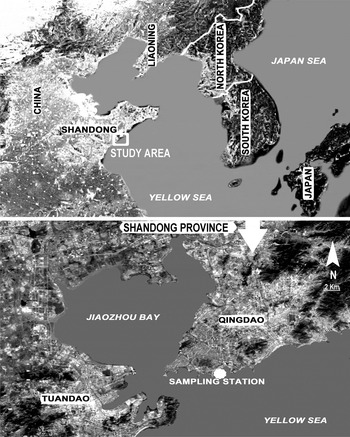
The sample site was located in coastal waters, near the mouth of Jiaozhou Bay surrounding Qingdao (Figure 1). This is a coastal area of the Yellow Sea in northern China. It has an average depth of ~9 m (average tidal range: ~3 m), having a high diaphaneity of ~3 m (light visibility depth measured by Secchi disk).
Map of the sampling station in coastal waters of the Yellow Sea, near Qingdao, northern China.

Periphytic ciliates were collected using glass slides as an artificial substrate. The sampling method used was according to Xu et al. (Reference Xu, Min, Choi, Jung and Park2009a, Reference Xu, Min, Choi, Kim, Jung and Lim2009b, Reference Xu, Zhang and Jiang2014). A total of 24 PVC frames (6 frames in each depth) holding 240 glass slides (2.5 × 7.5 cm) were used for collecting periphytic ciliates at four depths of 1, 2, 3.5 and 5 m from the water surface. In each sampling event, four PVC frames were randomly collected from each of the four depths at time intervals of 3, 7, 10, 14, 21 and 28 days after exposure to examine the species composition, community structure and the colonization process. Collected frames containing ciliate samples were preserved with in situ water and transported to the laboratory as soon as possible for microscopic observation.
Enumeration and identification
Species identification and enumeration were carried out in vivo following the methods outlined by Xu et al. (Reference Xu, Zhang and Jiang2014). Individual numbers of ciliates were enumerated at a 10–400× magnification using an inverted microscope (model: Motic A-31) as soon as possible (2–4 h) after sampling (Xu et al., Reference Xu, Zhang and Jiang2014). For improved results, the whole slide (17.5 cm2) was examined to record both occurrences and individual abundances, using bright field illumination on the inverted microscope. Abundance was calculated from five replicate glass slides at each depth, on each occasion, to confirm the average abundance which was expressed as individual species number present per square centimetre (ind. cm−2).
Taxonomic classification of ciliates was based on reference to keys and guides such as Song et al. (Reference Song, Warren and Hu2009). In some cases, protargol staining was needed for species identification (Berger, Reference Berger1999).
Data analysis
The colonization process of periphytic ciliates can be fitted to the colonization equilibrium model expressed by MacArthur & Wilson (Reference MacArthur and Wilson1967):
 $$S_t = S_{{\rm eq}}({\rm 1} - {\rm e}^{-Gt})$$
where, S t = the species number at time t; S eq = the estimated equilibrium species number of ciliate colonization; G = the constant value of colonization rate; T 90% = the time taken for reaching 90% S eq. Three functional parameters (S eq, G and T 90%) were calculated using the statistical software Sigma Plot (v12.5).
Fitness tests were conducted to assess if the species numbers observed according to days, fit with the MacArthur–Wilson model at the 0.05 significance level.
The increase of individual abundance over the total experimental phase was tested if it was fitted to the logistic model:
 $$N_t = \displaystyle{{N_{{\rm max}}} \over {[{\rm 1} + {\rm e}^{(a - rt)}]}}$$
where, N t = the individual abundance at time t; N max = the carrying capacity of individual abundance (maximum abundance); r = the growth rate constant; and a = the coefficient constant of initial individual abundance; T 50% = the time to reach 50% N max. All parameters (e.g. N max and T 50%) were estimated using Sigma Plot. Fitness tests were to determine whether the individual abundance recorded at each time interval fit with the logistic model at the 0.05 significance level (Zhang et al., Reference Zhang, Xu, Jiang, Zhu and Al-Resheid2012).
Multivariate analyses of community structure among the four water depths were analysed using the PRIMER v7.0.13 + PERMANOVA (Anderson et al., Reference Anderson, Gorley and Clark2008; Clarke & Gorley, Reference Clarke and Gorley2015). A shade plotting analysis in terms of the relative abundance of species across the four water depths during colonization period summarized the vertical species distribution, from standardized species-abundance data (Anderson et al., Reference Anderson, Gorley and Clark2008; Clarke & Gorley, Reference Clarke and Gorley2015). Similarity percentage (SIMPER) analysis was performed for summarizing the vertical species contribution of each water depth in average Bray–Curtis similarity matrix during the colonization period. SIMPROF based clustering analysis was performed to determine the significant difference of each colonization stage in each of four water depths. The vertical differences in community patterns among four water depths during colonization period were summarized, using the submodule dbRDA (distance based redundancy analysis). PERMANOVA was tested for summarizing significant vertical community variation across the four depths during the colonization period.
The differences of species number and colonization rates across four depths were evaluated by a non-parametric Kolmogorov–Smirnov test at the 0.05 level, data were log transformed before use.
Results
Taxonomic composition and species distribution
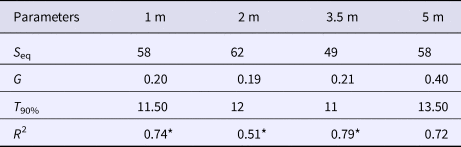
Species composition, species distribution in terms of average abundances, and ecological types of the recorded 92 ciliate species (belonging to 21 orders and 48 genera) at depths of 1, 2, 3.5 and 5 m are summarized in Table S1. Of these species, 58 species occurred at a depth of 1 m, 62 at 2 m, 49 at 3.5 and 58 at 5 m.
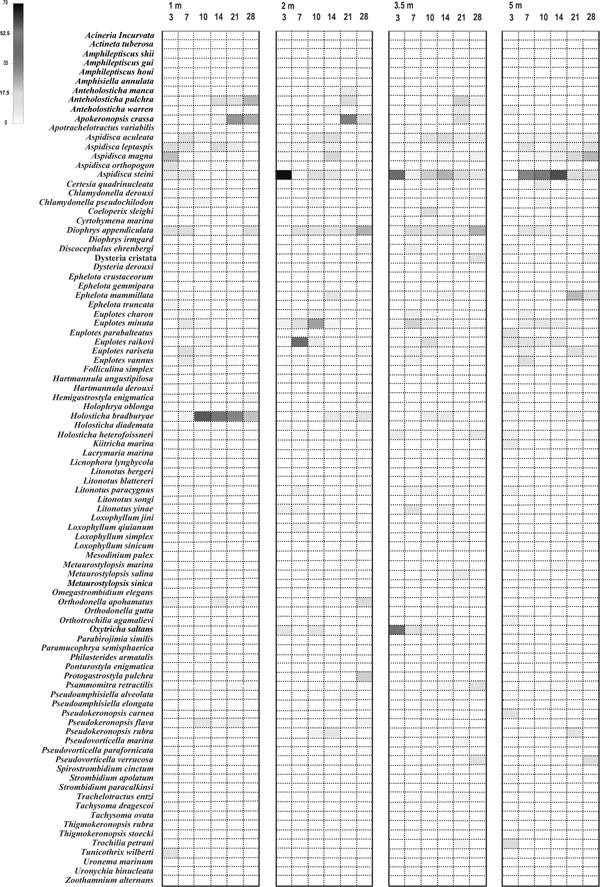
Shade plotting analysis in terms of the relative abundances showed that there was a clear vertical variability of species distribution across the four water depths. For example, 16 species occurred at 1 m, 17 species at 2 m, 15 species at 3.5 m and 10 species at 5 m, with a relative abundance of more than 20% (Figure 2).
Shade plotting analyses: showing the species distribution using group-average clustering on Bray–Curtis similarities on fourth root transformed/standardized abundance data of each species within the ciliate communities at four depths in coastal waters of the Yellow Sea, northern China during the study period.

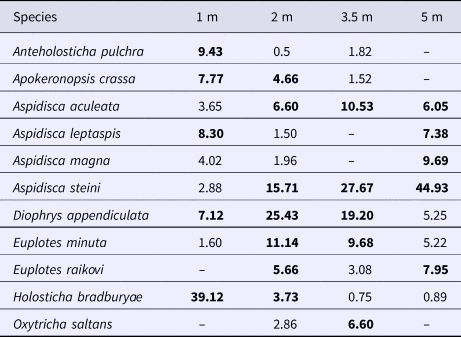
SIMPER analysis revealed a clear vertical difference in species contribution with regard to individual abundances across the four water depths. Among 92 species, 11 taxa were the primary contributors to the vertical variation at all four depths with a cumulative contribution of more than 70% (Table 1). For example, Holosticha bradburyae dominated the samples at a depth of 1 m with a maximum contribution of 39.12%, Diophrys appendiculata dominated the communities at 2 m with a contribution of 25.43%, and Aspidisca steini occurred at deep layers of 3.5 and 5 m with contributions of 27.67 and 44.93%, respectively (Table 1).
Contributions of the top 11 species with a cumulative contribution of more than 70% to the average Bray–Curtis similarity among four water depths of the periphytic ciliate communities in coastal waters in the Yellow Sea, northern China. –, negotiable contribution; bold font indicates top contributor species in each depth.

Colonization curves and growth curves at four depths
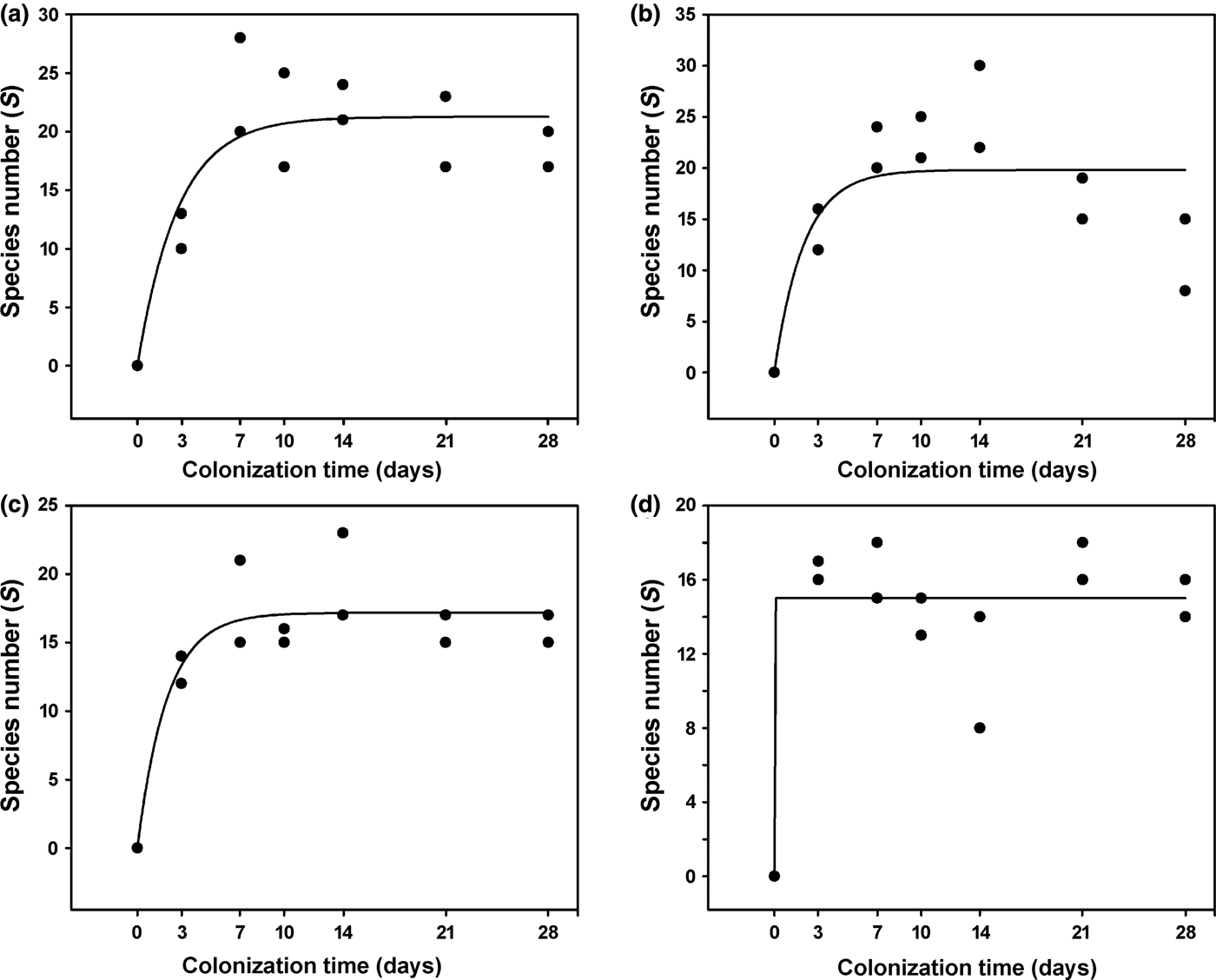
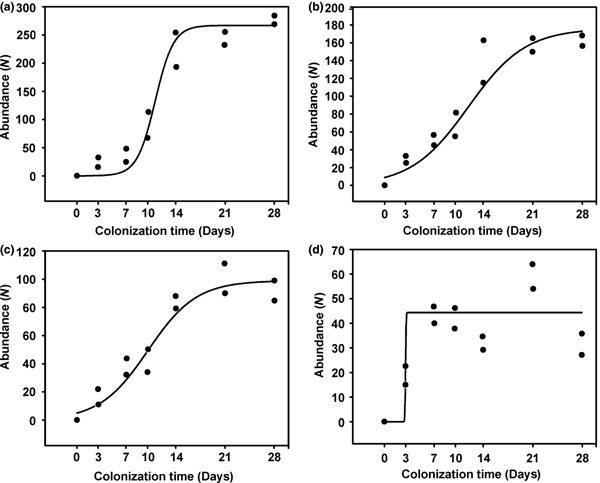
Colonization curves of the ciliate communities are summarized in Figure 3. Regression analysis demonstrated that the colonization process at depths of 1 to 3.5 m were well fitted to the MacArthur–Wilson equation model and divided into three successive stages such as initial, transitional and equilibrium while the data from a depth of 5 m showed a poor fit to the model (Figure 3). For example, colony formation in slides approaching equilibrium stage occurred either at 10 or 14 days at depths of 1 to 3.5 m except at a depth of 5 m, although the regression value at 5 m was close to the other three depths but not fitted to the equation model.
Colonization curves of periphytic ciliate communities at four depths in coastal waters of the Yellow Sea, northern China during the study period. (a) 1 m (initial at day 3–7; transition at day 7–10; equilibrium at day 14–28); (b) 2 m and (c) 3.5 m (initial at day 3; transition at day 7–14; equilibrium at day 21–28); (d) 5 m (non-uniform colonization).

Three functional parameters based on the MacArthur and Wilson model, equilibrium species number (S eq), colonization rate constant (G), and time required to reach 90% S eq (T 90%) are shown in Table 2. The colonization rates (G values) ranged from 0.19 to 0.21 with short T 90% values (11 to 12 days) compared with those at a depth of 5 m (Table 2).
Colonization curve fitness to the Mac-Arthur and Wilson model for periphytic ciliate communities at four water depths in coastal waters in the Yellow Sea, northern China.

S eq, the estimated equilibrium species number of ciliates colonization; G, the growth colonization rate constant; T 90%, the time (days) taken for reaching 90% S eq; R 2, regression coefficients.
*Significant difference at 0.05 level (P < 0.05).
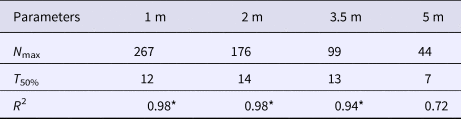
Regression analysis of growth curves revealed that the abundances were well fitted to the logistic model at three depths of 1 to 3.5 m (P < 0.05). Note that the estimated maximum values of abundances (N max) showed a decreasing trend from a depth of 1 to 5 m while the values levelled off (12–14 days) at depths of 1 to 3.5 m compared with that (7 days) at a depth of 5 m (Figure 4, Table 3).
Growth curves of periphytic ciliate communities at four depths in coastal waters of the Yellow Sea, northern China during the study period. (a) 1 m; (b) 2 m; (c) 3.5 m; (d) 5 m.

Increase curve fitness to the logistic model for periphytic ciliate communities at four water depths in coastal waters in the Yellow Sea, northern China.

N max, the carrying capacity of abundance or maximum abundance; T 50%, time (days) for the half of the maximum abundance; R 2, regression coefficients.
*Significant difference at 0.05 level.
Vertical variation in colonization dynamics of community patterns
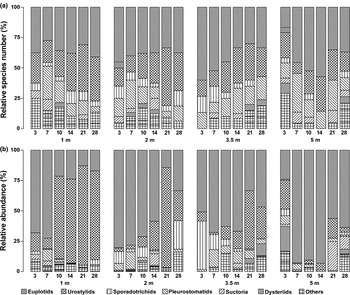
In terms of relative species number and relative abundance, ciliate communities showed a clear vertical variation in colonization patterns across the four water depths (Figure 5).
Vertical variations of relative species number (a) and relative abundance (b) of periphytic ciliate communities in coastal waters of the Yellow Sea, northern China during the study period.

In terms of relative species number, euplotids, urostylids and pleurostomatids were the top three contributors to the taxonomic structure (Figure 5a). In terms of relative abundance, three types could be identified: (1) those dominated by euplotids before 10 days followed by urostylids (1 m); (2) those dominated by euplotids before 21 days followed by urostylids (2 and 3.5 m); and (3) those dominated by euplotids, urostylids and dysteriids at initial stage, followed by euplotids at the equilibrium stage, and by euplotids, urostylids and suctoria after 21 days (Figure 5).
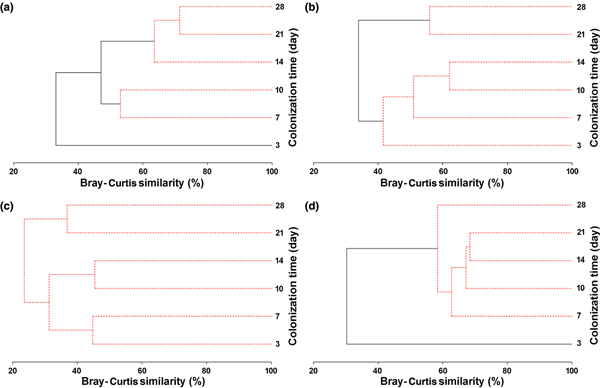
A SIMPROF test revealed that the colonization process of periphytic ciliates at a depth of 1 m was clearly divided into three stages: the initial (3 days), transitional (7–10 days) and the equilibrium (14–28 days) (Figure 6a). However, this pattern was different at the other three depths, for example, there was no significant difference among the initial, transitional and the equilibrium stages within 14 days (Figure 6b).
Cluster analyses with SIMPROF tests: showing the significant variation in each of the colonization stage at each depth of periphytic ciliates during the colonization process in coastal waters of the Yellow Sea, northern China. (a) 1 m; (b) 2 m; (c) 3.5 m; (d) 5 m.

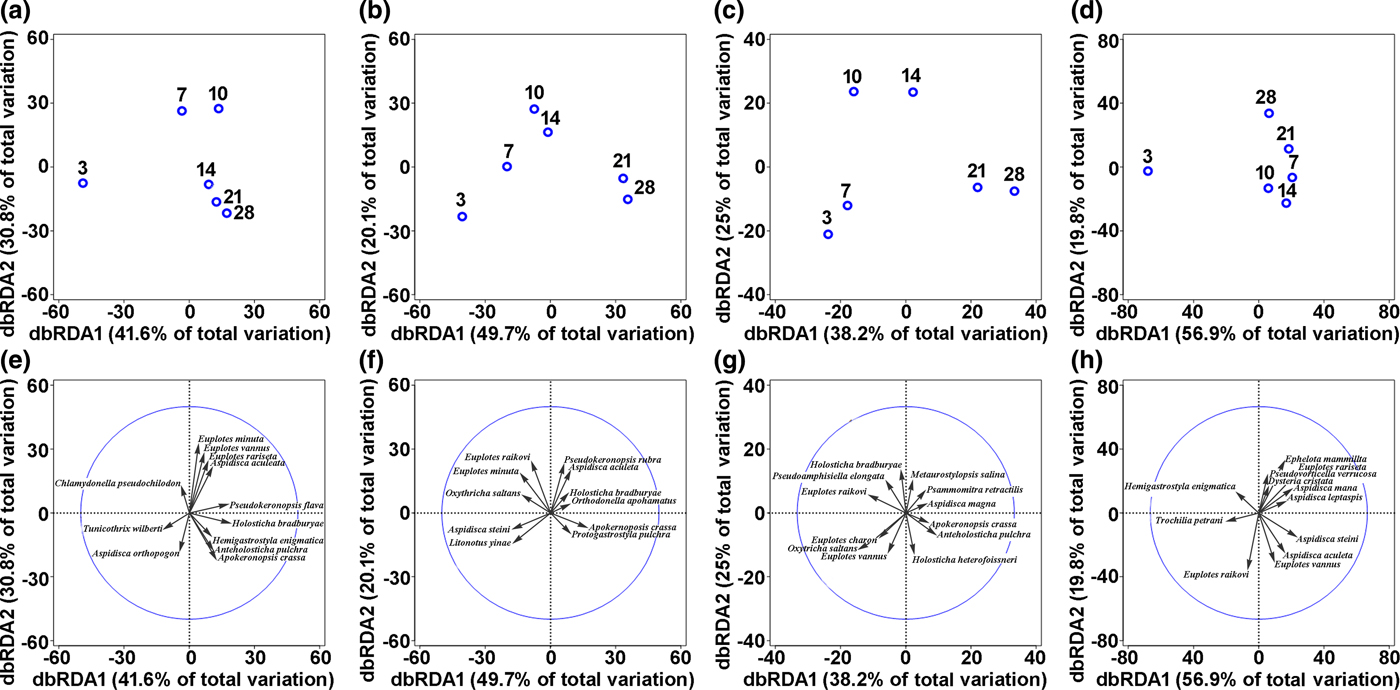
The dbRDA ordinations indicated that there were different colonization patterns of ciliate communities across the four water depths (Figure 7). PERMANOVA test demonstrated a significant difference in colonization patterns between a depth of 1 m and the other three depths (2 to 5 m) (P < 0.05).
Distance-based Redundancy analyses: showing the vertical variation in community patterns during the colonization process in coastal waters of the Yellow Sea, northern China during the study period. Ordinations: (a) 1 m; (b) 2 m; (c) 3.5 m; (d) 5 m. Vectors: (e) 1 m; (f) 2 m; (g) 3.5 m; (h) 5 m.

Discussion
Colonization dynamics of periphytic ciliates on artificial substrates commonly follow the MacArthur–Wilson equilibrium and logistic models (MacArthur & Wilson, Reference MacArthur and Wilson1967; Cairns & Henebry, Reference Cairns, Henebry and Cairns1982; Railkin, Reference Railkin1995; Franco et al., Reference Franco, Esteban and Tellez1998; Struder-Kypke, Reference Struder-Kypke1999; Zhang et al., Reference Zhang, Xu, Jiang, Zhu and Al-Rashied2013). Based on previous studies, the colonization process can be generally discriminated into three stages such as initial (1–7 days), transitional (7–10 days) and equilibrium (10–28) (e.g. Zhang et al., Reference Zhang, Xu, Jiang, Zhu and Al-Rashied2013).
Our recent reports have demonstrated that the community structure and trophic-functional patterns of periphytic ciliates can be shaped by water depths in spite of the water mixture among different water layers in coastal waters (Abdullah Al et al., Reference Abdullah Al, Gao, Xu, Wang and Xu2017, Reference Abdullah Al, Gao, Xu, Wang, Warren and Xu2018). Generally, the abundance of microalgae in biofilms are high in surface layers with high light intensity while the periphytic and planktonic bacteria are more abundant in deep layers (Coppellotti & Matarazzo, Reference Coppellotti and Matarazzo2000; Eisenmann et al., Reference Eisenmann, Letsiou, Feuchtinger, Bersker, Mannweiler, Hutzler and Arnz2001; Norf et al., Reference Norf, Arndt and Weitere2009a, Reference Norf, Arndt and Weitere2009b; Abdullah Al et al., Reference Abdullah Al, Gao, Xu, Wang and Xu2017, Reference Abdullah Al, Gao, Xu, Wang, Warren and Xu2018). Abdullah Al et al. (Reference Abdullah Al, Gao, Xu, Wang and Xu2017) considered the abundance and composition of food supply as the driver to shift community patterns of periphytic protozoa at different layers in water columns of coastal waters. In the present study, the colonization processes of ciliate community patterns showed different dynamics across four water depths. For example, only at depths of 1 to 3.5 m, the colonization dynamics of the ciliate communities fitted the MacArthur–Wilson model and logistic equation, and the estimated maximum values of abundance represented a decreasing trend from a depth of 1 to 5 m. This implies that water depths might change the colonization process of the ciliate communities through food supply under different light conditions in the water column.
Multivariate approaches are effective tools for summarizing temporal and spatial variations in community patterns (Anderson et al., Reference Anderson, Gorley and Clark2008; Xu et al., Reference Xu, Zhang, Jiang, Zhu, Al-Rasheid, Warren and Song2011; Clarke & Gorley, Reference Clarke and Gorley2015; Abdullah Al et al., Reference Abdullah Al, Gao, Xu, Wang and Xu2017). In this study, dbRDA ordinations of multivariate analysis revealed that the colonization process at 1 m depth was clearly categorized into three successive stages. This finding was consistent with previous reports such as Bamforth (Reference Bamforth and Cairns1982), Xu et al. (Reference Xu, Min, Choi, Jung and Park2009a, Reference Xu, Min, Choi, Kim, Jung and Lim2009b), Mieczan (Reference Mieczan2010) and Zhang et al. (Reference Zhang, Xu, Jiang, Zhu and Al-Resheid2012, Reference Zhang, Xu, Jiang, Zhu and Al-Rashied2013). However, the PERMANOVA test revealed that colonization patterns were significantly different between a depth of 1 m and the other three depths. Thus, these findings suggest that 1 m would be the best sample depth for community research into periphytic ciliates in marine/coastal waters.
The functional parameters based on colonization analysis are useful indicators for assessing the carrying capacity of external organic load/toxic levels of ecosystems (Zhang et al., Reference Zhang, Xu, Jiang, Zhu and Al-Resheid2012, Reference Zhang, Xu, Jiang, Zhu and Al-Rashied2013). For example, the lower the pollution levels were, the higher the values of S eq and G (Cairns & Henebry, Reference Cairns, Henebry and Cairns1982; Burkovskii & Mazei, Reference Burkovskii and Mazei2001; Xu et al., Reference Xu, Min, Choi, Jung and Park2009a, Reference Xu, Min, Choi, Kim, Jung and Lim2009b; Burkovskii et al., Reference Burkovskii, Mazei and Esaulov2011; Zhang et al., Reference Zhang, Xu, Jiang, Zhu and Al-Resheid2012, Reference Zhang, Xu, Jiang, Zhu and Al-Rashied2013). In this study, the colonization rate (G), S eq, N max showed a clear vertical variability from a depth of 1 to 5 m in water columns. The highest values of colonization rates (G), equilibrium species number (S eq) and carrying capacity (N max) were found at 1 m depth while lower values were measured at the deeper sites. However, these parameters generally levelled off at stable values at depths of 1 to 3.5 m. This implies that availability of food supply due to light intensity in deeper water depths might influence the colonization succession with lower abundance and higher variability at different depths. Another reason might be organic load, because higher organic pollutants can minimize the carrying capacity of ecosystems and have been reported elsewhere and are consistent with our present findings (Burkovskii & Mazei, Reference Burkovskii and Mazei2001; Burkovskii et al., Reference Burkovskii, Mazei and Esaulov2011; Zhang et al., Reference Zhang, Xu, Jiang, Zhu and Al-Resheid2012, Reference Zhang, Xu, Jiang, Zhu and Al-Rashied2013).
In conclusion, periphytic ciliate communities show similar colonization dynamics from a depth of 1 to 3.5 m: (1) temporal variability was well fitted to the MacArthur–Wilson and logistic models; (2) species composition reached an equilibrium during the exposure time periods of 10–14 days; and (3) maximum abundances were higher at a depth of 1 m than at 3.5 m. The colonization pattern at a depth of 1 m was significantly different from those at the other three depths. Results suggest that the colonization dynamics of periphytic ciliates may be shaped by water depths in coastal waters. This provides an important reference for establishing an optimal sampling strategy for bioassessment on large spatial/temporal scales in marine ecosystems.
Supplementary material
The supplementary material for this article can be found at https://doi.org/10.1017/S0025315418001121.
Financial support
This work was supported by ‘The Natural Science Foundation of China’ (project numbers: 31672308; 41076089), Excellent Master's from Chinese Scholarship Council (CSC no.: 2016GXY030) and a doctoral award from State Oceanic Administration (SOA) (CSC no.: 2017SOA016554) under the Ministry of Education of China.
Author ORCIDs
Mamun Abdullah Al 0000-0002-0944-3444