


The entire act of voting appears to be assisted by interactions with friends, neighbors, and family members. Voters rely on one another to become informed about elections (Robinson Reference Robinson1976). Friends and neighbors encourage one another to go to the polls on Election Day (McClurg Reference McClurg2004). People in social networks encourage one another to support particular candidates (Huckfeldt and Sprague Reference Huckfeldt and Sprague1991). Unfortunately, an inability to disentangle influence from other factors places the entire literature on a shaky empirical foundation. Likeminded individuals with similar habits, customs, and stations in life gravitate toward one another to populate neighborhoods and social networks (Mutz and Martin Reference Mutz and Martin2001). Once individuals are located in a network, members of the network are often exposed to identical outside pressures that alter behaviors and beliefs. Using observational data, there is no method of separating the unique effect of contagion from selection processes, congruence of material interests, or exposure to external forces without making nontrivial assumptions. Thus, the magnitude of contagion effects in voting behavior is uncertain.
This identification problem is not limited to voting behavior and permeates nearly every study invoking interpersonal processes. Whether one is studying civic engagement (Putnam Reference Putnam2000), criminal activity (Anderson Reference Anderson1990), volunteerism (Wilson and Musick Reference Wilson and Musick1997), protests (Lohman Reference Lohmann1994), riots (Myers Reference Myers1997), revolutions (Tilly Reference Tilly1978), or even suicide (Pickering and Walford Reference Pickering and Walford2000), distinguishing the unique roles played by the personality who selected into the social network, the social setting surrounding the events acting on all actors, and the effect of the social network on individuals requires simplifying assumptions that may not approximate reality. Selection and omitted variables are ubiquitous in social processes and make the effect of social networks on individual behaviors difficult to measure accurately.
The deficiencies in the empirical evidence marshaled on behalf of social networks in no way justifies ignoring interpersonal influence as a phenomenon. Most studies of voting assume an atomistic voter with weak ties to other members of a social network (e.g., Campbell et al. Reference Campbell, Converse, Miller and Stokes1964; Rosenstone and Hansen Reference Rosenstone and Hansen1993; Wolfinger and Rosenstone Reference Wolfinger and Rosenstone1980). Much of the variance in voting behavior may be best explained by peer effects, but studies focused on isolated individuals are incapable of detecting the influence. Experimental studies of voter mobilization systematically understate the cost-effectiveness of get out the vote (GOTV) campaigns by ignoring people who interact with the contacted voter (e.g., Gerber and Green Reference Gerber and Green2000; Green, Gerber, and Nickerson Reference Green, Gerber and Nickerson2003). Atomism is a convenient simplifying assumption, but evidence of voter contagion would cast doubt on both the assumption itself and the results that follow from atomistic analysis.
This paper surmounts the problem of isolating and measuring interpersonal influence by analyzing two placebo-controlled experiments conducted in Denver, CO, and Minneapolis, MN, during the 2002 Congressional primaries. Face-to-face blandishments to vote were provided to one person in households containing two registered voters, increasing her likelihood of voting. A parallel canvassing effort encouraging recycling was conducted to provide a comparison group to serve as a baseline. Voter turnout records were then consulted to determine the turnout of both members of the household. The boost in turnout among uncontacted persons in households assigned to the GOTV condition is directly attributable to behavioral contagion, net sampling error.
The carefully controlled design of the experiments isolates the effect of interpersonal influence by eliminating confounding factors such as selection processes, structural congruence, and exposure to external factors. The experiment also measures the effect of a single political event (i.e., the knock on the door) on behavior, rather than discovering broad similarities that have developed over time. The downside of the strategy is that external validity is a major concern. The limitations of the study are discussed at length in the conclusion. However, the uniqueness of this field experimental approach to social networks makes the study a helpful addition to the literature on interpersonal influence.
INTERPERSONAL INFLUENCE AND THE FAMILY
The similarity between people who live together is inescapable and has been noted throughout history. That said, the extent to which cohabitants are similar on average varies across topics, and scholars have attempted to correctly categorize these attitudes and behaviors. Once the commonality is noticed, the fundamental question researchers address is the degree to which interpersonal influence is the cause of the similarity between cohabitants.
Niemi, Hedges, and Jennings (Reference Niemi, Hedges and Kent Jennings1977) find that spouses have very similar political profiles (but see Zuckerman and Kolter-Berkowitz Reference Zuckerman and Kotler-Berkowitz1998 for evidence that politically apathetic households are heterogeneous in preferences). Hayes and Bean (Reference Hayes and Bean1992) analyze the South Bend snowball survey to conclude that the background characteristics of family members predict of a person's attitudes well. Kenny (Reference Kenny1994) concludes that even party identification, an attribute often viewed as fixed (Green, Palmquist, and Schickler Reference Green, Palmquist and Schickler2002), is influenced by spouses. Thus, politics is definitely a trait where congruence between cohabitants is observed.
A possible causal mechanism for the correlation in spousal behavior is the intimacy and frequency of interactions within the household. People may not talk about politics frequently, but when they do so it tends to be within the household. When asked to name political discussion partners, survey respondents are most likely to provide the name of a spouse (Beck Reference Beck1991). In every year the question has been asked, the National Election Study finds that family members are the most frequent targets of attempts at political persuasion. Clearly, the high level of interaction, familiarity, respect, and trust among cohabitants facilitates an open discussion of politics and convergence in political views is a likely outcome. Thus, it is not surprising that longitudinal analysis finds agreement among married couples increases over time (Zuckerman, Fitzgerald, and Dasovic Reference Zuckerman, Fitzgerald, Dasovic and Zuckerman2005; Stoker and Jennings Reference Wilson and Musick2005).
The quantity of discussion within the household, high correlation in attitudes, and behaviors between partners—even after controlling for partisanship and ideology—and convergence over time have led scholars to conclude that interpersonal influence is the major driver of similarity between spouses. Huckfeldt and Sprague declare spouses to be three times as influential as other relationships (Reference Huckfeldt and Sprague1995, 169). More directly relevant to the current study, Zuckerman, Dasovic and Fitzgerald (Reference Zuckerman, Dasovic and Fitzgerald2007, chapter 6) concludes the frequency of political discussion with a spouse increases voter turnout. Fowler uses the Watts-Strogatz model to capture the small-world properties of large-scale networks and suggests “a single person's decision to vote affects the turnout decision of at least four people on average in a ‘turnout cascade”’ (Reference Fowler and Zuckerman2005, 286). Although the scholars have undoubtedly uncovered an interesting and informative correlation, one should be hesitant to draw the conclusion that the attitudes and behaviors of one cohabitant cause the attitudes and behaviors of the other cohabitant for at least two reasons.
First, studies of interpersonal influence, like those cited previously, convincingly demonstrate that cohabitating couples share a host of views and habits, but do not demonstrate a mechanism or precipitating event for the convergence. Many studies focus on background characteristics of partners (e.g., Hays and Bean Reference Hayes and Bean1992). Scholars of social networks examine the strength and density of ties within social networks (e.g., Knoke Reference Knoke1990). Although studies often measure the frequency or type of discussion among partners over a period, none consider the effect of a particular conversation (e.g., Huckfeldt and Sprague Reference Huckfeldt and Sprague1995; Mutz Reference Mutz1998; Zuckerman, Dasovic and Fitzgerald Reference Zuckerman, Dasovic and Fitzgerald2007). Perhaps interpersonal influence is a gradual process where partners take subtle clues from one another over time, but the case for causality would be stronger if the effect of a single precipitating event was measured. Studies that examine specific turnout decisions (e.g., Fowler Reference Fowler and Zuckerman2005) most closely approximate this goal, but inertia (e.g., past turnout behavior) or an external force (e.g., the closeness of the election, campaign contact, the importance of a particular issue) could be acting on both the ego and the alter. A distinct event affecting only one member of the network would be maximally convincing.
Second, omitted variables and selection processes could account for the similarity between spouses. Although all of the analyses discussed earlier include important control variables in the analysis, roommates are so similar to one another (relative to other pairs of individuals) that it may not be possible to adequately account for the similarity of people who live with one another. Chief among these potentially omitted variables are material congruence between cohabitants, similar exposure to outside factors, and the selection process that brought the housemates together.
Material Congruence
Statistical analyses of political behavior use control variables to obtain the hallowed condition of “all else being equal.” Cohabitants represent an unmatched degree of equality: subjects not only live in the same city but also share living quarters; housing expenses are not roughly the same, but exactly the same; children are not only present, but also are the same children; and so forth. Housemates are similar to a degree that cannot be captured in social science databases. Thus, it is possible that the congruent behaviors and beliefs among couples are not due to influence, so much as having identical material interests and any correlation is an artifact of omitted variable bias.
Exposure to Outside Factors
Because the lives of cohabitants are so intertwined, they are exposed to the same outside factors affecting behavior and beliefs more often than individuals in a randomly sampled survey. The parallel exposure to external influences occurs on every level. The exposure to mass media, such as newspapers, magazines, and television programs, are likely to be similar. Common political experiences need not be national like the Kennedy assassination or the September 11 attack on the World Trade Center, but could be more local such as a corrupt mayor or encounters with neighborhood activists. Most contact from political campaigns reaches more than one member of a household. Cohabitants can share even the most idiosyncratic political events such as court cases, dinner with an elected official, or negotiating government bureaucracies. Thus, it is possible that the similarity in political behaviors between two-voter households is due to innumerable shared experiences rather than interpersonal influence.
Selection
Housemates are not randomly paired together (but see Sacerdote Reference Sacerdote2001 or Klofstad Reference Klofstad2007 for studies of first-year college roommates). Although most individuals do not select a person to live with based on explicitly political criteria, it is not unusual to find someone who shares fundamental values and worldview. These ineffable, deep-seated value structures inform and shape a person's ideological structure, which in turn shapes political decisions. Therefore, partisan homogeneity among cohabitants is not the overt purpose of the selection process, but the pairing of two very similar individuals is a reasonable outcome. It is important to note that although many manifestations of this shared core belief system can be measured (e.g., partisanship or placement on a 7-point liberal/conservative scale), the true preexisting commonality is something that cannot be measured. Thus, the correlation between attitudes and actions among couples may be the result of careful selection rather than interpersonal influence.
This short list of alternative explanations for the high correlation of behaviors within a household is not intended to be exhaustive. Rather, it is indicative of the complexity and hurdles facing scholars of interpersonal influence. Disentangling the overspecified web of causes to isolate the effect of interpersonal influence alone is nontrivial, especially because the full extent of the processes cannot be measured.
The next section describes a randomized experimental protocol for detecting behavioral contagion that surmounts both challenges faced by the extant literature. An external stimulus is applied to a social network and its effect traced. The imposition of a single stimulus and the randomized application allows causal inferences to be made. That is, the experiment possesses internal validity. However, there are legitimate concerns regarding the external validity of the study, and these are discussed at length in the conclusion of the paper.
EXPERIMENTAL STRATEGY
Influence, material congruence, outside experiences, and selection reach an unknowable balance of political behaviors and habits in a household. In order to detect and isolate influence, a controlled exogenous shock can create a disturbance in the pattern of behaviors. The shock can then be traced through the two-voter system. Figure 1 offers a graphic illustration of the logic.
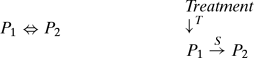
Prior experiments have demonstrated that face-to-face canvassing can be an effective means of increasing voter turnout (Gerber and Green Reference Gerber and Green2000; Green, Gerber, and Nickerson Reference Green, Gerber and Nickerson2003). By encouraging one member of the household to vote, it should be possible to measure the boost in turnout that a person receives, T, and then measure the indirect boost in turnout for the other person in the household, S. The contagion effect, α, is then the percentage of the direct treatment effect passed onto the other member of the household. That is,

The key to this straightforward idea is isolating and accurately measuring both T and S. The experimental protocol described next accomplishes both tasks.
Prior to the 2002 Congressional Primaries households in Denver, CO, and Minneapolis, MN, with two registered persons were culled from the official voter rolls and randomly assigned to three conditions: (1) receive a GOTV appeal; (2) receive encouragement to recycle; (3) receive no contact from the campaign. Each appeal was delivered door-to-door the weekend prior to the Tuesday primary by a group of paid workers. The labor pool consisted of area college students, who typically had little experience in canvassing but were carefully trained. Canvassers were instructed to:
1. Provide the correct appeal at the correct household (designated by “V” for voting and “R” for recycling);
2. Give the pitch to whichever person of voting age answered the door;
3. Ask the name of the individual and record the person directly contacted.
Execution of the protocol went well in both Minneapolis and Denver. Volunteers reported no trouble delivering the correct script at each household since the walk between doors afforded sufficient time for canvassers to double-check the assignment (see Appendix B for the scripts). Conversations were very brief, and subjects contacted about recycling were left with a flyer. Flyers in support of voting were printed, but canvassers were given very few and instructed to hand-out flyers only when specifically requested by the person at the door (see Appendix A). In all, 486 households received the GOTV treatment and 470 received the recycling treatment.Footnote 1
Both Minneapolis and Denver are large cities with a majority white population. Neighborhoods with a high density of two-voter households were targeted to facilitate efficient door-knocking campaigns. These neighborhoods exhibited a higher rate of home ownership and slightly higher levels of education and income than the national average, but are typical of many communities.
Two key features make the experimental protocol a convincing test for contagion. First, only two voter households are considered, so the network is manageable. Second, the appropriate treatment is administered to the first person who answers the door. These two details tell the researcher where to look for the direct treatment effect, T, and the secondary treatment effect, S. Table 1 helps to illustrate how the experimental protocol isolates contagion within the household.
Possible Outcomes under placebo protocol

a N.A. = Not applicable.
Once a canvasser knocks on a door, two outcomes are possible: the door is answered, occurring with probability π, or not, occurring with probability 1 - π. The person answering the door has an average baseline propensity to vote, μ1. In the recycling condition, the observed rate of voter turnout among people who answer the door,  , is a function solely of the baseline propensity to turnout having received no encouragement to vote from the campaign. This assumption can be checked empirically by comparing the rate of turnout in the recycling condition, which is intended as a placebo intervention, to turnout in the control condition where no contact whatsoever was attempted. However, in the GOTV condition, the observed rate of voter turnout among door answerers,
 , is a function of the baseline plus the average effect of the treatment, μ1 + T. Thus, the direct mobilization effect of the GOTV treatment can be calculated by subtracting the rate of turnout among people who answered the door in recycling group from the rate of turnout among people who answered the door in the GOTV condition.

An identical strategy can be used when calculating the secondary mobilization of the person in the household not directly spoken to. The person not answering the door potentially has a different baseline propensity to vote from the person answering the door, μ2. However, the random assignment of the delivered message assures that μ2 will be the same in both the GOTV and recycling conditions. Thus, one can calculate the secondary mobilization effect, S, by subtracting the average turnout among nonanswering residents of households where the recycling message was delivered,  , from the turnout among nonanswering residents of households where the GOTV message was delivered,
 .

Estimating T and S is straightforward because of the care in the design of the placebo protocol. This conceptual clarity makes the calculation of voter contagion, α, possible. Furthermore, contact rates are not a concern since the only households considered are those where a treatment was successfully applied (see Nickerson Reference Nickerson2005). Ultimately, the placebo assures a perfectly comparable set of subjects from which to establish a baseline level of voting.
This estimation process makes no assumptions about the baseline rate of voting between the two people in the household (see Table 1). In the analysis, the two individuals in the household are permitted to have separate predictive models of voter turnout. It is unlikely that members of the same household possess radically divergent patterns of voting behavior, but the placebo-controlled design frees the researcher from guessing either way.
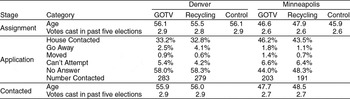
Good placebos possess two properties: (1) the compliance profile of the placebo is exactly the same as the treatment; (2) the placebo is not causally related to the dependent variable. In the current setting, application of the treatment (i.e., GOTV message) and the placebo (i.e., recycling message) means a registered voter was contacted at the door and the appropriate message was given. The canvassers were asked to record what occurred at each door attempted. The GOTV and recycling messages featured nearly identical application profiles across every event category (e.g., “Contacted,” “Not Home,” or “Go Away; see Table 2, middle panel). Furthermore, the people exposed to the GOTV and recycling messages were identical across every observable trait (see Table 2, lower panel). Thus, there is no reason to believe that the subjects exposed to the treatment differed in any way from the subjects exposed to the placebo. The placebo also exhibited no ability to motivate voters to the polls on Election Day (38.9% vs. 38.4% in Denver and 17.8% vs. 17.2% in Minneapolis). So the two criteria for an effective placebo are satisfied and the assumptions behind Table 1 hold.
Balance of Observable Traits by Treatment Assignment

Note. Age and vote history were taken from county voter files. Canvassers were asked to record the disposition of each door knock.
Since the estimates for T and S rely only on the contrasting voting rates of the treatment and placebo conditions, the reader might wonder why subjects were also placed into a control group that received no contact from the campaign. The control group is unnecessary to derive the estimates, but it does provide a useful check on the implementation of the protocol. The two treatment conditions were assigned randomly prior to the canvassing, and the analysis relies on the assignment, so volunteers could not manipulate the pitch a household received. Yet, a skeptical reader might note that since the estimator is based on contact, perhaps volunteers selectively decided to contact households. For instance, rogue volunteers could avoid low voting households in the GOTV condition and, conversely, eschew high voting households in the recycling condition. If such selection occurred successfully, then those contacted by the GOTV campaign would turnout at higher rates than those contacted in the recycling condition—even if the treatment had no effect. However, the selective process described previously would do nothing to increase the turnout rate of the GOTV campaign over that of the control group.Footnote 2 There is no reason to believe that volunteers behaved in an untoward manner, but the control group offers a method of detecting problems in the implementation and provides assurance that the results are not epiphenomenal.
RESULTS
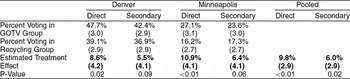
The first thing to check for is a direct mobilization effect from the GOTV intervention, T. If the exogenous shock does not boost the rate of turnout of the subject treated, then the boost cannot be passed onto the other person in the household. Table 3 presents the rates of turnout among the 956 households contacted in the experiment (562 in Denver and 394 in Minneapolis).
Treatment Effect among Contacted Households

Note. Numbers in parentheses represent standard errors. P-values test the one-tailed hypothesis. Pooled estimates are weighted averages of results for both cities.
Each city experienced a statistically and substantively significant rise in turnout from the GOTV campaign. The effect sizes (8.6% and 10.9%) are well within the range expected from the 1998 New Haven and 2001 YouthVote experiments (Gerber and Green Reference Gerber and Green2000; Gerber, Green, and Nickerson Reference Green, Gerber and Nickerson2003). To double-check the veracity of the mobilization effect, the households assigned to the GOTV condition were compared to the households assigned to the control condition using a two-stage least-squares estimator (Angrist, Imbens, and Rubin Reference Angrist, Imbens and Rubin1996). The results (not presented) confirm that the canvas caused a rise in turnout in the vicinity of 8% regardless of the control variables included (e.g., age, vote history, neighborhood dummies). Thus, the exogenous shock appears to have altered the behavior of the person treated.
The next step is to look for a mobilization effect among the untreated persons in contacted households, S. Table 3 estimates the indirect mobilization effect from the GOTV campaign to be 5.5% in Denver and 6.4% in Minneapolis. Individually, neither of these estimates crosses the traditional 0.05 level of statistical significance, but the null hypothesis that there is no secondary effect is unlikely to be true since both cross p < 0.1 levels of significance. Given that identical protocols were used and the settings were very similar, results the two experimental results can be pooled together to estimate a secondary effect of 5.8%, which surpasses the 0.05 threshold using a one-tailed test.
From Table 3 the contagion effect, α, can be estimated for both cities. The treated person passed on 64% and 59% of the increased propensity to vote in Denver and Minneapolis, respectively. That is, a person who might be 25% likely to vote in the primary would become 85% likely to vote as a direct result of a cohabitant deciding to vote. The magnitude of the contagion effect is remarkable when compared to other well studied predictors of voting such as education, income, and age. Examining reported turnout levels in the 2004 American National Election Study: the difference in turnout between people with an eighth-grade education or less (39%) is 47 percentage points lower than people with an advanced degree (86%); turnout in households with less than $10,000 income (42%) is only 30 percentage points lower than households earning more than $60,000; and, turnout among 18- to 24-year-olds (42%) lags that of respondents in their 60s (77%) by only 26 percentage points. This sizable experimental estimate of contagion is actually conservative, since some households contained people who planned to vote already and, therefore, would not be susceptible to contagion effects. The unavoidable conclusion is that voting is a highly contagious behavior and an important determinant of turnout.
A subtle point of interpretation deserves attention. If the recycling message has no effect on voter turnout, the control group should vote in the 2002 Congressional primary at roughly the same rate as those people treated with the placebo. This expectation is largely borne out since both the directly contacted persons in the recycling condition and the other members of the household vote near the rates of the control group for each city (38.3% in Denver and 17.2% in Minneapolis). The observed deviations are well within the bounds of sampling error and not particularly notable. However, even if the placebo condition does not mobilize voters, there is good reason to believe that persons contacted by the campaign will vote at higher rates than the control group. Being contacted by the campaign means that the person has neither moved nor died, both of which decrease the likelihood of voting from a particular address. It is somewhat surprising that the recycling group does not vote at a higher rate than the control group. This parity between the placebo and control groups is probably the result of canvassing in neighborhoods with high residential stability. Volunteers found that the people listed had moved at only 1% of the homes (see Table 2). The placebo-controlled protocol was designed to sidestep these problems and in the process demonstrated that, in this particular sample, households contacted differ little from households not contacted.
DISCUSSION
Political scientists study people embedded within families, neighborhoods, and social networks rather than hermits living on desert islands. The Minneapolis and Denver experiments provide strong evidence that interpersonal influence shapes the behaviors of people living within the same household, thereby contradicting the atomistic assumptions underlying much survey based research. Unlike past studies of interpersonal influence, the placebo-controlled experiments isolate peer effects from selection processes and omitted variables to provide an unbiased estimate of the contagiousness of voter turnout within these households.
Despite these virtues of the design, external validity is a major concern of these experimental findings for five reasons. First, the exogenous shock may create an atmosphere within the household that does not resemble daily life. It is possible that the turnout behavior of one person matters less in normal circumstances and that campaign contact triggers or enhances interpersonal influence. Thus, the experiment may overstate the degree by which voting is a contagious behavior and measures only the extent to which campaign contact spills over. Given the frequency of campaign contact in elections at all levels of government, this quantity is also of substantive interest, but it may not measure voter contagion in the absence of contact.
Second, the results from two-voter households may not be applicable to broader social networks. Given the high degree of trust, intimacy, and interactions, it is likely that voting is far less contagious in other social settings. Although the household is an important political network, it is hardly exhaustive of social settings. Ironically, the experiment's isolation of households may cause it to understate spillover from campaign contact since friends and neighbors may have been affected by the campaign. Detecting contagion in other settings is an empirical question that requires separate experiments.
Third, even within households there is no guarantee contagion will be consistent for households in other settings. To facilitate efficient canvassing, neighborhoods with a high density of households with two registered voters were selected. A wide range of racial and income levels were included in the sample, but the neighborhoods exhibited higher residential stability and marriage rates than average. Two-voter households in other areas may feature a greater number of roommates and intergenerational pairings than the neighborhoods sampled here. Thus, the strength of the bond between cohabitants and contagion effects may vary across settings. The neighborhoods contained in the experiments are representative of a large number of communities, but by no means encompass the full breadth and depth of the diversity across the United States.
Fourth, the election considered in the experiment is a low-salience primary election and voter contagion may be heterogeneous across elections. A low-salience election was selected to reduce background noise (i.e., competing contacts from political campaigns) and provide an opportunity to detect contagion effect cleanly. Increased activity from campaigns in competitive elections may obscure contagion effects by contacting each member of the household and possibly drowning out the experimental treatment. The marginal effect of one knock on the door is likely to be zero when both subjects have already received 20 knocks on the door. One might imagine that voting is more contagious in high salience elections because people are more likely to discuss the election and barriers to participation are lower, but identifying a strategy to reliably measure contagion in high salience elections is difficult. The two experiments contained in this paper certainly do nothing to speak to heterogeneity across elections.
Finally, other behaviors or attitudes may not be as contagious as voter turnout. One advantage of observational, survey based strategies of detecting behavioral contagion is that it is possible to measure a range of behaviors and attitudes. In contrast, the exogenous shocks utilized in these experiments are only designed to affect turnout. The contagiousness of vote choice, attitudes about democracy, campaign donations, volunteerism, and other interesting behaviors are beyond the scope of this inquiry. Extrapolating the 60% contagion of voter turnout within the households to other behaviors is not possible.
Each of these concerns about external validity is an empirical question and answerable through further experiments. Fortunately, the placebo-controlled protocol utilized in this paper is extremely flexible and could be used in a wide variety of settings to study contagion through social networks. The challenge is to find valid placebos and unobtrusive means of accurately measuring the outcome variable of interest throughout the network. The very intimacy that makes interpersonal influence within households so difficult to isolate for observational studies provides an ideal conditions for the experiment. Conversely, observational techniques may prove more useful in broader social networks where researchers lack sufficient control to conduct experiments. Voting is very contagious within households; the challenge is to devise creative means to measure contagion of other behaviors in other settings.
Although the placebo-controlled experiments provide an excellent means of detecting behavioral contagion, the process by which contagion occurs within the household remain unknown. It is possible that intrahousehold voter contagion is the result of lowered costs of voting (i.e., one person is driving to the polls already and the second person catches a ride). Another hypothesis is that social pressure to vote is the motivating agent. One could formulate other hypotheses, but there is no way to distinguish between them given the data from the experiments conducted in Denver and Minneapolis. Exogenous shock strategies are useful for detecting an effect, but not useful for testing the process that transmits the effect.
Although the experiments cannot provide a mechanism for the contagion itself, the contagiousness of voting behavior provides a mechanism for broad changes in political culture. Rates of voter turnout may have remained relatively stable since the 1970s (McDonald and Popkin Reference McDonald and Popkin2001), but electoral participation has declined since the 1960s (Dalton and Wattenberg Reference Dalton and Wattenberg2002; Patterson Reference Patterson2002; Putnam Reference Putnam2000). Since voting is a highly contagious behavior, self-reinforcing cycles of turnout and abstention are to be expected. As turnout declines, a person encounters fewer people who vote and the social pressure to vote declines. As aggregate turnout increases, an individual interacts with a larger number of voters and the propensity to vote increases (Fowler Reference Fowler and Zuckerman2005). Evidence of behavioral contagion provides a micro-level process for macro-social forces.
Contagion also implies prior voter mobilization experiments (e.g., Gerber and Green Reference Gerber and Green2000; Michelson Reference Michelson2003; Nickerson Reference Nickerson, Friedrichs and King2006; Nickerson Reference Nickerson2007) were not justified in invoking the stable unit treatment value assumption (SUTVA). By focusing only on one individual in a household these experiments consistently underestimate the number of votes created from campaign contact of households. If a campaign contacted 100 people in households with multiple registered voters, the direct effect of the contact generates nine votes. This placebo-controlled experiment suggests that the contact also generates six votes through behavioral contagion—a 60% increase in efficiency.
These results highlight the degree to which contagion effects can alter the world. To accurately measure causal effects, researchers need to account for influence through social networks. Even in settings characterized by extreme selection processes, congruent material interests, and similar exposure to outside factors—such as the households studied in the Minnesota and Denver experiments—there is room for powerful interpersonal influence. The behaviors and beliefs between husbands and wives are extremely similar, but the relationships between husbands and wives are still dynamic and evolving. The challenge is to design careful studies to successfully isolate the roles played by friends and family members.
APPENDIX A

APPENDIX B
GOTV Script
Hi, my name is ____ and I'm with the Center for Environmental Citizenship. How are you today?
I don't want to take up much of your time, but we'd like to remind you that the primary election is occurring this Tuesday and that voting is an important duty. We don't care for whom you vote, we just like to see you at the polls this Tuesday.
For our records, could you please tell me whether you are ____ or ____?
Thanks and have a nice day.
Recycling Script
Hi, my name is ____ and I'm with the Center for Environmental Citizenship. How are you today?
I don't want to take up much of your time and we're not asking for money. We'd just like to remind you that recycling is only effective if everyone participates. Does your household recycle?
<If yes> Great. Please keep up the good work.
<If no> It is very easy to do and doesn't take up much time. We hope that you start recycling soon.
For our records, could you please tell me whether you are ____ or ____?
Thanks and have a nice day.
 .




Comments
No Comments have been published for this article.