Selective mutism (SM), earlier called elective mutism, is a psychiatric disorder characterized in DSM-IV-TR (American Psychiatric Association, 2000) by persistent failure to speak (or extreme reluctance to speak) in specific social situations in which speaking is expected (e.g., school) despite speaking in other situations (e.g., with family and in the home environment). According to DSM-IV-TR, associated features may include “excessive shyness, fear of social embarrassment, social isolation and withdrawal, clinging, compulsive traits, negativism, temper tantrums, or controlling and/or oppositional behavior, particularly at home” (American Psychiatric Association, 2000).
Studies have investigated social, emotional, and cognitive factors related to SM (e.g., Bergman, Piacentini, & Mc Cracken, Reference Bergman, Piacentini and McCracken2002; Black & Udhe, Reference Black and Uhde1995; Dummit, Klein, Tancer, Asche, & Martin, Reference Dummit, Klein, Tancer, Asche and Martin1996; Dummit, Klein, Tancer, Asche, Martin, & Fairbanks, Reference Dummit, Klein, Tancer, Asche, Martin and Fairbanks1997; Kristensen Reference Kristensen2000, Reference Kristensen2001; Steinhausen & Juzi, Reference Steinhausen and Juzi1996; Yeganeh, Beidel, & Turner, 2003). Other researchers have investigated whether individuals with SM have atypical auditory processing (Arie et al., Reference Arie, Henkin, Lamy, Tetin-Schneider, Apter and Sadeh2007; Bar-Haim et al., Reference Bar-Haim, Henkin, Ari-Even-Roth, Tetin-Schneider, Hildesheimer and Muchnik2004). However, little information is known about the neurobiology underlying SM. A hint regarding a potential neurophysiological mechanism mediating the observed mutism may come from the behavioral observation that SM children, by an extension of the DSM-IV-TR definition, tend to have difficulties shifting behavioral state to engage others and appear to exhibit a degree of behavioral inhibition when requested to respond either verbally or behaviorally. These reliable observations invite the investigation of whether their physiological response profiles are functionally interfering with the SM child's ability to mobilize and to engage others.
The polyvagal theory (Porges, Reference Porges1995, Reference Porges2007) provides a theoretical framework in which to examine the relationship between neurophysiology and social behavior in individuals with SM. According to the polyvagal theory, the ability to shift between behavioral states is dependent on the efficiency of the neural regulation of the autonomic nervous system to shift among physiological states. The ability to efficiently shift among physiological states is essential to human survival, enabling rapid and adaptive changes in behavior as context changes. This ability to rapidly shift physiological state would, in a risk environment, enable a rapid shift back and forth between a physiological state that would promote social communication and proximity to a state that would promote defensive mobilization behaviors such as fight and flight. It is possible, given the clinical features of SM, that individuals with SM have difficulties in reestablishing safe, calm states that would promote social communication even within relatively low-risk environments.
The polyvagal theory (Porges, Reference Porges1995, Reference Porges2007) describes three predominant phylogenetic shifts in regulation of autonomic function in vertebrates. The theory provides insights into the repertoire of adaptive behaviors that humans exhibit. In the most primitive evolutionary state of vertebrates, the neural regulation of the autonomic nervous system is dependent on an unmyelinated vagus, which supports behavioral immobilization as a defense strategy (e.g., death feigning). This ancient defense system is manifested in the slowing of heart rate and the cessation of breathing. Following this phylogenetic stage, a sympathetic–adrenal system evolved as a second defense strategy. In contrast to the immobilization strategy of the unmyelinated vagal system, the sympathetic–adrenal system promoted mobilization (i.e., fight/flight) behaviors. An activated sympathetic–adrenal system is expressed as increased heart rate, respiration rate, and muscle activity. Because physical exercise mimics flight behaviors, the polyvagal theory makes an explicit statement regarding the autonomic features that would be associated with mobilization behaviors such as flight. Paralleling these flight behaviors is a withdrawal of myelinated vagal activity to provide the necessary metabolic resources to mobilize. Under normal circumstances, the withdrawal of the vagal brake will be terminated when “flight” is no longer required. Autonomic recovery from the metabolic demands of flight reflects the phylogenetic adaptation of the autonomic nervous system of mammals when they escape from danger and then are able to reengage socially.
In the phylogenetic transition from reptiles to mammals, a myelinated branch of the vagus evolved. The brainstem regulation of the myelinated mammalian vagus is integrated and coordinated in the brainstem with the neural circuits that regulate the striated muscles of the face and head through special visceral efferent pathways that travel through cranial nerves V, VII, IX, X, and XI. This integrated, neurally regulated, face–heart connection functions as a social engagement system and fosters social communication by downregulating visceral state via the myelinated vagus and promoting the reception (e.g., middle ear muscles facilitating the extraction of human voice) and expression of social cues (e.g., vocal prosody, facial expressions). To synchronize visceral state with the positive features of social engagement, the myelinated vagus functions as a dynamic brake on heart rate (Porges, Doussard-Roosevelt, Portales, & Greenspan, Reference Porges, Doussard-Roosevelt, Portales and Greenspan1996). During normal safe contexts, the “vagal brake” exerts great influence on the heart and maintains heart rate well below its intrinsic rate. When the vagal brake is released, the vagal inhibition to the heart is decreased and heart rate immediately increases. The rapid release of the vagal brake precedes sympathetic excitation and enables rapid mobilization by disinhibiting the heart and increasing heart rate. Moreover, because the autonomic nervous system is organized in a hierarchical manner, the vagal brake can actively inhibit sympathetic influences. Thus, if the vagal brake is not disengaged, then the influence of the sympathetic nervous system on the heart will be blunted. By quantifying the amplitude of respiratory sinus arrhythmia (RSA), the dynamically changing influence of the myelinated vagus on the heart (i.e., vagal brake) can be indexed. Of relevance to SM, because the vagal brake is an integral part of a biobehavioral social engagement system, the regulation of the vagal brake may index an ability to modulate the structures of the social engagement system involved in social communication such as the laryngeal and pharyngeal muscles involved in speech and the facial muscles involved in emotional expression.
An understanding of the functioning of the vagus nerve at the level of the heart and lungs can be used to predict the relationship among cardiac measures (such as heart rate/period and RSA) and respiratory measures, such as respiratory rate (breaths per minute), and tidal volume (volume inspired or expired with each normal breath), common measures of ventilatory physiology that are the measures of interest in the proposed study. Studies have shown a negative correlation between RSA and respiration rate (Hayano et al., Reference Hayano, Mukai, Sakakibara, Okada, Takata and Fujinami1994; Hirsch & Bishop, Reference Hirsch and Bishop1981) and a positive correlation between RSA and tidal volume (Angelone & Coulter, Reference Angelone and Coulter1994; Hayano et al., Reference Hayano, Mukai, Sakakibara, Okada, Takata and Fujinami1994; Hirsch & Bishop, Reference Hirsch and Bishop1981; Poyhonen, Syvaoja, Hartikainen, Ruokonen, & Takala, Reference Poyhonen, Syvaoja, Hartikainen, Ruokonen and Takala2004). However, assessments of the respiratory parameters, in addition to the cardiac parameters, may provide unique insight into the unique contributions of the vagus to the heart and lungs, and allow for examination of individual differences in cardiac–respiratory couplings, which may also underlie the behavioral features of selective mutism.
Although the behavioral features of SM can be reliably assessed, little is known about the underlying neurophysiological mechanisms that mediate these atypical and frequently maladaptive behaviors in response to an unfamiliar social situation. The current study addresses this scientific gap by investigating heart rate and respiratory parameters during a social challenge, designed to temporarily heighten symptoms of selective mutism in a safe environment, and a physical challenge, designed to shift neurophysiological regulation into a state of mobilization. The experimental protocol provides the opportunity to evaluate whether SM is characterized by atypical autonomic regulation, reactivity and recovery. Specifically, the protocol evaluated whether the vagal brake would be efficiently removed and reengaged to regulate the dynamic changes in heart rate elicited during both social and physical exercise challenges.
Methods
Participants
Sixty-nine individuals between ages 3 and 18 years (31 males, 38 females) participated in the study.Footnote 1 Individuals in the SM group (12 female, 8 male) were recruited from local clinics and nationwide advocacy organizations. A diagnosis of “selective mutism” according to the diagnostic section for selective mutism in The Anxiety Disorders Interview Schedule (Parent Interview Schedule; Silverman & Albano, Reference Silverman and Albano1996) was required for inclusion in the SM group. Individuals in the typically developing control (TYP) group were recruited from the greater Chicago area via public solicitation (e.g., newspapers, magazines, announcements at area preschools and schools, fliers, Internet). Individuals were excluded from the TYP group, if their scores on the Achenbach System of Empirically Based Assessment (Achenbach Reference Achenbach1991; Achenbach & Rescorla, Reference Achenbach and Rescorla2000) suggested high levels of anxiety, depression, or difficulties in social behavior. All participants included in the comparison TYP group scored within the subclinical range on the Achenbach System of Empirically Based Assessment and/or youth self-report on the anxious/depressed, withdrawn/depressed, and social problems syndrome scales. In addition, individuals were excluded from both the SM and TYP group if they were taking medications that could interfere with the physiological data (e.g., anticholinergics) or had a clinical condition that could interfere with the interpretation of the physiological data (e.g., heart condition). However, five participants in the SM group were receiving selective serotonin reuptake inhibitors (fluoxetine, escitalopram, sertraline, or paroxetine) as part of their clinical management.Footnote 2
In the SM group, 10% of the participants were African American, 50% of the participants were Caucasian, 5% were Asian, 5% were African American and Caucasian, and 5% were Asian and Caucasian (25% of parents did not report racial group of the child). Of those participants, 25% were Hispanic or Latino and 60% were not Hispanic or Latino (15% of parents did not report ethnic group of the child). Primary caregivers averaged 14.10 years of education (range = 0–18 years). Seventy percent of parents reported an annual household income above $50,000, 20% reported annual household income below $50,000 and 10% reported receiving public aid (4% of parents did not report family income.)
In the TYP group, 59.2% of the participants were African American, 20.4% of the participants were Caucasian, and 4% were Asian and Caucasian (16.3% of parents did not report racial group of the child). Of those participants, 6.1% were Hispanic or Latino and 61.2% were not Hispanic or Latino (32.7% of parents did not report ethnic group of the child). Primary caregivers averaged 14.38 years of education (range = 8–18 years). A total of 40.8% of parents reported an annual household income above $50,000, 44.9% reported annual household income below $50,000, and 10.2% reported receiving public aid (4% of parents did not report family income).
Apparatus and physiological recording
Heart rate, respiration, and activity were monitored with a LifeShirt® (Vivometrics, Ventura, California). The LifeShirt is a noninvasive, continuous ambulatory monitoring system that collects cardiac, ventilatory, and activity data. Heart period data (i.e., the time interval between successive heart beats) were continuously recorded from the ECG signal using three self-adhering electrodes (Meditrace) placed directly onto the skin on the upper chest and on the lateral surface of the abdomen.
Breath by breath measures of respiratory rate and tidal volume were derived from the Respibands embedded in the LifeShirt. Respibands consist of a sinusoidal arrangement of electrical wires that are excited through an extremely low current, electrical oscillator circuit. One sensor is sewn into the shirt at the level of the ribcage and another at the level of the abdomen. Calibration against fixed volume bags (400 ml for pediatric vest sizes and 800 ml for adult vest sizes) was accomplished using the least-squares method. Motor activity was assessed with a dual axis accelerometer placed on the anterior surface of the rib cage. The sum of x- and y-motion axes provided the parameter of activity used in this study.
Procedure
Prior to the onset of the research protocol, approximately 30 min were allotted to familiarize the participant with the research setting, the protocol, and the researcher. After this familiarization period, the researcher demonstrated to the participant and parent how the LifeShirt worked and asked the participant to change into the LifeShirt in a private restroom (a parent and/or researcher were available to assist the participant if necessary).
After the participant returned to the research room wearing the LifeShirt, the researcher activated the LifeShirt and assisted the participant with the respiration calibration procedure. The calibration procedure consisted of four segments. During each segment, participants were asked to clamp their nostrils with their fingers and to exhale and to inhale into a fixed calibration bag seven times consecutively. Segments 1 and 3 were conducted while the participant was sitting in a chair. Segments 2 and 4 were conducted while the participant was standing.
After the calibration procedure was completed, the researcher exited the room and entered an adjoining room to nonintrusively observe the participant through a two-way mirror or a video monitor. To minimize any anxiety that may be created by the presence of an unfamiliar person, the parent remained in the research room and was responsible for proctoring the research protocol. The researchers were absent from the testing room, except during the social and physical exercise challenge. A time line of the research procedures is provided in Figure 1.
The time line of the research procedure. BL, baseline; SC, social challenge; PC, physical exercise challenge.

Baseline
Data were collected for 2 min during an initial baseline. During the baseline recording, participants were asked to sit motionless without talking. Younger participants were encouraged to play the “quiet game” with their parents during the baseline recordings as an incentive to minimize moving and talking. Parents were asked to refrain from holding or touching their child during the baseline recordings.
Social challenge
Prior to and immediately following the social challenge, baseline data were collected for 2 min consistent with procedures used in the initial baseline. The 15-min social challenge was divided into three segments. During the first 5 min of the social challenge (Social Challenge 1 [SC1]), a female researcher who was unfamiliar with the participant entered the testing room and remained distal to the location of the participant and parent. While the unfamiliar researcher remained in the room the participant was allowed to engage in age-appropriate free time activities (e.g., toys, books, videos, homework). The unfamiliar researcher did not engage the participant or parent during SC1.
During the second 5 min (Social Challenge 2 [SC2]) the researcher interacted directly with the participant in the presence of the parent by attempting to verbally engage the participant with casual conversation regarding school, sports, friends, movies, and/or hobbies. The parent was excused from the research room during the final 5 min (Social Challenge 3 [SC3]), while the researcher continued to verbally engage the participant. At the conclusion of SC3, the researcher exited the research room, and the parent returned. Following the postbaseline, the participant was allowed to engage in free time activities (play with toys, read, work on homework, watch videos, etc.) until the beginning of the physical exercise challenge.
Physical exercise challenge
Prior to and immediately following the physical exercise challenge baseline data were collected for 2 min consistent with procedures used in the initial baseline. Approximately 40 min after completion of the social challenge, the familiar researcher, who consented the participant and parent at the beginning of the study, reentered the research room to guide the physical exercise challenge. During the physical exercise challenge, participants were asked to pedal a stationary bicycle for 10 min. Participants older than 11 years pedaled an adult-sized, recumbent stationary bicycle. Participants younger than 11 years pedaled a SimCycle (a modified stationary bicycle consisting only of foot pedals.) The SimCycle (Eloton 2001) was connected to an interactive videogame (Need for Speed: Porsche Unleashed, EA Sports 2002). The videogame, which could only be won if the participant rapidly pedaled the bicycle, motivated the participants to engage in physical exercise. Participants sat in a child-sized chair that was positioned directly in front of the computer monitor while pedaling the SimCycle. Participants who were too small to pedal with their legs were asked to kneel on the floor and pedal the SimCycle with their arms while playing the videogame.
Following the postbaseline, the researcher returned to the room and deactivated the LifeShirt. The participant was asked to change clothes in the restroom and return the LifeShirt to the researcher. The participant and parent were thanked for their participation and dismissed.
Data reduction and editing
Data were analyzed during each baseline, each segment of the social challenge, and during the physical exercise challenge. The 10-min physical exercise challenge was divided into two sequential 5-min segments (physical exercise challenge 1 [PC1] and physical exercise challenge 2 [PC2]).
Ventilatory, activity, heart period, and ECG data were exported from the Vivometrics recorder. Heart period data were visually inspected and edited off-line using MXedit software (Brain–Body Center, University of Illinois at Chicago). Editing consisted of integer arithmetic (i.e., dividing intervals when detections were missed or and adding intervals when spuriously invalid detections occurred). RSA was derived from the edited heart period via CardioBatch (Brain–Body Center, University of Illinois at Chicago), which employs the Porges method (Reference Porges1985). The Porges method applies a time-frequency algorithm to quantify the amplitude of RSA with age-specific parameters, sensitive to the maturational shifts in the frequency of spontaneous breathing. Steps include the following:
1. R-R intervals are timed to the nearest millisecond to produce a time series of sequential heart periods;
2. sequential heart periods are resampled into 250-ms intervals to produce time-based data;
3. the time-based series is detrended by a 51-point cubic moving polynomial (Porges & Bohrer, Reference Porges, Bohrer, Cacioppo and Tassinary1990) that is stepped through the data to create a smoothed template and the template is subtracted from the original time-based series to generate a detrended residual series;
4. the detrended time series is bandpassed to restrict the variance in the heart period pattern associated with spontaneous breathing (i.e., 0.12–1.00 Hz to include the range of spontaneous breathing for the wide age range of participants); and
5. the natural logarithm of the variance of the bandpassed time series is calculated as the measure of the amplitude of RSA (Riniolo & Porges, Reference Riniolo and Porges1997).
These procedures are statistically equivalent to frequency domain methods (i.e., spectral analysis) for the calculation of the amplitude of RSA when heart period data are stationary (Denver, Reed, & Porges, Reference Denver, Reed and Porges2007; Porges & Byrne, Reference Porges and Byrne1992).
Data analyses
Data were analyzed using analyses of covariance and correlations to evaluate group differences in levels, trajectories throughout the conditions, and covariations among variables. The analyses are structured and presented in the following clusters: initial baseline, reactivity and recovery to social challenge, reactivity, and recovery to physical exercise challenge, covariation of activity, and heart period. As previous research has suggested that cardiac activity may be influenced by race (Anderson Reference Anderson1989), race was included as a grouping variable in baseline, reactivity, and recovery analyses. However, as race was not a significant grouping variable in any analyses (whether used alone or as an interaction grouping variable with diagnosis), race was not included in the results presented in the current paper. Although the mean age between groups was not statistically significant (SM = 9.25 years, SD = 4.19; TYP = 10.45 years, SD = 3.57), because age was significantly related to most of the physiological variables (e.g., normal maturational shifts in heart rate, RSA, and respiration), analyses of covariance (ANCOVAs), with age as a covariate, were used. Huyhn–Feldt corrections were used when necessary to adjust for sphericity violations.
Results
Physiological responses during social and physical exercise challenges
Univariate analyses demonstrated no group differences in any physiological measure during the initial baseline. Group differences in reactivity and recovery to challenges were evaluated with a Group × Condition repeated-measures ANCOVA. Sixty-six participants (SM = 20, TYP = 46) had complete data for physical exercise challenge protocolFootnote 3 and all 69 participants (SM = 20, TYP = 49) had complete data for the social challenge protocol.
Social challenge
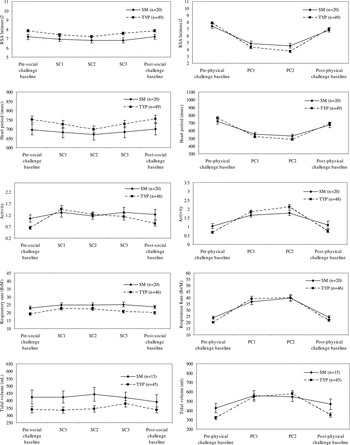
During the presocial challenge baseline, several physiological parameters distinguished between the groups. Specifically, in the SM group, RSA was significantly lower, F (1, 68) = 5.13, p < .03, respiratory rate was significantly higher, F (1, 65) = 7.27, p < .009, and activity was significantly higher, F (1, 67) = 7.36, p < .008. Thus, these findings describe a biobehavioral state that would support mobilization behaviors, which could be interpreted as symptoms of anxiety. A similar profile was observed during the postsocial challenge baseline in which the SM group had lower RSA, F (1, 68) = 5.05, p < .03, and faster respiratory rate, F (1, 64) = 7.14, p < .01.
During the social challenge, activity was the only variable that exhibited a significant Group (SM, TYP) × Condition (pre-SC baseline, SC1, SC2, SC3, post-SC baseline) interaction, F (2.91, 189.35) = 3.26, p < .02. As illustrated in Figure 2, the TYP group had a greater increase in activity at the start of the social challenge, which progressively decreased toward the postsocial challenge baseline. In contrast, the activity levels of the SM group were similar during all phases of the social challenge. In addition, there was a significant condition effect for activity, F (2.91, 189.35) = 9.16, p < .000, RSA, F (3.60, 237.74) = 8.30, p < .00, and for respiratory rate, F (3.80, 239.54) = 9.74, p < .000. These effects illustrate an increase in respiratory rate and decrease in activity and RSA during the social challenge relative to the pre-social challenge baseline.
(Left) Repiratory sinus arrhythmia (RSA), heart period, activity, respiratory rate, and tidal volume for each group during the social challenge protocol. (Right) RSA, heart period, activity, respiratory rate, and tidal volume for each group during the physical exercise challenge protocol.

Physical exercise challenge
During the pre- and postphysical challenge baselines, RSA and heart period did not differ between the groups. However, during the prephysical challenge baseline, the SM group had faster respiratory rate, F (1, 65) = 7.00, p < .01, greater tidal volume, F (1, 59) = 6.33, p < .02, and more activity, F (1, 67) = 6.62, p < .01. During the postphysical challenge baseline, the SM group had greater tidal volume, F (1, 59) = 4.62, p < .04.
As illustrated in Figure 2, significant Group (SM, TYP) × Condition (pre-PC baseline, PC1, PC2, post-PC baseline) interactions were identified for RSA, F (2.03, 127.71) = 6.36, p < .002, and for heart period, F (2.16, 136.06) = 6.01, p < .002. The interaction was characterized by greater reactivity in both RSA and heart period to the physical exercise challenge in the TYP group. The group effect was not significant for either RSA or heart period. Significant condition effects were identified for RSA, F (2.03, 127.71) = 27.19, p < .000, and heart period, F (2.16, 136.06) = 9.54, p < .000.
As illustrated in Figure 2, significant Group (SM, TYP) × Condition (pre-PC baseline, PC1, PC2, post-PC baseline) interactions were identified for activity, F (2.17, 141.04) = 5.45, p < .004, respiratory rate, F (1.74, 109.69) = 5.16, p < .01, and for tidal volume, F (1.83, 104.51) = 4.77, p < .01.Footnote 4 The interactions were characterized by greater reactivity in the TYP group. In addition, there was a significant condition effect for respiration rate, F (1.74, 109.69) = 67.53, p < .000.
Group differences in cardiac reactivity to challenges
Additional analyses were conducted to further delineate the distinguishing features of dampened reactivity to the physical exercise challenge observed in SM. To evaluate group differences in reactivity, change scores were computed for each physiological variable for reactivity to physical exercise challenge (PC 1, prephysical exercise challenge baseline). Because of the statistical dependence between a given change score and its respective baseline, change scores were residualized (via regression analysis). The residualized change scores are used in the following analyses.
One-way ANCOVA evaluated group differences for the residualized change score for each variable (Group [SM, TYP] × Condition [reactivity to PC]). The analyses demonstrated group differences in reactivity to the physical exercise challenge for RSA, F (1, 64) = 6.28, p < .02, heart period, F (1, 64) = 15.25, p < .000, activity, F (1, 65) = 4.71, p < .03 and respiratory rate, F (1, 63) = 8.00, p < .006, with the SM group being less reactive on these variables. There were no significant group differences for tidal volume.
Post hoc analyses
Testing the “sluggish” vagal brake hypothesis
Because, in the above analyses, the physiological responses to physical exercise challenge were dampened in the SM group, we conducted post hoc analyses to determine whether these effects could be conceptualized as a “sluggish” vagal brake. A sluggish vagal brake would be manifested in either the degree of vagal withdrawal during exercise and/or the effectiveness of vagal withdrawal on heart period to support the metabolic demands of exercise. Thus, a sluggish vagal brake might be observed as either less reduction of RSA during physical exercise challenge and/or a dampened decrease heart period when RSA is reduced. Because initial levels of RSA are related to degree of RSA decrease to the physical exercise challenge, each diagnostic group was subdivided into two equal groups based on median RSA during the initial baseline (SM-low, SM-high, TYP-low, TYP-high).
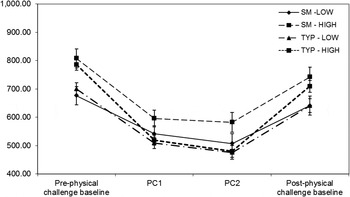
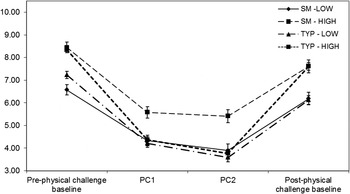
Repeated-measures ANCOVA (Group [SM, TYP] × Condition [pre-PC baseline, PC1, PC2, post-PC baseline]) conducted evaluating RSA and heart period reactivity and recovery for the two high RSA groups (SM-high, TYP-high) support this hypothesis. As illustrated in Figures 3 and 4, for the High RSA groups, there were significant interactions for heart period, F (2.54, 76.19) = 3.78, p < .02, and RSA, F (2.15, 64.38) = 4.91, p < .009. The SM-high group, although having RSA levels similar to the TYP-high group, had attenuated reductions in RSA and a parallel dampened decrease in heart period. In contrast, the groups with low RSA appear to express a similar, but smaller effect. For the low RSA groups (SM-low, TYP-low), there was a significant interaction for heart period, F (2.32, 69.54) = 4.37, p < .01. This interaction illustrates that even the SM-low group had a dampened decrease in heart period in response to the physical exercise challenge. However, although the pattern of diminished depression of RSA is observed in the SM-low group, the effect is not statistically significant.
The estimated marginal means (±1 SE) for heart period, by diagnosis and median split of baseline heart period, during the physical exercise challenge.

The estimated marginal means (±1 SE) for respiratory sinus arrhythmia (RSA), by diagnosis and median split of baseline RSA, during the physical exercise challenge.

Cardiac–somatic coupling
Additional analyses were conducted to determine whether the degree of cardiac–somatic coupling differed between the diagnostic groups. Approximately 40 years ago, Obrist and his colleagues introduced the cardiac-somatic coupling hypothesis (e.g., Obrist, Reference Obrist1968; Obrist, Webb, Sutterer, & Howard, Reference Obrist, Webb, Sutterer and Howard1970) to explain parallel decreases in heart rate (i.e., increases in heart period) and somatic movements during periods of sustained attention. In the current study, the physical exercise challenge condition focuses on the converse of the cardiac consequence of inhibition of movement described by Obrist and investigates coupling during the increased somatic demands of the physical exercise challenge. Cardiac–somatic coupling was evaluated within each diagnostic group by correlating changes in activity and heart period during the physical exercise challenge. Correlations were calculated on the unstandardized residual changes for heart period and activity removing the effect of baseline levels. Because heart period is influenced by age, age was covaried from the correlations. The correlations illustrated a diagnostic group difference in cardiac–somatic coupling. Only in the TYP group were the increases in motor activity correlated with decreases in heart period (r = −.40, p = .007). Thus, these findings demonstrate three features of the SM group during physical exercise that are consistent with the sluggish vagal brake hypothesis: (a) reduced vagal withdrawal measured by changes in RSA, (b) reduced decrease in heart period, and (c) a decreased coupling between increases in activity and decreases in heart period.
Discussion
The experimental procedures identified two autonomic response differences between the SM group and typically developing children. First, in response to mild exercise, the SM group expressed a dampened biobehavioral response consistent with the “sluggish” vagal brake hypothesis. The features of this sluggish brake were expressed during the physical exercise challenge as reduced withdrawal of cardiac vagal tone (i.e., RSA) and a dampened increase in heart rate (e.g., shorter heart period). Because individuals in the SM group had a sluggish vagal brake, and were unable to react to the physical exercise challenge in a similar manner as those individuals without SM, the results from this condition indicate a more universal difficulty in the dynamic autonomic adjustments required to move between states requiring mobilization and those requiring social engagement behaviors. Although there may have been a social component to the physical exercise challenge, given that the participant was relatively unfamiliar with the researcher who guided the physical exercise challenge, the larger effect of physical exercise on autonomic activity likely superceded the social, cognitive, and/or emotional effect of having an unfamiliar person in the room.
Second, although the groups had similar RSA at the start of the experiment (i.e., initial baseline), as the experiment progressed, there were group differences during the pre- and postsocial challenge baselines. This effect was characterized by lower RSA in the SM group, a finding consistent with the clinical assumption that anxiogenic stimulation, such as an unfamiliar social situation for a SM child, would trigger a shift in physiological state consistent with mobilization (i.e., decreasing RSA).
The results suggest that during the exercise protocol, individuals with SM may have difficulties in efficiently shifting neurophysiological state to support mobilization. The inability to shift state can not be attributed to a “ceiling effect,” because individuals with SM were not significantly different from the control group during the exercise related baselines on any of the measures of autonomic state (RSA, heart period, respiratory rate, tidal volume). Instead, the difficulty in shifting state may be dependent on a deficiency in the regulation of the vagal brake (i.e., the sluggish vagal brake hypothesis).
Results supported the sluggish vagal brake hypothesis, as the SM-high group uniquely expressed a dampened withdrawal of the RSA and a diminished decrease in heart period during the physical exercise challenge, relative to the TYP-high. All groups, except the SM-high group, in response to the metabolic demands of exercise, reach a heart period asymptote of approximately 500 ms (i.e., heart rate of 120 beats/min). These groups, except for the SM-high group, all reach a similar level of depressed RSA. Thus, SM participants with high RSA appear to be uniquely expressing a “sluggish” vagal brake withdrawal that is paralleled by a diminished decrease in heart period during physical exercise challenge.
Analyses also provide support for group differences in cardiac–somatic coupling during the physical exercise challenge, as change in heart period was negatively correlated with change in activity in the typical group only. In contrast to the anticipated cardiac–somatic coupling linking changes in RSA to activity that was observed in the typically developing group, this coupling was not observed in the SM group. Consistent with these findings, we previously reported a similar lack of covariation between changes in RSA and activity during a social challenge in young children with subclinical levels of anxiety (Heilman et al., Reference Heilman, Bal, Bazhenova, Sorokin, Perlman and Hanley2008). However, the above study reported a significant relationship between changes in RSA and activity during a similar physical exercise challenge. Thus, the lack of relationship between RSA reactivity and activity during a physical exercise challenge may be unique to individuals with SM.
The physical exercise provided a robust challenge of the autonomic system with minimal confound by social context. Thus, the results from this condition may provide an opportunity to quantify a defining feature of SM as having difficulties in regulating autonomic state. The opportunity to observe these difficulties in other more socially relevant contexts (i.e., social challenge protocol), may be obscured by the wide range of individual differences in reactivity to social challenge due to age, functional severity, anxiety, treatment status, and perceived risk and uncertainty in the testing environment.
In addition, there are several other potential explanations for the unexpected findings that the SM group did not differ in reactivity to or recovery from the social challenge. First, the assumptions related to the diagnosis of selective mutism may have been oversimplified. The current study assumed homogeneity of the diagnosis of selective mutism, when SM may be better characterized dimensionally, rather than categorically. Future studies could include both self-report (when applicable) and parent report of severity of symptoms, as severity of symptoms of SM and related functional impairment may effect degree of physiological response. Second, the assumptions of the effect of the protocol manipulations may have been oversimplified. Including a self-report (when applicable) and parent-report measure of anxiety symptoms and impairment during administration of the protocol would enable researchers to examine the relationship between purported anxiety, behavioral characteristics, and physiological reactivity to the social challenge. Third, additional variables may have mediated or moderated the physiological response. For example, age and other age-related variables that could impact autonomic activity, such as pubertal status and neurohormonal influences, were not considered in the analyses. Because of the low prevalence of SM, the age range for recruitment was widened to generate a sufficient sample size for between-group analyses. Age effects had to be covaried from the physiological analyses, rather than studied within a developmental framework. Future studies with access to larger samples of individuals with SM could examine the relationship between autonomic trajectories and behavioral symptoms with age. Individual difference models which examine duration and severity of symptoms, type, and duration of treatment (including medication), and behavioral strategy (e.g., avoidance, freezing, mobilizing, vocalizing, whispering) within a developmental framework would be useful for developing diagnostic and treatment plans specific to each individual with SM.
Although the study provides the first demonstration of a neurophysiological substrate (i.e., sluggish vagal brake) that would explain why individuals with SM may have difficulties adjusting to new social situations, the study is merely the first step in understanding the neurobiological and biobehavioral features of SM. A sluggish vagal brake may index the ability to rapidly access the neural control of the striated muscles of the face and head, including the muscles involved in vocalization (i.e., laryngeal and pharyngeal) and emotional expressivity. An inability to rapidly or reliably access control of the striated muscles of the social engagement system would result in several of the features observed in SM. Therefore, future studies with this under researched clinical disorder might explore the response features of other aspects of the social engagement system including facial muscle expressivity, prosodic features of voice, and the specific auditory processing dependent on the middle ear muscles in dampening background low frequency sounds to facilitate the extraction of human voice (see Porges & Lewis, Reference Porges, Lewis and Brudzynski2009).