INTRODUCTION
The study of mechanisms that lead to the segregation of resources and facilitation of species coexistence is a fundamental issue in community ecology (Weiher & Keddy Reference WEIHER and KEDDY1999). The three primary mechanisms that facilitate coexistence involve interspecific subdivision of food, space and time (Schoener Reference SCHOENER1974). Specifically, the role of time as a mediator of ecological interactions that shape the structure of ecological communities is poorly understood (Kronfeld-Schor & Dayan Reference KRONFELD-SCHOR and DAYAN2003). Most ecologists have overlooked research on the relevance of temporal activity patterns and their ecological effects on community dynamics (Morgan Reference MORGAN2004), even though theory predicts that resource partitioning among competitors can promote coexistence in ecological communities (Schoener Reference SCHOENER1974). In a temporally partitioned community, each species should be able to obtain exclusive access to space or food, facilitating coexistence and enhancing local richness. Although time as a niche axis has rarely been quantitatively explored in species-rich tropical communities, it has been deemed to be uncommon overall (Schoener Reference SCHOENER, Kikkawa and Anderson1986); however, evidence has accumulated that attaches ecological significance to activity patterns (Kronfeld-Schor & Dayan Reference KRONFELD-SCHOR and DAYAN2003).
Groups of syntopic species within a clade (i.e. assemblages sensu Fauth et al. Reference FAUTH, BERNARDO, CAMARA, RESERARITS, VAN BUSKIRK and MCCOLLUM1996) are the most likely to compete for food and space. They consequently represent an appropriate focus for studying the mechanisms that structure communities. Rodents generally have small home ranges, so it is possible to encounter several species which potentially interact within relatively small areas that can be sampled exhaustively. Indeed, rodent assemblages have been used often to address questions regarding community organization (Bowers & Brown Reference BOWERS and BROWN1982, Dayan & Simberloff Reference DAYAN and SIMBERLOFF1994, Kotler & Brown Reference KOTLER and BROWN1988). Numerous studies have documented food and microhabitat partitioning in rodent assemblages (Dayan & Simberloff Reference DAYAN and SIMBERLOFF1994, Morris Reference MORRIS1987), but studies that deal with temporal partitioning are much fewer (Halle & Stenseth Reference HALLE and STENSETH2000). Most studies of diel activity patterns in rodents have been of a descriptive nature (Eccard et al. Reference ECCARD, MEYER and SUNDELL2004), sometimes including interspecies comparisons (Mal'kova et al. Reference MAL'KOVA, PAL'CHEKH, YAKIMENKO and KUZ'MIN2004, O'Farrell Reference O'FARRELL1974, Vieira & Baumgarten Reference VIEIRA and BAUMGARTEN1995). Notable exceptions include a series of experiments that demonstrated an important role for time in facilitating coexistence of rodent species within deserts (Gutman & Dayan Reference GUTMAN and DAYAN2005, Jones et al. Reference JONES, MANDELIK and DAYAN2001, Kotler et al. Reference KOTLER, BROWN and SUBACH1993) or within grasslands (Cameron et al. Reference CAMERON, KINCAID and CARNES1979, Glass & Slade Reference GLASS and SLADE1980, Prochaska & Slade Reference PROCHASKA and SLADE1981). These comprehensive studies provide insight into the mechanisms that promote temporal segregation of activity, but their findings cannot be extrapolated to species-rich assemblages or to questions involving assemblage-wide patterns. Experimental approaches can address pairwise interactions but do not fully address assemblage-wide patterns of temporal overlap. In natural assemblages all species potentially vie for resources, thus creating simultaneous interactions that need to be addressed concurrently. The use of an explicit hypothesis to evaluate patterns in the absence of a mechanism represents an advance over traditional statistical tools and one capable of detecting assemblage-wide patterns (Gotelli & Graves Reference GOTELLI and GRAVES1996).
Temporal separation of species activities can occur at several scales. Simulation approaches have shown that coexisting beetle species reduce overlap by using different seasons of the year (Loreau Reference LOREAU1989). Moreover, syntopic species separating into diurnal and nocturnal groups facilitate coexistence in diverse assemblages (Arrington & Winemiller Reference ARRINGTON and WINEMILLER2003). Nonetheless, evidence for interspecific differences in activity patterns in assemblages that are strictly nocturnal or strictly diurnal have never been explored with simulation approaches (but see Presley et al. Reference PRESLEY, WILLIG, CASTRO-ARELLANO and WEAVER2009).
We carried out an interval trapping protocol to gather data on the simultaneous nocturnal activity patterns of rodent species present in a diverse as well as in a species-poor assemblage. Specifically, we hypothesized that (1) temporal activity patterns will be species specific, and (2) a more diverse assemblage will have a higher likelihood of exhibit temporal segregation. Empirical data were subjected to traditional statistical comparisons and a null-model analysis aimed to assess the role of chance in the creation of the empirical activity patterns we detected. We present evidence for non-random temporal partitioning in a diverse subtropical rodent assemblage at the diel scale.
MATERIALS AND METHODS
Study area
El Cielo Biosphere Reserve (ECBR) encompasses 144 500 ha in south-western Tamaulipas, Mexico. The east-facing slopes in the south-east portion of ECBR (23°03′42″N, 99°12′18″W) have a pronounced (200–1800 m) elevational gradient that includes three vegetation zones: Tropical semideciduous forest (TSF), Cloud forest (CF) and Pine–Oak forest (POF). We established two sampling sites, one in TSF and one at CF. At the TSF site (320 m), dominant tree species are Bursera simaruba (L.) Sarg., Brosimum alicastrum Sw., Lysiloma divaricatum (Jacq.) J.F.Macbr., Mirandaceltis monoica (Hemsl.) Sharp, Croton niveus Jacq., Savia sessiliflora (Sw.) Willd., Drypetes lateriflora (Sw.) Krug & Urban, Acalypha schiedeana Schltdl. and Ficus spp. L. (Valiente-Banuet et al. Reference VALIENTE-BANUET, GONZALEZ and PIÑERO1995). Mean annual temperature is 22.8°C and total annual precipitation is 1852 mm (Puig & Bracho Reference PUIG and BRACHO1987). Just 8 km away, the CF site (1320 m) has as dominant canopy species Liquidambar styraciflua L., Quercus sartorii Liebm., Q. germana Cham. & Schlecht., Clethra pringlei S. Wats., Magnolia schiedeana Schlecht., Podocarpus reichei Buch & Grey, Acer skutchii Rehder, Carya ovata (Mill.) K. Koch and Cercis canadensis L. (Puig & Bracho Reference PUIG and BRACHO1987). Mean annual temperature is 13.8°C, and total annual precipitation is 2522 mm (Puig & Bracho Reference PUIG and BRACHO1987).
Experimental design
Because activity patterns of rodents can change between seasons (O'Farrell Reference O'FARRELL1974), we restricted fieldwork to the months of May to August 2001, 2002 and 2003, except at CF where road conditions impeded trapping in 2003. In all years, sampling sites within each forest type included all common habitats. A trapping session was conducted during a 9-d period centred on the new moon, when activity is presumably highest (Paise & Vieira Reference PAISE and VIEIRA2006, Wolfe & Summerlin Reference WOLFE and SUMMERLIN1989). For each session, we established one transect of 150–180 Sherman LFA live traps (7.62 × 8.89 × 22.9 cm) set 7 m apart, and baited with peanut butter, rolled oats and vanilla extract. All traps were set by 19h00, and checked every 2 h until 07h00 (Cameron et al. Reference CAMERON, KINCAID and CARNES1979, Vieira & Baumgarten Reference VIEIRA and BAUMGARTEN1995). Average sunrise and sunset were at 06h28 (05h55–06h51) and 19h50 (19h11–20h26), respectively. Because traps were checked every 2 h, we used trap-intervals as measure of capture effort (Vieira & Baumgarten Reference VIEIRA and BAUMGARTEN1995). Overall, we completed 6850 trap-nights representing 34 250 trap-intervals. Traps were open during the day to detect any diurnal activity, but were not checked until re-baiting in the afternoon. Average daily success rate (percentage of successful traps per night) was greater in the CF (8.12%) than in the TSF (5.96%), with a corresponding higher trapping effort at the TSF (5810 trap-nights that equal 29 050 trap-intervals) compared with the CF (1040 trap-nights that equal 5200 trap-intervals).
Determination of activity patterns by trapping is subject to methodological biases (Halle & Stenseth Reference HALLE and STENSETH2000, Hicks et al. Reference HICKS, MENZEL and LAERM1998). Based on previous studies, we implemented two protocols to reduce such bias. First, every time a transect was checked, traps with captured animals were removed and replaced with new traps to maintain uniform trap effort during each 2-h interval. Second, captured individuals were kept at the field station until the end of the night and released at the site of capture after processing. Ear-marks were used to identify recaptured individuals. For each individual we determined species, sex, age class (juvenile or adult) and mass.
Data analysis
We characterized assemblages using a variety of diversity metrics including species richness (i.e. number of species), Shannon diversity (Pielou Reference PIELOU1975), evenness (Camargo Reference CAMARGO1993) and dominance (Berger & Parker Reference BERGER and PARKER1970). The activity pattern for each species was quantified by the proportions of total captures of that species at each of six night-time intervals. We assumed that all captures were independent (Bruseo & Barry Reference BRUSEO and BARRY1995), regardless of whether it was the first time an individual was captured (i.e. first capture) or it was the capture of a previously recorded individual (i.e. recapture). Because the same individual is only captured once per night, and very rarely on consecutive nights, the assumption of independence between captures of the same individual is reasonable. To further support this approach, for each species we tested for differences in frequency distributions and central tendency of activity between first capture and recapture data with the Kolmogorov–Smirnov two-sample (K–S) tests and the Mann–Whitney (M–W) test, respectively (Sokal & Rohlf Reference SOKAL and ROHLF1995). In addition, whenever we made intraspecific or interspecific comparisons we ran separate tests for first captures and for all captures to assess if using these two data subsets provided different outcomes.
Reduction of available number of individuals during the night due to their removal can potentially be a source of bias. However, in our study the numbers of individuals of any particular species that were captured in the same night was low and represented a small fraction of the total number of individuals detected at each transect in each year. This potential bias is more critical for species with small population sizes but for the species with the smallest sample size (Baiomys taylori) we never captured more than a single individual in any given night. Thus, it is safe to assume that any trapping effects that may create a reduced population size available for later parts of the night were not large enough to affect our results (Vieira & Baumgarten Reference VIEIRA and BAUMGARTEN1995).
Pairwise interspecific differences in activity patterns among species at each site were assessed with the K–S and M–W tests. Also, Pianka (Pianka Reference PIANKA1973) and Czekanowski (Feisinger et al. Reference FEISINGER, SPEARS and POOLE1981) indices provided an estimate of pairwise temporal niche overlaps at each assemblage. For these interspecific comparisons we used all the data for each species independent of sex, year or age. Then, activity patterns within each species are assumed to be homogeneous and an overall representation of the species use of time. To assess the validity of this intraspecific homogeneity of activity we compared males and females, juveniles and adults, and years with the K–S and M–W tests. We performed all statistical analyses with SPSS (SPSS for Windows version 11.0, SPSS Inc., Chicago, IL, USA).
For all analyses significance is considered if P ≤ 0.05. Exact P-values are shown and we did not implement a correction when multiple tests are performed. Use of methods to maintain Type I error rates at a certain α-level for a group of analyses is controversial in ecology (Hurlbert & Lombardi Reference HULRBERT and LOMBARDI2003, Moran Reference MORAN2003). These methods can raise Type II error rates to a point that they could be greater than Type I error rates committed if no correction for multiple tests is done (i.e. they are extremely conservative). In general, corrections for multiple tests are not advised when it comes to the kind of exploratory analyses carried herein (Roback & Askins Reference ROBACK and ASKINS2005).
Null-model simulations
We used Monte Carlo simulations to evaluate assemblage-wide temporal niche overlap at TSF. Analyses had as basis a species (rows) by time interval (columns) matrix that was populated with number of captures (i.e. activity) for each species at each 2-h interval. Amount of temporal overlap at the assemblage level (i.e. among the five common species at TSF) was estimated as the average of all pairwise overlaps calculated with Pianka (Pianka Reference PIANKA1973) and Czekanowski (Feisinger et al. Reference FEISINGER, SPEARS and POOLE1981) indices. Simulation scenarios generated null distributions of overlap against which the empirical index was compared. In each of 1000 iterations, the activity pattern of each species is randomized and the assemblage-level overlap is estimated. Temporal coincidence in activity (i.e. more overlap than expected by chance) is indicated by an unusually large overlap as compared with randomized assemblages. In contrast, temporal segregation (i.e. less overlap than expected by chance) is designated by an uncommonly small overlap as compared with randomized assemblages.
We did randomizations with a new algorithm, termed Rosario, designed specifically for temporal data (Castro-Arellano et al. Reference CASTRO-ARELLANO, PRESLEY, WILLIG, WUNDERLE and SALDANHA2009, Presley et al. Reference PRESLEY, WILLIG, CASTRO-ARELLANO and WEAVER2009). Rosario maintains the empirical structure of the data while creating the simulated scenarios in each iteration. More specifically, it generates a series of alternative activity patterns for each species by advancing the empirical pattern in sequence until modal activity has occupied each of n time intervals that make up the time extent. Each alternative distribution represents the same frequency distribution, but with a different location within the time extent. Additionally, Rosario includes m distributions that are mirror-images of each one of the previously created distributions. In each algorithm iteration a pseudo-assemblage is generated by randomly selecting one of these possibilities from each of the 2n distributions of each of S species. Other alternative models used for niche overlap like randomization algorithm 3 (RA3) and randomization algorithm 4 (RA4) (Winemiller & Pianka Reference WINEMILLER and PIANKA1990) were designed for nominal unordered resources (e.g. categories of prey or microhabitat) and as such are not adequate for time, which is an ordered and sequential form of resource. Both RA3 and RA4 reshuffle the values of each time interval within each species and thus destroy the shape of activity patterns, eliminate empirical temporal autocorrelation, and create large null spaces that include biologically unrealistic activity patterns (Presley et al. Reference PRESLEY, WILLIG, CASTRO-ARELLANO and WEAVER2009). Rosario not only maintains temporal autocorrelation of temporal data but also creates a more biologically meaningful null space and it is less prone to Type I errors. Simulations using Rosario were conducted with the Time Overlap program. This program is freely available at http://hydrodictyon.eeb.uconn.edu/people/willig/Research/activity%20pattern.html. We excluded data for CF from null-model analyses because we only gathered activity data for the two numerically dominant species. The statistical finding that niche overlap in a particular pair of species is lower than expected is difficult to evaluate with the null model we used, because the randomization scenarios are very limited.
RESULTS
Assemblage structure and use of recapture data
Large differences existed in the species composition and diversity of rodent assemblages at TSF and CF. At TSF, 213 individuals from 357 captures represent nine species: Peromyscus pectoralis Osgood (white-ankled mouse), Sigmodon toltecus Saussure (cotton rat), Oryzomys couesi (Alston) (Coues's rice rat), Baiomys taylori Thomas (northern pygmy mouse), Liomys irroratus Gray (Mexican spiny pocket mouse), Oligoryzomys fulvescens Saussure (pygmy rice rat), Reithrodontomys fulvescens Allen (fulvous harvest mouse), Mus musculus Linnaeus (house mouse) and Rattus rattus Linnaeus (roof rat). The last four species were rare (four or less individuals) and excluded from all analyses. At CF, 98 individuals from 127 captures represent three species: Peromyscus ochraventer Baker (El Carrizo deer mouse), Peromyscus levipes Merriam (brush mouse) and Oryzomys chapmani Thomas (Chapman's rice rat). The last species was rare (four captures) and excluded from all analyses. The rodent assemblages we studied differed strongly in compositional and structural characteristics despite their geographic proximity (8 km). The TSF assemblage had more species (S = 9), was more diverse (H′ = 1.31), less even (E = 0.498) and had higher dominance (D = 1.85), compared with the CF assemblage (S = 3, H′ = 0.748, E = 0.624, and D = 1.73).
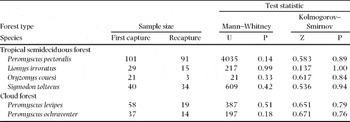
Both the frequency distributions and central tendency of activity between first captures and recaptures were indistinguishable (Table 1), thus supporting the pooling of data of first captures and recaptures for each species. In addition, the outcomes of all intraspecific and interspecific comparisons are the same regardless if all captures or only first captures are used. As such, we only report the results considering all data.
Comparison between first captures and recaptures for common rodent species at two assemblages at El Cielo Biosphere Reserve, Mexico, using the Kolmogorov–Smirnov two-sample test (for differences in frequency distributions of activity) and Mann–Whitney test (for differences of central tendency of activity) between the two data subsets. Baiomys taylori is not included here as data for this species represent first captures only.

Activity patterns and temporal overlap
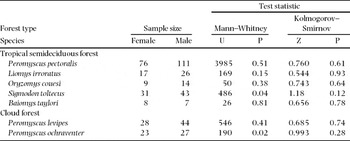
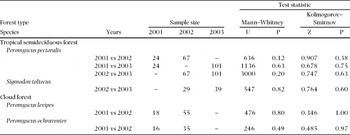
Although traps were open during the day, no daytime captures were recorded. In general, activity patterns were highly consistent across sexes, age classes and years within each species. For most rodent species, regardless of assemblage, the central tendency of activity and frequency distribution of captures did not differ between males and females (Table 2). Only in S. toltecus and P. ochraventer was the central tendency of activity between males and females different. Comparisons of activity among years (Table 3) further demonstrate the consistency of activity patterns within species. Only P. pectoralis, at TSF, had enough captures to compare juvenile (n = 29) and adult (n = 163) activity patterns. In this species, age classes had the same central peak of activity (M–W, U = 2156, P = 0.44) and frequency distribution of captures (K–S, Z = 0.896, P = 0.40). At CF, we did not capture any juveniles for either species of Peromyscus.
Comparisons of male and female activity patterns for common rodent species at two assemblages at El Cielo Biosphere Reserve, Mexico, using the Kolmogorov–Smirnov two-sample test and Mann–Whitney test for differences in frequency distributions of activity and central tendency of activity, respectively. Data used represent all captures.

Interannual comparison of activity patterns in four common rodent species at two assemblages at El Cielo Biosphere Reserve, Mexico, using the Kolmogorov–Smirnov two-sample test and Mann–Whitney test for differences in frequency distributions of activity and central tendency of activity, respectively. Data used represent all captures. Only years with 15 captures or more are included.

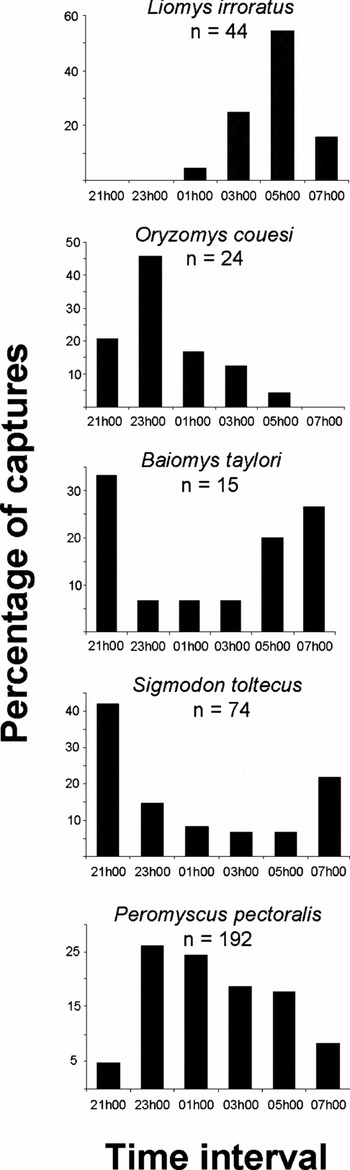
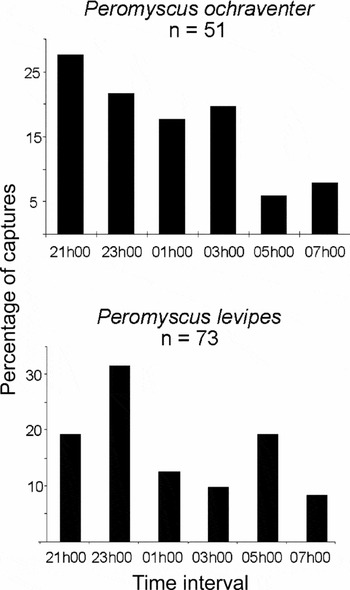
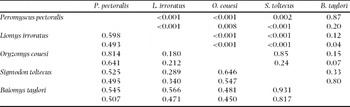
Most species, regardless of site, showed a heterogeneous use of time during the night (Figures 1, 2). At TSF the activity patterns of P. pectoralis and L. irroratus were significantly different from those of all other species, with the exception of B. taylori (Table 4). Moreover, the activity pattern of B. taylori was not different from that of any other species in the community. Within the TSF assemblage the highest pair-wise overlap was between S. toltecus and B. taylori (Table 4); both species evinced a bimodal pattern that suggested a crepuscular habit (Figure 1). In contrast, L. irroratus and O. couesi had the least temporal overlap among all pair-wise comparisons (Table 4), and essentially had opposed patterns (Figure 1). At CF, both species of Peromyscus had indistinguishable activity patterns, with more activity earlier in the night, and gradually decreasing thereafter (Figure 1). Peromyscus ochraventer and P. levipes did not differ in central tendency of activity (M–W, U = 1677, P = 0.34) or in frequency distribution of captures (K–S, Z = 0.824, P = 0.50).
Percentage of activity at each of the 2-h night-time intervals for each of five common rodent species at the Tropical semideciduous forest at El Cielo Biosphere Reserve, Mexico. The percentage of captures is based on all captures during the study and the time intervals denote when traps were checked during the night, thus representing activity during the previous 2 h.

Percentage of activity at each of the 2-h night-time intervals for each of two common rodent species at the Cloud forest at El Cielo Biosphere Reserve, Mexico. The percentage of captures is based in all captures during the study and the time intervals denote when traps were checked during the night, thus representing activity during the previous 2 h.

Pairwise interspecific comparisons of activity patterns in the Tropical semideciduous forest assemblage at El Cielo Biosphere reserve, Mexico. Values above the diagonal correspond to significance of statistical tests (first row correspond to Mann–Whitney test and second row to Kolmogorov–Smirnov test). Values under the diagonal correspond to pairwise observed niche overlaps (first row correspond to Pianka's index and second row to Czekanowski). Sample sizes are: P. pectoralis, 192; L. irroratus, 44; O. couesi, 24; S. toltecus, 74; and B. taylori, 15.

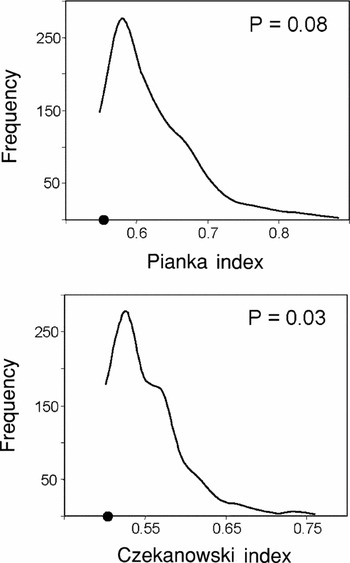
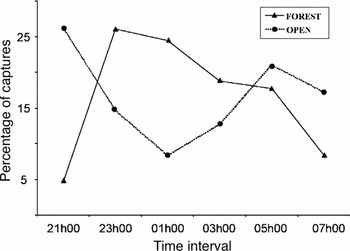
Rodent species at the TSF had an average temporal overlap of 0.558 and 0.497 with Pianka and Czekanowski indices, respectively. Results from simulations using the Pianka index approached significance, whereas for the Czekanowski index, the empirical assemblage-wide overlap was significantly smaller than the expected value in the simulation (Figure 3). In general, species at TSF are temporally segregated during the night. Since at TSF species can be grouped into open-area and closed-forest species (Castro-Arellano Reference CASTRO-ARELLANO2005) we pooled and compared activity patterns of these two groups (Figure 4). These groups had the same central peak of activity (Mann–Whitney test, U = 14734, P = 0.71) but had a different frequency distribution of captures (Kolmogorov–Smirnov two-sample test, Z = 1.99, P = 0.001).
Comparison of empirical values of temporal overlap, measured with Pianka and Czekanowski indices, against the probability distribution frequencies of temporal overlap in the pseudo-assemblages generated by the Rosario randomization algorithm. Closed circles (●) indicate empirical overlap of the rodent assemblage at the Tropical semideciduous forest in El Cielo Biosphere Reserve, Mexico. P values correspond to the probability of finding, by chance alone, an equal or smaller niche overlap than the empirical value.

Comparison of pooled activities of four species that use open/ecotone habitats against activity in the single species that uses closed-forest habitat (Peromyscus pectoralis) at the Tropical semideciduous forest in El Cielo Biosphere Reserve, Mexico.

DISCUSSION
Few studies document (Paise & Vieira Reference PAISE and VIEIRA2006) or compare (Vieira & Baumgarten Reference VIEIRA and BAUMGARTEN1995) diel activity patterns among tropical rodents. Thus, differences between species and the extent to which temporal overlap changes among assemblages remain poorly understood. At ECBR, activity patterns of each rodent species did not differ between years, sexes or age classes. This intraspecific consistency in activity patterns provided the opportunity to contrast them at the assemblage level without having additional noise created by intraspecific variation. Most species used the night heterogeneously and exhibited distinct peaks of activity. Temporal niche segregation may not be equally important for all rodent assemblages. At CF temporal partitioning was absent but at TSF rodent species have an unusually low temporal overlap. The rodent assemblages we studied differed strongly in compositional and structural characteristics despite their geographical proximity. Given these differences, it becomes relevant to question what mechanistic processes might select for temporal niche partitioning. As richness increases, temporal niche partitioning should have a higher likelihood of being important for species coexistence (Kronfeld-Schor & Dayan Reference KRONFELD-SCHOR and DAYAN2003). Nonetheless, our results should not be interpreted as an indirect estimation of competition because other phenomena such as predator-induced segregation (Carothers & Jaksic Reference CAROTHERS and JAKSIC1984), and historical (phylogenetic) factors (Roll et al. Reference ROLL, DAYAN and KRONFELD-SCHOR2006) may be in operation. In addition, all these mechanistic processes are not mutually exclusive.
Insights into possible mechanistic causes for temporal segregation, or lack of it, can be derived from the natural history of interacting species. The rodent assemblage at TSF occurs along a habitat gradient, and although a high degree of overlap existed between species, P. pectoralis preferred closed-forest zones whereas the other species mostly used ecotonal or open areas (Castro-Arellano Reference CASTRO-ARELLANO2005). Contrasting activity at each microhabitat reveals a pattern in which open-area species avoided activity in the middle of the night, whereas the single closed-forest species showed an activity peak during this time (Figure 4). Ecotonal or open-area species might have a predator-mediated constraint associated with use of time (Fraser et al. Reference FRASER, GILLIAM, AKKARA, ALBANESE and SNIDER2004, Kotler et al. Reference KOTLER, BROWN, DALL, GRESSER, GANEY and BOUSKILA2002, Presley et al. Reference PRESLEY, WILLIG, CASTRO-ARELLANO and WEAVER2009). Several species of owl (ferruginous pygmy-owl, Glaucidium brasilianum, Tamaulipas pygmy-owl, Glaucidium sanchezi, and the mottled owl, Ciccaba virgata) occur in TSF (Arvin Reference ARVIN2001), and these are most likely nocturnal predators of rodents. Predation may present a higher risk in open areas during certain intervals, and activity during those times may be avoided by species using these areas (Jacob & Brown Reference JACOB and BROWN2000, Presley et al. Reference PRESLEY, WILLIG, CASTRO-ARELLANO and WEAVER2009). Competition for ‘enemy-free space’ (Jeffries & Lawton Reference JEFFRIES and LAWTON1984) could have a strong effect on the temporal niche partitioning of this assemblage.
Evolutionary constraints of activity patterns and assemblage-level implications
Phylogenetic constraints of activity patterns in each TSF species might provide an explanation for the division of activity patterns between microhabitats (Roll et al. Reference ROLL, DAYAN and KRONFELD-SCHOR2006). Baiomys taylori and S. hispidus, a sister taxon to S. toltecus, have been reported as crepuscular (Ceballos & Oliva Reference CEBALLOS and OLIVA2005). Furthermore, S. hispidus did not change its activity pattern after a presumed competitor was removed experimentally (Cameron et al. Reference CAMERON, KINCAID and CARNES1979). Perhaps rodents with preferences for open microhabitats, like Sigmodon and Baiomys species, have evolved time-use strategies that now represent evolutionary constraints (Kronfeld-Schor et al. Reference KRONFELD-SCHOR, DAYAN, ELVERT, HAIM, ZISAPEL and HELDMAIER2001, Roll et al. Reference ROLL, DAYAN and KRONFELD-SCHOR2006). Determining whether similarities in activity patterns are associated significantly with phylogenetic distances could provide insight into this hypothesis.
Evolutionary constraints limit the ability of rodents to segregate over a 24-h diel cycle (Roll et al. Reference ROLL, DAYAN and KRONFELD-SCHOR2006), suggesting that temporal partitioning should be uncommon among closely related rodent competitors (Kronfeld-Schor et al. Reference KRONFELD-SCHOR, DAYAN, ELVERT, HAIM, ZISAPEL and HELDMAIER2001). Niche conservatism, the tendency for closely related species to be ecologically similar (Webb et al. Reference WEBB, ACKERLY, MCPEEK and DONOGHUE2002), suggests that closely related taxa should have similar time-use strategies. This is reflected in our data, where very similar activity patterns occurred among the three species of Peromyscus. Whether temporal partitioning is created by inclusion of species whose activity budgets ‘fit’ the assemblage or by species showing some plasticity in their activity to facilitate coexistence is largely unknown. Answering this question within a phylogenetic framework would provide deep insight into assemblage structure and species coexistence (Webb et al. Reference WEBB, ACKERLY, MCPEEK and DONOGHUE2002).
Energetic constraints and niche complementarity
Body masses and microhabitat use provides additional insight into patterns of activity in syntopic species at ECBR. At the TSF assemblage, L. irroratus and O. couesi did not differ in microhabitat use (Castro-Arellano Reference CASTRO-ARELLANO2005) and had the lowest temporal overlap, thus suggesting niche complementarity. Unfortunately, little is known about their activity patterns in other assemblages, so we cannot make broader inferences. A theoretical analysis of fitness differences between activity and inactivity costs, suggests optimum time for activity onset in small mammals is immediately after dusk (Daan & Aschoff Reference DAAN, ASCHOFF, Aschoff, Daan and Gross1982). In this scenario, a species like L. irroratus that forages later in the night, would incur higher fitness costs than would one with earlier activity, like O. couesi. Temporal partitioning would be a viable mechanism for reducing competition if the shared limiting resources are renewed within the time involved in the partition (Kronfeld-Schor & Dayan Reference KRONFELD-SCHOR and DAYAN2003). But as models suggests that strong resource depletion must occur before it is optimal to end foraging in the same patch as competitors (Schoener Reference SCHOENER1974) interference competition must be more prevalent than resource competition in driving temporal separation (Carothers & Jaksic Reference CAROTHERS and JAKSIC1984). Indeed, competitively induced shifts in activity patterns have been demonstrated experimentally for some small mammals, where one species is relegated to a less favourable activity time by a more dominant species (Ziv et al. Reference ZIV, ABRAMSKY, KOTLER and SUBACH1993). In these examples, competing small-mammal pairs are congeners, whereas in this study L. irroratus and O. couesi represent different families. Closely related species should show some similar constraints in resource use, but this is not necessarily the case for phylogenetically separated species. Two hypotheses can explain the extreme temporal niche separation in this pair of species: (1) convergent use of a locally abundant resource coupled with aggressive interference competition (Ovadia & Dohna Reference OVADIA and DOHNA2003), or (2) competition for enemy-free space as a consequence of a shared predator(s) (Jeffries & Lawton Reference JEFFRIES and LAWTON1984).
Species with similar body masses experience similar energetic constraints, and body mass distributions in some rodent assemblages do not follow random patterns; this suggests that competitive exclusion of similar-sized species influences assembly rules (Bowers & Brown Reference BOWERS and BROWN1982). As such, similarly sized syntopic species should partition resources along other niche axes such as time. This hypothesis provides a plausible explanation for the separation of L. irroratus and O. couesi, as they are of comparable size (body mass ratio of 1.1). Moreover, the largest overlap in activity pattern (S. toltecus and B. taylori) corresponds to the largest difference in size (body mass ratio of 8.24). Finally, both species of Peromyscus at CF showed no activity pattern differences and overlapped greatly in habitat use (Castro-Arellano Reference CASTRO-ARELLANO2005), but were different in size (body mass ratio of 1.5). Similarly, a hyper-diverse assemblage of dung-carrion beetles in French Guiana showed a similar pattern of complementarity between body size and activity. Multivariate analyses of the beetle assemblage suggest that the combination of temporal differentiation, along with the separation in another niche axis (i.e. body size) facilitates the coexistence of species (Feer & Pincebourde Reference FEER and PINCEBOURDE2005). A counter-argument to this hypothesis is that similarly sized rodent species might be using different food resources, thus facilitating coexistence. Although specific diet information is not available at present for our study area L. irroratus is mainly a seed hoarder equipped with cheek pouches (Janzen Reference JANZEN1983) and O. couesi is an omnivore that consumes seeds, fruits, grasses and even invertebrates (Ceballos & Oliva Reference CEBALLOS and OLIVA2005), thus supporting the notion that these species are not competing for food and that time partition between this species pair is more likely to be mediated by a predator.
The interplay of competition, predation, microhabitat use and evolution of diel rhythms is not extensively documented for species-rich tropical communities. Ecological understanding would be advanced by comparative study of structurally complex tropical sites using a simulation approach and guided by a phylogenetic framework. The emergence of chronoecology as a subdiscipline may assist in bridging the gap between physiologists and ecologists, with potential for new insights on the role of time in the ecology and evolution of organisms (Halle & Stenseth Reference HALLE and STENSETH2000). Our study is the first to report significant assemblage-wide temporal segregation in a rodent assemblage with more than two interacting species. Logistical and analytical difficulties have prevented most researchers from evaluating temporal discrimination. Recent advances for automated collection of activity data (Rehmeier et al. Reference REHMEIER, KAUFMANN and KAUFMANN2006) and development of null models to test for time overlap (Castro-Arellano et al. Reference CASTRO-ARELLANO, PRESLEY, WILLIG, WUNDERLE and SALDANHA2009) will likely ease the acquisition and analysis of this kind of data, hopefully facilitating widespread evaluation of temporal partitioning in many different assemblages.
ACKNOWLEDGEMENTS
The American Society of Mammalogists, the Chicago Zoological Society and the Caesar Kleberg Chair in Wildlife Ecology endowment provided funding for fieldwork. ICA received a graduate scholarship from Conacyt-Mexico, and salary support from the Center for Environmental Sciences and Engineering at the University of Connecticut. We are indebted to field assistants (C. Madrid, R. Tovar, B. Hernandez, Y. Dominguez, R. Salazar, A. Skeeles, A. King and C. Merkord) who endured harsh conditions and sleep deprivation during interval trapping sessions. R. Rosas-Vega, A. Gardner, D. Wilson, M. Willig, B. Klingbeil and L. Cisneros provided useful comments for the enhancement of the manuscript. We also thank the facilities provided by the Universidad Autonoma de Tamaulipas – Instituto de Ecologia Aplicada. We followed the American Society of Mammalogist guidelines for animal care and use during the course of this study and methodologies were approved by the Texas A&M University Laboratory Animal Care Committee. The Direccion General de Recursos Naturales y Medio Ambiente from Tamaulipas authorized the research at ECBR and the Direccion General de Vida Silvestre provided federal collecting permits.