Children with specific language impairment (SLI) often encounter difficulties with social integration. Their behavior appears more passive, withdrawn, and reticent in social interaction contexts compared with typical peers (Conti-Ramsden & Botting, Reference Conti-Ramsden and Botting2004; Fujiki, Brinton, Morgan, & Hart, Reference Fujiki, Brinton, Morgan and Hart1999; Tallal, Dukette, & Curtis, Reference Tallal, Dukette and Curtis1989). Several investigations support these observations, demonstrating, for instance, that children with SLI are less effective than typically developing age peers to engage in peer interaction and to manage peer conflicts and reconciliations, and further, have more negative representations about peers consequences in conflict situations (Botting & Conti-Ramsden, Reference Botting and Conti-Ramsden2000; Brinton, Fujiki, & Higbee, Reference Brinton, Fujiki and Higbee1998; Brinton, Fujiki, Spencer, & Robinson, Reference Brinton, Fujiki, Spencer and Robinson1997; Horowitz, Westlund, & Ljungberg, Reference Horowitz, Westlund and Ljungberg2007; Liiva & Cleave, Reference Liiva and Cleave2005; Timler, Reference Timler2008). It has been hypothezised that in association with impaired linguistic skills, poor emotional competencies may contribute to problems with communication in children with SLI, which may lead to negative consequences in social interactions and friendship formation (Brinton, Spackman, Fujiki, Ricks, Reference Brinton, Spackman, Fujiki and Ricks2007; Ford & Milosky, Reference Ford and Milosky2003; Fujiki, Spackman, Brinton, & Illig, Reference Fujiki, Spackman, Brinton and Illig2008; Spackman, Fujiki, Brinton, Nelson, & Allen, 2005; Spackman, Fujiki, & Brinton, Reference Spackman, Fujiki and Brinton2006; Timler, Reference Timler2003; Trauner, Ballantyne, Chase, & Tallal, Reference Trauner, Ballantyne, Chase and Tallal1994). For instance, children with SLI encounter more difficulties than their typical peers in understanding social rules of emotion display. They display more emotion confusions when trying to infer others’ emotional feelings in different social situations (Ford & Milosky, Reference Ford and Milosky2003; Spackman et al., 2005, Reference Spackman, Fujiki and Brinton2006). Further, children with SLI show less correct responding in indicating when an emotion may be concealed in particular social situations compared to their peers (Brinton et al., Reference Brinton, Spackman, Fujiki and Ricks2007). However, emotional competencies tested in these studies demand a high level of social cognition. Because little research to date has paid attention to emotion expression understanding in children with SLI, the current study aims to examine further their ability to recognize and label emotions conveyed by facial display. Deficits in perception and understanding of others’ facial emotions are frequently highlighted as an explanation for poor social competence in individuals with various developmental disorders including autism (Boraston, Blakemore, Chilvers & Skuse, Reference Boraston, Blakemore, Chilvers and Skuse2007; Celani, Battacchi, & Arcidiacono, Reference Celani, Battachi and Arcidiacono1999; Lacroix, Guidetti, Rogé, & Reilly, Reference Lacroix, Guidetti, Rogé and Reilly2009), William syndrome (Kasari, Freeman, & Hughes, Reference Kasari, Freeman and Hughes2001; Lacroix et al., Reference Lacroix, Guidetti, Rogé and Reilly2009), learning disabilities (Dimitrovsky, Spector, Levy-Shiff, & Vakil, Reference Dimitrovsky, Spector, Levy-Shiff and Vakil1998; Holder & Kirkpatrick, Reference Holder and Kirkpatrick1991; Nabuzoka & Smith, Reference Nabuzoka and Smith1995), as well as SLI (Spackman et al., 2005; Timler, Reference Timler2003).
LEXICAL AND SEMANTIC DEFICITS IN SLI
The Diagnostic and Statistical Manual of Mental Disorders, Fourth Edition (American Psychiatric Association, 2000), defines SLI as atypical language development that is believed to differ from a simple developmental delay and is not associated with any other sensory, motor, cognitive, neurological, or psychotic disorders. SLI is the umbrella term for various types of syndromes that have been classified in several ways (Conti-Ramsden & Botting, Reference Conti-Ramsden and Botting1999; Korkman & Häkkinnen-Rihu, Reference Korkman and Häkkinnen-Rihu1994; Rapin & Allen Reference Rapin, Allen and Plum1988; Van Weerdenbur, Verhoeven, & Van Balkom, Reference Van Weerdenburg, Verhoeven and Van Balkom2006). Language deficits can either affect receptive or expressive abilities, or both. When both production and understanding are impaired, the related term is mixed receptive/expressive SLI. Numerous studies have examined phonological, morphological, or syntactical problems, and have attempted to formulate models to describe and explain them. Children with SLI also encounter lexical and semantic difficulties, because they show a delayed onset of lexical acquisition and long-term deficits in lexical knowledge compared to age- and gender-matched typically developing children (Leonard, Reference Leonard1998). Deficits concern the storage and organization of lexical information in lexicon, and/or the access to lexical items in lexicon (Brackenbury & Pye, Reference Brackenbury and Pye2005), and manifest themselves through a more limited lexicon (Watkins, Kelly, Harbers, & Hollis, Reference Watkins, Kelly, Harbers and Hollis1995; Watkins, Rice, & Moltz, Reference Watkins, Rice and Moltz1993), word retrieval difficulties (McGregor, Reference McGregor1997; McGregor & Waxman, Reference McGregor and Waxman1998), slow naming (Katz, Curtis, & Tallal, Reference Katz, Curtis and Tallal1992; Lahey & Edwards, Reference Lahey and Edwards1996), and frequent errors in naming objects or actions (Lahey & Edwards, Reference Lahey and Edwards1999; McGregor, Reference McGregor1997).
Underspecified semantic representations have been shown to contribute to word retrieval failure and to frequent naming errors in children with SLI by McGregor and colleagues (McGregor & Apple, Reference McGregor and Apple2002; McGregor, Friedman, Reilly, & Newman, Reference McGregor, Friedman, Reilly and Newman2002; McGregor, Newman, Reilly, & Newman, Reference McGregor, Newman, Reilly and Capone2002). These authors assessed the level of semantic representations in analyzing both drawing and verbal responses, because they tackle common semantic representations. Their results indicated that for both children with SLI and typically developing peers, correct naming was associated with rich semantic representations, whereas naming errors were associated with weak semantic representations.
Thus, the current study examines whether emotion labeling is also affected by atypical semantic representation, and whether this affects one or several emotion concepts. We hypothesize that semantic representations of emotional labels may be underspecified in children with SLI. More specifically, we expect labeling errors to be more frequent for emotions that share similar semantic features, as, for example, the same valence.
FACIAL EMOTION IDENTIFICATION IN LANGUAGE IMPAIRED CHILDREN
A few previous studies have investigated the ability of children with language impairments to identify facial emotional expressions. However, their results appear paradoxical, mainly because the populations studied and the methods used differed. For example, Trauner et al. (Reference Trauner, Ballantyne, Chase and Tallal1994) used a forced-choice paradigm whereby participants were required to choose the appropriate emotion label from happiness, anger, or sadness to identify emotional expressions presented on photographed still faces. Children with SLI from 9 to 13 years old had similar labeling performances compared with age-matched control peers. This result was later confirmed by different research teams in kindergarten children. Ford and Milosky (Reference Ford and Milosky2003) and McCabe and Meller (Reference McCabe and Meller2004) compared the capacity of children with SLI and typical peers to label four emotions (happiness, anger, fear, and sadness) expressed by prototypical facial drawings, or cartoon faces, by asking children to point to the appropriate face corresponding to the given emotional label. Authors observed no significant differences in labeling performances between children with SLI and typical peers. Creusere, Alt, and Plante (Reference Creusere, Alt and Plante2004) compared the ability of children with and without SLI to identify four emotions (happiness, anger, sadness, and surprise) expressed through dynamic faces using a two-forced choice paradigm between two labels. Here again, no significant group differences were found.
However, other studies did not corroborate these results. Dimitrovsky et al. (Reference Dimitrovsky, Spector, Levy-Shiff and Vakil1998) compared labeling accuracy in 9- to 12-year-old children diagnosed with different types of learning disorders (associated with verbal deficit or not), to the performances of matched typical peers. They used a free-labeling task to measure children's ability to identify seven different facial emotional expressions from still faces (happiness, anger, disgust, fear, sadness, surprise, and a neutral expression). Children with verbal deficits were slower and less accurate in identifying facial expressions than typically developing peers. The possibility that the different origins of the learning disabilities account for such differential results can not be excluded here. However, more recently, Spackman and colleagues (Reference Spackman, Fujiki and Brinton2006) revealed parallel results in 5- and 12-year-old language impaired children using a forced-choice task that required less verbal demand. They explored labeling capacities of six emotions (happiness, anger, disgust, fear, sadness, surprise) expressed through still faces, by asking children to point to the appropriate emotion response cards that associated a written label and a figurative drawing. The authors also analyzed which emotions were confused. Children with SLI performed more poorly than typical peers in identifying the emotions of disgust and surprise, and more often misidentified disgust as anger and to a lesser extent surprise as fear.
Although the results of these studies seem contradictory, it must be noted that the difficulty level of the tasks is highly different in the above-mentioned studies. This factor directly influences the capacity of children to perform (Gosselin, Reference Gosselin2005). It is possible that the two- to four-forced choice tasks used in the aforementioned studies made the task too easy for children, thus creating a ceiling effect. Conversely, the six-forced choice task or the free-labeling task among seven emotions requires the use of more elaborative cognitive functions. For instance, in order to label the different emotional expressions freely and accurately, children must have knowledge of each emotional label, be able to have rapidly access to the target label in their lexicon, and use it categorically for only one emotional expression. Thus, although this task is more difficult it removes the risk of a ceiling effect. This is the paradigm we chose to employ in the current study. We also included a priming phase prior to the free-labeling task, in order to ease children's access to the emotional labels in their lexicon and optimize label retrieval. Finally, in the aforementioned studies, authors generally analyzed children's global scores of correct identification responses. To study emotion understanding, we considered that it would be more effective to focus on the way emotional labels were used by the children, taking into account the exclusivity of their use, and the type of emotional confusion mistakes made. As Widen and Russell (Reference Widen and Russel2003, Reference Widen and Russel2008) hypothesized, the study of the nature of these mistakes may inform us about the level of meaning being used by the children to produce labels, and may further highlight the emotion semantic fields that overlap. Thus, the close examination of the accuracy of emotion label use and of the patterns of emotion confusions made in children with SLI compared with controls matched on gender, age, and facial emotional expression perceptual skills, will allow for testing whether some emotion concepts are more difficult to master for children with SLI than for typical control peers. Such an investigation is important for theoretical reasons and for its clinical implications.
CURRENT ISSUES
The aim of the current study is to assess and identify what differentiates children with SLI and typical peers in emotional facial expression free labeling skills. Two main issues were investigated:
1. To compare the extent of emotional productive lexicon of children with SLI and typical peers.
2. To examine how children with SLI and typical peers differ in the accuracy of the emotional labels use in comparing (a) correct identification performance, (b) the use exclusivity of specific emotional labels, and (c) the patterns of emotion confusions.
METHOD
Participants
The participants in this study were 12 children with SLI and 12 typical language-developing children matched on gender, age, and visual perceptual capacities. The group of children with SLI included only one female. Such distribution is in line with medical epidemiologic reports indicating that SLI is mostly represented in males (American Psychiatric Association, 2000). The children were recruited to participate in the study after their parent and the certified speech therapist (for the children with SLI) gave written informed consent.
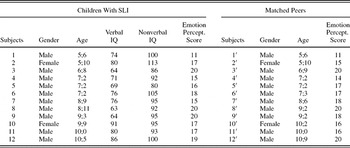
All of the children with SLI were identified by a certified speech therapist as experiencing mixed SLI that affects both receptive as well as expressive skills. They were recruited from a center for language difficulties (Children's Hospital, Purpan, Toulouse, France), where they were diagnosed and were undergoing a speech and language remedial program. The diagnosis of SLI was carried out using standardized tests assessing language understanding and production abilities, after establishing the neurological, motor, cognitive profile. At the time of testing, children with SLI were between 5 years, 6 months (5;6) and 10;5 (mean age = 96.6 months, SD = 20 months; see Table 1). As all children with SLI were involved in a speech and language remedial program, this improved their verbal IQ, reaching 74.5 on average (SD = 8.87, range = 63–91; see Table 1). Thus, the children with SLI who were tested in the present study could understand simple instructions such as those used in the present study.
Individual characteristics of the children with SLI and matched typically developing peers

Note: SLI, specific language impairment. Ages are in years;months.
Typically developing children were between 5;6 and 10;9 (mean age = 97.4 months, SD = 20.9 months; see Table 1) at the time of testing. They were reported to be developing normal language skills by their teacher and parents and no language difficulties were identified during routine pediatrician visits. Children were recruited from several school establishments in the Toulouse city center in France. All the children were from a middle socioeconomic background. Children were matched on one to one basis on three criteria: gender, chronological age, and emotion perceptual skills (Table 1).
Materials
The facial stimuli used in the current study were used from the San Diego Affective Facial Expression (Reilly & Stiles, Reference Reilly and Stiles2006). They were black and white photographs (dimensions = 7 × 10 cm) of facial expressions. Models included six Caucasian adults (four women, two men) who posed while displaying happy, angry, surprised, sad, afraid, and neutral expressive faces. All facial expressions retained were first validated by the Facial Action Coding System (Ekman, Friesen, & Hager, Reference Ekman, Friesen and Hager2002) with a certified coder (J.R.) and then by a panel of 35 adults in a pilot study, with a minimal score of 92% of correct recognition for all facial expressions. Four models (two women, two men) were used in the perceptual matching task, and the remaining women were reserved for the free labeling task. In the perception-matching task, photographs were presented in a digital format (JPEG file) directly on a computer screen, whereas in the labeling task they were presented on laminated cards.
Design and general procedure
The experimenter began the testing session with a familiarization period during which she spent time conversing with the child until he/she became comfortable. Then, the experimenter invited the child to play with a computerized game realized with Presentation software (version 9.9) and introduced it with the following: “We are going to play together.” The testing session included a facial emotion visual matching task (realized in order to match children on the basis of perceptual skills) and the free labeling task of facial emotional expressions.
Emotion perceptual task
A first task was used as a screening test in order to match children with SLI with typical children on the basis of visual percepual skills of facial emotions. This task consisted of an expressive face-matching task. It was presented as a computerized game using three-forced choices. It began with two training trials to ensure that every child understood the matching principle and how to answer correctly. During these trials the experimenter invited the child to look at a picture (either a dog or a smiley drawing) presented on the top of the computer screen. Then three pictures including the target picture presented previously appeared on the bottom of the screen, while the target picture was still visible on the top of the screen. The experimenter invited the child to choose the picture corresponding to the one presented initially. The child responded by pointing to the picture chosen with his/her finger, while the experimenter recorded the response by pressing on the right, middle, or left mouse button.
The formal task began immediately after these training trials. All trials were run according to the three protocol stages: (a) presentation of an expressive face on the top of the screen; (b) presentation of three photographs of different persons demonstrating a facial expression (apart from the person displaying the target expression) on the bottom of the screen. Those faces expressed either the target emotional expression, an emotional distractor, or a neutral one. (c) The experimenter asked the child to look at the target person and to choose the one who feels the same, among the three faces presented at the bottom of the screen. The task comprised 20 trials (4 trials per basic emotion) with the order of initial expression presentation and the side of presentation counterbalanced for expression type, gender, and person posing. The total number of faces presented was also balanced for each person, both for the initial target expression presentation stage, and for the three-forced choice presentation stage. Testing trials were carried out in two blocks separated by a 5-min break, during which the child was invited to play with stickers. The computer program used automatically generated one log file collating the responses given by every child.
A global score of correct matching was calculated by accumulating the number of times the child chose the target face so that the maximal score was 20 points (totaling the number of trials).
Typically developing children were matched on the basis of perceptual skills with the 12 children with SLI so that variations in perceptual skills would not affect results.
Free emotion labeling task
A free labeling task was used to compare production and use of emotional labels in children with SLI and in typically developing children. Contrary to previous tasks, the current task was not computerized. Children's verbal term productions were recorded manually by an experimenter when cards with different affective facial expressions were presented.
Difficulties with word finding has often been observed in children with SLI (e.g., Fried-Oken, Reference Fried-Oken1987; Kail, Hale, Leonard, & Nippold, Reference Kail, Hale, Leonard and Nippold1984; Katz et al., Reference Horowitz, Westlund and Ljungberg1992; Lahey & Edwards, Reference Lahey and Edwards1996; McGregor, Reference McGregor1997; McGregor & Waxman, Reference McGregor and Waxman1998). Accordingly, this free labeling task was preceded by a label priming phase in order to avoid any lexicon access bias, and to balance label accessibility in verbal long-term memory in children with SLI and matched controls. This procedure has been used by Widen and Russell (Reference Widen and Russel2003, Reference Widen and Russel2008) during the investigation of emotional labeling in typically developing children. During the priming phase, conventional labels of the relevant emotions were verbally presented three times to the children by introducing them with a story in which a character experiences the respective emotions. Primed labels were happy, angry, surprised, sad, or afraid (labels were presented in French). The order of term presentation during the prior priming phase was counterbalanced.
The free labeling task was then realized with the following instructions: “We are going to play with cards that show the face of a girl. Then you will have to tell me how the girl on the card is feeling.” A familiarization labeling sequence with three training trials was carried out prior to recording the child's label productions. This training sequence presented the face of a woman with three different expressions, while testing trials were conducted with an unfamiliar face. The order of presentation of the different affective expressions was counterbalanced. Each emotional expression was presented three times so that the total number of trials in the free-labeling task reached 15 trials.
Label production and use analysis
The different labels produced by the children were classified as a function of their emotional meaning. Nonemotional labels (“wicked,” “not beautiful,” or “I don't know”) as well as ubiquitous labels (such as “good” or “bad”) were excluded from the analyses. Only emotional labels were retained. They comprised specific terms referring only to one distinct emotion and nonspecific terms that indicate an emotional valence (such as “unhappy”) or a level of arousal (such as “excited”).
Different types of responsiveness were analyzed and reported in the results. First, the emotional productive lexicon of children with SLI and typical peers was compared through two analyses: (a) a description and a quantification of the different emotional productions, and (b) an estimation of the priming effect on the frequency of primed emotional labels. Second, the accuracy of emotions labeling was compared in children with SLI and typical peers via three different analyses: (a) an assessment of correct emotion identification that was realized by adding the number of times children used a specific emotional label in an appropriate fashion and for each emotional expression tested, (b) a global estimation of the exclusive use of emotional labels produced by adding the number of times specific emotional labels were produced exclusively to identify one particular emotion, and (c) a description and scoring of the different emotional confusions displayed by children.
Statistical analyses
The data analyses focused on a systematic comparison between children with SLI and gender-, age-, and perceptual-matched controls, both qualitatively in terms of emotional labels production and use, and quantitatively in terms of identification abilities. We conducted either parametric, or nonparametric analyses as a function of the type of dependent variable considered, but always considered children's group as a between-subject factor (SLI vs. typical). All statistical analyses were conducted with an alpha error set at p < .05. The level of effect size (ES) was also estimated. To do this we report each analysis of variance (ANOVA) with partial eta squared defined by Cohen (Reference Cohen1988; negligible ES: η2p < 0.15, small ES: 0.15 ≤ η2p < 0.40, medium ES: 0.40 ≤ η2p < 0.75, and large ES: η2p ≥ 0.75). Analyses were conducted using Statistica software (8th version, Statsoft®, Tulsa, OK).
RESULTS
Emotion perceptual skills
Global visual matching scores were high in children with SLI (M = 17.1, SD = 2.6, range = 11–20), as well as in typical children (M = 17.2, SD = 2.8, range = 11–20; see Table 1). A Mann–Whitney U test confirmed that children were accurately matched on the basis of these scores (U = 69, Z = −0.14, p >.05). Thus, SLI and matched typical children both demonstrated appropriate visual and cognitive abilities to perceive and recognize emotional facial display.
Emotional productive lexicon
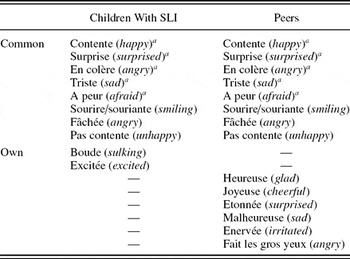
Emotional productions. Specific and nonspecific emotional labels produced (in French) by the children are listed in Table 2. The children, from both SLI and typical groups, produced a total range of 16 different emotional labels. Children with SLI produced 10 different emotional labels, whereas typically developing children produced 14 different emotional labels. A Mann–Whitney U test carried out on this data yielded no significant difference between the two groups total number of different emotional labels (U = 47, Z = −1.41, p > .05). Furthermore, 8 labels were common between the children with SLI and matched typical peers. These labels included the five conventional labels that had been primed in the preliminary phase.
Emotional labels produced in French (English translation) by SLI and typically developing children

aConventional labels previously primed.
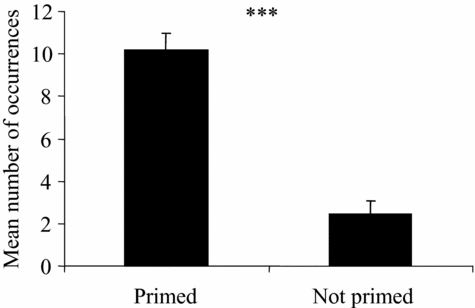
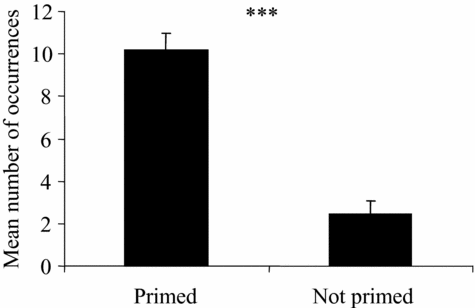
Priming effect on emotional productions frequency. Because the priming phase could have influencedthe children with SLI and their typical counterparts differently in their frequency of emotional label productions, we performed a two-way ANOVA with children's group as the between-subject factor (SLI vs. typical) and priming as the within-subject factor (primed labels vs. not primed labels). The ANOVA only revealed a main effect of priming, F (1, 22) = 38.88, p < .0001, η2p = 0.64, but no interactive effect. As illustrated Figure 1, children from both groups produced labels that had been previously primed five times more frequently (M = 10.17, SD = 0.81) than labels that had not been primed (M = 2.46, SD = 0.61; Figure 1). Thus, previous priming influenced the production frequency of emotional labels similarly in children with SLI and matched controls.
The total number of production occurrences (mean ± standard error) of primed and nonprimed emotional labels in specific language impairment typically developing children. ***p < .0001.
Use accuracy of the emotional labels produced
Correct identification of the different emotional expressions. To compare global labeling performances displayed by the children with SLI and typical peers, we conducted a two-way ANOVA on the scores of correct identification responses, considering children's group as the between-subject factor (SLI vs. typical) and emotional expressions as the within-subject factor (happiness, sadness, surprise, anger, and fear). This analysis yielded no significant differences between children's group, indicating that children with SLI and typical peers displayed similar abilities in correct emotional expression identification when emotional expressions were pooled, as well as when they were considered one by one.
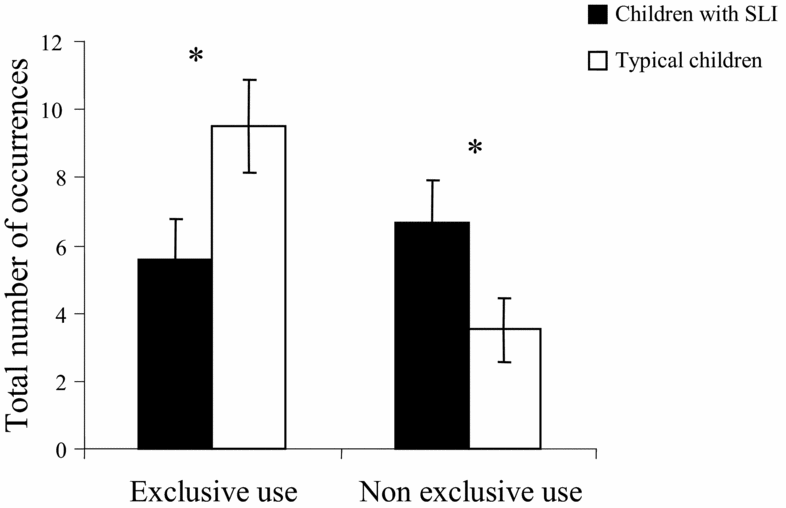
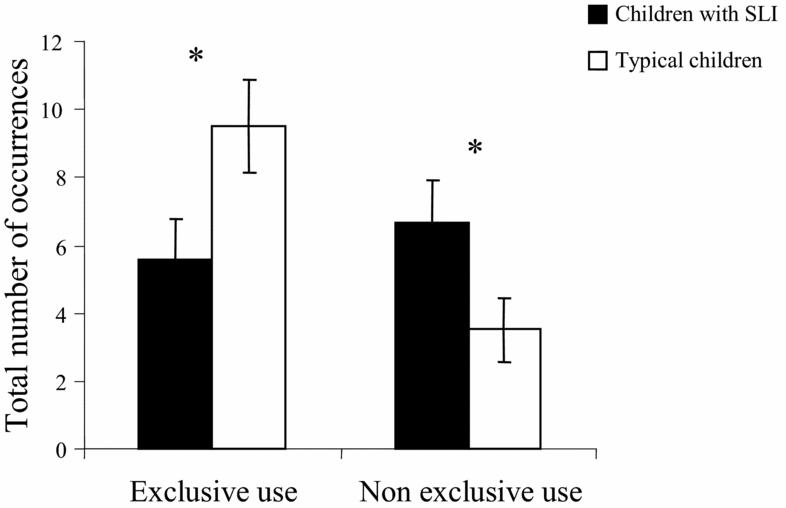
Exclusive use of the emotional labels produced. Next, we wanted to examine whether children with SLI and typical matched peers would differ in their use exclusivity of the specific emotional labels. To do so, we computed a two-way ANOVA on the occurrences of emotional label production, considering children's group as a between-subject factor (SLI vs. typical) and the exclusivity of emotional labels use as a within-subject factor (exclusive vs. nonexclusive use). A significant interaction effect appeared, F (1, 22) = 5.47, p = .029, η2p = 0.20. Post hoc matched samples t tests revealed for showed that typical children used emotional labels more often exclusively for only one emotion (M = 9.5, SD = 1.28), than not exclusively for several emotions (M = 3.5, SD = 1.09), t (11) = 2.88, p = .015; Figure 2. However, children with SLI used emotional labels as often exclusively for one emotion (M = 5.58, SD = 1.28), as not exclusively (M = 6.66, SD = 1.09), t (11) = −0.49, p > .05; Figure 2. Moreover, t tests for independent samples revealed that children with SLI used emotional labels exclusively significantly less often than typical children did, t (11) = −2.16, p = .042. Thus, these results demonstrate that, although they display similar correct emotion identification performances, children with SLI were less accurate than gender-, age-, and perceptual-matched controls, because they used less frequently specific emotional labels in an exclusive fashion.
The total number of occurrences of emotional label use (mean ± standard error) either exclusively for one emotional expression or in a nonexclusive way in children with specific language impairment and typical children. *p ≤ .05.
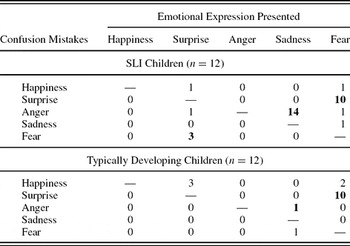
Patterns of emotional confusions. The descriptive matrixes of emotional confusions, illustrated Table 2 and Table 3, show that both SLI and typical groups of children did not display the same patterns of emotional confusion. Different types of nonparametric statistical analyses were performed to verify whether SLI and typical children displayed a significantly different number of emotional confusions.
Matrix of emotional confusions displayed in children

First, a Mac Nemar test revealed that the group of children with SLI produced more emotion confusion mistakes (n = 32) than typical group (n = 17) when considering all emotional expressions (χ2Mac Nemar = 4.0, p = .045). Second, Mann–Whitney U tests were performed to specify which emotional expressions were confused at different rates in SLI and typical groups by comparing each emotional confusion type in pairs. It was found that both groups often confused fear and surprise. Children with SLI and typical peers used fear labels to identify surprise (U = 60, Z = 0.66, p > .05), and surprise labels to identify fear equally often (U = 65.5, Z = −0.34, p > .05). Nevertheless, more precise observations revealed that within the SLI group, fear labels were used to identify surprise faces by two subjects for a total number of three occurrences, but none of the children in the typical group displayed this type of confusion. On the contrary, surprise labels were used to identify fear faces in both groups by four subjects, for a total number of 10 occurrences in each group. Thus, although typical children mislabeled only fear faces, children with SLI mislabel surprise as well as fear expressions.
In addition, children with SLI also displayed frequent confusions of emotion between sadness and anger contrary to matched typical children (U = 33.5, Z = 2.19, p = .02). Contrary to their matched typical children, more than half of the children with SLI mislabeled a sad expression, using terms referring to anger instead of sadness. Within the SLI group, seven participants used anger labels to identify sad faces for a total occurrence of 14 times (Table 3), whereas this type of confusion was made only once in the typically developing group (Table 3). Moreover, it is noticeable that a confusion of the reversed type was never observed either within the SLI group or the typical group. Thus, the close examination of emotional confusions highlights SLI children's deficits in labeling the negative emotional expression of sadness, and the use of anger labels to identify this negative emotional expression. This suggests that the concepts of these two negative emotions are not mastered and overlap in 6- to 10-year-old children with SLI.
DISCUSSION
This study investigated the ability of SLI children to identify facial emotional expressions in a free-labeling task compared with typically developing children matched on gender, chronological age, and facial emotional expression perceptual skills.
First, the results showed that although children with SLI produced fewer emotional label productions than typical children, the difference did not reach significance. This does not corroborate the results of previous studies related to lexical deficits of children with SLI (Brackenbury & Pye, Reference Brackenbury and Pye2005; Watkins et al., Reference Watkins, Rice and Moltz1993, Reference Watkins, Kelly, Harbers and Hollis1995). The difference with these other studies could be explained by the fact that, in the current study, free production of emotional labels was facilitated by the priming phase of expected specific emotional labels. Second, consistent with previous studies, global correct identification of facial emotional expressions appeared similar in children with SLI and matched typical children (Creusere et al., Reference Creusere, Alt and Plante2004; Trauner et al., 1993). However, a closer analysis of label use accuracy and emotional confusions highlighted deficiencies in children with SLI. Compared to matched controls, they used less frequently emotional labels in an exclusive way. Therefore, although children with SLI were able to access different emotional labels in their lexicon and produce them, they used labels less accurately than typically developing peers.
In addition, children with SLI and typical peers did not show the same confusion patterns between emotions. Both groups often confused fear and surprise, whereas children with SLI also frequently confused sadness with anger. These two types of confusions could rely either on perceptual similarities, or on semantic deficits in the acquisition of the underlying emotional concepts, or both. The first confusion between fear and surprise was reported by different research teams in children as well as in adults (Gosselin, Reference Gosselin1995; Gosselin & Kirouac, Reference Gosselin and Kirouac1995; Russell & Bullock, Reference Russell and Bullock1985). Gosselin and Simard (Reference Gosselin and Simard1999) further showed that the distinction between those expressions in children directly depends on the number of facial action units that are distinct in both facial patterns. According to these authors, the confusion between surprise and fear may be due to perceptual similarities between the two patterns. Nevertheless, because SLI children aged 5 to 12 years of age are not known to confuse these two negative emotions more frequently than typically developing children (Spackman et al., 2005), this confusion could be explained by an overlap of the semantic representation between fear and surprise.
Contrary to fear and surprise facial expressions, there are not many common action units between sadness and anger facial patterns. In addition, because the children enrolled in the current study were matched on emotional facial perceptual skills, their perceptual skills were similar. Consequently, we can conclude that the semantic knowledge of anger and sadness emotion concepts is deficient in 6- to 10-year-old SLI children compared with their typically developing peers. That the children with SLI used conventional labels referring to anger in order to identify sadness may be explained by their lacking of words for sadness expression and/or because the semantic category of anger concept is underspecified. The results obtained by Spackman and colleagues support this second suggestion. They found that children with SLI from 5 to 12 years old were more likely to mislabel disgust facial expression as anger than their typical peers, whereas both groups misidentified anger as disgust as frequently (Spackman et al., 2005). Moreover, in another study exploring others’ feelings inference in children with SLI aged from 5 to 12 years of age and typical peers, they reported that the former inferred anger instead of sadness more often than the latter (Spackman et al., Reference Spackman, Fujiki and Brinton2006).
It is notable that the confusion patterns evinced in children with SLI concern emotion categories with the same negative valence, and they are also frequently observed in younger children (Spackman et al., 2005, Reference Spackman, Fujiki, Brinton, Nelson and Allen2006), for example, confusion between sadness and anger, which are recurrent in typically developing kindergartners but disappear by the age of 5 to 6 years when typical children make the distinction between sadness and anger concepts (Durand, Gallay, Seigneuric, Robichon, & Baudouin, Reference Durand, Gallay, Seigneuric, Robichon and Baudouin2007; Gosselin, Reference Gosselin2005; Herba, Landau, Russell, Ecker, & Phillips, Reference Herba, Landau, Russell, Ecker and Phillips2006; Russell & Widen, Reference Russell and Widen2002; Vicari, Reilly, Pasqualetti, Vizzotto, & Caltagirone, Reference Vicari, Reilly, Pasqualetti, Vizzotto and Caltagirone2000; Widen & Russell, Reference Widen and Russel2003, Reference Widen and Russel2008). Widen and Russell (Reference Widen and Russel2003, Reference Widen and Russel2008) described the systematic pattern of emotion label production and confusions in typically developing children in an American sample. They reported that the first emotional labels produced between the age of 2 and 5 years old are “happy,” “angry,” and “sad” and that their underlying semantic categories are initially broad (or underspecified) and then become progressively narrow. For instance, the label “angry” is first produced in order to identify any negative expressions including sadness and is then used increasingly more specifically. Thus, taking into account both the singular confusion pattern of children with SLI from 6 to 10 and the characteristics of the typical way emotional terms are acquired, we can hypothesize that emotion labeling deficiencies evinced in children with SLI may simply correspond to a delay in emotion conceptual development.
This would be in line with Leonard's (Reference Leonard1998) conclusions about linguistic deficiencies observed in children with SLI, which proposes that many of the difficulties with registration, organization of new words in lexicon, and specifying the meaning of a new word, reflect more of a delay in acquisition than the presence of deviant processes.
IMPLICATIONS FOR CLINICAL ASSESSMENT AND TREATMENT
The results of the present study suggest that emotion labeling confusions revealed in SLI are discrete rather than general, and that these may simply be due to a developmental delay, as such emotional labeling abilities of SLI children could be improved by training programs focusing on semantic enrichment. It has been shown experimentally that word meaning improvement is input dependent in children with SLI as well as in typically developing peers (Conti-Ramsden & Jones, Reference Conti-Ramsden and Jones1997; Rice, Oetting, Marquis, Bode, & Pae, Reference Rice, Oetting, Marquis, Bode and Pae1994). Furthermore, McGregor and Leonard (Reference McGregor and Leonard1989) showed evidence of improvement in naming after SLI children underwent training treatment and learned new semantic information about target words. More recently, Capone and McGregor (Reference Capone and McGregor2004, Reference Capone and McGregor2005) stated that the use of gestures (manual and facial mimics) may be especially relevant to enrich semantic knowledge of children with SLI, because gestures are known to enhance word learning in conveying salient semantic information in typically developing children (Capone & McGregor, Reference Capone and McGregor2005; Guidetti & Nicoladis, Reference Guidetti and Nicoladis2008; Gullberg, De Boot, & Volterra, Reference Gullberg, De Boot and Volterra2008; McNeil, Alibali, & Evans, Reference McNeil, Alibali and Evans2000), and because they involve nonverbal modalities that may be compatible with the relative strengths of children with SLI.
CONCLUSIONS
We suggest that speech and language therapists assess the semantic knowledge of emotion concepts and determine the different types of semantic relationships the children with SLI have developed within and between emotion labels, particularly for emotions with negative valence. Then, treatment tools for semantic knowledge enrichment may be applied to emotion concepts underspecified, in order to improve emotion understanding and thus decrease the level of confusion. However, further research is needed first to examine how emotion labeling develops in typically developing children in the French population, and second, to verify whether children suffering from receptive, expressive, or mixed-language impairment would display different abilities in emotion labeling.
ACKNOWLEDGMENTS
We are grateful to the children and their parents who agreed to participate in the study. We thank the teachers, schoolmasters, and students (MA in psychology, Toulouse 2 University, France) for their help in recruiting children and conducting the experiment. A special thanks to Isabelle Barry and Juliette Elie for their help in collecting data for the children with SLI. This work was supported by a grant from the French National Research Agency (ANR) to the “Emotion” project (Grant 05–4_43763). Finally, the first author thanks Delphine Picard for her constructive advice on earlier drafts, Nathalie Goubet for her suggestions in the final version, and Loveday Newmann for improvement of the English.