In his dissertation of 1980 on Office antiphons in the Old Roman tradition, Edward Nowacki identified a series of Old Roman melodies that use the chant Crucem tuam as a model.Footnote 1 These are: Tres video viros, Inter natos mulierum, Liberabit nos dominus, A viro iniquo, Ante torum huius virginis, Mentem sanctam and Justi autem. In an article from the same year, I suggested that the Old Roman version of Crucem tuam was based on the Palestinian chant Τον σταυρον σου.Footnote 2 In my article, I compared the Byzantine version in Greek manuscripts with versions in Church Slavonic and Latin. The text of this chant unites the idea of the life-giving Cross as a sign of victory with that of the resurrection:
The liturgical celebration of the cross finds its origins in the discovery of the True Cross by Helena in 320 and the dedication of churches on the site of the Holy Sepulchre and Calvary in Jerusalem on 13 and 14 September 325. From Jerusalem, the ritual spread to other Oriental and Occidental Churches.Footnote 3 Rome adopted the Feast of the Exaltation of the Holy Cross in the seventh century. In the eighth century, the Gallican Churches introduced the Feast of the Invention of the Holy Cross on 3 May. In the Greek Church, Tον Σταυρόν σου is associated with two feasts with strong ties to the liturgy of Jerusalem: that is, the feast of the Exaltation of the Cross (14 September) and the feast of the Adoration of the Cross (third Sunday in Lent).Footnote 4 The original setting of the troparium was probably within the ceremonies venerating the Holy Cross on Holy Friday, as practised by the Church of Jerusalem, for it was here during Passion Week that the cult of the Cross was observed with particular fervour.
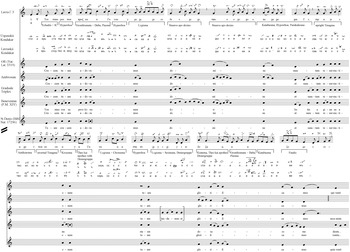
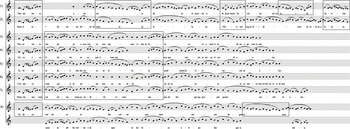
Crucem tuam appears in numerous Latin manuscripts, but, with the exception of the Ambrosian version, they are all distinguished by an additional line of text. Example 1 compares five of these versions with the Greek and Slavonic melodies. From both a text-critical and a musical point of view, the most faithful rendition of the Greek text is preserved in the so-called Old Roman rite (codex Vatican, Biblioteca Apostolica, lat. 5319). Both the Greek and the Latin versions have eleven syllables in the first line. In the second line, the Old Roman version has one extra syllable, and it omits the initial et found in other Latin sources.
Eight versions of Crucem tuam.

In Example 1, four Latin traditions can be distinguished on the basis of the text and melody: an Old Roman, an Ambrosian, a Beneventan and a Gregorian.Footnote 5 The Gregorian version introduces the text reading laudamus et before glorificamus and has et before sanctam.
The Old Roman version has the additional line qui venit salus in universo mundo. The Gregorian version reads, in contrast, ecce enim propter crucem venit gaudium in universo mundo. The bilingual Beneventan version in codex Vatican lat. 10673 in Greek and Latin transmits the Gregorian melody with melismas on the words domine and glorificamus but it omits the text laudamus et and has the additional line venite gentes adoremus Christi resurrectionem (=deute pantes proskynumen tin tu Xristu anastasin). The Tuam crucem from the St Denis antiphonary (Paris, Bibl. nat. lat. 17296) begins as the Gregorian recension on E but omits the laudamus et of the second line. The additional line reads quia venit salus in universo mundo as in the Old Roman text.
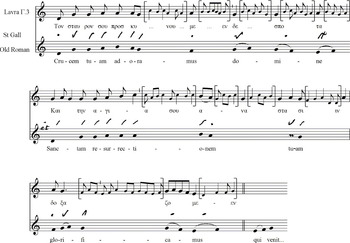
Books from St Gall preserve both the Gregorian and Old Roman versions of Crucem tuam. Bruno Stäblein was of the opinion that the liturgy of St Gall was sung in accordance with the Old Roman chant recension until about 900, when it was replaced by the Gregorian.Footnote 6 In Example 2, the Greek version in the Athos manuscript Lavra Γ. 3 (fol. 58) is compared with the Old Roman versions in Vat. lat. 5319 (fol. 30) and the second version of Crucem tuam in St Gall, codex 339 (pp. 102–103), which has the et of the Greek original. The Gregorian versions in the St Gall manuscripts 339 (p. 102), 378 (p. 319), 380 (p. 335) and 382 (p. 256) retain the et and have the reading laudamus et. In these sources, the Gregorian versions have a combination with a quilismaFootnote 7 on domine while the alternate Old Roman versions have here an episematic flexa (i.e. clivis/clinis).Footnote 8 The episem is a rhythmic sign found in St Gall notation, which indicates a lengthening.
Greek and Old Roman melodies for the chant Crucem tuam.

The two versions also appear in Aquitanian manuscripts. The antiphonary of St Denis, Paris, Bibliothèque nationale, lat. 17296 (twelfth century) contains, among a series of antiphons for 14 September, both the Gregorian Crucem tuam and a Tuam crucem version with the Old Roman text quia venit salus in universo mundo.Footnote 9 The Aquitanian manuscripts Paris, Bibl. nat. lat. 776 and 903 from the first half of the eleventh century has the communion Tuam crucem for the Inventio feast on 3 May. Codex Paris, Bibl. nat. lat. 776 has the same chant in the liturgy for the Exaltatio on 14 September.Footnote 10 Dom René-Jean Hespert records that the ninth-century Compiègne Antiphonary (Paris, Bibl. nat. lat. 17436) has the Old Roman text Crucem tuam adoramus domine et sanctam resurrectionem tuam glorificamus quia venit salus in universo mundo.
According to Thomas Kelly, the Vatican codex lat. 10673, dating from the beginning of the eleventh century, mixes old Beneventan chant with Gregorian rites for Holy Week.Footnote 11 The bilingual chant Ton stauron/Crucem is preserved in three codices in the Biblioteca Capitolare of Benevento, namely Ben. 33, Ben. 35 and Ben. 40, as well as in the codices Lucca, Biblioteca Capitolare Feliniana ms 606, Vaticanus latinus 4770 and Vaticanus Barberininus latinus 560.Footnote 12 In the transliterated text, the original Δέσποτα is replaced with kyrie.Footnote 13 These sources can be divided into two groups based on whether the additional line begins with venite gentes Footnote 14 or venite omnes.Footnote 15
As demonstrated in Example 2, the original Greek melody in the second medial mode is most faithfully preserved in the Old Roman repertoire. In this article, Nowacki's identification of seven other chants in the Old Roman repertoire based on this melody will serve as the basis for an investigation of how the Crucem tuam melody was treated in these seven chants as well as in eight chants based on the Old Roman introit Omnis terra. These chants are then compared with the melodies in the Beneventan gradual Biblioteca Capitolare VI, 34. This codex preserves the Gregorian tradition and serves therefore as an example of both the Gregorian and the late Beneventan repertoire. The melodies isolated by Nowacki are then investigated in tonaries and treatises reflecting the Gregorian tradition.
The author wishes to emphasize that this article investigates the second medial mode in Latin sources. It is concerned neither with imported or local melodic elements in the various sources nor with any lack of thoroughness in introducing the Gregorian reforms.
In the Universale Neumenkunde, Constantin Floros cites Crucem tuam as a paradigm of a melody in the medial second mode.Footnote 16 The echema (intonation formula) of the mesos deuteros is NENANO. Its finalis is E and a is the main reciting tone.Footnote 17 The note a functions as a cadential or repercussion tone, and the prominence of D serves to underline the medial character. Medial modes are mentioned in theoretical sources, but their actual characteristics were unknown until Floros identified a series of Greek chants in the medial second and medial fourth modes in his investigation of the Slavonic kondakarian notation in the years 1961, 1962 and 1963.Footnote 18
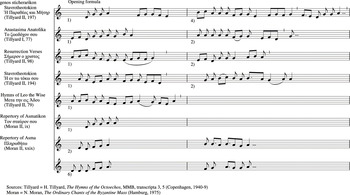
In Example 3, characteristic formulas of the medial second mode have been tabulated. Although the E–F–G–a opening appears frequently in this mode, melodies also occasionally begin and cadence on the repercussion tone a. Many of the formulas in Example 3 might appear in other modes, but they are especially important in defining the mesos deuteros. The formulas are drawn from chants in the syllabic, choral and solo repertoires or, to use the technical term, from the genos sticherarikon, the repertory of the asmatikon, and the repertory of the Asma.
Characteristic formulas of the medial second mode.

Of the melodies in Example 1, the Greek and Slavonic versions are already removed by several centuries from the simple syllabic chant preserved in the Latin tradition. The Eastern sources are written in differing stages of notation (i.e. Middle Byzantine and an early form of Byzantine notation known as kondakarian), but both retain the melody as sung in the melismatic choral repertory of the asmatikon. The Latin sources, in contrast, retain the more syllabic tradition of the genos sticherarikon.Footnote 19
One characteristic feature of the medial second which speaks for the reliance of the Old Roman version on the Greek prototype is the accentuation of both crucem and sanctam by an ascending fourth (D–G). In the Slavonic versions of Krestu tvoemu, this beginning is indicated by the echadin. The name of this figure is derived from ‘echos’ and is illustrated in Table XXXV.3 in the study by Floros on kondakarian notation. The Ambrosian version ameliorates the D opening by passing notes; the remaining three Latin chants set the beginning on E.Footnote 20
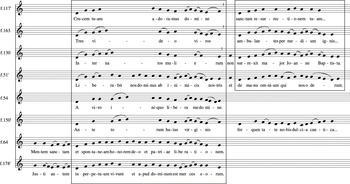
The list prepared by Edward Nowacki allows us to add another dimension to this ancient chant in the medial second mode. In Example 4, the first phrase of this group has been collated. All the examples include the typical D–G medial formula at the beginning of the melody. Mentem sanctam and Justi autem precede this formula with a descending initium (G EF EF D). Nowacki states that these typical ‘Type E.4’ melodies begin with a leap from D to G, followed by a further ascent to B, embellished pitch-repetition on A, and an embellished descent to E.
Antiphons of the Old Roman rite in the medial second mode (codex I-Rvat S Pietro B.79).

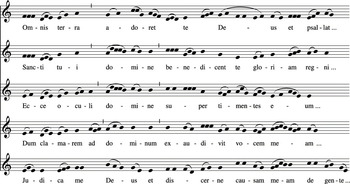
The introit antiphon Omnis terra from the Old Roman gradual also falls without difficulty into the pattern established for the second medial mode in the Greek sources and in Crucem tuam.Footnote 21 Since the melodies of the gradual generally retain a rather ornamented structure, this chant provides a better means of comparison with the Eastern examples of the mesos deuteros than the syllabic texture of Crucem tuam. In Example 5, the Old Roman version of Omnis terra has been compared with seven other introits with the same basic melody: Sancti tui, Protexisti me, Ecce oculi, Jubilate deo, Clamaverunt iusti, Dum clamarem and Iudica me deus. All commence with a characteristic medial second opening, which includes the leap D–G. This is followed by a figure emphasising the note a. One formula in several of the versions involves a descent from c or a to D or C, which is brought to a conclusion by a leap to F–G–a.
The Old Roman Omnis terra (1) and seven other introits compared.

One remarkable structural feature of the chants is the prominence of the two conjunct tetrachords D–G/G–c at the opening of all the chants except Omnis terra. Omnis terra uses leaps of D–G/G–c, however, at the beginning of the second half of the melody. In the introit Clamaverunt, the two conjunct tetrachords are clearly outlined at the end of the chant at the alleluia (Example 6).
From Clamaverunt, Vat. lat. 5319, fol. 104.

The eight Old Roman introits in Example 5 can be classified into three different groups. The most archaic structure is shown by Omnis terra and Sancti tui domine. Like Crucem tuam, they manifest a simple binary form. The second group consists of Protexisti me, Ecce oculi, Jubilate Deo, Clamaverunt justi and Dum clamarem. All these chants follow the opening figure with a longer section containing figures encircling the tone a. The chant Judica me seems to be exploring the relationship between the conjunct tetrachords in both ascending and descending motion. The cadential formulas are more conventional.
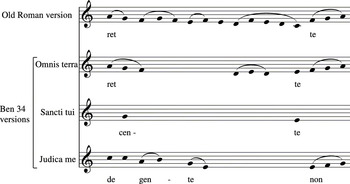
Of the eight Old Roman antiphons in the medial second mode, five are transmitted in the Beneventan Gradual, Biblioteca Capitolare VI.34 from the twelfth century.Footnote 22 This is a late Beneventan source that Thomas Kelly considers to be the latest of the five surviving graduals from Benevento. He states that it contains very few original Beneventan chants and therefore serves as an example of both the late Beneventan and the Gregorian repertoire. The initial formulas of Omnis terra, Sancti tui domine, Ecce oculi, Dum clamarem and Judica me are compared in Example 7.
The initial formulas of Omnis terra, Sancti tui, Ecce oculi, Dum clamarem and Judica me in the Beneventan codex Ben. 34.

In the Old Roman repertory, all the medial chants begin with the same figure. The Beneventan/Gregorian versions in codex Ben. 34 lack this uniformity, even if an outline of the initial figure is retained. The figures are placed more solidly within the range of the standard E modes, and in the case of Judica me, the complete melody is transformed into a second authentic mode chant. The chants Ecce oculi and Sancti tui in the Old Roman versions are distinguished by a subtle overlap between the initial words and the following invocation domine. In the Beneventan/Gregorian versions of codex Ben. 34, the text takes precedence and the melody is adapted to the words. The unhurried lingering about the medial repercussion tone a is frequently replaced by more stereotyped cadences.
Another characteristic medial formula is the stepwise descent from a to D (or C) followed by a leap to F–G–a. In Example 8, versions of this formula in codex Ben. 34 are presented. Only the version of Omnis terra resembles the medial formula, but the introduction of E before the F–G–a progression destroys the medial flavouring. Sancti tui eliminates the medial formula completely, and Judica me transposes the progession into a regular E mode formula.
The medial formula of the medial second mode in the Old Roman repertoire compared with the versions of Ben 34 of Omnis terra, Sancti tui, and Judica me.

Finally, the conjunct tetrachords remain to be investigated. Only a hint of this subtle feature of the Old Roman repertory is recaptured in most of the melodies of codex Ben. 34. Ecce oculi and Dum clamarem preserve the D–G leap of the initial formula (see Example 7), but both begin the formula firmly on E rather than, as in the Old Roman versions, on F. The second tetrachord, G–c, is outlined in Omnis terra and in Dum clamarem. Sancti tui and Ecce oculi transpose the tetrachord to a–d and thus replace the medial figure with a standard figure of the second plagal mode.Footnote 23
On the basis of an analysis of these tone formulas and figures, a number of chants in the Old Roman books could be assigned to the second medial mode. It remains to be seen how these same chants were treated in ‘Gregorian’ treatises and tonaries.
Five of the group of Old Roman antiphons cited by Nowacki appear in the Metz tonary.Footnote 24 They are relegated to either the authentic or plagal second mode within the standard eight-mode system:
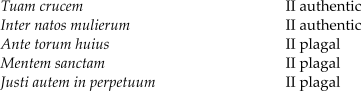
It is striking that Tuam crucem is listed rather than the Gregorian version Crucem tuam. This version is also found in manuscripts of St Gall and St Denis. This would lead one to suppose that Tuam crucem represents the original wording of the translation from the Greek. The text tuam crucem might have seemed to correspond to the accentuation of the rising fourth in the Old Roman setting. The D–G opening fits the wording Ton stavron perfectly but the strong accent on the syllable cru- upsets the balance. It is notable that the conservative Ambrosian rite retains the beginning on D. The word order and the beginning on E can probably be attributed to the influence of the Gregorian reform.
Eight melodies based on that of Omnis terra in the mesos second mode are presented in Example 4. To these can be added the chants Vocem iucunditatis and Sacerdotes tui mentioned in the study of the Old Roman introits by Thomas Connolly, although the versions in Vat. lat. 5319 differ slightly from the model.Footnote 25 Below are their modal designations in the Metz tonary, in the treatise Alia musica published by Jacques Chailley and in Les tonaires: inventaire, analyse, comparaison of Michel Huglo.Footnote 26 Seven of the chants are in either the second authentic or the second plagal mode. Huglo has already drawn attention to the hesitation in the sources between the authentic and plagal versions of the second mode of the chants Sancti tui, Ecce oculi and Dum clamarem.Footnote 27 It seems reasonable to assume that this variation can be attributed to the medial nature of these chants.

Three of the chants fall completely out of this pattern: Protexisti me (IV), Jubilate deo (IV plagal) and Clamaverunt iusti (I plagal). An examination of the musical sources, both Beneventan and Frankish, reveals that these three chants possess melodies that differ completely from those of the Old Roman sources. It may be that these chants did not belong to the original Old Roman repertory that was first brought across the Alps.Footnote 28 This comparison has, in any case, not confirmed the statement by Robert Snow that ‘the introits of the Old-Roman tradition, 149 in number, are identical in form with the Gregorian’.Footnote 29
As documented by Floros, Byzantine treatises list four medial modes (mesoi) in addition to the oktoechos and he concluded that ‘the modal system of the Middle Ages originally consisted of twelve modes’.Footnote 30 In Middle Latin treatises, the additional modes are designed as the moesi, parapteres, paracteres, circumaequales, medii and mesi. The author of the so-called Anonymous Vatican treatise in codex Vat. lat. 235 ‘speaks of the four authentic (autenti), the four plagal (plagi) and four medials, which he designates with the Greek term moesi’.Footnote 31 The treatise in codex Leipzig Rep. I 93 of the tenth century cites Crucem tuam as an example of a chant in the ‘medius (parapter) secundus’.
In a study of Latin treatises which refer to the extra tones, Charles Atkinson concluded, in contrast, ‘that medial signatures or other modulatory signs are not found in Western manuscripts, however, is rather telling evidence against an immediate translation of Byzantine practice’ and ‘the likelihood that the Western practice was taken over from the East seems a bit remote’.Footnote 32 The expression parapter is undoubtedly Greek (meaning side wing), but since it does not appear in Greek musical sources, he suggests that ‘the term parapter originated in the West’.Footnote 33 Atkinson admits that ‘the picture of the parapteres presented by the sources discussed so far is by no means a completely clear and unified one’ and he is well aware of the many discrepancies in the classification of chants in medial modes in Latin sources.
Atkinson seeks support for the view that the medial modes originated in the West in the legend that Charlemagne added four extra tones to the normal eight.Footnote 34 Aurelian states that the medial intonation formulas are ananno, noëane, nonannoëane and noëane. De modis musicis has the most thorough discussion of the medial modes among the sources, yet of the four antiphons listed as belonging to the second parapter (Quia mirabilia, Sede a dextris meis, Speret Israel and Omnis terra) only the last exhibits the melodic formula isolated by Nowacki.Footnote 35De modis musicis lists the medial intonation formulas Nenotenarsis, Anos, Anagetanenagis and Aianneagies.Footnote 36
In his Universale Neumenkunde, Floros reproduces the echemata from Leipzig, Rep. I 93 (German neumes) and Paris, Bibl. nat. lat. 118 (Aquitanian neumes).Footnote 37 Aurelian says outright that his discussion of the modes was based on a Greek source (sciat a Graecorum derivari fonte).Footnote 38 Floros comes to the conclusion that most of the echemata in Frankish sources appear to be corrupted versions of known Byzantine intonation formulas.Footnote 39 If Charlemagne did indeed have anything to do with the extra modes, Floros suggests that he may have sanctioned an already existing practice. The present study of Crucem tuam makes it more likely that Charlemagne simply called for the reintroduction of medial shadings that had been eliminated in the sanitised recension received from Rome.
Commenting on Atkinson's theory, Floros writes ‘the term parapter appears to be a newly invented Western form (as an analogy to πλάγιος/plagalis) which reflected a graecistic tendency’ in Carolingian Latin. He added: ‘this does not say very much … one does not have to be a believer in a Byzantine origin for the modes to recognise that there is a close connection between modi mesi and the Byzantine expression Echoi mesoi.’Footnote 40
On the basis of our survey, certain deductions about medieval modality and about the transmission of melodies in the early medieval period can be advanced. Using as an example a chant that was certainly in existence by the seventh century, it could be shown that the medial kernel of the chant remained preserved in the Greek, Slavonic and Old Roman repertories despite melodic variations or transfers from a syllabic to a melismatic idiom. The medial flavour was diluted or even disappeared, however, when the chant was introduced into the late Beneventan and Frankish rites. To judge by the various transformations of the opening formula of the group based on Omnis terra in the codex Ben. 34, it is to be questioned whether the singers of these melodies were fully aware that they were in a medial mode. The subtler features of the second medial mode, such as the conjunct tetrachords, seem to have been recognised in the chant Omnis terra. In most cases, however, the tonal figures or formulas that gave rise to the medial colouring were consciously or unconsciously transferred into the idiom of the traditional second modes.
Within a wider frame of reference, the nature of the relationship between Greek and Latin models raises a number of questions. In particular, claims that the system of the church modes was developed in the Frankish empire have been undermined. Helmut Hucke has written ‘that the Roman version of Gregorian chant originally did not involve the system of eight church modes, and that the system of church modes was adopted only late and gradually into the Roman version from its Frankish counterpart’.Footnote 41 The system of church modes, he writes, ‘was developed in the Frankish Empire’. Terence Bailey spoke of the ‘complete absence in Byzantine sources of any reference to extra modes’.Footnote 42 These hypotheses are not supported by the evidence presented here.
Some Gregorian scholars view notation and modality as developing in the Frankish realm out of a ‘zone of fog’ leading to more developed notations. Kenneth Levy discusses this development in Gregorian Chant and the Carolingians and illustrates the stages with diagrams.Footnote 43 It is well documented that the Roman liturgy was brought to the Franks prior to and during the reign of Charlemagne. Levy, however, proposes what he calls a ‘flow’ in the direction of Gallican to Gregorian to Roman: ‘In my alternative proposal, the repertory traveled decisively in the other direction: GALL-to-GREG-to-ROM.’Footnote 44 He writes: ‘the GREG music was not built with ROM musical input; rather, it was the other way round: the Romans accommodated GREG music to their own Roman style’.Footnote 45 During this period of incubation, the Franks supposedly developed the modal system and it was passed on to the Romans.Footnote 46 In an article entitled ‘Gregorian Chant to 900’, Michel Huglo and Barbara Haggh concur with Kenneth Levy's diagrams showing a ‘zone brumeuse’ or a ‘zone of fog’ leading to the more developed ‘gestural’ notations.Footnote 47
The preservation of the ancient medial second mode Palestinian chant Crucem tuam in the Old Roman repertoire as well as the Old Roman versions in Aquitanian sources, at St Gall and in the Metz tonary run counter to any theory of a GALL to GREG to ROM flow. I have examined an example of a medial fourth mode Palestinian chant in the Ambrosian rite elsewhere.Footnote 48
There remains the question of how a complicated melody originating in the Middle East could be so faithfully transmitted to the West.Footnote 49 Was it transmitted orally? An important indication of how this was achieved is preserved in at least one medieval theoretical treatise. Among the fragmentary materials contained in the ninth-century treatise Alia musica, there appears an echema that corresponds to the melodic traits outlined in the chants discussed in this article.Footnote 50 This source was overlooked by Atkinson, who wrote regarding the medial modes: ‘they are not discussed in terms of species of diapason, diapente or diatessaron’.Footnote 51
In a section on the second authentic mode, one of the authors introduces the intonation formula AIANE OEANAE with the following description:
Sequidem a paramese, peracta quarta specie diapente, ad lichanos hypaton descendit, et a lichanos meson per singulas chordas ascendendo diapente [recte: diatessaron] intendit, rursusque ad trite diezeugmenon gravando remittet; ad extremum in sua finali.Footnote 52
Chailley translated the terminology derived from the Pythagoreans into a formula on E, which includes the conjunct tetrachords D–G/G–c (Example 9). Chailley noted that this formula did not correspond to the intonation formula for the authentic second mode in the Commemoratio brevis. However, the chant Dum clamarem (see above) is mentioned immediately after this formula as an example of this mode. This demonstrates that an echema could be notated for the purposes of memorisation in terms of Pythagorian acoustics and it could thereafter be recreated wherever one might find a monochord. It was not dependent upon the development of notation that could record exact musical intervals.
Intonation formula from the ninth-century treatise, Alia musica.

I began my article of 1980 with a reference to Anton Baumstark's ‘Gesetz der Erhaltung des Alten in liturgisch hochwertiger Zeit’ (law of the preservation of ancient usages at times of especially solemn celebration). With this formulation, Baumstark drew attention to the apparent reticence on the part of the Church in introducing novelties into liturgical ceremonies which were particularly venerable.
In the foreword to Introduction to Early Medieval Notation, Floros notes that the many-layered problem of the so-called Old Roman chant has been frequently the centre of controversy.Footnote 53 The melodies of this repertory differ inherently from those of Gregorian chants. ‘All indications considered’, he writes, ‘it would appear that the peculiar Old Roman melodies were subject to a strong Byzantine influence.’ This article on the transformation of the second medial mode offers further evidence for the preservation of ancient usages in Rome.Footnote 54