Introduction
In Indonesia, population increase is a major driving force for the rising demand for animal products. To satisfy the demand for red meat, the government has implemented a policy to import meat and live exotic livestock. From the 1980s, the government has also promoted an Artificial Insemination (AI) programme using beef breeds from temperate regions, such as Simmental, Limousin and Angus, to improve the beef performances of local cattle. At present, the AI organisation uses almost exclusively exotic semen. Thus, cross-breeding is rapidly progressing.
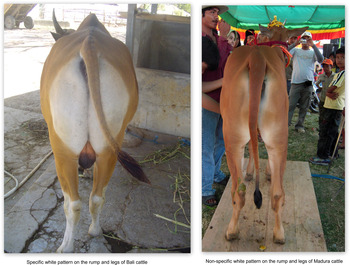
Many publications state that cross-breeding leads to a loss of indigenous breeds and loss of adaptation of livestock to local environments (Anderson, Reference Anderson2003; FAO, 2007). On Indonesia's Madura Island, until 2001, cross-breeding was not allowed to protect the local Madura cattle breed. Madura cattle developed approximately 1 500 years ago from crossing wild banteng or Bali cattle and zebu (Payne and Rollinson, Reference Payne and Rollinson1976). Continuous selection by the farmers in Madura created a uniform breed population (Anonymous, 2003). Its coat is reddish-brown with a non-specific white pattern on the rump and legs (Anonymous, 2003); see Figure 1. Madura cattle are extremely well adapted to the local conditions and traditional management. They are reported to be one of the best draught animals in the world relative to their size (Barwegen, Reference Barwegen, Boomgaard and David2004). Since the removal of import restrictions, the local government has allowed crossing with the Limousin breed (which is also preferred by Madura farmers) because of its red colour, similar to the Madura cattle. As a result, the cross-breeding through AI is threatening the survival of the Madura breed (Barwegen, Reference Barwegen, Boomgaard and David2004).
Colour pattern of the rump and legs of Bali versus Madura cattle (source: Widi, T.SM).

Currently, the number of cattle in Madura Island is about 600 000. It is not possible to obtain accurate data about the population of pure Madura cattle as not all regional government offices separate the data in terms of genetic group.
Understanding and assessing the cultural values of livestock are important in the implementation of interventions aiming at conservation and utilization of animal genetic resources (FAO, 2012). Madurese people have strong cultural ties to their animals, caring for their cattle as if they are their family members (De Jonge, Reference De Jonge1990). The significance of cattle within the culture is also evident from the appearance of bulls in local folk-tales, proverbs and wood carvings depicting bulls, and from the horns on traditional houses. Bull racing (karapan) and cow conformation contests (sonok), are important cultural events on the island (De Jonge, Reference De Jonge1990).
Cross-bred cattle are kept primarily for meat production. Therefore, cross-breeding may be a threat not only to the existence of purebred Madura cattle, but also for the cultural activities involving cattle in Madura.
In Indonesia, Madura cattle offer a unique opportunity to study cultural practices involving cattle and the effect of cross-breeding. This paper aims to analyse the cultural values of Madura cattle and the effect of cross-breeding on these local traditions.
Materials and methods
Study areas
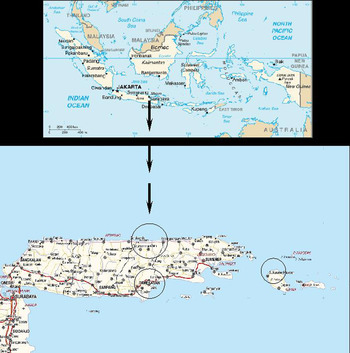
Madura (Figure 2) is a small, densely populated Indonesian island located off the northeast coast of Java Island. It is administered as part of East Java Province and consists of four districts: Bangkalan, Sampang, Pamekasan and Sumenep. Besides the mainland, Madura has some small outer islands. The climate is tropical, exhibiting defined wet (September to February) and dry (March to August) seasons, with an average annual rainfall of 1 500–2 000 mm.
Map of Indonesia and Madura Island with the three study areas (source: http://geography.about.com/library/cia/ncindonesia.htm).

Two districts were used in this study (Figure 2). One was Sumenep, within which is Sapudi, an isolated island that is demarcated by the national government as a conservation area for Madura cattle, particularly as a source of karapan cattle. For the study, Nong Gunong, one of two sub-districts, was used. This study area will be described as the “karapan” area. The second district was Pamekasan; Waru, Pasean, Larangan and Pegantenan sub-districts were used in this study. Waru and Pasean sub-districts are famous as the source of sonok cattle and are well-known as areas where the sonok contest started. This study area will be described as the “sonok” area. Larangan and Pegantenan sub-districts were selected by local government as cross-breeding areas owing to the abundance of crop by-products. Cross-bred cattle are expected to have larger body sizes than Madura cattle and, consequently, require more feed. Cross-bred cattle are not used for draught purposes. All the crossbreds resulted from Madura cows being inseminated with semen of Limousin bulls. The farmers named the cross-bred cattle madrasin. This study area will be described as “madrasin” area. Since 2007 the local government has promoted a conformation contest for madrasin cattle. Madura cattle in the madrasin area will be described as conventional Madura cattle.
The three study areas do not only differ in cattle keeping practices, but also differ in cropping practices. In the karapan area, cropping conditions are difficult because of small farm sizes and poor fertility of the soil. In the sonok area, tobacco is the main crop, which results in a relatively good income (Smith, Reference Smith2011). In the madrasin area, more crop by-products are available mainly because of the large paddy growing areas in this lowland area.
Data collection
Secondary data collection
Secondary data were collected from the Agricultural Department of Indonesia, the Animal Husbandry Office of East Java Province, Pamekasan and Sumenep District offices, government websites, publications and institutional reports. These provided insights into the local situation and policies.
Participatory observations
Quantitative and qualitative information were collected through participatory approaches involving farmers (cattle-keepers), government officials, community groups and other key informants and through direct observation of sonok, karapan and madrasin events. A historic overview of the cultural events was based on the secondary data and open interviews with key informants, comprising of persons well-versed in cattle keeping and cultural events, such as heads of cultural event groups, experienced farmers or village elders (three persons per study area).
Semi-structured interviews were conducted with three categories of cattle-keepers: 30 karapan farmers, 37 sonok farmers and 30 madrasin farmers. The farmers were interviewed about their background and motivation, technical aspects such as cattle management and the economics of cattle keeping. The input costs and the selling and buying prices of individual cattle in a farm over a period of one year (February 2010–January 2011) were estimated by farmers. The input costs consisted of purchases of forage and supplements, such as maize and rice bran, and additional feeds such as herbs, eggs and palm sugar for animals participating in the cultural events, veterinary services, AI or natural mating, training for and participating in the cultural events and hired labour costs. The interviews were used to evaluate the role of cattle in the livelihoods of Maduranese people, and the special characteristics of cattle that are important in maintaining local traditions.
Phenotypic characteristics of Madura and cross-bred cattle
Phenotypic characteristics of cows in the study farms were determined by taking height at withers, and estimation of body weight by measuring chest girth, using a measurement tape (FHK Ogawa Seki Co. Ltd, Tokyo, Japan). The age of each animal (in years) was determined by inspecting its teeth.
Data analysis
The qualitative data were analysed descriptively. The quantitative data were analysed using one-way ANOVA to compare the different areas (Ott and Longnecker, Reference Ott and Longnecker2001). Ranking was used to determine the level of agreement of farmers' motivations for keeping cattle. General Linear Model (GLM) (Ott and Longnecker, Reference Ott and Longnecker2001) was used to analyse ranking preferences. The smallest score of rank meant the most important motivation and the highest score of rank meant the least important motivation.
Results
The history of cultural cattle events in Madura Island
Karapan
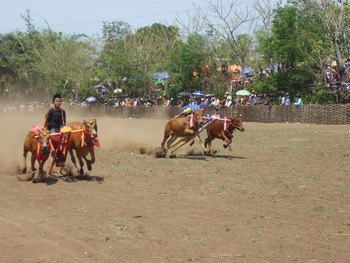
Karapan has a very long history. Noer and Maduratna (Reference Mohammad Noer and Maduratna1975) noted that on Sapudi Island, during the twelfth to thirteenth century, Prince Katandur wanted to make the soils more fertile. He introduced ploughing using a pair of bulls. To encourage people to keep cattle, he created a bull-racing game, karapan, in which pairs of bulls raced against each other in a field. The equipment used in the race was similar to equipment used in ploughing (Figure 3).
Karapan race (source: Schultinga, M).

Over time, karapan became a favourite game for Maduranese people, organized after the harvest season. These are now held in nearly every village in the eastern sub-districts. In these karapan races, two or three pairs of bulls are raced over a course of 100–140 m pulling a sledge with a jockey. The winners and losers of the first round are assigned to separate categories, after which the races continue according to the “cup system”: the winners go on, while the losers drop out. A major competition is held each year in which all the island's districts are represented. Since 1982, races for tourists are organized in western Madura Island.
In the 1970s, local government set some rules for karapan (Noer and Maduratna, Reference Mohammad Noer and Maduratna1975):
-
(1) Karapan bulls have to be purebred Madura bulls.
-
(2) The minimum height at the withers of the bulls is 120 cm and the maximum 130 cm.
-
(3) The minimum age of the bulls is 2 years.
-
(4) Mistreating bulls during racing is not allowed.
-
(5) The minimum number of bull pairs having to participate in a sub-district is 40. At that time, there were 20 sub-districts in Madura Island, so 1 600 bulls had to be used every year.
Nowadays, some of the rules are not respected because of the limited availability of Madura bulls that fulfil the physical and age criteria for karapan. In 2011, in the biggest racing event, no more than 30 pairs of bulls competed.
The total number of bulls actually participating in karapan is about 400 pairs on Sapudi Island and 200 pairs in Madura mainland (Kuswadi, 2010, personal communication).
Sonok
The key events in the sonok have resulted from the common practice in Madura that, from about 9 am until 1 pm, cattle are tethered between two pillars, locally named tacek, in view of the front veranda of the house. The cattle's forefeet stand on a platform, a piece of wood about 15 cm high, while they are tethered. This tethering practice gives farmers the opportunity to show their great pride in caring for their cattle. In the meantime, farmers clean the cattle and the barn, and undertake other activities, such as foot care and horn shaping. In 1963, a village head became particularly interested in farmers' behaviour in caring for their cattle. He showed cattle of good conformation tethered in the front of farmers' houses to high officials who were visiting his village. This idea to show cattle daily became a routine activity in the area (Anonymous, 2007)
In 1927, Sommerfeld (Reference Sommerfeld1927) described pajengan in which farmers bring their cattle, especially female cattle, to be tethered together in a field. In 1967, a local government official organized pajengan activities twice a week during the tobacco harvest season. Pajengan is currently still taking place every month. It gives farmers an opportunity to meet, showing their good cattle and sharing information with the extension officers. Year after year, this event is well supported by farmers (Rudi Haryanto, 2009, personal communication).
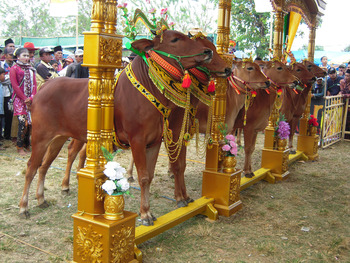
Key informants mentioned that in the 1980s, to make pajengan more attractive, the competing farmers chose pairs of good females, harnessed to make them walk in pairs and dressed with beautiful adornments. The pairs of cattle, guided by a jockey, have to walk 25 m to reach a finishing line, designed like a gate, while their forefeet step in a harmonious manner. Saronen, traditional music, is played to accompany the cattle when they walk to the stage. This event was named sonok; see Figure 4. The total number of cattle participating in different sonok events in Madura is about 600 pairs (Rudi Haryanto, 2009, personal communication).
Sonok contest (source: Widi, T.S.M).

Sonok cattle are judged by conformation traits, such as height at withers, colour, body conformation, body condition, health and harmonious walking in a pair. Unlike karapan, there are no winners and losers in this event. Every contestant farmer receives a gift from the officials without exception, and there is dancing accompanied by traditional music. There are juries who provide the audience with information about the farmer, scores of performance during walking and their opinion about the matching appearance of the pairs. Often the jury consists of influential people, for example, the head of the sonok community group, the inseminator and the head of the district. Since there are no winners, there is no gambling. Although there are no prizes, the contest is very important because during the contest day many transactions among farmers take place; farmers can show their cattle and trade them for good prices. The cows that perform well are very popular for breeding.
Madrasin
In the area where cross-breeding is practiced, farmers, encouraged by the government, have organized the madrasin contest since 2007. The criteria are body size and body weight, and, for cows, the conformation of their calves.
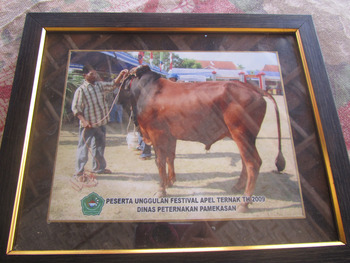
The cattle are tied up next to each other in the traditional way for Madura cattle: rope goes through the nose of the cattle and is tied between two pillars, and cattle stand with their front legs on a platform. In the madrasin contest, the cattle do not parade and are not harnessed or dressed with adornments; see Figure 5. Responses from the interviews showed that the number of participants and the number of participating cattle are growing every year, but it is less attractive to spectators than the karapan and sonok events.
Picture of a winner in madrasin contest (source: Widi, T.S.M).

Livestock farming systems
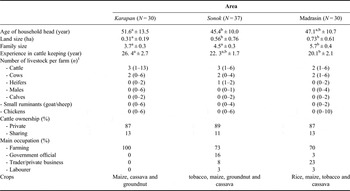
Table 1 gives selected household and farm characteristics for the livestock farming systems in the three study areas. Karapan farmers were relatively older than farmers in the other two areas. Most of the farmers have crop production as their main source of farm income. Family size was significantly larger in the madrasin area. More than half of the farmers in the three study areas only completed elementary school. Farmers had a long experience in cattle keeping, about 20 years or more; karapan farmers had significantly more experience than madrasin farmers.
Characteristics of households and farms in the three study areas.

a,b,cDifferent superscripts indicate significant differences between areas (P < 0.05).
nsNon-significant.
1Number of livestock is presented in mode and range.
Cattle are the main livestock (Table 1). Goats, sheep and chickens are of secondary importance. Even though the land sizes of farmers in Sapudi Island were quite different from those of farmers in the sonok area, the number of cattle was not much different. Farmers kept about three head of cattle. Only in the madrasin area were the numbers of cattle slightly smaller than in the two other areas. Farmers in the sonok area will participate in the sonok contest only if they have pairs of animals that meet the criteria for participation and if they have sufficient cash available to pay for the fee to join the contest. If farmers in the karapan area have a pair of potential racing bulls, they will first enter this pair in a village race. If this pair runs well, they will enter the pair in a regional contest. Again, a farmer will need sufficient cash to join the race and to cover the additional costs. When the farmers have insufficient cash to purchase cattle, the farmers join with other farmers. Around 12 percent of the farmers were sharing cattle (Table 1). The main occupation of the interviewees was farming, although in the madrasin area, 23 percent were traders or businessmen.
Motivations for keeping cattle
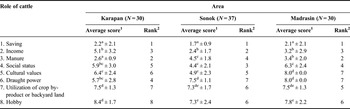
As in other areas in Indonesia, in Madura, cattle-keeping serves various objectives. Table 2 shows the ranking of the motivations for cattle-keeping in the three study areas. Farmers mentioned the following motivations: financial security (saving), income, providing manure, utilization of crop by-products, raising the social status of their owner, cultural events, draught purposes and hobby. Most farmers mentioned “saving” as the most important motivation. Farmers consider saving in terms of being able to sell cattle to meet unexpected or large expenditures, such as sending children to school, paying hospital bills for a family member, financing a wedding party or a pilgrimage to Mekka. Sonok and madrasin farmers gave income as the second motive. Farmers consider income as the cash they receive regularly from the annual sale of progeny.
Farmers' ranking of motivations for keeping cattle in the three study areas.

1Different superscripts indicate significant differences between reasons (P < 0.05).
2Rank = the smallest score of rank (1) means the most important motivation and the highest score of rank (8) means the least important motivation.
Karapan farmers ranked manure as the second most important motive for keeping cattle. Farmers in the karapan area depend on their cattle for ploughing. Since field sizes are small, and land is stony, a bit hilly and dry, cattle are the best option for ploughing. They use both pairs of cows or bulls for ploughing. If needed, they will borrow an animal from a neighbour to match their own animal. Sonok cattle are rarely used for ploughing. Sonok farmers said that they are afraid that ploughing will negatively affect the beauty of their cattle. They only use cattle that are not participating in sonok events for ploughing. Madrasin cattle are never used for ploughing, because of the absence of a hump (needed for the ploughing harness used) and their limited endurance. Another reason is that hand tractors are used extensively in the madrasin area, which is a lowland paddy-growing area.
Time allocation for caring for cattle
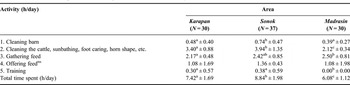
Table 3 gives the time spent caring for cattle in the three different areas. Sonok farmers and their family members spent significantly more time per day managing their cattle than karapan and madrasin farmers. They spent time on cleaning cattle, sunbathing, foot care and horn shaping. In the sonok area, significantly more time was spent on these activities than in the other two areas. Sonok respondents emphasized the cleanliness of their cattle and the surrounding environment, since the daily appearance of sonok cattle, in particular during the contests and pajengan meetings, is very important.
Time allocation per farm in caring for cattle in the three study areas.

a,b,cDifferent superscripts indicate significant differences between areas (P < 0.05).
nsNon-significant.
Madura cattle are very docile and easy to handle. About once a month, farmers pay attention to horn shape and foot caring. Farmers have a special preference for horn shape. They shape the horns when the cattle are around 4 months of age, by punching holes in the two horns and binding them using a wire: this results in small to medium size horns, curving inwards perfectly symmetrically. Most farmers shape cattle's horns, even when the cattle will not be used for cultural events. They check the hoofs of cattle participants in the karapan or sonok contest very regularly. Farmers use simple equipment for foot caring.
Madrasin farmers spent the least amount of time on caring for their cattle (P < 0.05). However, per animal, the time allocation was about the same in the three areas. This was because the madrasin farmers kept slightly fewer animals than the other farmers, and forage collection took up a large amount of time for madrasin cattle.
Physical characteristics of the cows
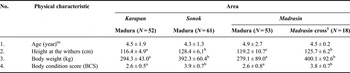
Table 4 shows that cows in the sonok area were higher and heavier (P < 0.05) than karapan and conventional Madura cows in the madrasin area. Madrasin cows were significantly higher and heavier compared with their conventional Madura herdmates. Sonok cows, however, were comparable with madrasin cows in these measurements. Both sonok and madrasin cows had a significantly higher body condition score compared with karapan cows and conventional Madura cows in the madrasin area.
Physical characteristics of Madura and madrasin cows in each study area.

a,b,cDifferent superscripts indicate significant differences between areas (P < 0.05).
1 Madrasin cross: cross of Madura (♀) × Limousin (♂).
Selling prices, costs and profit estimates
The time to sell cattle varies with the purpose of cattle-keeping. In general, farmers sell animals when they need cash, but they also sell “surplus” animals because they keep a specific number of animals in relation to the feeds available and the time they have available to care for their animals. Farmers sell weaned cattle for fattening or breeding, usually at 4–6 months after weaning, mainly to traders, whereas cattle for cultural events are sold directly to other farmers who are looking for cattle that can participate in the cultural events. Sonok farmers said that sometimes they are looking for cattle whose appearance is well-suited to be paired with one of their own cattle. Once they find a well-matched animal they are willing to offer a good price. Sonok cows are used not only for the cultural event but also for breeding, whereas only excellent karapan bulls are used as breeding bull. Once karapan bulls cannot be used for racing anymore, for instance they are already old or injured, they will be sold for slaughter. During the survey, only two karapan bulls were used both in the cultural event and for breeding.
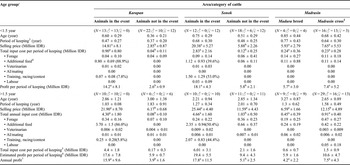
Table 5 presents the comparison of cattle prices and input costs among purposes and areas. The selling prices of animals below 1.5 years indicate that animals used for cultural purposes fetch much higher prices (P < 0.05) than their herdmates not used for cultural events. Also, the cash inputs are considerably higher (P < 0.05) for animals participating in cultural events. At (relatively) the same age and body weight, Madura cattle used for cultural events were valued at prices that were 2–3.5 times higher than cattle not participating in cultural events. Karapan and sonok farmers spent considerably more money on cattle older than 1.5 years, which participate in the cultural activities, 86 and 87 percent, respectively, than on their herdmates with no cultural function. In particular, the additional feed costs were high for cattle participating in the cultural events.
Age, period of keeping, selling price, input costs and cash profit per period of keeping of Madura and madrasin cattle based on the age group, area, purpose of keeping cattle and type of cattle (Million IDR) 1 .

a,bDifferent superscripts indicate significant differences between different categories of cattle between areas (P < 0.05).
1 One US $ = 9,200 IDR.
2 Madrasin cross: cross of Madura (♀) × Limousin (♂).
3Time needed to keep cattle from purchasing or being born until sold.
4Feeds that are added into the basal diet (forage), such as concentrate, rice bran, maize bran, palm sugar, herbs, etc.
5Total input cost per period of keeping (Million IDR) for cattle with age group >1.5 years was calculated by multiplying total annual input cost (Million IDR) and period of keeping (year).
6Profit per period of keeping (Million IDR) was calculated by deducting total input cost per period of keeping (Million IDR) from selling price (Million IDR).
7Annual profit (Million IDR) = Profit per period of keeping (Million IDR)/period of keeping (year).
The price of madrasin cattle usually depends on body size. Even when an animal wins the madrasin contest, the slaughter price is based on its body weight. In 2009, a 800 kg cross-bred bull won the contest, and a butcher bought it for 22 Million IDR (1 US$ = 9200 IDR), a normal price per kg live weight.
The profits per animal aged more than 1.5 years for cattle participating in karapan and sonok were 3 and 2 times higher, respectively, than for their non-cultural herdmates (Table 5). Madrasin cattle did not show significantly higher profit than their conventional Madura herd-mate cattle. Cattle not participating in the cultural event in the sonok area gave a more-or-less similar profit as madrasin cattle.
Discussion
The introduction of cross-breeding in Madura has highlighted that the Madura cattle population is not homogeneous. There are three cattle production systems, each in a more-or-less separate area, with now four types of cattle: karapan, sonok, madrasin and conventional Madura cattle. The main source area of karapan cattle is Sapudi Island. Sonok cattle are found mainly in the northern part of Madura Island. Madrasin cattle and the conventional Madura cattle can be found in the rest of Madura Island. This zonation reflects different cattle production systems in terms of cattle management practices and cultural activities. These differences also emphasize the need for different conservation and breeding strategies for the different Madura cattle sub-populations.
Synergy of culture and cattle farming in Madura
Karapan and sonok events as well as Madura cattle are unique, as markers of the traditions and culture for Maduranese people (De Jonge, Reference De Jonge1990; Smith, Reference Smith2011). The events are famous, not only in Madura itself but also throughout Indonesia and even abroad. Thus, they are also a tourist attraction. The total number of spectators in all events in a year is approximately 20,000–25 000 people. Karapan is much older and better known than sonok, but the enthusiasm for sonok seems to increase year by year. Sonok may become as important for rural tourism as karapan and might be preferred in the future because there are concerns about cruelty to karapan cattle and gambling during racing. Even though there is a rule about not hurting the bulls during racing, in practice, to get the bulls to run faster, people use nails or thorns, causing wounds and then even pour salt or lemon into the wounds (Kuswadi, 2009, personal communication). On Madura, spiritual leaders are already criticizing these practices and the gambling during karapan events.
The cultural practices have a marked effect on cattle husbandry. Cattle used for cultural events are well cared for and trained. This gives the owners an overall sense of well-being. Most writers about Madurese society emphasize the attention that is given to the animals. The men are said to be more devoted to their animals than to their wives (De Jonge, Reference De Jonge1990). Karapan and sonok farmers give intensive daily care and exercise to their animals (about 3 h/day per animal) to improve their physical appearance and performances. They also spend considerably more money (on average 46.5 percent) on better quality feeds for the animals that participate in the cultural events.
Alderson (2003) mentioned that breed characteristics that are important for socio-cultural practices generally relate to the appearance of an animal, and traits that define the market value of an animal. Also, in Madura, cultural values have a strong economic component. Most karapan and sonok farmers argued that they like the race or contest because it keeps the prices of cattle high. Karapan and sonok farmers received more than 50 percent higher prices for breeding stock than the normal market prices. Not only the prices of karapan and sonok cattle that participate in the contests were high, but also the overall input costs (Table 5). In general, farmers in the sonok area are relatively well-off due mainly to the income generated from tobacco (Smith, Reference Smith2011). Part of this income will be invested in their sonok cattle and the participation in sonok events.
Effect of cross-breeding on culture and cattle farming
Farmers outside the karapan and sonok areas kept conventional Madura cattle before the introduction of Limousin semen. These were relatively small in size. This made it easy for the government to introduce Limousin semen at that time, as the farmers wanted cattle as big as the sonok cattle. Almost all madrasin farmers said that they took more pride in keeping madrasin cattle than conventional Madura cattle. Table 4 shows that cross-breeding increased the body size of cows to about one-third. The body condition score of madrasin cows was also much higher than that of their conventional Madura herdmates. Cross-bred animals were fed better; this resulted in higher feeding costs for madrasin cattle (Table 5). Nevertheless, the selling prices minus the total cash costs for the period an animal is kept, show that the cash profits of madrasin animals were on average, 55 percent higher than from conventional Madura herdmates (Table 5). The economic profit estimates in Table 5 ignore the other benefits cattle provide, such as manure, draught power and security. A comprehensive economic analysis is needed to calculate the overall benefits of the different types of cattle keeping (Smith, Reference Smith2011).
Also, cross-breeding contributes to the overall pride resulting from keeping cattle that perform well. The madrasin contest was initiated by the government and seems a top-down initiative. It attracts in particular farmers; no tourists attend. The main motivation of farmers for enrolling their animals in the contest is the expectation that it can result in a fair price for their animals, since all the participants' cattle are weighed and the price per animal is based on the actual weight. In general, when the cattle are sold, the prices that traders offer are based on visual appraisal only.
Cross-breeding is not only influencing the feeding practices and selling prices of cattle, but also influences the cattle trade flows. Key informants explained that most small-scale slaughter-men in Madura do not like to slaughter cross-bred animals as they cannot handle and sell the products within one day. Therefore, cross-bred slaughter animals are transported as live animals to the abattoir in Surabaya, the nearest major city in Java.
Conservation and breeding developments
The different farming systems and the different cultural events, and consequently the different types of Madura cattle, show the importance of considering local variation when developing conservation strategies. Government bodies that are concerned with livestock conservation focus primarily on numerical factors (Alderson, Reference Alderson2009). Also, in Indonesia, the inventory of animal genetic resources for the FAO world's animal genetic resources gives only the total number of Madura cattle (Anonymous, 2003). It does not distinguish between different Madura types of cattle.
Although Sapudi is designated by the government as an in-situ conservation area for Madura cattle (Anonymous, 2003), until now, no specific conservation strategies have been implemented, except that cross-breeding is not allowed. In the whole of Madura, there are no reliable data on numbers of different cattle. There is an urgency to correct that deficiency, especially in the face of the rapid change in the genetic structure of the island's cattle herd because of the high adoption rate of cross-breeding in the major part of the island.
Field observations and the discussions with key stakeholders indicated that the populations of cattle in the karapan and sonok areas are relatively small: about 45 000 and 50 000 animals, respectively. However, there is no immediate threat that these populations will be reduced by cross-breeding because of the continuing importance of the cultural values of the karapan and sonok events. It is unlikely that the ban of importing other cattle, in particular crossbreds, in Sapudi Island will be lifted. Nevertheless, the future of the karapan event is at stake. There is no strict adherence to the government rules for the karapan race, and the numbers of bulls that can join a karapan race is going down.
Inbreeding is strictly avoided in the sonok area, by circulating the bulls between villages whereas, in the karapan area, which is an isolated island, selection to avoid inbreeding is not done. This may have contributed to the small size of karapan cows. This requires urgent attention, as it can be a threat to karapan as well as the capacity for ploughing on Sapudi Island.
AI was introduced in the late 1990s in Sapudi Island, but it was never a success. The main reasons were that infrastructure was poor, the availability of AI personnel was limited, farmers considered AI a sin and an abnormal way of mating their cattle, and farmers never believed that the Madura semen used for AI was from a karapan bull.
The phenotypic performances of sonok cattle are comparable with the performances of madrasin cattle. This shows that through good breeding practices, farmers have maintained good performances of sonok cattle. This guarantees successful conservation of Madura cattle in the sonok area in the future.
It can be speculated that, in the future, the great majority of the conventional Madura cattle will be crossbreds. Farmers outside the sonok and karapan areas prefer the madrasin cattle over conventional Madura cattle due mainly to their heavier body weights and consequently higher market prices; although farmers said that they are aware that there is a risk that the second and third generations of cross-bred cattle will show poorer performances than the present F1 crossbreds. Research is needed on the performances of future generations of crossbreds to inform farmers about potential losses in production with continuing cross-breeding.
The governmental breeding centre is promoting cross-breeding in the south of Madura and Madura cattle in the north. Unfortunately, it does not distinguish between the sonok and karapan sub-populations. The present top-down approach towards implementing the conservation of Madura breed has to be turned into support approaches that involve the livestock keepers themselves.
Assessment of cultural values
Gandini and Villa (Reference Gandini and Villa2003) developed a framework for assessing different cultural contributions of livestock breeds in Europe with the aim of strengthening their conservation. The present study illustrates the complexity behind assessing cultural values of local breeds in countries such as Indonesia. Cultural assessments should not be restricted to identifying cultural functions and estimating market value of cultural products and services; they have to include the effect of cultural functions on management and specific requirements for animals that have cultural value, and the social and economic contribution of these animals to the livelihoods of the households concerned.
The Madura example shows that the cultural value of a specific breed can be related to a complex mix of area-specific cultural functions that are associated with different animal performances, management practises and economic benefits. Consequently, participatory research approaches are needed to unravel such complexities, with information collection at animal, farm and regional levels.
Conclusions
The Madura cattle example shows that the cultural values of livestock can be a main driver of maintaining a local breed. The enthusiasm of people and farmers for maintaining the cultural values attached to Madura cattle, and consequently the high prices for cultural cattle are keys to conserve the Madura cattle within the areas where the cultural events are maintained. The future of sonok cattle is better than karapan cattle in terms of performances, and general preference of people. Cross-breeding will not directly influence the cultural events and management practices of Madura cattle in the areas where the cultural events are important. In the areas where the cultural events are not important, farmers, however, take more pride in keeping madrasin than conventional Madura cattle, mainly because of their growth performance and the resulting financial benefits. Therefore, cross-breeding is an immediate threat to the future of conventional Madura cattle in the main part of Madura. Monitoring and characterization of animal genetic resources studies have to consider cultural values of livestock breeds and how these values interact with management practices, animal performances and economic benefits.
Acknowledgements
The first author was supported by a PhD grant from the Directorate General of Higher Education, Department of Education, Republic of Indonesia. The first author acknowledges the support of the DGHE, Gadjah Mada University and Animal Production Systems, Wageningen University, the Netherlands, staff members of Livestock Bureaus in Madura, the leaders of sonok and karapan farmers community as well as all farmers. Last but not least, the first author would like to thank the undergraduate students for their support and assistance in collecting the data.